Skip to content

01 - Terminology

  • Slides: 28
  • Transcript segments: 577
  • Status: 自动按 slide 时间线归档;核心概念和长期笔记可以在每个 slide 的 Study Notes 下继续整理。

Time: 00:01

EN: This is Al Brooks.

ZH: 你好,我是阿尔·布鲁克斯

EN: Thank you for watching the Brooks Trading Course.

ZH: 欢迎收看布鲁克斯交易课

EN: This is the first video in the course,

ZH: 这是本系列课程的第一个视频

EN: and in this video I will talk about basic terminology.

ZH: 在这个视频中,我将讨论基本术语

Time: 00:12

Slide 001

EN: If you are already familiar with the terms that I use,

ZH: 如果你已经熟悉我使用的术语

EN: you can go ahead and skip this video.

ZH: 你可以跳过这个视频

EN: All traders often use words that can be very unclear, and for definitions,

ZH: 一些词语交易者每天都在说,但定义并不清晰

Time: 00:20

Slide 002

EN: you can go to my website, brookstradingcourse.com.

ZH: 在我的网站 brookstradingcourse.com

EN: There is a glossary there.

ZH: 有一个术语表 (中英对照的术语表也在制作中,完成后会上传)

EN: For example, throughout the video course…

ZH: 在视频课中

EN: ..I will be using abbreviations on different slides.

ZH: 我会在课件里使用缩写

Time: 00:40

Slide 003

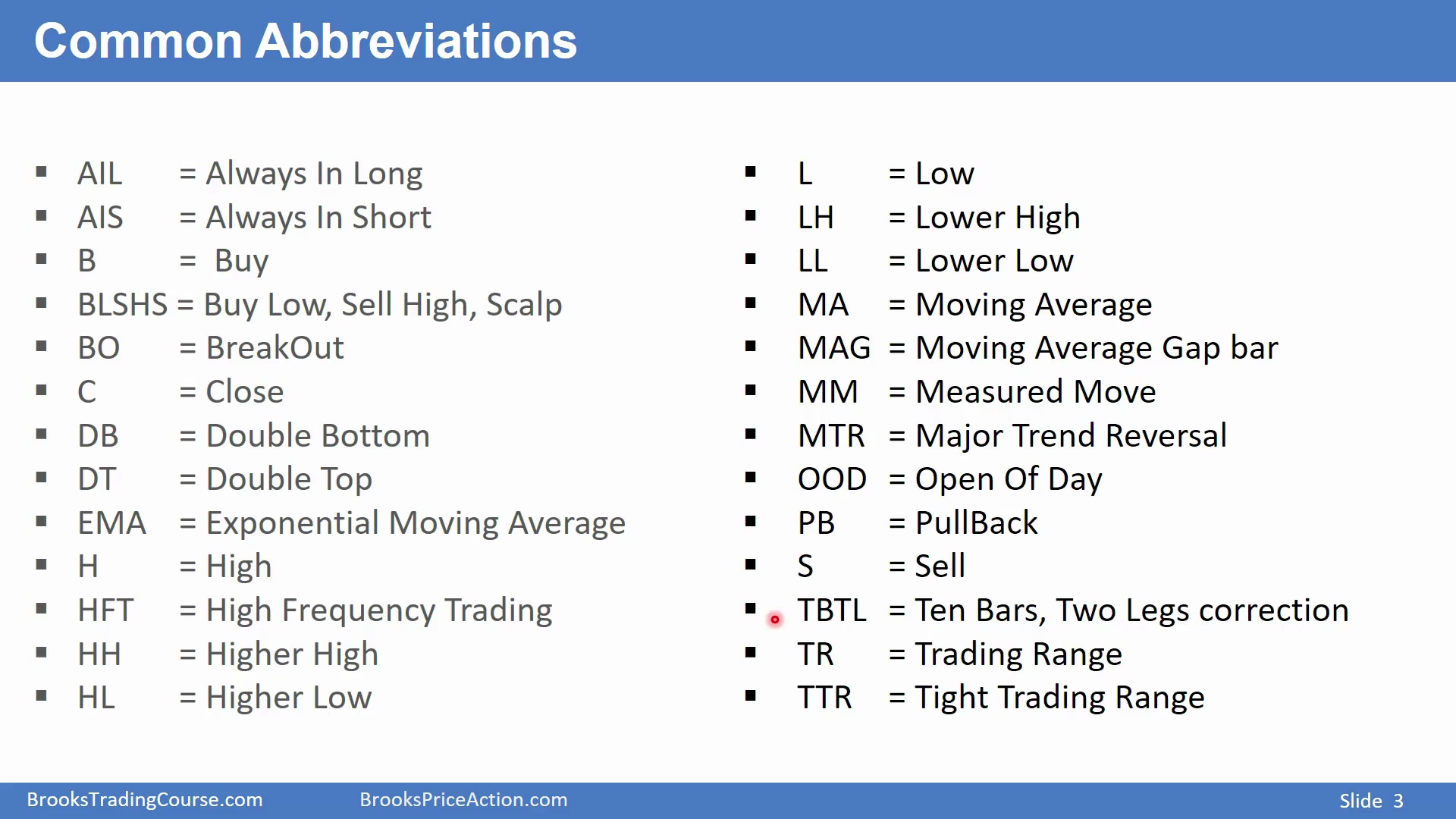
EN: These are some of the common ones that you will see.

ZH: 以下是你会看到的一些常见缩写

EN: Always In Long.

ZH: AIL,单边上涨

EN: Always In Short.

ZH: AIS,单边下跌

EN: Buy.

ZH: B,买入

EN: Buy low.

ZH: BL,逢低买入 SH,逢高卖出

EN: Sell high.

ZH: BL,逢低买入 SH,逢高卖出

EN: Scalp.

ZH: Scalp,剥头皮(即超短线交易)

EN: Breakout.

ZH: BO,突破

EN: The close of a bar.

ZH: C,一根K线的收盘价

EN: Double Bottom. Double Top.

ZH: DB,双底;DT,双顶

EN: When you hear me talk about a Moving Average,

ZH: 如果你听到我讲移动平均线

EN: I’m talking about a 20 bar Exponential Moving Average, or an EMA.

ZH: 我指的是指数移动平均线,周期是20 简称EMA20

EN: The high of the bar.

ZH: H,K线的最高点

EN: HFT, High Frequency Trading.

ZH: HFT,高频交易

EN: When you see me use “HH,” I’m talking about a Higher High.

ZH: 当你看到我使用“HH”时, 我指的是(比前一个高点)更高的高点

EN: Low is “L.” A Lower Low – a low that is below a prior low is a Lower Low.

ZH: 低点用“L”表示 LL,代表(比前一个低点)更低的低点

EN: When I say Moving Average, that’s the same as the exponential Moving Average,

ZH: 当我说移动平均线时,就是指EMA20

EN: except rarely I will talk about some simple Moving Averages.

ZH: 我几乎不会提到简单移动平均线(MA)

EN: When I do, I’ll explain it.

ZH: 如果我讲的话,我会特别说明

EN: Moving Average gap bar.

ZH: 均线缺口K线

EN: When there’s a bar where there’s a gap…

ZH: 即这根K线,它和EMA20之前没有碰到

EN: ..between the low or high of the bar in the Moving Average.

ZH: 两者之间存在缺口

EN: Measured Move.

ZH: Measured Move,MM,测量移动

EN: I talk about this in every video.

ZH: 每个视频中都会讲到MM

EN: Major Trend Reversal (MTR).

ZH: MTR,大反转

EN: I talk about that in almost every video.

ZH: 几乎每个视频中都会讲到大反转

EN: Open of the day.

ZH: O,当天的开盘价

EN: Pullback (PB).

ZH: PB,回调或反弹 (英语中是同一个词,但在翻译中我会区别开来)

EN: I refer to that in almost every video.

ZH: 几乎每个视频中都会提到PB

EN: Sell.

ZH: S,卖出

EN: Then when I talk about corrections,

ZH: 当我谈到调整时

EN: especially after a climax or when I’m expecting a reversal,

ZH: 尤其是在高潮之后,或当我预期市场会反转时

EN: you’ll often see me use the phrase “TBTL,” Ten Bars, Two Legs,

ZH: 你经常会看到我使用“TBTL”这个缩写 即(至少)持续10根K线,两段走势的调整

EN: which is a common occurrence when the market is trying to correct.

ZH: 这是市场试图调整时的常见行为

EN: Trading Range (TR).

ZH: TR,震荡区间

EN: When the Trading Range is particularly tight,

ZH: 当震荡区间特别狭窄时

EN: I call it a Tight Trading Range (TTR).

ZH: 我把它叫做窄震荡区间,缩写TTR

Time: 02:20

Slide 004

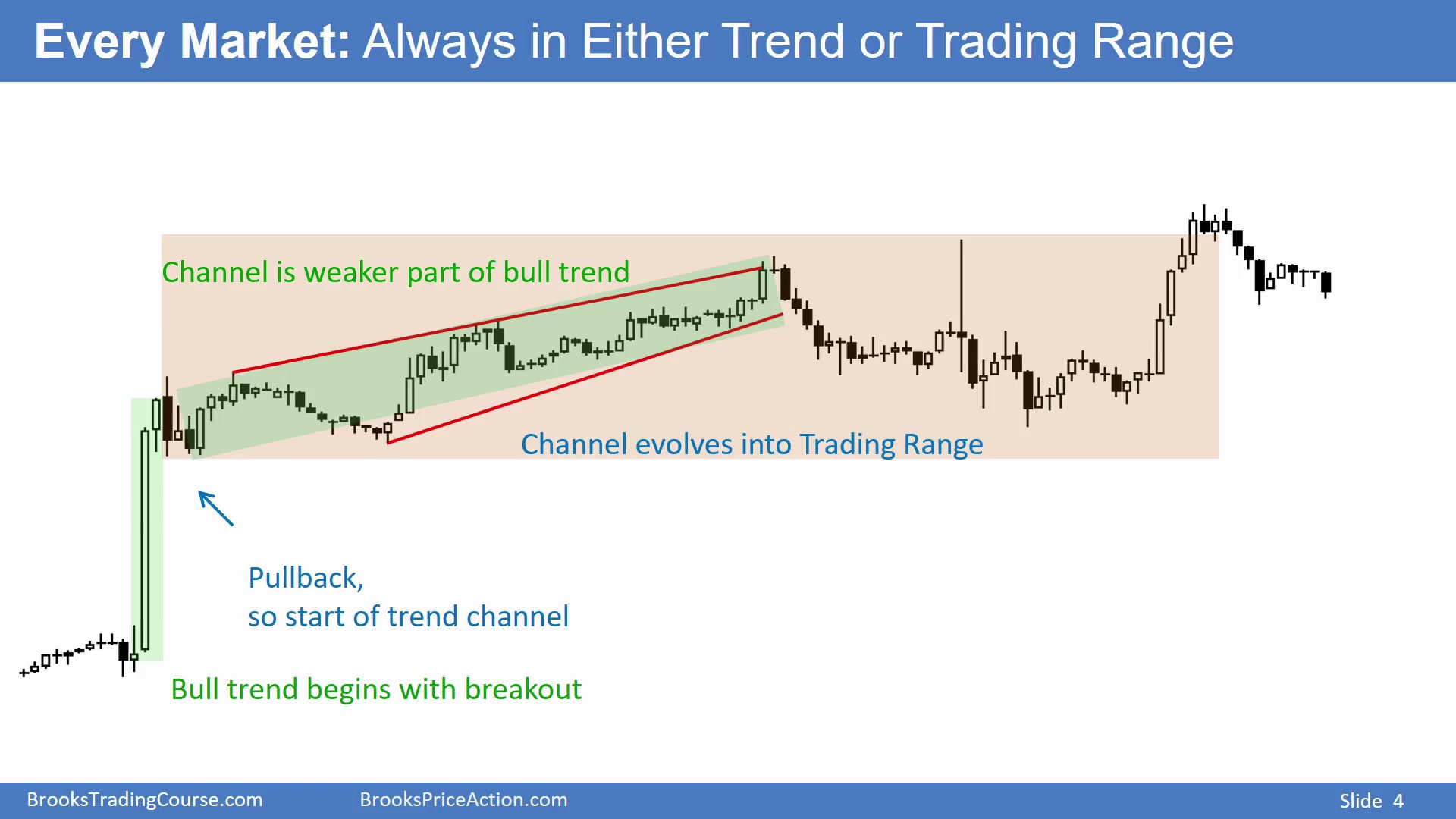
EN: Every market, at all times, is either in a trend or in a Trading Range.

ZH: 任何市场在任何时候, 要么处于趋势中,要么处于震荡区间中

EN: A bull trend typically begins with a bull breakout,

ZH: 上涨趋势通常从多头突破开始

EN: which is a big bull trend bar or white bar.

ZH: 即一个大的上涨趋势K线(大阳线) 通常用白色K线表示

EN: Bear bars are black bars.

ZH: 下跌的阴线,用黑色K线表示

EN: Here, the bar opens at this point at the bottom of the white box,

ZH: 这里,K线在白色框底部的这一点开盘

EN: and that is the close of the white box.

ZH: 上面是白色框的收盘价

EN: After the breakout, which can last many bars – here it lasted a couple bars –

ZH: 在突破之后,回调可能会持续多根K线 ——这里持续了几根K线

EN: there is a pullback where a low of a bar goes below the low of the prior bar.

ZH: 回调的定义是, 这根K线的低点,低于前一根K线的低点

EN: That usually results in a transition from the breakout phase of a trend,

ZH: 这通常会导致趋势从强势的突破阶段

EN: which is very strong, into a channel phase of the trend.

ZH: 转变成通道阶段

EN: A channel is a weaker trend, but it’s still a bull trend.

ZH: 通道是一个较弱的趋势,但仍然是上涨趋势

EN: We’re still going up.

ZH: 一直在上涨

EN: We have highs that are above prior highs,

ZH: 高点一个比一个高

EN: so we have Higher Highs, and we have Higher Lows.

ZH: 低点也一个比一个高

EN: That is the definition of a trend.

ZH: 这就是上涨趋势的定义

EN: Eventually a channel typically evolves into a Trading Range.

ZH: 最终,通道通常会演变成震荡区间

EN: So I view a bull channel as a bear flag because most of the time,

ZH: 所以我把上涨通道看作熊旗, 因为大多数情况下

EN: you get a bear breakout and a transition into a Trading Range.

ZH: 市场会向下突破,并转变为震荡区间

EN: Once the market’s in a Trading Range, it then is in breakout mode,

ZH: 一旦市场进入震荡区间,它就处于突破模式

EN: which means traders are anticipating a breakout.

ZH: 这意味着交易者在等待突破

EN: Here we have a bull trend in a Trading Range.

ZH: 这个上涨趋势处于震荡区间内

EN: The breakout can be to the upside, in which case you’re getting a resumption

ZH: 如果向上突破,那么就是延续了左边的上涨趋势

EN: of the prior bull trend – or it could be to the downside,

ZH: 也可能向下突破

EN: and you can get a reversal of the bull trend.

ZH: 那么就是逆转了左边的上涨趋势

EN: You’ll often hear traders talk about support and resistance.

ZH: 你会经常听到交易者讲“支撑和阻力”

Time: 04:00

Slide 005

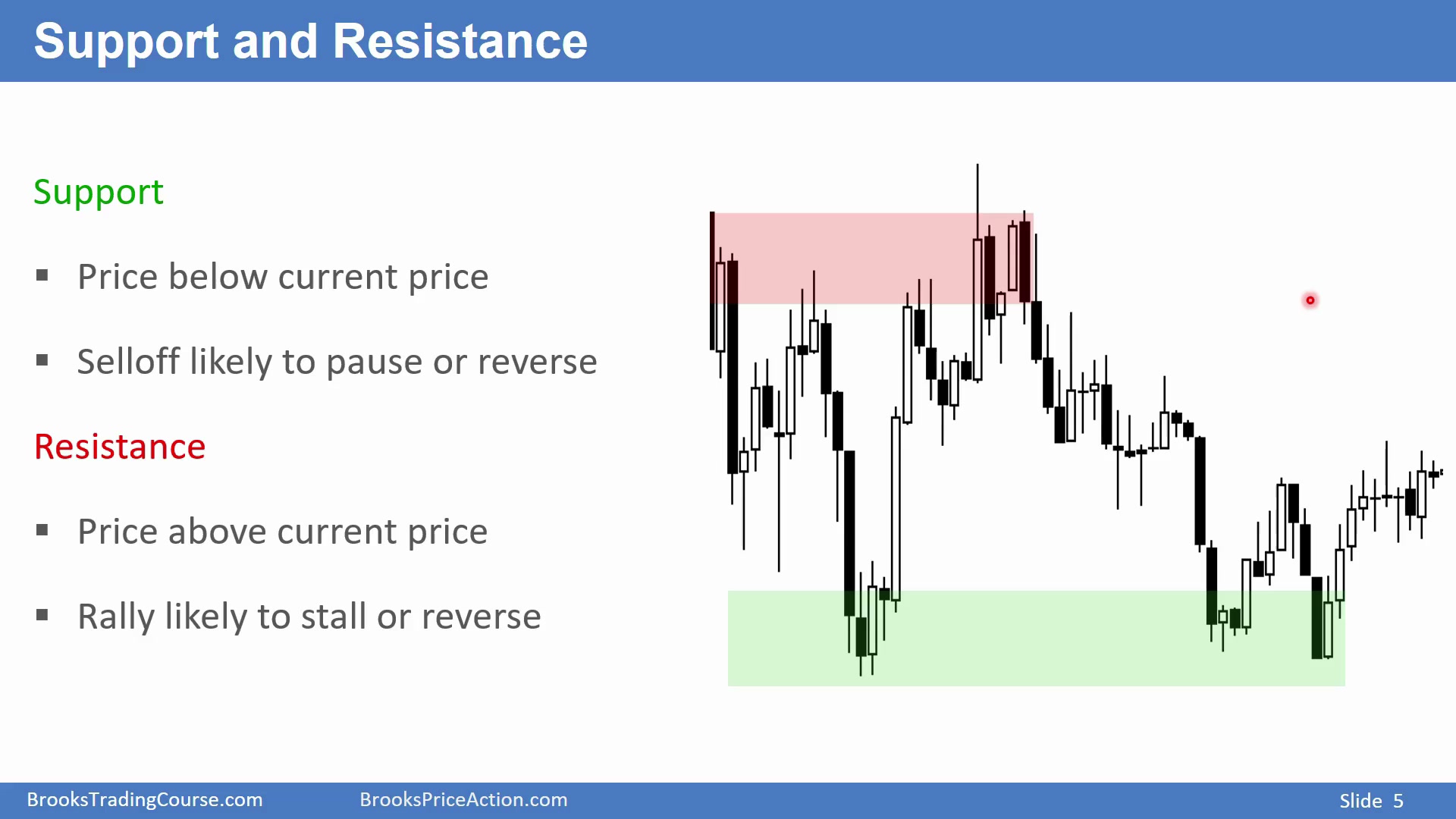
EN: Support is some price below the current price…

ZH: 支撑是低于当前价格的某个区域

EN: ..where a selloff is likely to pause or reverse.

ZH: 在支撑区域,下跌可能会暂停或反转

EN: So even though you don’t see anything right here…

ZH: 所以即使你在这里看不到任何东西

EN: ..that is causing the market to go up,

ZH: 实际上存在支撑,导致价格上涨

EN: the market believes this price is too low.

ZH: 因为市场认为这个价格太低了

EN: So when it gets down here, the market goes up.

ZH: 所以当它跌到这里时,价格就会反弹

EN: Here, we’re a little bit lower, but the same general area.

ZH: 这里,比前面稍微低一点,但还是在同一个区域

EN: There’s support down here.

ZH: 这里存在支撑

EN: Every selloff is being bought.

ZH: 每次下跌时,都有人逢低买入

EN: Resistance is the opposite.

ZH: 阻力与支撑相反

EN: It’s a price above the current price,

ZH: 它是高于当前价格的某个区域

EN: and a rally to that level is likely to stall or reverse.

ZH: 当价格涨到阻力区域,可能会停滞或反转

EN: On the chart, you don’t see a line drawn…

ZH: 在图上,不存在肉眼可见的阻力位

EN: ..across a resistance level, but you notice the price action.

ZH: 但通过价格行为可以知道它的存在

EN: The market goes up and it turns down.

ZH: 市场上涨然后回落

EN: It goes up to that same general price area, turns down.

ZH: 再次涨到这个区域,然后回落

EN: It goes a little bit higher and twice tries to go higher, and it turns down.

ZH: 这次涨得稍微高一点,两次尝试涨得更高,但都回落了

EN: Traders see this price level as resistance, and they expect that…

ZH: 交易者将这个价格区域视为阻力位

EN: ..if the market gets back up there again, it’ll do what it did the prior times.

ZH: 他们预计,如果市场再次涨到那里, 还会像之前一样回落

EN: Not always, but most of the time.

ZH: 并非100%,但大多数时间是这样的

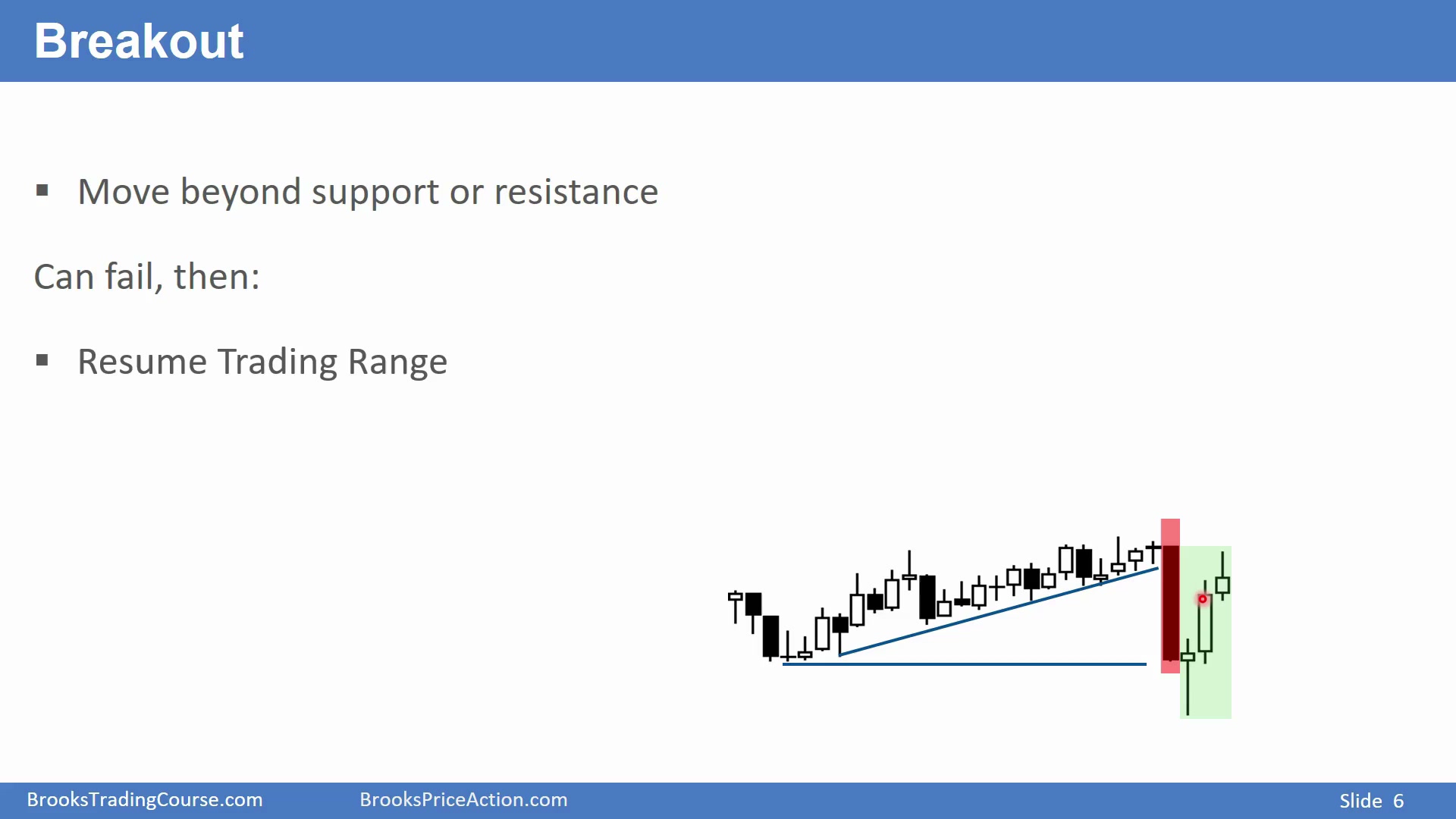
EN: A breakout is simply a move beyond support or resistance.

ZH: 突破只是指价格超越支撑或阻力的行为

Time: 05:15

Slide 006

EN: A bear breakout is a move below support.

ZH: 空头突破,指价格跌破支撑

EN: Here we have a bull channel – Higher Lows, Higher Highs –

ZH: 这里有一个上涨通道—— 更高的低点,更高的高点

EN: and then we have a break below the line.

ZH: 然后跌破了上涨趋势线

EN: This is a big bear trend bar, and it is a breakout.

ZH: 这是一根大阴线,是一次突破

EN: It’s a move below support.

ZH: 它是一个跌破支撑的行为

EN: There’s other support down here, and the market broke…

ZH: 下面还有其他支撑

EN: ..through support here; here it did not.

ZH: 市场跌破了这里的支撑, 这里没能跌破

EN: It kept holding support, holding support.

ZH: 支撑仍然有效,仍然有效

EN: Eventually it broke out, and now it’s testing…

ZH: 最终还是突破了

EN: ..the next lower support level, which is the prior low.

ZH: 现在正在测试下一个较低的支撑位,即前一个低点

EN: We don’t know yet if it will continue down…

ZH: 目前,我们还不知道它是否会继续下跌

EN: ..and break below that support or bounce at that support.

ZH: 是跌破那个支撑位呢? 还是在那个支撑位反弹

EN: When the market was at this price level earlier, it rallied.

ZH: 之前市场在这个价格反弹了

EN: Maybe it will do that again now that it’s at that same price level.

ZH: 现在它回到了那个价格,或许会再次反弹

EN: And it did.

ZH: 确实反弹了

EN: The support held, and a strong bear breakout led…

ZH: 支撑位守住了 这个强势的空头突破并没有发展成下降趋势

EN: ..to a bounce instead of a bear trend.

ZH: 而是在支撑位反弹了

EN: Every bear trend bar is a breakout.

ZH: 每个空头趋势K线都是一次突破

Time: 06:20

Slide 007

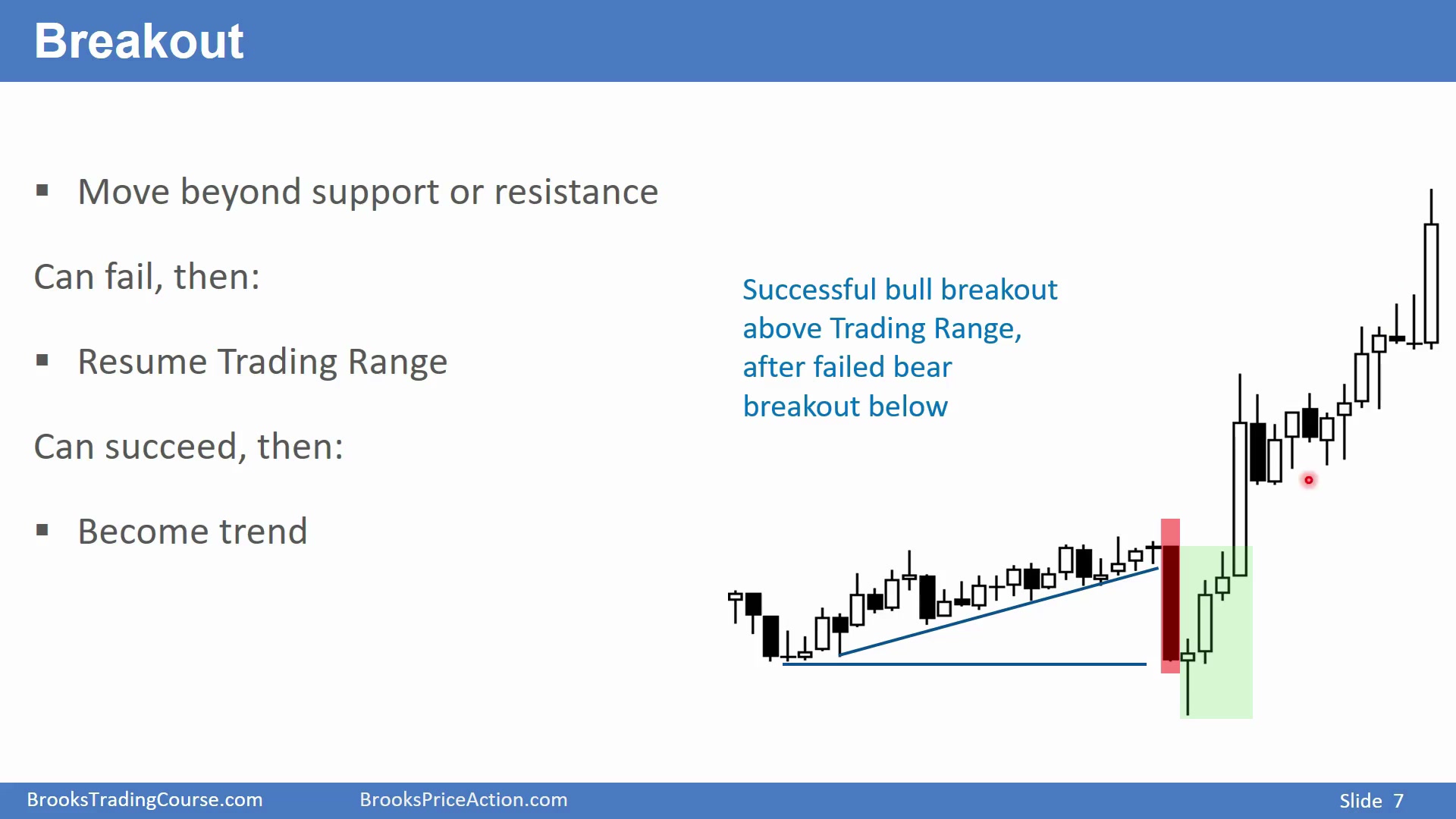
EN: Every bull trend bar is a breakout.

ZH: 每个上涨趋势K线都是一次突破

EN: It’s a bull breakout.

ZH: 这是一个多头突破

EN: We’re reversing up.

ZH: 市场正在向上反转

EN: You can also say that we’re breaking out,

ZH: 也可以说市场在突破

EN: breaking out of a very steep 2 bar bear trend.

ZH: 突破了一个非常陡峭的两根K线空头趋势

EN: We’re stalling here – a smaller bar with a tail on top –

ZH: 在这里滞涨——顶部有影线的小阳线

EN: at a price level where the market stalled repeatedly earlier.

ZH: 之前,市场也在这个价位滞涨

EN: So we’re stalling at resistance.

ZH: 这是阻力区域

EN: We don’t know yet if the market will reverse down…

ZH: 我们还不知道,市场是否会从阻力位回落

EN: ..from resistance or if it will break out.

ZH: 或者向上突破阻力位

EN: In this particular case,

ZH: 在这个案例中

EN: we broke far above the resistance level…

ZH: 价格远远突破了阻力位

EN: ..and we had follow-through buying.

ZH: 并且有好的跟随,交易者继续买入

EN: So this is a successful bull breakout after a failed bear breakout.

ZH: 空头突破失败后,多头突破成功

Time: 07:05

Slide 008

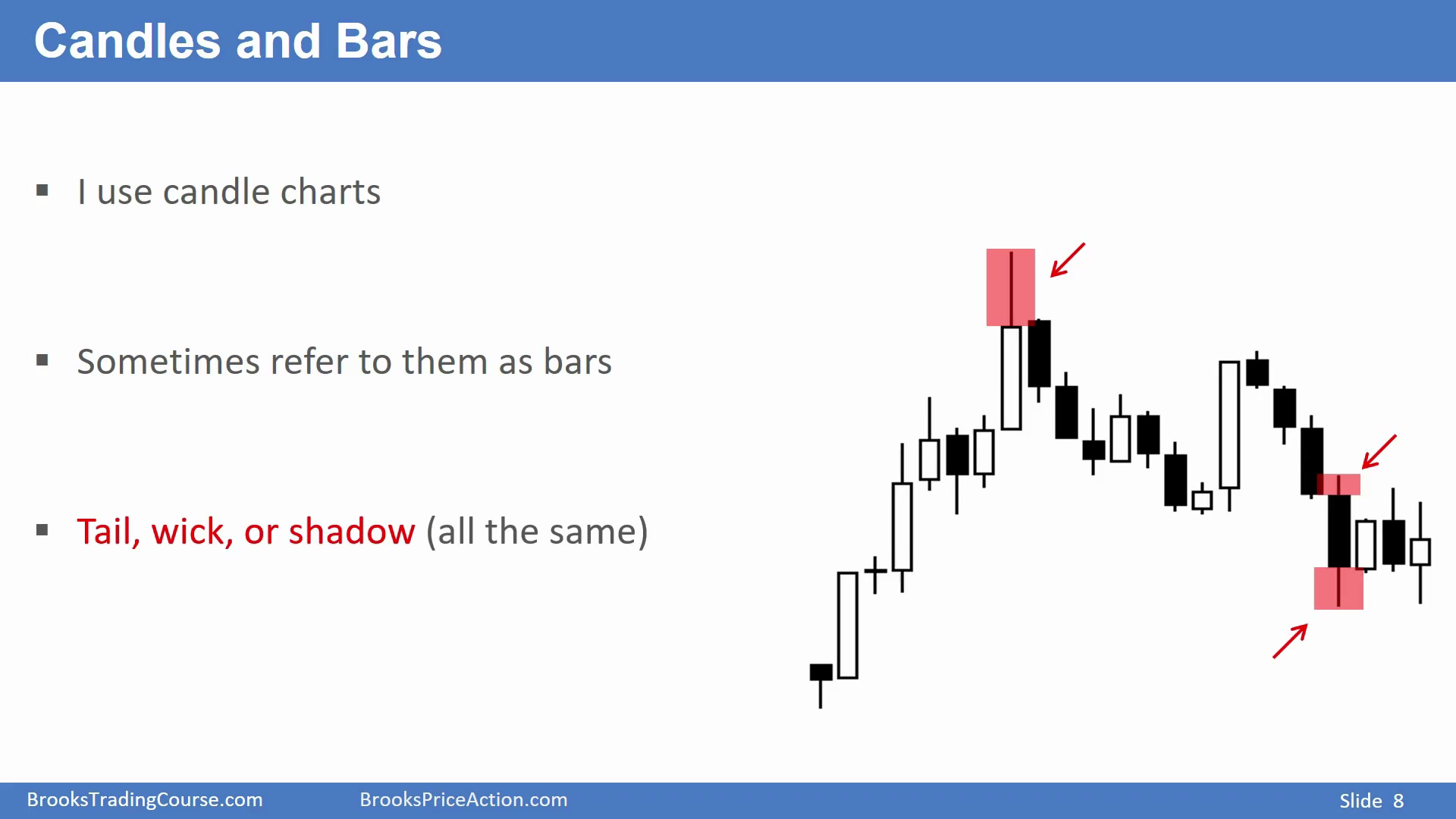
EN: This type of chart is a candle chart.

ZH: 这种图表的类型,是蜡烛图

EN: I sometimes refer to each candle as a bar instead of a candle.

ZH: 我把每个蜡烛图称为(翻译为)K线而不是蜡烛

EN: You’ll see on a lot of the bars, there’s a black line on top.

ZH: 你会在很多K线上看到顶部有一条黑线

EN: Sometimes there’s a black line on the bottom.

ZH: 有时底部有一条黑线

EN: White bars can have black lines on the bottom or on top.

ZH: 阳线的底部或顶部,可能有黑线

EN: Black bars can have black lines on the bottom or on top.

ZH: 阴线的底部或顶部,也可能有黑线

EN: They can have them on top and bottom.

ZH: 有时顶部和底部都有黑线

EN: Here’s a black bar with a line on top and bottom,

ZH: 这根阴线的顶部和底部都有黑线

EN: a white bar with a line on top and bottom.

ZH: 这根阳线的顶部和底部都有黑线

EN: I usually refer to those black lines as “tails.”

ZH: 我通常把这些黑线称为“尾巴”

EN: Other people refer to them as wicks or shadows.

ZH: 译者:翻译成上、下影线 (更符合中文的通用表达)

EN: It doesn’t matter; I just like the word tail.

ZH: 怎么说都可以,把不重要

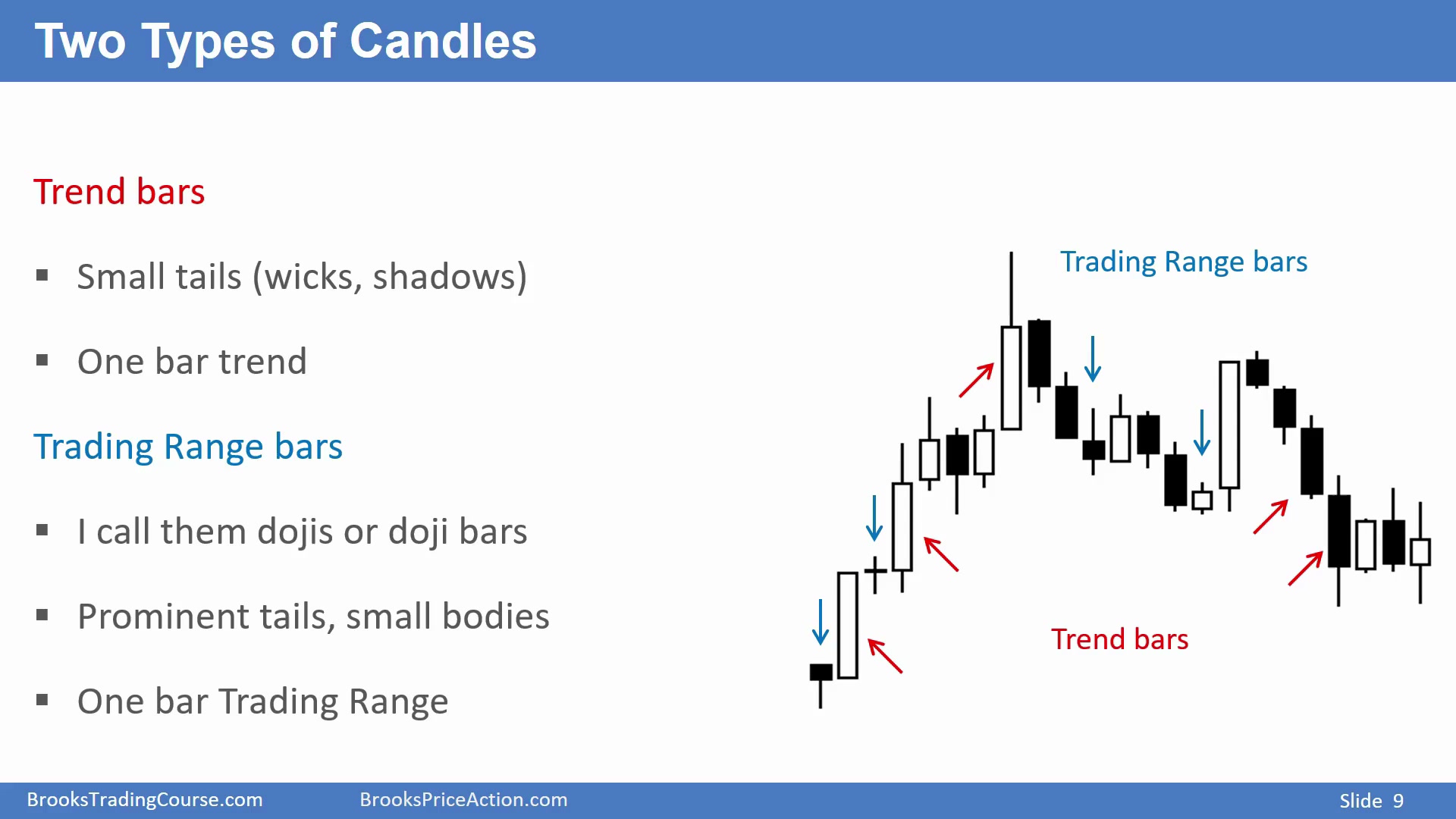
EN: A bar where there is either a big white box or a big black box is a trend bar.

ZH: 白色 或 黑色 实体部分很大的K线 我称它们为:趋势K线

Time: 07:50

Slide 009

EN: It occurs more commonly in trends.

ZH: 它在趋势中更常见

EN: I call it a trend bar because it’s a 1-bar trend.

ZH: 我称之为趋势K线,因为它存在趋势和方向

EN: So the market is trending up for this 1 bar.

ZH: 这根K线存在上涨趋势

EN: Open near its low, close near its high.

ZH: 开盘接近最低点,收盘接近最高点

EN: In general, the strongest trend bars have relatively small tails.

ZH: 一般来说,强势的趋势K线, 它的影线比较短

EN: Sometimes they have big tails like that, but it’s still a bull trend bar.

ZH: 有时影线比较长,但仍然是上涨趋势K线

EN: It’s mostly a bull trend bar.

ZH: 从的来说它是上涨的

EN: If the tails are more prominent relative to the size of the bodies,

ZH: 如果影线相对于实体部分的大小更显著

EN: I tend to say that’s not a trend bar.

ZH: 那它就不是趋势K线

EN: It’s more of a Trading Range bar.

ZH: 更像是一根震荡K线

EN: I refer to Trading Range bars as “dojis.”

ZH: 我把震荡K线称为“十字星”

EN: Trading Range bars in general have smaller bodies and more prominent tails.

ZH: 震荡K线通常有较小的实体,和更显著的影线

EN: I view them as a 1-bar Trading Range,

ZH: 我把它们看作一个 由一根K线组成的震荡区间

EN: and on some smaller timeframe charts,

ZH: 从更小时间级别的图去看它

EN: they are 1-bar Trading Ranges.

ZH: 是一个更明显的震荡区间

EN: A bull trend bar is a 1-bar bull trend,

ZH: 一根大阳线是上涨趋势K线

EN: and on a smaller timeframe chart,

ZH: 从更小时间级别的图去看它

EN: it’s a pretty strong bull trend.

ZH: 是一个很强的上涨趋势

EN: A Trading Range bar, or doji, is a Trading Range on a smaller timeframe chart.

ZH: 一个震荡K线,或十字星, 在小时间级别上是震荡区间

EN: I make decisions on what I’m going to do…

ZH: 我根据技术分析

Time: 09:10

Slide 010

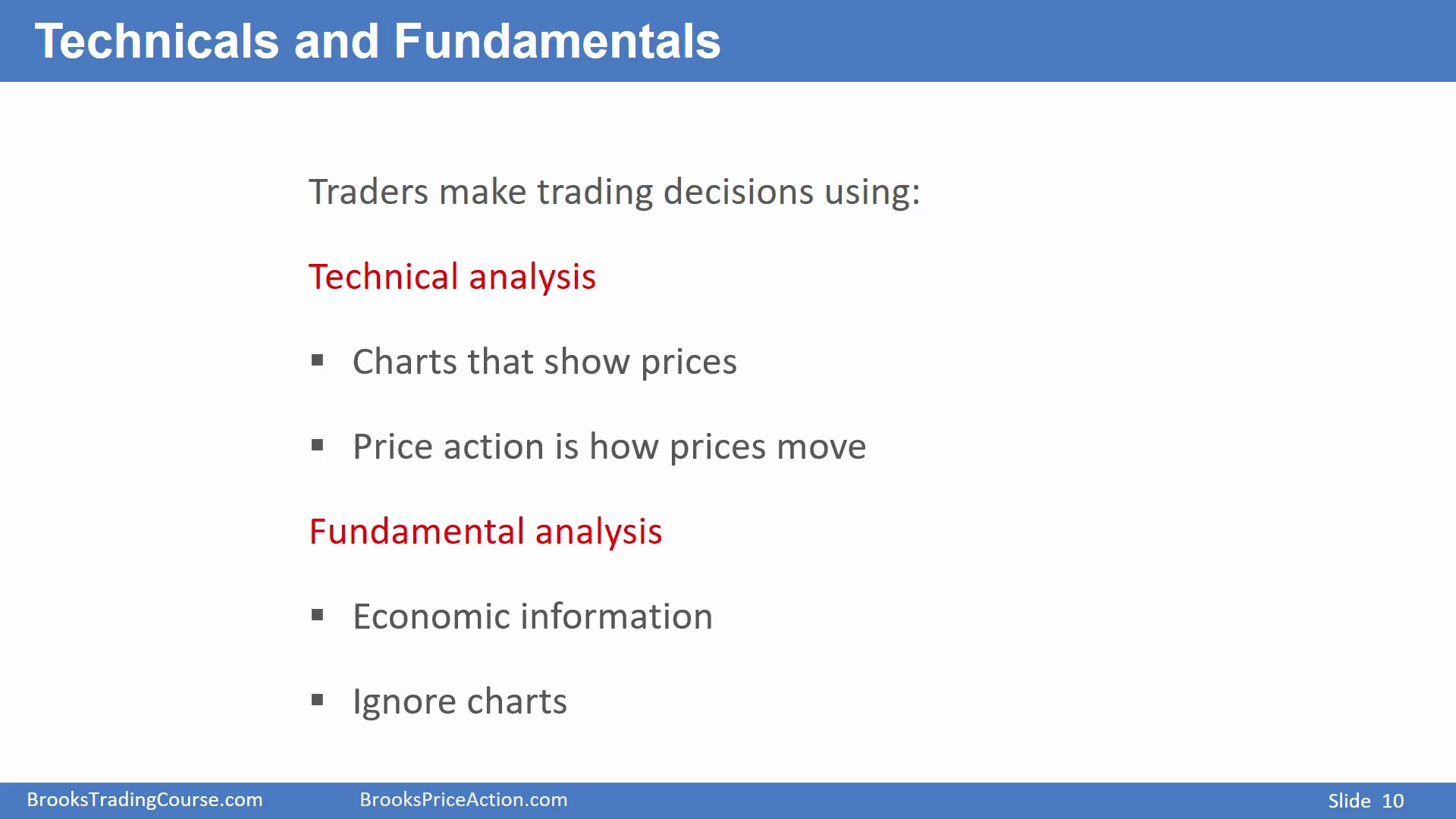
EN: ..with my trading based upon technical analysis.

ZH: 来做出交易决策

EN: A lot of institutions prefer fundamental analysis.

ZH: 许多机构更喜欢基本面分析

EN: Technical analysis, I’m looking at charts that show prices,

ZH: 技术分析,我看的是显示价格的图表

EN: and the price action is how the price moves.

ZH: 看价格如何移动

EN: How is the price acting? How is it going up, going down, going sideways?

ZH: 价格有什么样的行为?它是如何上涨,下跌,横盘的

EN: How much momentum, how strong are the moves up and down?

ZH: 动量有多大,上下幅度有多大?

EN: Fundamental analysis is mostly used by institutions,

ZH: 基本面分析主要是机构在使用

EN: and they are looking at economic information.

ZH: 他们关注经济情况

EN: They mostly ignore charts, but not entirely.

ZH: 尽管他们很多时候不看K线图,但并非完全如此

EN: A lot of fundamental traders will say

ZH: 很多基本面交易者会说:

EN: “ah, the fundamental information supports higher prices.”

ZH: “基本面的信息支持它继续上涨”

EN: Any time the market sells off, if it pulls back to some support level…

ZH: 任何时候,当市场下跌,回调到某个支撑位

EN: ..(like a Moving Average or a prior low), they’ll look to buy more.

ZH: (如均线或前一个低点) 他们会买入更多

EN: In their mind, they’re making the decision based upon fundamental information,

ZH: 他们根据基本面信息做出决定

EN: betting that the bear reversal will fail.

ZH: 押注空头反转会失败

EN: So a lot of fundamental traders also look at charts.

ZH: 所以很多基本面交易者也看图表

Time: 10:20

Slide 011

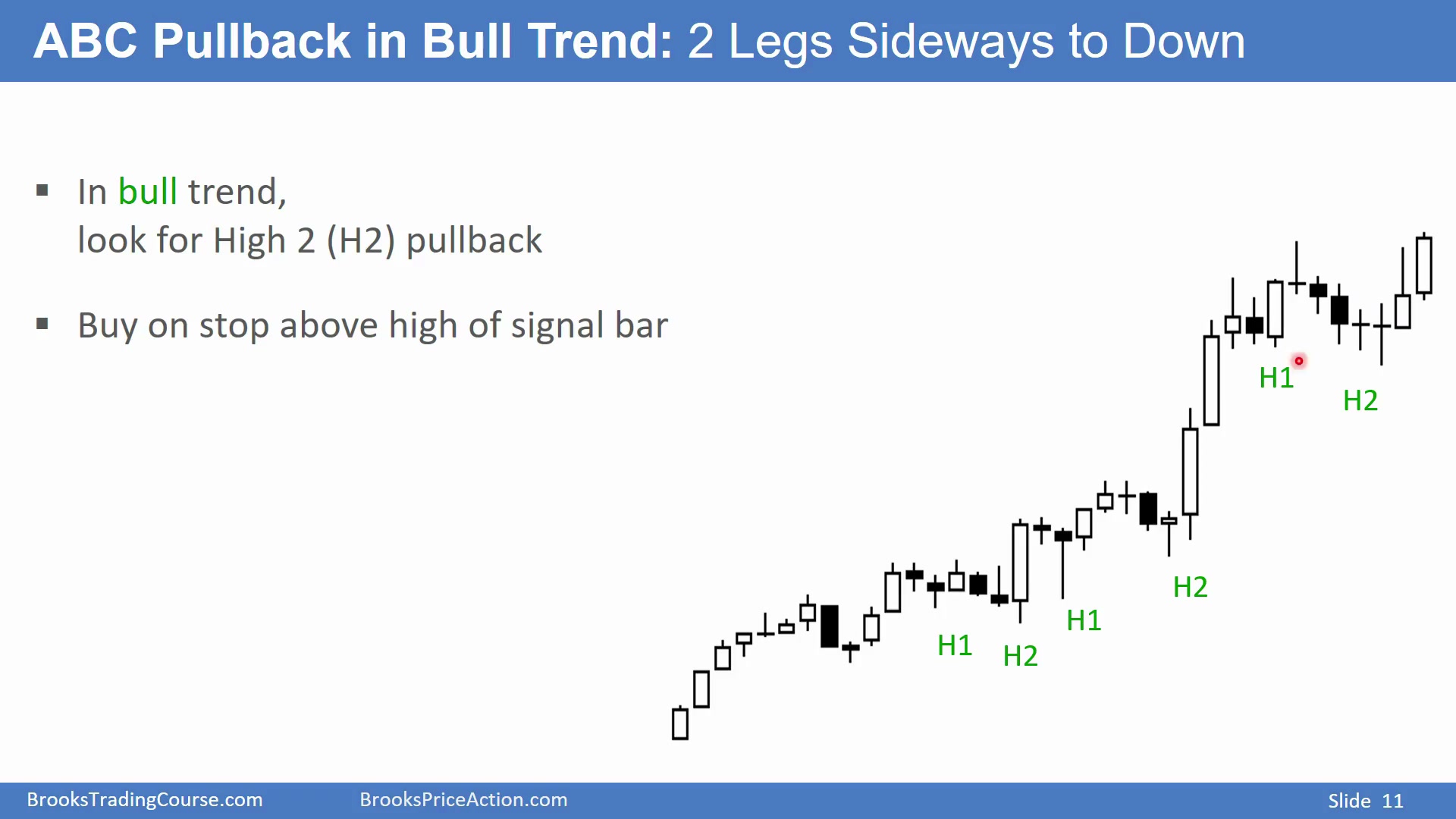
EN: Sometimes you’ll hear the expression “an ABC pullback.”

ZH: 有时你会听到“ABC回调”这个表达

EN: For example, let’s say an ABC pullback in a bull trend.

ZH: 例如,上涨趋势中的ABC回调

EN: It’s 2 legs, sideways to down.

ZH: 它是两段走势,横盘或下跌

EN: It doesn’t always have to be down.

ZH: 不是一定要向下跌

EN: It can simply be sideways.

ZH: 可以只是横盘震荡

EN: In a bull trend, I refer to those as a High 2 buy setup or a High 2 bull flag.

ZH: 在上涨趋势中,我把这些称为高2买入点 或者叫高2牛旗

EN: It’s an opportunity for traders to buy, to get long.

ZH: 这是交易者买入做多的机会

EN: For example, we have a little bull trend.

ZH: 例如,这里有一个小上涨趋势

EN: Bull trend started here, we have a new bull leg here.

ZH: 上涨趋势从这里开始, 然后在这里有一个新的多头走势

EN: We pulled back.

ZH: 回调

EN: We tried to resume up; it failed.

ZH: 试图继续上涨;失败了

EN: Maybe a second attempt will be successful.

ZH: 也许第二次尝试会成功

EN: This is a High 1 buy setup.

ZH: 这是高1买点

EN: Did not work.

ZH: 没成功

EN: This bar is a High 2 buy setup, and it did work.

ZH: 这根K线是高2买点,它成功了

EN: Buying above its high led to a profitable trade.

ZH: 在它的最高点上方,用突破买单入场 是一笔不错的交易

EN: Some traders would also call that an ABC pullback.

ZH: 有些交易者也叫它ABC回调

EN: So you have a bull trend, and then A, B, C –

ZH: 上涨趋势,然后A-B-C

EN: a three-legged correction, two legs down, one leg up.

ZH: 这个调整中一共有三段 两段下跌,一段上涨

EN: “A” leg down, “B” leg up, “C” leg down, and then bull trend resumption.

ZH: A段下跌,B段上涨,C段下跌, 然后上涨趋势继续

EN: Traders would buy using a stop order above the high of the bar.

ZH: 交易者会在K线的高点上方挂突破买单

EN: Here’s another example.

ZH: 来看另外一个案例

EN: Bull breakout, a pullback.

ZH: 多头突破,回调

EN: Did not lead to much of a trend.

ZH: 没有形成太大的趋势

EN: To me, this is a High 1 bull flag.

ZH: 对我来说,这是高1牛旗

EN: I would refer to this as a High 2 bull flag.

ZH: 这是高2牛旗

EN: If this breakout were bigger, I would restart the count.

ZH: 如果突破的幅度更大,我会重新开始计数

EN: For example, here we have a pretty big bull breakout.

ZH: 例如,这里有一个相当强的多头突破

EN: This correction has to do with this bar, not with this prior trend,

ZH: 这里的调整与这根K线有关, 和之前的趋势没有关系

EN: so I’m starting the process over again.

ZH: 所以我重新开始数K线

EN: New breakout, new pullback.

ZH: 新的突破,新的回调

EN: This breakout is not big enough for me to start the process over again.

ZH: 这个突破不够大, 不足以让我重新开始数K线

EN: You could call it a High 1.

ZH: 可以把它叫做高1

EN: You could say this is a breakout and a pullback.

ZH: 可以说这是一次突破和回调

EN: Or you could say maybe the market corrected down,

ZH: 或者,也可以说市场可能正在回调

EN: and maybe this is still part of the correction…

ZH: 也许这仍然是回调的一部分

EN: ..and this is part of the correction.

ZH: 这是回调的一部分

EN: This is an A, B, C, where “A” went above the top of the bull breakout,

ZH: 这里有A-B-C, 其中“A”突破了前期的高点

EN: but it’s still part of the corrective process.

ZH: 但它仍然是调整的一部分

EN: That’s why I say it can be sideways to down, not necessarily down.

ZH: 这就是为什么我说调整可以是横盘, 不一定非要是下跌

EN: This one was a little bit down, mostly sideways.

ZH: 这个稍微向下,主要是横盘

EN: But this one clearly is sideways.

ZH: 但这个显然是横盘

EN: Here’s another bull breakout.

ZH: 这里又有多头突破

EN: I’m looking for pullbacks.

ZH: 我在等待回调

EN: Ok.

ZH: 好的

EN: This is an inside bar, but it has a bear body.

ZH: 这是一个孕线,但它的实体部分是阴线

EN: On a smaller timeframe, that’s a small pullback.

ZH: 在较小时间级别上,它确实是一次小回调

EN: On this chart it’s technically not a pullback because the low of this bar…

ZH: 而在这个时间级别的图上 (按照定义)严格来说,它不是回调,

EN: ..did not go below the low of that bar, but it’s an inside bar.

ZH: 因为它的低点没有跌破前一根K线的低点

EN: It’s a pause.

ZH: 但既然是孕线,就是上涨的一次暂停

EN: For me, that’s a High 1 bull flag,

ZH: 所以对我来说,这就是高1牛旗

EN: and bulls will buy just above its high,

ZH: 多头会在它的最高点上方买入

EN: looking for resumption up.

ZH: 期待上涨趋势继续

EN: In general they’ll put a stop down here,

ZH: 通常来说,他们把止损设置在这里

EN: because sometimes the market will go sideways…

ZH: 因为有时市场会横盘

EN: ..and then slightly lower, but the trade is still valid.

ZH: 或者稍微下跌一点, 这笔交易的前提仍然成立

EN: For me, this is a bull trend in a pullback, a High 1 buy setup.

ZH: 上涨趋势,回调,高1买入点

EN: Is this enough of a breakout for me to restart the count…

ZH: 这里的突破幅度是否大到 让我重新开始数K线?

EN: ..and call this another High 1? You can.

ZH: 把这个看作新的高1买点? 一定要的话不是不行

EN: I would say that it’s not big enough,

ZH: 但在我看来,这个突破幅度还不够大

EN: and I would say this is all part of the same correction.

ZH: 市场还是处于这个调整阶段

EN: To me, this would be a High 1, a first attempt up.

ZH: 对我来说,这是高1, 回调后第一次尝试上涨

EN: Did not get very far.

ZH: 没涨多少

EN: This would be a High 2 buy setup,

ZH: 这是高2买点

EN: and traders would buy above the high of that bar…

ZH: 交易者将在那根K线的高点上方买入

EN: ..or above the high of this bar.

ZH: 或在这根K线的高点上方买入

EN: Any time the market forms a Double Bottom, bull flag, it’s a High 2 buy setup.

ZH: 每当市场形成双底牛旗时,就是高2买点

EN: In a bear trend, traders are looking for the exact opposite.

ZH: 在下降趋势中,交易者寻找完全相反的情况

Time: 13:45

Slide 012

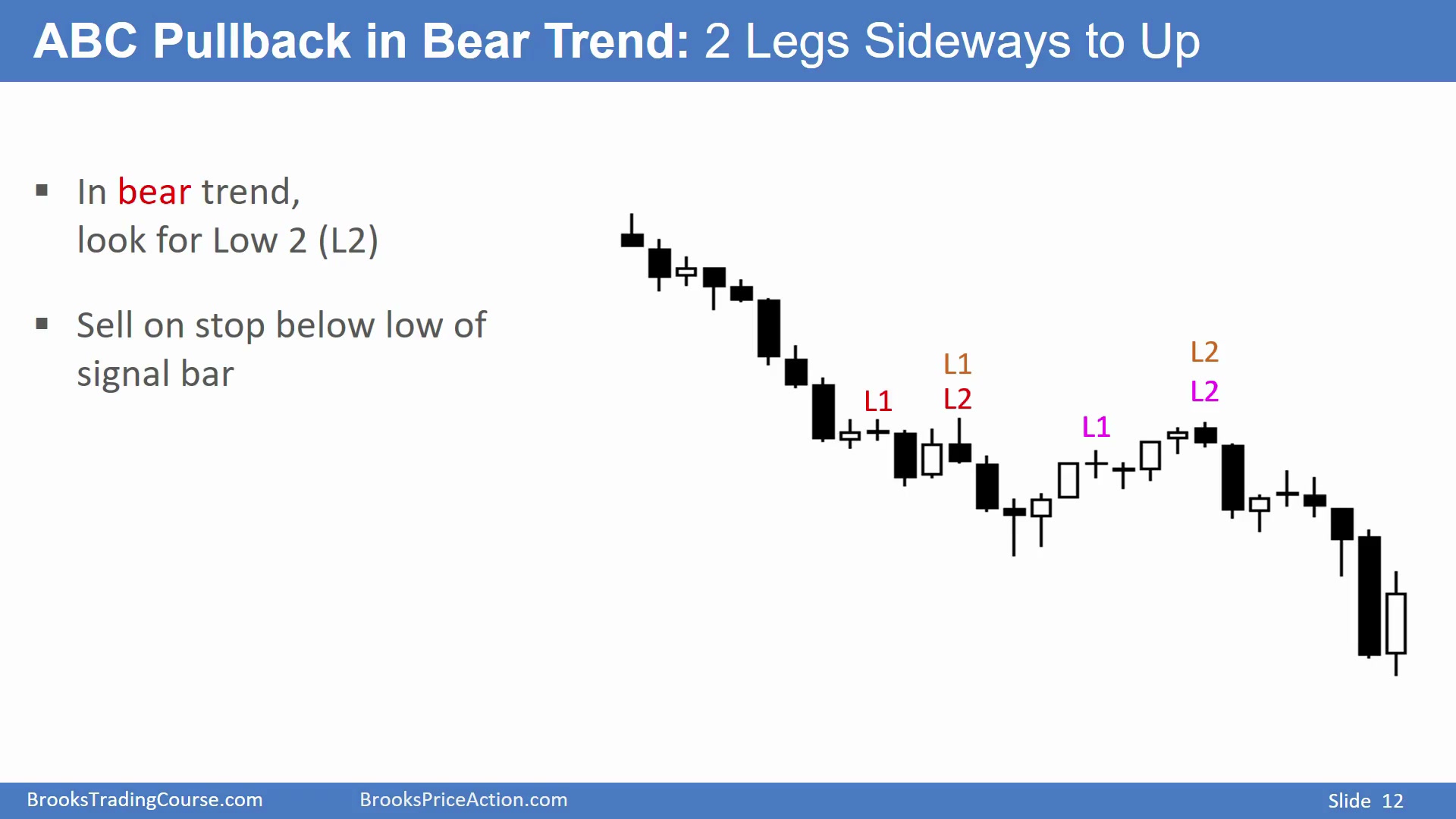
EN: Here’s a bear trend.

ZH: 这里是下降趋势

EN: Any time there is a pullback or a pause,

ZH: 每当出现反弹或暂停

EN: traders look at it as an opportunity to go short.

ZH: 交易者就看到了做空的机会

EN: The high of this bar did not go above the high of this bar,

ZH: 这根K线的高点没有超过这根K线的高点

EN: so it’s technically not a pullback on this timeframe –

ZH: 所以在这个时间级别上, 它严格来说不是回调

EN: but it probably is a pullback on a smaller timeframe.

ZH: 但在更小的时间级别上,它可能是一次回调

EN: In any case, it’s a pause, and traders will place a stop order…

ZH: 无论如何,这是一次暂停, 交易者会在这根K线的最低点下方

EN: ..to go short just below the low of this bar, betting that

ZH: 挂突破卖单

EN: if it does go below that bar, the trend will resume down.

ZH: 如果如果下一根K线跌破它的低点 下跌趋势将会继续

EN: Here, it simply went sideways.

ZH: 在这里,它只是横盘

EN: Here’s a second attempt to go down.

ZH: 这里是第二次尝试下跌

EN: For me, this is a Low 1 short, and then we have a Double Top bear flag.

ZH: 这是低1卖空点,然后有一个双顶熊旗

EN: That’s a Low 2 short.

ZH: 这是低2卖空点

EN: So you either sell there or you sell below this bar here.

ZH: 要么在这里卖出,要么在这根K线的低点下方卖出

EN: Low 1, bear flag.

ZH: 低1熊旗

EN: Low 2, bear flag.

ZH: 低2熊旗

EN: Same thing here.

ZH: 这里也是一样

EN: As the market’s going up, after each bar traders place…

ZH: 当市场反弹时,交易者会在每一根K线的下方

EN: ..a stop order to go short just below the low of the bar.

ZH: 都挂上突破卖单

EN: They place a stop order when this bar closes…

ZH: 他们在这根K线收盘时, 在它下方挂突破卖单

EN: ..to sell right below the low of the bar.

ZH: 等待在它的低点下方开仓做空

EN: They get filled here.

ZH: 订单在这里成交

EN: It’s still going up.

ZH: 现在还是调整阶段

EN: It’s still correcting, but it’s still most…

ZH: 就算继续上涨

EN: ..likely a minor reversal and a bear flag.

ZH: 大概率也只是一次反弹,是熊旗

EN: Traders who did not sell here might instead…

ZH: 在这里没有开仓做空的交易者

EN: ..place an order to sell below this bar.

ZH: 他们在这根K线的低点下方挂一个突破卖单

EN: Does not get filled.

ZH: 第二根K线没有跌破它的低点, 所以订单不会触发,没有成交

EN: They then place an order to sell below this bar.

ZH: 然后他们在这根K线的低点下方,再挂一个突破卖单

EN: It does get filled.

ZH: 价格触发,成交了

EN: So a second entry short in a rally in a bear trend,

ZH: 下降趋势,反弹之后,第二个做空入场点

EN: it’s a Low 2 short, a Low 2 bear flag.

ZH: 就是一个低2做空点, 或者叫低2熊旗

EN: An ABC bear flag – A, B, C.

ZH: ABC熊旗,A-B-C

EN: There are always other ways to label things.

ZH: 数K线的标准并不是唯一的

EN: Some traders instead will look at this as a larger Low 1,

ZH: 一些交易者会把它看作一个更大的低1

EN: a sideways move Low 1, and then this is part of that correcting process,

ZH: 横盘过程中的低1,然后这是反弹过程的一部分

EN: and then a Low 2 where the second leg also subdivided.

ZH: 然后低2,第二段中也能拆分出小的结构

EN: They’ll look at this as sideways to a Low 1 and then up to a Low 2.

ZH: 可以看作横盘形成了低1, 然后上涨形成了低2

EN: So they’ll view this as a larger Low 2 bear flag…

ZH: 所以他们会将其视为一个较大的低2熊旗

EN: ..or a larger Double Top bear flag.

ZH: 或一个较大的双顶熊旗

EN: First top, second top.

ZH: 第一个顶,第二个顶

EN: It doesn’t matter what you call it.

ZH: 怎么叫它其实无所谓

EN: You’re looking for ways to enter the trend,

ZH: 你在寻找的是顺势交易的入场点

EN: and when you see these bear flags, look to sell.

ZH: 当看到这些熊旗时,寻找做空机会

Time: 16:05

Slide 013

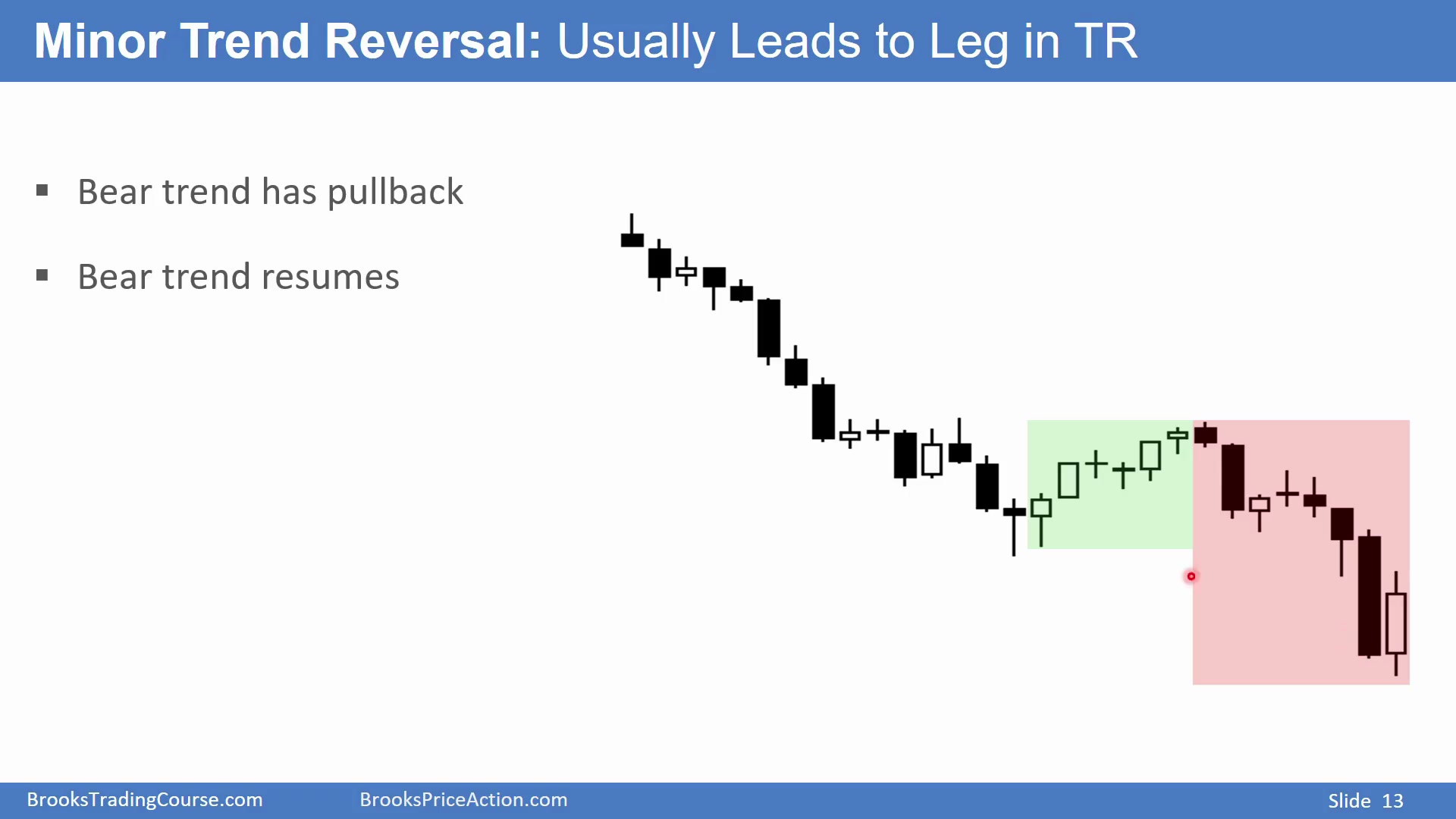
EN: This is a fairly Tight Bear Channel.

ZH: 这是一个很窄的下降通道

EN: The first reversal is probably minor.

ZH: 第一次反弹可能只是小反转

EN: A minor reversal is going to be usually a bull leg…

ZH: 小反转通常是震荡区间内,或熊旗里面的

EN: ..in a Trading Range or a bear flag.

ZH: 一个小的上涨趋势

EN: We’ve got a bear trend.

ZH: 这里是下降趋势

EN: We’re trying to reverse – probably a minor reversal.

ZH: 在尝试反转——可能是小反转

EN: I call it a pullback.

ZH: 我把它看作反弹

EN: Whenever I see a reversal attempt and I think it will not get very far…

ZH: 我看到反转的尝试, 但不认为它可以走很远,而且趋势会继续

EN: ..and the trend will resume, I call it a pullback.

ZH: 我就把它叫做反弹(或回调)

EN: That last slide, I showed a minor reversal.

ZH: 在上一张课件中,我们看了小反转的案例

Time: 16:40

Slide 014

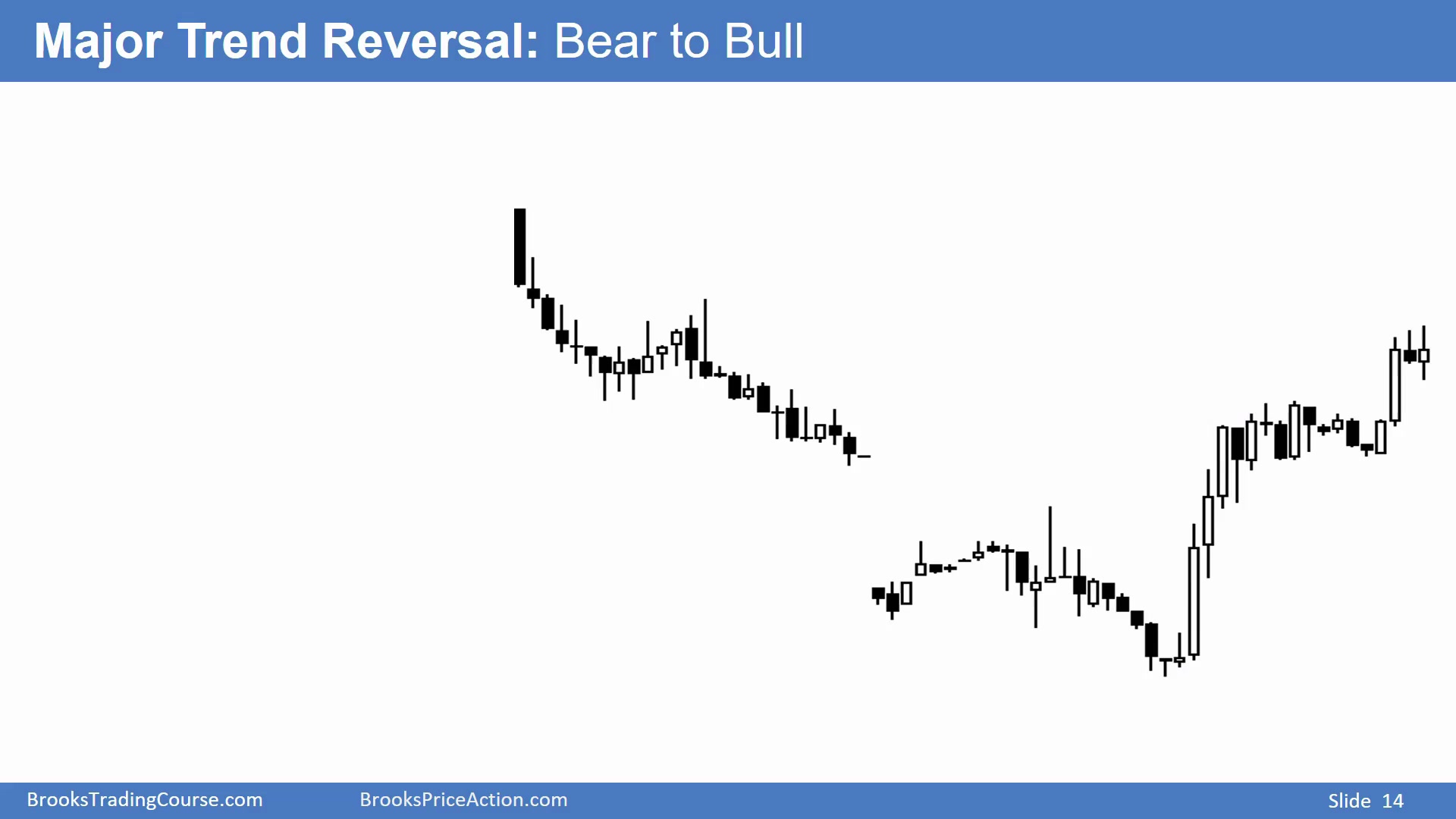
EN: Look at this reversal.

ZH: 再看看这个反转

EN: Bear trend, and a very strong bull breakout.

ZH: 下降趋势,一个非常强劲的多头突破

EN: Follow-through bar, another follow-through bar.

ZH: 后续有阳线跟随,又有好的跟随

EN: So at this point we’re in a bull trend.

ZH: 这个时候,市场已经处于上涨趋势

EN: Here, this is a major reversal, not just a bear flag.

ZH: 这里,这是一次大反转,而不仅仅是一个熊旗

EN: Here, minor reversal, bear flag.

ZH: 这里,小反转,熊旗

EN: Here, minor reversal, bear flag.

ZH: 这里,也是小反转,熊旗

EN: Minor reversal, bear flag.

ZH: 依旧是小反转,熊旗

EN: But look at the size of this breakout.

ZH: 但看看这个突破的大小

EN: Far above the bear channel.

ZH: 大幅超出了下降通道(的趋势线)

EN: This is a Major Trend Reversal,

ZH: 这是一个大反转

EN: which means the bear trend is becoming a bull trend.

ZH: 也就是说,下降趋势正在变成上涨趋势

EN: Now, look at this.

ZH: 来看这张图

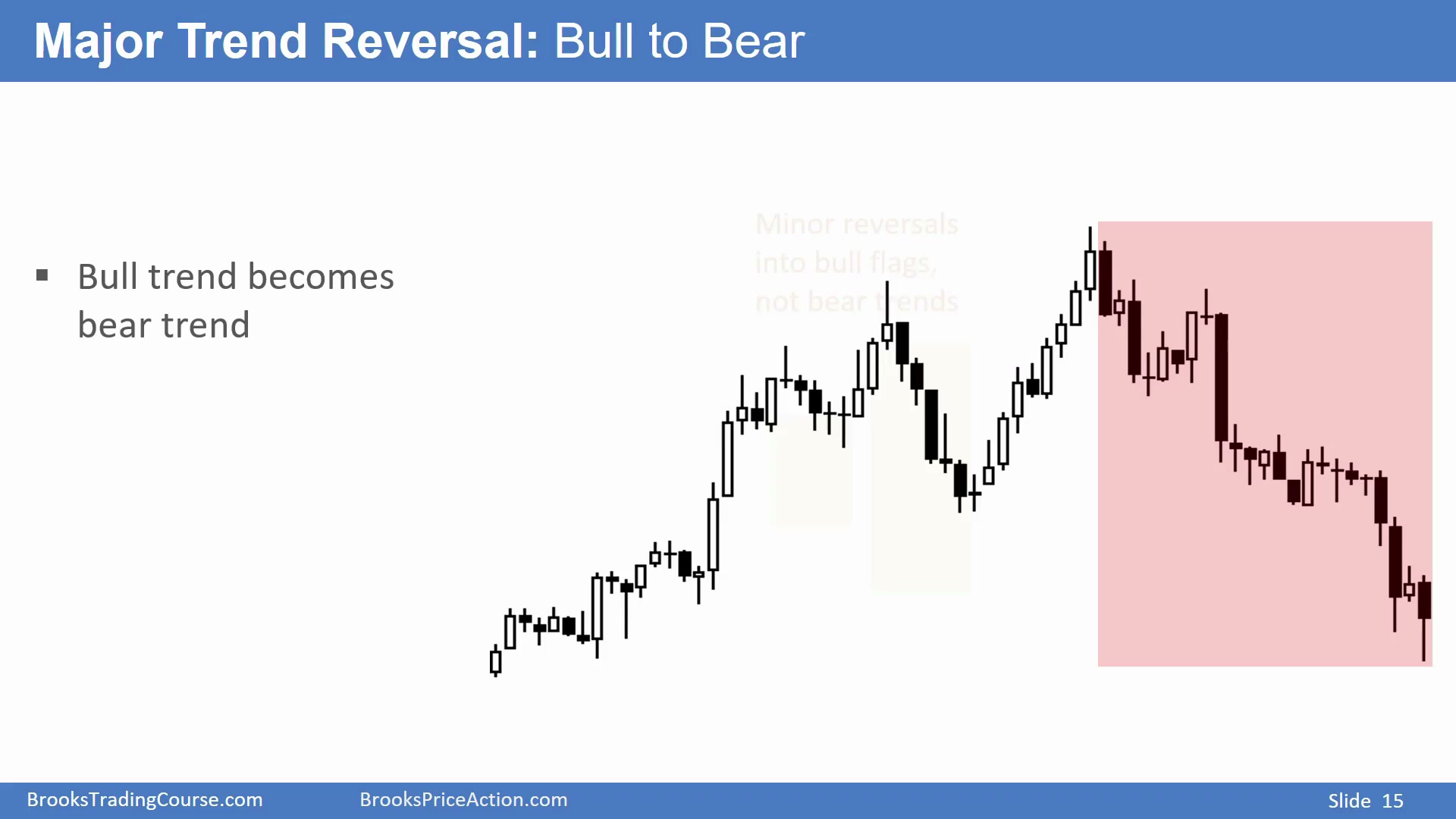
EN: We have a bull trend here and then a bear breakout to a broader bull channel.

ZH: 上涨趋势,然后空头突破 转变成更宽的上涨通道

Time: 17:20

Slide 015

EN: But you can look at this and say bull trend, pretty strong bear breakout.

ZH: 这里的空头突破很强势,回调非常深

EN: If we go above that high or test that high,

ZH: 重新测试这个高点之后

EN: maybe we’ll get a trend reversal into a bear trend.

ZH: 如果突破失败,很可能会再次反转 形成下降趋势

EN: That’s what we have.

ZH: 这就是所发生的事情

EN: We have a bull trend and then a bear trend.

ZH: 上涨趋势被反转,变成了下降趋势

EN: If a bull trend goes to a bear trend, it’s a major reversal.

ZH: 这是一次大反转

EN: If a bull trend just goes sideways…

ZH: 如果上涨之后只是横盘

EN: ..and the bull trend resumes, it’s a minor reversal.

ZH: 然后上涨趋势继续,那就只是一次小反转

EN: Even this is a minor reversal because the bull trend resumed.

ZH: 即使像这里,也只是一个小反转

EN: So minor reversal, the trend resumes instead of reversing.

ZH: 因为上涨趋势恢复了,而没有反转

Time: 18:05

Slide 016

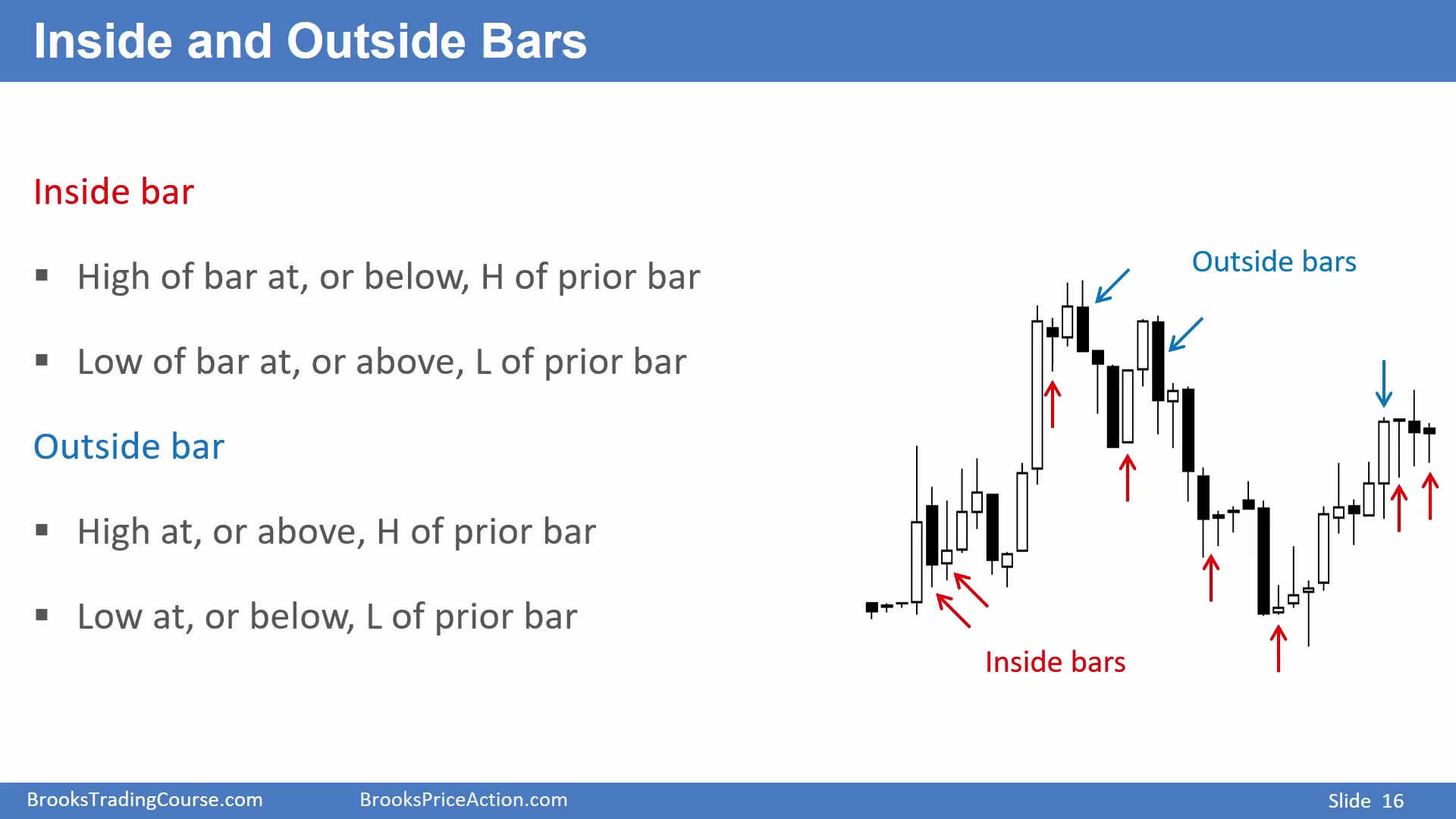
EN: Sometimes you’ll see a bar like this.

ZH: 有时你会看到这样的K线

EN: Its low is below the low of the prior bar.

ZH: 它的低点低于前一根K线的低点

EN: Its high is above the high of the prior bar.

ZH: 它的高点高于前一根K线的高点

EN: That is an outside bar.

ZH: 是一根外包K线(也叫吞噬K线)

EN: It does not have to be below.

ZH: 不一定要低于,相等也可以

EN: I call it an outside bar if the high is exactly at the high…

ZH: 如果它的高点和前一根K线的高点相等

EN: ..of the prior bar and the low goes below the low of the prior bar.

ZH: 低点低于前一根K线的低点,也是吞噬线

EN: For example, over here.

ZH: 例如,在这里

EN: This bar did not go above that high.

ZH: 这根K线没有超过那个高点

EN: The two highs are of the same price, yet its low went below.

ZH: 两个高点价格相同,但它的低点更低

EN: I would still call that an outside down bar.

ZH: 我会称之为吞噬大阴线(从上往下吞噬、反转)

EN: An outside bar.

ZH: 这是吞噬K线

EN: And an inside bar is a bar where its high and low…

ZH: 如果一根K线的高低点,都在前一根K线的范围内

EN: ..are within the range of the prior bar.

ZH: 那它就是内含K线 (被包含在内部,也叫做孕线)

EN: This bar, the low is above that low; the high is below that high.

ZH: 这根K线,低点更高,高点更低

EN: So this black bar is an inside bar.

ZH: 所以这根黑色K线是孕线

EN: Look at the next bar, this white bull body.

ZH: 看下一根K线,这个白色的小阳线

EN: It’s inside of the black bar.

ZH: 它被包在在黑色K线内部

EN: Its high is below that high and its low is above that low.

ZH: 它的高点更低,低点更高

EN: Same here.

ZH: 这里也是一样

EN: Another inside bar.

ZH: 另一根孕线

EN: This bar is inside that bar, this bar is inside that bar.

ZH: 这根K线在那根K线内,这根K线在那根K线内

EN: A small inside bar here.

ZH: 这是一根小孕线

EN: Here’s an inside bar.

ZH: 这是一根孕线

EN: The high is the same as that high, but the low is above that low,

ZH: 高点一样高,但低点被包在里面

EN: so I would still refer to that as an inside bar.

ZH: 所以我仍然会称之为孕线

EN: That’s why I say for an outside bar, the high is at or above the high…

ZH: 吞噬K线的定义是,它的高点比前面更高,或相等

EN: ..of the prior bar, and the low is at or below the low of the prior bar.

ZH: 它的低点比前面更低,或相等

EN: An inside bar, the high is at or below the high of the prior bar,

ZH: 而孕线,它的高点比前面更低,或相等

EN: and the low is at or above the low of the prior bar.

ZH: 低点比前面更高,或相等

EN: An outside bar here, outside bar here.

ZH: 吞噬线,这也是吞噬线

EN: This is actually an outside bar as well.

ZH: 这实际上也是一根吞噬线

EN: Its low was below the low of that bar.

ZH: 它的低点低于那根K线的低点

EN: Its high was above the high of this bar.

ZH: 它的高点高于这根K线的高点

EN: Here’s the Australian dollar versus the U.S. dollar, a 5-minute Forex chart.

ZH: 这是外汇,澳元对美元的5分钟图

Time: 20:05

Slide 017

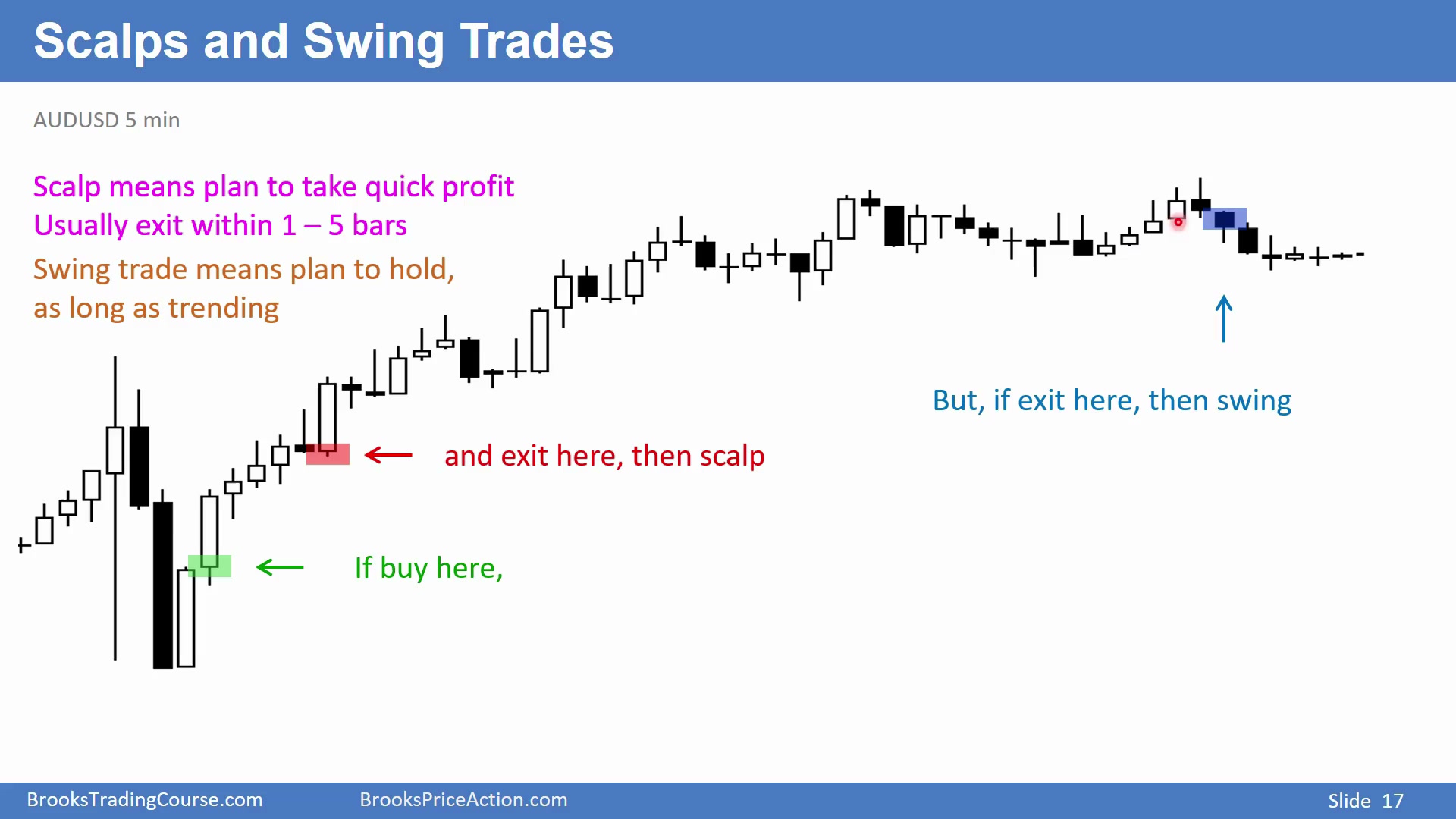
EN: I distinguish trades into swing trades and scalps.

ZH: 我将交易分为波段交易和剥头皮交易

EN: A scalp means that I’m trying to take a quick profit.

ZH: 剥头皮交易意味着我尝试赚一笔快钱

EN: I usually exit within 5 bars, and sometimes just 1 bar.

ZH: 我通常在5根K线之内离场,有时只需1根K线

EN: A swing trade means I’m planning to hold onto my position…

ZH: 波段交易意味着,只要趋势还在

EN: ..as long as the trend is going in my direction.

ZH: 我就一直持有下去

EN: Let’s look at this chart and let’s talk about buying here.

ZH: 看这张图,假设在这里买入

EN: If I buy above the high of this bar,

ZH: 如果我在这根K线的高点上方买入

EN: I get filled right here, just above that high.

ZH: 我在这里成交,刚好在那个高点上方

EN: Let’s say I get out 4 or 5 bars later, below this bear bar,

ZH: 假设我在4或5根K线后, 在这根阴线下方离场

EN: right where this red box is right below the low of that bar.

ZH: 就在这个红色框框出, 正好在那根K线的低点下方

EN: To me, that’s a scalp.

ZH: 这就是一笔剥头皮交易

EN: I did not allow any pullbacks.

ZH: 我没有允许回调让我的利润回撤

EN: I get out within 1, 2, 3, 4, 5 bars.

ZH: 我在5根K线内离场

EN: It did not matter to me that the trend continued.

ZH: 趋势是否继续,对我来说无关紧要

EN: If I buy here and get out a few bars later…

ZH: 如果我在这里买入,并在几根K线后离场

EN: ..and did not allow pullbacks, that’s a scalp.

ZH: 并且没有允许回调,那是剥头皮交易

EN: On the other hand, what happens if I exit up here or up here?

ZH: 但如果说,我在这里或这里离场,会怎样

EN: If I’m exiting up here at the end of the session, to me that’s a swing trade.

ZH: 如果我一直持有到交易时段结束时退出 对我来说那是波段交易

EN: So I buy here, I don’t worry about the pullback…

ZH: 我在这里买入,并不担心回调

EN: ..here or here, or here or here or here.

ZH: 在这里或这里,或这里或这里或这里

EN: None of these look like major reversals.

ZH: 全都不像是大反转

EN: I’m willing to continue to hold despite all of the pullbacks,

ZH: 尽管有很多回调,我仍坚定持有

EN: and then I look to exit at the end of the session.

ZH: 然后我在收盘前止盈离场

EN: If you’re holding through pullbacks

ZH: 如果你持有了很多根K线 (至少15~20根K线)

EN: and for a lot of bars, that is a swing trade.

ZH: 并且挺过了这些回调阶段 那就是一笔波段交易

Time: 21:40

Slide 018

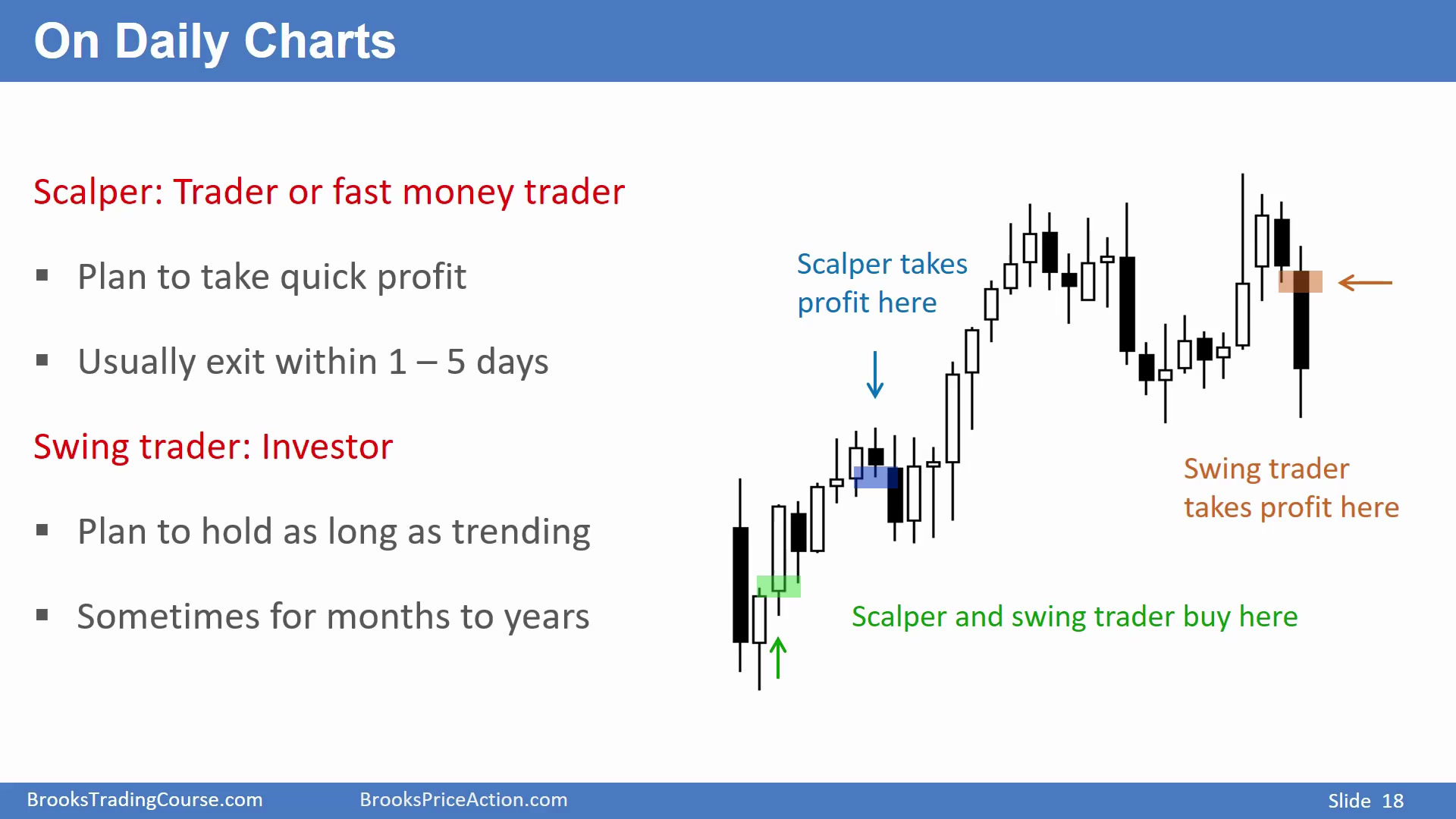
EN: That last chart was a 5-minute chart, and here is a daily chart.

ZH: 上一张是5分钟图,这张是日K线

EN: There are other terms to use when talking about scalping…

ZH: 在更高的时间周期剥头皮或者做波段 比如日K线,或者周K线

EN: ..and swing trading on higher timeframe charts, daily or weekly charts.

ZH: 还有一些其它的相关术语

EN: So for example, let’s say a bull trader bought here and he got out here.

ZH: 例如,假设多头在这里买入,在这里离场

EN: He’s a scalper.

ZH: 他是一个剥头皮交易者

EN: You might call him a fast money trader or simply a trader.

ZH: 可以说他为短线交易者, 或简单地称为交易者

EN: If you get out here and this was a monthly chart,

ZH: 如果在这里离场,而且这张图是月K线的话

EN: people would call him an investor.

ZH: 人们会称乎他为投资者

EN: If it was a weekly chart, they might call him an investor.

ZH: 如果是周K线,他们可能会称他为投资者

EN: To me, I would call him a swing trader even on this chart.

ZH: 对我来说,我会称他为波段交易者

EN: But in general, if you’re taking quick profits on a daily chart,

ZH: 但总的来说,如果你在日线图上赚快钱

EN: traders will call you a trader or a fast money trader or a scalper.

ZH: 交易者会称你为交易者,或短线交易者 或剥头皮交易者

EN: But usually they use the term “trader.” If a person is holding for a long time –

ZH: 总之会用“交易者”这个词来形容 但如果你持有很长时间——

EN: 20, 30, 40 bars – you start to get into the realm of being an investor,

ZH: 20、30、40根K线——你开始进入投资者的领域

EN: especially if it’s a weekly or monthly chart.

ZH: 尤其是在周线、月线图上的话

EN: Some swing traders will hold far beyond a typical swing,

ZH: 一些波段交易者会持有非常非常久

EN: which might be 10, 20, or 30 bars.

ZH: 有时是10、20或30根K线

EN: They may hold indefinitely, sometimes for years or months.

ZH: 也可能无限期持有,几个月,甚至几年

EN: And that would be an investor.

ZH: 那就是一个投资者

EN: People would use the term “investor”

ZH: 大家会用“投资者”来形容这样的人

EN: instead of swing trader for that kind of a person.

ZH: 而不是“波段交易者” 这种词

Time: 23:00

Slide 019

EN: If you look at a chart, you see the market going…

ZH: 在任何一张图上,你会看到市场

EN: ..up and down, up and down, up and down.

ZH: 你会看到市场上涨,下跌 一会儿涨,一会儿跌

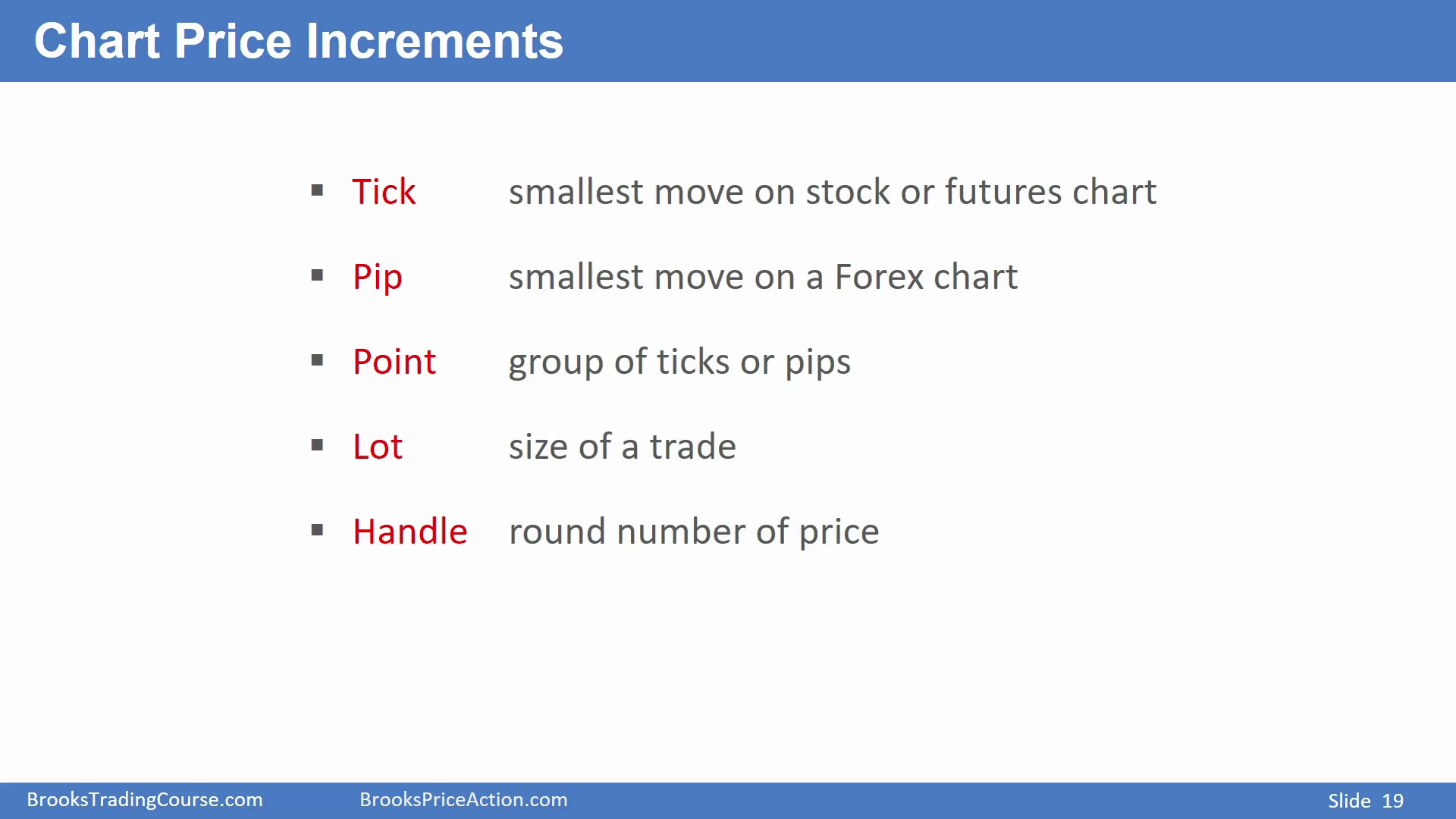
EN: The smallest move up or down on a chart is a tick.

ZH: 价格变化的最小单位是一个tick (tick 目前没有统一的翻译,所以就用英文)

EN: So if it goes up one move, it’s called a tick.

ZH: 如果它上涨了一个单位,就是上涨了一个tick

EN: If it goes up three or four, it’s called 3 or 4 ticks.

ZH: 如果涨了3~4个单位 就是3或者4个ticks

EN: If you’re looking at a Forex chart, people tend to use the term “pip”

ZH: 在外汇交易中,价格跳动的最小单位

EN: instead of a tick, but it’s the same thing.

ZH: 人们倾向于使用“pip”这个词 它和“tick”的意思是一样的

EN: Nowadays, pips are also subdivided into tenths or even hundredths,

ZH: 如今,pip也被再细分到十分之一甚至百分之一

EN: but I just refer to pips and don’t worry about the tiny, small divisions.

ZH: 但我用pip就足够了,不用担心那些微小的细分

EN: A point is a group of ticks or pips.

ZH: 几个ticks,或者几个pips,组成一个点 (每个品种不同)

EN: So for example, 1 point on the E-Mini chart is 4 ticks.

ZH: 比如,在标普的股指期货(ES)中 1个点等于4个ticks

EN: A corresponding move on the SPDR ETF chart is 10 ticks.

ZH: 等同于SPY(标普ETF)移动10个ticks

EN: You’ll sometimes hear traders talk about their lot size.

ZH: 有时你会听到交易者谈论他们的“手数”

EN: “I traded 5 lots,” which means you traded 5 contracts…

ZH: “我交易了5手”,这意味着他交易了5个合约

EN: ..or 5 shares or 5 units or 5 something.

ZH: 或者5股股票,或5个单位的什么东西

EN: A handle is a big round number.

ZH: “报价”是指整数部分

EN: So if the SPDR is trading at 202.50, you would say it has a 202 handle on it.

ZH: 比如说,SPY现在的价格为202.50 就可以说,它的报价是202

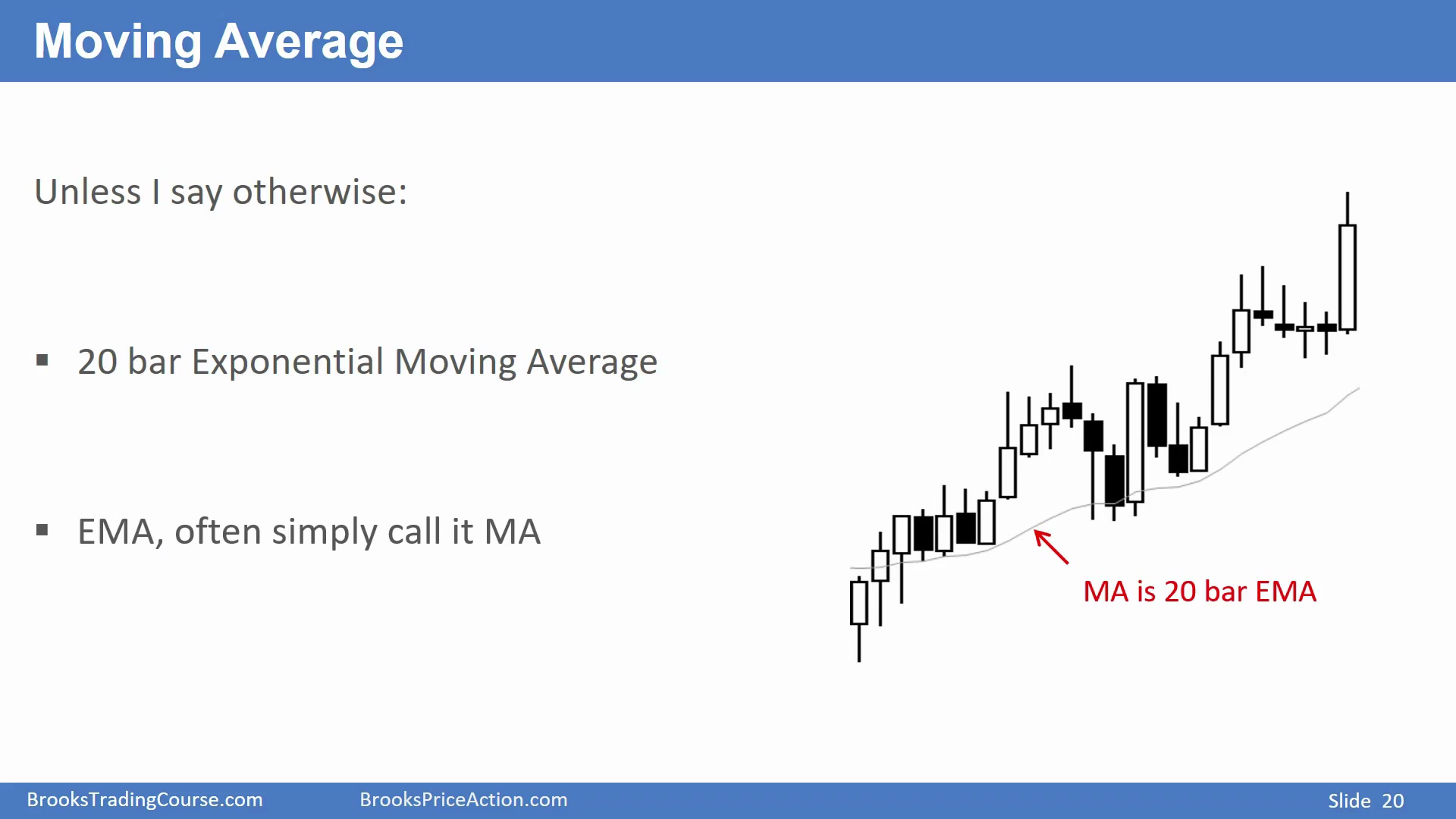
EN: When I talk about Moving Averages, I’m usually talking

ZH: 当我谈论移动平均线时

Time: 24:15

Slide 020

EN: about a 20 bar Exponential Moving Average.

ZH: 我通常指的是:周期为20的指数移动平均线 (会全部翻译成EMA20)

EN: Whether it’s a 5-minute chart or a month chart, it doesn’t matter.

ZH: 无论是在5分钟图,还是在月K线图上,都一样

EN: If you hear me say Moving Average and I don’t qualify it,

ZH: 如果你听到我说均线,没有其它具体的说明

EN: I’m talking about a 20 bar Exponential Moving Average.

ZH: 我指的是EMA20

EN: Some people refer to it as an EMA, Exponential Moving Average.

ZH: 有些人喜欢把它缩写成EMA (比如译者)

EN: I simply call it a Moving Average.

ZH: 我一般就叫他均线

EN: This Moving Average is a 20 bar Exponential Moving Average.

ZH: 这根均线是EMA20

Time: 24:45

Slide 021

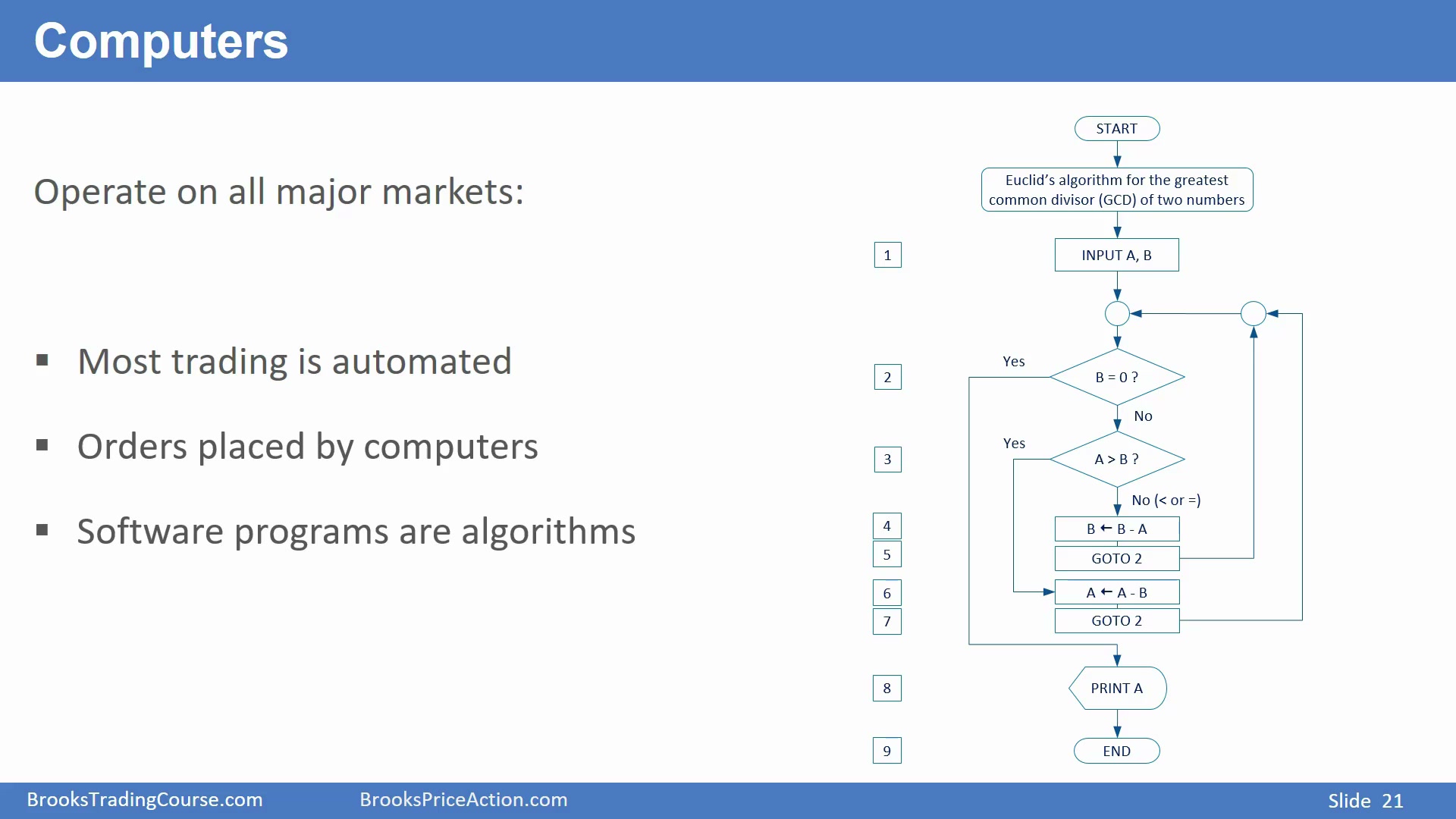
EN: Computers, you cannot get around the reality…

ZH: 你我们无法否认一个事实:

EN: ..that they control all major markets.

ZH: 机构的电脑城,控制着所有的主要市场

EN: Most trading nowadays is automated.

ZH: 如今绝大部分交易都是自动化的

EN: That means the orders are placed by computers and software programs,

ZH: 这意味着订单是由计算机和程序下达的

EN: which are called algorithms, are making decisions about when to buy,

ZH: 这些程序被称为算法,它们决定何时买入

EN: when to sell, when to add on to positions, when to slightly reduce positions.

ZH: 何时卖出,何时加仓,何时减仓

EN: Here’s an example of a flowchart of an algorithm.

ZH: 这里是一个算法流程图的例子

EN: You’ll sometimes hear me talk about an institution – Bank of America, CalPERS,

ZH: 有时你会听到我谈论某个机构—— 比如美国银行,

Time: 25:15

Slide 022

EN: the pension fund for state employees in California – but only investments.

ZH: 或者加州公务员退休基金CalPERS(仅限于投资)

EN: Those are all institutions.

ZH: 这些都是机构

EN: Goldman Sachs.

ZH: 高盛 Goldman Sachs

EN: An institution could be a bank, it could be a hedge fund,

ZH: 一个机构可以是银行,可以是对冲基金

EN: a high frequency trading firm, a pension fund like CalPERS,

ZH: 可以是高频交易的机构, 或者CalPERS这样的养老金基金

EN: mutual funds like Fidelity.

ZH: 还有富达这样的共同基金

EN: Any large entity is an institution, and that includes large individual traders.

ZH: 任何大型实体都是一个机构,包括大型个人交易者

EN: For example, the smallest position size in the E-Mini is 1 contract.

ZH: 例如,E-Mini的最小头寸是1个合约

EN: If a trader is trading 100 contracts or 200 contracts or more,

ZH: 如果一个交易者交易100个合约或200个合约或更多

EN: I would consider them to be as significant as an institution,

ZH: 我会认为他们和一个机构一样重要

EN: even if they’re trading for their own account.

ZH: 即使他们是为自己的账户交易

Time: 26:00

Slide 023

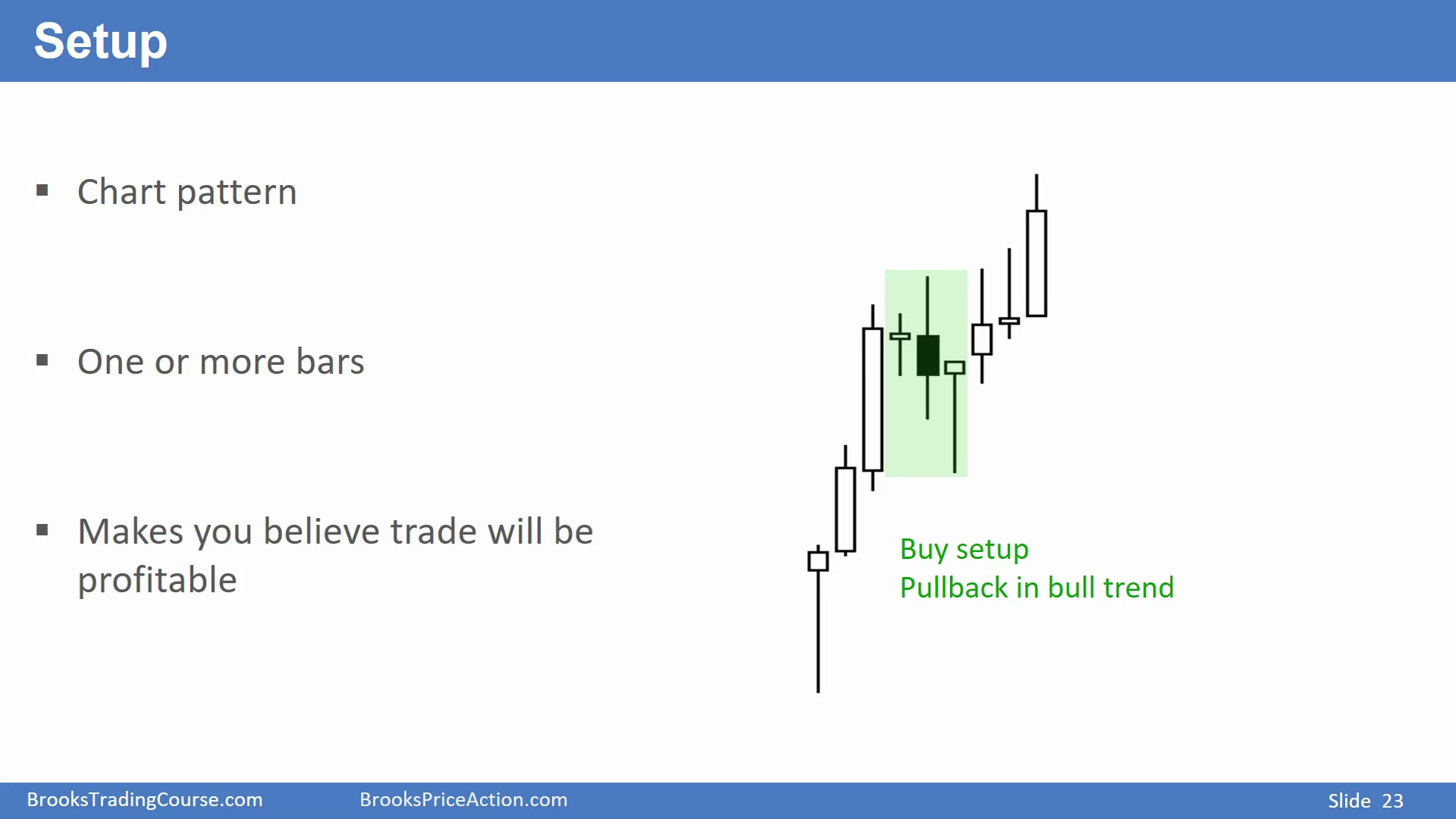
EN: You’ll often hear me talk about setups.

ZH: 你经常会听到我讲交易机会

EN: It’s a chart pattern.

ZH: 指的是图标上的某个价格行为模式

EN: It’s something on the chart, and it makes me believe

ZH: 图表上的某些东西让我相信

EN: that there’ll be a profitable trade.

ZH: 会有一笔赚钱的交易

EN: Sometimes the setup is 1 bar, sometimes it’s 3 or 4 bars.

ZH: 有时是1根K线,有时是3或4根K线

EN: Sometimes it’s 20 or 30 bars.

ZH: 有时是20~30根K线的大形态

EN: For example, we have a bull trend and it’s pulling back for a few bars.

ZH: 例如,这里有一个上涨趋势, 这几根K线正在回调

Time: 26:20

Slide 024

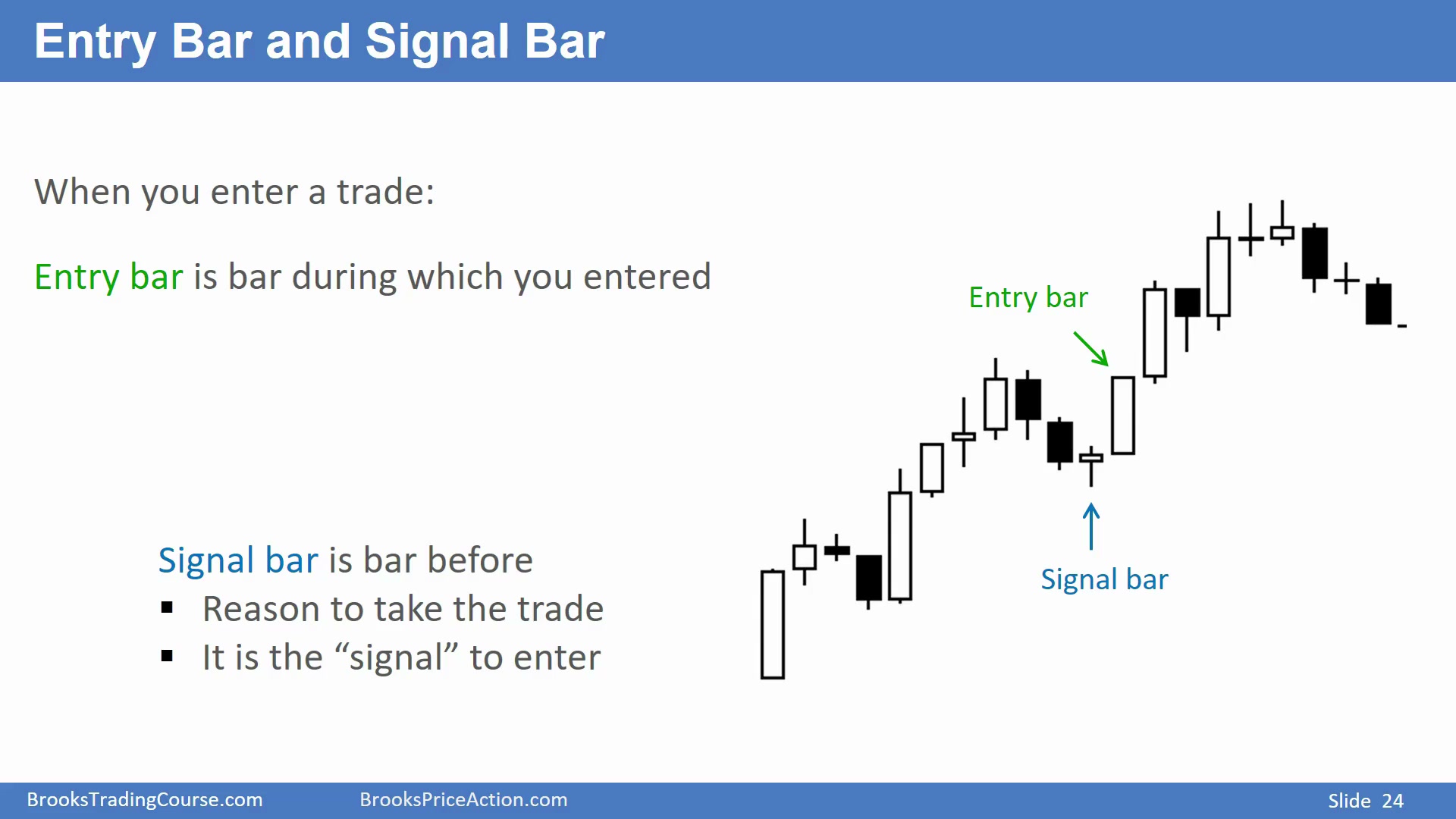
EN: As it’s pulling back, traders are placing buy stops…

ZH: 在市场回调的时候, 交易者会在前一根K线的最高点上方一个tick

EN: ..1 tick above the high of the prior bar.

ZH: 挂上突破买单(Buy Stop Order)

EN: Did not get filled.

ZH: 这根K线没有成交 (没有突破它的高点,突破买单无法触发)

EN: The new bar closes, they place a buy stop 1 tick

ZH: 新的K线收盘了, 交易者会在这根K线的最高点上方

EN: (or 1 pip) above the high of that bar.

ZH: 一个tick(外汇中是一个pip)挂突破买单

EN: In this case, the trader did get filled.

ZH: 这里他们就可以成交买入了

EN: This is the bar when they entered their trade, so it’s the entry bar,

ZH: 他们是在这根K线上成交入场的 所以这是他们的入场K线

EN: and this is the bar that signaled the entry.

ZH: 而这是发出入场信号的K线

EN: When they saw this bar, they thought…

ZH: 当他们看到这根K线时,交易者想:

EN: ..“if it goes above the high of this bar, I want to get long.”

ZH: “如果它突破这根K线的高点,我要做多。”

EN: This is the signal bar, and traders get in on the entry bar.

ZH: 这是信号K线,然后交易者在后一根K线入场

EN: The signal bar is the reason to take the trade.

ZH: 信号K线是一笔交易的理由

EN: It’s the signal to look to enter.

ZH: 是入场的信号

Time: 27:02

Slide 025

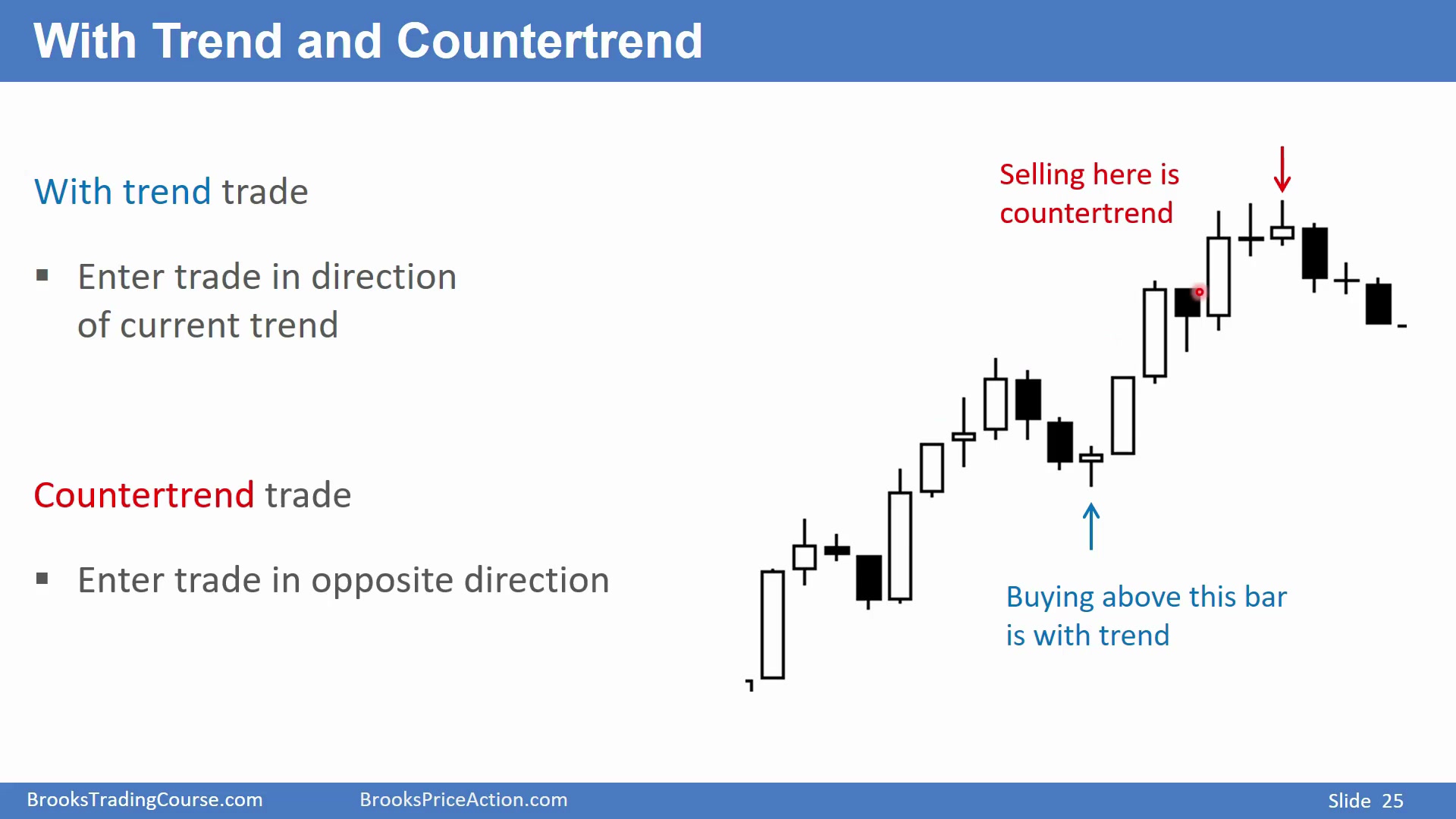
EN: So here’s the signal bar.

ZH: 所以叫做信号K线

EN: We’re with the trend, we’re trading in the direction of the trend.

ZH: 我们顺应趋势,我们在趋势的方向上交易

EN: Buying above this bar is buying with trend.

ZH: 在这根K线上方买入,是顺势买入

EN: Countertrend means doing the opposite.

ZH: 逆势意味着做相反的事情

EN: For example, we have a bull trend,

ZH: 例如,在上涨趋势中

EN: and if I’m selling below that bar right here,

ZH: 如果我在这里这根K线下方开仓做空

EN: it’s a countertrend trade.

ZH: 这是一笔逆势交易

EN: I’m trading in the direction opposite to the trend.

ZH: 我在逆趋势交易

Time: 27:30

Slide 026

EN: Context.

ZH: 背景

EN: You’ll often hear me talk about context.

ZH: 你会经常听到我谈论上下文

EN: Is it a buy setup or a sell setup? I’m always interested in the context.

ZH: 这是一个做多机会还是做空机会?我总是对背景感兴趣

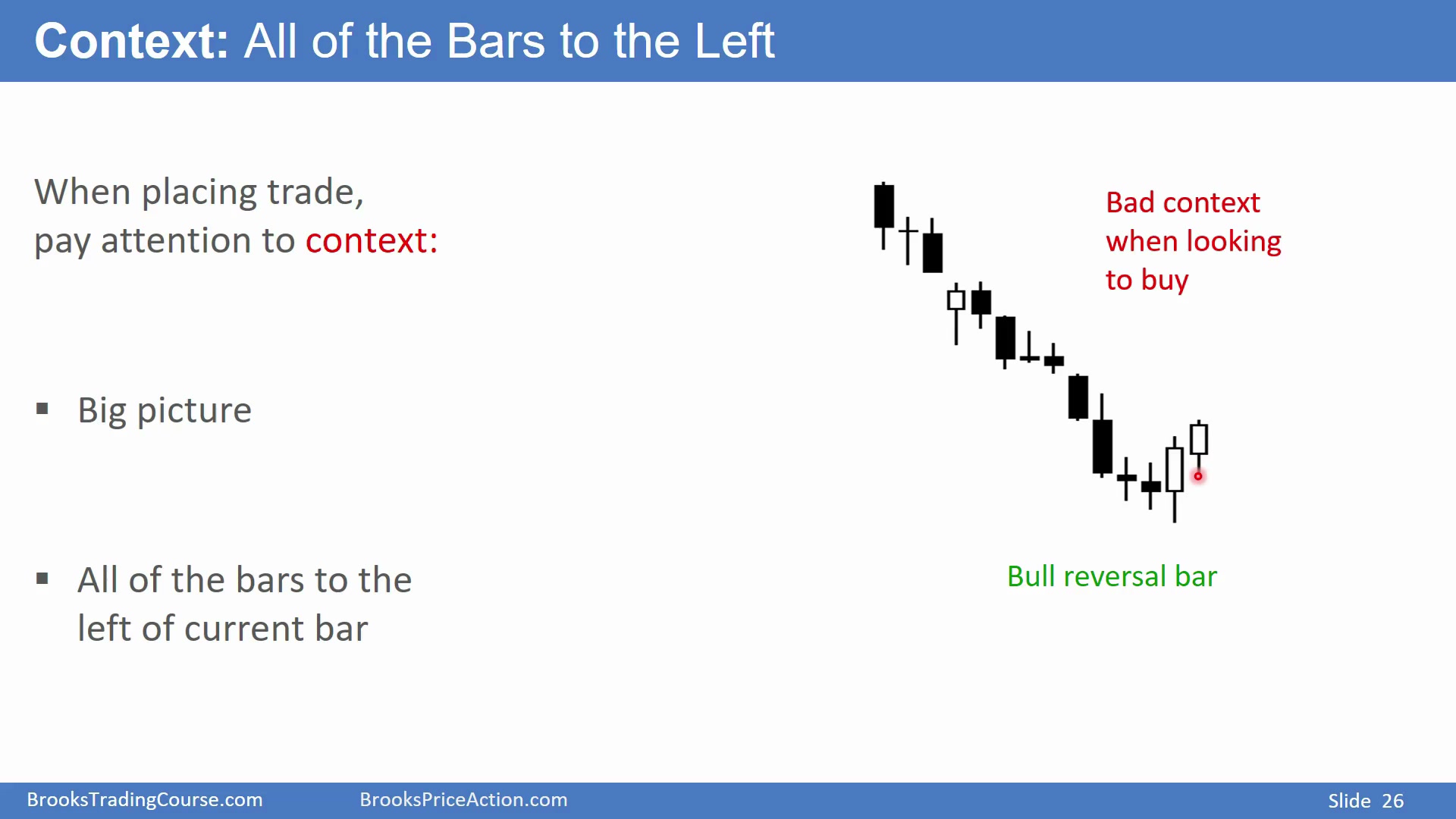
EN: Context means all the bars to the left.

ZH: 背景指的是所有左边的K线

EN: If I see this bar, I want to know what took place before it.

ZH: 如果我看到一根K线,我想知道它之前发生了什么

EN: Do I want to buy here? Maybe it’s better to sell here.

ZH: 在这里做多好吗?还是做空更好?

EN: I want to know what the bars to the left look like.

ZH: 我需要知道左边的K线是什么样的

EN: Those bars to the left provide the context.

ZH: 左边的K线提供了背景

EN: So for example, if there’s a strong bear trend,

ZH: 比如这个案例,左边是很强的下降趋势

EN: do I really want to be buying here? No.

ZH: 我真的要在这里买入吗?我不买

EN: It’s a bull reversal bar, it’s a buy signal,

ZH: 尽管它确实是多头反转K线,是一个做多信号

EN: but it’s a buy signal that I would not take.

ZH: 但我不会采纳它

EN: If anything, I’m looking to sell.

ZH: 因为我在寻找做空的机会

EN: When there’s a very tight bear channel like this, I don’t care

ZH: 当有市场处于非常窄的下降通道时

EN: if there’s a good bull reversal bar and a good follow-through bar.

ZH: 我不在乎有没有反转的阳线, 哪怕他后面有跟随

EN: It’s more likely the reversal will fail…

ZH: 反转的尝试更有可能失败

EN: ..and this bull reversal will end up as a bear flag.

ZH: 这个反弹最终会成为一个熊旗

EN: This is a Low 1 sell signal bar.

ZH: 这是低1做空信号K

EN: Traders will sell just below its low, expecting the reversal to fail,

ZH: 交易者会在其低点下方卖出,预期反转失败

EN: become a bear flag, and for the bear trend to resume.

ZH: 成为熊旗,然后下降趋势继续

Time: 28:35

Slide 027

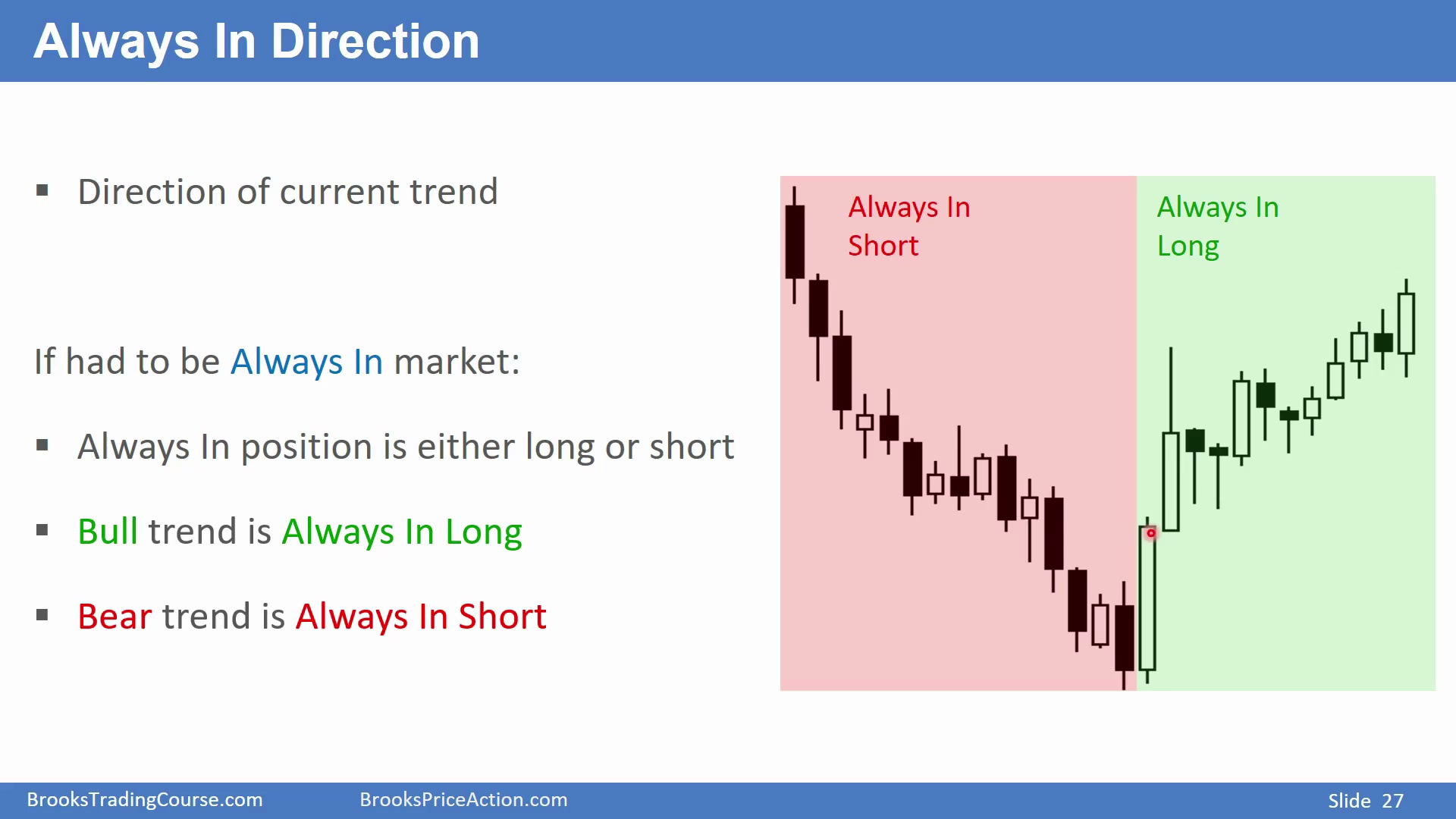
EN: I often talk about “Always In.” That is the direction of the current trade.

ZH: 我经常谈论单边趋势(always in) 这是市场当前交易的方向

EN: For example, here I would say the market is Always In Long.

ZH: 例如,在这里我会说市场是单边上涨

EN: If I had to be in the market this instant, would I rather be long or short?

ZH: 如果我必须在此刻参与市场, 我应该做多还是做空?

EN: If I had to be always in the market at this point,

ZH: 如果一定要我选一个方向

EN: I would be long because odds are the market is going higher.

ZH: 我会做多,因为市场继续上涨的概率较大

EN: In a bear trend, the market is Always In Short.

ZH: 市场在单边下跌

EN: At this moment, do I want to be long or short?

ZH: 此时此刻,我应该做多还是做空?

EN: If I had to be in the market this instant,

ZH: 如果我必须立刻入场

EN: if I had to be always in the market…

ZH: 必须选择一个方向交易

EN: ..and it’s right at this instant, I want to be short.

ZH: 就在这个瞬间,我想做空

EN: The market is Always In Short here,

ZH: 因为市场在单边下跌

EN: and somewhere in here it became Always In Long.

ZH: 在某个地方,变成了单边上涨

EN: Traders thought it was better to be long.

ZH: 交易者认为做多更好

EN: Easier to make money being long than short.

ZH: 做多比做空更容易赚钱

Time: 29:30

Slide 028

EN: I pay attention to context.

ZH: 我非常关注背景

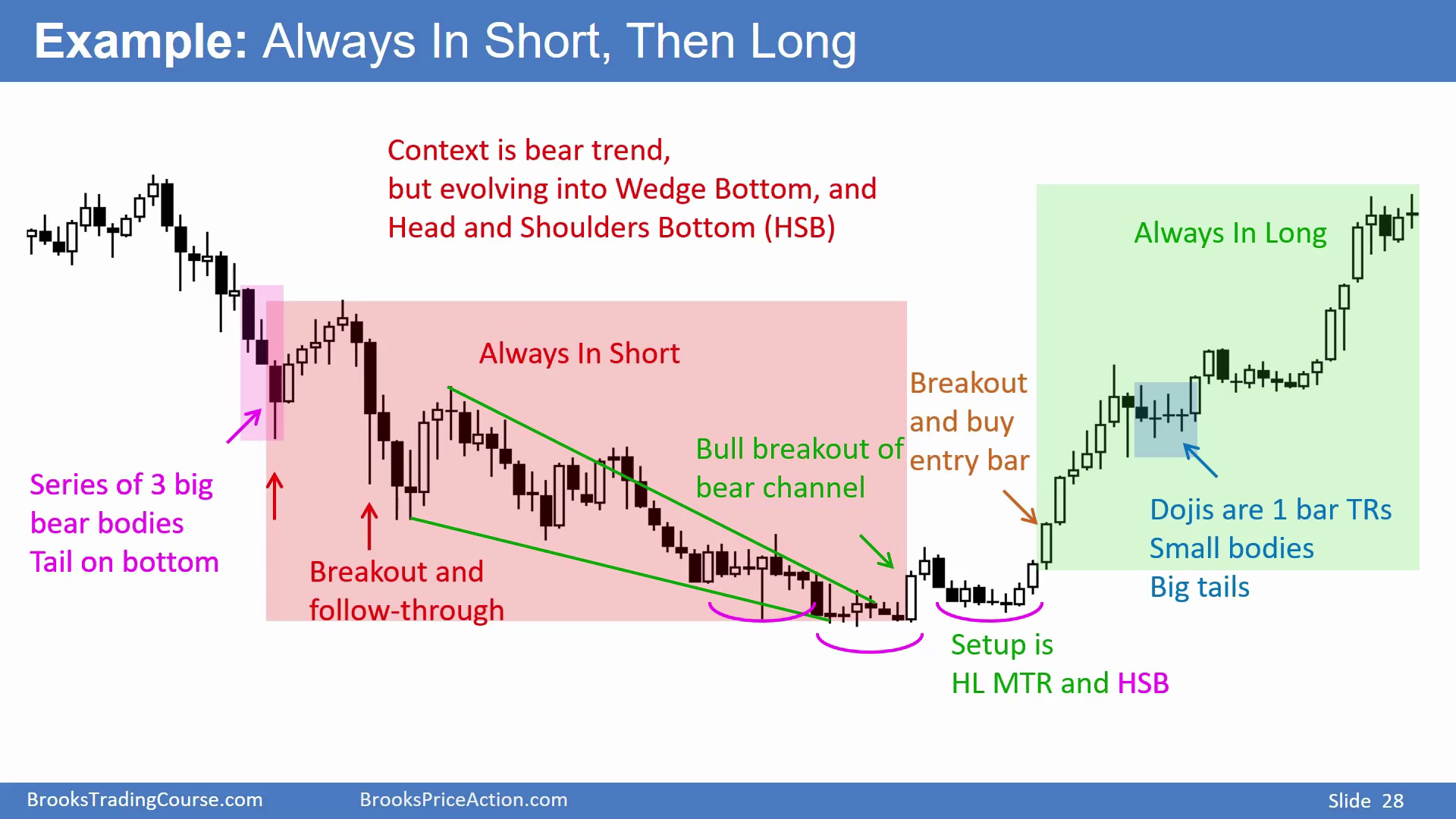
EN: The context here is that we’re in a bear trend.

ZH: 这里的背景是,市场处在一个下降趋势中

EN: We’re getting Lower Highs and Lower Lows.

ZH: 高点和低点,都在不断降低

EN: We’re starting to get a lot of two-sided trading –

ZH: 这里开始有很多双向交易 (剥头皮交易者高抛低吸赚快钱)

EN: tails below bars, some bull bars, smaller bars, sideways bars.

ZH: K线下方有尾巴,一些阳线,较小的K线,横盘K线

EN: It’s still Always In Short, but it looks like it’s evolving

ZH: 它仍然算是在单边下跌

EN: into a Trading Range, which means that it may soon reverse into Always In Long.

ZH: 但看起来它正在演变成一个震荡区间, 这意味着它可能很快反转上涨,甚至单边上涨

EN: 3 big bear bars, a bear channel with about 8 or 10 bars –

ZH: 3根大阴线,一个有大约8到10根K线的下降通道

EN: but tail on the bottom of the bar.

ZH: 但K线底部有尾巴

EN: That’s weakening, a weakening trend.

ZH: 这说明趋势正在衰弱

EN: Another big bear breakout, but a big tail below.

ZH: 又有一根大阴线突破,但下影线非常长

EN: The close of this bar, the bottom of that black box,

ZH: 这根K线的收盘价,即这个黑色柱体的底部

EN: is above the breakout point.

ZH: 收盘在突破点上方

EN: There are problems with this bear trend.

ZH: 这个下降趋势有问题

EN: Another breakout, a close just around the breakout point instead of far below.

ZH: 再次突破,收盘价刚好在突破点附近, 而不是远低于突破点

EN: Bulls are buying prior lows and they’re making money.

ZH: 多头在可以在前期低点买入并且赚钱

EN: That usually means that a bear channel

ZH: 这通常意味着

EN: is in the process of evolving into a Trading Range.

ZH: 下降通道正在演变成一个震荡区间

EN: And once it’s in a Trading Range,

ZH: 一旦进入震荡区间

EN: traders will start to look for trend reversals.

ZH: 交易者将开始寻找反转的机会

EN: So we have a fairly tight bear channel and we have a bull trend bar…

ZH: 大阳线,突破了下降通道

EN: ..breaking above the high of the channel, breaking above the top of the channel.

ZH: 突破了通道线 / 趋势线

EN: Trend lines are rarely perfect.

ZH: 很少有完美的趋势线

EN: You can see I’m using this high and then this series of highs.

ZH: 我把这些高点连接起来划线

EN: The market looks like it’s turning down every time…

ZH: 每当价格碰到这根线(假想的趋势线)

EN: ..it hits an imaginary line at that point.

ZH: 就继续下跌了

EN: I would extend the line from here all the way here.

ZH: 我会把线从这里一直延伸到这里

EN: I could draw it from this high across that high,

ZH: 我可以从这个高点画到那个高点

EN: or I could simply use a small trend line from here to here.

ZH: 或者我可以从这里到这里 画一条小趋势线

EN: In any case, we’re getting a bull breakout of a bear channel.

ZH: 不管怎么画线,市场突破了下降通道

EN: That means traders will start looking for possible trend reversals.

ZH: 这意味着交易者将开始寻找可能的反转

EN: We have a low here.

ZH: 左边这个低点

EN: We reversed up.

ZH: 反弹

EN: We have a Lower Low.

ZH: 中间,更低的低点

EN: We reversed up.

ZH: 反弹

EN: Here, the bears are trying to resume back down,

ZH: 空头尝试让下降趋势延续

EN: but this is forming a Higher Low.

ZH: 但这个低点抬高了

EN: This setup, this buy setup here is called a Higher Low Major Trend Reversal –

ZH: 这个反转模式叫做:低点抬高的大反转 (缩写:HLMTR)

EN: Higher Low with a potential of reversing to a major trend.

ZH: 低点抬高,可能有大的趋势反转

EN: It’s also a Head and Shoulders Bottom.

ZH: 也可以叫它头肩底反转

EN: This would be the left shoulder, this is the head,

ZH: 这里是左肩,这是头

EN: and this would be the right shoulder.

ZH: 这里是右肩

EN: So it’s a reversal setup.

ZH: 是一个反转模式

EN: Not a high probability buy at this point, but once you start to get 3 or 4 bars

ZH: 在这个时候,概率并不是特别高 但是,一旦你看到 Not a high probability buy at this point, but once you start to get 3 or 4 bars

EN: with big bull bodies closing on their highs, the bars getting bigger,

ZH: 连续3~4根阳线,有较大的实体部分, 全都收在高位,体积越来越大

EN: at some point the market becomes Always In Long for everybody –

ZH: 它就处于单边上涨的阶段了

EN: which means that traders can buy for any reason,

ZH: 也就是说,市场上的交易者会找任何理由买入

EN: expecting that the market will be higher as more bars become visible.

ZH: 预期市场会随着更多阳线的出现而上涨

EN: Another breakout.

ZH: (前面突破了下降趋势线) 这里再次突破

EN: We have a small breakout here, and now we have 3 bull bars.

ZH: 连续3根阳线,第3根突破了前面反弹的高点

EN: Traders might buy this bar as it moves above that high,

ZH: 有些交易者会在这根K线上涨的过程中市价买入

EN: the neckline of the Head and Shoulders Bottom.

ZH: 因为头肩底的颈线被跌破了

EN: They may simply buy the close, arguing that it’s the third bull close,

ZH: 或者在它的收盘买入,因为连续三根阳线收在高位

EN: very little overlap between the bars, and the bodies are getting bigger.

ZH: 而且他们之间没有重叠,实体部分越来越大

EN: It’s following a Higher Low Major Trend Reversal.

ZH: 它们的左边是一个低点抬高的大反转模式

EN: Over here, the tails are starting to become prominent.

ZH: 在这里,开始有很多明显的上影线

EN: The bodies are getting small.

ZH: 而且实体部分缩小了 (所以很快滞涨,开始横盘调整)

EN: Each doji is a 1-bar Trading Range.

ZH: 十字星是单根K线的震荡区间

EN: Here, it’s following a pullback.

ZH: 它们的左边是回调

EN: A pullback means, that when I refer to an attempt at a reversal

ZH: 当我说回调的时候,我指的是一次反转的尝试

EN: as a pullback instead of a Trading Range,

ZH: 我相信趋势更有可能会继续

EN: that means I believe the trend will resume instead of reverse.

ZH: 而不是被反转

EN: Each one of these bars is a 1-bar Trading Range, a doji bar,

ZH: 这些K线中的每根十字星,都是一个小的震荡区间

EN: and together they form a slightly bigger Trading Range.

ZH: 组合在一起,形成了一个稍大一点的震荡区间

EN: Somewhere in here, traders concluded that the market became Always In Long.

ZH: 在这里的某个地方,交易者得出结论, 市场在单边上涨

EN: It was Always In Short all the way down here.

ZH: 之前是单边下跌

EN: This is Al Brooks.

ZH: 我是阿尔·布鲁克斯

EN: Thank you for watching this video in the Brooks Trading Course.

ZH: 感谢观看布鲁克斯交易课

EN: This video was on terminology.

ZH: 讲解术语的视频到这里就结束了