Skip to content
Price Action Encyclopedia Index

al-brooks-course

15 - ii, ioi, OO Patterns- Definitions

Raw transcript and slide notes for 15 - ii, ioi, OO Patterns- Definitions.

Overview

  • Slides: 29
  • Transcript segments: 679
  • Status: 自动按 slide 时间线归档;核心概念和长期笔记可以在每个 slide 的 Study Notes 下继续整理。

Source Media

Transcript 001

Time: 00:02

Bilingual Transcript

00:02 - 00:06

EN: I’m Al Brooks, and I am recording a bonus video.

00:06 - 00:11

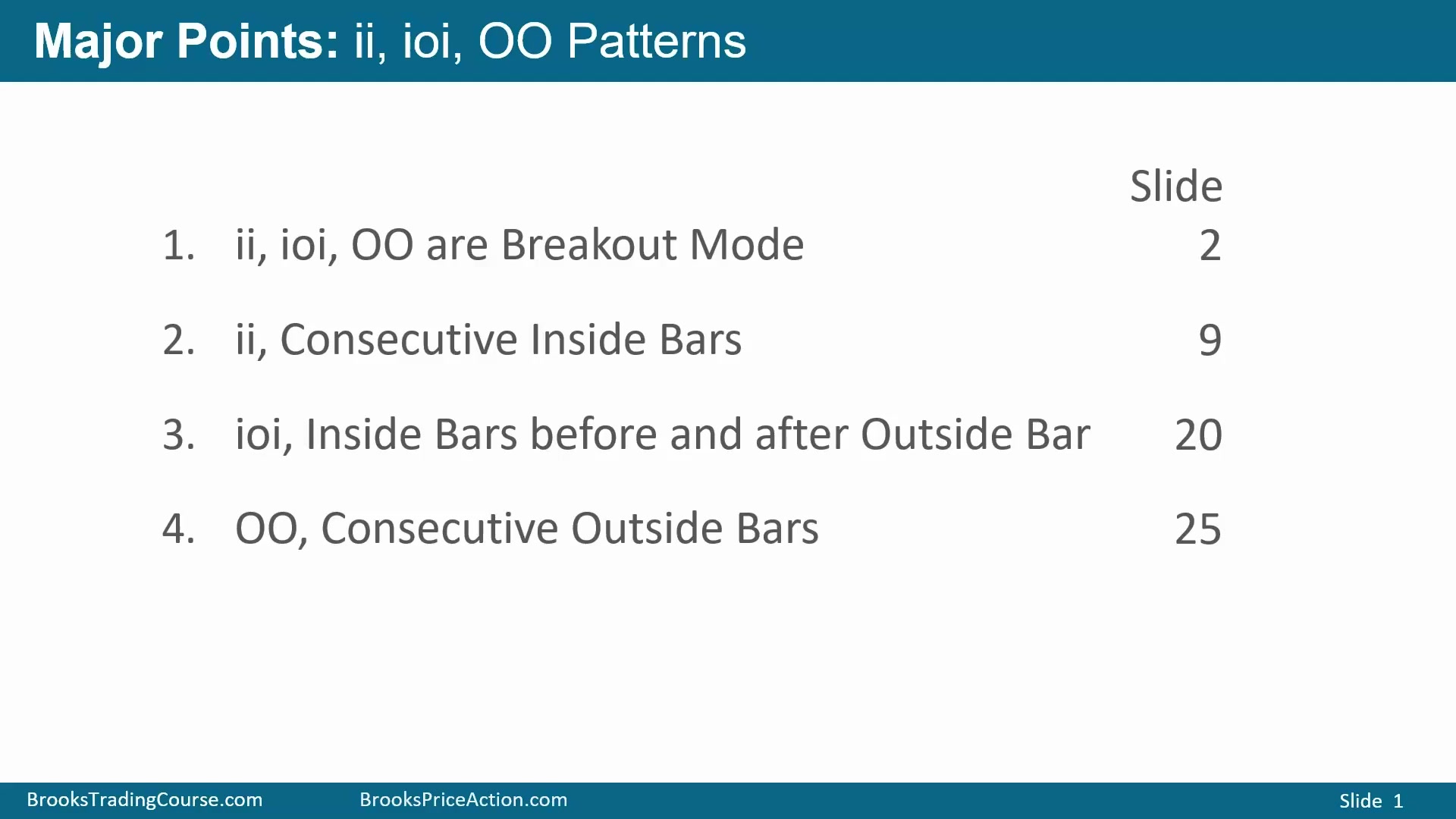
EN: Today I’m going to be talking about three relatively common small chart patterns:

00:11 - 00:16

EN: ii, ioi, and OO patterns.

00:16 - 00:18

EN: In this video, the first of two videos,

00:18 - 00:21

EN: I’m going to define what I mean by those terms.

Slide 001

Time: 00:22

Slide 001

Bilingual Transcript

00:23 - 00:25

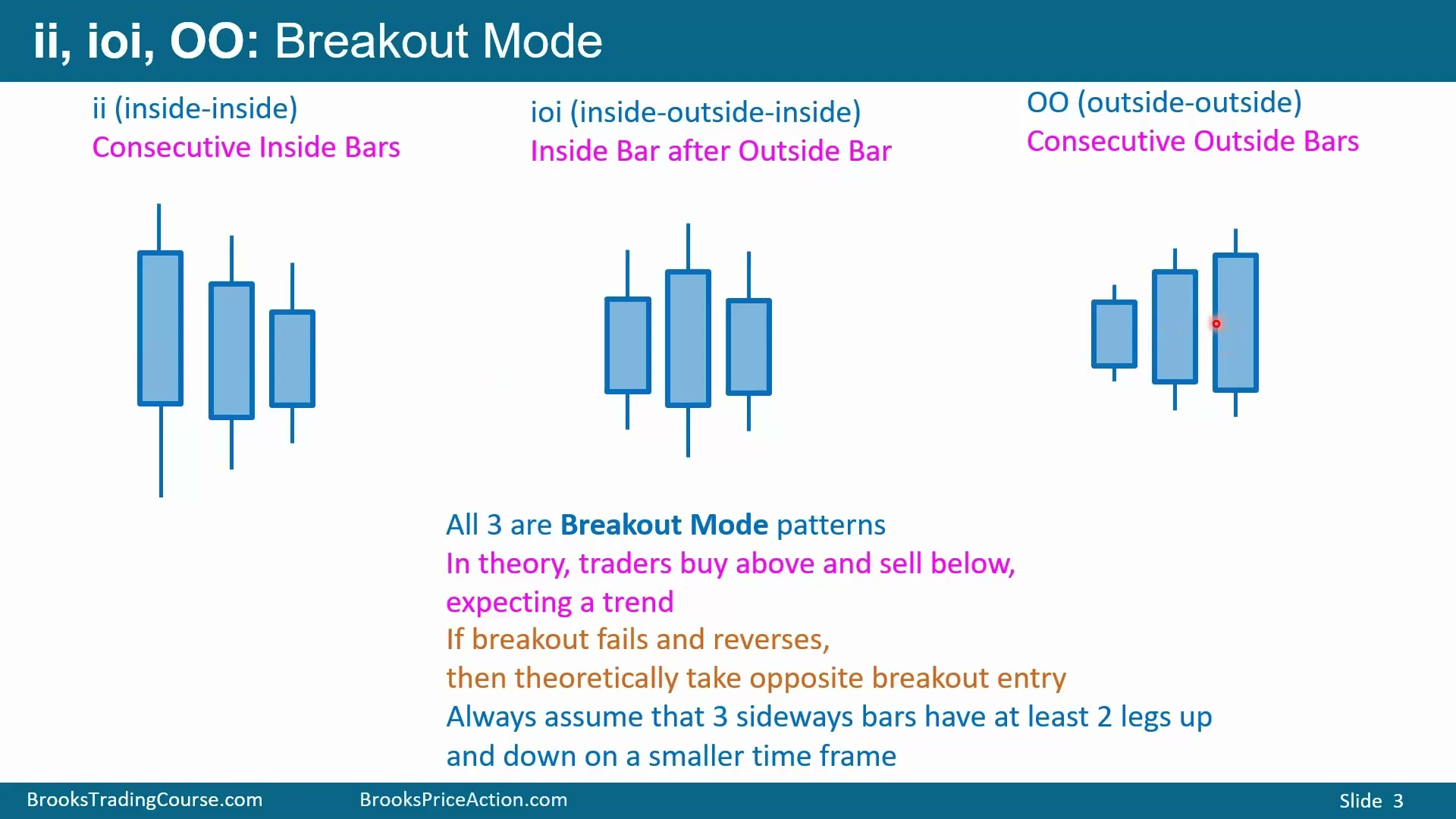
EN: All three are BreakOut Mode patterns.

00:25 - 00:27

EN: They’re all sideways bars.

00:27 - 00:31

EN: Traders are looking to enter on breakout, buy above or sell below,

00:31 - 00:34

EN: and if it goes one way and then the other way,

00:34 - 00:37

EN: theoretically a trader would take both trades.

00:37 - 00:40

EN: An ii is inside-inside.

00:40 - 00:42

EN: It’s consecutive Inside Bars.

00:42 - 00:47

EN: An Inside Bar is a bar whose high is at or below the high of the prior bar,

00:47 - 00:50

EN: and its low is at or above the low of the prior bar.

00:51 - 00:57

EN: Next I’ll talk about an ioi, which is an Outside Bar followed by an Inside Bar.

00:57 - 01:00

EN: By definition, if a bar is an Outside Bar,

01:00 - 01:02

EN: it has a high above the high of the prior bar

01:02 - 01:05

EN: and a low below the low of the prior bar,

01:05 - 01:08

EN: and therefore that prior bar is inside the Outside Bar.

01:08 - 01:13

EN: So it’s an Inside Bar, an Outside Bar, and then another Inside Bar.

01:13 - 01:18

EN: And finally, I’ll talk about OO, consecutive Outside Bars.

01:19 - 01:23

EN: An Outside Bar is the bar whose high is at or above the high of the prior bar

01:23 - 01:27

EN: and its low is at or above the low of the prior bar.

01:30 - 01:33

EN: I want to begin with an overview of the three patterns.

01:33 - 01:35

EN: Again, they’re BreakOut Mode.

01:35 - 01:37

EN: Traders are looking to enter on breakout,

01:37 - 01:40

EN: hoping that they are catching the start of a trend.

Slide 002

Time: 01:42

Slide 002

Bilingual Transcript

01:45 - 01:47

EN: On the left I have 3 bars.

01:47 - 01:51

EN: This bar is inside of that bar; that bar is inside of that bar.

01:51 - 01:55

EN: So it’s an Inside Bar, inside of another Inside Bar.

01:55 - 01:57

EN: Consecutive Inside Bars, or ii.

01:58 - 02:02

EN: Next I have an Outside Bar followed by an Inside Bar,

02:02 - 02:06

EN: so there’s an Inside Bar, an Outside Bar, and an Inside Bar.

02:06 - 02:10

EN: Any time you have an Outside Bar, the bar before is an Inside Bar.

02:11 - 02:15

EN: And finally, I have 3 bars and the bars are getting bigger.

02:15 - 02:18

EN: The high of this bar is at or above the high of that bar;

02:18 - 02:21

EN: the low of this bar is at or below the low of that bar.

02:21 - 02:25

EN: It’s an Outside Bar, and it’s followed by a second consecutive Outside Bar.

02:27 - 02:29

EN: These are BreakOut Mode patterns.

02:29 - 02:34

EN: Theoretically a trader buys above and sells below, expecting a trend.

02:38 - 02:41

EN: If the breakout fails and reverses,

02:41 - 02:43

EN: theoretically a trader would take the opposite breakout.

02:43 - 02:48

EN: So for example, if a person bought on a stop above the high of the ii

02:48 - 02:51

EN: and then the market turned down and broke below the bottom of the ii,

02:52 - 02:53

EN: a trader would short.

02:53 - 02:56

EN: So he’d buy above the ii and sell

02:56 - 02:58

EN: if it fell below the lower of the two bars of the ii.

03:00 - 03:05

EN: Whenever you look at a 3-bar pattern like this, a sideways pattern like that,

03:05 - 03:09

EN: always assume that there are at least two legs up

03:09 - 03:12

EN: and two legs down on a smaller timeframe.

03:12 - 03:17

EN: Typically, an ii pattern is a Triangle on a smaller timeframe,

03:17 - 03:22

EN: and an OO pattern is an Expanding Triangle on a smaller timeframe.

03:22 - 03:26

EN: A Triangle has three pushes one way and two the other way.

Slide 003

Time: 03:28

Slide 003

Bilingual Transcript

03:31 - 03:33

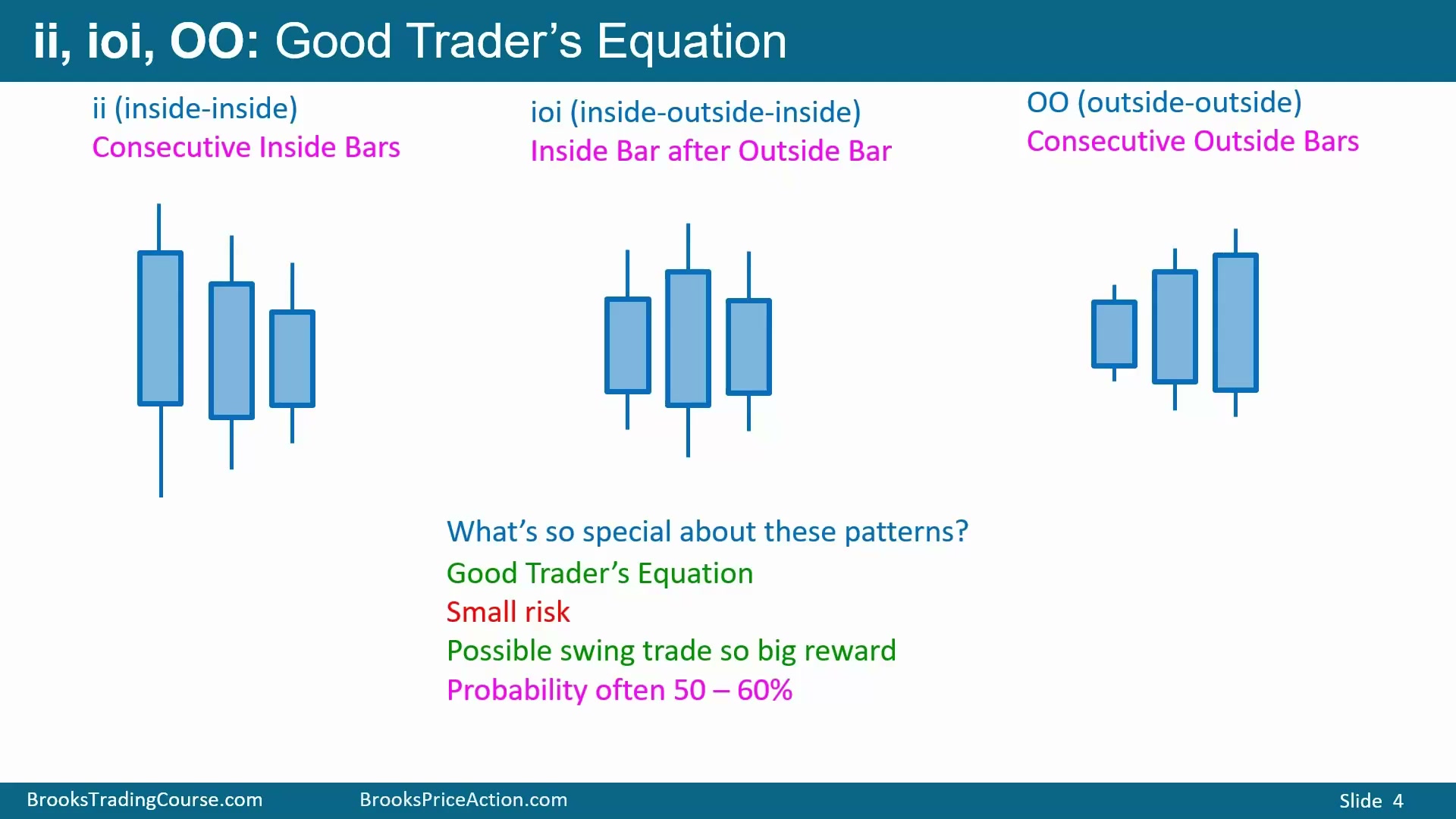
EN: Now, what’s so special about these patterns?

03:33 - 03:35

EN: Why am I talking about them?

03:37 - 03:41

EN: Well, the most important reason is they all have a good Trader’s Equation.

03:41 - 03:45

EN: If you think about it, if you buy above the high of this bar

03:45 - 03:48

EN: and your stop is below the low of the ii,

03:48 - 03:51

EN: the lower of the two ii bars, the risk is small.

03:51 - 03:56

EN: You’re buying here and your stop is here or below here.

03:56 - 04:00

EN: Not much risk if you’re looking for a move that could last 10 or 20 bars.

04:00 - 04:05

EN: So very good risk/reward, and the probability is pretty good.

04:05 - 04:07

EN: Any time you have a BreakOut Mode pattern,

04:07 - 04:13

EN: in general the probability that a breakout will succeed or fail is about 50%.

04:13 - 04:16

EN: So 50% chance if it goes above the ii,

04:16 - 04:19

EN: 50% chance it’ll keep going up enough for a swing,

04:19 - 04:22

EN: 50% chance it’ll reverse down and go below.

04:22 - 04:26

EN: And if it breaks below, 50% chance it’ll go down for a swing.

04:26 - 04:29

EN: And sometimes if the pattern is especially good

04:29 - 04:32

EN: – good context (the bars to the left),

04:32 - 04:36

EN: a good signal bar – the probability can be as high as 60%.

04:36 - 04:40

EN: So for example, if you have any of these patterns after a Sell Climax,

04:40 - 04:45

EN: it often is a very good buy if the third bar is a bull bar closing on its high.

04:45 - 04:50

EN: And if it’s coming at the end of a Buy Climax, especially if there’s resistance,

04:50 - 04:55

EN: like a Double Top, then if you have a third bar closing on its low,

04:55 - 04:56

EN: it’s a higher probability sell.

04:56 - 05:00

EN: In those instances, the probability could be 60% that you’ll get a swing trade.

Slide 004

Time: 05:04

Slide 004

Bilingual Transcript

05:05 - 05:07

EN: Some examples.

05:07 - 05:08

EN: This is a bear bar.

05:08 - 05:10

EN: Open here, close here.

05:10 - 05:10

EN: This is a bull bar.

05:10 - 05:12

EN: Open here, close there.

05:16 - 05:21

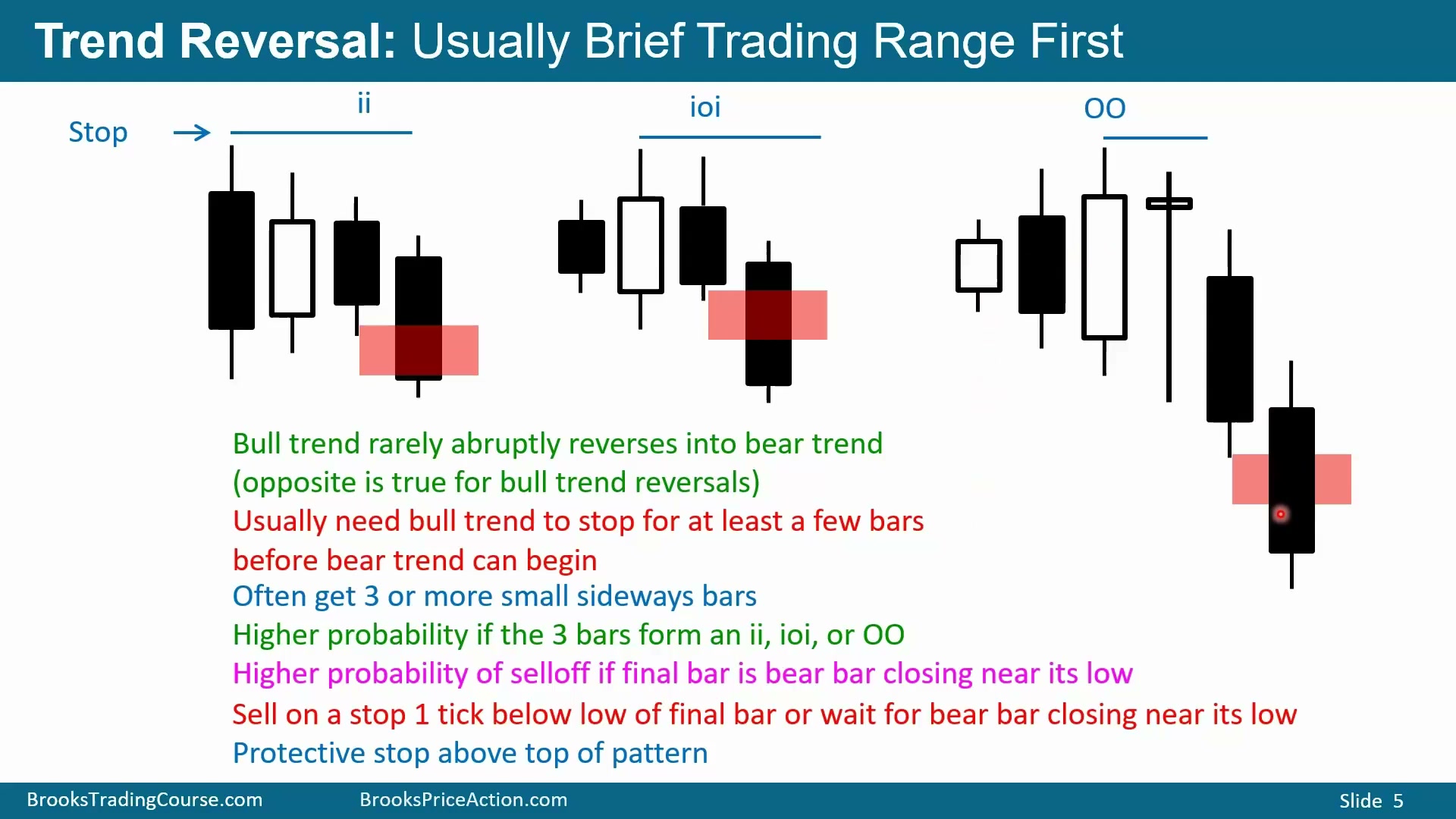
EN: A bull trend rarely abruptly reverses into a bear trend.

05:21 - 05:24

EN: Opposite is true for a bull trend reversal.

05:24 - 05:28

EN: A bear trend rarely immediately, instantly reverses into a bull trend.

05:28 - 05:31

EN: Normally a bull trend has to stop going up,

05:31 - 05:34

EN: at least for a few bars, before a bear trend can begin.

05:34 - 05:38

EN: And sometimes it stops going up and goes sideways for a few bars

05:38 - 05:40

EN: and creates one of these patterns.

05:44 - 05:49

EN: Sometimes you get more than 3 bars, but I’m talking today about 3-bar patterns.

05:50 - 05:54

EN: It’s higher probability if you’re looking to sell

05:54 - 05:57

EN: and you have a bear bar closing on or near its low.

05:57 - 05:59

EN: You’d sell below the low of that bar.

05:59 - 06:01

EN: Here, ioi.

06:01 - 06:03

EN: Inside-outside-inside.

06:03 - 06:06

EN: You sell on a stop 1 tick below the low of that bar.

06:06 - 06:11

EN: If it’s a Forex market, you sell 1 pip below the low of that bar.

06:11 - 06:13

EN: It doesn’t matter on the timeframe.

06:13 - 06:15

EN: This applies to all timeframes.

06:15 - 06:17

EN: Outside Bar, bigger Outside Bar.

06:17 - 06:20

EN: Theoretically, you sell below the low of that bar.

06:20 - 06:23

EN: But in general, selling below a big bull bar

06:23 - 06:26

EN: is not a particularly high probability thing to do.

06:26 - 06:29

EN: In this case, it’s probably better to wait

06:29 - 06:31

EN: until you have a bear bar closing near its low

06:31 - 06:33

EN: and then sell on a stop below that bear bar.

06:39 - 06:40

EN: Here are examples.

06:40 - 06:43

EN: You’d sell on a stop 1 tick below that bar

06:43 - 06:46

EN: and put a stop either above the top of the ii,

06:46 - 06:50

EN: the higher of the 2 bars, or the top of the move.

06:50 - 06:54

EN: So if this is a bull trend and you reverse down and get an ii,

06:54 - 06:57

EN: you could put a stop just above the top of the bull trend

06:57 - 06:59

EN: since it’s not much above that.

06:59 - 07:02

EN: So you’re risking a little bit more and you’re getting higher probability.

07:04 - 07:06

EN: Same thing here, ioi.

07:06 - 07:08

EN: You’d sell on a stop 1 tick below that bar

07:08 - 07:13

EN: – if it’s a Forex market, 1 pip below that bar – and put a stop above the high.

07:14 - 07:16

EN: And then here, an OO.

07:16 - 07:18

EN: Let’s say it’s coming in a bull trend.

07:19 - 07:22

EN: If you sell here, below that bear bar,

07:22 - 07:26

EN: you could put a stop above the bear bar, but this is not much higher.

07:26 - 07:31

EN: It’s probably better to put the stop above the top of the bull trend.

07:31 - 07:33

EN: We’re assuming this is a bull trend.

07:33 - 07:36

EN: We got the OO and then a reversal down.

Slide 005

Time: 07:39

Slide 005

Bilingual Transcript

07:41 - 07:44

EN: Now, I said BreakOut Mode patterns in general,

07:44 - 07:49

EN: 50% chance the breakout will succeed, 50% chance it’ll reverse.

07:49 - 07:54

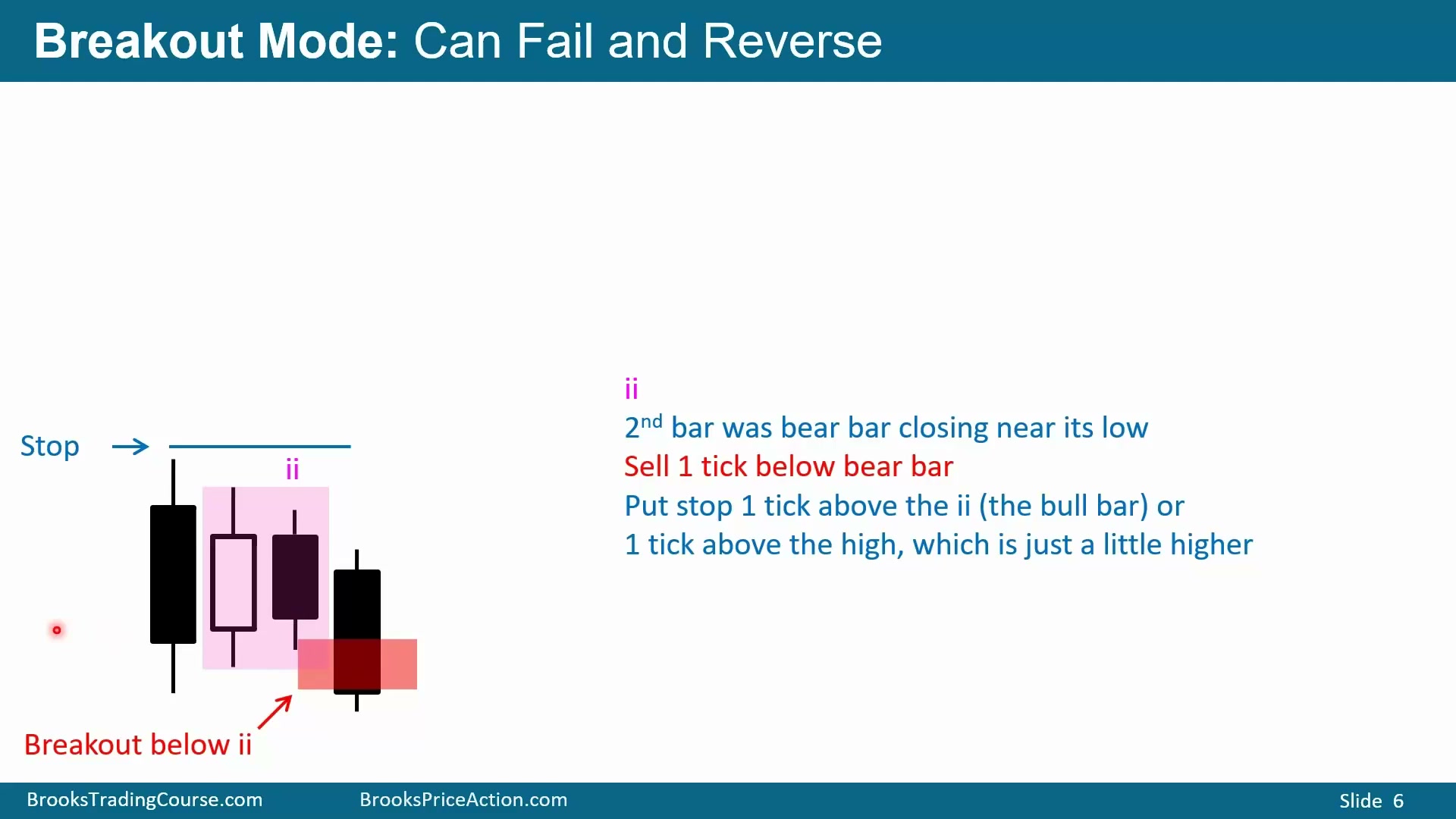
EN: Here we have an ii, and we have a bear bar closing on its low,

07:54 - 07:57

EN: so it’s reasonable to look to sell below the low of the bar.

07:57 - 08:01

EN: That’s assuming that this is occurring either in a bull trend or a bear trend.

08:02 - 08:05

EN: It’s much less reliable to trade any of these patterns

08:05 - 08:07

EN: if the market is sideways in a tight range.

08:11 - 08:14

EN: A trader would place an order to sell 1 tick below the low

08:14 - 08:17

EN: of that bear bar closing on or near its low.

08:17 - 08:18

EN: Here it’s in the lower third.

08:18 - 08:24

EN: He’d get filled here, and he’d put a stop either 1 tick above the ii,

08:24 - 08:27

EN: the higher of the 2 bars, or 1 tick above the top of the move,

08:27 - 08:28

EN: which would be up here.

Slide 006

Time: 08:30

Slide 006

Bilingual Transcript

08:34 - 08:37

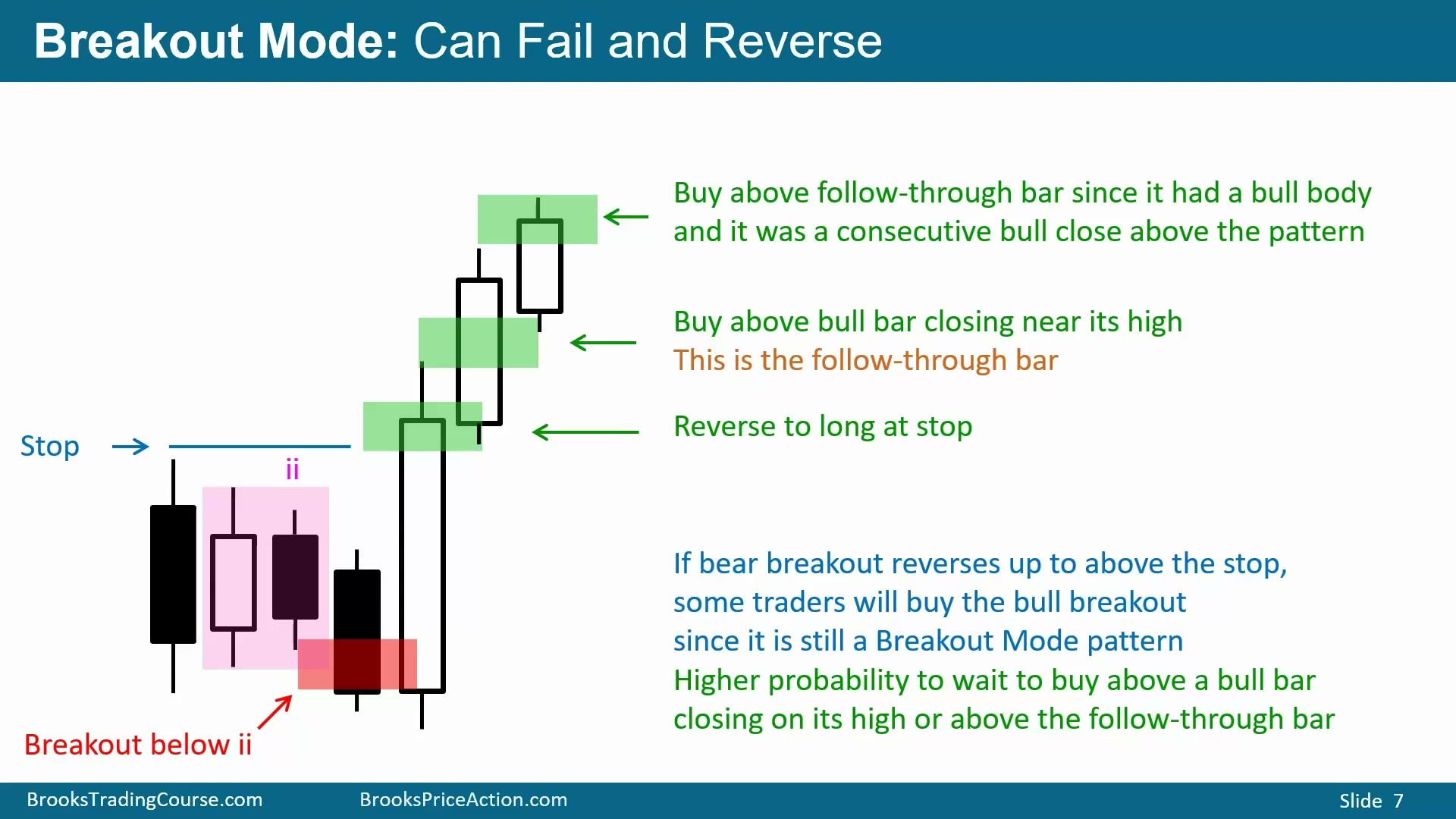
EN: If the market reverses abruptly like that,

08:37 - 08:42

EN: he would get stopped out of his short either above that or above this,

08:42 - 08:45

EN: and then he’d have to consider going long.

08:45 - 08:47

EN: It’s still a BreakOut Mode pattern.

08:47 - 08:50

EN: It’s a bear breakout that failed, and now we’re having a bull breakout.

08:50 - 08:53

EN: Theoretically, a trader could buy on a stop 1 tick above the bull bar

08:53 - 08:59

EN: or 1 tick above the high, assuming this is a rally and then we have a high.

08:59 - 09:03

EN: Or he could wait and buy above the high of the Outside Up bar.

09:03 - 09:08

EN: This is big bull Outside Up bar, a bull bar closing on or near its high.

09:08 - 09:10

EN: He could buy on a stop above that.

09:10 - 09:11

EN: Here’s the follow-through bar.

09:11 - 09:15

EN: He could buy on a stop above the high of the follow-through bar.

09:18 - 09:23

EN: If a bear shorted here, he could reverse to long above that or above the ii here.

09:25 - 09:28

EN: Higher probability if you get consecutive bull bars.

09:28 - 09:31

EN: We have a close above the top of the trend,

09:31 - 09:35

EN: assuming this was a bull trend, which is good for the bulls.

09:35 - 09:39

EN: You can buy on a stop above that bar or you can buy on a stop above the high

09:39 - 09:42

EN: of the follow-through bar,

09:42 - 09:44

EN: especially when you have a pretty good follow-through bar.

09:44 - 09:45

EN: This is an example of that.

09:46 - 09:48

EN: You have a good follow-through bar, you have consecutive,

09:48 - 09:53

EN: decent-size bull bars closing on their highs, both closing above the pattern.

09:53 - 09:57

EN: Higher probability to sell on a stop above the high of this follow-through bar.

09:57 - 09:58

EN: You’d get filled over here.

09:59 - 10:01

EN: High probability, stop further away.

10:01 - 10:03

EN: But that’s always the tradeoff.

10:03 - 10:08

EN: Whenever you get a higher probability trade, the risk/reward is going to be worse.

10:08 - 10:14

EN: There’s less room for profit because more of the move has already taken place

10:14 - 10:15

EN: and the stop is further away.

10:20 - 10:25

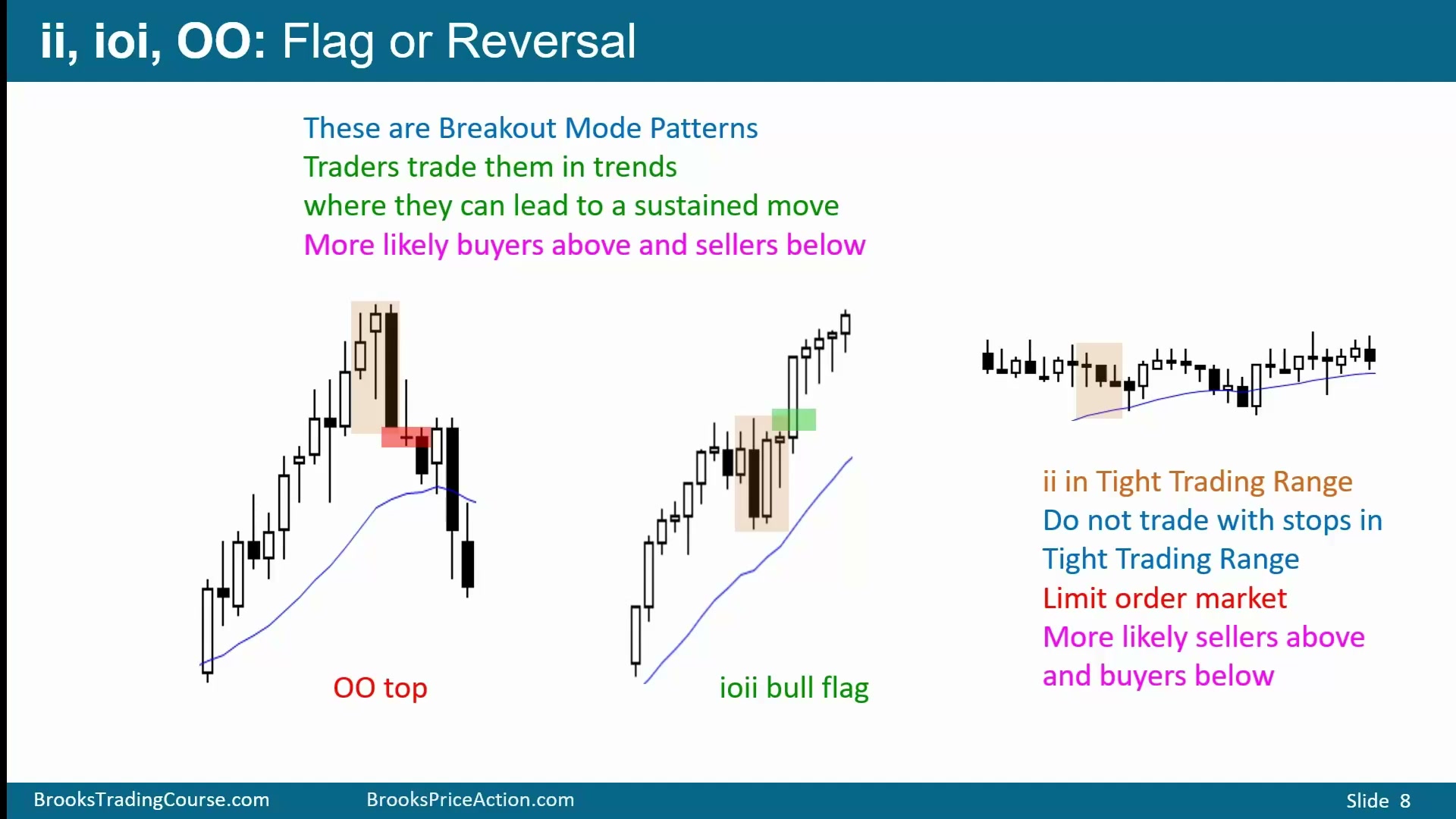
EN: ii, ioi, OO patterns are BreakOut Mode patterns.

Slide 007

Time: 10:20

Slide 007

Bilingual Transcript

10:26 - 10:28

EN: Traders look to trade them in trends.

10:28 - 10:30

EN: They want sustained moves.

10:30 - 10:33

EN: They want a market where there probably are traders

10:33 - 10:36

EN: entering with stops above or below.

10:36 - 10:41

EN: Therefore, they’re looking for reversal patterns or flags.

10:41 - 10:43

EN: For example, here we have a bull trend

10:43 - 10:48

EN: and then we have an OO pattern (Outside Bar, Outside Bar).

10:48 - 10:52

EN: Traders look for either a resumption of the bull trend above

10:52 - 10:57

EN: – in other words, a bull flag – or a top, a reversal below.

10:57 - 11:00

EN: In this case they’ll look to sell below the bear bar on a stop

11:00 - 11:04

EN: 1 tick below the bar, and they did get their reversal.

11:04 - 11:05

EN: So OO.

11:05 - 11:07

EN: It could’ve been a bull flag.

11:07 - 11:09

EN: In this case, it was a top.

11:10 - 11:14

EN: And here, we have an ioi pattern.

11:14 - 11:17

EN: There’s an Inside Bar after an Outside Bar.

11:17 - 11:19

EN: It’s coming in a trend.

11:19 - 11:22

EN: The market broke above and we got more trend.

11:22 - 11:33

EN: Here, we have an ioi, but also a second Inside Bar, so it’s both an ioi and an ii.

11:33 - 11:36

EN: You could call it an ioii.

11:36 - 11:37

EN: That’s what I would call it.

11:37 - 11:40

EN: Traders will enter with a stop above or below.

11:41 - 11:44

EN: In general, if you have bull bars closing near their highs

11:44 - 11:48

EN: at the end of the pattern, traders will be more interested in buying above.

11:48 - 11:51

EN: And if you have a bear bar as the third bar in the pattern,

11:51 - 11:56

EN: especially a strong bear bar, traders will be more interested in selling below,

11:56 - 11:58

EN: less interested in buying above.

11:59 - 12:04

EN: These are trend patterns, either for trend reversal or trend continuation.

12:05 - 12:07

EN: They are not limit order patterns.

12:07 - 12:09

EN: Here we have consecutive Inside Bars.

12:09 - 12:13

EN: We have 3 of them, but they’re coming in a Tight Trading Range.

12:13 - 12:16

EN: This is a Limit Order Market, not a stop order market.

12:16 - 12:19

EN: A stop order market, if you sell below a bar,

12:19 - 12:23

EN: you’re expecting a series of bars down below, like we have over here.

12:23 - 12:25

EN: You’re looking for a trend.

12:25 - 12:29

EN: In a Limit Order Market, you’re expecting more buyers

12:29 - 12:31

EN: below bars and more sellers above bars.

12:31 - 12:34

EN: It’s a Limit Order Market, and therefore,

12:34 - 12:37

EN: you should not be trading with stops in a Tight Trading Range.

12:37 - 12:40

EN: Any of these patterns – this is an ii, but any of these patterns,

12:40 - 12:43

EN: if they’re coming in a Tight Trading Range,

12:43 - 12:47

EN: especially where the bars are very small and the bodies are very small,

12:47 - 12:49

EN: it’s better not to trade them.

12:49 - 12:51

EN: So yes, we have an ii.

12:51 - 12:53

EN: In fact, we have an iii, 3 Inside Bars.

12:53 - 12:56

EN: We have a bear bar closing near its low.

12:56 - 12:57

EN: We have another bear bar here.

12:57 - 13:01

EN: But the bars are all small and they’re coming in a Tight Trading Range.

13:01 - 13:03

EN: This is a Limit Order Market.

13:03 - 13:07

EN: There probably will be more buyers below that bear bar than sellers.

13:08 - 13:12

EN: A Limit Order Market is a market where traders look to buy

13:12 - 13:16

EN: at the low of the prior bar and buy more lower, and then scalp out,

13:16 - 13:20

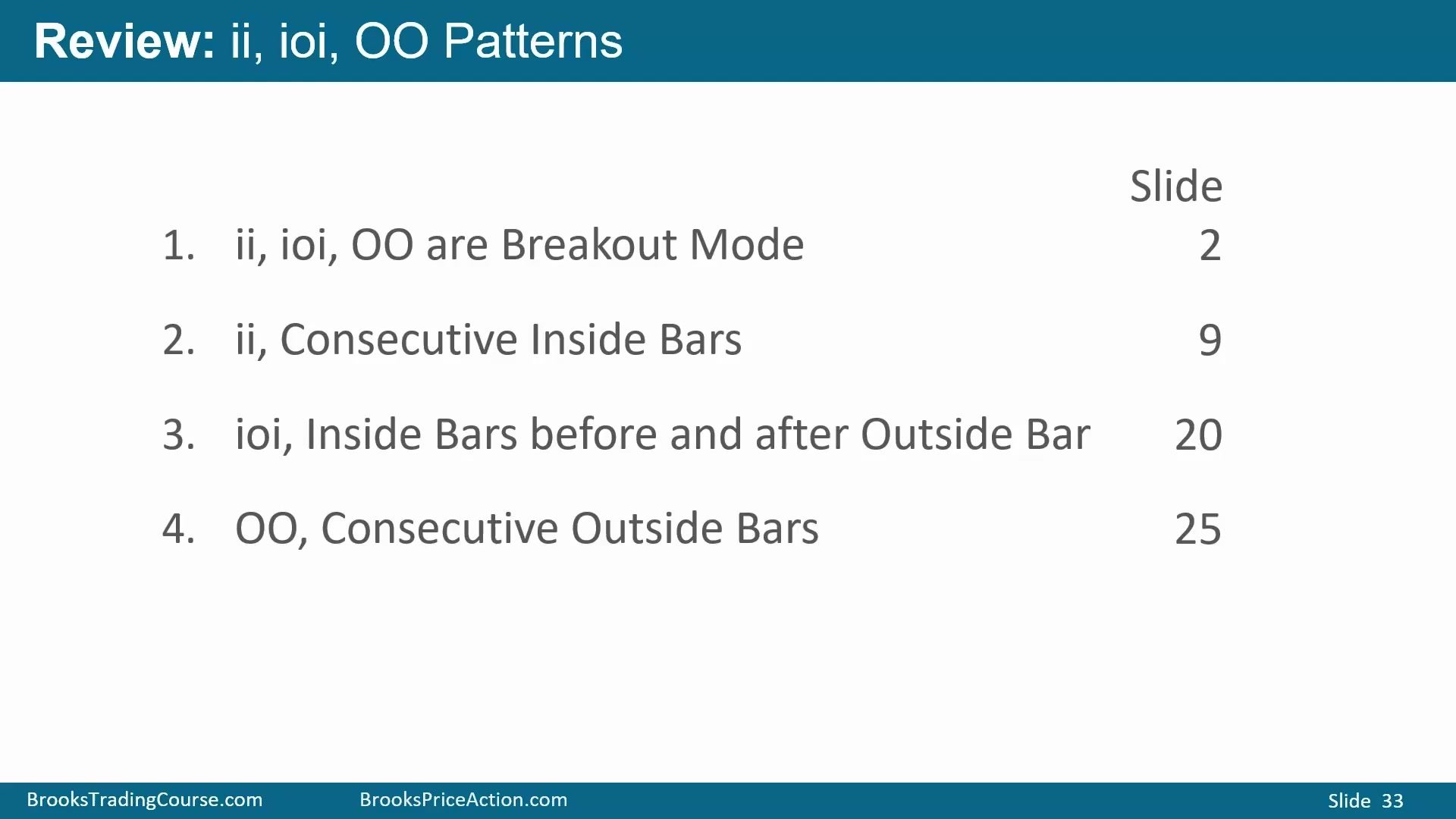
EN: and they sell above the high of the prior bar and sell more higher,

13:20 - 13:22

EN: and then scalp out.

13:22 - 13:27

EN: This is not the kind of pattern where traders should be entering with stops.

13:27 - 13:31

EN: So if you see any of these patterns in a Tight Trading Range,

13:31 - 13:35

EN: it’s better not to trade them with stops, and wait for some other pattern.

13:35 - 13:38

EN: It’s better to wait for a strong breakout up or down,

13:38 - 13:40

EN: or for a breakout that reverses,

13:40 - 13:44

EN: so an upside breakout that reverses, and then maybe sell that.

13:44 - 13:47

EN: Or a downside breakout that reverses, maybe buy that.

13:47 - 13:49

EN: Or a very strong downside breakout,

13:49 - 13:52

EN: and then start to sell because then it’s a bear trend.

13:52 - 13:58

EN: Or an upside breakout, then look to buy because then it’s a bull trend.

14:03 - 14:06

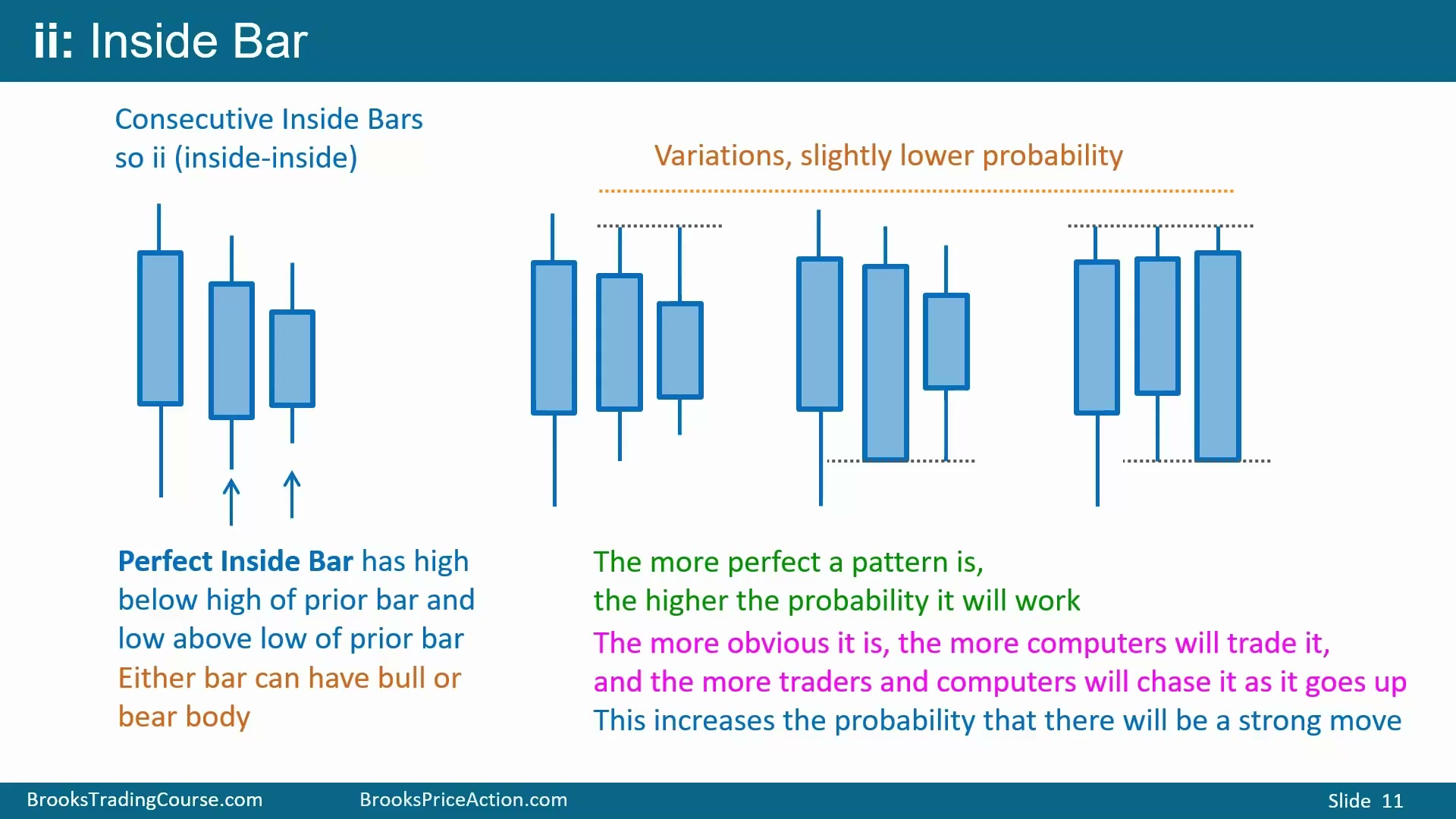
EN: Consecutive Inside Bars (ii).

Slide 008

Time: 14:08

Slide 008

Bilingual Transcript

14:09 - 14:11

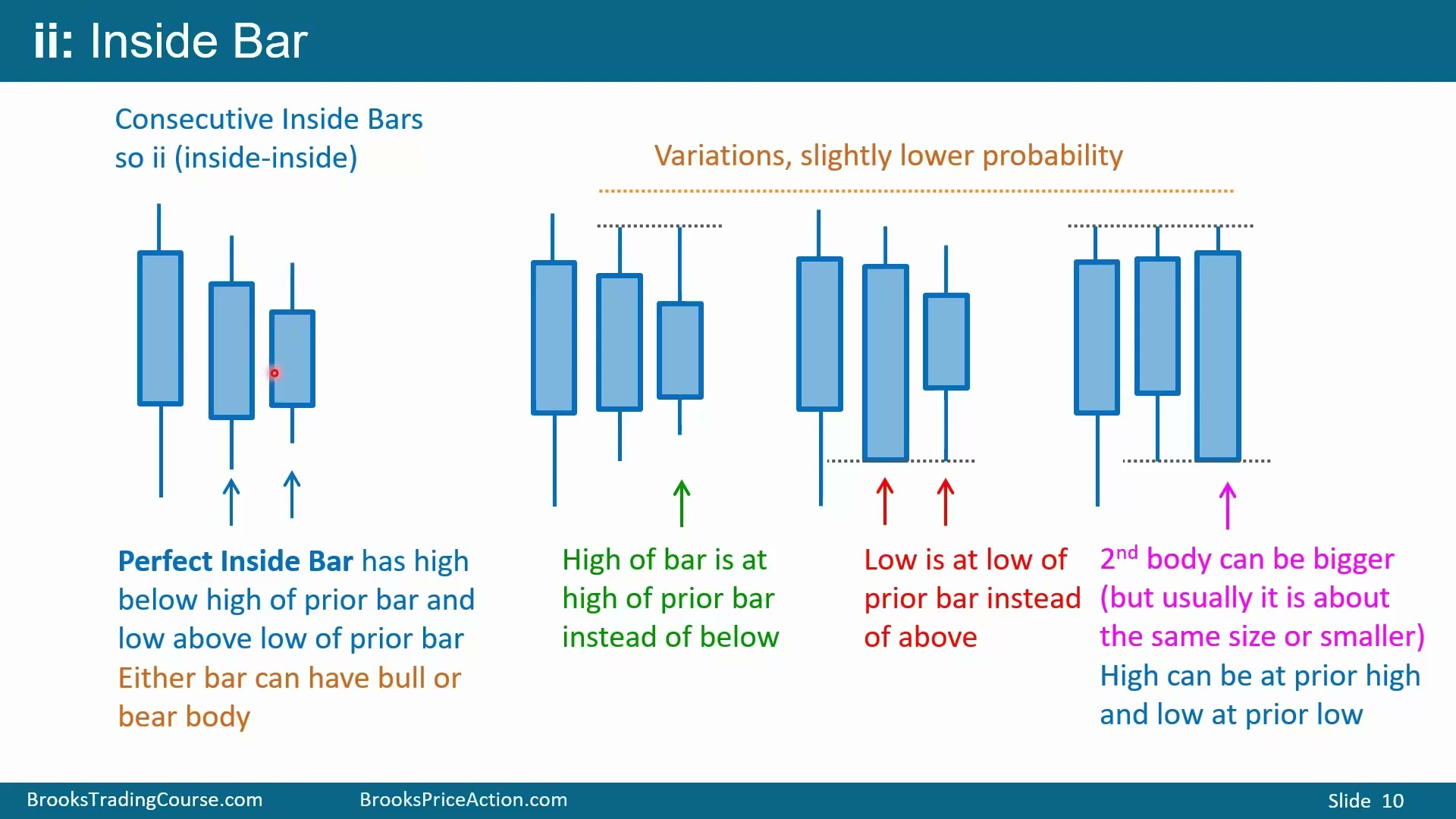
EN: This bar is inside of that bar.

14:11 - 14:12

EN: This bar is inside of that bar.

14:12 - 14:15

EN: So ii, inside-inside.

14:18 - 14:21

EN: These are what I would call perfect Inside Bars.

14:21 - 14:25

EN: Remember I said that an Inside Bar has its low at

14:25 - 14:27

EN: or above the low of the prior bar.

14:27 - 14:29

EN: If it’s above, I call it perfect.

14:29 - 14:31

EN: So this is a perfect Inside Bar.

14:31 - 14:35

EN: Here’s the second one, low above that low, not at that low;

14:35 - 14:38

EN: high below that low, not at that high.

14:39 - 14:44

EN: Perfect Inside Bars have a higher probability of leading to a profitable trade.

14:46 - 14:49

EN: Here are some variations of an ii pattern.

14:49 - 14:51

EN: This bar is inside of that bar,

14:51 - 14:54

EN: and I would say this one is inside of that bar as well.

14:55 - 14:59

EN: High of the bar is at that high, and the low is above that low,

14:59 - 15:02

EN: so I would still call this an ii,

15:02 - 15:05

EN: but I think it’s a little bit less reliable than a perfect pattern

15:05 - 15:09

EN: where the highs are lower and the lows are higher.

15:13 - 15:14

EN: Another example.

15:14 - 15:18

EN: So instead of the two Inside Bars having identical highs,

15:18 - 15:20

EN: here the two Inside Bars have identical lows.

15:25 - 15:30

EN: And then here’s an example where all three bars have the same high,

15:30 - 15:32

EN: and the two ii bars have the same low.

15:32 - 15:37

EN: The two Inside Bars have identical highs and identical lows, but they’re still ii.

15:38 - 15:40

EN: The body can be bigger,

15:41 - 15:45

EN: but usually if you’re getting shrinking bars, you’ll get shrinking bodies.

15:45 - 15:52

EN: So more often than not, the body is the same size as the second bar or smaller.

15:52 - 15:55

EN: This would be unusual to have a bigger second body.

15:56 - 16:01

EN: In these examples, I’m not showing whether the bodies are bull or bear bodies.

16:01 - 16:02

EN: It doesn’t matter.

16:02 - 16:05

EN: In terms of what I’m explaining here, the bodies don’t matter.

16:05 - 16:09

EN: But as I said, if you’re looking to buy, it’s better if the third bar,

16:09 - 16:13

EN: the second bar of the ii, closes at or near its high.

16:13 - 16:14

EN: If you’re looking to sell,

16:14 - 16:18

EN: it’s better if it has a bear body and it closes at or near its low.

16:24 - 16:27

EN: In general, the more perfect a pattern is,

Slide 009

Time: 16:25

Slide 009

Bilingual Transcript

16:27 - 16:30

EN: the higher the probability that you’ll get a profitable trade.

16:31 - 16:37

EN: If you have a perfect ii, Lower Highs, Higher Lows, and you’re looking to sell,

16:37 - 16:41

EN: and this bar closes on or near its low, it would be a higher probability sell

16:41 - 16:44

EN: than if it had let’s say a bull body.

16:48 - 16:52

EN: The more obvious a pattern, the more perfect it is,

16:52 - 16:55

EN: the more computers will recognize it, the more computers will trade it,

16:55 - 16:59

EN: the more traders will trade it, and the more traders and computers

16:59 - 17:04

EN: will chase it as it goes up, if we’re talking about buys in these examples.

17:04 - 17:06

EN: For sells, it would be the opposite.

17:06 - 17:09

EN: If everybody sees it and it starts to go down

17:09 - 17:13

EN: and you start to get a series of bear bars closing on their lows, that’s perfect.

17:13 - 17:17

EN: You’ll get more and more traders willing to sell as it goes down.

17:17 - 17:21

EN: It increases the probability that you’ll make a good profit.

17:25 - 17:27

EN: A bull bar, bear bar, bull bar.

Slide 010

Time: 17:25

Slide 010

Bilingual Transcript

17:27 - 17:29

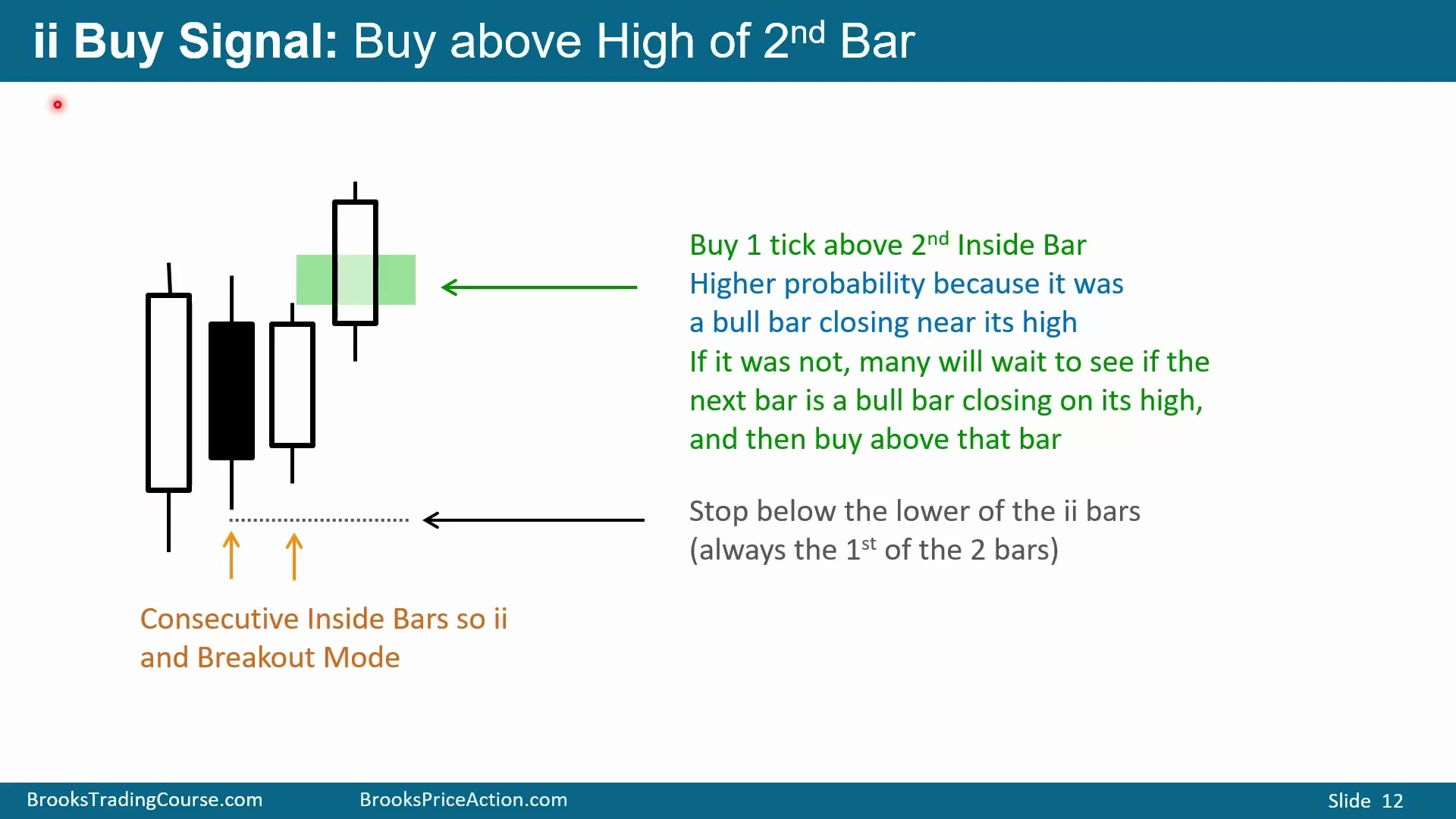
EN: Consecutive Inside Bars, and they’re perfect.

17:29 - 17:34

EN: This low is above that low, this low is above that low, and we have Lower Highs.

17:34 - 17:36

EN: We have a bull bar closing near its high.

17:37 - 17:40

EN: It doesn’t matter if this is a bull trend; this would be a bull flag.

17:40 - 17:44

EN: If it was a bear trend, it could be a reversal up,

17:44 - 17:47

EN: and you’d buy above the high of that bar.

17:51 - 17:55

EN: Place a stop to enter 1 tick above the high of the second bar.

17:55 - 18:01

EN: As I said before, if this second bar of the ii had a bear body

18:01 - 18:06

EN: and it breaks out above, it’s higher probability to wait to see if the entry bar

18:06 - 18:10

EN: is a bull bar closing on its high and then buy above the entry bar.

18:10 - 18:13

EN: It’s higher probability buying above bull bars,

18:13 - 18:16

EN: especially bull bars closing at or near their highs.

18:19 - 18:22

EN: The stop theoretically is below the ii.

18:22 - 18:26

EN: If this is coming in a bear trend and we get the ii,

18:26 - 18:29

EN: you could put the stop here or below the low of the bear trend.

18:29 - 18:32

EN: Remember, if it goes above the ii, it’s a buy.

18:32 - 18:35

EN: If it goes below the lower of the two bars, it’s a sell.

18:35 - 18:39

EN: So theoretically, you could exit below the bear bar

18:39 - 18:41

EN: or you could go short below the bear bar,

18:41 - 18:44

EN: or you could exit or go short below the bottom of the trend,

18:44 - 18:47

EN: assuming this ii is coming in a bear trend.

Slide 011

Time: 18:50

Slide 011

Bilingual Transcript

18:52 - 18:56

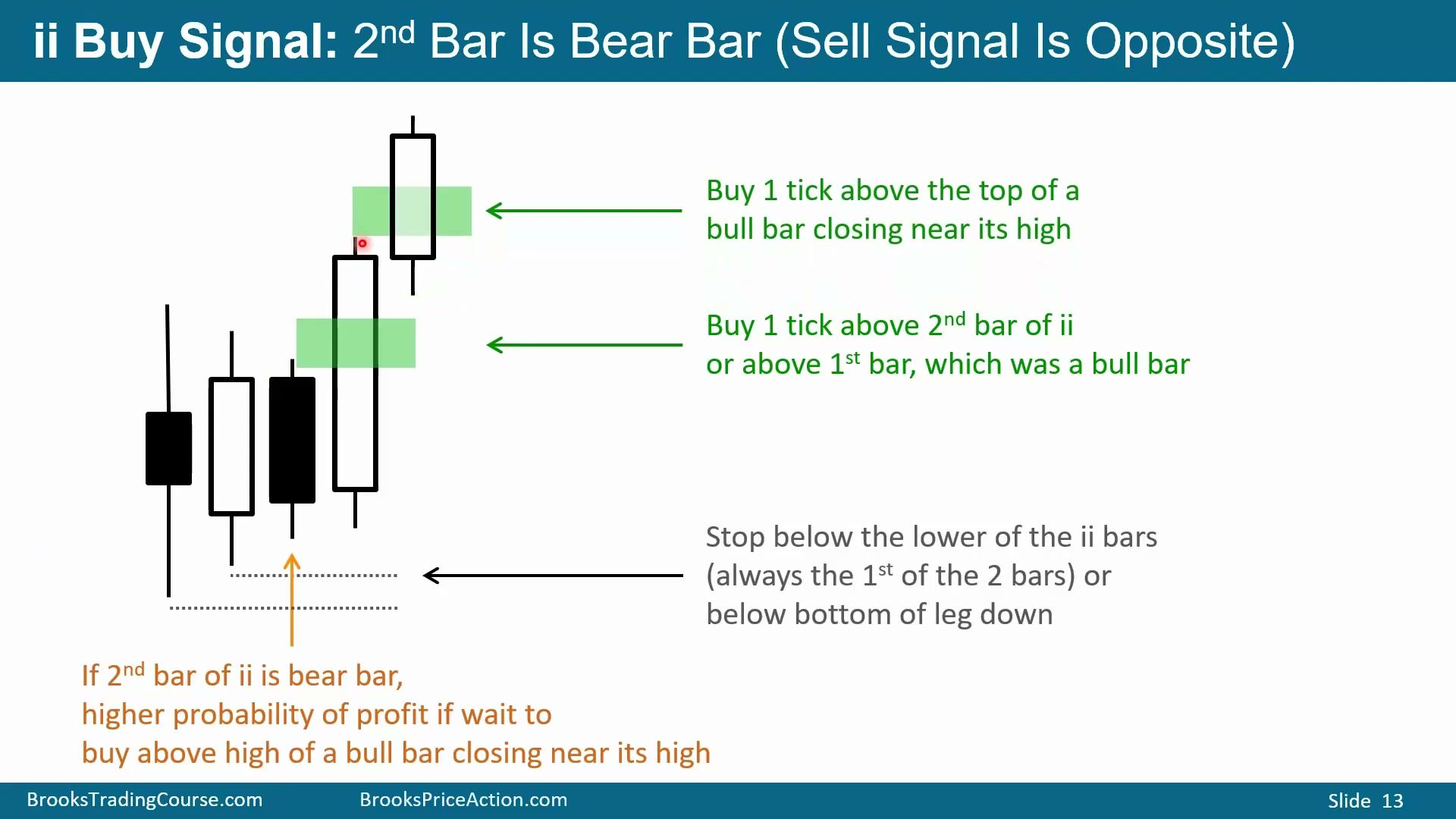
EN: I mentioned a few minutes ago, if you are breaking above an ii

18:56 - 19:01

EN: and the second Inside Bar is a bear bar, it’s still a buy above that bar.

19:01 - 19:03

EN: Some traders will buy above a bull bar.

19:03 - 19:04

EN: This is a bull bar.

19:04 - 19:05

EN: They’d buy above that.

19:05 - 19:07

EN: Others would wait for the breakout bar,

19:07 - 19:11

EN: and if it’s a bull bar closing near its high, they’ll buy above that.

19:11 - 19:12

EN: That’s higher probability.

19:12 - 19:18

EN: The stop is further away, but the increased risk – that’s the price you pay

19:18 - 19:21

EN: to get higher probability, and that’s an okay thing to do.

19:23 - 19:26

EN: You could buy above the second Inside Bar,

19:29 - 19:33

EN: and you could put a stop either below the ii or, if this is a bear trend,

19:33 - 19:36

EN: you’d put the stop below the bottom of the bear trend.

19:38 - 19:43

EN: Higher probability, buy 1 tick or 1 pip above the high of a bull bar.

19:43 - 19:47

EN: In this case, the entry bar, the breakout bar, is a bull bar.

Slide 012

Time: 19:50

Slide 012

Bilingual Transcript

19:52 - 19:58

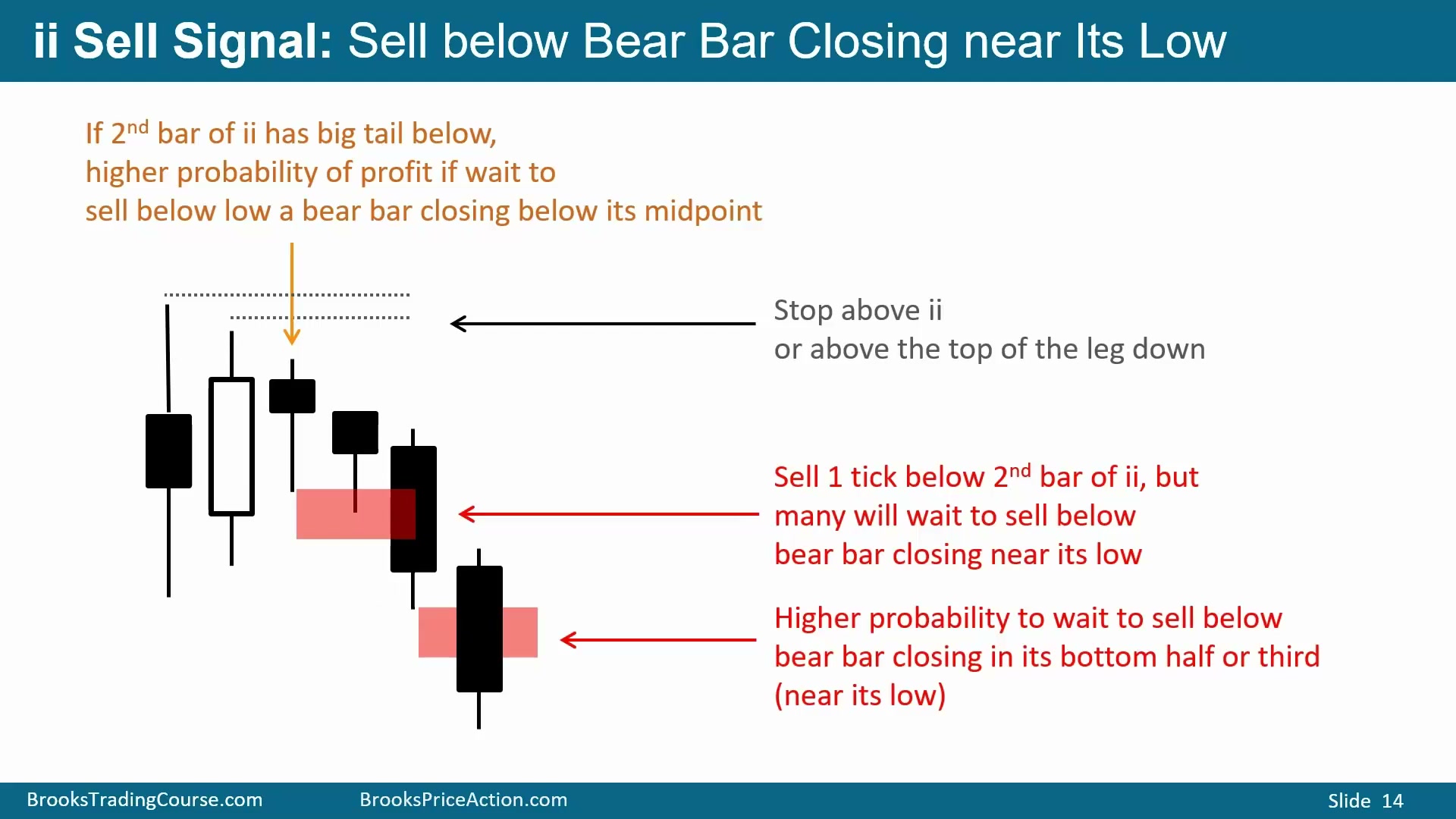
EN: Here we have an Inside Bar following an Inside Bar, and we’re breaking below it.

19:58 - 20:02

EN: But the close of the bar is above the midpoint of the bar,

20:02 - 20:05

EN: so that’s not a particularly strong sell signal bar

20:05 - 20:09

EN: because when we were down here, traders bought and it went up.

20:09 - 20:13

EN: It reduces the chances that a lot of traders will sell if it goes below that bar.

20:13 - 20:16

EN: And here’s another bar with a big tail below.

20:17 - 20:20

EN: Theoretically, you could sell on a stop below this bar,

20:20 - 20:22

EN: but a lot of traders prefer to sell below bear bars

20:22 - 20:27

EN: that close on or near their lows, so it’s higher probability to sell below this bar,

20:27 - 20:31

EN: 1 tick or 1 pip below that bar, and put the stop

20:31 - 20:34

EN: either above the ii or above the top of the pattern.

20:34 - 20:36

EN: So if this is a bull trend, you’d put the stop up here.

20:36 - 20:42

EN: If it’s a bear trend, then this is a bear flag and you’d put the stop above here.

20:46 - 20:51

EN: You could sell below the ii or, if you want higher probability

20:51 - 20:55

EN: – and many traders do – they’ll wait for a bear bar closing on or near its low,

20:55 - 20:59

EN: and they’ll sell below that bar and get filled over here.

Slide 013

Time: 21:03

Slide 013

Bilingual Transcript

21:04 - 21:07

EN: Here we have an ii, and what do you notice?

21:07 - 21:12

EN: Traded below the ii, triggering a sell, and in the same bar,

21:12 - 21:19

EN: it immediately went above the high of the ii, the first of the two Inside Bars.

21:19 - 21:20

EN: So what do you do?

21:20 - 21:23

EN: First of all, I don’t like to sell below a bull bar,

21:23 - 21:26

EN: but technically it’s okay to do that.

21:26 - 21:31

EN: If you did sell below the bull bar, you’d get filled here on your short.

21:31 - 21:35

EN: In the same bar, your stop would get hit, and that’s okay.

21:35 - 21:38

EN: You could reverse to long above that or you could wait

21:38 - 21:41

EN: for a bull bar closing near its high and get long above this.

21:42 - 21:45

EN: Here, in this case, we have the opposite.

21:45 - 21:49

EN: We have an ii where the second bar has a bull body.

21:49 - 21:52

EN: Only a small bull body, but a bull body.

21:52 - 21:55

EN: You could sell below the low of that bull bar.

21:55 - 21:58

EN: You could sell below this bar because it’s below the ii

21:58 - 22:02

EN: and it’s a bear bar closing near its low, or you could sell

22:02 - 22:05

EN: below the low of that bar, a bear bar closing on its low.

22:09 - 22:17

EN: We have 4 bars, and the second and third bar are consecutive Inside Bars – ii, ii.

22:19 - 22:21

EN: Now, I want you to look at this.

22:21 - 22:24

EN: Remember I said every ii, every ioi,

22:24 - 22:29

EN: every OO has at least some kind of a Double Top of a Double Bottom.

22:29 - 22:33

EN: Here we went down, we went up to the high of that bar,

22:33 - 22:36

EN: we came down to the close of that bar – at some point we were up

22:36 - 22:39

EN: at the high of this bar and then we closed down here.

22:39 - 22:43

EN: So in this particular case, we have a low and a Higher Low,

22:43 - 22:46

EN: so it doesn’t look like a Double Bottom, but it’s a type of Double Bottom,

22:46 - 22:47

EN: and we have two highs.

22:47 - 22:50

EN: So there’s a Double Top and a Double Bottom.

22:51 - 22:52

EN: In this case, same thing.

22:52 - 22:57

EN: We have a low, we have a second low, and we have a high and a second high.

22:57 - 23:02

EN: Remember I said that ii’s on smaller timeframes are usually Triangles.

23:02 - 23:06

EN: At a minimum, they’re going to be at least a Micro Double Top

23:06 - 23:10

EN: and a Micro Double Bottom, and that’s why I call it a BreakOut Mode pattern.

23:10 - 23:12

EN: It’s a small Trading Range.

23:15 - 23:19

EN: Micro Double Bottom, this low and that pullback

23:19 - 23:22

EN: to the close of the bar from the high of the bar.

23:24 - 23:25

EN: Micro Double Top.

23:25 - 23:29

EN: We went up here, down to the close, up here, down to the close.

23:33 - 23:37

EN: As I said, it’s probably a Triangle on a smaller timeframe.

23:37 - 23:40

EN: On this timeframe, there’s a Micro Double Top

23:40 - 23:42

EN: and a Micro Double Bottom.

23:45 - 23:46

EN: Same thing over here.

23:46 - 23:52

EN: A Micro Double Top on this timeframe and a Micro Double Bottom on this timeframe

23:52 - 23:56

EN: – that low and then the pullback from that high to that close.

23:56 - 24:00

EN: And if you looked at a smaller timeframe chart, you’d probably see a Triangle.

Slide 014

Time: 24:04

Slide 014

Bilingual Transcript

24:05 - 24:08

EN: Here’s an ii, 5-minute chart, and we’re breaking above it.

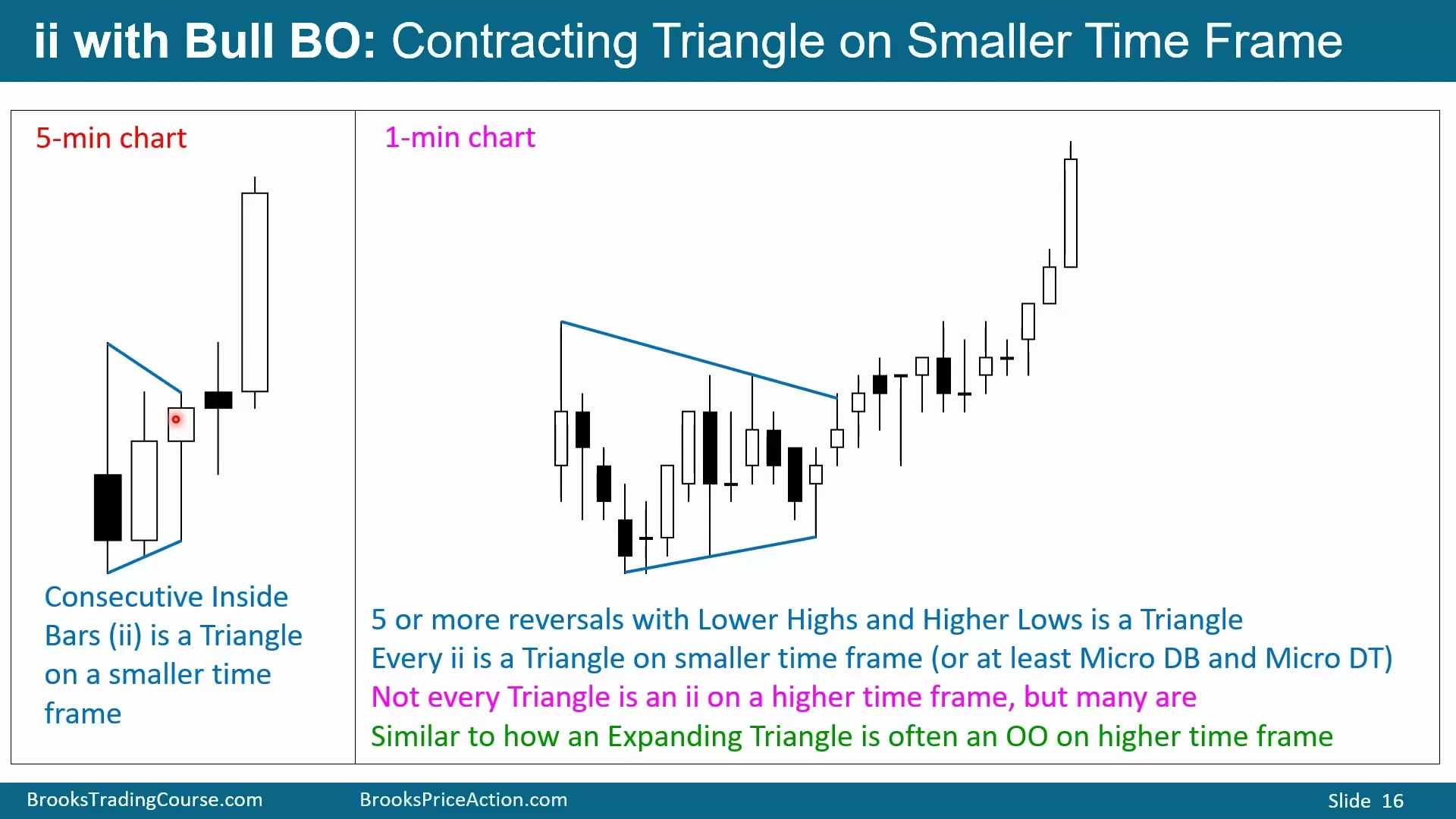
24:08 - 24:10

EN: Consecutive Inside Bars.

24:16 - 24:19

EN: Usually a Triangle on a smaller timeframe chart.

24:19 - 24:22

EN: If you looked at a 1-minute chart, you’d see we have three lows

24:22 - 24:26

EN: – one, two, three – and two highs, and a Trading Range

24:26 - 24:30

EN: where you have a Lower High and two Higher Lows, that’s a Triangle.

24:30 - 24:32

EN: This looks like this.

24:32 - 24:34

EN: This is the 1-minute version of that.

24:34 - 24:37

EN: You can see it’s a Triangle and we’re breaking above the top.

24:39 - 24:42

EN: Not every Triangle is an ii on a higher timeframe,

24:42 - 24:46

EN: so you could probably find some timeframe

24:46 - 24:50

EN: where the Triangle is an ii, but it’s not worth looking.

24:50 - 24:54

EN: Also, if you see an ii on the timeframe that you’re trading,

24:55 - 24:57

EN: it’s not worth looking at a smaller timeframe to see a Triangle.

24:57 - 24:59

EN: You know it’s there.

25:02 - 25:04

EN: This is a monthly chart of Bitcoin.

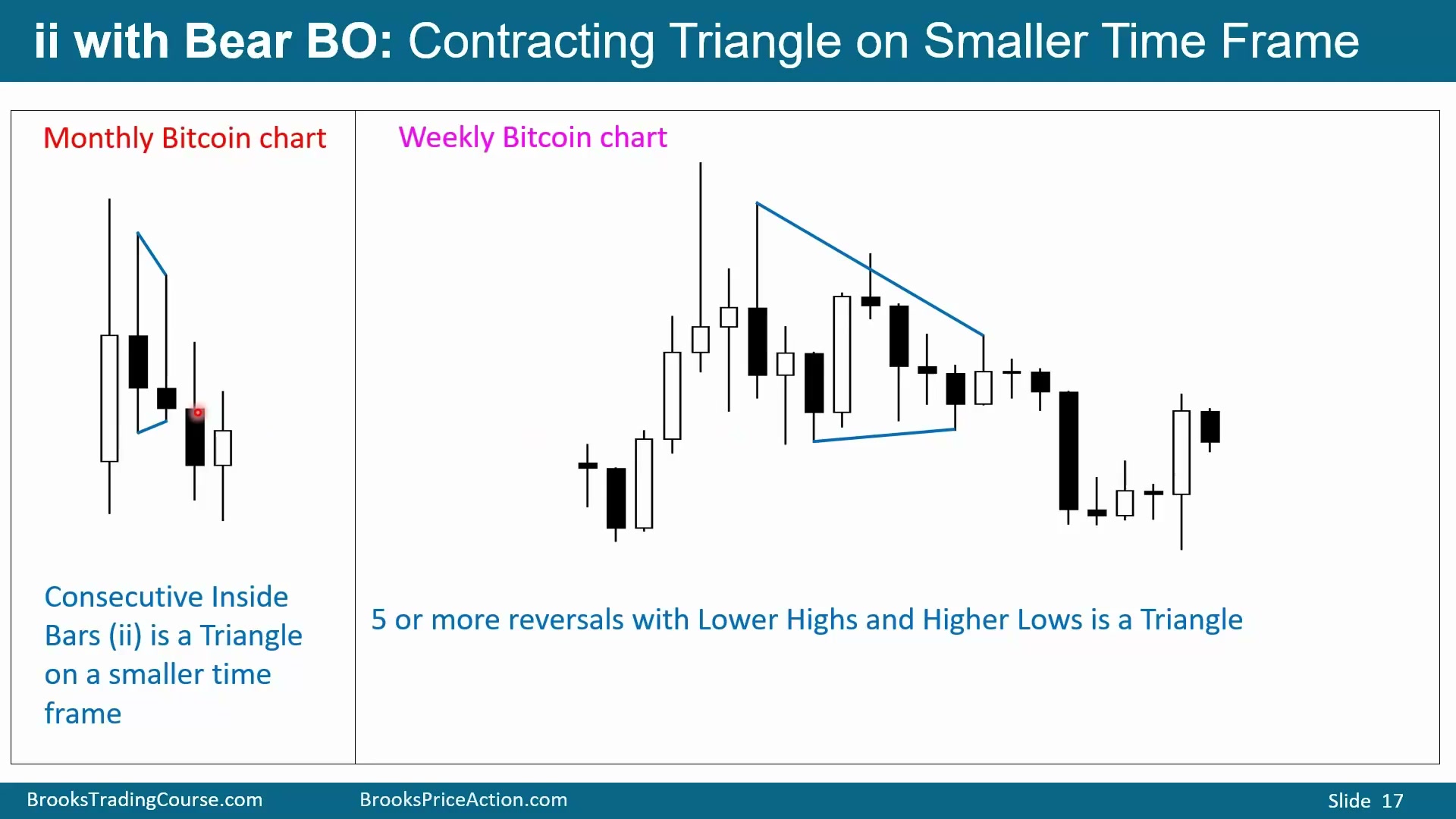
25:04 - 25:06

EN: Consecutive Inside Bars.

Slide 015

Time: 25:05

Slide 015

Bilingual Transcript

25:07 - 25:10

EN: Here’s a weekly chart of Bitcoin.

25:10 - 25:13

EN: We have three highs – one, two, and three – and two lows.

25:13 - 25:14

EN: A Triangle.

25:14 - 25:18

EN: And we have a bear breakout here, and this is the bear breakout on the weekly chart.

25:23 - 25:25

EN: Look at this: 4 consecutive Inside Bars.

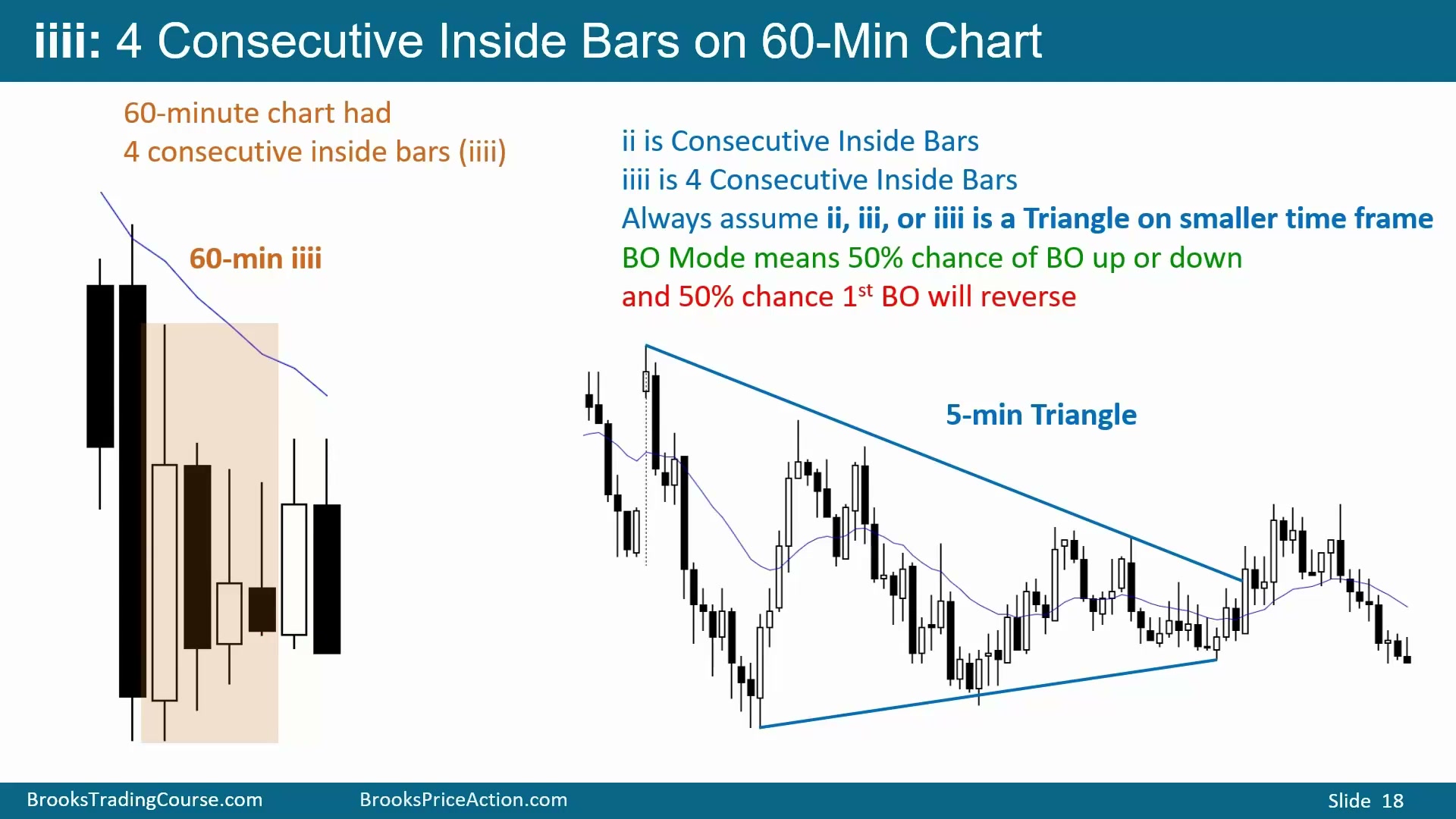
Slide 016

Time: 25:25

Slide 016

Bilingual Transcript

25:25 - 25:29

EN: This bar is inside that, and then we have 3 more Inside Bars.

25:29 - 25:31

EN: So we have 4 consecutive Inside Bars.

25:31 - 25:33

EN: No different from an ii.

25:33 - 25:37

EN: It doesn’t matter if the pattern has 3 Inside Bars

25:37 - 25:41

EN: or 4 Inside Bars or 100 Inside Bars; it’s still a BreakOut Mode pattern,

25:41 - 25:44

EN: and it’s going to be a Triangle on a smaller timeframe chart.

25:47 - 25:50

EN: 60-minute, 4 consecutive Inside Bars.

25:50 - 25:53

EN: 5-minute chart, you can see it’s a Triangle.

25:55 - 26:03

EN: Always assume that every ii or iii or iiii is a Triangle on a smaller timeframe.

26:03 - 26:05

EN: And that really doesn’t help you.

26:05 - 26:09

EN: It might help you feel more comfortable that it’s a BreakOut Mode pattern

26:09 - 26:11

EN: because a Triangle is a more common

26:11 - 26:15

EN: or more classic BreakOut Mode pattern, but it doesn’t matter.

26:15 - 26:19

EN: The market’s sideways and we’re contracting; we’re in BreakOut Mode.

26:19 - 26:23

EN: Whether or not you know it’s a Triangle on a smaller timeframe chart,

26:23 - 26:26

EN: you’re going to trade it like a BreakOut Mode pattern on the chart in front of you.

26:27 - 26:32

EN: With a BreakOut Mode pattern, as I said, 50% chance the first breakout up

26:32 - 26:37

EN: or down will fail, and 50% chance you’ll get an upside breakout,

26:37 - 26:40

EN: 50% chance you’ll get a downside breakout.

26:40 - 26:41

EN: And sometimes you get both.

26:41 - 26:43

EN: Here we went down and up.

Slide 017

Time: 26:46

Slide 017

Bilingual Transcript

26:47 - 26:54

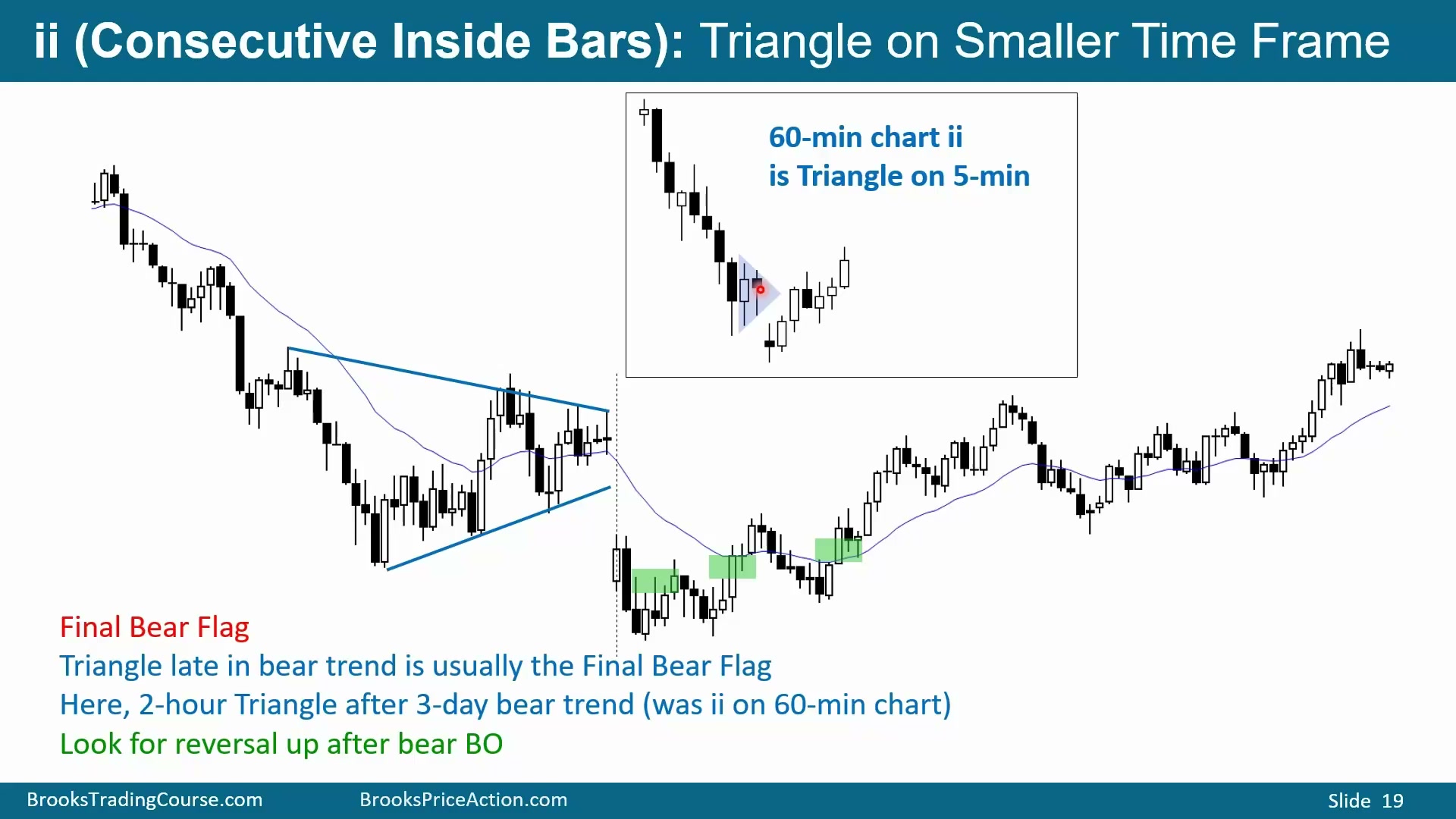
EN: Here is a Triangle late in a bear trend, so a bear trend and a Triangle.

26:54 - 26:58

EN: A Triangle late in a bear trend is typically the Final Flag, final bear flag.

26:58 - 27:00

EN: It’s an area of agreement.

27:00 - 27:02

EN: Traders think this price is fair.

27:02 - 27:06

EN: If we break out to the downside or to the upside,

27:06 - 27:09

EN: the market will tend to gravitate back to this fair price.

27:09 - 27:13

EN: So it’s often the Final Flag in a bear trend; if you get a downside breakout,

27:13 - 27:16

EN: you’re probably soon going to come back to the apex of the Triangle.

27:20 - 27:23

EN: This is a 5-minute chart, and on the 60-minute chart,

27:23 - 27:28

EN: if you looked at it, you’d discover that this Triangle was in fact an ii.

27:28 - 27:33

EN: If you were trading the 60-minute chart, you would assume this ii is a Triangle

27:33 - 27:36

EN: on a smaller timeframe chart, like a 5-minute chart.

27:40 - 27:44

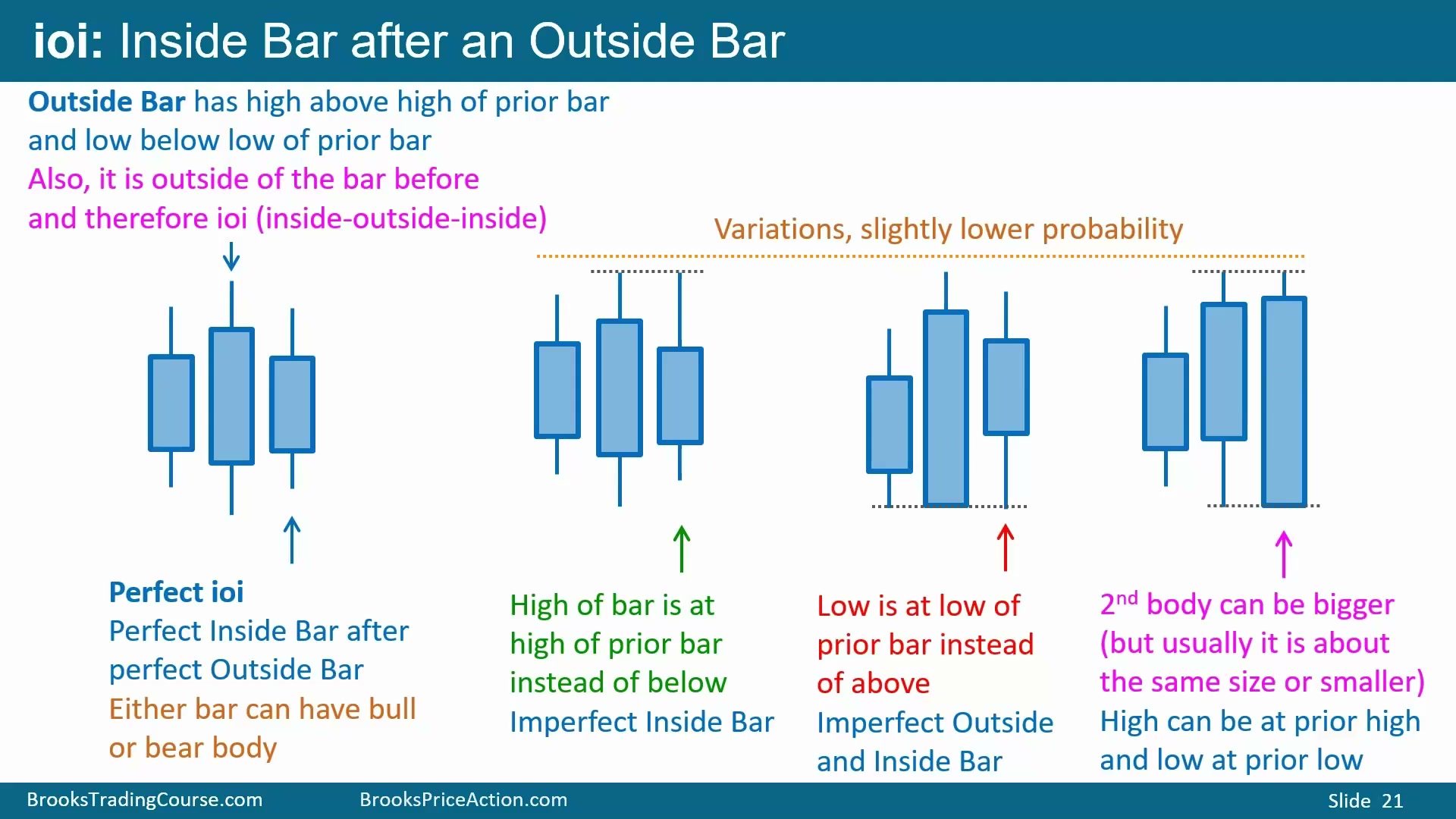
EN: ioi, an Inside Bar after an Outside Bar.

Slide 018

Time: 27:45

Slide 018

Bilingual Transcript

27:46 - 27:48

EN: We have an Inside Bar.

27:48 - 27:53

EN: The bar before it is an Outside Bar, and therefore the bar before the Outside Bar

27:53 - 27:57

EN: is an Inside Bar, and therefore we have an inside-outside-Inside Bar.

27:57 - 27:59

EN: Again, a BreakOut Mode pattern.

28:03 - 28:06

EN: This is an example of a perfect ioi.

28:06 - 28:11

EN: The low of the Outside Bar is below, not at, the low of the prior bar.

28:11 - 28:16

EN: The high of the Outside Bar is above, not at, the high of the prior bar.

28:16 - 28:22

EN: And then the Inside Bar that follows has a high below the high of the Outside Bar

28:22 - 28:25

EN: and a low above the low of the Outside Bar.

28:29 - 28:31

EN: Here are some variations.

28:31 - 28:35

EN: This bar is inside because its low is above the low of that bar

28:35 - 28:38

EN: and its high is at the high of that bar.

28:39 - 28:41

EN: Again, the more perfect a pattern is,

28:41 - 28:44

EN: the higher the probability that you make money.

28:44 - 28:47

EN: But here are some variations where the Inside Bar

28:47 - 28:50

EN: has a high at the high of the Outside Bar, not below.

28:54 - 28:59

EN: Here’s another example where all 3 bars have identical lows,

28:59 - 29:03

EN: but the Outside Bar is above both Inside Bars.

29:06 - 29:10

EN: Another example where the Outside Bar is perfect,

29:11 - 29:15

EN: but the bar after it has a high at the high of that bar

29:15 - 29:17

EN: and a low at the low of this bar.

29:18 - 29:22

EN: Therefore, this bar is an Inside Bar, but its high is at that bar,

29:22 - 29:24

EN: so it’s also an Outside Bar.

29:24 - 29:28

EN: Its low is at that low, so it’s also an Outside Bar.

29:28 - 29:33

EN: So this is an ioi, and it’s also an OO.

29:33 - 29:38

EN: This bar is an Outside Bar; this bar is both an Inside Bar and an Outside Bar,

29:38 - 29:42

EN: so you can call it either an ioi or an OO.

29:42 - 29:43

EN: It doesn’t matter.

29:43 - 29:45

EN: Both are BreakOut Mode patterns.

Slide 019

Time: 29:48

Slide 019

Bilingual Transcript

29:48 - 29:51

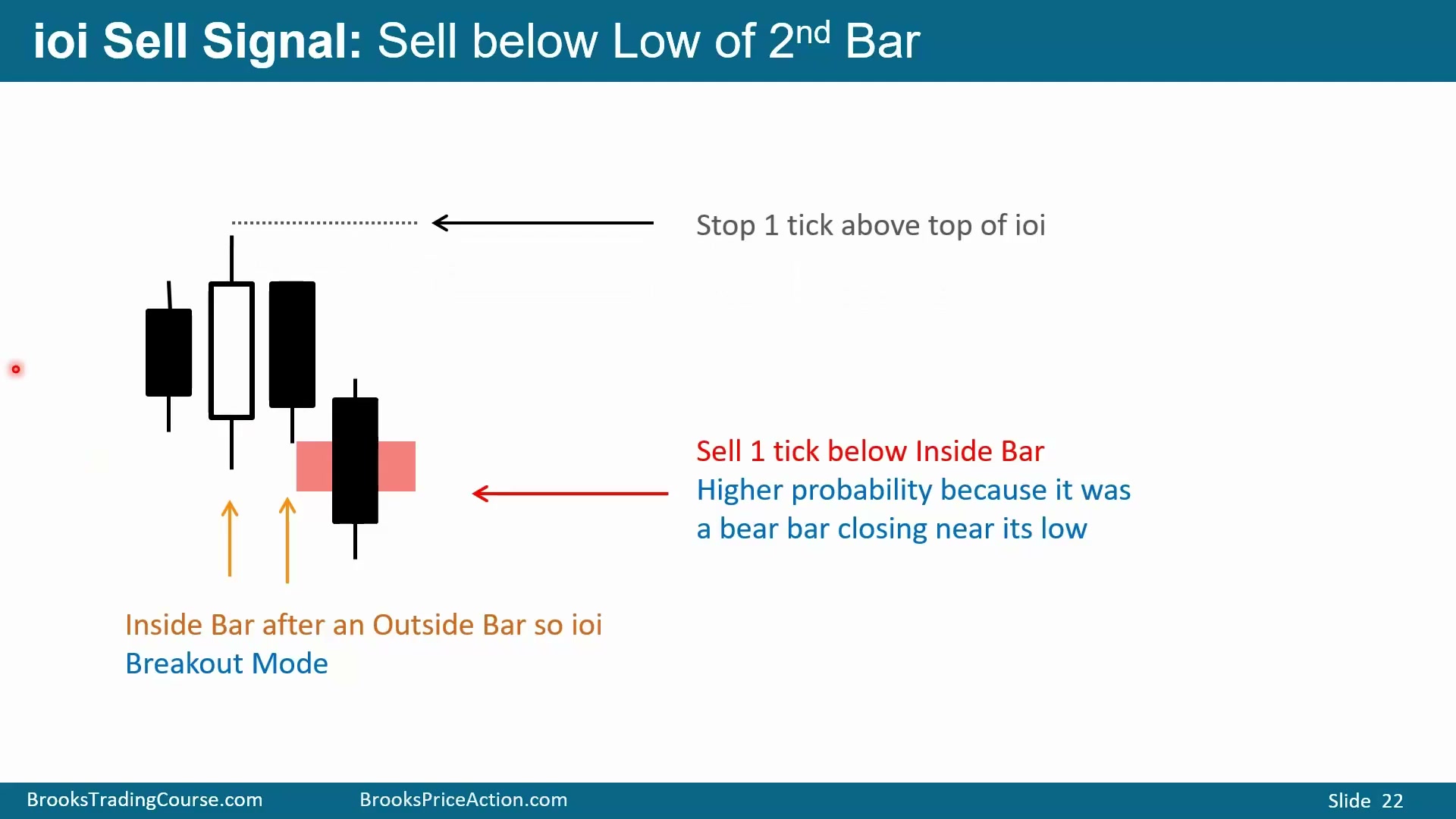
EN: We have an Outside Bar and the second bar is a bear bar.

29:51 - 29:55

EN: This could be in a bear trend; it could be a bull trend,

29:55 - 29:57

EN: so it could be the top of a bull trend.

29:57 - 29:59

EN: It could be a bear flag in a bear trend.

29:59 - 30:01

EN: We have a bear bar closing on or near its low.

30:01 - 30:06

EN: Traders will sell on a stop 1 tick or 1 pip below the low of that bear bar.

30:12 - 30:17

EN: It’s a higher probability ioi because it’s perfect.

30:17 - 30:18

EN: It looks very good.

30:18 - 30:22

EN: We have a big bull bar and then we have a bear bar closing on or near its low.

30:22 - 30:25

EN: That’s a pretty reliable pattern.

30:25 - 30:30

EN: You’d put a stop above the top of the pattern, the ioi.

30:33 - 30:36

EN: Here’s an example of an ioi.

Slide 020

Time: 30:35

Slide 020

Bilingual Transcript

30:36 - 30:39

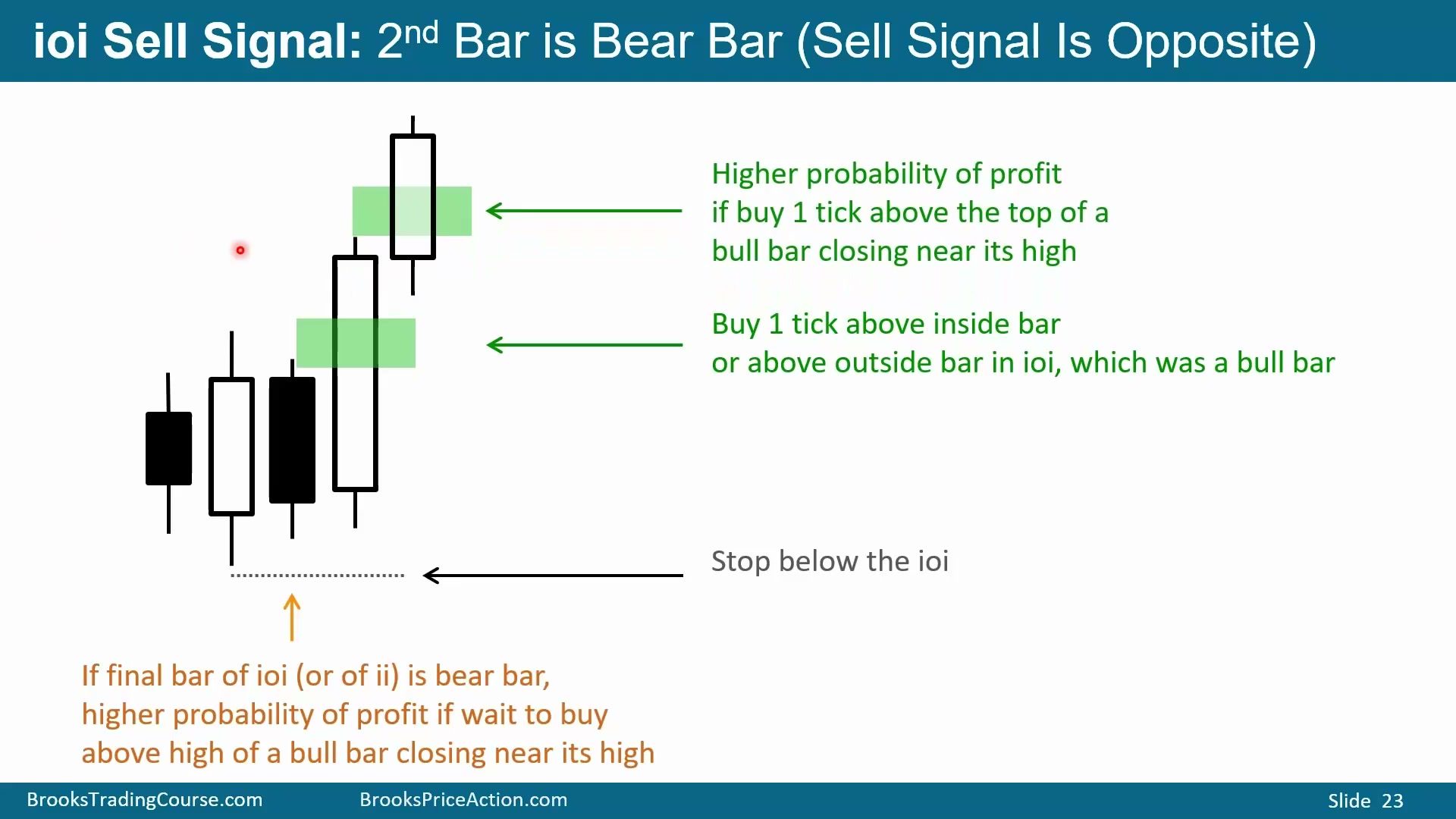
EN: Instead of getting a bear breakout, we have a bull breakout.

30:39 - 30:41

EN: But remember what I said.

30:41 - 30:46

EN: It’s in general a higher probability trade to buy above a bull bar closing on

30:46 - 30:48

EN: or near its high, and not above a bear bar.

30:49 - 30:52

EN: Theoretically, you could buy on a stop above this bar.

30:52 - 30:53

EN: Here’s a bull bar.

30:53 - 30:55

EN: You could buy on a stop above that bar.

30:55 - 31:00

EN: I usually wait to see the entry bar and then buy on a stop above the entry bar.

31:00 - 31:03

EN: When you have a bad signal bar like this – this is a bear bar

31:03 - 31:07

EN: – it would be better if it went below and triggered a sell.

31:07 - 31:09

EN: Instead, we’re going above, triggering a buy.

31:09 - 31:12

EN: That’s lower probability.

31:12 - 31:16

EN: So instead of buying above this bar, I would buy above that bar.

31:16 - 31:21

EN: If instead this bar went below that bar, I would sell below the Inside Bar.

31:27 - 31:31

EN: You could buy above the ioi, but if you want higher probability,

31:31 - 31:34

EN: it’s better to buy above a bull bar closing on its high.

31:36 - 31:39

EN: So you’d buy on a stop 1 tick or 1 pip

31:39 - 31:42

EN: above the high of this bar and get filled over here.

Slide 021

Time: 31:45

Slide 021

Bilingual Transcript

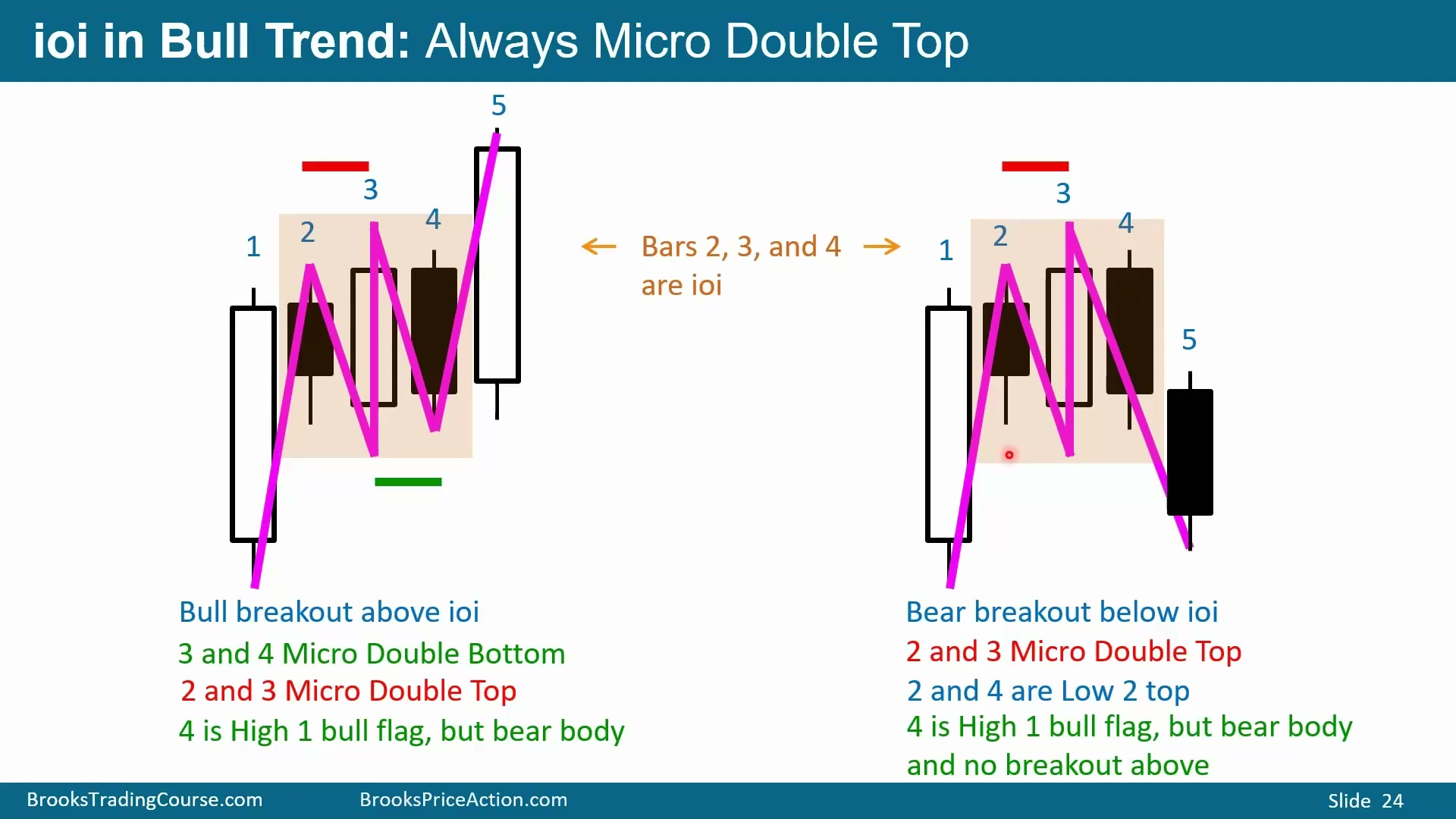
31:46 - 31:48

EN: Here we have 5 bars.

31:48 - 31:49

EN: We have an ioi.

31:49 - 31:51

EN: Bars 2, 3, 4.

31:51 - 31:53

EN: BreakOut Mode, and we broke out above,

31:53 - 31:57

EN: and here we have the same pattern but we broke out below.

31:58 - 32:04

EN: Reasonable to sell below Bar 4, a bear bar closing on its low and an ioi.

32:04 - 32:08

EN: Here, less reasonable to buy above that bar because it’s a bear bar.

32:11 - 32:15

EN: Bars 2, 3, and 4 form ioi patterns.

32:18 - 32:21

EN: We went up and then we went down to that low, right?

32:21 - 32:24

EN: We went up here and here’s the close, so we’re going down.

32:24 - 32:26

EN: And then on this bar we went above that bar,

32:26 - 32:29

EN: and then we have a bear bar here, so we went down here.

32:29 - 32:34

EN: So in this pattern, we have at least a Micro Double Top and a Micro Double Bottom.

32:34 - 32:38

EN: That is what you often see in BreakOut Mode patterns

32:40 - 32:44

EN: – the market making several attempts to go up or down

32:45 - 32:47

EN: and then traders are looking for a breakout.

32:47 - 32:52

EN: Here, there’s a Micro Double Bottom and we also have a Micro Double Top,

32:52 - 32:54

EN: this high and that high.

32:58 - 33:01

EN: Here, it’s in a bull trend.

33:01 - 33:03

EN: This is a High 1 bull flag.

33:03 - 33:04

EN: That’s the high of the bull trend.

33:04 - 33:05

EN: We have a pullback.

33:05 - 33:08

EN: It’s a High 1 bull flag above that bar.

33:08 - 33:11

EN: You could buy above the bear bar, you could buy above the bull bar,

33:11 - 33:12

EN: or you could wait for the breakout bar and,

33:12 - 33:15

EN: if it closes near its high, buy above the high of that bar.

33:19 - 33:24

EN: In this chart the market went from that low up to that close and up to that high,

33:24 - 33:26

EN: and then it went down to this low,

33:26 - 33:29

EN: and then it went up to that high, and then down here.

33:29 - 33:31

EN: Bear bar, so it’s going down.

33:31 - 33:32

EN: This is a Micro Double Top.

33:35 - 33:37

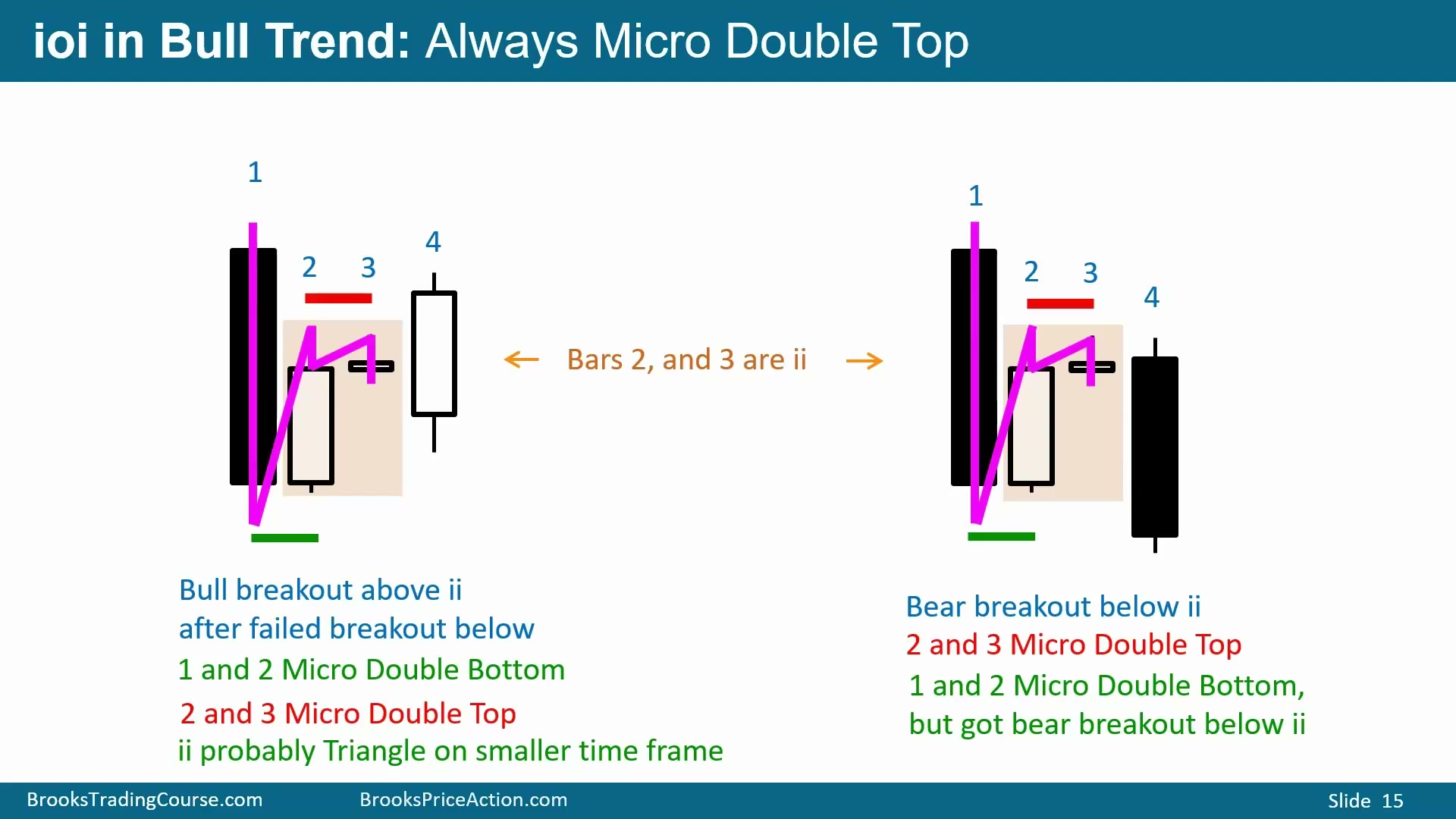
EN: Bar 2 and 3 form the Micro Double Top.

33:40 - 33:44

EN: And 2 and 4 are a Low 2 top.

33:44 - 33:48

EN: We went up here, we went down; we went up here, we went down.

33:48 - 33:51

EN: This bar went below that, so it’s a first reversal,

33:51 - 33:54

EN: and now we have a second reversal, so that’s a Low 2 top.

33:59 - 34:04

EN: Bar 4 is a High 1 bull flag, but it’s a bear body, so it’s a lower probability buy.

34:04 - 34:06

EN: I talked about that here.

34:07 - 34:10

EN: The High 1 buy did not trigger in this example.

34:10 - 34:13

EN: In this example it did trigger, but the example on the right,

34:13 - 34:16

EN: the buy did not trigger but the Low 2 top did.

34:20 - 34:22

EN: Outside-outside (OO).

Slide 022

Time: 34:25

Slide 022

Bilingual Transcript

34:25 - 34:28

EN: An Outside Bar followed by another Outside Bar.

34:28 - 34:31

EN: The high of the bar is above the high of that bar;

34:31 - 34:33

EN: the low of the bar is below the low of that bar.

34:33 - 34:36

EN: It’s outside, and then there’s a second Outside Bar.

34:39 - 34:44

EN: A perfect OO because the lows are lower and the highs are higher.

34:45 - 34:48

EN: It doesn’t matter; the bars could have bull bodies or bear bodies.

34:49 - 34:54

EN: What does matter is if the bodies are big and the tails are small.

34:54 - 34:58

EN: If the 3 bars are little doji bars in a Tight Trading Range,

34:58 - 34:59

EN: it’s a Limit Order Market.

34:59 - 35:02

EN: You should not be buying above or selling below.

35:02 - 35:06

EN: But if the bodies are pretty big – for example, if you have a big bull bar,

35:06 - 35:10

EN: a big bear bar, a big bull bar – you’ll get traders more interested

35:10 - 35:12

EN: in buying above the high of that bull bar.

35:16 - 35:17

EN: Variations.

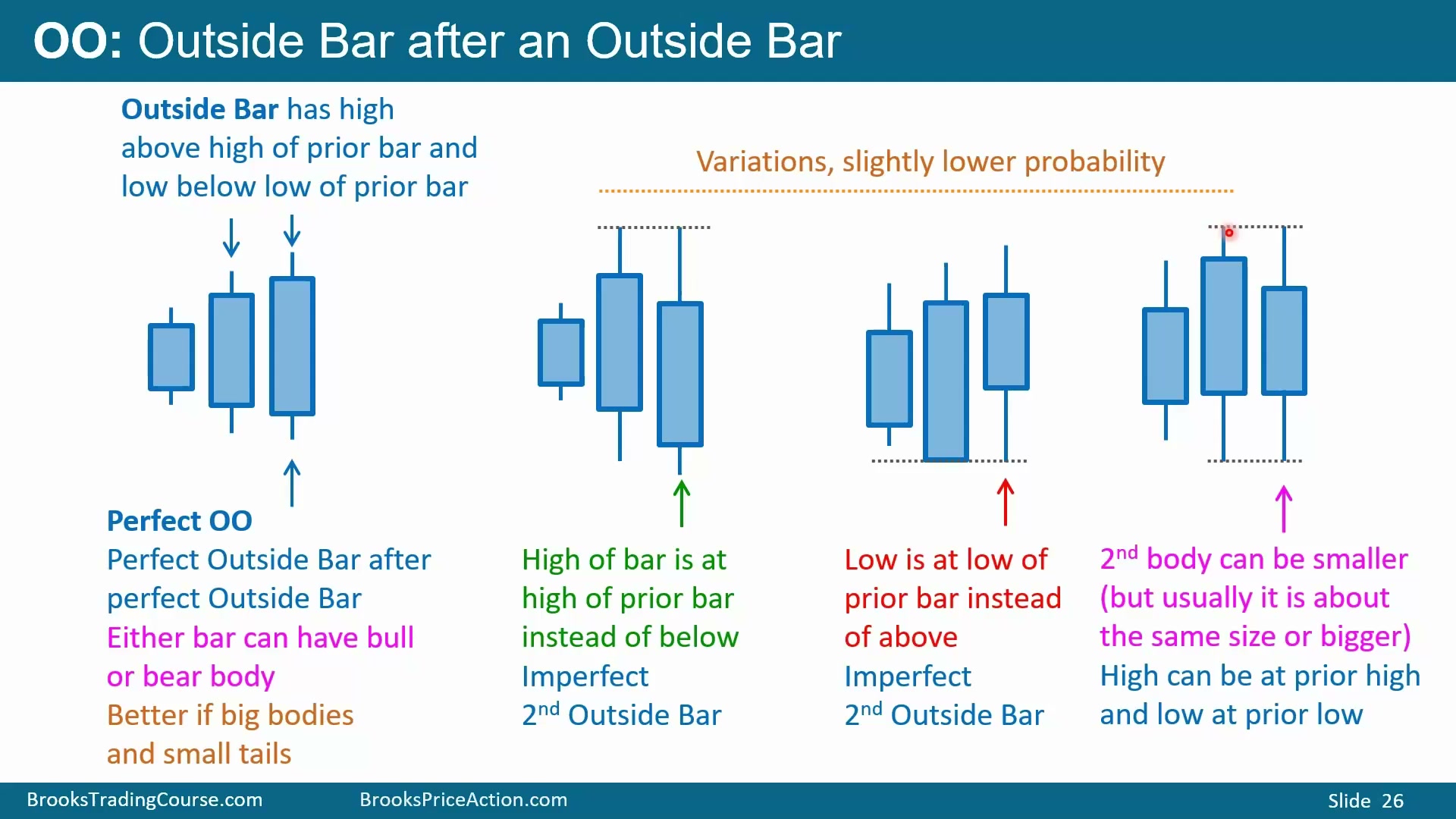
35:17 - 35:21

EN: Here, the low is below that bar, this low is below that bar,

35:22 - 35:24

EN: and the high is at that high instead of above.

35:25 - 35:29

EN: Though it’s still an OO pattern, but it’s not perfect like this,

35:29 - 35:31

EN: where the high is above the high.

35:34 - 35:40

EN: And then here’s an example where the third bar, the second Outside Bar,

35:40 - 35:44

EN: has a low at the low of the first Outside Bar, not below.

35:48 - 35:54

EN: And then here’s an example where the second Outside Bar is identical in height

35:54 - 35:57

EN: and has identical highs and identical lows.

36:02 - 36:04

EN: A perfect OO.

36:04 - 36:08

EN: We have a bull bar, a bigger bear bar closing on or near its low,

Slide 023

Time: 36:05

Slide 023

Bilingual Transcript

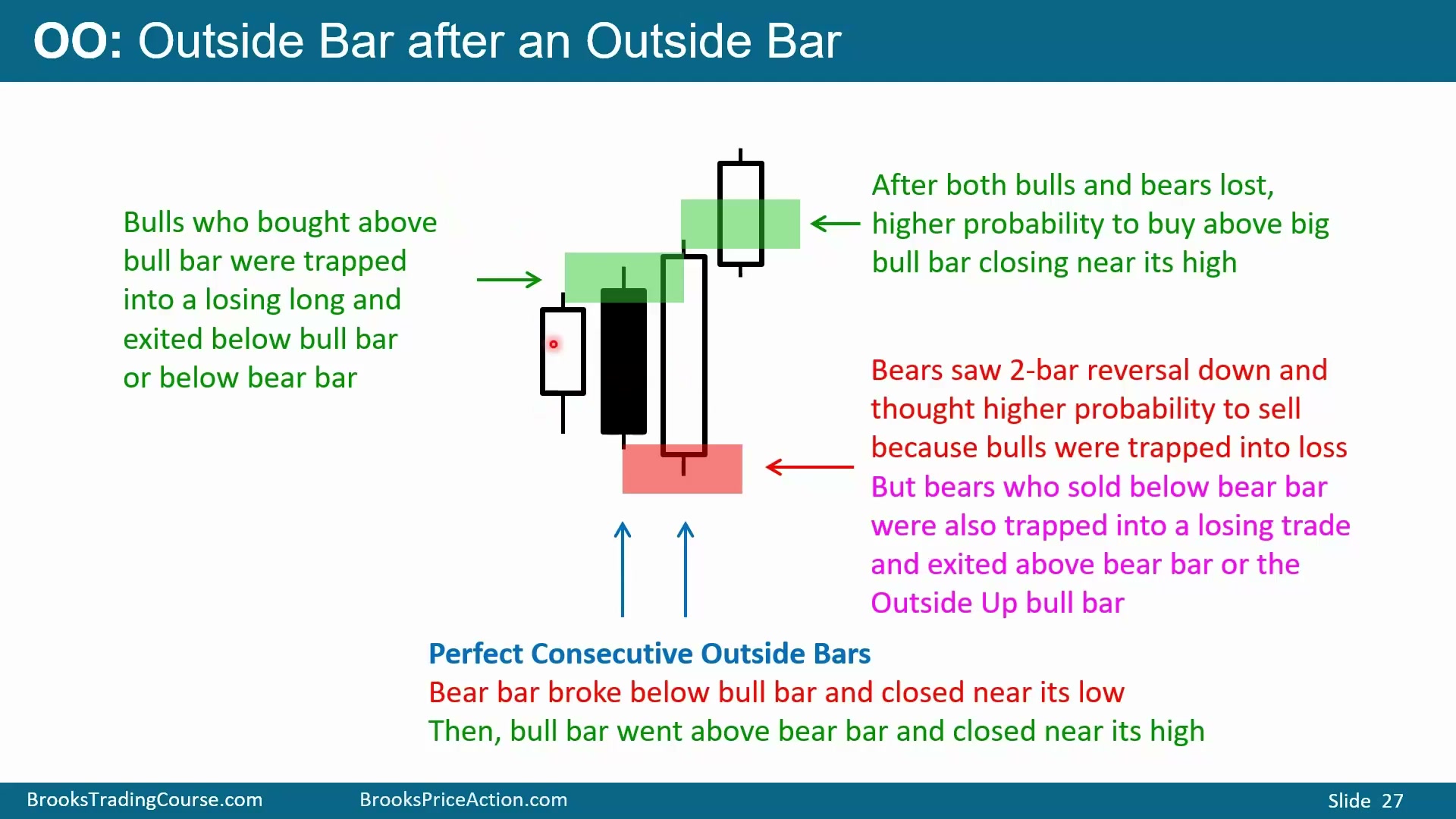
36:08 - 36:11

EN: followed by a bigger bull bar closing on or near its high.

36:15 - 36:17

EN: Let’s say this is a bull trend.

36:17 - 36:19

EN: You have a bull bar closing near its high.

36:19 - 36:22

EN: Some traders will buy above the high of that bull bar

36:22 - 36:25

EN: and they’ll get out either below the low of that bull bar

36:25 - 36:28

EN: or they’ll wait for a bear bar and get out below the low of that bar.

36:28 - 36:31

EN: Other traders will reverse to short.

36:31 - 36:34

EN: If you have a failed buy and then an Outside Down bar,

36:34 - 36:35

EN: they’ll sell below the low of that bar.

36:36 - 36:40

EN: And then here, it goes back above the high of that bar,

36:40 - 36:42

EN: so you have bulls buying above this bar,

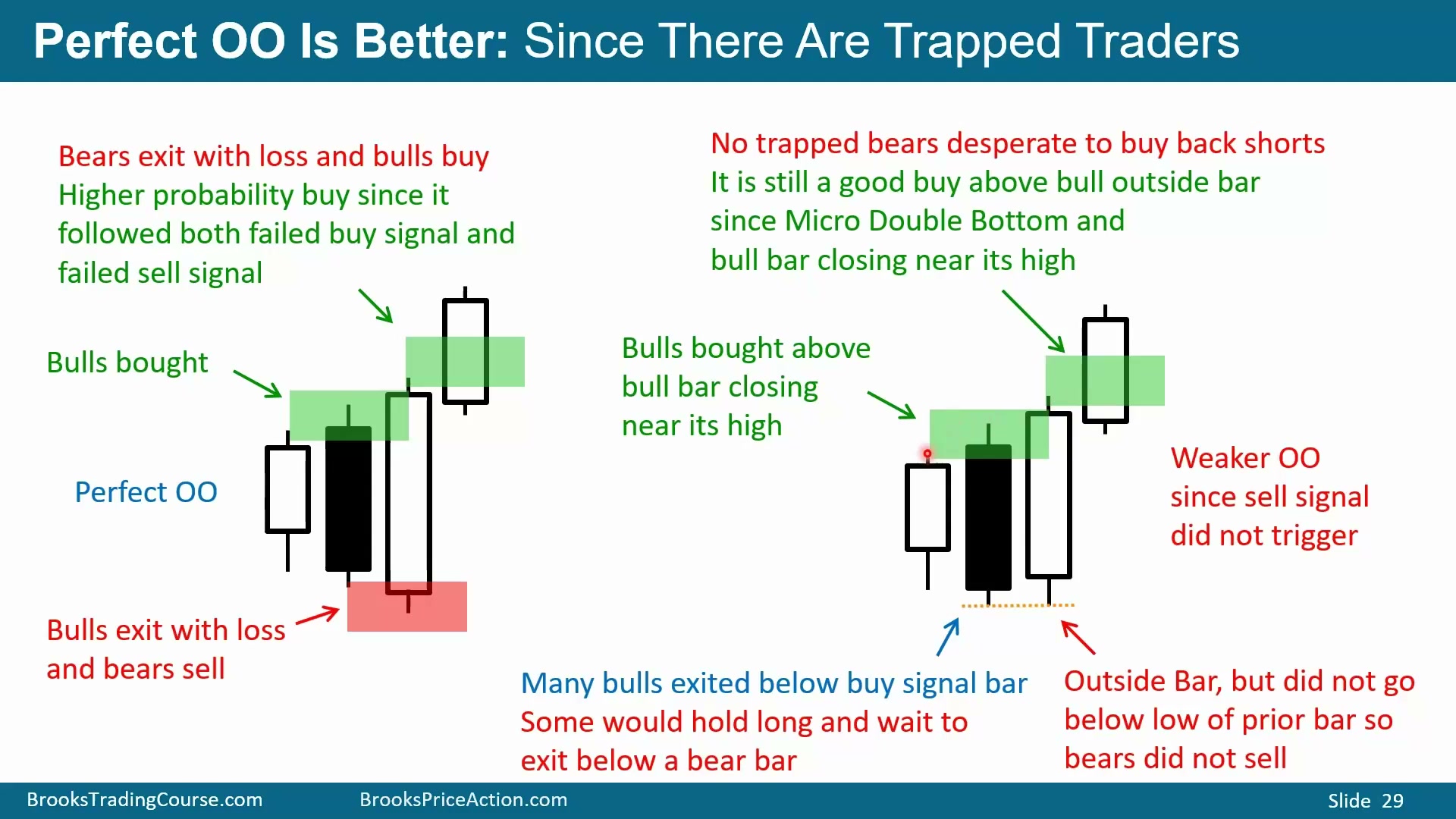
36:42 - 36:47

EN: and you’ll have some bears selling below that bar, and these bulls lost money

36:47 - 36:51

EN: when it went below that bar or this bar; these bears lost money

36:51 - 36:54

EN: when it went above the high of the signal bar or above that bar.

36:54 - 36:59

EN: So you have trapped bulls into a bad long, trapped bears into a bad short.

37:00 - 37:05

EN: That increases the chance that if we get a third breakout, it’ll be profitable.

37:09 - 37:11

EN: For the bears, they see a 2-bar reversal.

37:11 - 37:12

EN: We went up, we went down.

37:12 - 37:15

EN: They sell on a stop below that bar,

37:15 - 37:19

EN: just after the bulls had a failed buy above that good-looking bull bar.

37:20 - 37:24

EN: And then the bears got stopped out and the bulls have a second buy signal bar.

37:25 - 37:29

EN: I’m not saying you should take that buy and that sell.

37:29 - 37:30

EN: It depends on context.

37:30 - 37:33

EN: You might take it, you might not take those two signals.

37:33 - 37:37

EN: However, once you see the two signals and then you see the market

37:37 - 37:41

EN: go above this bull bar, this is usually a pretty good buy.

37:41 - 37:43

EN: You’ll have trapped bulls, trapped bears,

37:43 - 37:46

EN: and now a bull bar closing on or near its high.

37:46 - 37:48

EN: That’s a reasonable buy.

37:48 - 37:52

EN: It could be in a bull trend, in which case it’s an OO bull flag.

37:52 - 37:57

EN: It could be in a bear trend, in which case it’s an OO bottom.

37:57 - 37:58

EN: If you’re looking to buy,

37:58 - 38:02

EN: you want to be buying above a bull bar closing on or near its high.

Slide 024

Time: 38:05

Slide 024

Bilingual Transcript

38:09 - 38:15

EN: Now, one difference between an OO and the other two patterns, ii and ioi,

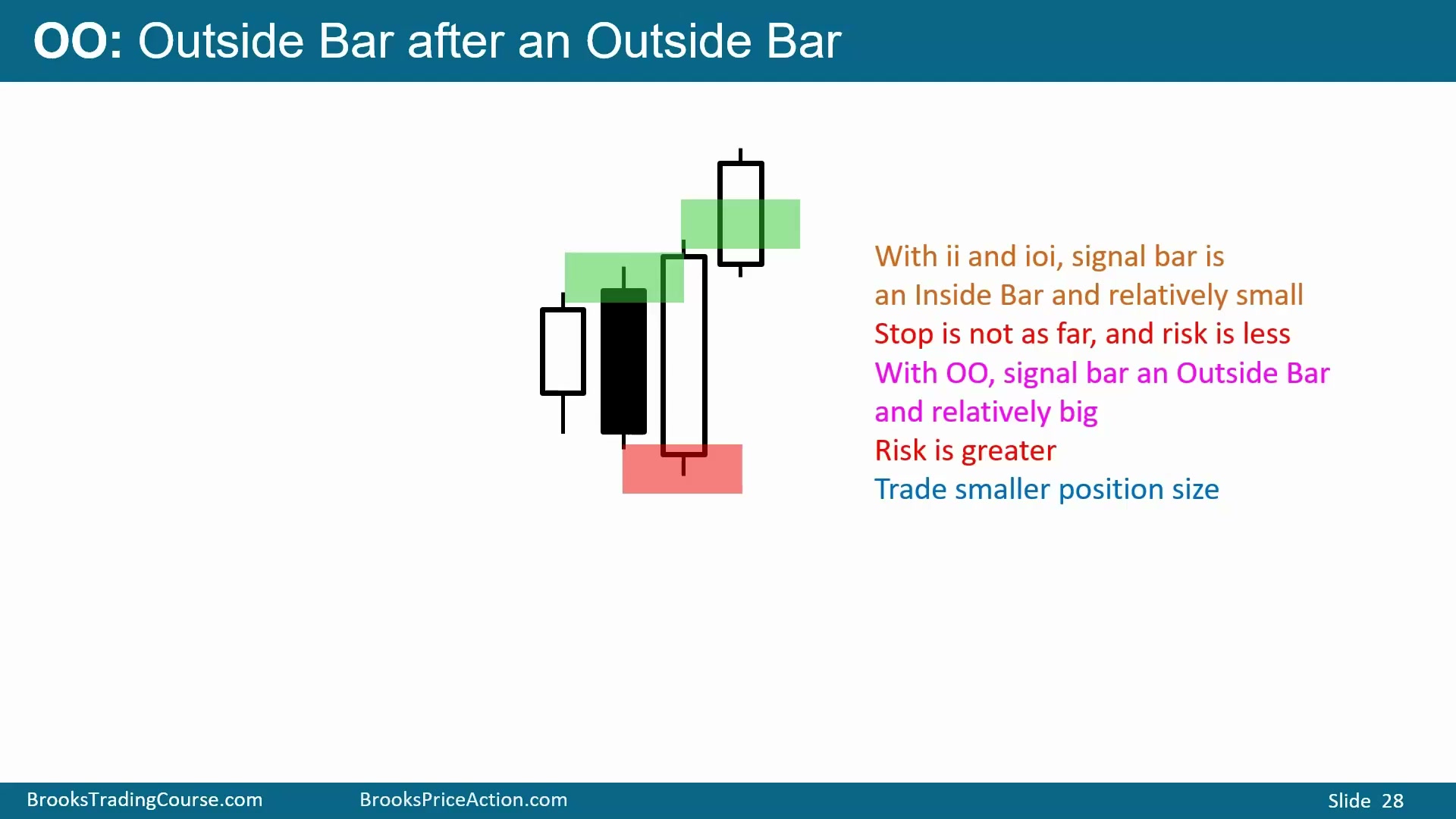
38:15 - 38:19

EN: is the third bar in the other two patterns is small.

38:19 - 38:25

EN: It’s an Inside Bar, so the stop is not as far and the risk is relatively less.

38:25 - 38:29

EN: When you’re trading an OO pattern, the third bar is big.

38:29 - 38:33

EN: It’s the second consecutive Outside Bar, and the stop is further away.

38:34 - 38:35

EN: Your risk is greater.

38:35 - 38:39

EN: You should always trade small enough so that you’re not risking

38:39 - 38:43

EN: any more on any trade than you are on any other trade.

38:43 - 38:46

EN: So very often, with an OO pattern,

38:46 - 38:49

EN: you have to trade a little bit smaller position size.

38:52 - 38:57

EN: A perfect OO and a not-so-perfect OO.

Slide 025

Time: 38:55

Slide 025

Bilingual Transcript

38:57 - 38:59

EN: This low did not go below that bar,

38:59 - 39:03

EN: and therefore, yes, you might’ve triggered a buy above this bar,

39:03 - 39:06

EN: but we did not trigger a sell below that bar.

39:06 - 39:08

EN: We did not go below the low of that bar.

39:08 - 39:10

EN: Some bulls would still be long.

39:10 - 39:13

EN: They’d have a stop below the bear bar, and they would not have been stopped out.

39:17 - 39:22

EN: Over here, theoretically bulls would buy above the bull bar, sell below the bear bar.

39:22 - 39:27

EN: So you have bulls losing money, bears losing money, and if you have a third breakout,

39:27 - 39:30

EN: which you have here, it’s a higher probability trade.

39:30 - 39:33

EN: Higher probability that you’ll make money.

39:33 - 39:38

EN: Again, you don’t necessarily take the first buy or the first sell.

39:38 - 39:40

EN: You do depending on context.

39:40 - 39:45

EN: But if you see the OO and a perfect OO like that, you know we had trapped bulls,

39:45 - 39:49

EN: you know we had trapped bears, this becomes a higher probability buy.

39:56 - 40:00

EN: Here, depending on the context, you might buy above that bull bar,

40:00 - 40:01

EN: but you never got the short.

40:01 - 40:03

EN: It never went below the low of the bear bar.

40:07 - 40:12

EN: A lot of the bulls who bought here might hold and get out below a bear bar,

40:12 - 40:15

EN: so a lot of these bulls are still long, even though we went below that bar.

40:23 - 40:28

EN: If you did buy here and did not get stopped out, you could buy more here.

40:29 - 40:33

EN: If you did buy here and got stopped out, you could buy there.

40:33 - 40:34

EN: It’s a second buy signal.

40:39 - 40:40

EN: What do you think about this?

Slide 026

Time: 40:40

Slide 026

Bilingual Transcript

40:40 - 40:44

EN: We have 3 bars with identical highs and identical lows.

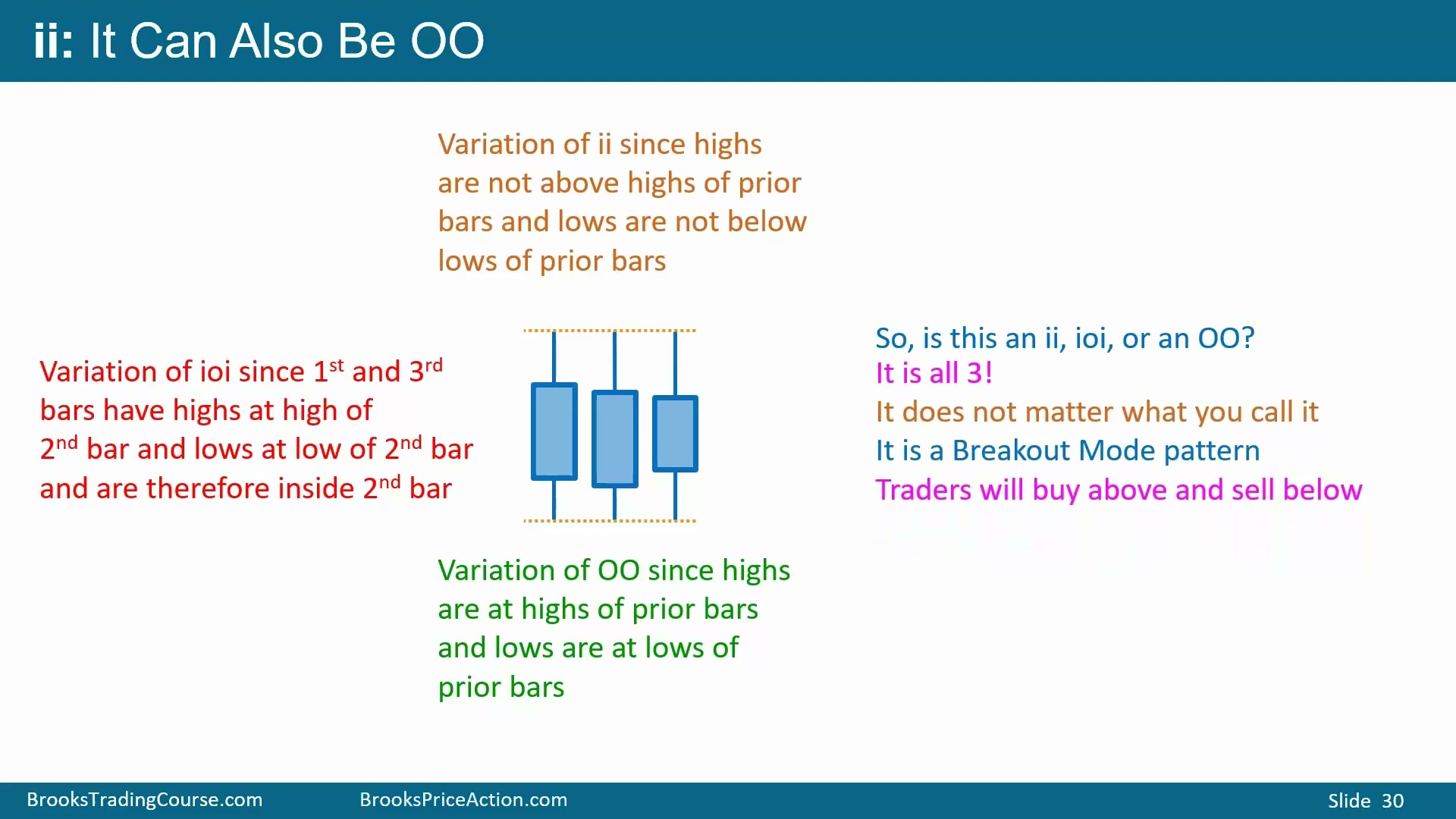
40:44 - 40:48

EN: It’s a variation of an inside-inside pattern (ii).

40:48 - 40:50

EN: This is an Inside Bar.

40:50 - 40:51

EN: Did not go below that.

40:51 - 40:54

EN: It’s an Inside Bar, did not go above that, and then you have a second Inside Bar.

40:58 - 41:01

EN: But it’s also a variation of an ioi.

41:02 - 41:06

EN: This bar, it’s an Inside Bar, but it’s also an Outside Bar.

41:07 - 41:11

EN: An Inside Bar has a high at or below the high of the prior bar;

41:11 - 41:15

EN: an Outside Bar has a high at or above the high of the prior bar.

41:15 - 41:18

EN: So this bar is both an Inside Bar and an Outside Bar.

41:18 - 41:19

EN: And the same with this bar.

41:19 - 41:22

EN: It’s both an Inside Bar and an Outside Bar.

41:22 - 41:26

EN: So in addition to being an ii, it’s also an ioi.

41:26 - 41:29

EN: You could view this as an Outside Bar and this as an Inside Bar.

41:29 - 41:33

EN: So this is an ii and an ioi.

41:37 - 41:40

EN: It doesn’t take much to realize that it’s also an OO

41:40 - 41:43

EN: because this qualifies as an Outside Bar, and so does this one.

41:43 - 41:47

EN: So it’s consecutive Outside Bars as well as consecutive Inside Bars.

41:52 - 41:56

EN: Is it an ii, is it an ioi, or is it an OO?

41:56 - 41:59

EN: As I said, it’s all three, and it doesn’t matter what you call it.

41:59 - 42:03

EN: You’re looking for a BreakOut Mode pattern, and no matter how you look at it,

42:03 - 42:05

EN: it’s a BreakOut Mode pattern.

42:05 - 42:07

EN: Traders are going to buy above, they’ll sell below.

Slide 027

Time: 42:10

Slide 027

Bilingual Transcript

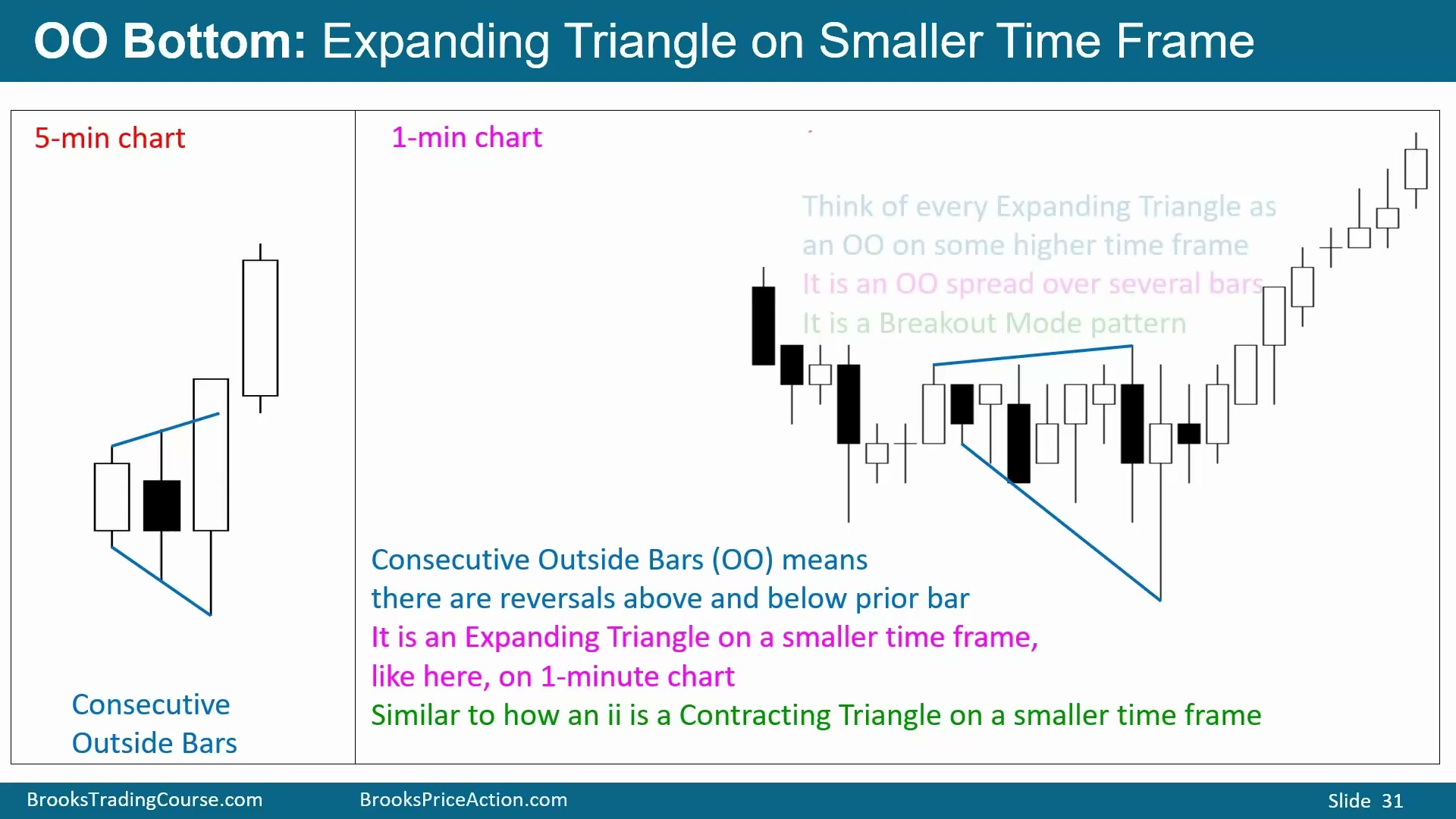
42:12 - 42:13

EN: 5-minute chart.

42:13 - 42:15

EN: We have consecutive Outside Bars.

42:19 - 42:22

EN: On a smaller timeframe chart – here, a 1-minute chart

42:23 - 42:26

EN: – you should assume that it’s going to be an Expanding Triangle.

42:26 - 42:31

EN: Just like the mirror image of this, consecutive Inside Bars,

42:31 - 42:34

EN: is a contracting Triangle, consecutive Outside Bars

42:34 - 42:37

EN: on a smaller timeframe chart is an Expanding Triangle.

42:38 - 42:40

EN: It doesn’t matter if you have a contracting Triangle

42:40 - 42:44

EN: or an Expanding Triangle; both are BreakOut Mode patterns.

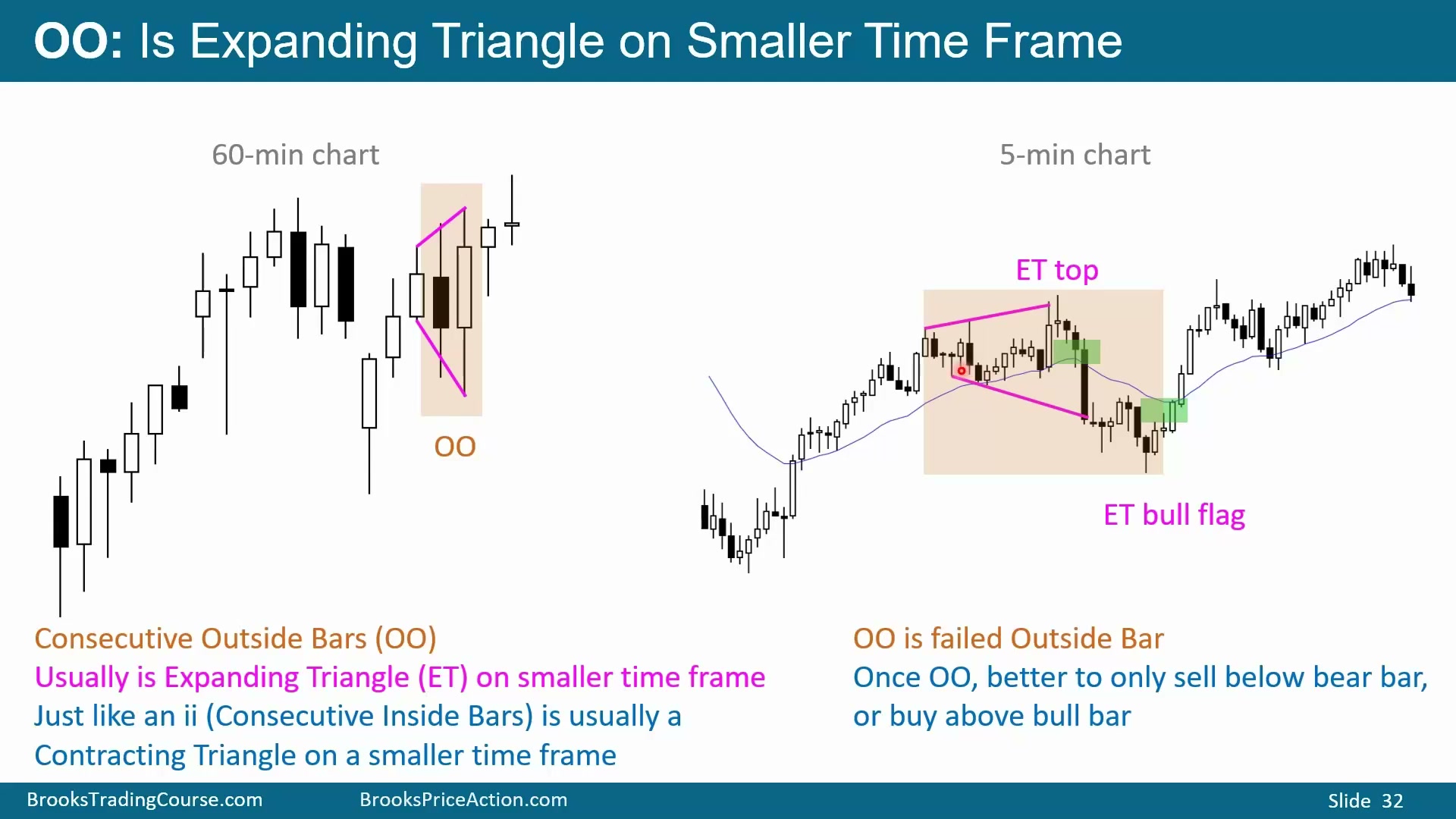
42:51 - 42:56

EN: Here’s a 60-minute chart, and we have an Outside Bar and then a bigger Outside Bar.

Slide 028

Time: 42:55

Slide 028

Bilingual Transcript

42:56 - 43:00

EN: You have to assume it’s going to be an Expanding Triangle

43:00 - 43:02

EN: on a smaller timeframe chart.

43:06 - 43:08

EN: Here’s a 5-minute chart of that.

43:08 - 43:13

EN: The brown box here is the same as here.

43:13 - 43:15

EN: 2 hours of trading here, 2 hours of trading here,

43:15 - 43:19

EN: and the OO here is an Expanding Triangle here.

43:24 - 43:27

EN: I talked about three small sideways patterns.

Slide 029

Time: 43:25

Slide 029

Bilingual Transcript

43:27 - 43:31

EN: They’re all BreakOut Mode patterns, and they could be bull flags,

43:31 - 43:34

EN: they can be bear flags, they could be reversal patterns.

43:34 - 43:37

EN: So if you have one of these patterns at the top of a bull trend,

43:37 - 43:40

EN: it’s a bull flag and it’s a possible top.

43:40 - 43:42

EN: You buy above, you sell below.

43:42 - 43:44

EN: If you have one of the patterns at the bottom of a bear trend,

43:44 - 43:47

EN: it’s both a bear flag and a reversal pattern.

43:47 - 43:49

EN: You sell below, you buy above.

43:49 - 43:57

EN: ii, consecutive Inside Bars; ioi, Inside Bars before and after an Outside Bar;

43:57 - 43:59

EN: and then OO, consecutive Outside Bars.

44:04 - 44:06

EN: I’m Al Brooks. Thank you so much for your attention.

44:06 - 44:08

EN: I hope that you found the video helpful.