al-brooks-course
43C - Trading Tight Bull Channels
Raw transcript and slide notes for 43C - Trading Tight Bull Channels.
Overview
- Slides: 21
- Transcript segments: 547
- Status: 自动按 slide 时间线归档;核心概念和长期笔记可以在每个 slide 的
Study Notes下继续整理。
Source Media
Transcript 001
Time: 00:02
Bilingual Transcript
00:02 - 00:03
EN: This is Al Brooks.
ZH: 你好,我是阿尔·布鲁克斯
00:03 - 00:05
EN: Thank you for watching the Brooks Trading Course.
ZH: 欢迎观看布鲁克斯交易课程
00:05 - 00:10
EN: This is the third of four videos on trading Tight Bull Channels.
ZH: 这是如何交易窄上涨通道的第3节课
Slide 001
Time: 00:13
Bilingual Transcript
00:14 - 00:18
EN: I’ll begin by talking about scaling into trades.
ZH: 首先我会讲到加仓
00:19 - 00:21
EN: I also want to make the very important point
ZH: 我还想强调一个非常重要的点:
00:21 - 00:25
EN: that if the bears cannot make money selling,
ZH: 如果空头做空赚不到钱
00:25 - 00:29
EN: then the bull trend is strong and bears should not start to sell.
ZH: 那就说明上涨趋势很强,不应该做空
00:29 - 00:32
EN: They should wait to sell until they see other bears making money.
ZH: 应该等看到其他空头能够赚钱之后,再考虑做空
Slide 002
Time: 00:33
Bilingual Transcript
00:36 - 00:39
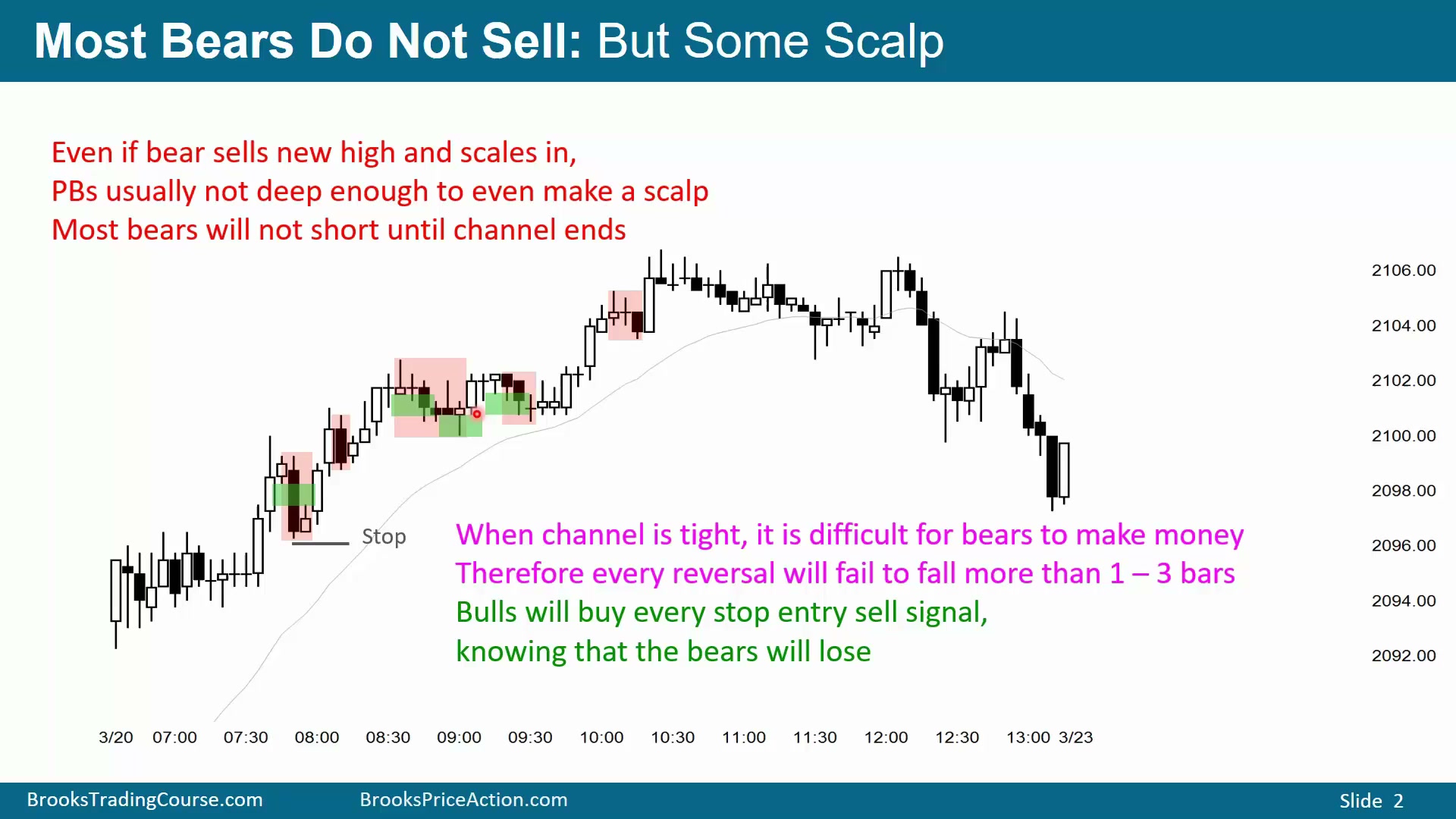
EN: The bulls have a breakout and then a 1 bar pullback,
ZH: 多头突破,回调了1根K线
00:39 - 00:41
EN: and then about a 10 bar bull Micro Channel
ZH: 然后是一个持续了大约10根K线的上涨微通道
00:41 - 00:45
EN: and a couple bars down – 1 bar down, 3 bar pullback.
ZH: 然后有一些回调——1根K线,3根K线
00:45 - 00:47
EN: A pretty Tight Bull Channel.
ZH: 总体是一个很窄的上涨通道
00:54 - 00:57
EN: Even if a bear sells at the prior high and scales in,
ZH: 即使空头在前期高点做空、并逢高加仓
00:57 - 01:01
EN: the pullbacks for the most part are not deep enough to make even a scalp,
ZH: 大多数时候回调都不够大,甚至连剥头皮都做不了
01:01 - 01:09
EN: and most bears will not short until they start to believe
ZH: 所以大多数空头不会做空,直到他们认为通道即将结束、 即将转变成震荡区间、或至少是宽通道
01:04 - 01:09
EN: that the channel is ending and transitioning into a Trading Range,
ZH: 所以大多数空头不会做空,直到他们认为通道即将结束、 即将转变成震荡区间、或至少是宽通道
01:08 - 01:09
EN: or at least a Broad Channel.
ZH: 所以大多数空头不会做空,直到他们认为通道即将结束、 即将转变成震荡区间、或至少是宽通道
01:10 - 01:12
EN: Selling above this high, not making money.
ZH: 在这个高点上方做空,赚不到钱
01:12 - 01:16
EN: Selling at this high, scaling in higher, very difficult to make money.
ZH: 在这个高点挂单做空、并逢高加仓,很难赚到钱
01:17 - 01:19
EN: Stop entry bears, it’s even more difficult to make money
ZH: 使用突破卖单入场的空头,更难赚钱——
01:19 - 01:22
EN: - selling below that low, selling below this low
ZH: 在这个低点下方卖出,在那个低点下方卖出
01:22 - 01:25
EN: or that low or that low, or this low for that matter.
ZH: 或者那个低点、那个低点、这个低点(都赚不到钱)
01:32 - 01:38
EN: In general, when a channel is tight and you look at it
ZH: 通常来说,如果通道很窄,你发现空头很难赚钱,
01:35 - 01:38
EN: and you see that it’s difficult for the bears to make money,
ZH: 通常来说,如果通道很窄,你发现空头很难赚钱,
01:38 - 01:40
EN: you should only be looking to buy.
ZH: 那么就只考虑买入做多
01:40 - 01:46
EN: And every time you see a stop entry sell,
ZH: 当你看到任何做空机会、任何反转的尝试, 都假设它会失败
01:43 - 01:46
EN: a reversal attempt, you should assume it will fail.
ZH: 当你看到任何做空机会、任何反转的尝试, 都假设它会失败
01:46 - 01:49
EN: The bears will not make money, and they’ll have to buy back their shorts.
ZH: 空头赚不到钱,不得不买入回补
01:49 - 01:55
EN: And therefore, bulls will be buying every reversal attempt,
ZH: 因此,多头一看到下跌就买入,押注空头会失败
01:53 - 01:55
EN: betting that the bears will lose.
ZH: 因此,多头一看到下跌就买入,押注空头会失败
Slide 003
Time: 02:00
Bilingual Transcript
02:03 - 02:08
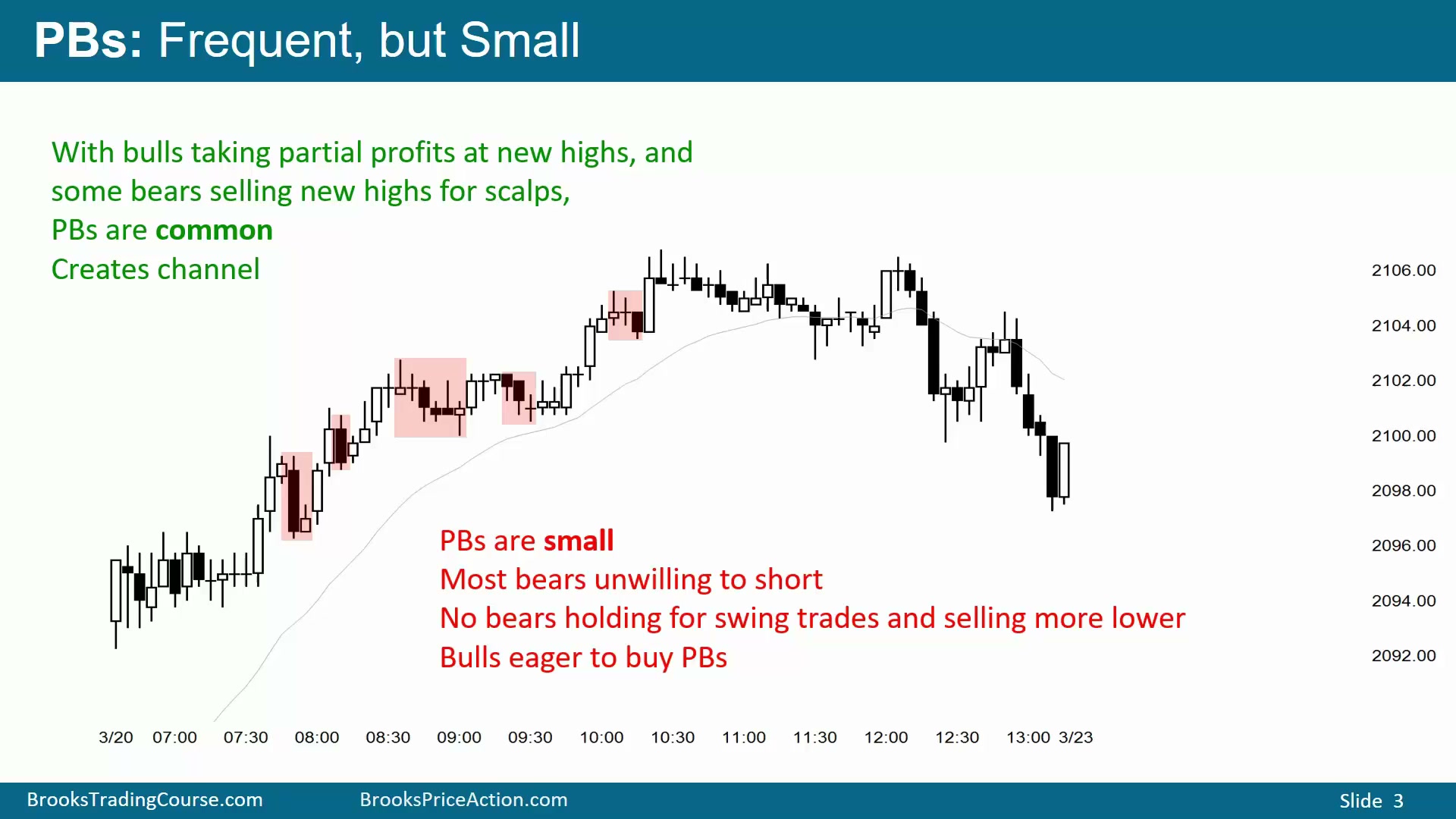
EN: When the market’s in a bull trend, the bulls are always looking for reasons
ZH: 当市场处于上涨趋势时, 多头总是在寻找止盈(至少部分仓位)的机会
02:06 - 02:12
EN: to take at least partial profits, and they’ll take partial profits
ZH: 当市场处于上涨趋势时, 多头总是在寻找止盈(至少部分仓位)的机会 他们会在前期高点附近止盈一部分
02:10 - 02:12
EN: about prior highs or at prior highs.
ZH: 他们会在前期高点附近止盈一部分
02:12 - 02:15
EN: For example, they might take some partial profits here,
ZH: 例如,他们可能会在这里减仓
02:15 - 02:16
EN: and that creates a small pullback.
ZH: 导致有一些小的回调
02:16 - 02:20
EN: We get a new high here, some of the bulls will take partial profits again.
ZH: 在这里创了新高,一些多头会再次止盈一部分
02:20 - 02:21
EN: A pullback.
ZH: 导致回调
02:21 - 02:24
EN: So the pullbacks are common, and that’s what creates the channel.
ZH: 所以回调很常见,这就是形成通道的原因
02:24 - 02:30
EN: We have a breakout, a spike, and then we start getting little pullbacks
ZH: 突破、极速上涨,然后多头卖出止盈,导致开始出现回调
02:28 - 02:30
EN: as bulls take partial profits.
ZH: 突破、极速上涨,然后多头卖出止盈,导致开始出现回调
02:30 - 02:35
EN: Once they see the bears are unable to reverse the market, the bulls buy again,
ZH: 一旦他们看到空头无法反转趋势,就会再次买入
02:35 - 02:40
EN: betting that the reversal attempt will be a bull flag
ZH: 押注反转的尝试会变成牛旗,然后趋势继续上涨
02:38 - 02:40
EN: and that the bull trend will continue higher.
ZH: 押注反转的尝试会变成牛旗,然后趋势继续上涨
02:46 - 02:50
EN: When the pullbacks are small like this, most bears will not short.
ZH: 回调幅度这么小,大多数空头不会做空
02:51 - 02:54
EN: The bears certainly are not going to be holding for a swing trade,
ZH: 尤其不可能去持有做波段交易
02:54 - 02:56
EN: looking to sell more as the market’s going down.
ZH: 不可能在下跌时去加仓做空
02:57 - 03:01
EN: In general, bears will not sell until they see evidence
ZH: 通常来说,空头不会轻易入场,
03:01 - 03:02
EN: that bears can make money selling.
ZH: 除非他们看到了做空能够赚钱的证据 (注:比如大幅的回调,或者很多重叠,等等)
03:03 - 03:07
EN: On the other hand, the bulls are eager to buy the reversal attempts
ZH: 同时,多头迫切地在回调时买入
03:07 - 03:11
EN: because they believe each one will become a bull flag
ZH: 因为他们相信所有的下跌都只是回调,然后上涨趋势会继续
03:10 - 03:11
EN: and that the bull trend will resume.
ZH: 因为他们相信所有的下跌都只是回调,然后上涨趋势会继续
03:11 - 03:14
EN: Until the bears are consistently making money,
ZH: 除非空头能不断地赚钱
03:14 - 03:16
EN: bulls are going to buy aggressively.
ZH: 否则多头就会一直积极地买入
Slide 004
Time: 03:20
Bilingual Transcript
03:22 - 03:25
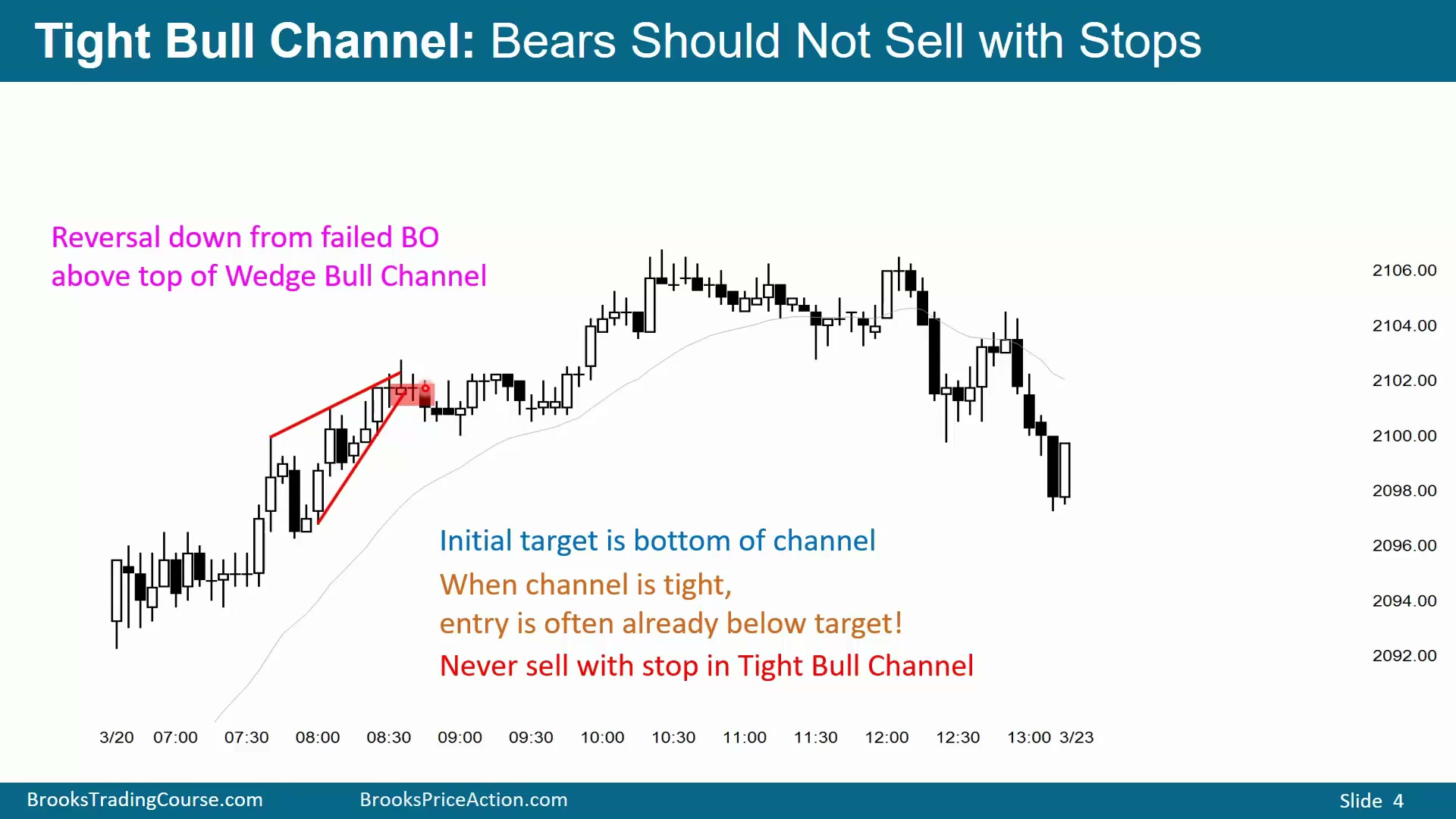
EN: The bears, they see a spike, pullback, second push, pullback,
ZH: 在空头眼中,这是极速上涨、回调;第2推,回调;
03:25 - 03:30
EN: third push, so a Wedge bull channel, and they get a reversal down.
ZH: 第3推;所以是一个楔形的上涨通道,然后开始反转下跌
03:33 - 03:38
EN: Initial target: the beginning of the channel,
ZH: 初始目标:通道的起点,即第1次回调的最低点,在这里
03:36 - 03:38
EN: the bottom of the channel, down here.
ZH: 初始目标:通道的起点,即第1次回调的最低点,在这里
03:41 - 03:43
EN: However, when a channel is tight like this
ZH: 然而,如果通道这么窄——
03:43 - 03:47
EN: - for example, there’s not a pullback in 10 bars.
ZH: 连续上涨了10根K线没有回调 (注:微通道,每一根K线的最低点都在抬高)
03:47 - 03:51
EN: Bulls are going to be eager to buy at or below the low of the prior bar.
ZH: 多头会迫切地在前一根K线最低点及下方挂限价买单
03:51 - 03:54
EN: They’ve been buying above the low of the prior bar for 10 bars.
ZH: 过去10根K线,他们的买入价格始终高于前一根K线的最低点 (言外之意:如果好不容易有在低点下方买入的机会,当然更加愿意)
03:54 - 03:57
EN: Therefore, when you get a very Tight Bull Channel,
ZH: 因此,如果是很窄的上涨通道
03:57 - 03:59
EN: it does not matter that there is a Wedge.
ZH: 3推的楔形结构根本不重要
03:59 - 04:03
EN: If the channel is a Wedge but the pullbacks are very small,
ZH: 如果这个楔形通道中的回调非常小
04:03 - 04:11
EN: it’s not going to lead to much of a reversal, and it’s better to be looking
ZH: 那么它就不会造成大的反转; 所以最好在前一根K线的低点下方逢低买入,而不是卖出做空
04:07 - 04:11
EN: to buy below the low of the prior bar than to sell.
ZH: 那么它就不会造成大的反转; 所以最好在前一根K线的低点下方逢低买入,而不是卖出做空
04:12 - 04:15
EN: Therefore, even though someone might look at this and say
ZH: 有人肯定会这样想:
04:15 - 04:20
EN: “Oh, it’s a spike pullback channel;
ZH: “哦!这是极速变通道,应该会下跌测试通道的起点!” 不对
04:17 - 04:20
EN: it should test down to the beginning of the channel” – no.
ZH: “哦!这是极速变通道,应该会下跌测试通道的起点!” 不对
04:20 - 04:23
EN: When the channel is this tight, the reversal is going to be minor
ZH: 当通道这么窄的时候,基本都是小反转
04:23 - 04:29
EN: and become a bull flag, and more likely you’ll get a Measured Move up
ZH: 然后变成熊旗,更有可能的是涨到MM目标位—— 把这个楔形通道的高度往上翻一倍
04:27 - 04:29
EN: based upon the height of the Wedge.
ZH: 然后变成熊旗,更有可能的是涨到MM目标位—— 把这个楔形通道的高度往上翻一倍
04:29 - 04:32
EN: Breakout, Measured Move up.
ZH: 突破,MM目标位
04:33 - 04:39
EN: I want to be clear about this: whenever you have a channel
ZH: 我想再强调一下:每当市场尝试加速突破上涨通道 (注:只有25%的时候能成功)
04:37 - 04:39
EN: and you have a bull breakout above the channel,
ZH: 我想再强调一下:每当市场尝试加速突破上涨通道 (注:只有25%的时候能成功)
04:39 - 04:44
EN: the initial target is the bottom of the channel, the bull trend line here.
ZH: 初始目标是通道的下沿,也就是这个上涨趋势线
04:44 - 04:48
EN: But when the channel is tight, that target is not far enough for a scalp,
ZH: 但由于通道太窄,目标太近了,连剥头皮都做不了
04:48 - 04:50
EN: and therefore traders cannot sell.
ZH: 所以无法以此为依据做空
04:51 - 04:57
EN: If this was going to be a successful reversal,
ZH: 如果反转成功,空头的目标是整个通道的起点
04:54 - 04:57
EN: the target for the bears would be the beginning of the channel.
ZH: 如果反转成功,空头的目标是整个通道的起点
04:57 - 04:59
EN: Sometimes I call that the bottom of the channel,
ZH: 有时我称之为“通道的底部” (注:在翻译的时候,我全部翻译成通道的起点,而不用底部一词)
04:59 - 05:01
EN: but it’s really the beginning of the channel.
ZH: 但实际上它是通道的起点 (注:因为第一次回调标志着通道阶段的开始)
05:01 - 05:03
EN: The bottom of the channel is the bull trend line here.
ZH: “通道的底部”通常指的是这个上涨趋势线
05:03 - 05:10
EN: The initial target for bears looking to sell a Wedge Top
ZH: 空头在楔形顶做空的第1目标位是通道的下沿,也就是上涨趋势线
05:07 - 05:10
EN: is the bottom of the channel, which is the bull trend line.
ZH: 空头在楔形顶做空的第1目标位是通道的下沿,也就是上涨趋势线
05:10 - 05:13
EN: Their next target is the beginning of the Wedge.
ZH: 下一个目标就是楔形通道的起点
05:15 - 05:19
EN: Whenever a bear is looking to sell a reversal down from a failed breakout
ZH: 在加速突破通道失败后,如果空头要找机会做反转,
05:19 - 05:24
EN: above a bull channel, he’s going to be selling with a stop
ZH: 他会在反转信号K下方用突破卖单入场,
05:23 - 05:28
EN: below the reversal bar and his first target
ZH: 他会在反转信号K下方用突破卖单入场, 第1个目标上涨趋势线,即通道的下沿
05:25 - 05:28
EN: is the bull trend line, the bottom of the channel.
ZH: 第1个目标上涨趋势线,即通道的下沿
05:28 - 05:36
EN: However, when the channel is tight, you’re selling at the first downside target,
ZH: 然而,如果通道太窄,距离第1目标太近,没有利润可言
05:33 - 05:36
EN: and therefore there’s not much profit to be made.
ZH: 然而,如果通道太窄,距离第1目标太近,没有利润可言
05:36 - 05:42
EN: If the channel were broader, you might be hoping
ZH: 如果是宽通道,跌到趋势线的话可以做一笔剥头皮交易
05:39 - 05:42
EN: to get a move down to the beginning of the channel,
ZH: 如果是宽通道,跌到趋势线的话可以做一笔剥头皮交易
05:42 - 05:44
EN: but that’s not likely when the channel is this tight.
ZH: 但在这么窄的通道中没办法这样做
05:48 - 05:53
EN: The lesson is whenever you have a Tight Bull Channel, never sell with a stop.
ZH: 交易者得到的教训是:遇到这么窄的上涨通道, 永远不要用突破卖单入场做空
05:54 - 05:59
EN: Bulls will buy where you’re going short, and they will win and you will lose.
ZH: 多头会在你做空的地方买入(注:用限价买单,正好是你的对手盘) 他们会赚钱,而你会亏钱
Slide 005
Time: 06:00
Bilingual Transcript
06:04 - 06:10
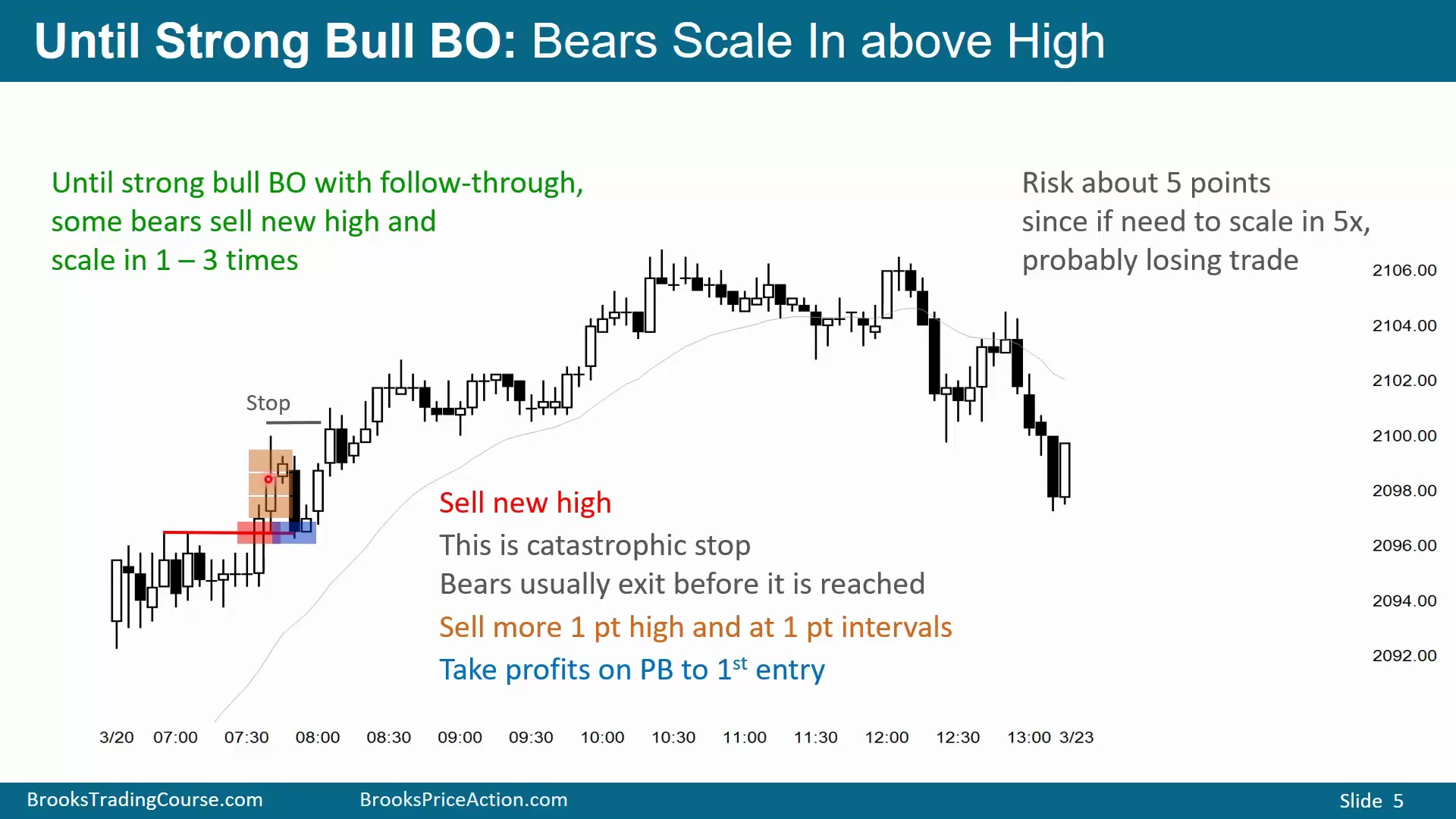
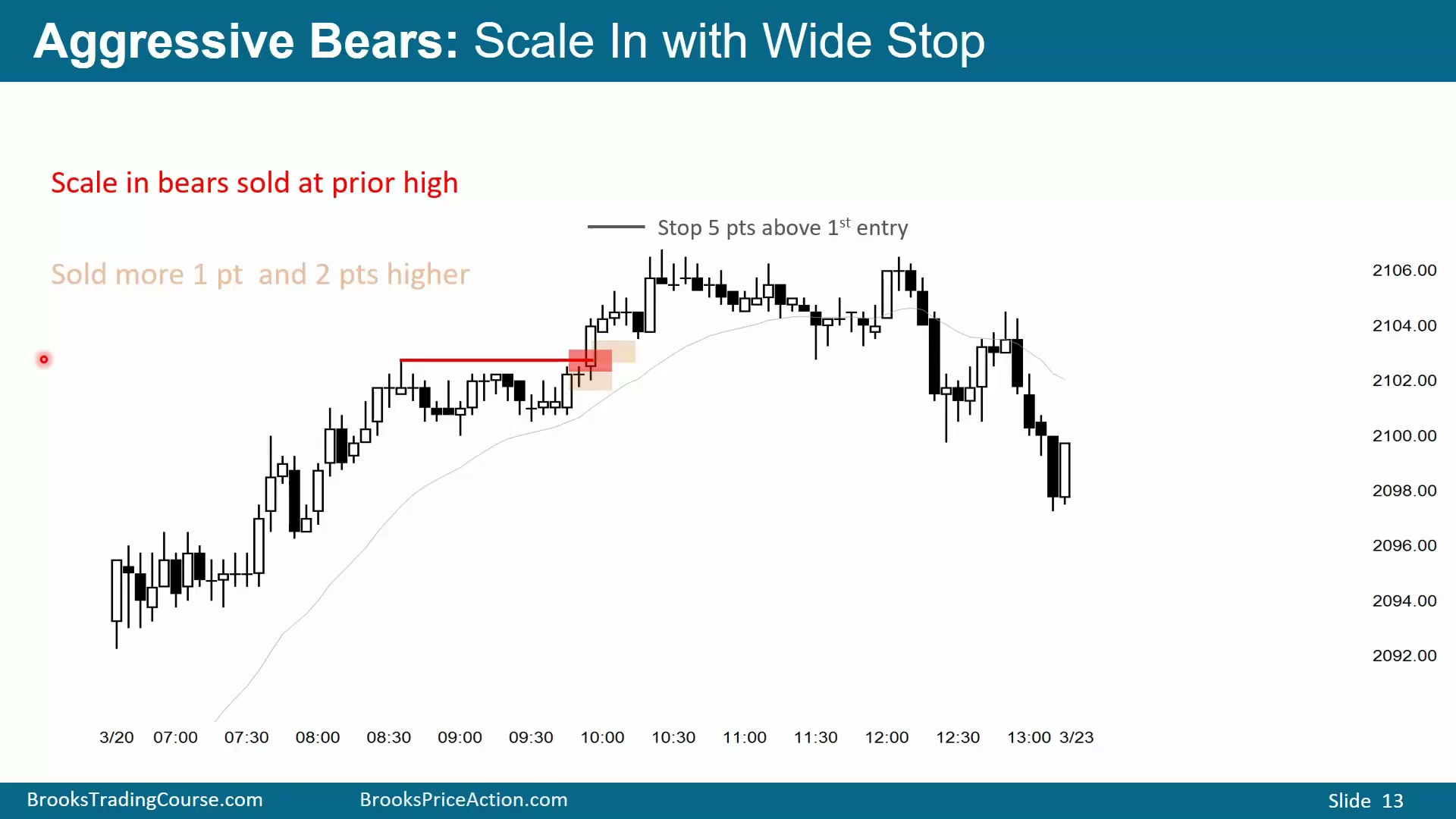
EN: When the market is channeling up like this, some bears will sell every new high
ZH: 当市场像这样在通道中上涨时,一些空头会在每次创新高的时候卖出做空
06:10 - 06:15
EN: and scale in, sometimes one or two or even three times as the market’s going up.
ZH: 然后逢高加仓,有时甚至加两次、三次
06:16 - 06:19
EN: Once there’s a reasonably strong breakout, like this,
ZH: 一旦出现强势的突破,比如这根阳线
06:19 - 06:22
EN: and a follow-through bar, the bears will stop selling.
ZH: 而且还有跟随K线,空头就会放弃
06:22 - 06:26
EN: So a bear who sold here would probably get out and take a loss,
ZH: 所以在之前卖出的空头会在这里止损离场
06:26 - 06:29
EN: and some traders would reverse to long,
ZH: 其中一些人会反手做多
06:29 - 06:32
EN: expecting that the market would recover their loss.
ZH: 希望能够挽回做空的亏损
06:32 - 06:36
EN: So if they sell at this high, they buy on the close of the follow-through bar
ZH: 如果他们在这个高点挂单卖出, 然后在跟随K线的收盘买入回补,并反手做多
06:36 - 06:42
EN: and then exit to recover the size of the loss
ZH: 等利润足以弥补之前做空所产生的亏损时,止盈离场
06:39 - 06:42
EN: that they made on their original sell.
ZH: 等利润足以弥补之前做空所产生的亏损时,止盈离场
06:44 - 06:48
EN: Let’s say for example bears look at this as a Trading Range,
ZH: 假设空头认为市场处于震荡区间
06:48 - 06:51
EN: and he sold with a limit order at this high.
ZH: 并且在这个高点挂限价卖单做空
06:51 - 06:52
EN: He’d get filled right here.
ZH: 他会在这里成交
06:56 - 06:59
EN: Maybe he would risk about 5 points, maybe a Measured Move up
ZH: 假设他设置了5个点的止损,或者把止损放在MM目标位的外面——
06:59 - 07:01
EN: based upon the height of that range.
ZH: 把区间的高度往上翻一倍
07:02 - 07:05
EN: If he risked about 5 points or so, his stop might be up here.
ZH: 他把止损放在5个点的外面,也就是这里
07:06 - 07:08
EN: Why would he want to risk about 5 points?
ZH: 为什么是5个点?
07:08 - 07:12
EN: Let’s say he’s looking to scale in at 1 point intervals.
ZH: 假设他打算每隔1个点就加一次仓
07:12 - 07:16
EN: He might scale in once or twice, sometimes even three times.
ZH: 他可能会加仓一两次,有时甚至3次
07:16 - 07:21
EN: He knows that if he has to scale in five times,
ZH: 他知道,如果到了要加仓四次、五次的地步, 那他肯定被套牢在一笔糟糕的交易中了
07:19 - 07:21
EN: four or five times, he’s in a losing trade.
ZH: 他知道,如果到了要加仓四次、五次的地步, 那他肯定被套牢在一笔糟糕的交易中了
07:21 - 07:26
EN: He’s going to lose money, and therefore if he puts a stop 4 or 5 points
ZH: 那样做会亏钱,所以他需要设置一个限制
07:26 - 07:31
EN: above the first entry and his premise is valid, he should be okay.
ZH: 把止损放在初始入场点上方5个点,如果前提仍然成立, 那么这样做是可行的
07:31 - 07:35
EN: If his stop gets hit, the market’s telling him that his premise is wrong.
ZH: 如果止损被打到,说明他的前提是错误的
07:39 - 07:41
EN: It’s a catastrophic stop.
ZH: 这是一个保护性止损
07:41 - 07:43
EN: You put the stop far away.
ZH: 初始止损比较远
07:43 - 07:45
EN: You’re never planning on letting the stop get hit.
ZH: 你永远不应该真的让它被打到
07:45 - 07:52
EN: Usually there’ll be evidence that you’re wrong
ZH: 通常在打掉止损之前,会有证据表明前提已经不再成立, 一旦你看到那个信号,就应该提前离场
07:48 - 07:52
EN: before the stop gets hit, and once you see that evidence, you get out.
ZH: 通常在打掉止损之前,会有证据表明前提已经不再成立, 一旦你看到那个信号,就应该提前离场
07:52 - 07:55
EN: For example, if you had a limit order to sell at this high
ZH: 例如,如果你在这个高点挂限价卖单做空
07:55 - 07:58
EN: and then you saw a bull bar closing on its high,
ZH: 然后你看到一根阳线收在最高
07:58 - 08:01
EN: you might want to get out if the next bar is a bull bar.
ZH: 下一根还是阳线的话,你就要离场了
08:01 - 08:04
EN: So you exit on the close here or on the close here,
ZH: 所以空头要在它的收盘,或者它的收盘离场
08:04 - 08:06
EN: and do not wait for that stop to be hit.
ZH: 而不是眼睁睁地让保护性止损被打到
08:10 - 08:14
EN: A trader, a bear, might sell at this high, and he might have limit orders
ZH: 一些空头,在这个高点挂单卖出之后,
08:14 - 08:19
EN: in the market to sell more 1 point higher, 2 points higher, 3 points higher.
ZH: 可能会在上方1个点、2个点、3个点的地方挂更多的限价卖单
08:20 - 08:24
EN: After a strong bull bar like this closing above the high of the past 10 bars,
ZH: 看到这样一根强势的阳线,收盘高于过去10根K线
08:24 - 08:28
EN: most traders would cancel their orders to scale in 1 or 2 or 3 points higher.
ZH: 大部分空头会取消上方的这些订单 (注:放弃逆势亏损加仓的做法)
08:28 - 08:32
EN: They would wait to see what the market does before they’d scale in.
ZH: 在加仓之前,他们想要再观察一下(震荡的前提是否成立)
08:36 - 08:40
EN: If a trader did scale in 1, 2, or 3 points higher,
ZH: 如果一个交易者真的在上方1、2、3个点加仓了
08:40 - 08:43
EN: he would probably look to get out breakeven on his first entry
ZH: 他想要市场跌回到他的初始入场价格
08:43 - 08:47
EN: - in other words, on a pullback to below this breakout point.
ZH: ——换句话说,跌回到突破点以下
08:47 - 08:49
EN: And you can see the market went 1 tick below.
ZH: 可以看到,市场跌到了突破点下方1个tick
08:49 - 08:53
EN: Even with that strong bear reversal, it still resumed back up,
ZH: 尽管有这根大阴线,但上涨趋势仍然恢复了
08:53 - 08:58
EN: and this was a pullback from this breakout and not a reversal.
ZH: 所以它只是突破之后的回调,而不是反转
09:00 - 09:01
EN: The bears were lucky here.
ZH: 这里空头非常幸运
09:01 - 09:05
EN: If a bear took this short and sold more 1, 2, 3 points higher,
ZH: 如果他在这里做空,然后在上方1、2、3个点的地方加仓
09:05 - 09:08
EN: he may profit on his three scale-in entries,
ZH: 3次加仓的部分最终能够盈利
09:08 - 09:10
EN: and he’d get out breakeven on his first entry.
ZH: 初始仓位则是打平离场
09:11 - 09:15
EN: As I said, most traders, if they see a strong bull breakout bar like this
ZH: 然而,正如之前所说,大部分空头在看到这样的强势突破后
09:15 - 09:18
EN: and they had a limit order to sell at this high,
ZH: ——他们在这个高点挂的限价卖单已经成交了
09:18 - 09:21
EN: they’d get filled, but they would not sell 1 point higher.
ZH: 但他们不会急着在上方1个点的地方加仓
09:21 - 09:24
EN: They might place a limit order to sell 2 or 3 points higher
ZH: 他们也许会在上方2或3个点的地方加仓
09:24 - 09:28
EN: and then try to avoid a loss and get out at the midpoint
ZH: 然后尝试避免亏损——在两次入场价格的中点离场
09:28 - 09:32
EN: between their second entry – let’s say they sold 3 points higher
ZH: 在第2次入场——假设是距离3个点。 和第1次入场价格的当中
09:31 - 09:32
EN: - and their first entry.
ZH: 在第2次入场——假设是距离3个点。 和第1次入场价格的当中
09:32 - 09:37
EN: They would be so disappointed by the breakout and follow-through
ZH: 突破和跟随非常强势,空头知道还会继续上涨
09:35 - 09:37
EN: that they think the market’s going higher.
ZH: 突破和跟随非常强势,空头知道还会继续上涨
09:37 - 09:41
EN: They simply want to get out to avoid a loss and not worry about a profit.
ZH: 所以能避免亏损就很满足了,他们不再追求盈利
Slide 006
Time: 09:45
Bilingual Transcript
09:48 - 09:51
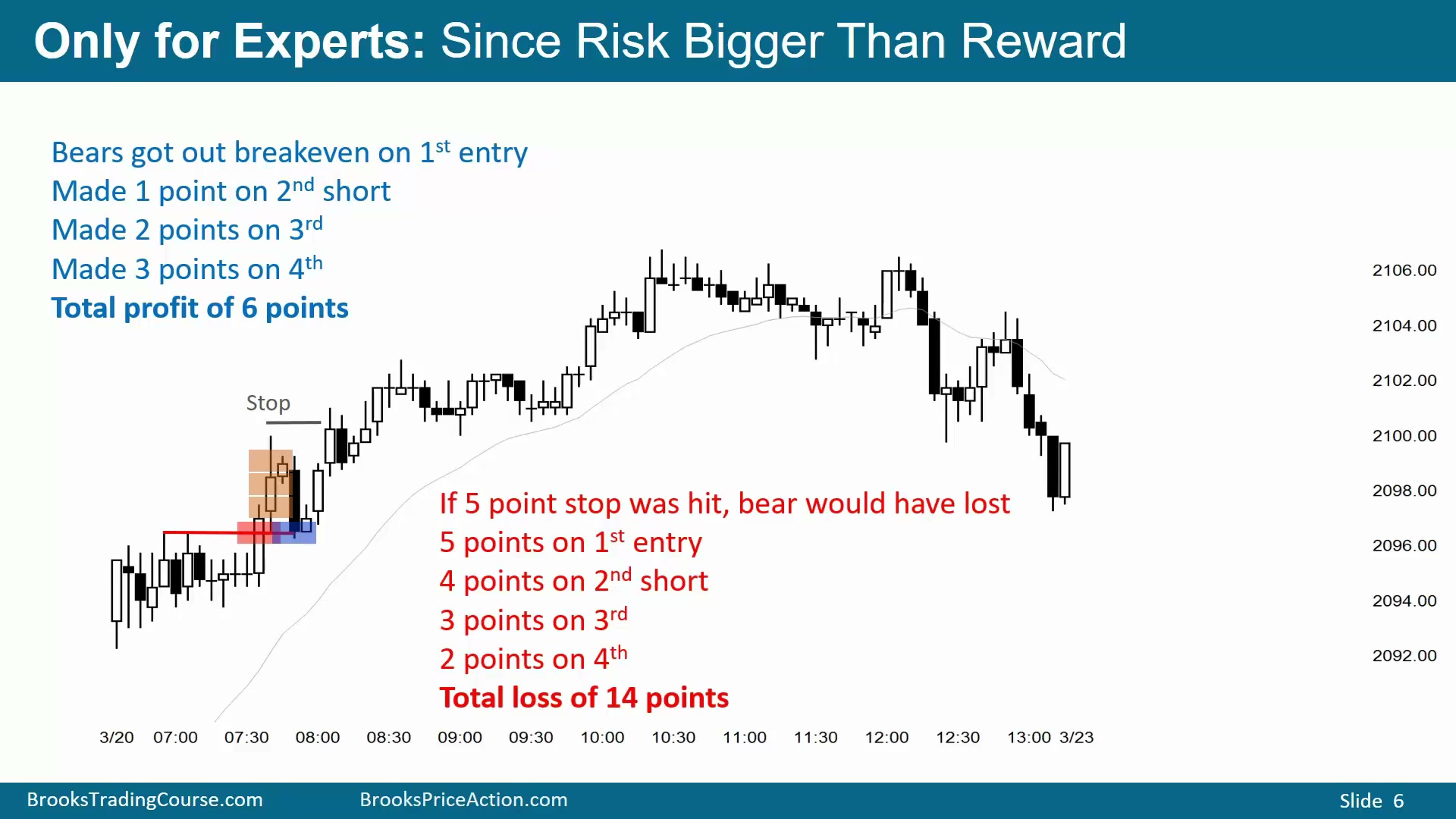
EN: In this particular case, if a trader did sell here and more
ZH: 在这个案例中,如果一个空头在这里做空,
09:51 - 09:55
EN: here and more here and more here, he was lucky.
ZH: 并且在上方不断加仓、加仓,最终他的运气足够好
09:55 - 09:56
EN: He got out breakeven.
ZH: 能够打平离场
09:56 - 10:00
EN: The market fell 1 tick below his original entry at that high.
ZH: 市场跌到了初始入场价格下方1个tick
10:00 - 10:03
EN: He made 1 point on his first scale-in trade,
ZH: 第1次加仓的部分赚了1个点
10:03 - 10:05
EN: 2 points on his second, and 3 points on his third.
ZH: 第2次加仓的部分赚了2个点,第3次加仓的部分赚了3个点
10:05 - 10:08
EN: He made a total of 6 points.
ZH: 他总共赚了6个点
10:09 - 10:12
EN: However, what was his risk?
ZH: 然而,他承担了多少风险?
10:15 - 10:17
EN: If he had a 5 point stop,
ZH: 它的止损距离是5个点
10:17 - 10:21
EN: his risk was 5 points on the first entry, 4 points on the second,
ZH: 初始仓位冒了5个点的风险,第2次入场冒了4个点,
10:21 - 10:28
EN: 3 points on the third, and if he got filled on a fourth,
ZH: 第3次入场冒了3个点,如果还有第4次,那就是再冒2个点的风险, 总共承担了14个点的风险(5+4+3+2)
10:24 - 10:28
EN: he would’ve had 2 points risk on that, and his total risk was 14 points.
ZH: 第3次入场冒了3个点,如果还有第4次,那就是再冒2个点的风险, 总共承担了14个点的风险(5+4+3+2)
10:28 - 10:30
EN: Yet he only made 6 points.
ZH: 然而他只赚了6个点
10:31 - 10:34
EN: That means you need an extremely high winning percentage
ZH: 这意味着你需要保持极高的胜率才能盈利 (注:至少85%才能较好地盈利)
10:34 - 10:39
EN: to make this profitable, and that’s beyond what most traders can do.
ZH: 绝大部分交易者没有这样的能力
10:43 - 10:49
EN: The scale-in bear in this particular case
ZH: 在这个特定的案例中,加仓的空头冒着14个点的风险,赚了6个点
Slide 007
Time: 10:45
Bilingual Transcript
10:46 - 10:49
EN: ended up risking 14 points to make 6 points.
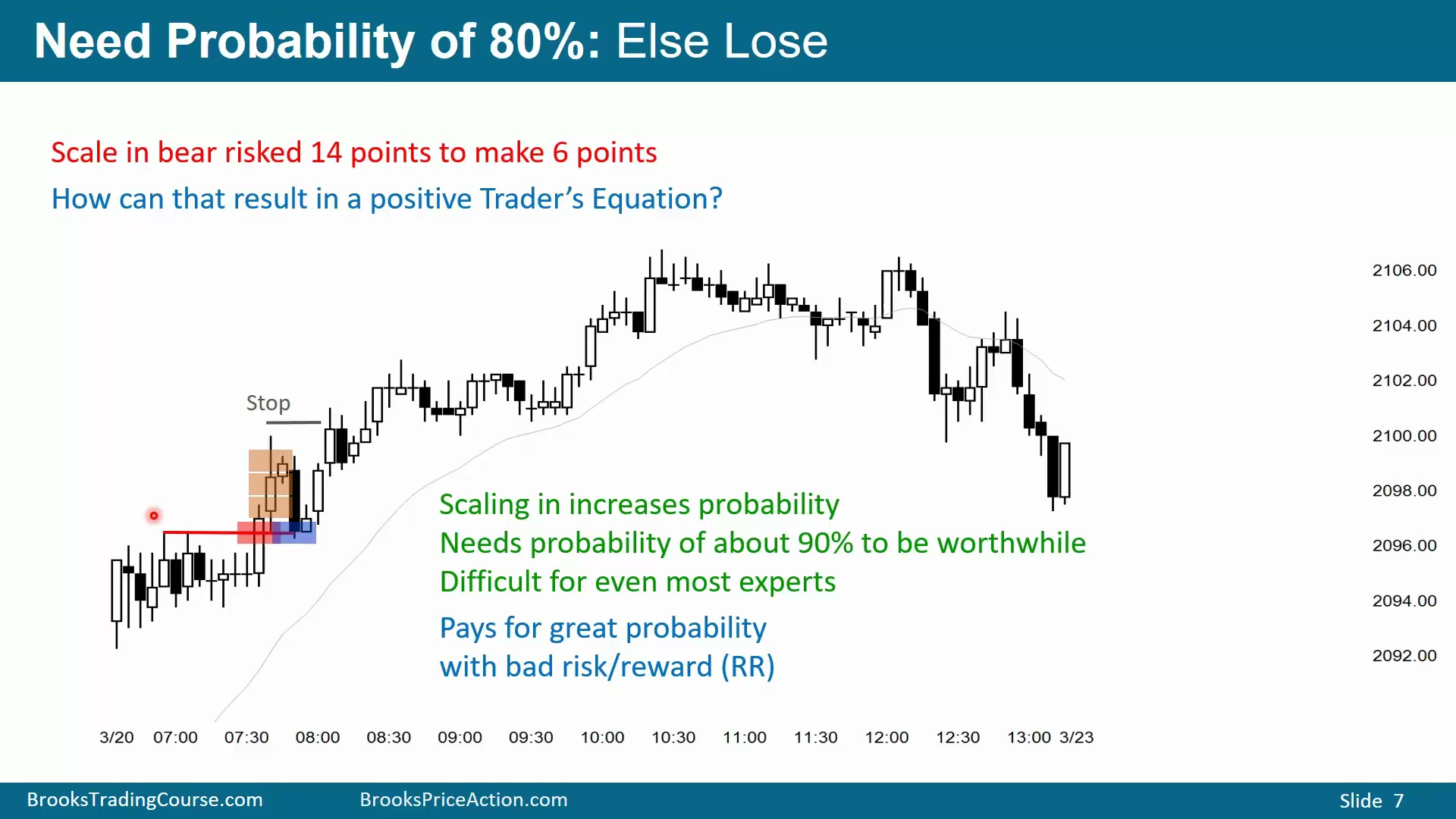
ZH: 在这个特定的案例中,加仓的空头冒着14个点的风险,赚了6个点
10:50 - 10:54
EN: Can that result in a positive Trader’s Equation? Well, it can.
ZH: 能否得到一个正的数学期望?不是不行
10:58 - 11:02
EN: Scaling into any trade increases the probability of success,
ZH: 加仓可以提高盈利的概率
11:02 - 11:05
EN: the probability of making money, the probability of avoiding loss.
ZH: 提高赚钱的概率,提高避免亏损的概率
11:06 - 11:11
EN: However, it comes at the price of increased risk.
ZH: 然而,代价是风险成倍增加
11:11 - 11:19
EN: In a situation like this, you have to be probably 90% certain
ZH: 在这种情况下,你必须有超过90%的把我,才能这样加仓
11:16 - 11:19
EN: of making money doing the scale-in trade to take the trade,
ZH: 在这种情况下,你必须有超过90%的把我,才能这样加仓
11:19 - 11:23
EN: because if you’re risking more than two times your reward,
ZH: 如果风险是利润的两倍以上
11:23 - 11:29
EN: it’s not worth taking the trade unless you’re 90% confident
ZH: 除非确定性高达90%,否则这样的交易是不值得做的
11:27 - 11:29
EN: that you’re going to succeed.
ZH: 除非确定性高达90%,否则这样的交易是不值得做的
11:29 - 11:33
EN: 90% certainty is very rare.
ZH: 极少数行情有90%的确定性
11:33 - 11:39
EN: Even expert traders rarely will look at a trade and say
ZH: 即使是专业的交易员,也很少说: “哦耶,90%的概率我可以赚到钱”
11:36 - 11:39
EN: “Oh yeah, there’s a 90% chance I’m going to make money.”
ZH: 即使是专业的交易员,也很少说: “哦耶,90%的概率我可以赚到钱”
11:43 - 11:48
EN: Again, you pay for high probability with bad risk/reward.
ZH: 再次强调,这样做是在用成倍增加的风险,来换取更高的胜率
11:48 - 11:58
EN: If you’re scaling into a trade, you’re increasing the probability
ZH: 亏损加仓虽然增加了赚钱的胜率, 但代价是风险也增加了,而且通常利润会减少
11:51 - 11:58
EN: of making money, but you’re paying for it
ZH: 亏损加仓虽然增加了赚钱的胜率, 但代价是风险也增加了,而且通常利润会减少
11:54 - 11:58
EN: with increased risk and usually diminished reward.
ZH: 亏损加仓虽然增加了赚钱的胜率, 但代价是风险也增加了,而且通常利润会减少
Slide 008
Time: 12:00
Bilingual Transcript
12:05 - 12:08
EN: Most experts would not scale in like this.
ZH: 绝大部分高手不会这样子加仓
12:08 - 12:12
EN: As I said, if they took this short, they might scale in once
ZH: 正如之前所说,如果在这里做空了,
12:12 - 12:15
EN: they see the big tail on this breakout bar,
ZH: 他们也许会在看到长上影线之后加仓一次
12:15 - 12:17
EN: but most would simply get out and take a loss.
ZH: 但大部分人会选择直接认亏离场
12:18 - 12:27
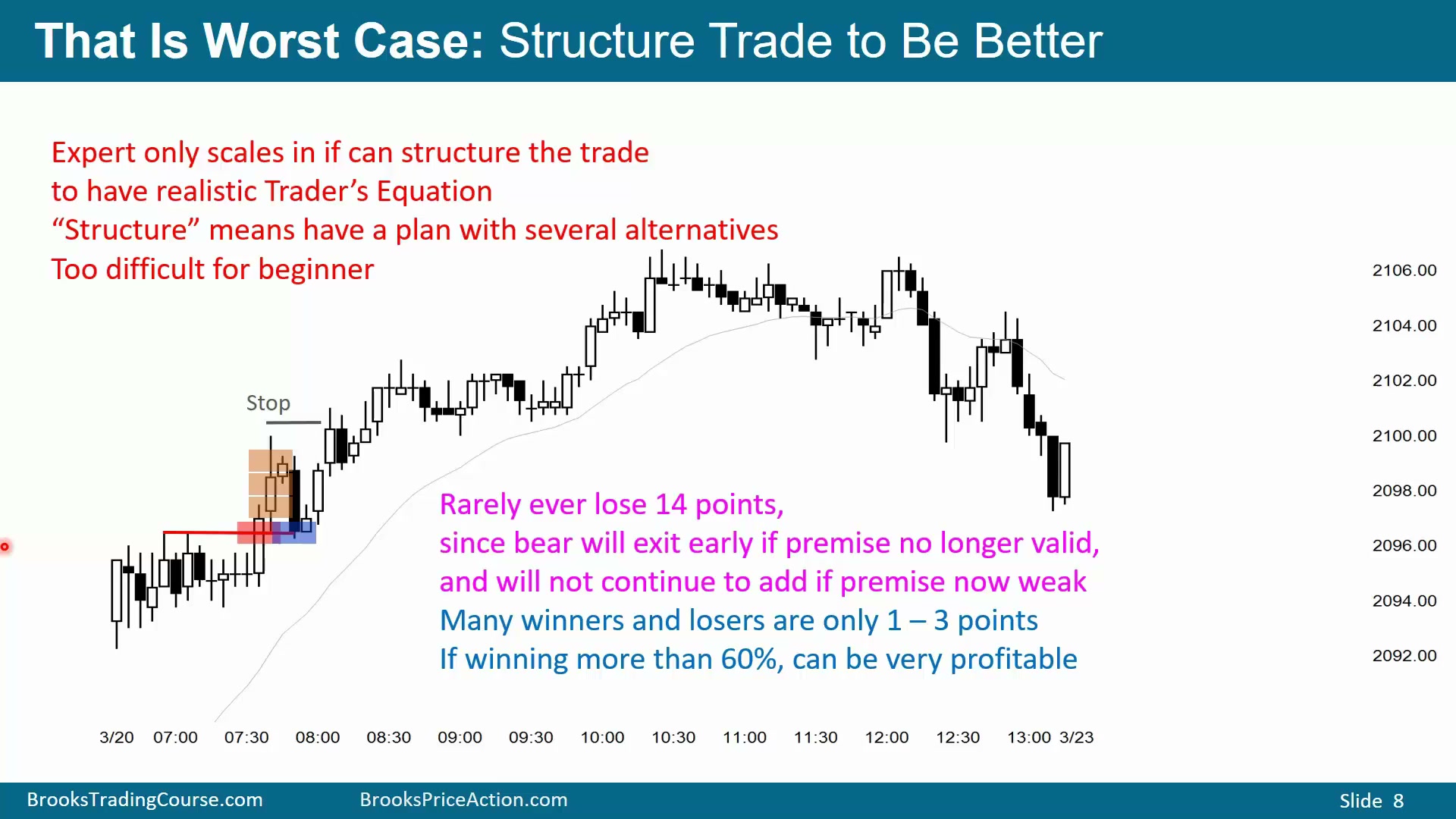
EN: An expert will only scale into a trade if he can look
ZH: 专业交易员加仓的前提是: 他觉得自己能够构建一笔数学期望足够好的交易
12:21 - 12:27
EN: at the trade and structure it in a way
ZH: 专业交易员加仓的前提是: 他觉得自己能够构建一笔数学期望足够好的交易
12:23 - 12:27
EN: so that he feels like he has a reasonably good Trader’s Equation.
ZH: 专业交易员加仓的前提是: 他觉得自己能够构建一笔数学期望足够好的交易
12:27 - 12:31
EN: And when I say structure a trade, I mean you have to have a plan
ZH: “构建一笔交易”的意思是:你必须有一个计划
12:31 - 12:35
EN: with several alternatives and you have to be willing to make very quick changes,
ZH: 还要有几个替代方案,并且你能够非常快速地根据行情改变思路
12:35 - 12:37
EN: and that’s something that beginners cannot do.
ZH: 这是新手无法做到的
12:37 - 12:40
EN: So beginners should not be scaling into trades,
ZH: 所以新手不应该加仓
12:40 - 12:43
EN: especially scaling into trades against a trend.
ZH: 尤其不应该逆势亏损加仓 (注:最真诚的建议,在稳定盈利之前不要考虑加仓这件事)
12:43 - 12:46
EN: It’s a different thing to be scaling into trades with the trend
ZH: 顺着趋势盈利加仓是另一回事
12:46 - 12:49
EN: - for example, buy this bar and then buy more above here,
ZH: 比如,在这根K线买入,然后在上方盈利加仓
12:49 - 12:52
EN: a High 2 bull flag, or here, a Triangle.
ZH: 高2牛旗,或者这里,三角形牛旗
12:52 - 12:58
EN: That is something beginners can do if their account is big enough
ZH: 如果账户足够大,初始仓位足够小,是可以这样盈利加仓的
12:57 - 12:58
EN: and if they’re trading small enough.
ZH: 如果账户足够大,初始仓位足够小,是可以这样盈利加仓的
13:04 - 13:13
EN: I talked about how if this stop got hit, the bears who took all of these trades,
ZH: 刚才讲到,如果这个止损被打到, 那些多次加仓的空头,最终会亏损14个点
13:09 - 13:13
EN: scaling into their trade, would lose 14 points.
ZH: 刚才讲到,如果这个止损被打到, 那些多次加仓的空头,最终会亏损14个点
13:13 - 13:19
EN: However, as I said, it’s really important to know
ZH: 而真正优秀的交易员不会让这种事情发生,这才是关键
13:16 - 13:19
EN: that experienced traders are not going to let that happen.
ZH: 而真正优秀的交易员不会让这种事情发生,这才是关键
13:19 - 13:22
EN: They’ll rarely ever let their wide stop get hit.
ZH: 他们很少会让宽止损真的被打到
13:22 - 13:27
EN: They’ll decide that their trade is bad long before their stop gets hit,
ZH: 在止损被打掉之前,他们能意识到情况不对
13:27 - 13:29
EN: and they’ll get out with a much smaller loss.
ZH: 于是提前以较小的亏损离场
13:30 - 13:34
EN: You’re not going to keep adding to a trade once you decide the trade is bad.
ZH: 一旦你发现前提不再成立,就不应该继续加仓了
13:35 - 13:39
EN: So for example, let’s say you took the first entry selling here
ZH: 例如,假设你一开始在这里入场做空
13:39 - 13:41
EN: and you placed a limit order to sell more here
ZH: 然后你在上方挂了限价卖单,打算加仓
13:41 - 13:43
EN: and you get filed at the high of that bar.
ZH: 加仓的卖单在这里成交
13:43 - 13:48
EN: Most traders will just get out at the market, or they’ll get out on that close.
ZH: 优秀的交易员会市价止损离场,或者在跟随阳线的收盘离场
13:48 - 13:51
EN: You’re going to decide that the premise is bad and that we’re going higher.
ZH: 因为震荡区间的前提已经不再成立,市场会继续上涨
13:51 - 13:54
EN: And if you’re fast enough, not only will you get out,
ZH: 如果反应足够快,你不仅要止损离场,
13:54 - 13:57
EN: you’ll buy looking for at least a small second leg up.
ZH: 还应该反手做多,押注至少会有小的第2段上涨
14:02 - 14:08
EN: For scale-in traders, most of the losers and winners are only 1 to 3 points,
ZH: 对于加仓的交易者而言,大部分交易的盈亏都在1~3个点之间
14:08 - 14:12
EN: but if you’re winning more than 60% of the time,
ZH: 如果胜率超过60%
14:12 - 14:14
EN: that is a very profitable strategy.
ZH: 那就是一个可以盈利的策略
14:15 - 14:19
EN: High probability can offset bad risk/reward.
ZH: 高胜率可以弥补糟糕的盈亏比
14:19 - 14:22
EN: Bad risk/reward means big risk and small profits.
ZH: 盈亏比糟糕,代表风险大、利润小
14:23 - 14:29
EN: And that’s usually what you’re doing
ZH: 如果你在上涨趋势中逆势做空、且不断加仓, 通常盈亏比就很糟糕(注:而且胜率也不高)
14:25 - 14:29
EN: if you’re scaling into shorts in a bull trend.
ZH: 如果你在上涨趋势中逆势做空、且不断加仓, 通常盈亏比就很糟糕(注:而且胜率也不高)
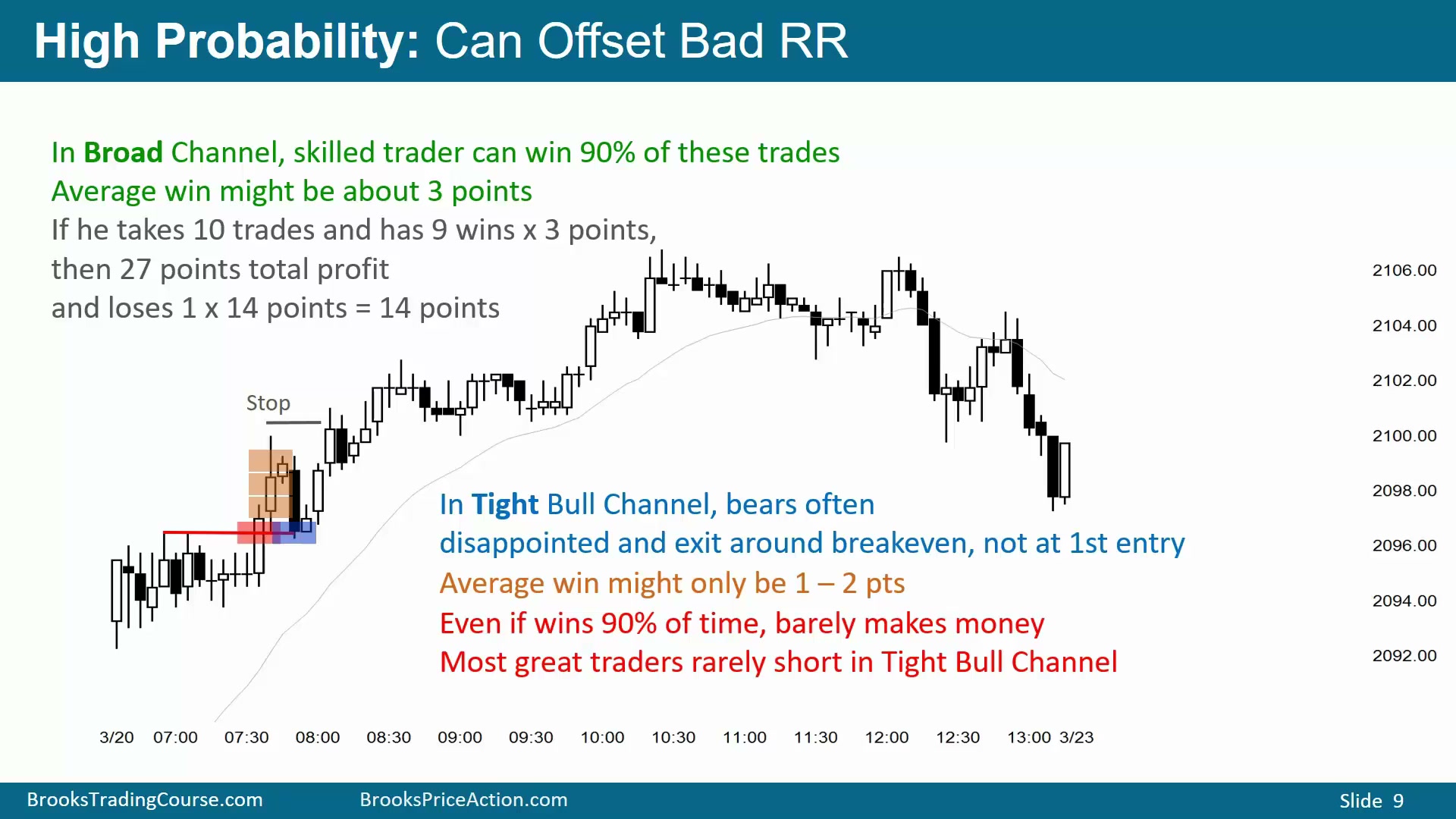
Slide 009
Time: 14:30
Bilingual Transcript
14:37 - 14:40
EN: If the channel is broad, a skilled trader can scale
ZH: 如果是宽上涨通道,一个技巧丰富的空头
14:40 - 14:45
EN: into shorts above prior highs and win 90% of the times.
ZH: 通过在前期高点做空、并逢高加仓的做法, 可以保持90%的胜率
14:46 - 14:48
EN: His average win might be 3 points, might be more.
ZH: 他的平均盈利大约是3个点,甚至更多
14:48 - 14:55
EN: So if he takes 10 trades and has 9 wins,
ZH: 如果他做了10笔交易,其中9笔盈利,每次盈利3个点, 总的利润是27个点
14:51 - 14:55
EN: each for 3 points, he wins a total of 27 points.
ZH: 如果他做了10笔交易,其中9笔盈利,每次盈利3个点, 总的利润是27个点
14:55 - 14:59
EN: And if he loses one time, times 14 points,
ZH: 假设在那笔亏损的交易中,他亏了14个点
15:00 - 15:05
EN: he would have a 14 point loss compared to his 27 points win.
ZH: 27减14,还剩13个点的利润 (注:盈亏比3/14,胜率0.9,数学期望为0.09)
15:05 - 15:07
EN: Again, that is not this trade.
ZH: 我指的不是这种情况
15:07 - 15:11
EN: That is if the channel is broad, which this is not.
ZH: 我说的是在宽通道中那样做
15:16 - 15:23
EN: In a very Tight Channel – here, we have at this point a 6
ZH: 而这是一个很窄的通道——这里,微通道持续了7根K线, 通道很窄
15:20 - 15:23
EN: or 7 bar bull Micro Channel; that’s a Tight Channel
ZH: 而这是一个很窄的通道——这里,微通道持续了7根K线, 通道很窄
15:24 - 15:28
EN: - all the way up here, no pullback for 10 bars, very Tight Channel,
ZH: 一直涨到这里,连续10根K线没有回调,非常窄
15:29 - 15:32
EN: anyone scaling in is going to be disappointed
ZH: 所有加仓的空头都会感到非常失望
15:32 - 15:34
EN: and he’s going to exit pretty quickly.
ZH: 他们很快就会放弃
15:34 - 15:37
EN: So for example, if a trader did take this short
ZH: 如果一个空头在这里做空,
15:37 - 15:40
EN: and he sold any of these additional shorts,
ZH: 然后在某个地方加仓了
15:40 - 15:44
EN: he’ll probably try to avoid a loss rather than make a profit.
ZH: 他不再想着盈利,只要不亏损就谢天谢地了
15:45 - 15:50
EN: That means that instead of holding, hoping to get out breakeven on
ZH: 也就是说,他不会继续持有, 不再寄希望于市场跌回到他的初始入场价格
15:49 - 16:02
EN: - on his first entry, he’ll look at his average price and simply hope
ZH: 也就是说,他不会继续持有, 不再寄希望于市场跌回到他的初始入场价格 而是会关注平均入场价格,希望市场能够回调到那里, 让他的总仓位可以在平均价格打平离场
15:53 - 16:02
EN: that the market comes down far enough
ZH: 而是会关注平均入场价格,希望市场能够回调到那里, 让他的总仓位可以在平均价格打平离场
15:55 - 16:02
EN: so that it reaches his average entry price,
ZH: 而是会关注平均入场价格,希望市场能够回调到那里, 让他的总仓位可以在平均价格打平离场
15:59 - 16:02
EN: allowing him to get out breakeven on his entire trade.
ZH: 而是会关注平均入场价格,希望市场能够回调到那里, 让他的总仓位可以在平均价格打平离场
16:02 - 16:08
EN: This means that the trader taking this short,
ZH: 在这里做空的空头,看到突破之后会说: “哎哟,太厉害了
16:05 - 16:08
EN: if he looks at the rally, he’s saying, “Oh, this is too strong.
ZH: 在这里做空的空头,看到突破之后会说: “哎哟,太厉害了
16:08 - 16:12
EN: I’m going to give up my idea of making a profit.
ZH: 这笔交易也别想着赚钱了
16:12 - 16:16
EN: I’m simply going to scale in to avoid a loss,
ZH: 加仓之后,能避免亏损就很好了
16:15 - 16:27
EN: thinking that there’ll be a pullback that drops far enough
ZH: 加仓之后,能避免亏损就很好了 希望回调足够深,跌回到我的平均成本, 跌回到两次入场价格的中点。”
16:19 - 16:27
EN: so that I can get out without a loss.
ZH: 希望回调足够深,跌回到我的平均成本, 跌回到两次入场价格的中点。”
16:21 - 16:27
EN: It’ll fall below my average entry price,
ZH: 希望回调足够深,跌回到我的平均成本, 跌回到两次入场价格的中点。”
16:23 - 16:27
EN: my first entry and wherever my second entry is.”
ZH: 希望回调足够深,跌回到我的平均成本, 跌回到两次入场价格的中点。”
16:31 - 16:35
EN: When the channel is tight, if you are scalping shorts,
ZH: 当上涨通道很窄的时候,如果你做空剥头皮
16:35 - 16:39
EN: your average win is probably only going to be 1 point, maybe 2 points.
ZH: 平均利润可能只有一两个点
16:39 - 16:42
EN: Very difficult way to make a living.
ZH: 这样做很难赚钱谋生
16:42 - 16:47
EN: I personally do not sell above bars when the channel is tight.
ZH: 在窄通道中,我个人不会在K线上方挂单做空
16:47 - 16:48
EN: I’m only looking to buy.
ZH: 我只考虑买入
16:48 - 16:53
EN: However, once the market becomes two-sided, or if the channel becomes broad,
ZH: 然而,一旦出现震荡的价格行为,或者通道变得更宽
16:53 - 16:57
EN: then I would consider selling at prior highs and scaling in higher.
ZH: 我才会考虑在前期高点挂单做空,然后逢高加仓
17:02 - 17:10
EN: Again, if you’re scalping for 1 point in a Tight Bull Channel,
ZH: 再次强调,在窄上涨通道中,如果你在前期高点挂单做空, 每次赚1个点,你的胜率需要高达90%
17:06 - 17:10
EN: selling at prior highs, you have to win 90% of the time.
ZH: 再次强调,在窄上涨通道中,如果你在前期高点挂单做空, 每次赚1个点,你的胜率需要高达90%
17:10 - 17:13
EN: Even then, you’re barely going to make any money.
ZH: 即使如此,你也几乎赚不到什么钱 (注:利润只有1个点,那么手续费的比例就变得很大)
17:14 - 17:18
EN: Most great traders are rarely going to short in a Tight Bull Channel
ZH: 优秀的交易者不会在窄上涨通道做空
17:18 - 17:20
EN: because they know the math is bad.
ZH: 因为他们知道这样做在数学上不合理
17:20 - 17:22
EN: It makes much more sense to do the opposite.
ZH: 反过来做更加好——
17:22 - 17:27
EN: Buy breakouts, buy closes, buy bear closes,
ZH: 买突破、买收盘、买阴线的收盘
17:27 - 17:29
EN: buy below bars betting reversals will fail.
ZH: 在K线下方买入,押注反转会失败
17:29 - 17:37
EN: And because of that, an experienced trader is not going to be selling
ZH: 因此,有经验的交易员不会在一个很窄的上涨通道中做空
17:34 - 17:37
EN: in a very Tight Bull Channel.
ZH: 因此,有经验的交易员不会在一个很窄的上涨通道中做空
Slide 010
Time: 17:40
Bilingual Transcript
17:42 - 17:45
EN: I always pay attention to whether or not bears can make money,
ZH: 我总是关注空头是否能赚钱,
17:45 - 17:48
EN: and that’s really, really important.
ZH: 这真的非常重要
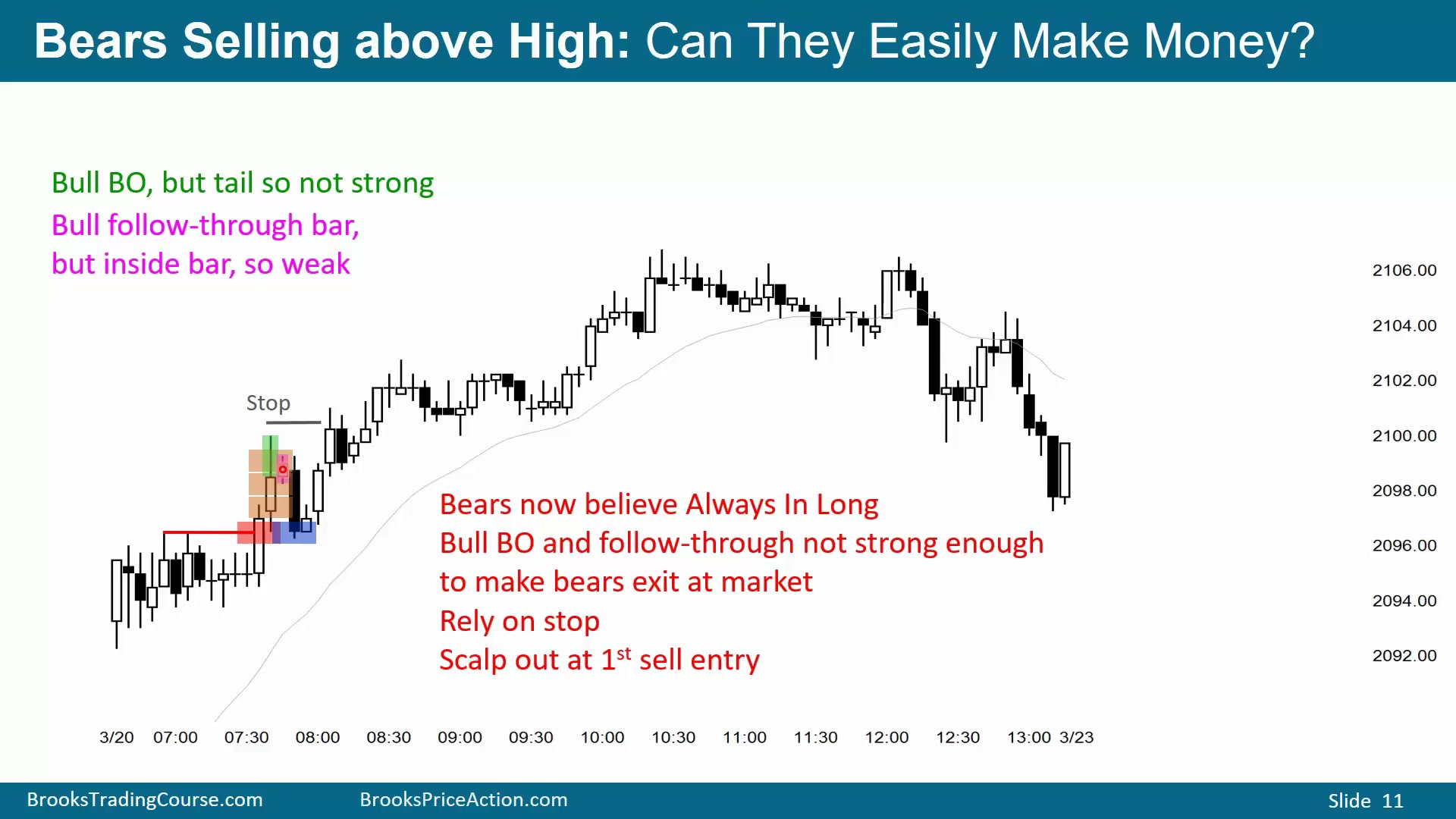
Slide 011
Time: 17:49
Bilingual Transcript
17:52 - 18:01
EN: If the market’s in a bull trend and the bears are having a very difficult time
ZH: 如果市场处于上涨趋势,且空头很难赚到钱, 这告诉了我两件事:一,我不想做空
17:56 - 18:01
EN: making money, that tells me two things: one, I don’t want to be shorting;
ZH: 如果市场处于上涨趋势,且空头很难赚到钱, 这告诉了我两件事:一,我不想做空
18:01 - 18:05
EN: and two, I can buy for any reason at any time
ZH: 二,我可以在任何时候、用任何方式买入
18:05 - 18:07
EN: and I’ll have a very good chance of making money.
ZH: 有很大的概率可以赚钱
18:07 - 18:10
EN: I’m always looking at every breakout.
ZH: 我总是在关注每一次突破
18:11 - 18:14
EN: Will the market reverse down enough to make money?
ZH: 回调的幅度是否足够让空头赚钱?
18:14 - 18:18
EN: If a bear sells that high and he scales in higher, can he make money?
ZH: 如果空头在那个高点挂单做空,并且逢高加仓,他能赚钱吗?
18:18 - 18:21
EN: Is it easy to make money as a bear? And if it’s not,
ZH: 做空容易赚钱吗?如果不容易
18:21 - 18:24
EN: then I’m going to be buying every reversal down,
ZH: 那么我就会在每次下跌的时候都逢低买入
18:24 - 18:28
EN: betting that the reversals will fail and that the trend will continue up.
ZH: 押注反转会失败,押注趋势会继续上涨
18:32 - 18:36
EN: Here, you can argue we have a breakout and more breakout here,
ZH: 这里,突破K线,又一根突破K线
18:36 - 18:39
EN: but a big tail, so maybe the market’s not all that strongly bullish.
ZH: 但是上影线很长,所以也许没有那么强势
18:42 - 18:46
EN: Also, the follow-through bar is small,
ZH: 此外,第3根阳线的体积很小
18:46 - 18:53
EN: so it’s not a particularly strong follow-through bar, so you can argue
ZH: 不是特别强的跟随K线,所以你可以说突破之后的跟随令人感到失望
18:49 - 18:53
EN: that we’re getting disappointing follow-through from the breakout.
ZH: 不是特别强的跟随K线,所以你可以说突破之后的跟随令人感到失望
19:00 - 19:02
EN: The bears believe the market is Always In Long.
ZH: 空头知道市场处于单边上涨
19:02 - 19:05
EN: We have a breakout, we have more breakout, we have follow-through.
ZH: 大阳线突破,突破继续,而且有跟随
19:06 - 19:09
EN: However, they also look at it and say, well, that big tail,
ZH: 然而,从另一个角度看,上影线很长,
19:09 - 19:15
EN: that small follow-through bar – maybe we’ll get a pullback
ZH: 跟随K线太小——也许会有一些回调, 也许幅度足够做空剥头皮
19:12 - 19:15
EN: that drops far enough down for a scalp.
ZH: 跟随K线太小——也许会有一些回调, 也许幅度足够做空剥头皮
19:16 - 19:26
EN: If a bear did short and scale in higher, or if he did not take that short
ZH: 如果空头在这里做空并逢高加仓; 或者他之前没有做空,直接在它或者它的收盘开仓做空
19:22 - 19:26
EN: and simply sold at the close of this bar or at the close of that bar,
ZH: 如果空头在这里做空并逢高加仓; 或者他之前没有做空,直接在它或者它的收盘开仓做空
19:26 - 19:30
EN: he’s going to be looking for a scalp, a 1 point scalp.
ZH: 他的目的是做一笔剥头皮交易——赚(至少)1个点
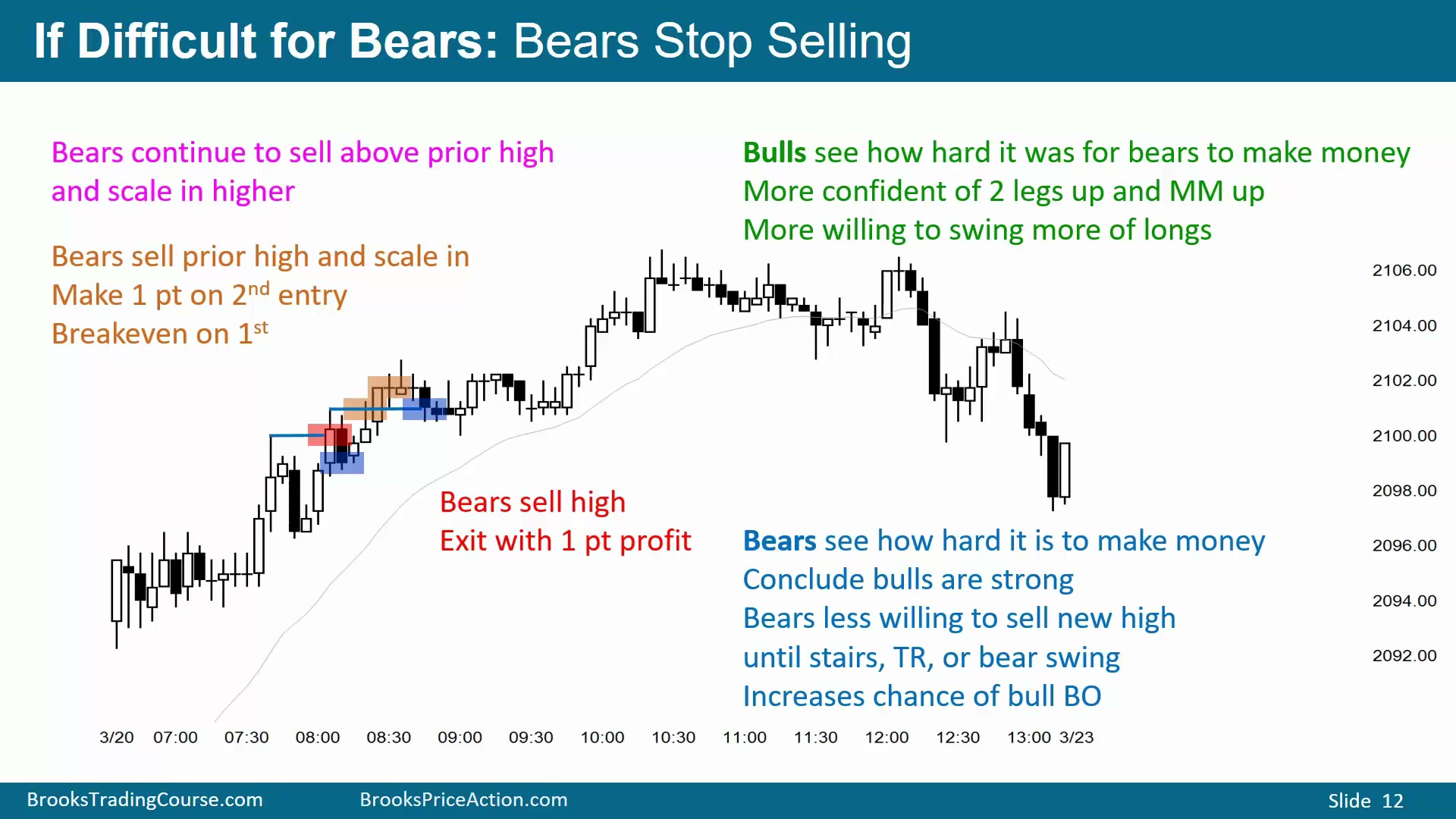
Slide 012
Time: 19:34
Bilingual Transcript
19:36 - 19:40
EN: Since the bears made money selling this high and scaling in higher
ZH: 空头在这个高点挂单做空并且逢高加仓,他们赚到了钱
19:40 - 19:44
EN: - this low fell below the breakout point – some bears will continue to do that.
ZH: ——回调低于突破点—— 于是一些空头会继续这样做
19:44 - 19:47
EN: We have a new high here, we have a breakout.
ZH: 突破前期高点、创新高
19:47 - 19:49
EN: Some bears will sell that high.
ZH: 一些空头会在这个高点挂单做空
19:49 - 19:51
EN: But did they make money? Probably not.
ZH: 这次他们能赚到钱吗?大概率不行
19:51 - 19:54
EN: And then we have a new high here and a bull breakout.
ZH: 市场再次突破创新高
19:54 - 19:57
EN: Did the bears make money selling this high, scaling in higher?
ZH: 在这个高点挂单卖出并逢高加仓,能赚到钱吗?
19:57 - 20:02
EN: Maybe, but they clearly did not make much, and it was not all that easy to do.
ZH: 就算能,也只是一点点利润,非常困难
20:02 - 20:06
EN: It’s difficult for the bears to make money selling prior highs.
ZH: 空头很难通过在前期高点挂单做空的方式赚钱
20:09 - 20:16
EN: Here, they sold at that high and the market pulled back
ZH: 这里,他们在那个高点挂单卖出 回调的幅度正好能让他们赚到1个点
20:14 - 20:16
EN: just enough for them to exit with a 1 point profit.
ZH: 这里,他们在那个高点挂单卖出 回调的幅度正好能让他们赚到1个点
20:21 - 20:24
EN: Bears sell this high, sell more 1 point higher.
ZH: 空头在这个高点挂单卖出,在上方1个点加仓
20:24 - 20:26
EN: It dropped back below this high,
ZH: 市场回调到前期高点的下方
20:26 - 20:29
EN: and they were able to make 1 point on that scalp as well.
ZH: 这里空头也赚到了1个点
20:29 - 20:34
EN: Breakeven on their first entry at that high,
ZH: 初始仓位打平,加仓的部分赚1个点
20:31 - 20:34
EN: and then with a 1 point profit on their second entry.
ZH: 初始仓位打平,加仓的部分赚1个点
20:43 - 20:46
EN: Bears see that they’re barely making money on their shorts,
ZH: 空头发现,做空几乎赚不到什么钱
20:46 - 20:51
EN: and as soon as it hits their limit order
ZH: 而且价格一碰到他们的止盈买单,就立刻恢复上涨
20:48 - 20:51
EN: to buy back their shorts with a profit, it continues up.
ZH: 而且价格一碰到他们的止盈买单,就立刻恢复上涨
20:52 - 20:54
EN: To me, this is not easy for the bears to make money.
ZH: 在我看来,空头很难赚到钱
20:55 - 20:59
EN: When I see a situation like this where the market barely falls far enough
ZH: 当我看到这样的情况:回调幅度不足以让空头赚钱,
20:59 - 21:03
EN: for them to make money and they have to scale in to make 1 point scalp,
ZH: 必须通过加仓的方式来赚1个点的剥头皮
21:03 - 21:05
EN: I think it’s not worth shorting.
ZH: 我认为做空是不值得的
21:05 - 21:08
EN: The bear reversal attempts will fail and become bull flags.
ZH: 反转下跌的尝试会失败,并成为牛旗
21:10 - 21:13
EN: The bears will decide that the bulls are very strong,
ZH: 空头会感觉到多头非常强壮
21:13 - 21:19
EN: and therefore the bears will become less willing to sell
ZH: 因此他们越来越不愿意在前期高点挂单做空、然后逢高加仓
21:17 - 21:19
EN: at prior highs and scale in.
ZH: 因此他们越来越不愿意在前期高点挂单做空、然后逢高加仓
21:19 - 21:24
EN: They’ll wait until they see the market become more two-sided,
ZH: 他们会等待,直到市场出现更多震荡的价格行为
21:22 - 21:24
EN: more of a Trading Range.
ZH: 他们会等待,直到市场出现更多震荡的价格行为
21:30 - 21:34
EN: When the bulls see that it’s hard for the bears to make money,
ZH: 当多头看到空头很难赚钱时
21:34 - 21:36
EN: they’re confident that the market’s going higher.
ZH: 他们有信心还会继续上涨
21:36 - 21:40
EN: They expect at least a couple legs up and maybe some kind of a Measured Move up,
ZH: 他们预期至少有几段上涨,很可能会涨到某个MM目标位
21:40 - 21:46
EN: and therefore they are more willing to hold onto their trade for a swing up.
ZH: 因此他们更愿意坚定持有,希望拿到大的上涨波段
Slide 013
Time: 21:50
Bilingual Transcript
21:52 - 21:55
EN: The market’s starting to enter a Trading Range here.
ZH: 市场开始进入震荡区间
21:55 - 21:57
EN: We have a bull breakout with bad follow-through.
ZH: 多头突破,但跟随不好
21:57 - 22:06
EN: Some bears would sell this high, betting that the breakout will fail
ZH: 一些空头会在这个高点挂单卖出, 押注突破走不了多远就会失败,因为这个可能是末端牛旗
22:03 - 22:06
EN: before it goes too far up, that this might be the final bull flag.
ZH: 一些空头会在这个高点挂单卖出, 押注突破走不了多远就会失败,因为这个可能是末端牛旗
22:10 - 22:12
EN: And they might put a stop about 5 points up,
ZH: 他们可以把止损放在上方5个点的地方
22:12 - 22:18
EN: arguing that if they scale in one, two, or three times, that’s okay.
ZH: 并且愿意(每隔1个点)加仓1、2、3次
22:18 - 22:23
EN: The market still might be good enough for them to make a profit selling.
ZH: 如果前提正确的话,他们觉得这样做空也能赚钱
22:23 - 22:31
EN: But if they have to scale in five times at 1 point, 2 points,
ZH: 然而,如果他们需要在1、2、3、4、5个点的地方, 总共加仓5次,那么前提大概率是错误的
22:27 - 22:31
EN: 3 points, 4 points, 5 points, then their premise is probably wrong.
ZH: 然而,如果他们需要在1、2、3、4、5个点的地方, 总共加仓5次,那么前提大概率是错误的
22:31 - 22:34
EN: Therefore, they don’t want to continue to hold short.
ZH: 所以他们就不应该继续做空了 (注:所以设置5个点的止损)
22:37 - 22:42
EN: Some bears would sell at this high, sell more 1 point higher,
ZH: 一些空头会在这个高点挂单卖出, 然后在上方1个点、2个点加仓卖出更多
22:41 - 22:42
EN: sell more 2 points higher.
ZH: 一些空头会在这个高点挂单卖出, 然后在上方1个点、2个点加仓卖出更多
Slide 014
Time: 22:45
Bilingual Transcript
22:53 - 22:58
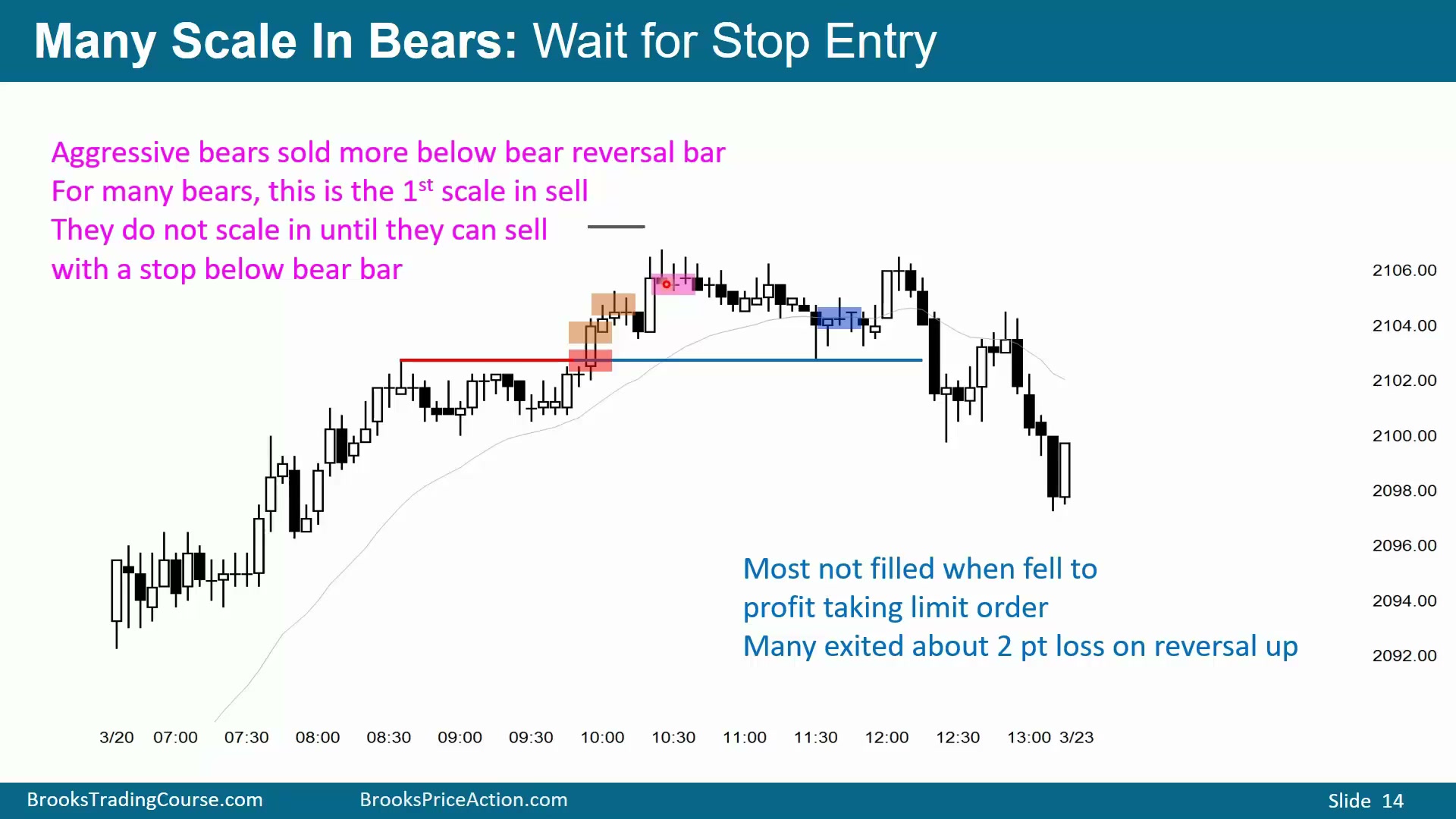
EN: Other bears will take that short and not scale in 1 or 2 points higher.
ZH: 一些空头不会急于挂加仓的限价卖单
22:58 - 23:02
EN: They’ll sell, and then they’ll look for a bear bar,
ZH: 卖出之后,他们会等待一根阴线
23:02 - 23:05
EN: like here, and sell more below a bear bar.
ZH: 比如这个,然后在阴线的下方卖出更多 (注:右侧加仓,看到信号K再加仓;左侧加仓,直接挂限价单)
23:05 - 23:08
EN: We have a bear bar here, but the market did not go below its low.
ZH: 这里有一个阴线,但市场没有跌破它的低点 (注:突破卖单无法成交)
23:08 - 23:13
EN: Also, had they sold below this low, it would be less than a scalp
ZH: 另外,如果他们在这个低点下方再次卖出,
23:13 - 23:17
EN: above their first entry, so most traders would not scale in there.
ZH: 这距离初始入场价格不到1个点,所以大多数空头不会在这里加仓 (注:多次入场之间要隔开一定的距离,否则没有意义)
23:17 - 23:19
EN: What they’re looking for is a bear bar.
ZH: 他们在等待一根阴线
23:19 - 23:26
EN: They sell below its low and they expect the market
ZH: 然后在它的下方再次卖出,期望市场能回到他们的初始入场价格
23:23 - 23:26
EN: to come back down to their original entry.
ZH: 然后在它的下方再次卖出,期望市场能回到他们的初始入场价格
23:26 - 23:31
EN: They want this entry to be at least two to three times the size
ZH: 他们还希望两个入场点之间相隔至少两三个点, 这样才是一个值得做的机会
23:29 - 23:31
EN: of a scalp to make it worthwhile.
ZH: 他们还希望两个入场点之间相隔至少两三个点, 这样才是一个值得做的机会
23:31 - 23:34
EN: So if an average scalp in the Emini is 1 point,
ZH: ES中剥头皮的最小目标是1个点
23:34 - 23:41
EN: they want this entry, if they’re going to take it,
ZH: 空头希望加仓的入场点,至少要距离初始入场价格两三个点
23:37 - 23:41
EN: to be at least 2 or 3 points above their first entry.
ZH: 空头希望加仓的入场点,至少要距离初始入场价格两三个点
23:41 - 23:48
EN: And then they hold, hoping for the market to come back down
ZH: 加仓之后持有,希望价格回调到他们的初始入场点, 这样初始仓位就能够打平
23:44 - 23:48
EN: to their original entry, where they can get out breakeven on their first entry
ZH: 加仓之后持有,希望价格回调到他们的初始入场点, 这样初始仓位就能够打平
23:48 - 23:55
EN: and then with 3 or 4 points profit on their third entry depending on
ZH: 然后加仓的部分可以赚3~4个点, 具体取决于加仓的位置到底在哪里
23:51 - 23:55
EN: how much above the first entry their second entry is.
ZH: 然后加仓的部分可以赚3~4个点, 具体取决于加仓的位置到底在哪里
23:56 - 24:00
EN: In general, this is a better approach.
ZH: 总体而言,这(右侧加仓)是一个更好的做法
24:00 - 24:04
EN: Instead of selling the high, selling more higher, selling more higher,
ZH: 在窄上涨通道中做空, 与其开仓之后不断用限价卖单逢高加仓、加仓
24:04 - 24:09
EN: wait instead to sell below a bear bar when the channel is tight.
ZH: 不如等待一根阴线,然后在它的下方卖出更多
24:09 - 24:20
EN: When the channel is broad and you can see that every breakout does not go
ZH: 如果通道比较宽,你发现每次突破创新高走不了多远就会反转下跌, 那么空头就更愿意直接在上方1个点、2个点加仓
24:14 - 24:20
EN: very far before it reverses, then you might be more willing
ZH: 如果通道比较宽,你发现每次突破创新高走不了多远就会反转下跌, 那么空头就更愿意直接在上方1个点、2个点加仓
24:17 - 24:20
EN: to scale in 1 point up, 2 points up.
ZH: 如果通道比较宽,你发现每次突破创新高走不了多远就会反转下跌, 那么空头就更愿意直接在上方1个点、2个点加仓
24:26 - 24:29
EN: The market came down exactly to their first entry,
ZH: 市场正好跌回到他们的初始入场点
24:29 - 24:33
EN: exactly to this high, and they were not able to get out.
ZH: 正好碰到这个高点,此时他们还无法离场 (注:要再跌1个tick才能确保成交)
24:33 - 24:37
EN: What would I do in that situation? Well, I’d look at the entire structure.
ZH: 在这种情况下我会怎么做? 我会观察整体的结构
24:37 - 24:39
EN: We have a High 1, a High 2.
ZH: 高1,高2
24:39 - 24:40
EN: It failed.
ZH: 没能恢复上涨
24:40 - 24:43
EN: We have two more legs down, one and two.
ZH: 又下跌了两段——1,2
24:43 - 24:47
EN: You can call it a High 4 type of pattern, a complex bottom type of pattern.
ZH: 你可以把它看作是高4的结构,是复合型的底部结构
24:47 - 24:50
EN: We have a High 1, High 2, tried to bottom.
ZH: 高1,高2,尝试筑底
24:50 - 24:53
EN: It failed, and then two more legs down – one, two.
ZH: 筑底失败,然后又有两段下跌——1,2
24:53 - 24:55
EN: Tried to reverse up again.
ZH: 再次尝试反转上涨
24:55 - 24:58
EN: So a complex bottom, or you can simply call it a big High 2
ZH: 所以是一个复合型的底部,或者可以把它看作一个大的高2——
24:58 - 25:02
EN: - Leg 1, pullback, Leg 2 – and we have a Micro Double Bottom here
ZH: 1,反弹,2——而且这里有一个小双底
25:02 - 25:05
EN: at the target price for the bears.
ZH: 就在空头想要止盈离场的价格
25:05 - 25:09
EN: They want to get out breakeven on their first entry, which is at that high,
ZH: 他们希望初始仓位可以打平——就在那个高点
25:09 - 25:16
EN: and now we’re getting a second reversal up – first reversal,
ZH: 而现在第2次尝试反转上涨——第1次,第2次; 有小双低的结构,以及阳线信号K
25:12 - 25:16
EN: second reversal up – with a Micro Double Bottom and a bull body.
ZH: 而现在第2次尝试反转上涨——第1次,第2次; 有小双低的结构,以及阳线信号K
25:16 - 25:18
EN: That’s a reasonable buy.
ZH: 这是合理的做多入场点
25:18 - 25:22
EN: If you’re a bull, you’re going to take that buy, and if you’re a bear,
ZH: 多头会在它的上方买入; 如果逆势空头
25:22 - 25:28
EN: had you taken this short and sold more below this bear bar, you’d get out here.
ZH: 如果你在这里挂单做空,并且在这根阴线下方加仓了, 此时你应该离场
25:28 - 25:30
EN: You’d have a small profit on your second entry,
ZH: 你加仓的部分小赚
25:30 - 25:33
EN: a small loss on your first entry.
ZH: 初始仓位小亏
Slide 015
Time: 25:35
Bilingual Transcript
25:41 - 25:43
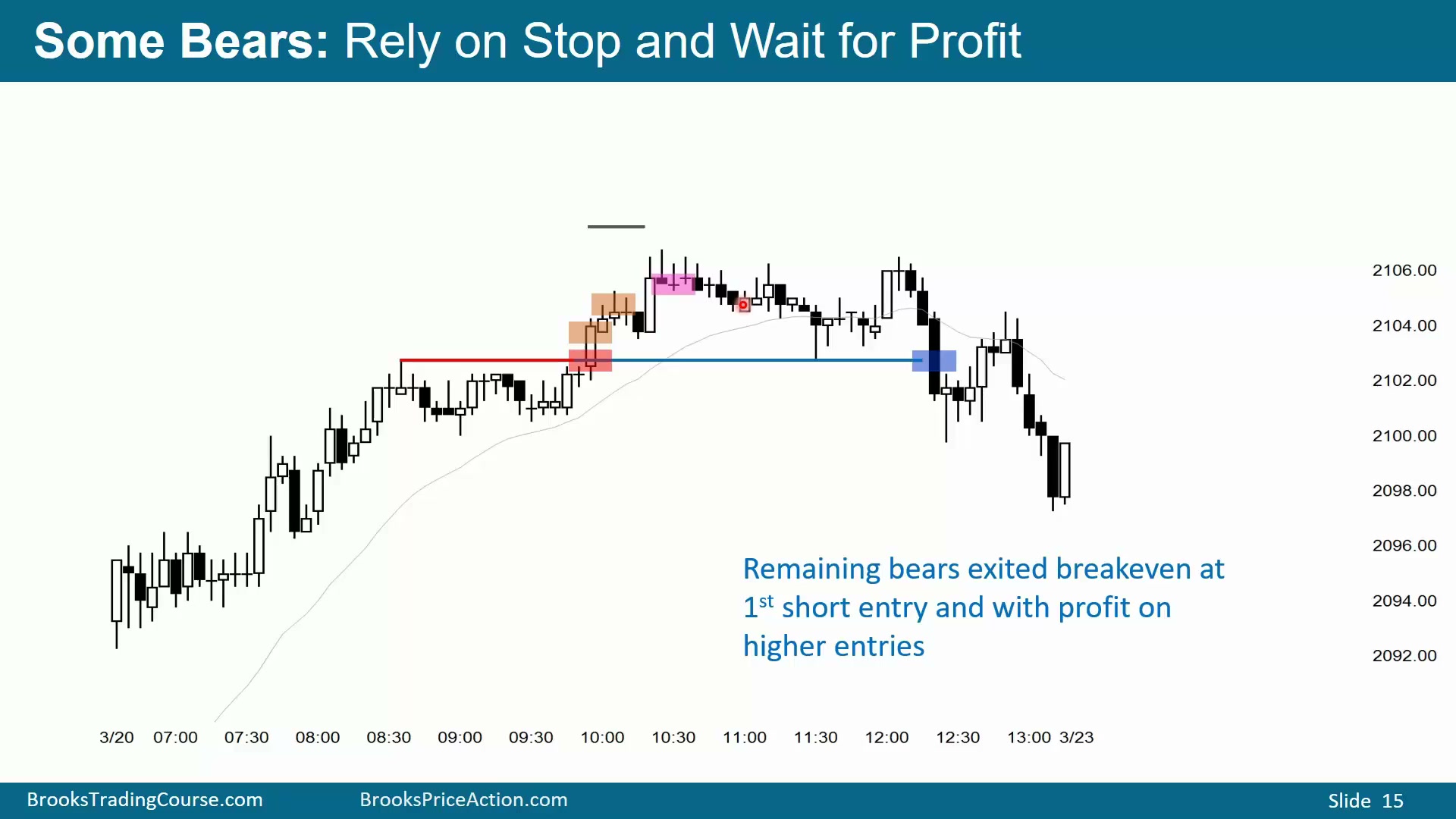
EN: Some bears would continue to hold short,
ZH: 一些空头会继续持有空单
25:43 - 25:46
EN: arguing that the market is transitioning into a Trading Range,
ZH: 理由是市场正在转变为震荡区间
25:46 - 25:50
EN: and if it’s a Trading Range it probably will fall below support,
ZH: 如果真的是震荡区间,就很可能会略微跌破支撑位
25:50 - 25:53
EN: which would be this low and this breakout point.
ZH: 也就是这个低点,那个高点
25:53 - 25:56
EN: You can look at it as possibly a trending Trading Range.
ZH: 你可以把它看作是震荡上涨
25:56 - 25:58
EN: We have a Trading Range, a brief breakout,
ZH: 前面有一个震荡区间,略微向上突破
25:58 - 26:01
EN: not all that strong, and then another Trading Range.
ZH: 没有那么强势,然后进入新的区间
26:01 - 26:08
EN: When you have that, there’s a 60% chance the market will fall
ZH: 在这种时候,60%的概率会跌破前一个区间的顶部至少1个tick (注:换句话说,60%的概率两个区间会有至少一点点重叠)
26:05 - 26:08
EN: at least 1 tick below the top of the lower range.
ZH: 在这种时候,60%的概率会跌破前一个区间的顶部至少1个tick (注:换句话说,60%的概率两个区间会有至少一点点重叠)
26:08 - 26:12
EN: And the bears know that, and some bears, or at least experienced bears,
ZH: 正因如此,一些空头,或者说有经验的空头
26:12 - 26:18
EN: might be willing to hold, expecting 60% chance we’ll drop
ZH: 可能会愿意继续持有, 预期60%的概率会跌破那个高点——就像这样
26:16 - 26:18
EN: below that high – which it did here.
ZH: 可能会愿意继续持有, 预期60%的概率会跌破那个高点——就像这样
26:18 - 26:19
EN: However, I would not.
ZH: 然而,我不会(继续持有)
26:20 - 26:24
EN: To me this is a reasonable buy, and if I’m selling in a bear trend
ZH: 在我看来,这是一个合理的买点, 如果我在上涨趋势中做空,
26:24 - 26:27
EN: and I see a reasonable buy, I’m going to get out.
ZH: 当看到合理的买点时,我会离场
Slide 016
Time: 26:30
Bilingual Transcript
26:35 - 26:40
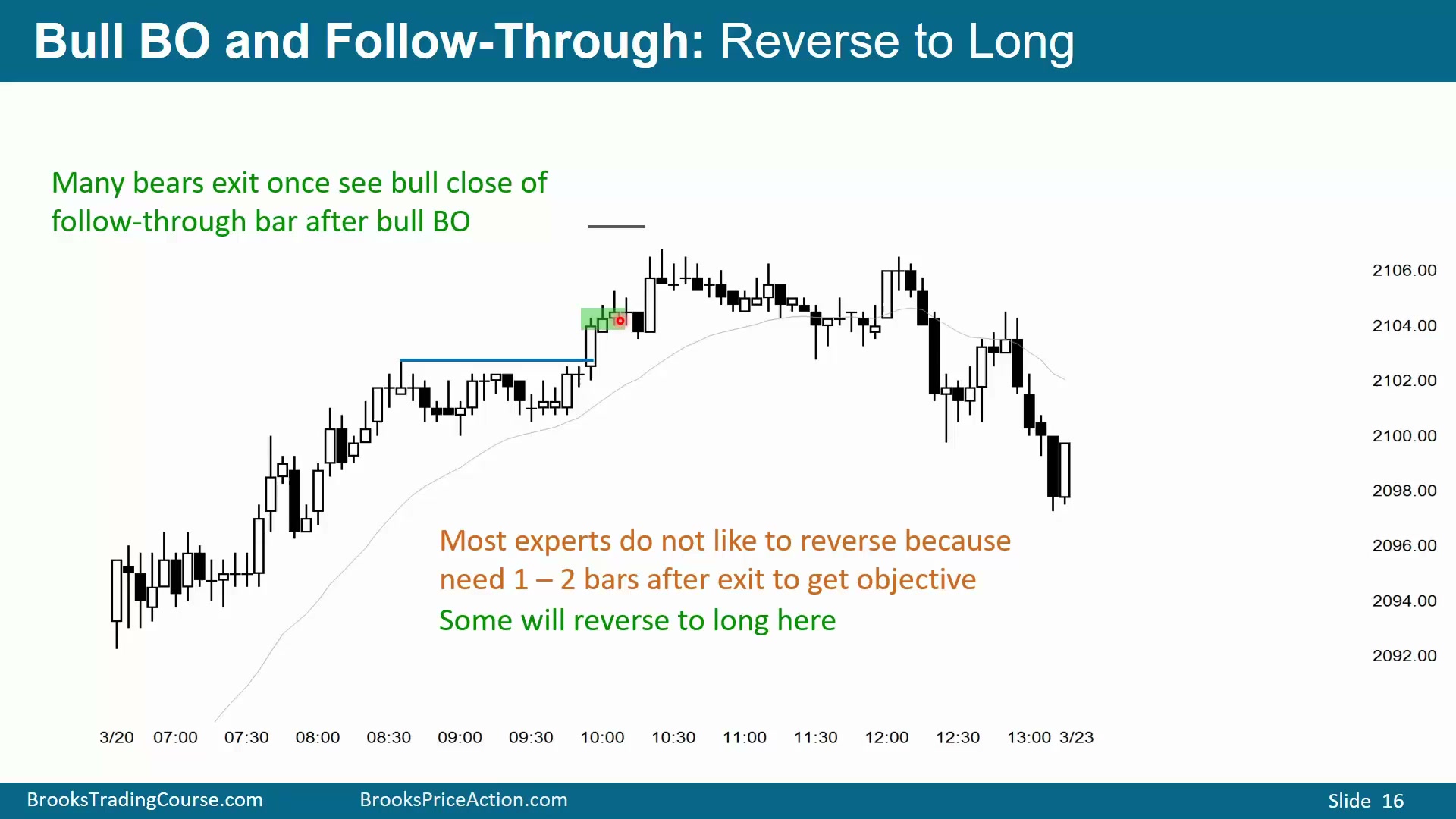
EN: A lot of bears, if they sell that high and they sell more higher
ZH: 很多空头,如果他们在那个高点挂单卖出并逢高加仓
26:40 - 26:44
EN: and then they see the close of this bar, and then they see a follow-through bar
ZH: 然后看到这根大阳线收在最高,又看到后续的跟随K线也收在最高,
26:43 - 26:52
EN: also closing on its high, they’re going to assume the breakout is strong enough
ZH: 然后看到这根大阳线收在最高,又看到后续的跟随K线也收在最高, 他们会认为突破足够强势,至少有小的第2段上涨, 所以他们会直接认亏离场
26:47 - 26:52
EN: to have at least a second leg up, and they’ll just get out with a loss.
ZH: 他们会认为突破足够强势,至少有小的第2段上涨, 所以他们会直接认亏离场
26:52 - 26:55
EN: They sold here, they sold more 1 point higher,
ZH: 他们在这里卖出,在上方1个点加仓
26:55 - 26:57
EN: and they’ll get out on the close of this bar.
ZH: 然后在这根K线的收盘全部止损离场
26:58 - 27:03
EN: And that’s another reason why when you get a breakout
ZH: 所以在上涨趋势中,如果有突破和跟随,多头会买入
27:00 - 27:03
EN: with a follow-through bar in a bull trend, bulls will buy.
ZH: 所以在上涨趋势中,如果有突破和跟随,多头会买入
27:03 - 27:06
EN: They’ll buy that close, they’ll buy the reversal down,
ZH: 多头会在它的收盘买入,会在下跌时买入
27:06 - 27:09
EN: they’ll buy above the high of this bar, betting that there’ll be
ZH: 他们会在这根K线的高点上方买入
27:09 - 27:13
EN: at least a second leg up, far enough up for them to make at least a scalp.
ZH: 押注至少会有第2段上涨,足够赚一笔剥头皮交易
27:18 - 27:22
EN: What about reversing? So let’s say you sold here, you sold more here.
ZH: 反向开仓呢?假设你在这里卖出,然后在这里加仓
27:22 - 27:25
EN: You decide on the close of this bar that it’s going higher.
ZH: 在这根K线的收盘,你认为还会继续上涨 (于是反手做多——止损空单的同时买入做多)
27:25 - 27:30
EN: Most experts do not like to reverse because they feel they’re not objective.
ZH: 很多人不喜欢反向开仓, 因为这样做感觉不够客观
27:30 - 27:33
EN: They’ve been looking at the market as a reasonable sell,
ZH: 如果他们一直认为做空是合理的
27:33 - 27:36
EN: and now they’re looking at it as a reasonable buy,
ZH: 现在突然要把它看作是一个合理的买点
27:36 - 27:40
EN: and usually it’s just tough emotionally to make the switch.
ZH: 情绪上很难做出这种快速的切换
27:40 - 27:42
EN: However, the math is pretty good.
ZH: 然而,在数学上是合理的
27:42 - 27:47
EN: If you did take that sell and sold more here and then you reversed to long here,
ZH: 如果你在这里做空,并且在这里加仓, 然后在这里反手做多
27:47 - 27:53
EN: you’re probably going to get a rally big enough
ZH: 接下来的涨幅大概率可以让你赚回刚才的亏损
27:49 - 27:53
EN: to reverse the losses that you had over here.
ZH: 接下来的涨幅大概率可以让你赚回刚才的亏损
27:53 - 27:55
EN: And that’s a common situation.
ZH: 这是很常见的情况
27:55 - 27:57
EN: Whenever you think the market is going to do something
ZH: 每当你认为市场会做某事
27:57 - 28:02
EN: and it does the opposite, usually if you take a reversal trade,
ZH: 结果它做了相反的事情,此时如果你反向开仓
28:02 - 28:04
EN: you’ll be able to recover your original loss.
ZH: 往往能够赚回刚才的亏损 (注:不要在震荡区间中被反复打脸了!)
28:04 - 28:09
EN: So if you sold here, and let’s say you bought on that close,
ZH: 所以,如果你在这里做空,然后在它的收盘反手做多
28:09 - 28:18
EN: usually the market will go up at least that far so that you’ll be able
ZH: 通常市场至少会上涨相同的距离,让你能够赚回刚才做空的亏损
28:13 - 28:18
EN: to make enough on your long to offset what you lost on your short.
ZH: 通常市场至少会上涨相同的距离,让你能够赚回刚才做空的亏损
28:24 - 28:27
EN: Some traders will reverse to long.
ZH: 一些交易者会反手做多
28:27 - 28:27
EN: Most will not.
ZH: 大部分不会
28:27 - 28:31
EN: They’ll exit, and then they’ll look to buy, maybe at the low of this bar,
ZH: 他们会先离场,然后等待买入的机会, 比如在这根K线的低点挂限价买单
28:31 - 28:37
EN: looking for at least a scalp up – a scalp equal to the size of their loss.
ZH: 想要做一笔剥头皮交易——把刚才的亏损赚回来
Slide 017
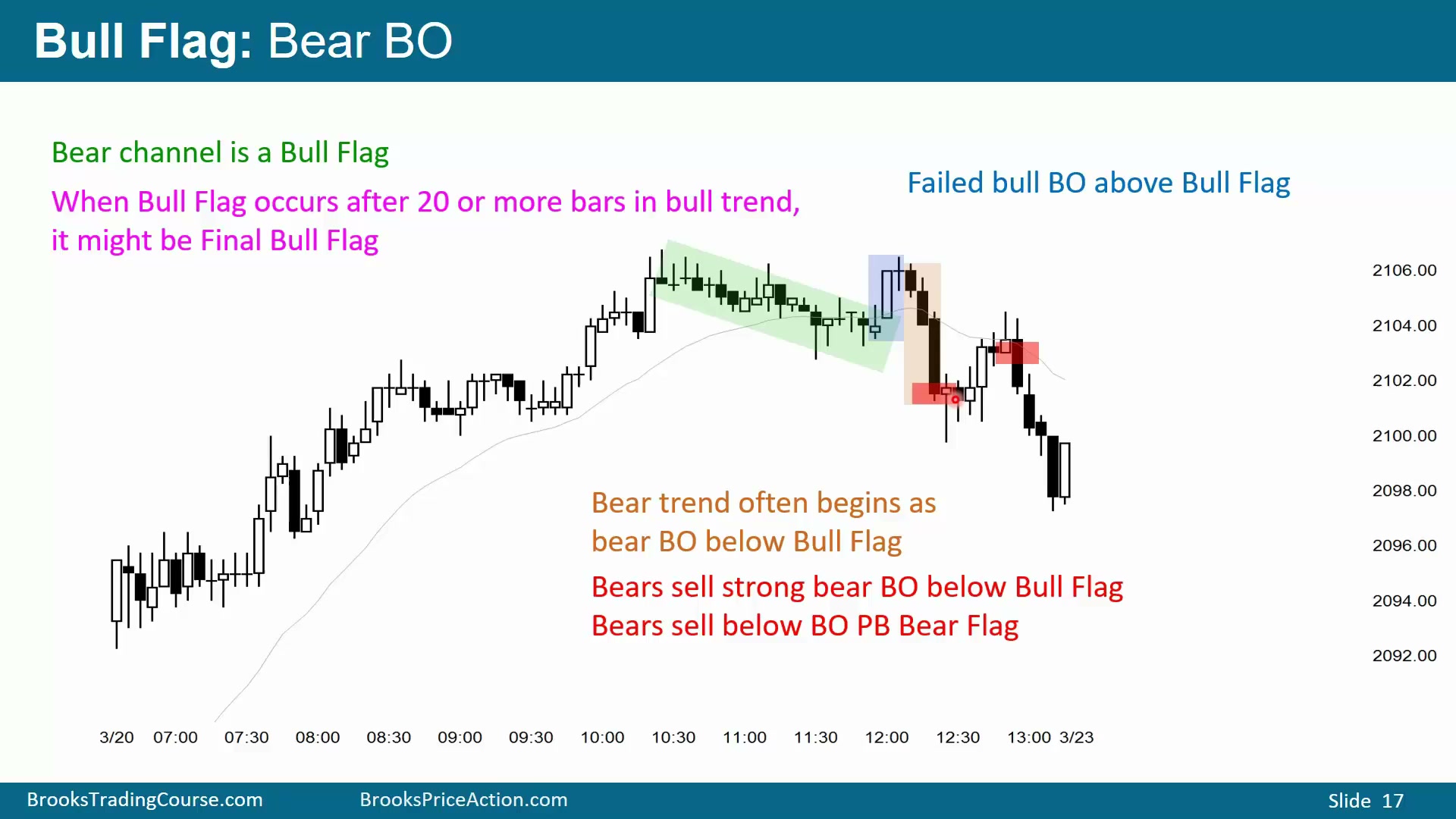
Time: 28:40
Bilingual Transcript
28:42 - 28:46
EN: We have a very Tight Bull Channel and we’re getting a pullback,
ZH: 非常窄的上涨通道,正在回调
28:46 - 28:50
EN: so it’s a High 1 bull flag, a High 2 bull flag, a High 3, so a Wedge.
ZH: 高1牛旗,高2牛旗,高3牛旗,所以变成了楔形牛旗
28:50 - 28:53
EN: And now it’s about 10 bars into the bull flag,
ZH: 现在回调已经持续了10根K线
28:53 - 28:57
EN: and at some point you have to decide, maybe it’s an endless pullback
ZH: 在某个时候你必须考虑到,也许它是一个无尽的回调
28:57 - 29:01
EN: and it’s going to lead to a reversal instead of a resumption of the bull trend.
ZH: 它会导致趋势反转,而不是上涨趋势恢复
29:02 - 29:04
EN: Every bear channel is a bull flag.
ZH: 每个下降通道都是牛旗
29:04 - 29:06
EN: 75% chance you get a bull breakout.
ZH: 75%的概率会向上突破
29:07 - 29:11
EN: But in a situation like this where the rally is fairly climactic
ZH: 但是根据左边的背景,有很多抢购高潮
29:11 - 29:14
EN: - climactic, climactic, here, here, here
ZH: ——高潮,高潮,还有这里,这里,这里
29:14 - 29:17
EN: - and then you get an extensive pullback like this,
ZH: 然后出现了长时间的回调
29:17 - 29:22
EN: the probability starts to go up
ZH: 向下跌破,并且跌到MM目标位的概率开始不断增加
29:19 - 29:22
EN: that you’ll get a bear breakout and a Measured Move down.
ZH: 向下跌破,并且跌到MM目标位的概率开始不断增加
29:27 - 29:32
EN: Whenever you have a bull flag and it lasts 20 or more bars
ZH: 每当你看到回调持续超过20根K线
29:32 - 29:35
EN: - here, it’s not 20 bars, but it might be 10 or 15 bars
ZH: ——这里还不到20根,只有十几根
29:35 - 29:38
EN: - you’ve got to be thinking that it might be the final bull flag,
ZH: 你就必须考虑,它可能是末端牛旗
29:38 - 29:41
EN: and that the breakout, when it comes,
ZH: 如果向上突破,
29:41 - 29:45
EN: will probably not get very far before you get a reversal down.
ZH: 可能涨不了太远,就开始反转下跌
29:45 - 29:47
EN: Here, we have a breakout.
ZH: 这里,大阳线突破
29:47 - 29:50
EN: Does not look like we went to a new high.
ZH: 看起来没有突破前期高点——
29:50 - 29:55
EN: Sometimes you’ll get a Final Flag reversal,
ZH: 有些末端牛旗反转,最后一次突破甚至无法创新高
29:52 - 29:55
EN: and the breakout did not even lead to a new high.
ZH: 有些末端牛旗反转,最后一次突破甚至无法创新高
29:55 - 29:59
EN: The breakout failed at a Lower High, which is the case here.
ZH: 从更低的高点开始失败、反转,就像这个案例一样
30:03 - 30:06
EN: Failed breakout above the bull flag.
ZH: 突破牛旗失败
30:06 - 30:12
EN: Bull breakout, reversal down, 3 consecutive bear bars
ZH: 多头突破,反转下跌,连续3根阴线收在最低
30:10 - 30:12
EN: closing on or near their lows.
ZH: 多头突破,反转下跌,连续3根阴线收在最低
30:12 - 30:15
EN: The odds are we’re going to get at least a small second leg down,
ZH: 大概率至少会有小的第2段下跌
30:15 - 30:18
EN: which we did over here at the end of the day.
ZH: 在收盘前出现了
30:22 - 30:28
EN: It’s fairly common for a bear trend to begin
ZH: 下降趋势从跌破牛旗开始,这是常见的情况
30:25 - 30:28
EN: as a bear breakout below a bull flag.
ZH: 下降趋势从跌破牛旗开始,这是常见的情况
30:28 - 30:31
EN: We have a bull flag; we tried to get a bull breakout,
ZH: 牛旗,尝试向上突破
30:31 - 30:34
EN: did not get very far, and then we reversed down.
ZH: 没有上涨太多,就反转下跌了
30:34 - 30:38
EN: Bear breakout below the bull flag, and you’d expect a second leg down
ZH: 跌破了前期的牛旗,交易者预期会有第2段下跌
30:38 - 30:41
EN: because the breakout is reasonably strong.
ZH: 因为空头的突破非常强势
30:47 - 30:52
EN: Therefore, bears will sell this close, and we got two or three legs up.
ZH: 所以空头会在它的收盘卖出做空; 然后有两三点的反弹
30:52 - 30:55
EN: We went up here, little bull bar and then a bear bar.
ZH: 1,小阳线,小阴线
30:55 - 30:59
EN: Up again, 2 more bull bars and then a bear bar, and then up a third time.
ZH: 然后2,两根阳线,一根阴线;然后是第3段上涨
30:59 - 31:06
EN: This is a Wedge Lower High, a Double Top
ZH: 3推反弹,低于前期高点;和这个大阴线的起跌点形成双顶, 同时也大约是50%反弹
31:02 - 31:06
EN: with this Sell Climax high, and about a 50% pullback.
ZH: 3推反弹,低于前期高点;和这个大阴线的起跌点形成双顶, 同时也大约是50%反弹
31:06 - 31:12
EN: Even though it has a bull body, it’s a reasonable short,
ZH: 尽管这根K线是阳线,在它下方卖出也是合理的, 预期在收盘前会有第2段下跌
31:09 - 31:12
EN: expecting a second leg down into the end of the day.
ZH: 尽管这根K线是阳线,在它下方卖出也是合理的, 预期在收盘前会有第2段下跌
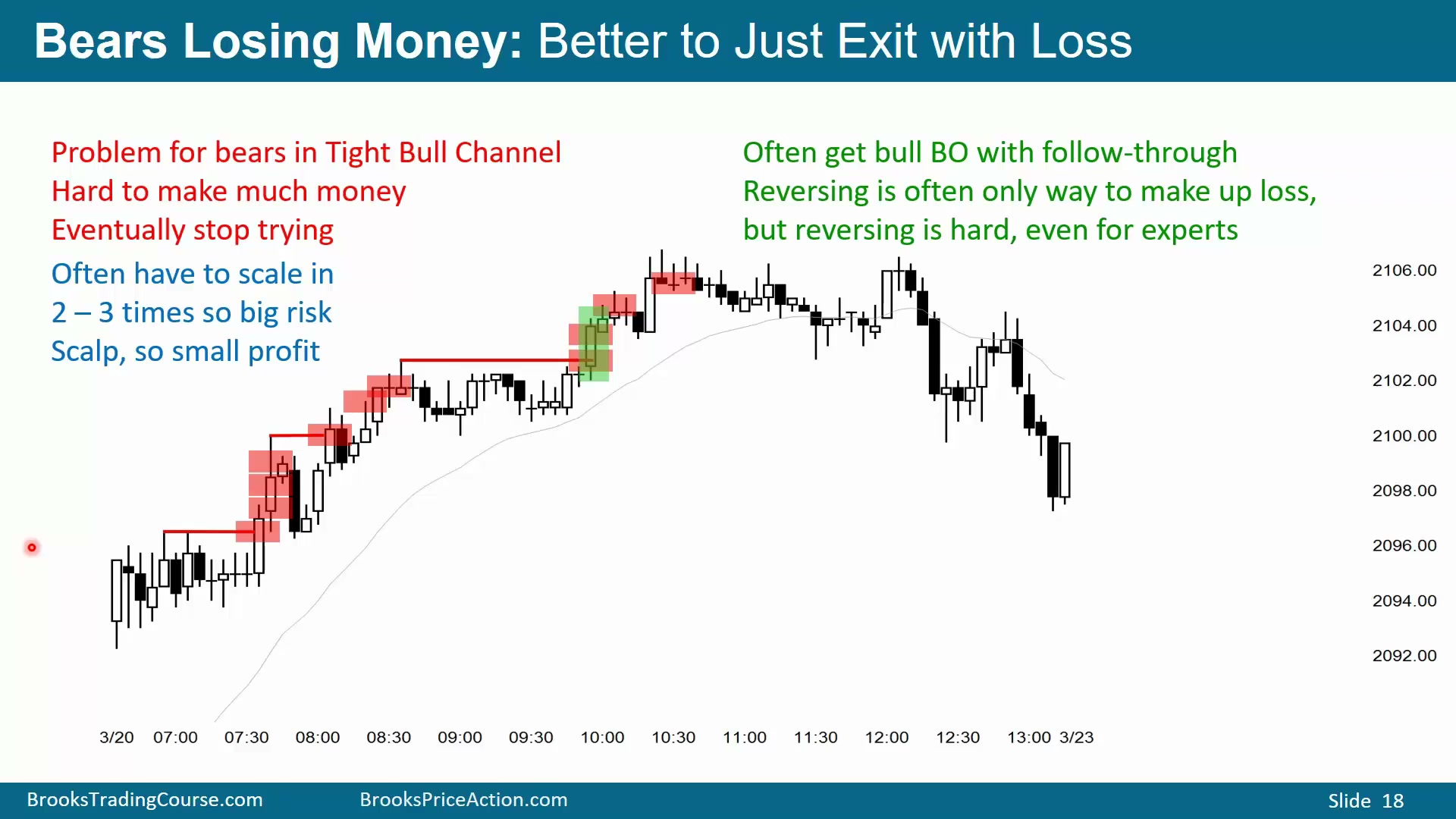
Slide 018
Time: 31:14
Bilingual Transcript
31:19 - 31:20
EN: Bears, they’re selling.
ZH: 空头一直在卖出
31:20 - 31:24
EN: They’ll sell this high – 1 point higher, 2 points higher, 3 points higher.
ZH: 他们在这个高点挂单做空,然后在上方1、2、3个点加仓
31:24 - 31:28
EN: Sell that high, sell this high, sell this bad close,
ZH: 在这个高点、这个高点挂单做空, 在这个弱阳线的收盘做空
31:28 - 31:30
EN: sell that high, sell more higher.
ZH: 在这个高点挂单做空,并且逢高加仓
31:32 - 31:36
EN: We have a pullback here, but look at how small the other pullbacks were.
ZH: 只有这个回调比较大,其他的回调幅度都很小
31:36 - 31:37
EN: They’re nonexistent here.
ZH: 这里甚至没有回调
31:38 - 31:43
EN: That means it’s really difficult for the bears to make money,
ZH: 这说明空头真的很难赚到钱,最终他们会停止尝试
31:41 - 31:43
EN: and eventually they stop trying.
ZH: 这说明空头真的很难赚到钱,最终他们会停止尝试
31:43 - 31:48
EN: At some point, after trying here, maybe here, the bears stop selling.
ZH: 到了某一时刻,尝试一次,尝试两次, 空头就不再做空了
31:48 - 31:52
EN: And if you have a relative absence of bears selling,
ZH: 如果很少人愿意卖出,
31:52 - 31:54
EN: the odds are the market’s going to go higher.
ZH: 那么市场大概率就会继续上涨
31:54 - 31:56
EN: The bears want to sell higher.
ZH: 空头想要在更高的价格卖出
31:56 - 31:59
EN: They want to sell after the market begins to enter a Trading Range.
ZH: 他们想要等市场进入震荡区间以后再做空
31:59 - 32:02
EN: They’ll stop selling in a Tight Bull Channel.
ZH: 他们不想在窄上涨通道里面做空
32:06 - 32:11
EN: Here the bears sell – more 1 point higher, 2 points higher, 3 points higher
ZH: 他们在这里做空——然后在上方1、2、3个点的距离加仓
32:11 - 32:13
EN: - and they were lucky to get out breakeven.
ZH: 最终幸运地打平离场
32:13 - 32:16
EN: That means it’s really difficult and very stressful,
ZH: 说明现在做空很难,而且压力很大
32:16 - 32:18
EN: and the risk/reward is terrible.
ZH: 盈亏比极度糟糕
32:18 - 32:24
EN: You had a large risk, very little reward, and not great probability.
ZH: 风险很大、利润很小,而且胜率也不高
32:24 - 32:26
EN: That means it’s hard for the bears to make money.
ZH: 所以做空赚钱的难度非常大
32:26 - 32:29
EN: The same with all of these other sells as well.
ZH: 其他这些做空入场点也是一样
32:29 - 32:33
EN: And when that’s the case, eventually the bears stop selling.
ZH: 在这种行情里,最终空头不再卖出
32:39 - 32:43
EN: Very common for the bulls to get a breakout with a follow-through bar,
ZH: 所以多头可以很轻松的制造突破和跟随K线
32:43 - 32:47
EN: so we have a decent bull bar and then the next bar has a bull body.
ZH: 不错的阳线,下一根K线也是阳线
32:47 - 32:51
EN: That increases the chances that the bulls will get at least a second leg up.
ZH: 这增加了至少会有第2段上涨的可能性
32:53 - 32:59
EN: And as I said, if you’re taking these shorts here
ZH: 正如刚才所说,如果你在这里做空,然后逢高加仓, 但上涨趋势很难被反转
32:56 - 32:59
EN: and more higher, it’s hard to reverse.
ZH: 正如刚才所说,如果你在这里做空,然后逢高加仓, 但上涨趋势很难被反转
32:59 - 33:09
EN: Most traders don’t do it, and therefore it’s hard to make up the loss
ZH: 大多数交易员不会这样做, 不断逆势加仓很容易造成巨大的、难以弥补的亏损,
33:03 - 33:09
EN: that you got from taking this scale-in short,
ZH: 大多数交易员不会这样做, 不断逆势加仓很容易造成巨大的、难以弥补的亏损,
33:06 - 33:09
EN: selling at this high and selling more higher.
ZH: 大多数交易员不会这样做, 不断逆势加仓很容易造成巨大的、难以弥补的亏损,
33:10 - 33:11
EN: Therefore, don’t do it.
ZH: 所以,不要这样做!
33:12 - 33:15
EN: Also, if you do it, just get out and take the loss,
ZH: 如果你真的用限价卖单做空了,早点止损就好
33:15 - 33:18
EN: and don’t worry about reversing to long.
ZH: 也不用强迫自己立刻反手做多
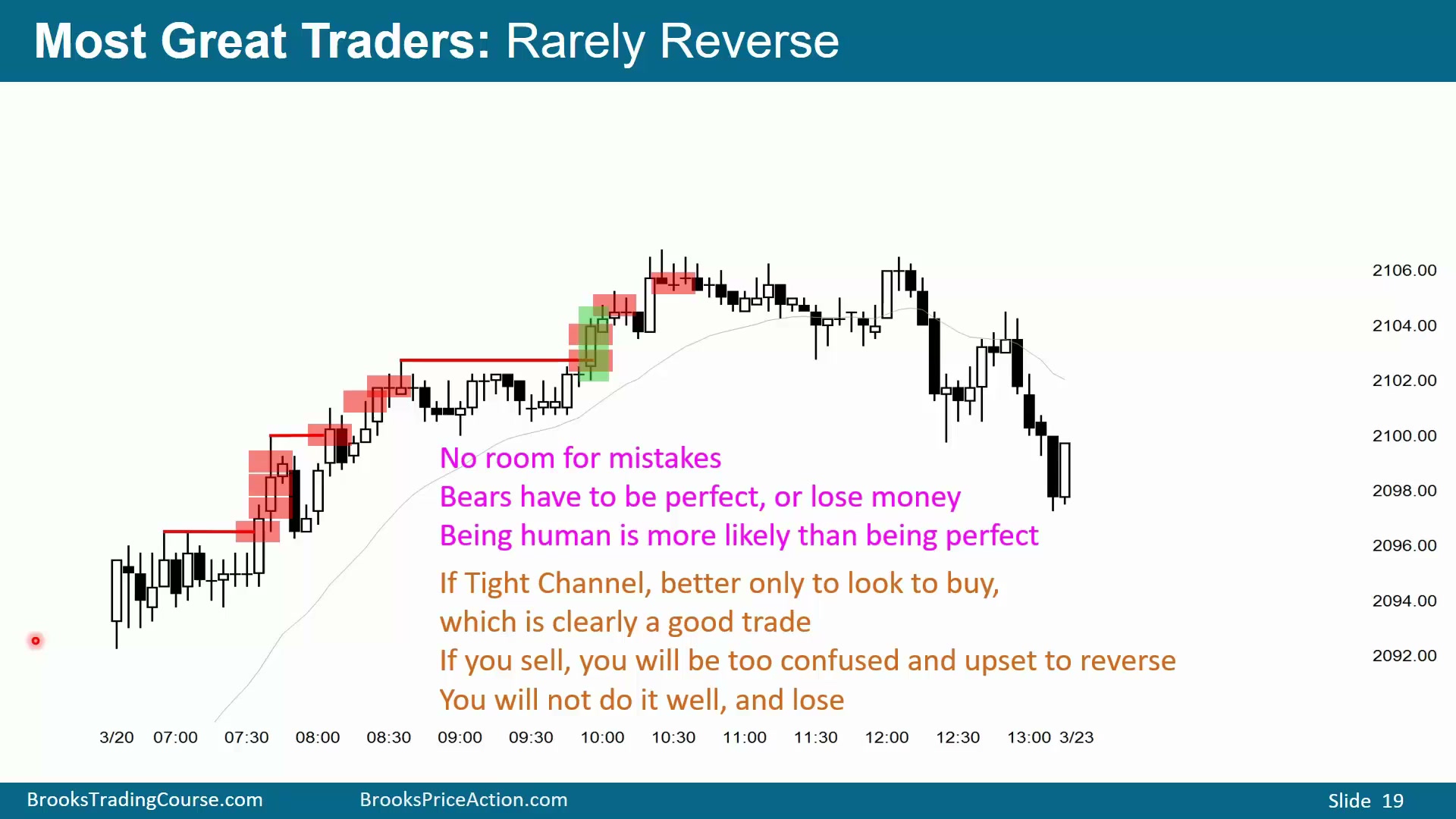
Slide 019
Time: 33:20
Bilingual Transcript
33:28 - 33:36
EN: Because it’s so difficult to make money and because the risk quickly gets bigger
ZH: 做空很难赚钱,因为风险迅速增加,远大于利润, 所以你需要很高的胜率才行
33:33 - 33:36
EN: than the reward and you need a very high probability of success,
ZH: 做空很难赚钱,因为风险迅速增加,远大于利润, 所以你需要很高的胜率才行
33:37 - 33:39
EN: it’s very, very difficult to make money.
ZH: 用这种方式赚钱是非常非常难的
33:39 - 33:41
EN: There’s no room for mistakes.
ZH: 没有犯错的余地
33:41 - 33:44
EN: You have to trade perfectly or you’re going to lose,
ZH: 你必须做到完美,否则就会大亏
33:44 - 33:48
EN: and it’s not easy to do even for an experienced trader.
ZH: 即使对于一个很有经验的交易员来说,也不容易做到
33:48 - 33:55
EN: Therefore, most experienced traders are not shorting
ZH: 因此,在这种和这种窄上涨通道里面, 专业的交易员不会去做空
33:51 - 33:55
EN: when you have a very Tight Bull Channel like this or like this.
ZH: 因此,在这种和这种窄上涨通道里面, 专业的交易员不会去做空
34:03 - 34:04
EN: Tight Channel.
ZH: 窄通道
34:04 - 34:08
EN: Better only to look to buy, and it’s clearly a good trade to buy
ZH: 最好只考虑做多,而且显然是好的做多机会
34:08 - 34:12
EN: because the reversals last 1 bar or are very small,
ZH: 因为反转只持续1根K线,幅度也很小
34:12 - 34:14
EN: and the odds are we’re going to go higher.
ZH: 大概率还会继续上涨
34:16 - 34:19
EN: Also, if you’re thinking about shorting,
ZH: 另外,如果你在考虑做空
34:19 - 34:22
EN: you probably will not take any of the buys.
ZH: 那么你就会错过所有这些买点
34:22 - 34:25
EN: You’ll just keep looking for shorts, looking for shorts, looking for shorts,
ZH: 你会一直寻找做空、做空、做空的机会
34:25 - 34:30
EN: and you’ll end up missing a bull trend that rallied 8 points above the breakout.
ZH: 最终错过了突破之后的大趋势
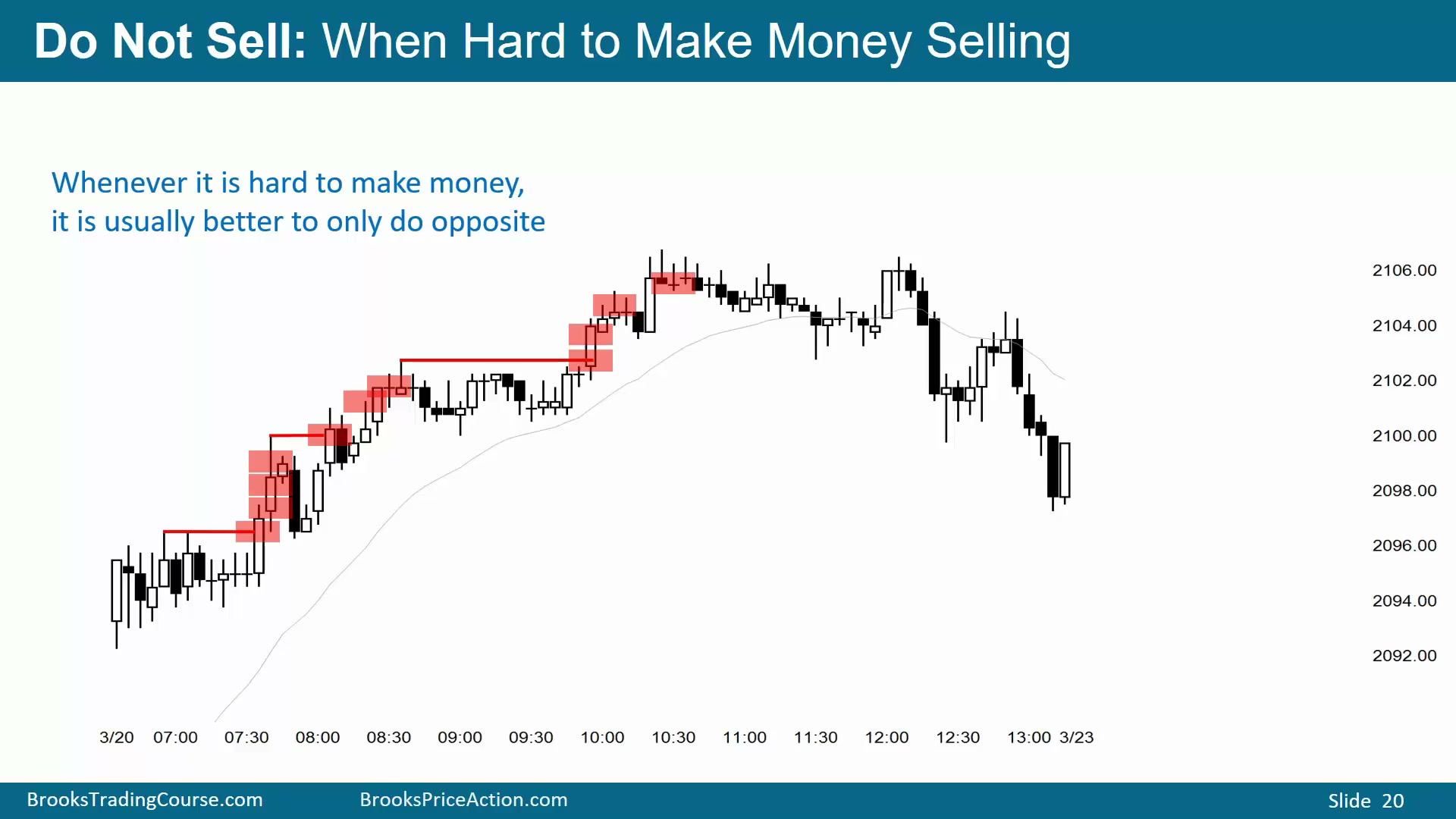
Slide 020
Time: 34:35
Bilingual Transcript
34:37 - 34:41
EN: Whenever you’re looking at a market from one perspective, long or short
ZH: 不管你从哪个视角去观察市场,多头或空头
34:41 - 34:45
EN: - in this case, if you’re looking at it to sell and it’s really hard to do,
ZH: ——在这个案例中,如果从空头的视角去看, 做空非常难赚到钱
34:45 - 34:49
EN: that’s telling you that it’s usually better to do the opposite.
ZH: 这就告诉你,最好应该做相反的事情
34:50 - 34:51
EN: So if you look at it and say,
ZH: 所以,如果你发现:
34:51 - 34:55
EN: “Wow, it’s pretty difficult to make money selling” – well, don’t sell.
ZH: “哇!做空好像不可能赚得到钱” 那就别做空了呀!
34:55 - 34:56
EN: Only buy.
ZH: 只做多
34:56 - 35:01
EN: In fact, very time you see something that you think is a sell, do the opposite.
ZH: 每当你看到一个做空入场点,就反过来做
35:01 - 35:03
EN: Buy exactly where you’re selling.
ZH: 在做空入场点买入做多
35:09 - 35:14
EN: I talked a little bit about scaling into shorts in a very Tight Bull Channel,
ZH: 这节课我讲了有些空头会在窄上涨通道中逆势加仓做空
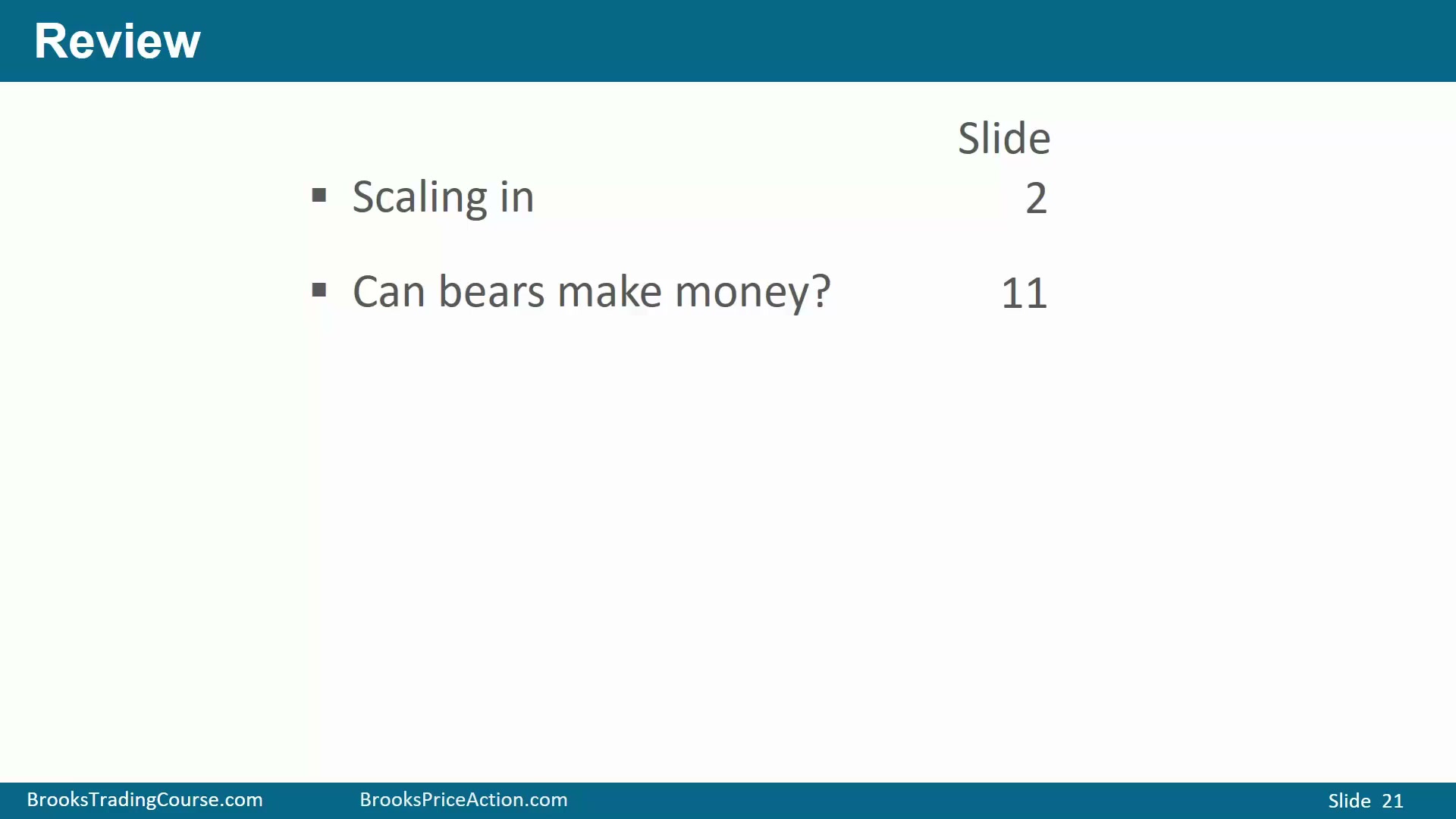
Slide 021
Time: 35:10
Bilingual Transcript
35:15 - 35:21
EN: and I made the very important point that I’m always paying attention
ZH: 我强调了非常关键的重点:我总是关注空头能不能赚到钱
35:19 - 35:21
EN: to whether or not the bears can make money.
ZH: 我强调了非常关键的重点:我总是关注空头能不能赚到钱
35:21 - 35:24
EN: If the market’s in a bull channel and it’s very difficult for the bears
ZH: 如果市场处于上涨通道,而空头很难赚钱,
35:24 - 35:28
EN: to make money and they can only make very little money and they have to scale
ZH: 如果空头要通过加仓的方式,才能赚到一点点钱的话
35:28 - 35:32
EN: in and their reward is much less than their risk,
ZH: 他们的利润就远小于风险
35:33 - 35:37
EN: then it tells me that I should only be doing the opposite.
ZH: 这说明我应该做他们的对手盘
35:37 - 35:39
EN: Instead of selling, I should only be looking to buy.
ZH: 只做多,不做空
35:40 - 35:43
EN: The channel is too tight to make money as a bear.
ZH: 通道太窄了,空头赚不到钱
35:43 - 35:44
EN: Easy to make money as a bull.
ZH: 做多很容易赚钱
35:48 - 35:50
EN: I’m Al Brooks.
ZH: 我是阿尔·布鲁克斯
35:50 - 35:52
EN: Thank you for watching the Brooks Trading Course.
ZH: 感谢观看布鲁克斯交易课程
35:52 - 35:57
EN: This is the third of four videos on trading in Tight Bull Channels.
ZH: 如何交易窄上涨通道的第3节课,就先讲到这里