Skip to content
Price Action Encyclopedia Index

al-brooks-course

50A - Scalping

Raw transcript and slide notes for 50A - Scalping.

Overview

  • Slides: 16
  • Transcript segments: 613
  • Status: 自动按 slide 时间线归档;核心概念和长期笔记可以在每个 slide 的 Study Notes 下继续整理。

Source Media

Transcript 001

Time: 00:02

Bilingual Transcript

00:02 - 00:03

EN: This is Al Brooks.

00:03 - 00:05

EN: Thank you for watching the Brooks Trading Course.

00:05 - 00:08

EN: This is the first of five videos on scalping.

Slide 001

Time: 00:10

Slide 001

Bilingual Transcript

00:12 - 00:14

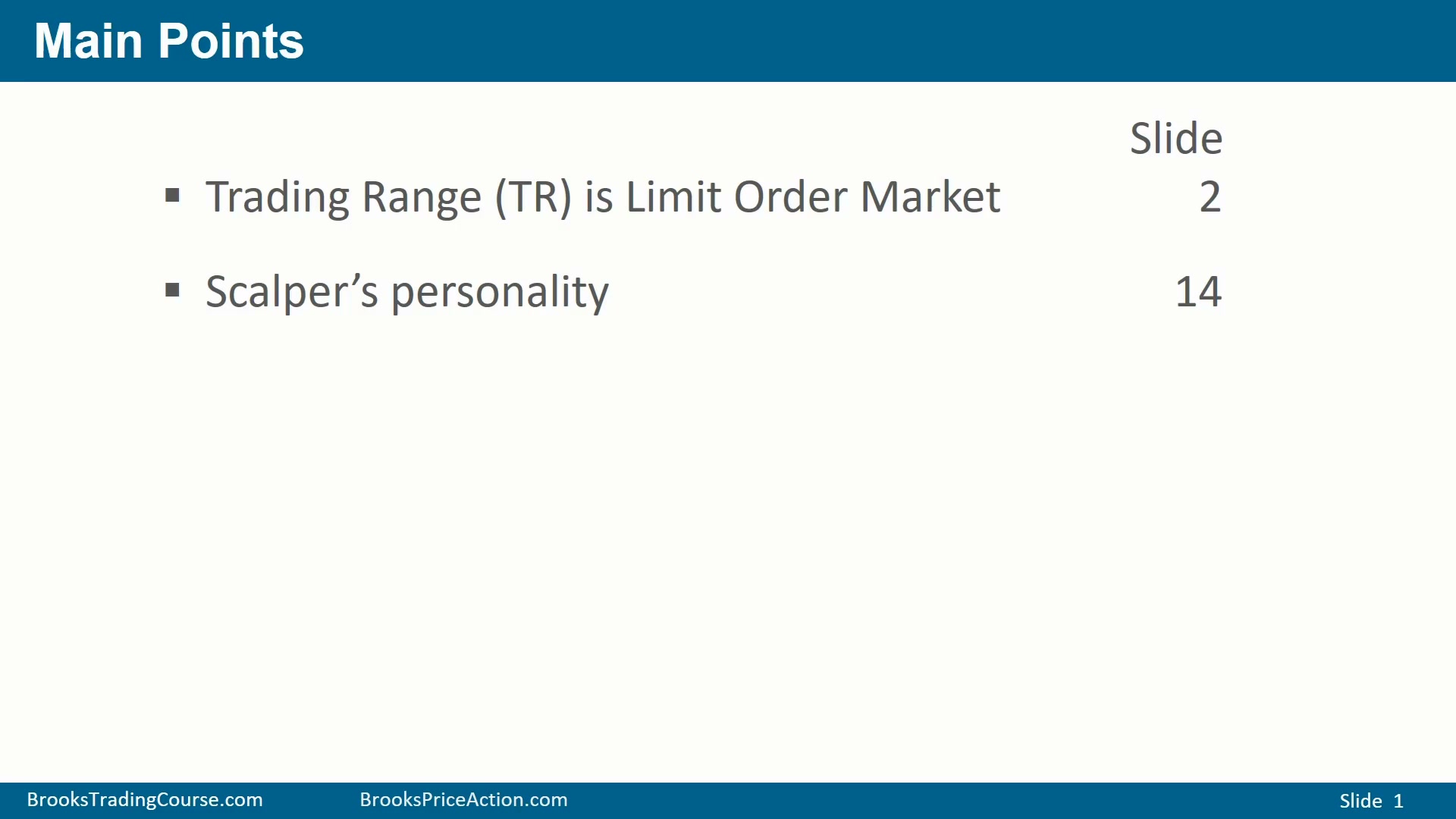
EN: I would like to begin by talking about the difference

00:14 - 00:18

EN: between a limit order market and a stop order market.

00:18 - 00:22

EN: A Trading Range, especially if it’s tight, is a limit order market,

00:22 - 00:24

EN: and traders should only be trading it

00:24 - 00:27

EN: if they’re scalpers and willing to enter with limit orders.

00:28 - 00:32

EN: Next, I want to talk about the personality that successful scalpers have.

00:32 - 00:37

EN: Most people do not have that personality – and don’t worry about it.

00:37 - 00:40

EN: Most profitable traders do not have scalpers’ personalities,

00:40 - 00:42

EN: yet they still can make a lot of money.

Slide 002

Time: 00:43

Slide 002

Bilingual Transcript

00:46 - 00:48

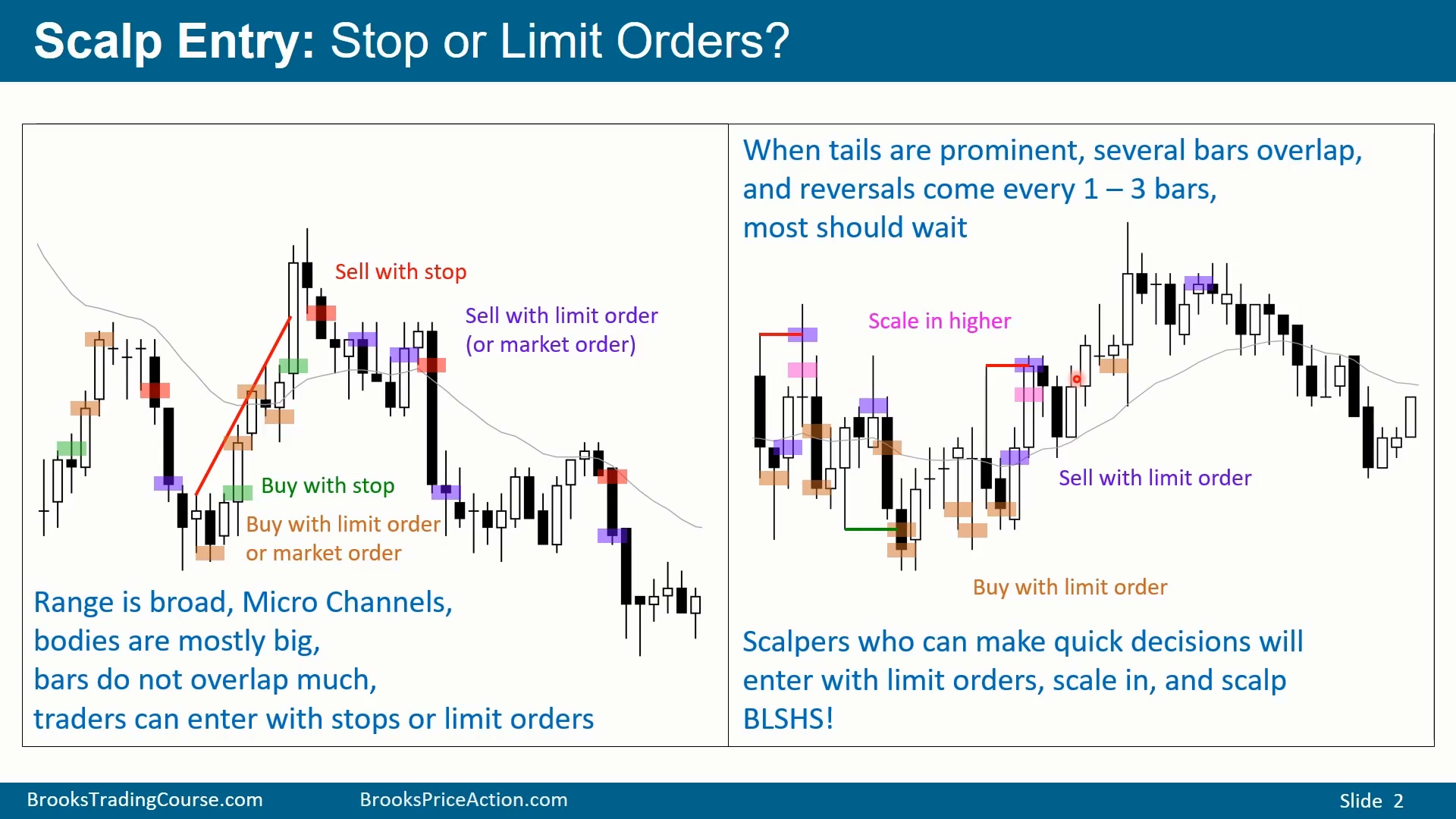
EN: These charts look fairly similar.

00:49 - 00:50

EN: They’re obviously in a Trading Range,

00:50 - 00:53

EN: but there are some differences between the two charts.

00:54 - 00:58

EN: For example, look at the open of this bar and the close of that bar.

00:59 - 01:01

EN: It’s above the close of this bar.

01:01 - 01:04

EN: That means that traders, as soon as this bar closed,

01:04 - 01:07

EN: hit “Buy the Market” and they got filled above the close.

01:08 - 01:11

EN: Look at the open of this bar and the close of that bar.

01:11 - 01:13

EN: Again, no overlap.

01:14 - 01:15

EN: Traders are eager to sell.

01:15 - 01:17

EN: There’s an urgency here.

01:17 - 01:20

EN: The bars are not overlapping very much on the way up or down.

01:20 - 01:23

EN: It entered much more of a tight range here.

01:23 - 01:27

EN: But overall, there are more legs with very little overlap

01:27 - 01:29

EN: and more of a sense of urgency.

01:29 - 01:32

EN: This market is a better market for entering with stop orders.

01:32 - 01:34

EN: On the other hand, look at this chart.

01:35 - 01:38

EN: The open of this bar is at that close, but the low of the bar

01:38 - 01:45

EN: fell below that close, and here, we closed here and the next bar opened lower.

01:45 - 01:47

EN: That means that traders sold the close.

01:47 - 01:50

EN: As soon as this bar closed, they hit “Sell the Market”

01:50 - 01:52

EN: and the market ended up going sideways.

01:52 - 01:56

EN: Lots of bars going sideways, lots of bars with prominent tails.

01:56 - 02:00

EN: I refer to this type of a market as a limit order market,

02:00 - 02:03

EN: and traders who are trading it in general are scalpers.

02:10 - 02:13

EN: We have several Micro Channels in this market.

02:13 - 02:16

EN: Even though it’s a Trading Range, most of the bodies are big,

02:16 - 02:19

EN: they do not overlap much, and we have several areas

02:19 - 02:22

EN: where we have consecutive, decent size trend bars.

02:22 - 02:24

EN: Traders in a market like this can enter

02:24 - 02:27

EN: with any kind of an order – stop orders or limit orders.

02:27 - 02:31

EN: You can scalp this market with limit orders, selling above bars,

02:31 - 02:35

EN: buying below bars, but you can also enter reversals with stop orders.

02:39 - 02:42

EN: When it’s low, you look to buy a reversal up.

02:42 - 02:44

EN: Here you have a Micro Double Bottom

02:44 - 02:47

EN: - down, up, down, up, a decent buy signal bar.

02:47 - 02:48

EN: You buy.

02:48 - 02:51

EN: Here we have 3 decent bull bars.

02:51 - 02:53

EN: Probably the first pullback will be bought.

02:53 - 02:57

EN: Some traders would buy with a limit order below the low of this bar.

02:57 - 02:58

EN: Others will simply sell with a stop

02:58 - 03:01

EN: above the high of this High 1 buy signal bar.

03:01 - 03:04

EN: Small bull trend, pullback, so it’s a small bull flag.

03:04 - 03:05

EN: Buy with a stop above its high.

03:10 - 03:14

EN: Experienced traders will buy with limit orders or market orders.

03:15 - 03:16

EN: A strong close of a bar, they’ll buy.

03:16 - 03:18

EN: Strong close of a bar, they’ll buy.

03:18 - 03:22

EN: Disappointment here, and you can see what took place here.

03:22 - 03:26

EN: The bulls did not like seeing a doji bar and then another doji bar,

03:26 - 03:30

EN: and a lot of them placed limit orders to try to get out breakeven at that close.

03:30 - 03:33

EN: Experienced traders did it.

03:33 - 03:35

EN: Others waited.

03:35 - 03:36

EN: They get out here or here.

03:39 - 03:42

EN: Reversal down, second reversal down.

03:42 - 03:44

EN: Tried to reverse down, could not.

03:44 - 03:45

EN: Tried to reverse down again.

03:46 - 03:48

EN: Reasonable to sell.

03:48 - 03:49

EN: Limit order traders.

03:49 - 03:52

EN: Here we have a Low 1 after a bear trend

03:52 - 03:55

EN: at the bottom of what is potentially a Trading Range.

03:55 - 03:59

EN: Big up, big down, big confusion, usually means sideways (a range).

03:59 - 04:03

EN: Traders will look to buy below bad sell signal bars.

04:03 - 04:07

EN: A bull body, a doji, a bad sell signal bar at the bottom of a range.

04:07 - 04:10

EN: So, traders will place a limit order to buy at the low of the bar.

04:10 - 04:14

EN: Strong bull bar closing on its high after a bull bar closing on its high.

04:14 - 04:17

EN: Scalpers will buy that close; they’ll buy that close.

04:17 - 04:20

EN: Is this going to be a Lower High leading to a reversal?

04:20 - 04:24

EN: Not likely after 3 consecutive bull bars, and therefore it’s a bad sell.

04:24 - 04:27

EN: Bull scalpers will place a limit order to buy

04:27 - 04:29

EN: at the low of the bar and they’ll get filled here.

04:29 - 04:33

EN: Reversal down from the top, a Parabolic Wedge, push up, and then a bear bar.

04:33 - 04:37

EN: 3 bars up and then a bear bar, 2 bars up and then a bear bar.

04:37 - 04:40

EN: Trading Range – up, down, up.

04:40 - 04:43

EN: Traders will sell with a stop below that bar.

04:43 - 04:46

EN: Here we have a Double Top Lower High, a Double Top bear flag

04:46 - 04:49

EN: after a very Tight Channel, almost a Micro Channel.

04:49 - 04:52

EN: Traders will sell the Double Top bear flag.

04:52 - 04:54

EN: We went up and then down.

04:54 - 04:55

EN: We went up.

04:55 - 04:56

EN: Maybe we’ll go down.

04:56 - 04:58

EN: We’re near the top of a potential Trading Range.

04:58 - 05:00

EN: We have a Parabolic Wedge.

05:00 - 05:03

EN: You expect two legs down – one, pullback, two.

05:03 - 05:05

EN: Here we have a Wedge bear flag.

05:05 - 05:08

EN: We went up and then down, and then up and then down.

05:08 - 05:11

EN: Up, and now we have a bear bar at the Moving Average.

05:11 - 05:14

EN: Strong, big bear trend bar.

05:14 - 05:17

EN: A breakout test of the bottom of this upper range.

05:17 - 05:19

EN: Traders will sell with a stop below the low of that bar,

05:19 - 05:21

EN: looking for at least a scalp down.

05:24 - 05:27

EN: Traders will sell with limit orders or market orders.

05:27 - 05:30

EN: A pair of strong bear bars, room to the bottom of the range – they’ll sell.

05:30 - 05:33

EN: We have 3 consecutive bear bars after a Parabolic Wedge.

05:33 - 05:38

EN: Traders expect at least a small second leg down – one, pullback, two

05:38 - 05:40

EN: - and they’ll sell with a limit order at the high.

05:40 - 05:45

EN: Here’s a High 2 buy – High 1, High 2, but 3 consecutive bear bars.

05:45 - 05:47

EN: Traders will sell above that bar,

05:47 - 05:49

EN: betting that even though this has two legs down

05:49 - 05:52

EN: - one, pullback, two – the channel is so tight,

05:52 - 05:56

EN: it’s probably the first of a more complex, bigger two legs down.

05:57 - 05:59

EN: One, pullback, and then two.

06:05 - 06:09

EN: On the chart on the right, look how prominent the tails are.

06:09 - 06:12

EN: That means the market tried to trend, it reversed.

06:12 - 06:14

EN: It tried to trend down, it reversed up.

06:14 - 06:16

EN: Tried to trend up, it reversed down.

06:16 - 06:18

EN: Very Tight Trading Range.

06:18 - 06:20

EN: Reversals coming every 1 to 3 bars.

06:20 - 06:24

EN: Most traders should not trade when they see the market looking like this.

06:24 - 06:26

EN: It’s too easy to lose money.

06:26 - 06:30

EN: However, a professional scalper feels very comfortable

06:30 - 06:31

EN: in this kind of a setting.

06:36 - 06:40

EN: If they make quick decisions and they can enter with limit orders,

06:40 - 06:44

EN: and especially if they can scale in and use fairly wide stops,

06:44 - 06:47

EN: they can make a lot of money even when the market looks like this.

06:47 - 06:51

EN: Most traders should not be trading that, but professional scalpers

06:51 - 06:55

EN: will look at it and say, “Eh, we get Tight Trading Ranges all the time.

06:55 - 06:56

EN: I’m here to make money.

06:56 - 06:57

EN: There’s opportunity here.

06:57 - 06:58

EN: I can do it.

07:02 - 07:05

EN: They’ll bet that every attempt to turn into a trend will fail.

07:05 - 07:08

EN: At one point this big doji bar was a big bull trend bar,

07:08 - 07:11

EN: and the scalper bet that after 2 bear bars,

07:11 - 07:16

EN: both with fairly prominent tails, the breakout will probably fail.

07:16 - 07:19

EN: We went down, we went up, we went down, we’re going up.

07:20 - 07:23

EN: Scalpers will bet that it’s a bad buy above a bear bar.

07:23 - 07:26

EN: They’ll place a limit order to sell at its high, looking for a scalp.

07:26 - 07:29

EN: They’ll also place a limit order to sell above this high,

07:29 - 07:30

EN: in case it kept going up.

07:30 - 07:33

EN: They’ll sell more here, expecting a scalp.

07:33 - 07:35

EN: They’ll sell more above this bar.

07:35 - 07:36

EN: They’d be selling over here.

07:36 - 07:38

EN: I don’t have it indicated, but they would.

07:38 - 07:41

EN: 3 bars down after a Buy Climax.

07:42 - 07:45

EN: Traders will sell above a bull bar, especially one with a big tail,

07:45 - 07:48

EN: betting that the best the bulls will get is a Trading Range

07:48 - 07:49

EN: - enough room for a scalp.

07:49 - 07:52

EN: They sell here, they buy back their shorts

07:52 - 07:56

EN: near the bottom of a potential Double Bottom at the Moving Average.

08:00 - 08:02

EN: They’ll also buy with limit orders.

08:03 - 08:07

EN: Fairly big bear bar, but also prominent tails top and bottom.

08:07 - 08:09

EN: They’ll look to buy at the bottom.

08:09 - 08:13

EN: Here we have an entry bar after this reversal – down and then up.

08:13 - 08:16

EN: Bulls will buy at the low of that bar,

08:16 - 08:18

EN: betting that the first breakout will fail.

08:18 - 08:20

EN: They’ll buy at the close of this bear bar,

08:20 - 08:22

EN: betting against consecutive big trend bars.

08:22 - 08:26

EN: They’ll bet that every time the bears try to get a trend, they’ll fail.

08:26 - 08:29

EN: They might get a couple bear bars, but they’re unlikely to get three.

08:29 - 08:34

EN: For example, 2 more bear bars – they’ll buy here, the close of this bar,

08:34 - 08:37

EN: betting that the bears will not be able to turn this into a trend.

08:37 - 08:39

EN: Consecutive bull bars – they’ll sell.

08:39 - 08:42

EN: Also, they’re selling at a prior high, looking for a scalp down.

08:43 - 08:47

EN: Here we’re trying to get a reversal down, but only a doji bar after 2 bull bars.

08:48 - 08:50

EN: You have to be very quick to understand what’s going on

08:50 - 08:52

EN: and to make the decisions and to place the orders,

08:52 - 08:55

EN: and you have to manage the trade quickly.

08:55 - 08:57

EN: You’ve got to make sure that your profit-taking order

08:57 - 09:00

EN: and your stops are in the right place.

09:04 - 09:06

EN: Traders will also scale in higher.

09:06 - 09:12

EN: For example, if a bear saw this pair of bear bars, prominent tails,

09:12 - 09:15

EN: Trading Range – they’ll place a limit order to sell at the high of this bar,

09:15 - 09:18

EN: but they’ll also be willing to sell more higher.

09:18 - 09:22

EN: The second entry has to be at least as big as a scalp

09:22 - 09:25

EN: because a lot of these scale-in traders are looking

09:25 - 09:27

EN: to take profits around their original entry,

09:27 - 09:31

EN: and they want to make at least a scalper’s profit on the second half.

09:31 - 09:33

EN: They get out breakeven on their first,

09:33 - 09:35

EN: and they get a scalper’s profit on the second.

09:36 - 09:37

EN: The same here.

09:37 - 09:39

EN: A pair of bear bars.

09:39 - 09:41

EN: It’s fairly low in the range to be selling,

09:41 - 09:45

EN: but traders might sell above its high, sell more higher

09:45 - 09:49

EN: - at least the size of a scalp above – expecting the market to pull back

09:49 - 09:52

EN: below the high of this bar, which it did right here.

09:52 - 09:56

EN: Then they get out breakeven on their first entry – they sold at this high

09:56 - 09:59

EN: - and then they get out with a scalper’s profit on the second entry.

09:59 - 10:04

EN: Part of the reason this reversed is bear scalpers were buying back their shorts.

Slide 003

Time: 10:10

Slide 003

Bilingual Transcript

10:16 - 10:18

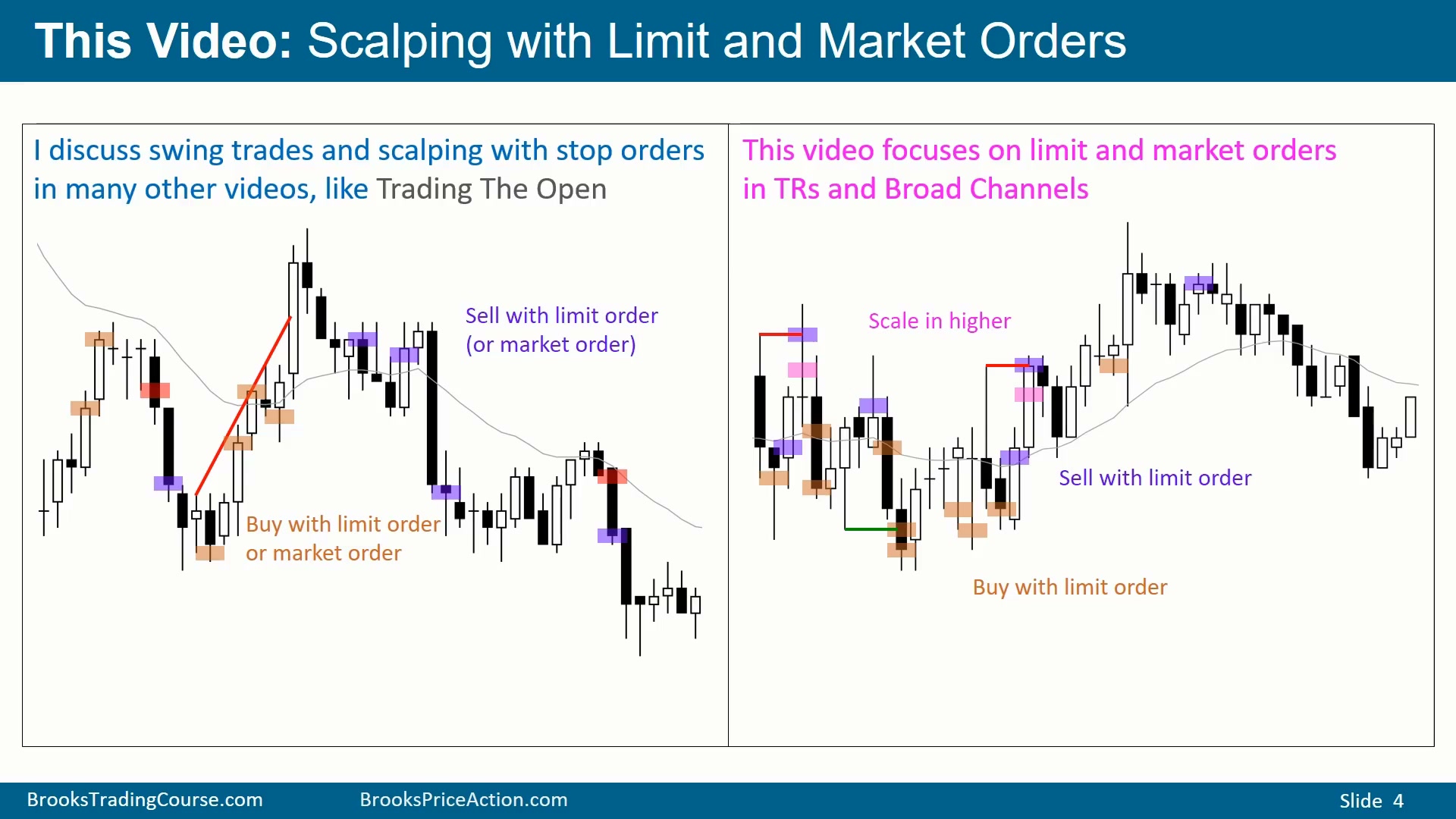
EN: I talk about swing trades and scalping

10:18 - 10:21

EN: with stop orders in other videos, like Trading the Open.

10:22 - 10:24

EN: I’m not going to talk about that much here.

10:24 - 10:27

EN: I’m going to talk much more about limit order

10:27 - 10:31

EN: and market order trades in Trading Ranges and in Broad Channels.

10:31 - 10:37

EN: A Broad Channel is basically a Trading Range that’s tilted up or tilted down.

Slide 004

Time: 10:38

Slide 004

Bilingual Transcript

10:45 - 10:48

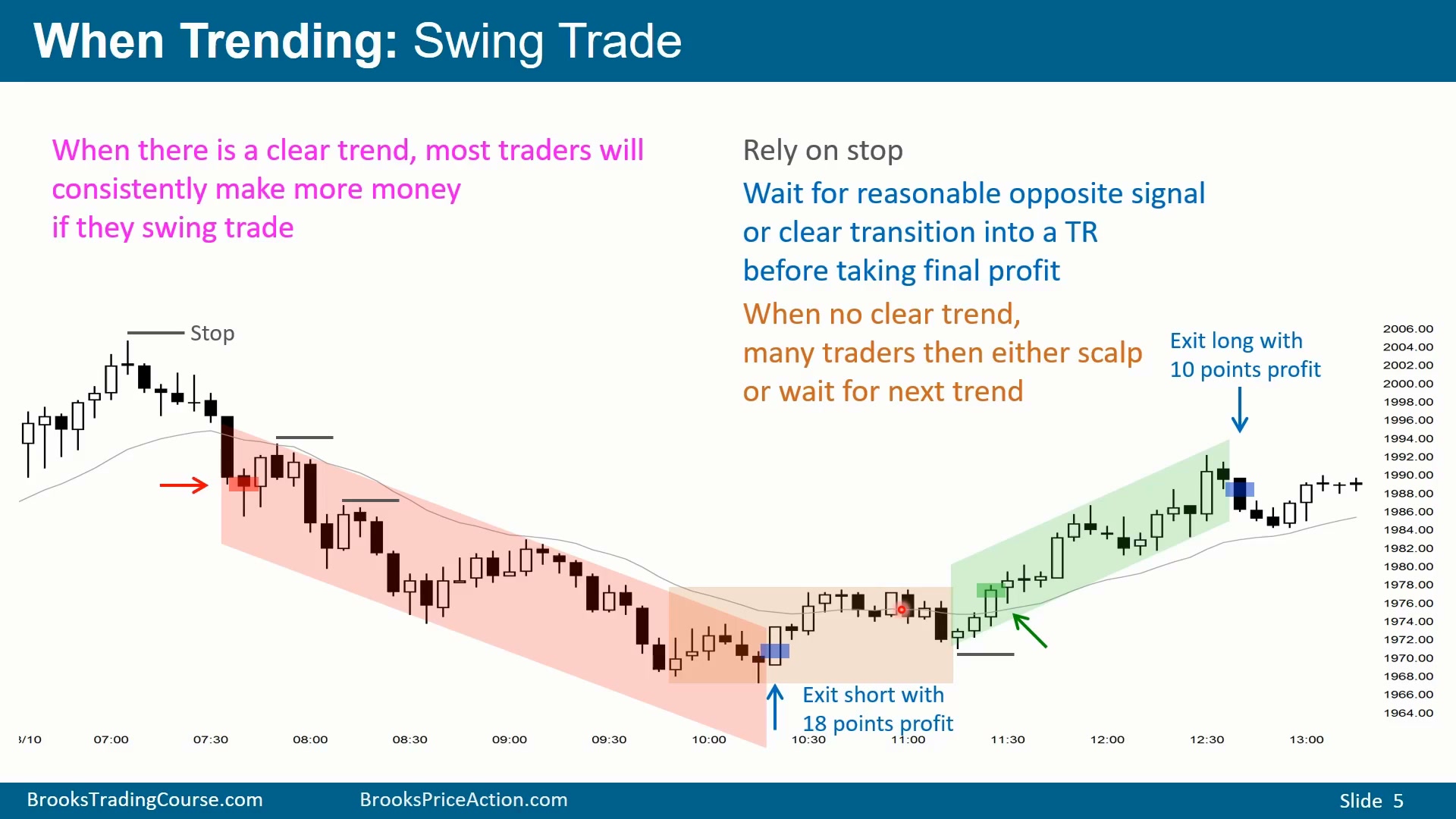
EN: When the market’s clearly trending fairly strongly,

10:48 - 10:53

EN: not much in terms of overlap, not much in terms of prominent tails,

10:54 - 10:58

EN: most traders will consistently make much more money if they swing trade.

10:58 - 11:00

EN: Look to enter early.

11:00 - 11:02

EN: A bear flag, a Low 1 bear flag – sell.

11:02 - 11:04

EN: Low 1 bear flag – sell.

11:04 - 11:06

EN: Up, down, up, down, up.

11:06 - 11:09

EN: A Wedge bear flag at the Moving Average – sell.

11:10 - 11:14

EN: We have a Higher Low Major Trend Reversal, 4 consecutive bull bars.

11:14 - 11:17

EN: Almost a bull bar here, 8 consecutive bull bars.

11:17 - 11:20

EN: Traders will look to buy either a High 1 or a High 2.

11:24 - 11:26

EN: Bear breakout with the bulls trying to have

11:26 - 11:28

EN: a bull flag here after this small rally.

11:28 - 11:32

EN: Instead we got a bear bar and a second consecutive bear bar,

11:32 - 11:33

EN: confirming the breakout.

11:33 - 11:35

EN: This is follow-through selling.

11:35 - 11:36

EN: Traders will sell.

11:37 - 11:39

EN: Here we have a Higher Low Major Trend Reversal

11:39 - 11:41

EN: and we have 3 consecutive bull bars.

11:41 - 11:42

EN: Bulls will start buying closes.

11:42 - 11:45

EN: They’ll buy the close of this bar, this bar, any of these bars,

11:45 - 11:48

EN: confident that the first reversal down will be minor,

11:48 - 11:51

EN: become a bull flag, and the market will resume up.

11:54 - 12:00

EN: If you take a sell for any reason, anywhere in here – even if you sell here,

12:00 - 12:04

EN: your stop is up here, the top of the most recent strong selloff.

12:04 - 12:07

EN: Every time you get a new breakout to a new low

12:07 - 12:11

EN: with a reasonably strong selloff, traders will tighten their stops.

12:11 - 12:16

EN: Once this bar closes, the bears who sold for any reason through here

12:16 - 12:18

EN: will lower their stop from here down to here.

12:19 - 12:20

EN: The same is true here.

12:20 - 12:24

EN: No matter where you sold – if you sold here, if you sold below that bar,

12:24 - 12:28

EN: if you sell below this bar – once you’ve seen 2 or more consecutive bear bars

12:28 - 12:31

EN: closing near their lows, breaking to a new low,

12:31 - 12:35

EN: traders will lower their stop to above the most recent major Lower High.

12:35 - 12:40

EN: It’s major because traders will consider the bear trend intact

12:40 - 12:42

EN: as long as it keeps making major Lower Highs.

12:42 - 12:45

EN: If it gets above a major Lower High,

12:45 - 12:49

EN: traders will assume the bear trend has ended and the market has evolved

12:49 - 12:52

EN: into either a Trading Range or possibly even a bull trend.

12:52 - 12:56

EN: Here’s a major Lower High, and the market rallied above it.

12:57 - 12:59

EN: We already knew that it probably was a bull trend

12:59 - 13:03

EN: before it got above that high, but once it does get above that high,

13:03 - 13:07

EN: the bears give up their premise that it’s still a bear trend.

13:07 - 13:10

EN: They assume it’s either a Trading Range or now a bull trend.

13:17 - 13:21

EN: If you are swing trading, you continue to hold your position

13:21 - 13:25

EN: until either your stop gets hit or until there’s a reasonable opposite signal.

13:26 - 13:29

EN: You could argue getting out at the bottom here makes sense.

13:29 - 13:33

EN: Three pushes down – one, two, three – a possible Wedge.

13:34 - 13:38

EN: A lot of traders will exit not above this bar, but above a bull bar here

13:38 - 13:42

EN: or after they believe the market is trying to convert into a Trading Range,

13:42 - 13:45

EN: forming a Higher Low Major Trend Reversal.

13:45 - 13:46

EN: A lot of the bears will exit here.

13:46 - 13:49

EN: Here, the bulls might exit here.

13:49 - 13:55

EN: Three pushes up – one, two, three or one, two, three, and a bear bar

13:55 - 13:59

EN: - knowing that a bear channel usually evolves into a big Trading Range.

14:00 - 14:01

EN: We have a spike, pullback, channel.

14:02 - 14:07

EN: We’re near the top of the channel and it’s a logical area for the bulls

14:07 - 14:11

EN: to take profits, and therefore if you have any kind of a Wedge Top

14:11 - 14:14

EN: and a decent sell bar, a decent bear body,

14:14 - 14:17

EN: bulls will take profits no matter where they bought.

14:18 - 14:22

EN: Just because bulls take profits, does not mean the signal

14:22 - 14:24

EN: is strong enough for the bears to sell.

14:24 - 14:26

EN: If the channel is tight like this,

14:27 - 14:29

EN: the bears will wait in general for a second signal.

14:29 - 14:31

EN: They won’t take the first signal.

14:31 - 14:35

EN: But the first signal, especially when the location is near the top

14:35 - 14:40

EN: of a possible developing Trading Range, is good enough for the bulls to exit.

14:40 - 14:42

EN: If the market resumes up, they’ll buy again.

14:46 - 14:50

EN: In the Emini, if a trader took this sell and sold the close

14:50 - 14:53

EN: of the follow-through bar after the bear break below the bull flag,

14:54 - 14:57

EN: it’s reasonable to exit on this reversal up.

14:57 - 15:00

EN: You have a small Double Bottom or a Wedge Bottom – one, two, three

15:00 - 15:03

EN: - and we’re starting to get Trading Range types of bars.

15:03 - 15:07

EN: Smaller bars, doji bars, prominent tails, and sideways.

15:07 - 15:09

EN: The strong trend might be ending.

15:13 - 15:16

EN: If a bull bought here – and as I said,

15:16 - 15:19

EN: a Wedge near the top of the channel, possible Trading Range

15:19 - 15:23

EN: - it’s reasonable for a bull to take profits here with 10 points.

15:28 - 15:30

EN: We’re starting to get smaller bodies.

15:30 - 15:31

EN: A lot of overlap among the bars.

15:31 - 15:33

EN: It’s entering a Tight Trading Range.

15:33 - 15:38

EN: In fact, you could call this whole 40 or 50 bars a Tight Trading Range.

15:40 - 15:43

EN: When there is no clear trend, many traders either scalp

15:44 - 15:47

EN: - experienced traders will do that – or they wait for the next trend.

15:47 - 15:49

EN: For example, a Higher Low Major Trend Reversal.

15:49 - 15:53

EN: Higher probability to buy after you see a series of bull bars,

15:53 - 15:55

EN: consecutive bull bars closing near their highs,

15:55 - 15:59

EN: but a reasonable buy here as well, a Wedge Higher Low.

15:59 - 16:01

EN: Bear bars, bull bars.

16:01 - 16:02

EN: Bear bar, bull bar.

16:02 - 16:03

EN: Bear bar, bull bar.

16:03 - 16:05

EN: Three pushes down to a Higher Low.

Slide 005

Time: 16:10

Slide 005

Bilingual Transcript

16:11 - 16:14

EN: I’ve been talking about a lot of scalps in Trading Ranges,

16:14 - 16:16

EN: in which you’re buying near the bottom,

16:16 - 16:19

EN: betting that the bear leg will fail and reverse up.

16:19 - 16:21

EN: You’re selling near the top, betting that the bull leg

16:21 - 16:23

EN: will fail and reverse down.

16:24 - 16:28

EN: Scalping in the direction of a strong trend is also a good strategy.

16:35 - 16:40

EN: One of the problems scalping in a strong trend is scalpers tend

16:40 - 16:44

EN: to take their profit and then take a break for a bar or two or three,

16:44 - 16:48

EN: and then they miss the next scalp, and they end up taking far fewer scalps

16:48 - 16:52

EN: than what you see on the screen, and they’ll end up making far less money

16:52 - 16:55

EN: than a swing trader when the trends are strong like this.

16:59 - 17:04

EN: When you’re scalping, you’re going for a small profit, and that means

17:04 - 17:08

EN: you need very high probability to offset the terrible risk/reward.

17:08 - 17:11

EN: For example, if you’re selling this close for a scalp,

17:11 - 17:14

EN: it doesn’t matter whether you’re selling for a scalp or a swing

17:14 - 17:15

EN: - your stop is still up here.

17:15 - 17:18

EN: A swing trader is going to hold for a big profit.

17:18 - 17:20

EN: The scalper is just looking for a little profit.

17:20 - 17:25

EN: A scalper taking that much risk for this profit in general is better off

17:25 - 17:30

EN: if he’s willing to scale in higher in case the market goes up near his stop.

17:32 - 17:36

EN: That’s one way to increase the probability to offset the bad risk/reward.

17:37 - 17:41

EN: Usually the risk is at least as big as the reward,

17:41 - 17:43

EN: and therefore you have to be winning 70% or 80%

17:43 - 17:46

EN: of the time for this to be a profitable strategy.

17:46 - 17:50

EN: That is very difficult for most traders to do,

17:50 - 17:52

EN: and therefore most traders should not scalp.

17:58 - 18:02

EN: A trader can consistently make a good profit scalping

18:02 - 18:04

EN: if he takes high probability scalps.

18:04 - 18:08

EN: There are not many that are high probability without proper management

18:08 - 18:11

EN: - for example, using wide stops and scaling in.

18:21 - 18:25

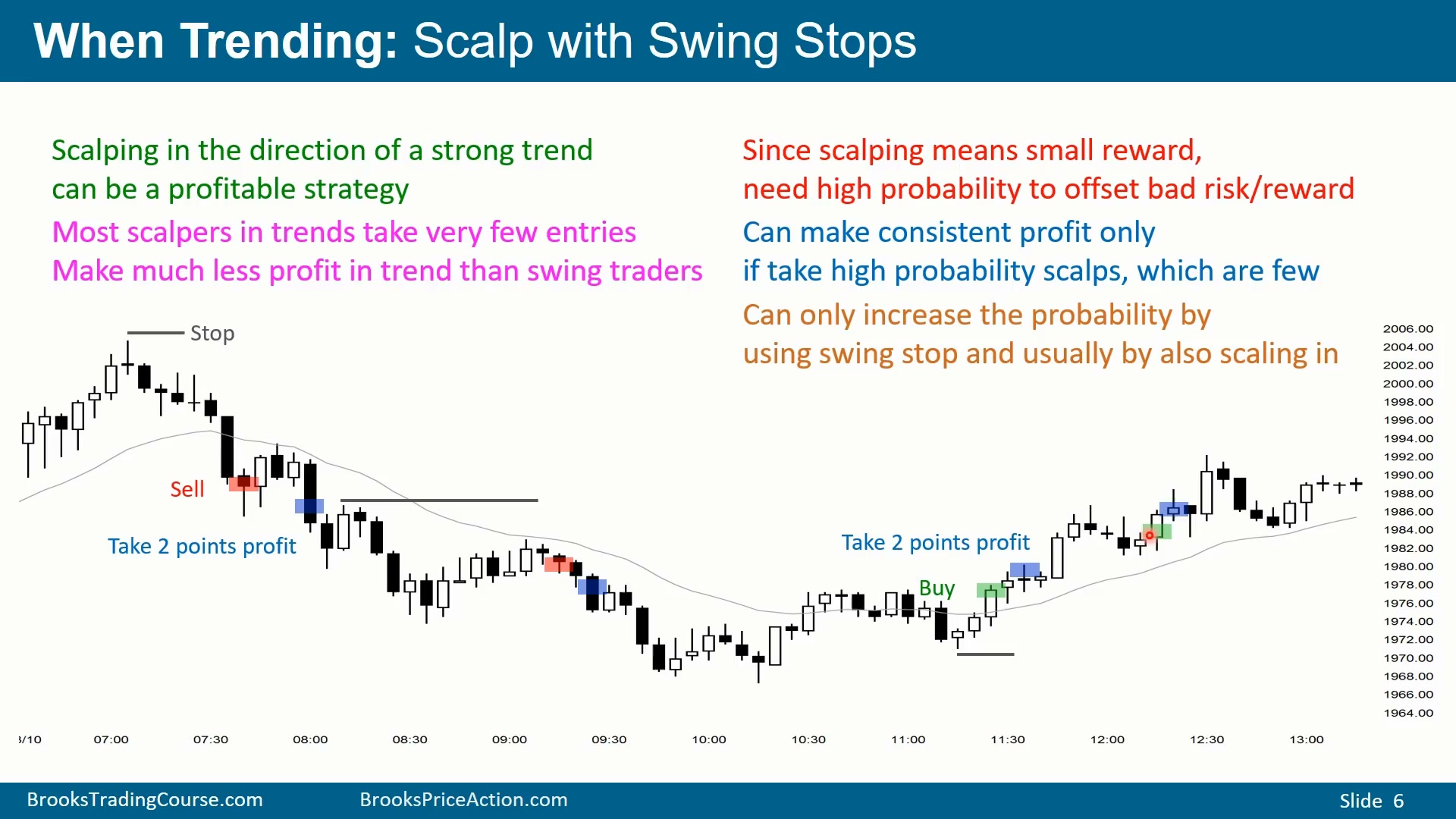
EN: For example, the bear who sold the close of this follow-through bar

18:25 - 18:29

EN: after the bear breakout has a stop up here – did not pull back very much,

18:29 - 18:32

EN: and here he can exit with 2 points profit.

18:32 - 18:35

EN: When you look at that, he sells here and buys back his shorts here.

18:35 - 18:38

EN: He made very little compared to the size of the trend.

18:39 - 18:41

EN: Also compared to the size of his risk.

18:42 - 18:45

EN: Not an ideal way to trade.

18:45 - 18:49

EN: Just because mathematically it might make sense to take profits here,

18:50 - 18:53

EN: does not mean that it’s the best solution.

18:53 - 18:57

EN: In general, going for the minimum for anything in life is a bad idea.

18:58 - 19:01

EN: Hoping to make minimum wage for your career is a bad idea.

19:04 - 19:08

EN: A bear who sells below here – a Wedge bear flag, a Low 3 short

19:08 - 19:13

EN: - Low 1, an attempt at a Low 2, and then Low 3 at the Moving Average

19:13 - 19:17

EN: - puts a stop above the top of the most recent major Lower High.

19:17 - 19:20

EN: We have a series of bear bars, 2 of them pretty good size,

19:20 - 19:22

EN: closing on their lows, and a new low.

19:22 - 19:26

EN: If this is still a bear trend, it should not get above a major Lower High.

19:26 - 19:28

EN: It certainly should not get above this Lower High.

19:30 - 19:32

EN: This is a reasonable location for a stop.

19:32 - 19:34

EN: This is a higher probability.

19:35 - 19:39

EN: In general, when you use a stop that’s further away, it’s not going to get hit

19:39 - 19:43

EN: as often, but when it does get hit you’re going to lose more money.

19:43 - 19:44

EN: Both are reasonable.

19:44 - 19:48

EN: Stop here at the top of the Wedge channel – one, two, three

19:48 - 19:52

EN: - or stop here, the top of this small major Lower High.

19:53 - 19:59

EN: If you take this trade 100 times using the tighter stop or using the wider stop,

20:00 - 20:02

EN: you’ll end up with about the same amount of money.

20:06 - 20:10

EN: A trader could buy this close, knowing it’s the third consecutive bull bar

20:10 - 20:14

EN: after a Higher Low Major Trend Reversal, and the market’s probably going higher.

20:14 - 20:17

EN: If he takes that buy, he has a high probability of making money,

20:17 - 20:19

EN: putting a stop down here.

20:19 - 20:23

EN: He could exit here – a 2 point profit, a small scalp

20:23 - 20:26

EN: - but when you look at the size of the swings on the screen,

20:26 - 20:31

EN: going for a 2 point scalp here and going for a 2 point scalp here

20:31 - 20:34

EN: just looks too small for the size of the risk

20:34 - 20:36

EN: and for the size of the profit potential.

20:36 - 20:38

EN: Most traders should not be doing that.

20:38 - 20:44

EN: Professional scalpers who do buy, exit, buy, exit, buy, exit, can do very well.

20:44 - 20:47

EN: Sell, exit, sell again, sell again, and then exit,

20:47 - 20:49

EN: and then just repeatedly sell.

20:49 - 20:51

EN: But that is very difficult to do.

20:52 - 20:55

EN: It’s very difficult to get out and then immediately get back in,

20:55 - 20:57

EN: or get back in a bar or two later.

20:57 - 21:02

EN: It sounds good, but it’s very difficult to do and very few people can do that.

21:02 - 21:07

EN: It’s much better, when you see a market having a reasonably good swing

21:07 - 21:12

EN: and a likelihood of having a swing, hold for a swing and rely on your stop.

21:13 - 21:14

EN: A bull scalper.

21:14 - 21:16

EN: We have a bull channel, a bear breakout.

21:16 - 21:18

EN: Probably will fail.

21:18 - 21:20

EN: High 1, High 2 with a bull bar.

21:20 - 21:23

EN: You buy above, exit with 2 points.

21:23 - 21:28

EN: That’s another example of a scalp in the direction of a trend.

Slide 006

Time: 21:30

Slide 006

Bilingual Transcript

21:35 - 21:38

EN: This video, I’m not going to be talking so much about the trends.

21:38 - 21:40

EN: I’m going to be talking about the Trading Ranges

21:41 - 21:45

EN: and scalping within those ranges, and during the transitions

21:45 - 21:47

EN: from a trend to a Trading Range.

21:54 - 21:57

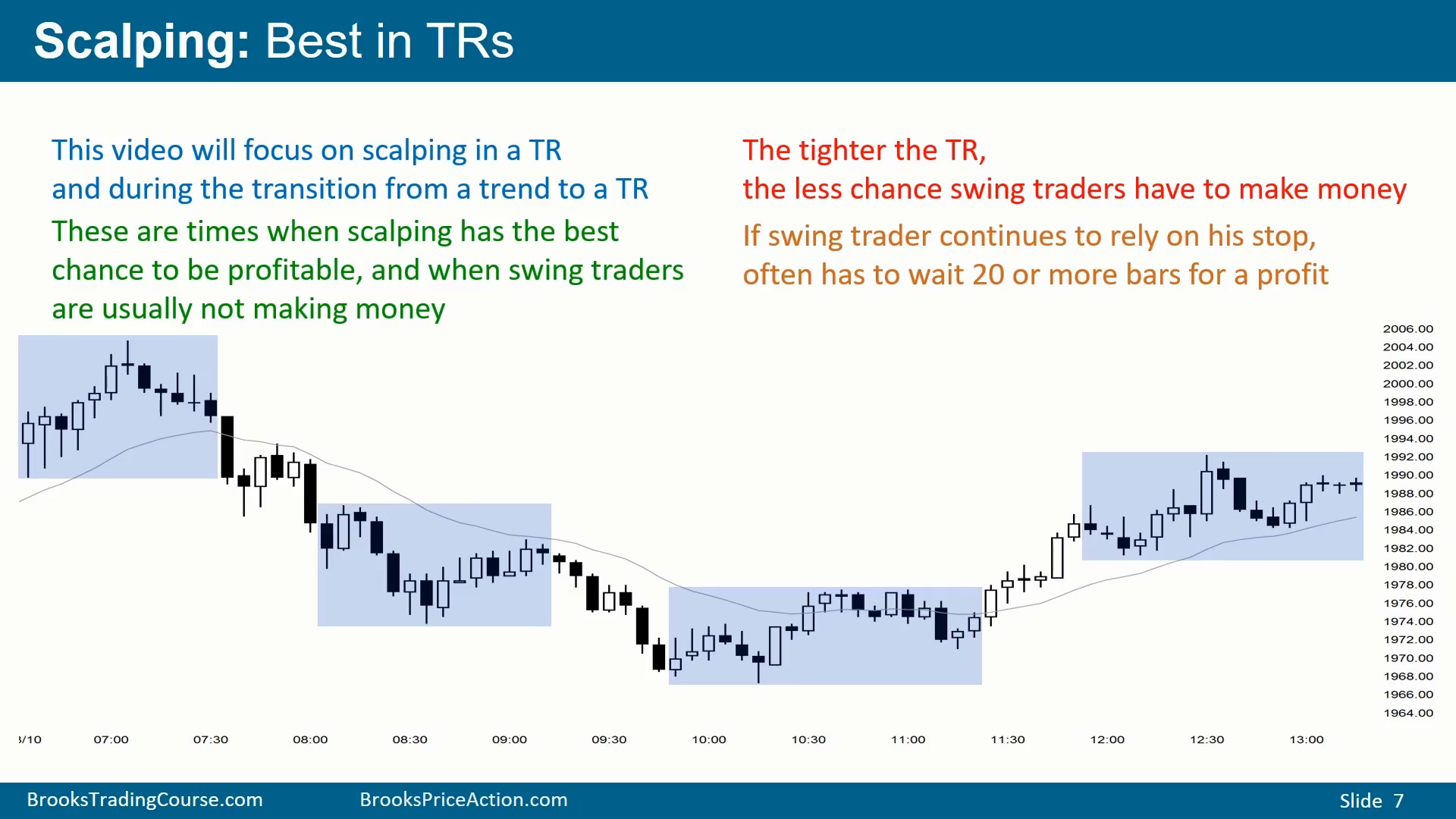
EN: A lot of the time the environment is much better for scalpers,

21:57 - 21:59

EN: and most traders should not be trading.

22:01 - 22:04

EN: When the market looks like this, swing traders are not making money.

22:04 - 22:07

EN: They’re not making money here; they’re not making money here.

22:07 - 22:11

EN: They are if they’re holding, hoping for trend resumption – trend resumption up

22:11 - 22:16

EN: - but in general, these are areas where scalpers can make a lot of money.

22:20 - 22:25

EN: The tighter the Trading Range, the less likely swing traders will make money,

22:25 - 22:27

EN: and the more bars they have to hold

22:27 - 22:31

EN: while they wait for a trade to become profitable.

22:37 - 22:40

EN: For example, if you’re a bear holding short down here

22:40 - 22:45

EN: - let’s say you sold anywhere in here and you’re hoping for a profit

22:45 - 22:48

EN: - it’s still below the most recent major Lower High.

22:48 - 22:51

EN: We still do not have a credible buy signal,

22:51 - 22:54

EN: and therefore you end up holding for 10 bars, 20 bars,

22:54 - 22:57

EN: waiting for your premise to play out, waiting to make money.

22:58 - 23:00

EN: That’s just part of the game.

23:00 - 23:02

EN: If you’re a swing trader, that’s what you’re going to do.

Slide 007

Time: 23:05

Slide 007

Bilingual Transcript

23:06 - 23:09

EN: Scalpers look for Trading Range environments,

23:09 - 23:11

EN: and then they bet against breakouts.

23:16 - 23:18

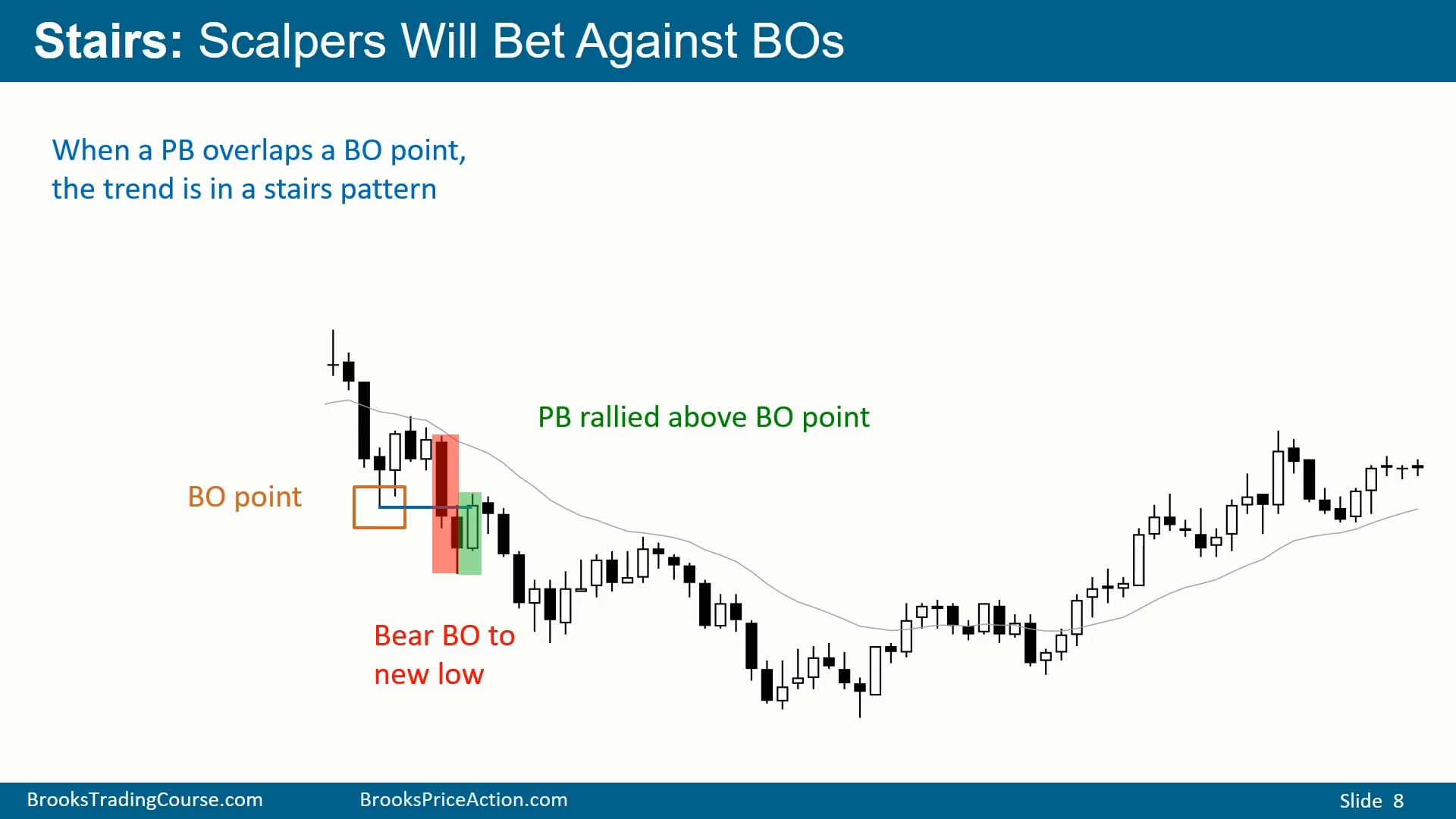
EN: Here we have a strong bear breakout to a new low.

23:21 - 23:23

EN: Here’s the breakout point.

23:26 - 23:27

EN: Look at this.

23:27 - 23:30

EN: Look at the high of this bar and look at the low of that bar.

23:30 - 23:34

EN: Do you see what took place? The market went above the high of that bar.

23:35 - 23:39

EN: Therefore, pullbacks are going above breakout points.

23:39 - 23:44

EN: What does that tell you? It tells you that a bull who either bought this low

23:44 - 23:48

EN: and bought more lower could make money – he buys at this low,

23:48 - 23:51

EN: he buys more at least the size of a scalp lower,

23:51 - 23:54

EN: and then places a limit order to get out at his first entry.

23:54 - 23:58

EN: He gets out breakeven there and then with a profit on his lower entry.

23:58 - 24:02

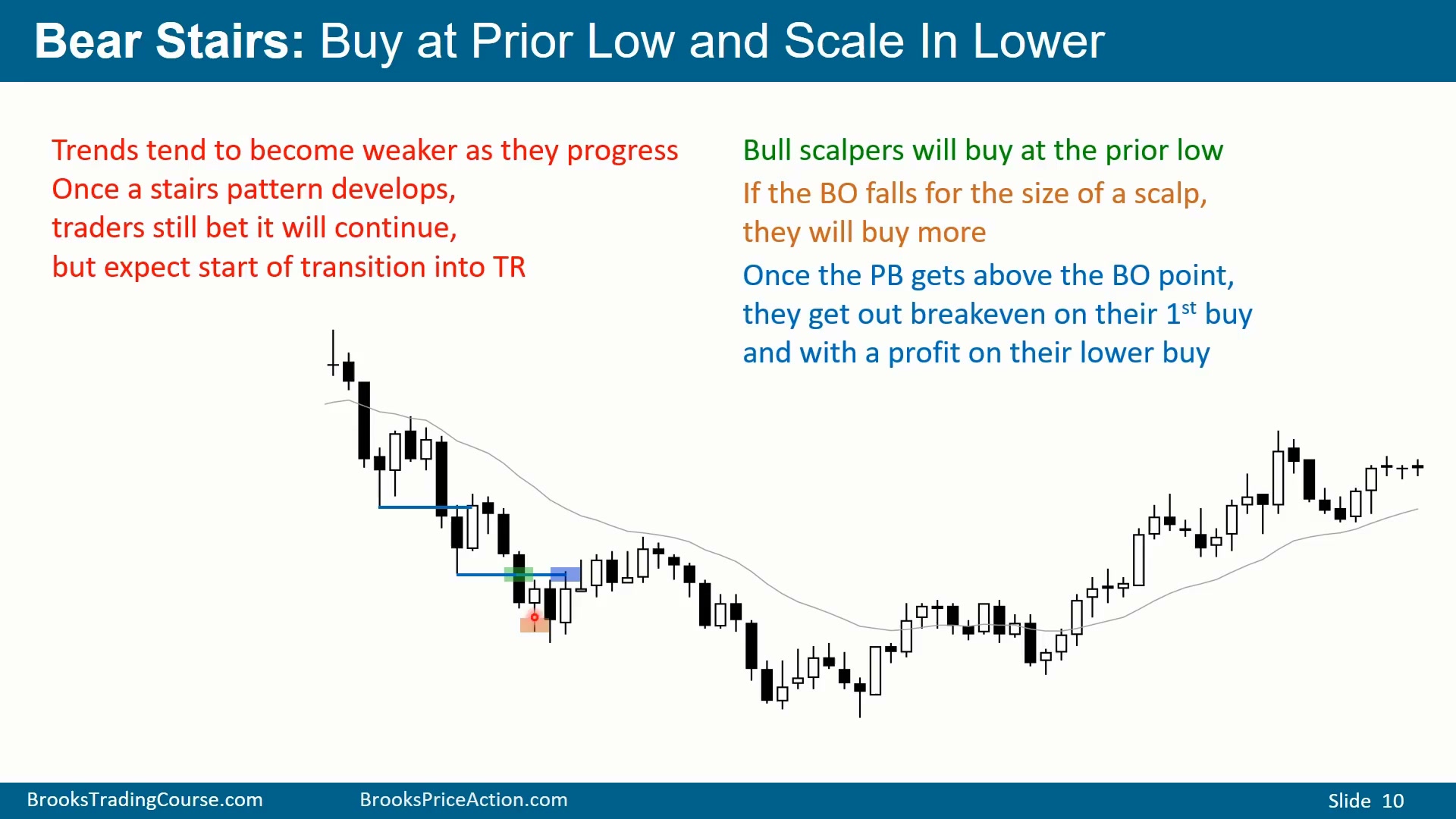
EN: This is what I call a stairs pattern, whenever you’re in a channel

24:02 - 24:05

EN: - but the pullbacks are overlapping the breakout points.

24:05 - 24:09

EN: That tells you that traders buying below the bars are making money.

24:09 - 24:13

EN: It also tells you that the bears are taking profits below every new low.

24:14 - 24:16

EN: This is a good environment for scalpers.

Slide 008

Time: 24:20

Slide 008

Bilingual Transcript

No transcript segment aligned to this slide.

Slide 009

Time: 24:25

Slide 009

Bilingual Transcript

24:30 - 24:32

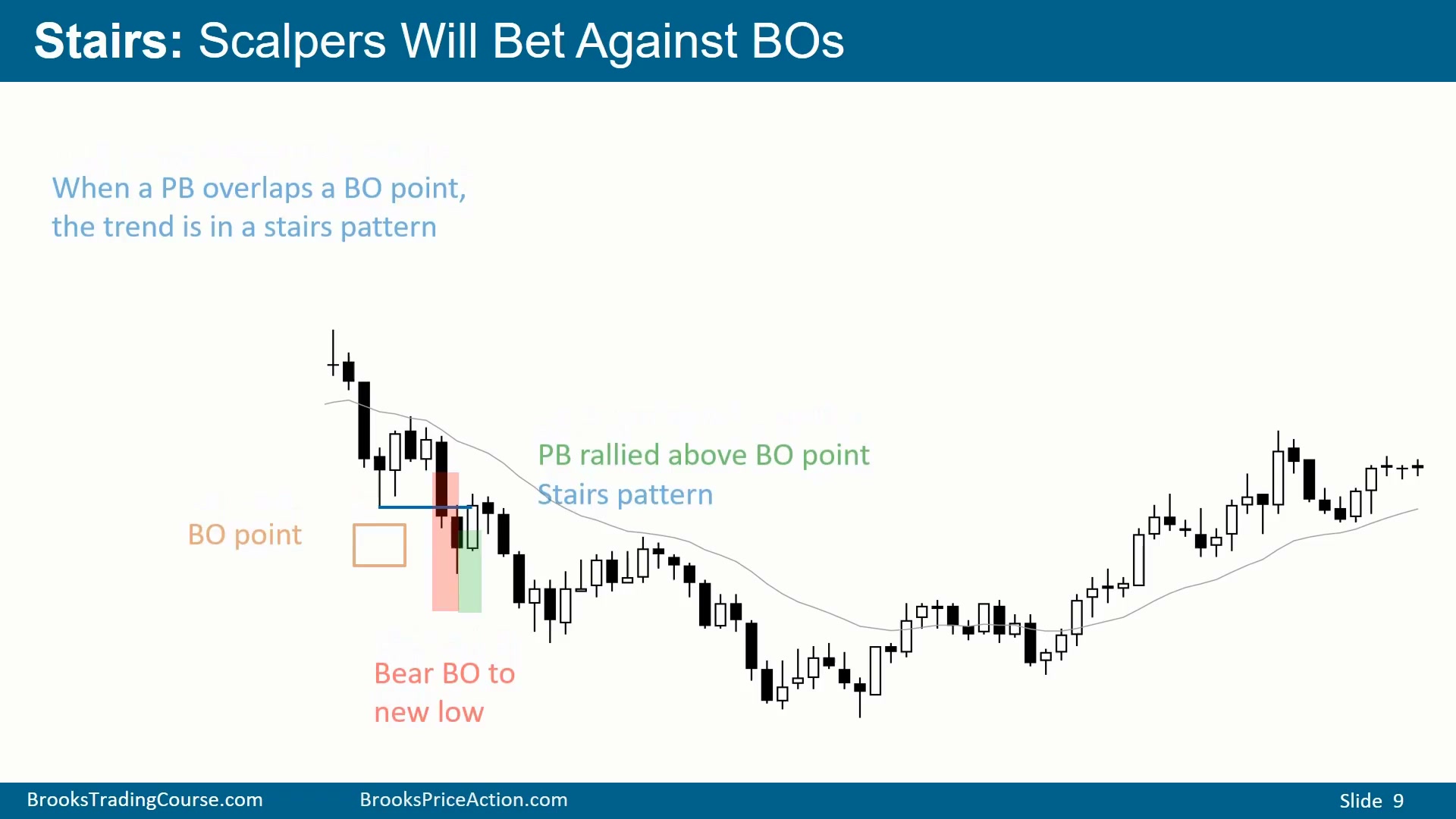
EN: As a trend goes on, remember the market cycle.

24:32 - 24:35

EN: Initially you have a breakout and then a channel,

24:35 - 24:37

EN: and then the channel gets flatter.

24:37 - 24:41

EN: It transitions into a Trading Range, and then either breaks

24:41 - 24:45

EN: in the opposite direction – here we have trend reversal – or it resumes down.

24:45 - 24:48

EN: You get another breakout and then another channel and another Trading Range.

24:50 - 24:54

EN: When you start getting stairs patterns, you know the bulls are making money

24:54 - 24:57

EN: in a bear trend, and therefore it’s the earliest sign

24:57 - 25:00

EN: that the market might be soon transitioning into a Trading Range.

25:05 - 25:07

EN: Some bulls will buy the low and buy more lower.

25:07 - 25:12

EN: Others, instead of buying the low, will simply buy lower,

25:12 - 25:15

EN: the size of a scalp or twice the size of a scalp,

25:15 - 25:17

EN: expecting the market to come back above the breakout point.

25:18 - 25:23

EN: A lot of scalpers do not do that until they see a stairs pattern.

25:24 - 25:27

EN: For example, would I buy below this bar or this bar?

25:27 - 25:30

EN: We don’t know if this pullback overlapped the breakout point,

25:30 - 25:31

EN: but let’s say it did not.

25:31 - 25:33

EN: Let’s say the prior low was here,

25:33 - 25:35

EN: and there’s a gap between this low and that bar.

25:36 - 25:38

EN: That is not a stairs pattern.

25:38 - 25:40

EN: We’re getting gaps, possible Measuring Gaps.

25:41 - 25:43

EN: Traders are much less willing to buy prior lows.

25:44 - 25:47

EN: However, once you see a pullback going above a breakout point,

25:48 - 25:50

EN: the scalpers start to trade.

25:50 - 25:54

EN: They start to buy at the prior low and lower, or they simply buy lower.

26:04 - 26:09

EN: If they bought that low and bought more lower, at least the size of a scalp,

26:09 - 26:12

EN: if it gets back just a little bit above that low,

26:13 - 26:16

EN: these scalpers will be able to get out with a limit order.

26:16 - 26:17

EN: They buy here.

26:17 - 26:20

EN: In case it just goes straight up, they’ll make a scalp and they’ll exit,

26:21 - 26:25

EN: and they’re willing to buy more lower in case it goes a little bit lower.

26:25 - 26:28

EN: It might go one times the size of a scalp;

26:28 - 26:30

EN: it might go two times the size of the scalp.

26:30 - 26:34

EN: They’ll buy more, betting that it’ll start overlapping breakout points.

26:34 - 26:36

EN: It overlapped a breakout point here.

26:36 - 26:40

EN: Trends tend to become weaker, and therefore you get more

26:40 - 26:43

EN: Trading Range price action, and the overlap tends to become greater.

26:45 - 26:48

EN: They want to make at least the size of a scalp.

26:48 - 26:52

EN: If they buy here and buy more here, they’ll place a limit order

26:52 - 26:54

EN: to get out breakeven at that low.

26:54 - 26:58

EN: They get out breakeven on this trade and with a profit on this lower entry.

26:59 - 27:03

EN: As I said, some bulls do not place a limit order to buy

27:03 - 27:05

EN: at that low and then more lower.

27:05 - 27:09

EN: They simply place the limit order to buy 1 point or 2 points or 3 points

27:09 - 27:13

EN: below that low, betting that we’re now in a stairs pattern

27:13 - 27:14

EN: and we’ll get above this low.

27:14 - 27:17

EN: They know that sometimes it’ll just go a tick below the low

27:17 - 27:19

EN: and rally strongly and they’ll be flat.

27:19 - 27:20

EN: They won’t be in the trade.

27:20 - 27:22

EN: But a lot of times they’ll take that chance.

27:22 - 27:26

EN: They see that it fell a couple points below this low here.

27:26 - 27:28

EN: It probably will fall a couple points below the low here,

27:28 - 27:32

EN: and therefore instead of buying at the low and adding on,

27:32 - 27:36

EN: just take the second entry down here and then scalp out with a profit.

Slide 010

Time: 27:40

Slide 010

Bilingual Transcript

27:46 - 27:48

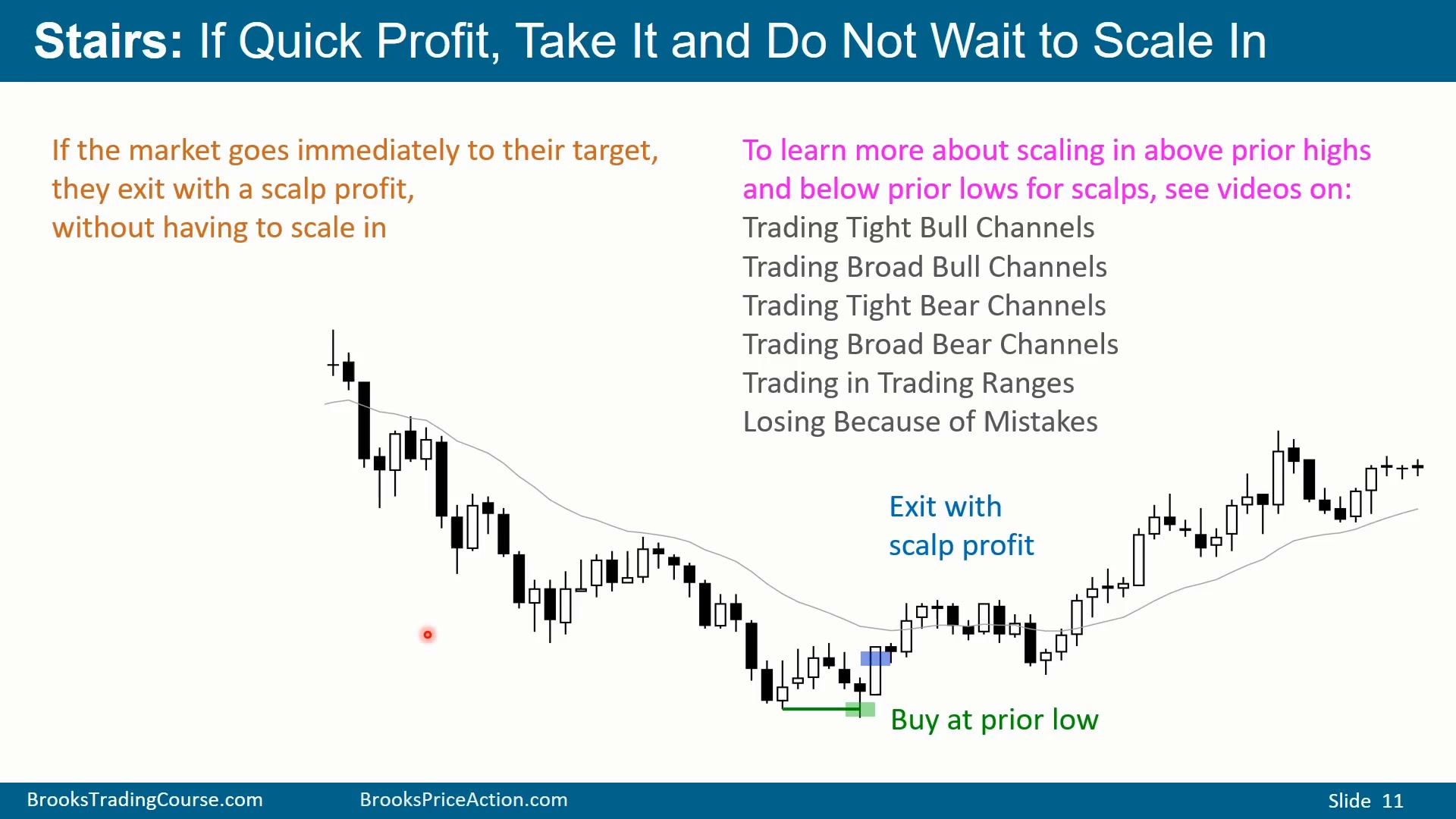
EN: Here’s an example of what I was talking about.

27:48 - 27:51

EN: If a bull bought with a limit order at this low

27:51 - 27:55

EN: and he was willing to buy more lower – it never went lower.

27:55 - 27:58

EN: It immediately went up, so he did not have to scale in.

27:58 - 28:00

EN: He immediately got his profit.

28:03 - 28:06

EN: Exit with a scalp, betting that the market’s

28:06 - 28:08

EN: probably going to be in a Trading Range.

28:09 - 28:11

EN: He doesn’t know where the top of the range is.

28:11 - 28:12

EN: It might be simply here.

28:12 - 28:15

EN: However, he made his scalp and he’s happy to exit

28:15 - 28:17

EN: and then look for his next trade.

28:25 - 28:30

EN: I talk more about scaling into trades above prior highs and below prior lows

28:30 - 28:34

EN: for scalps in several of the videos: Trading in Tight Bull Channels,

28:34 - 28:37

EN: Tight Bear Channels, Broad Bull Channels, Broad Bear Channels,

28:37 - 28:41

EN: Trading Ranges, and in the video on Losing Because of Mistakes.

28:41 - 28:43

EN: I’m not going to talk too much about it here.

Slide 011

Time: 28:44

Slide 011

Bilingual Transcript

28:47 - 28:49

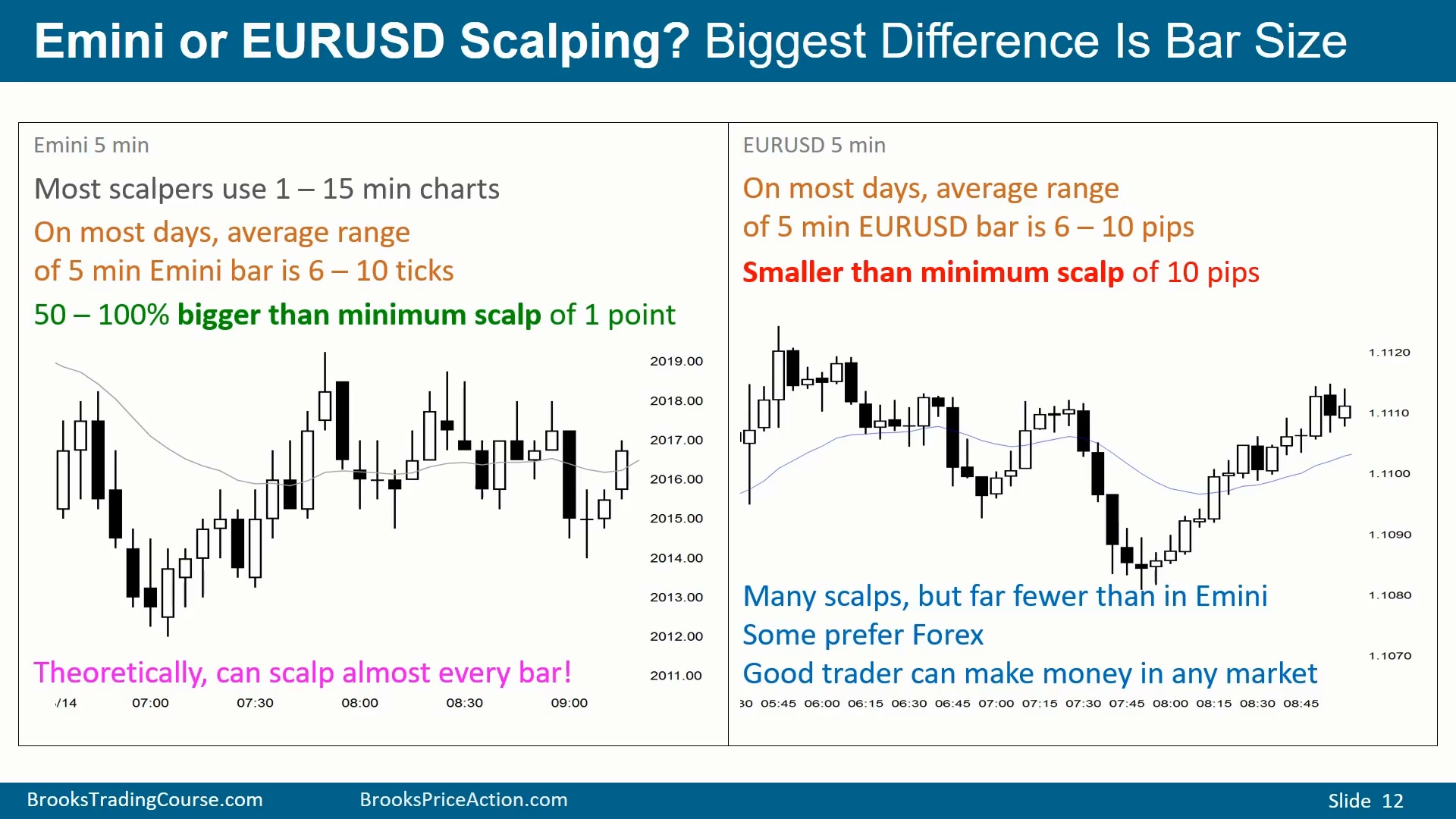
EN: Here’s a 5-minute chart of the Emini

28:49 - 28:52

EN: and then a 5-minute chart of the euro versus the dollar.

28:54 - 28:57

EN: Some traders scalp one of them, some traders scalp both.

28:57 - 29:01

EN: There’s a big difference between scalping in these two markets.

29:01 - 29:04

EN: Can you see what it is? It’s a very important difference.

29:08 - 29:12

EN: Most scalpers use charts that are 1 minute to 15 minutes long.

29:12 - 29:16

EN: Most scalpers – in general, most traders – should not be trading on any chart

29:16 - 29:20

EN: that has more than 20 bars per hour – in other words, a 3-minute chart.

29:20 - 29:22

EN: I use 5-minute charts.

29:27 - 29:30

EN: In the Emini, most days an average bar

29:30 - 29:33

EN: is 6 to 10 ticks tall on a 5-minute chart.

29:37 - 29:42

EN: The minimum scalp in the Emini is 1 point, and therefore the average bar

29:42 - 29:45

EN: is 50% to 100% bigger than the minimum scalp size.

29:50 - 29:53

EN: In a Forex market, the euro versus the dollar, 5-minute chart,

29:53 - 29:56

EN: most of the bars are 6 to 10 pips tall.

30:00 - 30:04

EN: But the smallest scalp traders should consider is 10 pips,

30:05 - 30:09

EN: and therefore most of the bars are smaller than the smallest scalp.

30:09 - 30:13

EN: Emini, most of the bars are bigger than the smallest scalp.

30:14 - 30:15

EN: That is critical,

30:18 - 30:22

EN: because in the Emini if every bar is bigger than a scalp,

30:22 - 30:24

EN: you can scalp on almost every bar.

30:25 - 30:28

EN: There are countless scalping opportunities in a chart

30:28 - 30:31

EN: where the bars are bigger than the smallest scalp.

30:38 - 30:41

EN: On the other hand, if you’re scalping on a 5-minute Forex chart,

30:41 - 30:42

EN: there are far fewer trades.

30:43 - 30:46

EN: A good trader can make money in any market.

Slide 012

Time: 30:50

Slide 012

Bilingual Transcript

30:51 - 30:54

EN: I want to talk a little bit about a scalper’s personality.

30:54 - 30:58

EN: Everyone is drawn to scalping when they start out because of two things.

30:58 - 31:00

EN: The risk is small.

31:00 - 31:04

EN: When traders start out, their greatest fear is losing their account.

31:04 - 31:08

EN: It’s their death of a dream as a trader, and therefore they’re drawn

31:08 - 31:12

EN: to trading styles that have smaller risk (in other words, scalping).

31:14 - 31:17

EN: However, to trade professionally as a scalper

31:17 - 31:21

EN: for year after year after year and to do it happily and profitably,

31:21 - 31:24

EN: you need a whole bunch of personality factors

31:24 - 31:27

EN: that most traders simply do not have.

31:27 - 31:28

EN: But don’t worry about it.

31:28 - 31:30

EN: You can make a lot of money as a swing trader,

31:31 - 31:34

EN: and most traders who make a lot of money are swing traders.

Slide 013

Time: 31:36

Slide 013

Bilingual Transcript

31:46 - 31:48

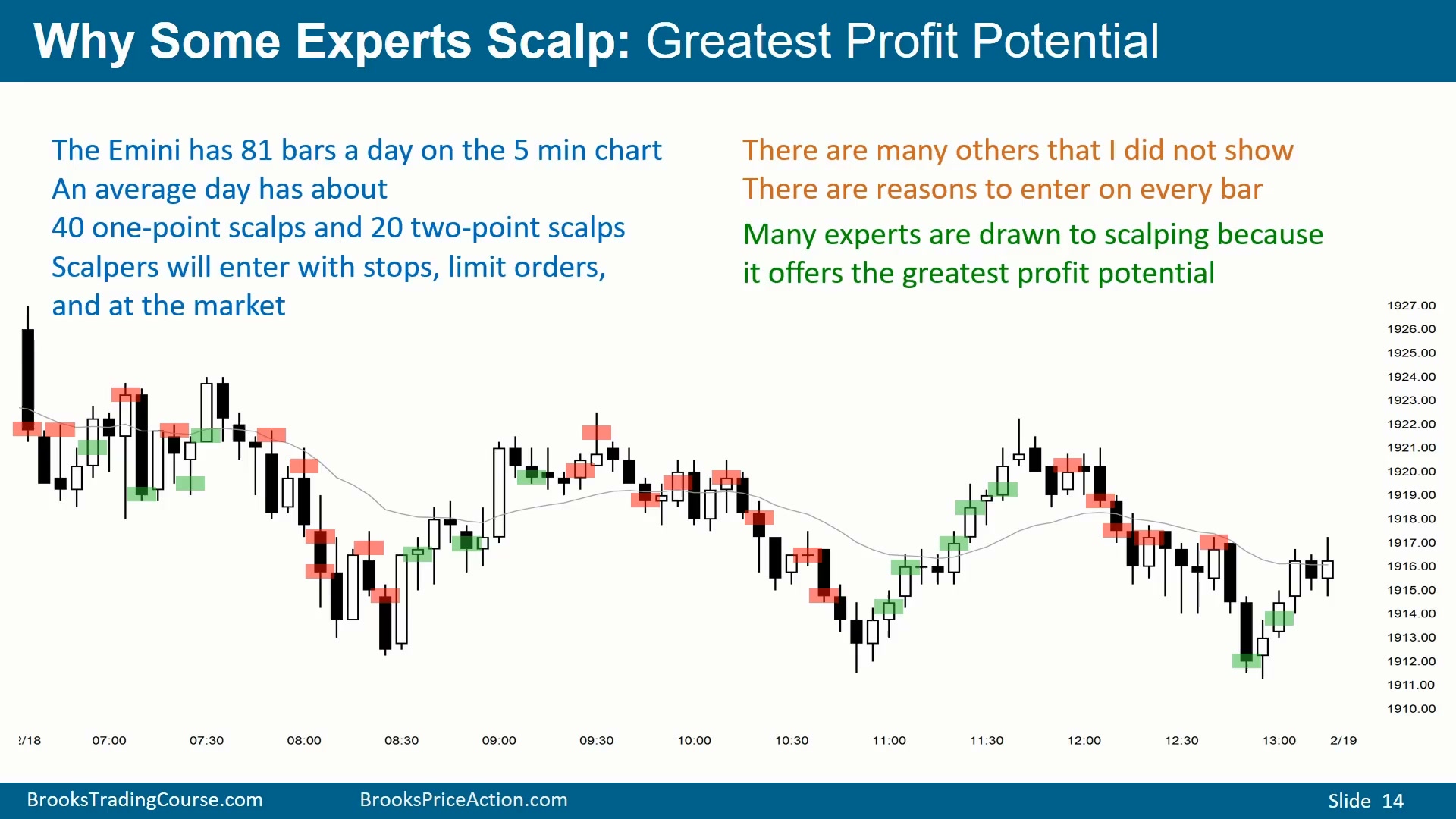
EN: This is a 5-minute chart of the Emini.

31:48 - 31:52

EN: The day session has 81 bars, and an average day has

31:52 - 31:57

EN: about 40 1-point scalps and about 20 2-point scalps.

31:57 - 32:01

EN: Scalpers will enter with stop orders, limit orders, at the market.

32:01 - 32:03

EN: They’ll use wide stops, they’ll scale in.

32:03 - 32:06

EN: An incredible number of opportunities to make money.

32:09 - 32:11

EN: These are all reasonable scalps.

32:11 - 32:14

EN: I’ll talk about the basis for most of these trades

32:14 - 32:16

EN: at some point over the next many videos.

32:17 - 32:21

EN: You can see the bears, lots of opportunity to sell.

32:21 - 32:23

EN: The bulls, lots of opportunity to buy.

32:25 - 32:28

EN: Nobody takes all of these trades, but a good scalper will take a lot of them.

32:33 - 32:37

EN: There are also many other scalps that I did not show.

32:37 - 32:39

EN: There are reasons to enter on every bar.

32:41 - 32:43

EN: If you look at the volume on a chart,

32:43 - 32:46

EN: every bar has a lot of contracts being traded.

32:46 - 32:49

EN: That means there’s a lot of trading taking place on every bar,

32:49 - 32:53

EN: and a good scalper understands the forces going on.

32:53 - 32:54

EN: They understand what the bulls are doing,

32:54 - 32:56

EN: they understand what the bears are doing,

32:56 - 32:59

EN: and they’re constantly trying to structure profitable trades.

32:59 - 33:02

EN: Where do I enter? Can I buy here, can I sell here?

33:02 - 33:06

EN: If I buy, where’s my stop? Can I scale in? Where do I get out?

33:11 - 33:13

EN: I said that a lot of beginners are drawn

33:13 - 33:15

EN: toward scalps because of the minimum profit.

33:15 - 33:18

EN: A lot of experienced traders are drawn to it

33:18 - 33:20

EN: because of the great profit potential.

33:20 - 33:24

EN: If you have 40 opportunities to scalp during the day,

33:24 - 33:28

EN: that’s 40 points, and if the range is 15 points tall,

33:28 - 33:31

EN: you’re making 40 points on a range that’s 15 points tall.

33:31 - 33:35

EN: You’re making more than twice as many points as there are in the range.

33:35 - 33:37

EN: Some traders can do that.

33:37 - 33:40

EN: Very few can, but those who can, can make a lot of money,

33:40 - 33:42

EN: and therefore they scalp.

Slide 014

Time: 33:45

Slide 014

Bilingual Transcript

33:47 - 33:54

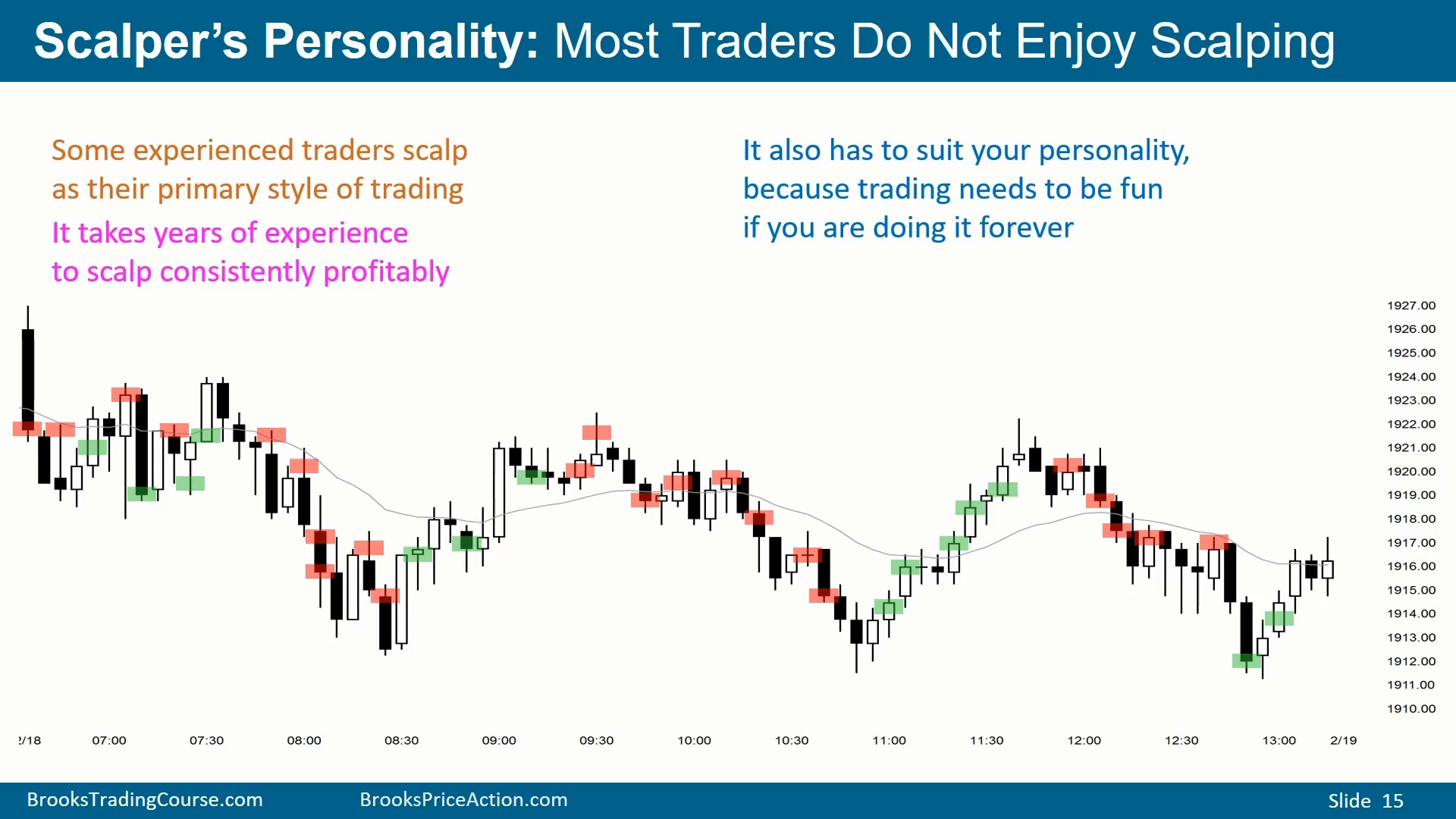
EN: There are a few very good traders who scalp as their primary method of trading.

33:57 - 34:00

EN: Again, it takes a lot of experience to scalp profitably,

34:00 - 34:03

EN: and it also takes an unusual personality

34:03 - 34:05

EN: to be able to do it comfortably year after year.

34:10 - 34:12

EN: Trading has to be fun.

34:12 - 34:15

EN: If you’re going to be doing this forever, it has to be fun.

34:15 - 34:20

EN: Just because you can make money as a scalper, does not mean it’s right for you.

34:20 - 34:24

EN: If you feel stressed out and miserable doing it, don’t do it.

34:25 - 34:26

EN: Swing trade instead.

34:26 - 34:29

EN: Find a style of trading that suits your personality.

34:29 - 34:30

EN: You have to be happy.

34:30 - 34:32

EN: Life has to be fun.

Slide 015

Time: 34:35

Slide 015

Bilingual Transcript

34:38 - 34:42

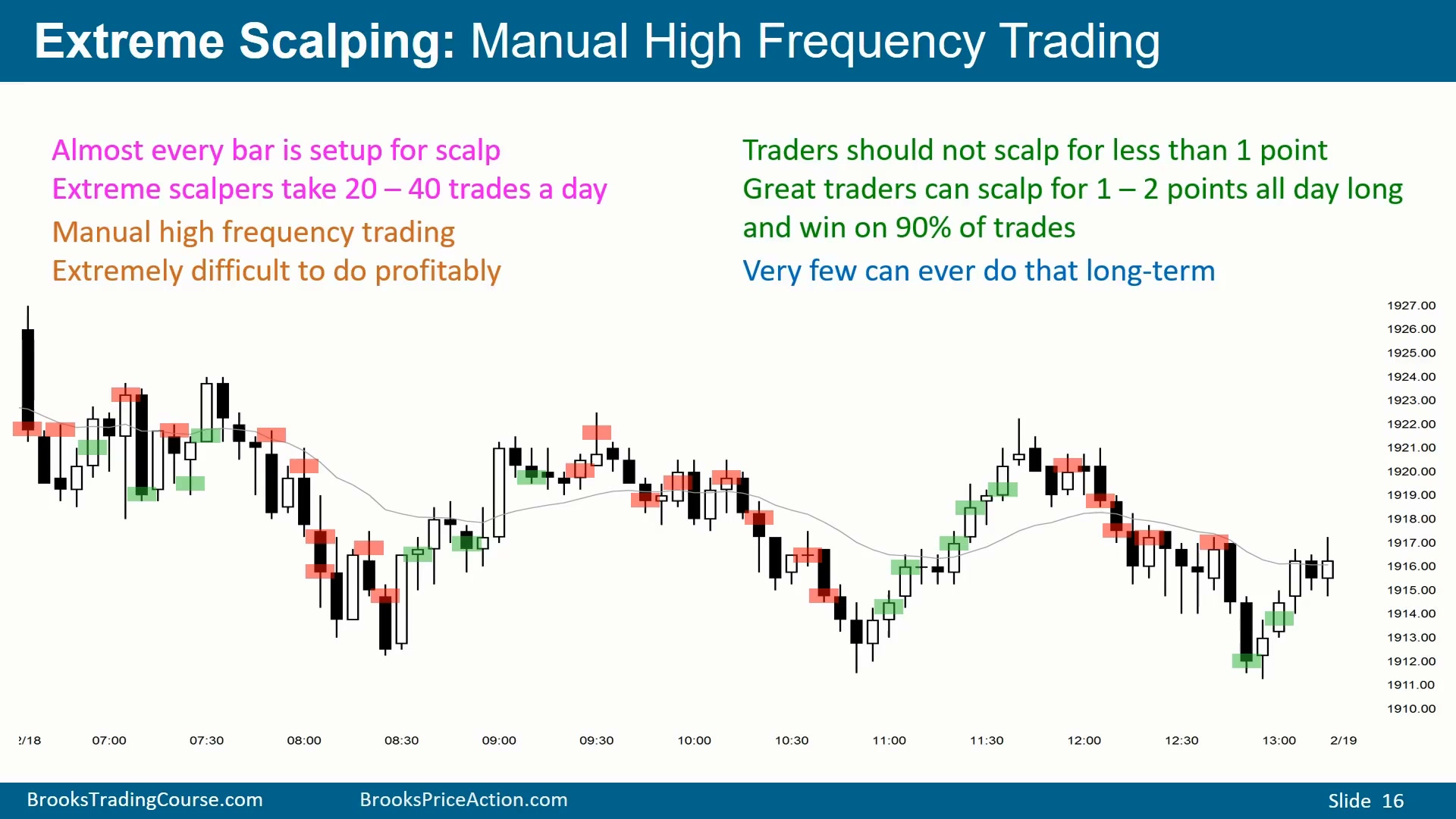
EN: As I said, almost every bar has some kind of a setup for a scalp,

34:43 - 34:46

EN: and an extreme scalper might take 20 to 40 trades a day.

34:47 - 34:50

EN: Most experienced scalpers take about 10 trades a day.

34:50 - 34:52

EN: Some days they might take 20.

34:56 - 34:59

EN: If you are taking 20 to 40 trades a day,

34:59 - 35:04

EN: you’re doing manual high-frequency trading – again, extremely difficult to do.

35:04 - 35:06

EN: Extremely difficult to do profitably.

35:12 - 35:15

EN: In the Emini, the minimum scalp size is 1 point.

35:16 - 35:21

EN: Great traders can scalp for 1 to 2 points all day long and win 90% of the time.

35:21 - 35:24

EN: I’ve known many traders who have done that over the years.

35:27 - 35:29

EN: But very few can do it long-term.

35:29 - 35:32

EN: I had a friend who would look for swing trades every day,

35:32 - 35:34

EN: but he liked to scalp to show off.

35:34 - 35:37

EN: I traded with him online for years, and most of the days

35:37 - 35:40

EN: he would be going for 4 point trades, and then every now

35:40 - 35:42

EN: and then he’d say “Hey Al, I’m going to scalp today.”

35:42 - 35:46

EN: He would take a whole bunch of 1 point trades.

35:46 - 35:48

EN: He’d probably take 15 or 20 1-point trades,

35:48 - 35:52

EN: and I remember a lot of days in which he won on every trade.

35:52 - 35:56

EN: But he said it was too stressful, and it was not fun.

35:56 - 35:58

EN: He liked doing it to show off.

35:59 - 36:02

EN: There are fun things to do in life that you don’t want to do every day.

36:02 - 36:05

EN: You don’t want to climb the top of a tall mountain every day,

36:05 - 36:06

EN: but you do want to do it occasionally

36:06 - 36:08

EN: because it gives you a sense of accomplishment.

36:09 - 36:11

EN: Just because you can do something,

36:11 - 36:14

EN: doesn’t mean you should be doing it for your career.

36:14 - 36:16

EN: If you climb Mount Everest, you don’t want to be climbing it

36:16 - 36:18

EN: every two months for the rest of your life.

36:19 - 36:20

EN: It’s not fun.

36:20 - 36:24

EN: It’s fun the first time, but it’s not fun the fifth time or the twentieth time.

36:28 - 36:32

EN: In this video I talked about Trading Ranges as limit order markets

Slide 016

Time: 36:30

Slide 016

Bilingual Transcript

36:32 - 36:37

EN: - markets where scalpers take trades at the bottom, betting that it will go up.

36:37 - 36:38

EN: They buy at the bottom.

36:38 - 36:41

EN: They sell at the top, betting breakouts will fail

36:41 - 36:42

EN: and the Trading Range will continue.

36:43 - 36:46

EN: I then talked about the personality of scalpers.

36:46 - 36:48

EN: Most traders do not have the personality

36:48 - 36:51

EN: that would allow them to scalp profitably long-term.

36:52 - 36:54

EN: It’s simply not fun for most traders.

36:54 - 36:59

EN: However, if you are that rare person who can scalp profitably

36:59 - 37:02

EN: and you enjoy doing it, then it’s a good opportunity for you.

37:03 - 37:07

EN: Every trader, every swing trader, takes scalps some of the time.

37:07 - 37:10

EN: Not necessarily because they plan the scalp,

37:10 - 37:14

EN: but a lot of swing trades end up disappointing the trader

37:14 - 37:17

EN: as soon as he takes the trade, and he’ll scalp out with a small profit.

37:18 - 37:20

EN: Therefore, knowing how to scalp is valuable.

37:24 - 37:26

EN: I’m Al Brooks.

37:26 - 37:29

EN: This is the first of five videos on scalping.

37:29 - 37:31

EN: Thank you for watching the Brooks Trading Course.