Skip to content
Price Action Encyclopedia Index

al-brooks-course

35A - Scaling In

Raw transcript and slide notes for 35A - Scaling In.

Overview

  • Slides: 18
  • Transcript segments: 592
  • Status: 自动按 slide 时间线归档;核心概念和长期笔记可以在每个 slide 的 Study Notes 下继续整理。

Source Media

Transcript 001

Time: 00:03

Bilingual Transcript

00:03 - 00:04

EN: This is Al Brooks.

ZH: 你好,我是阿尔·布鲁克斯

00:04 - 00:06

EN: Thank you for watching the Brooks Trading Course.

ZH: 欢迎观看布鲁克斯交易课程

00:06 - 00:11

EN: This is the first of three videos on scaling into a trade.

ZH: 接下来的3节课,我们来讲加仓(注:即分批入场)

Slide 001

Time: 00:12

Slide 001

Bilingual Transcript

00:15 - 00:19

EN: I’ll begin by talking about who scales in and why they scale in.

ZH: 这节课的第1个话题是:哪些交易者会加仓, 以及他们为什么要加仓

00:20 - 00:25

EN: Next I’ll move on and talk about scaling into a winning trade.

ZH: 第2个话题是:盈利加仓

Slide 002

Time: 00:28

Slide 002

Bilingual Transcript

00:30 - 00:38

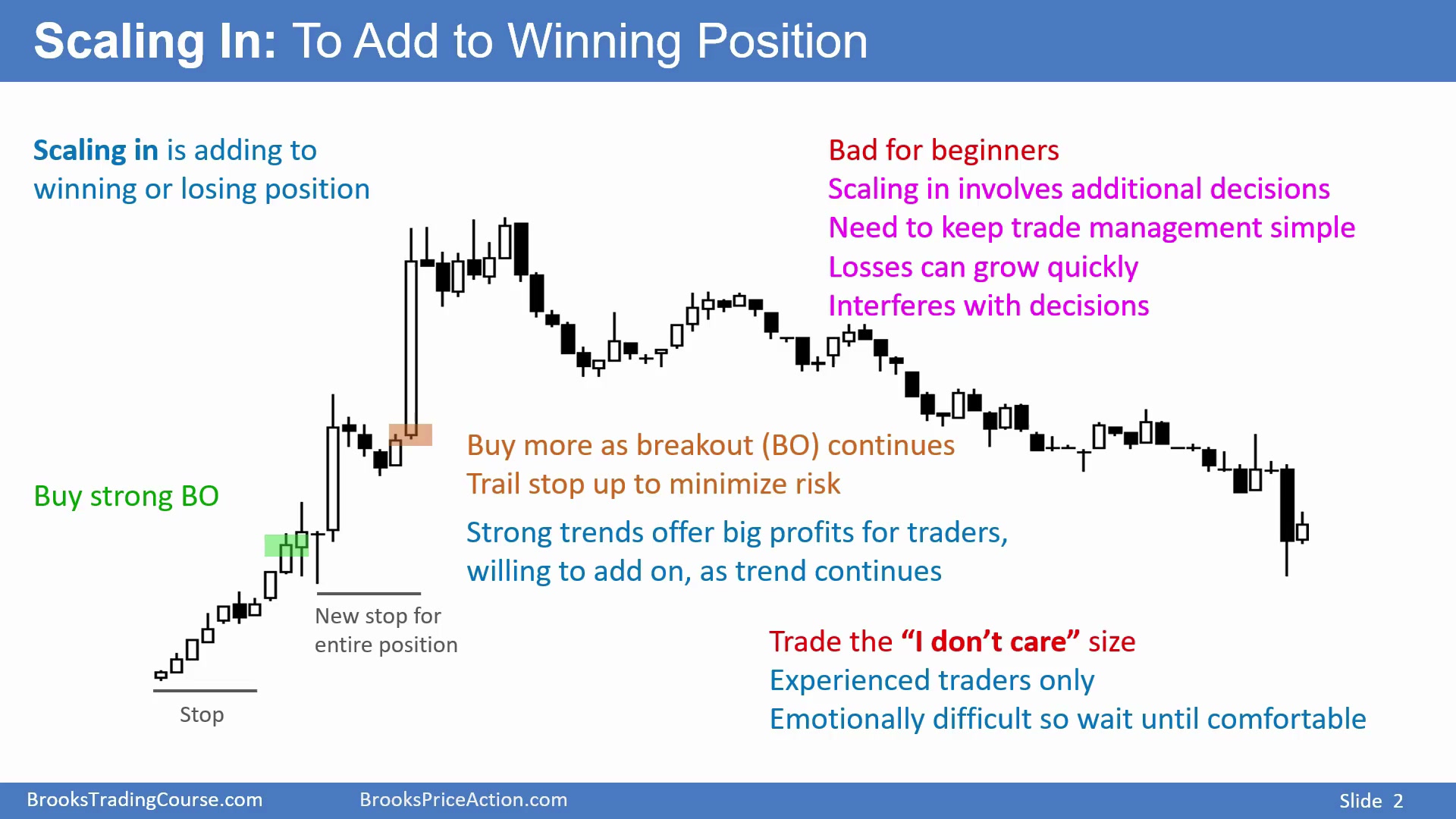
EN: I’m going to use this slide to illustrate scaling

ZH: 我会用这一页课件来说明, 盈利加仓和亏损加仓分别是什么样的

00:34 - 00:38

EN: into a winning or a losing trade.

ZH: 我会用这一页课件来说明, 盈利加仓和亏损加仓分别是什么样的

00:40 - 00:45

EN: We have a bull trend and then a bear channel, which is also a bear trend.

ZH: 上涨趋势,然后是下降通道,它也已经变成了下降趋势

00:51 - 01:01

EN: Scaling in is a technique that traders should consider using

ZH: 交易者应该在有了一些经验之后,再去考虑加仓这件事

00:57 - 01:01

EN: after they have some experience trading,

ZH: 交易者应该在有了一些经验之后,再去考虑加仓这件事

01:01 - 01:04

EN: and preferably after they’ve become consistently profitable.

ZH: 最好是在稳定盈利之后再去考虑加仓

01:05 - 01:06

EN: It’s difficult for beginners.

ZH: (加仓)对新手来说是很困难的

01:06 - 01:11

EN: It’s tempting, because they understand

ZH: 它很诱人,因为人们知道加仓可以增加胜率

01:08 - 01:11

EN: that it can increase the probability of success.

ZH: 它很诱人,因为人们知道加仓可以增加胜率

01:11 - 01:18

EN: But whenever you increase your probability of success,

ZH: 但是,每当胜率增加的时候,风险也在增加

01:15 - 01:18

EN: you additionally increase your risk.

ZH: 但是,每当胜率增加的时候,风险也在增加

01:18 - 01:22

EN: Also, there are added decisions that you have to make,

ZH: 此外,(如果加仓的话)你还需要做出更多的决定

01:22 - 01:31

EN: and sometimes you have to make them quickly, and one of the common mistakes

ZH: 在交易的时候,总是需要快速做出决定, 而新手常见的错误之一就是不知道什么时候离场, 或者(在应该离场的时候)拒绝离场

01:26 - 01:31

EN: that beginners make is they don’t know when to get out or they refuse to get out.

ZH: 而新手常见的错误之一就是不知道什么时候离场, 或者(在应该离场的时候)拒绝离场

01:32 - 01:36

EN: Their losses start to grow, they no longer are objective,

ZH: 当他们的浮亏越来越大,他们就无法保持可观了

01:36 - 01:39

EN: they manage their trades incorrectly, and then they end up

ZH: 他们用错误的方法管理交易,

01:39 - 01:42

EN: losing much more money than they ever expected.

ZH: 导致最终的亏损远超预期

01:46 - 01:56

EN: However, strong trends do offer great opportunities for traders to scale in,

ZH: 然而,强趋势确实为交易者提供了加仓的机会, 交易者随着价格的变化分批入场

01:52 - 01:56

EN: add on to their position as the trade continues.

ZH: 然而,强趋势确实为交易者提供了加仓的机会, 交易者随着价格的变化分批入场

01:58 - 02:03

EN: For example, at the beginning here we have 5 consecutive bull bars

ZH: 例如,这里一开始有连续5根阳线

02:03 - 02:05

EN: and then we have a little pullback and then we have a breakout,

ZH: 小回调之后,再次向上突破

02:05 - 02:07

EN: so it’s a strong bull breakout.

ZH: 强势的多头突破

02:08 - 02:10

EN: It’s reasonable to buy here,

ZH: 在这里买入是合理的

02:10 - 02:14

EN: and your stop goes below the bottom of the bull trend down here.

ZH: 把止损放在这个上涨趋势的起涨点下方

02:20 - 02:23

EN: And if you’re still long at this point – we have another breakout,

ZH: 如果此时你仍然持有多头仓位——再次向上突破,

02:23 - 02:27

EN: another bull flag, 3 bar pullback, but then we have a bull bar.

ZH: 然后3根K线回调,这是牛旗,然后又有1根阳线

02:27 - 02:29

EN: So it looks like the trend is resuming.

ZH: 看起来趋势还在继续

02:29 - 02:33

EN: You can buy on a stop just above the high of that signal bar,

ZH: 你可以在信号K线的高点上方挂突破买单

02:34 - 02:37

EN: so now you have a bigger position.

ZH: 现在你的仓位变大了

02:40 - 02:44

EN: Every time there’s a strong breakout, especially to a new high,

ZH: 每次有强势的突破,特别是创新高之后,

02:44 - 02:50

EN: traders raise their stop to just below the low of that new leg up.

ZH: 交易者会把他们的止损抬高到新的起涨点下方

02:53 - 02:56

EN: One of the most important things when scaling into

ZH: 加仓(分批入场)时最重要的事情之一是:

02:56 - 03:06

EN: a trade is trading the appropriate size, and it’s often much smaller

ZH: 要用很小的仓位进行交易,我称之为“不在乎”的仓位

03:02 - 03:06

EN: than you think, and I call it the “I don’t care” size.

ZH: 要用很小的仓位进行交易,我称之为“不在乎”的仓位

03:06 - 03:10

EN: You have to trade so small that you really do not care.

ZH: 你必须用很小的仓位,小到你真的不在乎

03:10 - 03:17

EN: You need to remain objective, and you can only remain objective

ZH: 交易者需要保持客观,而人只有在不考虑金钱时才能保持客观

03:15 - 03:17

EN: as long as you’re not thinking about money,

ZH: 交易者需要保持客观,而人只有在不考虑金钱时才能保持客观

03:17 - 03:23

EN: and instead you’re thinking about the trade

ZH: 你应该专注于交易本身——根据K线图做出正确的决定

03:20 - 03:23

EN: - and by doing what is right based upon the charts,

ZH: 你应该专注于交易本身——根据K线图做出正确的决定

03:23 - 03:33

EN: not based upon the growing loss in my account or not based upon

ZH: 而不是根据账户上的浮盈或浮亏来做决定

03:29 - 03:33

EN: my risk increasing because of my increased position size.

ZH: 而不是根据账户上的浮盈或浮亏来做决定

03:35 - 03:38

EN: Traders starting out often cannot remain objective,

ZH: 新手交易者往往无法保持客观

03:39 - 03:43

EN: and therefore scaling in is emotionally too difficult for them,

ZH: 所以在情感和心态上,新手很难把握加仓的交易方法 (注:加仓,风险变大,压力变大)

03:43 - 03:45

EN: and they need to wait.

ZH: 而且加仓的时机也需要等待 (注:新手往往加仓太早、太急)

03:50 - 03:53

EN: Every trade eventually ends.

ZH: 每一笔交易最终都要平仓; 每一个趋势最终都会结束

Slide 003

Time: 03:50

Slide 003

Bilingual Transcript

03:51 - 03:53

EN: Every trend eventually ends.

ZH: 每一笔交易最终都要平仓; 每一个趋势最终都会结束

03:53 - 03:57

EN: Here we have a Micro Channel lasting about 8 or 9 bars.

ZH: 这个微通道持续了大约8~9根K线

03:57 - 04:00

EN: That’s a breakout on a higher timeframe.

ZH: 在更高的时间周期上,它是一次突破

04:00 - 04:02

EN: Here’s another breakout, even stronger,

ZH: 这里是更强的突破

04:02 - 04:06

EN: and then look at this – we have an even stronger breakout.

ZH: 再看这个——比上一次突破更强

04:06 - 04:13

EN: So we have consecutive Buy Climaxes there,

ZH: 所以这是连续的抢购高潮—— 这里,然后这里,这里(注:不断加速上涨的抛物线)

04:10 - 04:13

EN: a bigger one here, and an even bigger one here.

ZH: 所以这是连续的抢购高潮—— 这里,然后这里,这里(注:不断加速上涨的抛物线)

04:13 - 04:18

EN: This one is the biggest one occurring after 20 bars in a trend.

ZH: 趋势持续超过20根K线之后,出现最大的大阳线

04:19 - 04:25

EN: Whenever that happens, it’s more likely that it is the final leg of the trend

ZH: 每当这种情况发生时,它很有可能就是最后一段上涨,

04:25 - 04:28

EN: or near the final leg of the trend, and the trend is about to reverse.

ZH: 或至少趋势接近尾声、即将反转

04:28 - 04:33

EN: A breakout that strong often has one more push up before it tries to reverse.

ZH: 这么强的突破,通常在尝试反转之前还会有一小段上涨

04:35 - 04:44

EN: Selling a first reversal down, especially below a bull bar or at the bottom

ZH: 在第一次下跌时做空,尤其是在阳线下方, 或者在窄震荡区间下方开仓,不是高胜率的做法

04:40 - 04:44

EN: of a Tight Trading Range, is usually not a high probability trade.

ZH: 在第一次下跌时做空,尤其是在阳线下方, 或者在窄震荡区间下方开仓,不是高胜率的做法

04:44 - 04:50

EN: However, after the market has 1, 2, 3, 4 bear bars,

ZH: 然而,当市场出现1、2、3、4根阴线

04:50 - 04:55

EN: 3 of them closing on their lows and having a decent size body,

ZH: 其中3根收在最低,而且体积不错

04:55 - 05:00

EN: then we have a big up, big down, big confusion setup.

ZH: 这就是一个大涨、大跌、大困惑的交易机会

05:00 - 05:07

EN: Probably the best the bulls will get over the next 10 or 20 bars

ZH: 接下来的10~20根K线里,多头能得到的最好情况 就是震荡区间,而不是上涨趋势恢复

05:04 - 05:07

EN: is a Trading Range rather than a resumption of the bull trend.

ZH: 接下来的10~20根K线里,多头能得到的最好情况 就是震荡区间,而不是上涨趋势恢复

05:09 - 05:13

EN: Because of that, bears are starting to sell.

ZH: 因此,空头开始卖出做空

05:13 - 05:17

EN: For example, they’ll maybe sell this close.

ZH: 例如,他们会在它的收盘卖出

05:17 - 05:20

EN: Because it might be a Trading Range, they have to put their stop above the high.

ZH: 因为有可能是震荡区间,所以他们必须把止损放在高点上方

05:20 - 05:23

EN: It may also be a bear trend.

ZH: 也有可能反转成为下降趋势

05:23 - 05:27

EN: On a higher timeframe chart, this 5 bar bear channel is probably a breakout,

ZH: 在更高的时间周期上,这连续5根K线就是一次空头突破

05:27 - 05:32

EN: so we might get a spike, pullback, and channel – which we did.

ZH: 所以可能会变成急速下跌、反弹、通道——就像这样

05:36 - 05:37

EN: Traders will sell.

ZH: 交易者会卖出

05:37 - 05:41

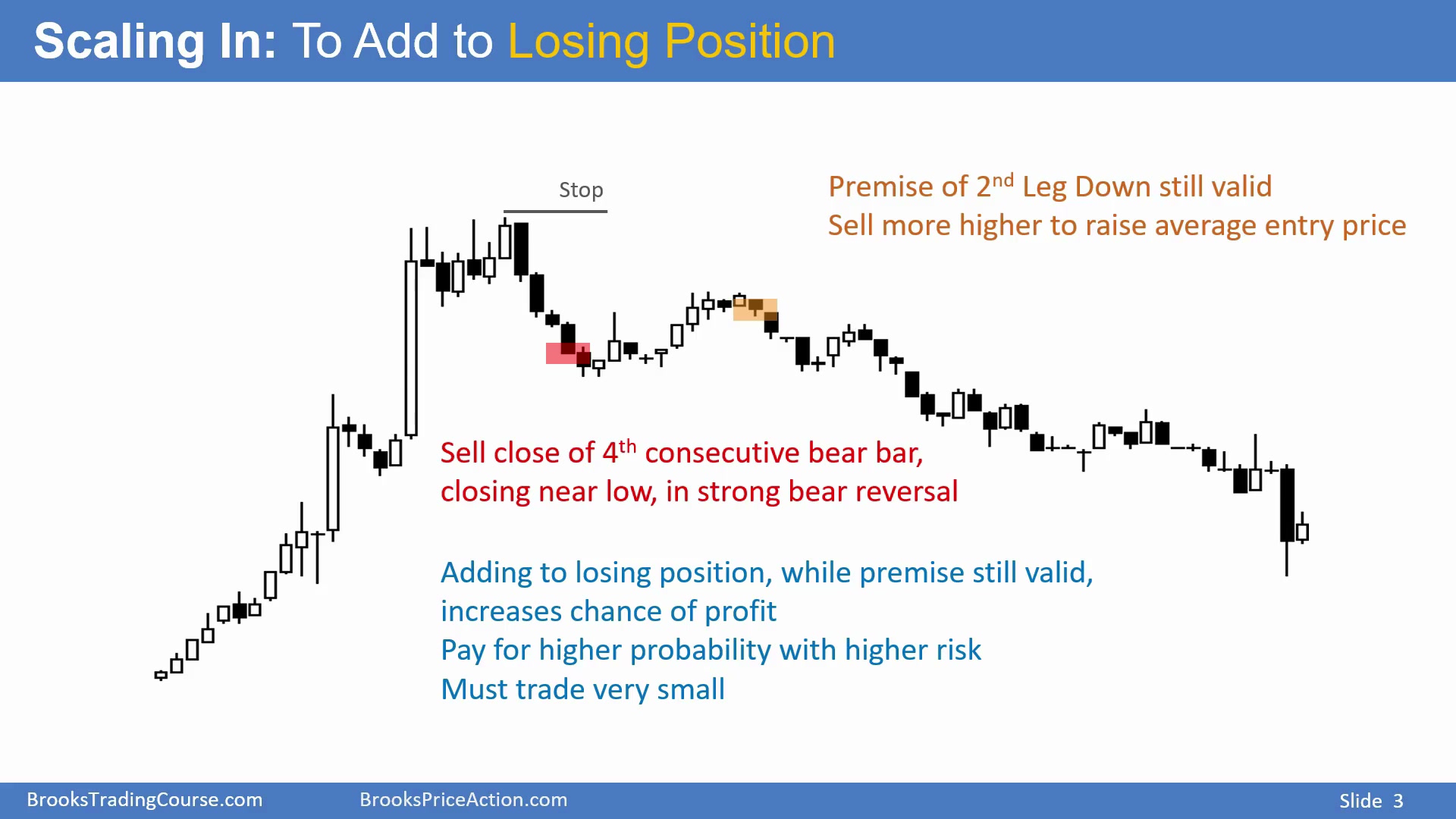
EN: Some traders will sell the close of that fourth consecutive bear bar.

ZH: 有些交易者会在连续第4根阴线的收盘卖出

05:41 - 05:45

EN: Some will sell the close of that third or even the second when the two bars

ZH: 有些人在第3,甚至第2根阴线的收盘就卖出了,

05:45 - 05:48

EN: are as big as they are and closing near their lows.

ZH: 因为它们体积很大,而且收在最低

05:48 - 05:52

EN: This bar closed below the low of the past 6 or 7 bars.

ZH: 这根K线的收盘价低于过去6~7根K线的最低点

05:52 - 05:53

EN: And we have a Wedge.

ZH: 而且有楔形顶

05:53 - 05:56

EN: You can call it a Wedge – one, two, three.

ZH: 你可以把它看作楔形——1,2,3

05:56 - 06:00

EN: Also very strong bull breakout, strong enough for a second leg up.

ZH: 在这么强的突破之后,至少会有第2段上涨

06:01 - 06:02

EN: That’s the second leg up.

ZH: 这就是它的第2段上涨

06:04 - 06:08

EN: And it is not strong, so traders are expecting a reversal.

ZH: 第2段并不强势,所以交易者预期它会反转

06:12 - 06:17

EN: Strong enough leg down, bears will put their stop above the top of the bear leg.

ZH: 下跌足够强势,所以空头把止损放在起跌点的上方

06:21 - 06:27

EN: Whenever there’s a strong trend that has consecutive Buy Climaxes or a Wedge

ZH: 如果在强趋势里出现连续的抢购高潮, 或者楔形顶——1,2,3

06:27 - 06:30

EN: - one, two, three – traders are expecting two legs down.

ZH: ——交易者预期会有两段下跌(注:TBTL)

06:30 - 06:33

EN: One and then pullback and then two.

ZH: 1,反弹,然后2

06:36 - 06:39

EN: Some traders will wait for a bear bar like this.

ZH: 一些交易者会等待像这样的阴线

06:39 - 06:42

EN: A weak rally, two legs up – one, pullback, two

ZH: 较弱的两段式反弹——1,回调,2

06:42 - 06:48

EN: - and they’ll sell below the bear bar or maybe they’ll sell here, a Wedge.

ZH: ——然后空头在阴线下方卖出; 或者在这里卖出,看作是楔形熊旗——1,2,3

06:46 - 06:48

EN: One, two, three.

ZH: ——然后空头在阴线下方卖出; 或者在这里卖出,看作是楔形熊旗——1,2,3

06:48 - 06:51

EN: So small Wedge, Lower High Major Trend Reversal.

ZH: 小的楔形熊旗,高点降低的大反转

06:51 - 06:54

EN: Bull trend, strong bear breakout.

ZH: 上涨趋势,强势的空头突破

06:54 - 06:57

EN: Weak rally, testing the prior high.

ZH: 弱反弹,测试前期的高点

06:57 - 07:02

EN: So traders are looking for a second leg down, and they’ll sell below there.

ZH: 所以交易者预期会有第2段下跌,他们在这根K线下方卖出

07:02 - 07:07

EN: So they sold here, they’re losing money, and they add to their losing position.

ZH: 假设之前他们在这里卖出,目前是浮亏的,然后他们加仓

07:07 - 07:11

EN: But when they’re selling here, they knew their stop was up here

ZH: 当他们在这里卖出时,他们知道他们的止损在上方

07:11 - 07:16

EN: and they knew they may want to sell more higher, so they traded small enough

ZH: 他们做好了逢高卖出更多的打算,所以他们的仓位足够小

07:16 - 07:19

EN: so that this position plus this position

ZH: 这两部分的仓位加起来

07:19 - 07:23

EN: would not create too much risk using a stop up here.

ZH: 就算被止损,也不会比其它交易亏更多钱

07:24 - 07:29

EN: When they sell higher, their average entry price now is in between the two,

ZH: 在更高的位置加仓做空之后, 他们的平均入场价格就在两者的中点(假设两笔仓位一样大)

07:29 - 07:32

EN: so their average entry price is right here.

ZH: 所以他们的平均入场价就在这里

07:36 - 07:43

EN: Whenever you add to a losing position,

ZH: 只有当交易的前提仍然成立时,才能够亏损加仓

07:40 - 07:43

EN: you’re only doing it if your premise is still valid.

ZH: 只有当交易的前提仍然成立时,才能够亏损加仓

07:43 - 07:54

EN: It increases your probability, but whenever you get high probability,

ZH: 这会增加你的胜率,但也要为此付出代价, 交易的盈亏比就会变差(因为风险增加了)

07:49 - 07:54

EN: you have to pay for it, and the other side of probability is risk/reward.

ZH: 这会增加你的胜率,但也要为此付出代价, 交易的盈亏比就会变差(因为风险增加了)

07:55 - 07:59

EN: If you’re going to create high probability, you’re going to pay for it

ZH: 如果你想提高交易的胜率,就需要用盈亏比作为交换

07:59 - 08:04

EN: with worse risk/reward, and usually with greater risk.

ZH: 通常需要承担更大的风险

08:04 - 08:08

EN: So you’re doubling your position size, so you’re increasing your risk.

ZH: 因为你的仓位翻倍了,所以风险大幅增加

Slide 004

Time: 08:10

Slide 004

Bilingual Transcript

08:15 - 08:19

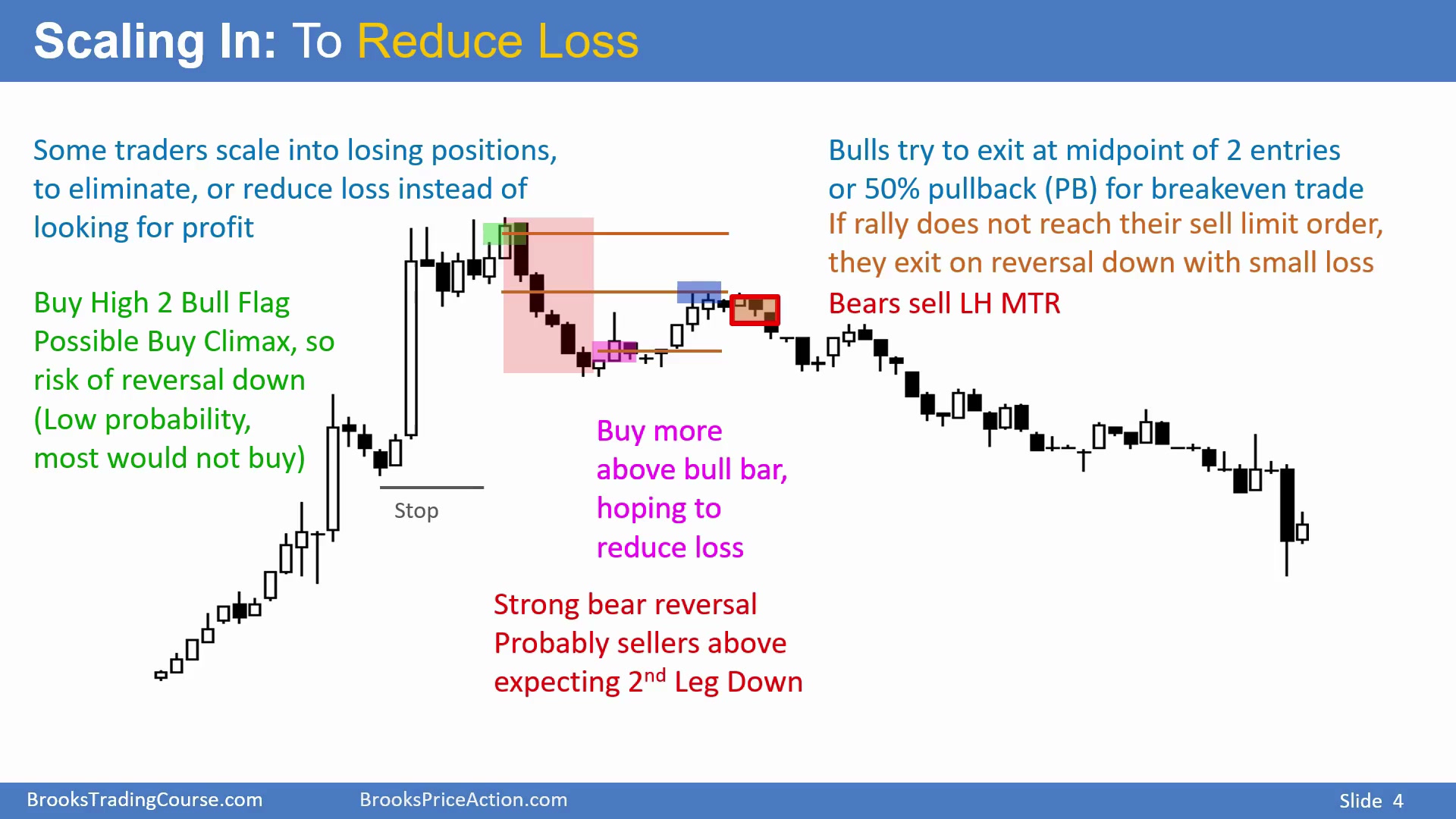
EN: Some traders, when they’re increasing their position size

ZH: 一些交易者在亏损加仓的时候,

08:19 - 08:24

EN: and it’s a losing position, they’ve given up their hope of making a profit.

ZH: 他们已经放弃了盈利的希望

08:24 - 08:27

EN: Instead, they’ve changed their goal.

ZH: 他们已经改变了这笔交易的目标

08:27 - 08:35

EN: Instead of hoping for a profit,

ZH: 不再期待盈利,而是希望可以不亏、或少亏离场

08:30 - 08:35

EN: they’re simply trying to reduce or eliminate their risk.

ZH: 不再期待盈利,而是希望可以不亏、或少亏离场

08:39 - 08:46

EN: So for example, let’s say an optimistic bull did not think

ZH: 比如说,假设一个乐观的多头, 认为这不是抢购高潮后的衰竭反转

08:43 - 08:51

EN: about this as being a likely exhaustion bar, and instead he saw a pullback

ZH: 比如说,假设一个乐观的多头, 认为这不是抢购高潮后的衰竭反转 而是把它看作回调——高1,然后高2

08:48 - 08:51

EN: - one, so a High 1, and then a High 2,

ZH: 而是把它看作回调——高1,然后高2

08:51 - 08:54

EN: a small Double Bottom, and he bought above that bar.

ZH: 可以看作小双底,他在那根K线上方买入

08:54 - 08:56

EN: And then he starts to see this and this

ZH: 结果出现了两根大阴线

08:56 - 08:59

EN: and he’s saying “Oh my gosh, it’s not good.

ZH: 于是他想到:“天哪,这下坏了,开始回调了。”

08:58 - 09:01

EN: It’s pulling back.” But after a strong bull trend,

ZH: 于是他想到:“天哪,这下坏了,开始回调了。” 但是在这么强的上涨趋势之后,

09:01 - 09:06

EN: the first reversal down usually results in a Trading Range and not a bear trend.

ZH: 第1次回调通常会变成震荡区间,而不是下降趋势

09:07 - 09:09

EN: Maybe it’s safe to buy more lower.

ZH: 也许逢低买入加仓是安全的

09:12 - 09:15

EN: That’s his stop at the bottom of most recent bull breakout.

ZH: 他的止损放在最近一次多头突破的起涨点下方

09:16 - 09:23

EN: Now he has a strong bear reversal, and he knows when a reversal is that strong,

ZH: 现在出现了强势的空头反转, 他知道,当反转如此强势时,

09:23 - 09:26

EN: the market probably will have a second leg down.

ZH: 大概率会有第2段下跌

09:26 - 09:30

EN: He also sees the consecutive Buy Climaxes and the Wedge

ZH: 他还看到了连续的抢购高潮和楔形顶

09:30 - 09:38

EN: - three pushes up, one, two, three – so he expects two legs down

ZH: 3次向上推动——1,2,3—— 所以他预期在这么强势的空头反转之后,会有第2段下跌

09:35 - 09:38

EN: after such a strong bear reversal.

ZH: 3次向上推动——1,2,3—— 所以他预期在这么强势的空头反转之后,会有第2段下跌

09:40 - 09:44

EN: However, he also knows that it was reasonable taking this buy.

ZH: 同时,他也知道在这里买入是合理的

09:45 - 09:47

EN: Usually if you do something that’s reasonable

ZH: 通常,如果你的入场点是合理的

09:48 - 09:52

EN: and then you manage your trade properly, usually by scaling

ZH: 然后你正确地管理这笔交易——需要加仓, 并且使用正确的止损

09:51 - 09:57

EN: in using appropriate stops, you can either make a profit or avoid a loss.

ZH: 然后你正确地管理这笔交易——需要加仓, 并且使用正确的止损 通常你是可以赚钱的,至少可以避免亏损

09:58 - 10:03

EN: So what a bull might do is buy here, sit through the bear trend

ZH: 所以一个多头在这里买入之后,可以在回调中继续持有

10:03 - 10:07

EN: - it’s around a 50% pullback – and he waits for a bull bar,

ZH: ——这里大约是50%回调—— 然后他等待一根阳线

10:07 - 10:09

EN: and then he buys above that bull bar.

ZH: 在阳线的上方买入加仓

10:09 - 10:14

EN: Or he might say, “Oh, 5 bear bars.

ZH: 或者他可能会说:“哎哟,连续5根阴线, 还是等第2做多入场点比较好。”

10:12 - 10:14

EN: Maybe I’d better wait for a second entry buy,”

ZH: 或者他可能会说:“哎哟,连续5根阴线, 还是等第2做多入场点比较好。”

10:14 - 10:17

EN: so maybe he’ll buy above this bar or that bar.

ZH: 所以他可以在这根K线,或那根K线上方买入

10:17 - 10:22

EN: However, his goal at this point is not to make a profit.

ZH: 然而,他此时的目标已经不再是盈利

10:22 - 10:26

EN: He believes that the market’s going to have a Lower High and a second leg down,

ZH: 他认为高点会降低,然后会有第2段下跌

10:26 - 10:29

EN: but he also believes doing this was rational

ZH: 但他也认为在这里买入是合理的

10:29 - 10:31

EN: and buying above a bull bar is rational.

ZH: 然后在这根阳线的上方加仓也是合理的

10:31 - 10:35

EN: So the market will probably let him out breakeven.

ZH: 所以市场可能会让他打平离场 (注:两个合理的入场点,打平的概率是80%)

10:35 - 10:42

EN: He’s buying here, hoping to exit exactly at the midpoint

ZH: 他在这里买入,希望能在平均入场价格打平离场, 他的入场点分别是这里和这里

10:40 - 10:42

EN: of his two entries, here and here.

ZH: 他在这里买入,希望能在平均入场价格打平离场, 他的入场点分别是这里和这里

10:48 - 10:51

EN: That’s his first entry, just a little bit above that bar.

ZH: 这是他的第1次入场,就在那根K线的上方

10:51 - 10:54

EN: His second entry’s a little bit above this bar,

ZH: 他的第2次入场在这根K线上方

10:54 - 10:56

EN: and the average entry price is right here.

ZH: 平均入场价就在这里

10:57 - 11:02

EN: He might place a limit order to get out at that average entry price.

ZH: 他可以在平均价格这里挂一个限价卖单

11:04 - 11:09

EN: If it’s not filled and then we get a Micro Double Top

ZH: 假设订单没有成交,然后出现小双顶——上涨,回调,上涨

11:07 - 11:11

EN: - up, pullback, up – he’ll then get out below the low of that bar.

ZH: 假设订单没有成交,然后出现小双顶——上涨,回调,上涨 那么他就可以在那根K线的低点下方离场

11:13 - 11:18

EN: By taking the second entry, he either eliminates his risk

ZH: 通过在这里加仓,如果在这里成交离场,他就避免了亏损

11:16 - 11:20

EN: if he got filled there, or he reduces his loss.

ZH: 通过在这里加仓,如果在这里成交离场,他就避免了亏损 或者减少了亏损(如果没有成交,在后面离场)

11:20 - 11:25

EN: So he eliminates his loss, gets out breakeven

ZH: 如果他的限价卖单在这里成交,他就成功地打平离场

11:23 - 11:25

EN: on his trade here if he gets filled.

ZH: 如果他的限价卖单在这里成交,他就成功地打平离场

11:25 - 11:29

EN: If he does not, he’ll get out here and he’ll still have a loss,

ZH: 如果没有,他在这里离场,仍然有亏损

11:29 - 11:32

EN: but it will be a much smaller loss because he scaled in here.

ZH: 但少亏了很多钱,因为他在这里加仓了

11:40 - 11:43

EN: The bears are thinking the same thing.

ZH: 空头也知道这一点

11:43 - 11:46

EN: Wedge Top, strong bear reversal, two legs down,

ZH: 楔形顶,强势的空头反转,(会有)第2段下跌

11:46 - 11:49

EN: so they’re looking to sell a Lower High.

ZH: 所以他们想要在高点降低的时候去做空

11:49 - 11:52

EN: So they’ll sell exactly where the bulls are getting out.

ZH: 他们会在多头离场的地方卖出

11:53 - 11:57

EN: We have a Micro Double Top, 4 or 5 bars up,

ZH: 上涨了4~5根K线之后,出现了小双顶

11:57 - 12:00

EN: a reasonable sell – and it’s a 50% pullback.

ZH: 这是合理的做空入场点——也是50%反弹

12:00 - 12:03

EN: I’ve talked about 50% pullbacks in my other videos.

ZH: 我在其他视频中讲过50%回调 / 反弹

12:04 - 12:08

EN: At 50%, the risk for the bears is here

ZH: 在50%的地方,空头的风险在这里,

12:08 - 12:12

EN: and minimum reward is here, about the same.

ZH: 最低利润目标在这里,大致相同

12:12 - 12:16

EN: And for the bulls, their risk is here, their reward is here.

ZH: 对于多头来说,风险在这里,利润目标在这里

12:16 - 12:21

EN: But in this particular situation,

ZH: 但在这种情况下,大概率会有第2段下跌

12:18 - 12:21

EN: the odds are we’re going to have a second leg down.

ZH: 但在这种情况下,大概率会有第2段下跌

12:22 - 12:26

EN: Yes, the risk and reward is equal for the bulls and for the bears,

ZH: 对于多头和空头来说,尽管风险和利润是相等的 (注:盈亏比一样)

12:26 - 12:28

EN: but the bears have higher probability.

ZH: 但空头的胜率更高

12:28 - 12:30

EN: So it’s a reasonable short.

ZH: 所以这是一个合理的卖点

12:31 - 12:34

EN: The bears will sell a 50% pullback,

ZH: 空头会在50%反弹时卖出

12:34 - 12:37

EN: either with a limit order or on the reversal down.

ZH: (在50%)挂限价卖单,或是在反转下跌时用突破卖单

Slide 005

Time: 12:40

Slide 005

Bilingual Transcript

12:42 - 12:46

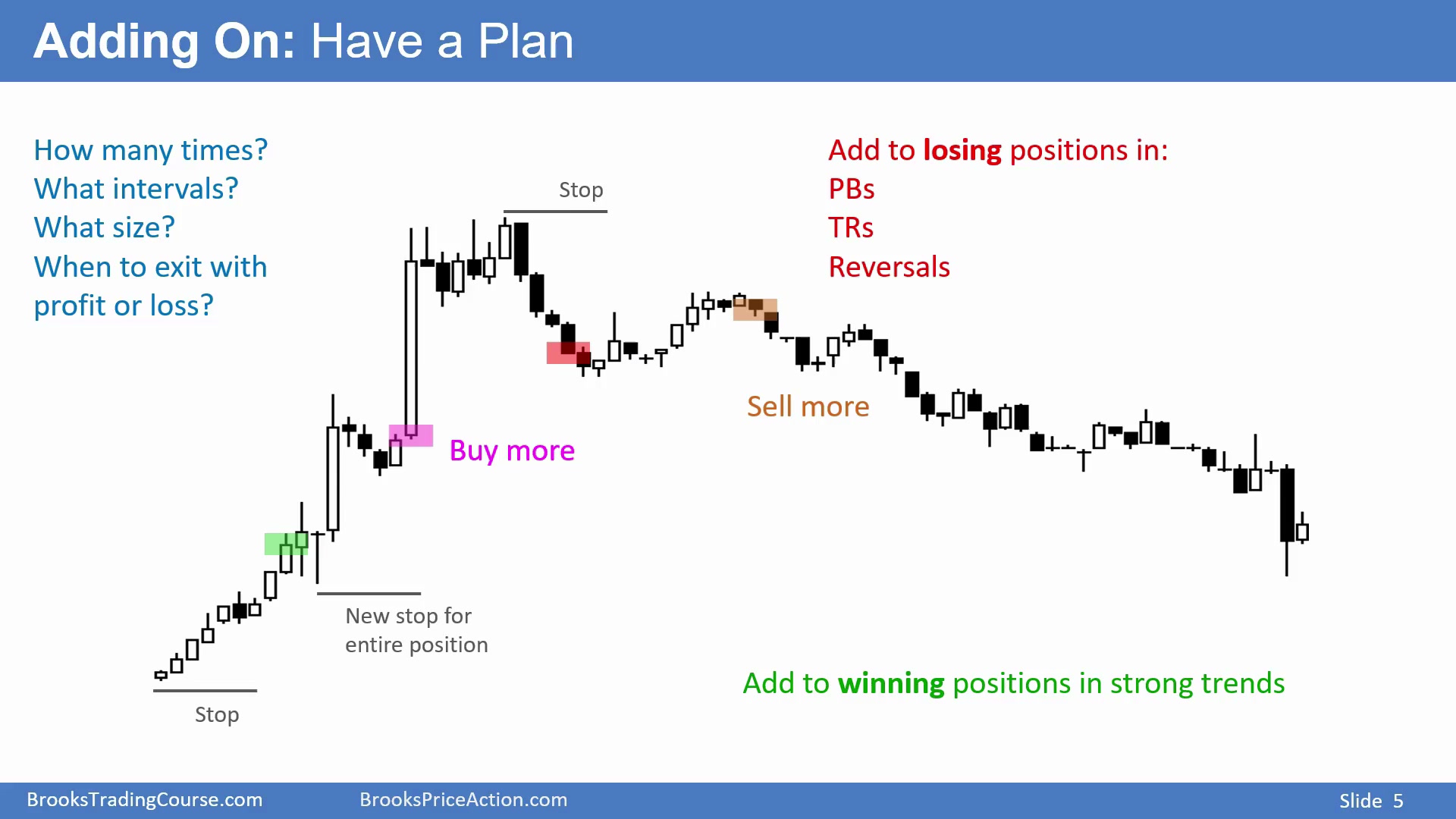
EN: Whenever traders scale in, they have to have a plan.

ZH: 如果想要加仓,交易者就必须做好计划

12:48 - 12:56

EN: How many times are they going to add to their position? At what intervals?

ZH: 他们打算加仓多少次? 每次间隔多少距离?用多少仓位?

12:52 - 12:56

EN: How far apart will their entries be? What size?

ZH: 他们打算加仓多少次? 每次间隔多少距离?用多少仓位?

12:56 - 13:00

EN: And then they also have to know when they plan to exit,

ZH: 他们还必须知道什么时候离场

13:00 - 13:05

EN: and if they’re planning to exit with a profit or a loss or breakeven.

ZH: 目标到底是盈利,还是少亏或打平

13:10 - 13:14

EN: I talked about adding to a winning position in a strong trend

ZH: 我们也讲过如何在强趋势中盈利加仓——

13:14 - 13:19

EN: - buying here, stop here, and then buying more higher.

ZH: 在这里买入,止损在这里; 突破之后买入更多

13:21 - 13:22

EN: New stop.

ZH: 新的止损在这里

13:24 - 13:32

EN: And I talked about adding to a position

ZH: 我们也讲了在浮亏的时候加仓, 通过加仓去避免亏损

13:28 - 13:32

EN: where you’re probably going to lose money and you’re trying to avoid a loss.

ZH: 我们也讲了在浮亏的时候加仓, 通过加仓去避免亏损

13:34 - 13:37

EN: I also talked about adding to a losing position.

ZH: 另外一个浮亏加仓的例子是

13:38 - 13:44

EN: Bears selling here, expecting that it’s such a strong reversal after a Wedge,

ZH: 空头在这里卖出,预期楔形顶(以及连续抢购高潮) 之后的强势反转

13:44 - 13:48

EN: the market’s going lower, probably at least to the bottom of the Buy Climax,

ZH: 市场在下跌,大概率至少会跌到抢购高潮的起涨点

13:48 - 13:50

EN: and it probably will have two legs down.

ZH: 大概率会有两段下跌

13:50 - 13:52

EN: It may just go straight down.

ZH: 它可能会直接下跌

13:52 - 13:53

EN: It may bounce first.

ZH: 也可能会先反弹

13:54 - 13:59

EN: But in either case, the bears know the probability

ZH: 无论是哪种情况,空头都知道他们的胜率很高

13:58 - 13:59

EN: is they’re going to make a profit.

ZH: 无论是哪种情况,空头都知道他们的胜率很高

14:01 - 14:04

EN: They sell here, thinking that “Okay, I’ll put a stop up here

ZH: 他们在这里卖出,心想:“好,我把止损放在这里,

14:04 - 14:09

EN: but I’ll trade small enough so that if in fact we enter a Trading Range,

ZH: 但是用很小的仓位,以防它变成震荡区间

14:09 - 14:15

EN: I can sell more higher and then either avoid a loss or make a profit.”

ZH: 那么我就可以在高位卖出更多,至少不会亏钱,甚至可以赚钱。”

14:17 - 14:20

EN: The bear sells here, he has a losing position at this point.

ZH: 空头在这里卖出,他此时是浮亏的

14:20 - 14:24

EN: He sells more here, stop up here, and he trades small enough

ZH: 他在这里卖出更多,止损在这里; 由于仓位足够小,

14:24 - 14:29

EN: so that if that stop gets hit, his entire position will not result

ZH: 所以即使止损真的被打到,

14:29 - 14:33

EN: in a loss any bigger than he would get on any other trade.

ZH: 他的亏损也不会大于平时的其它交易

14:35 - 14:38

EN: And if he held for a swing, he ended up making a nice profit.

ZH: 如果他持有做波段交易,最终能够获得不错的利润

Slide 006

Time: 14:40

Slide 006

Bilingual Transcript

14:42 - 14:46

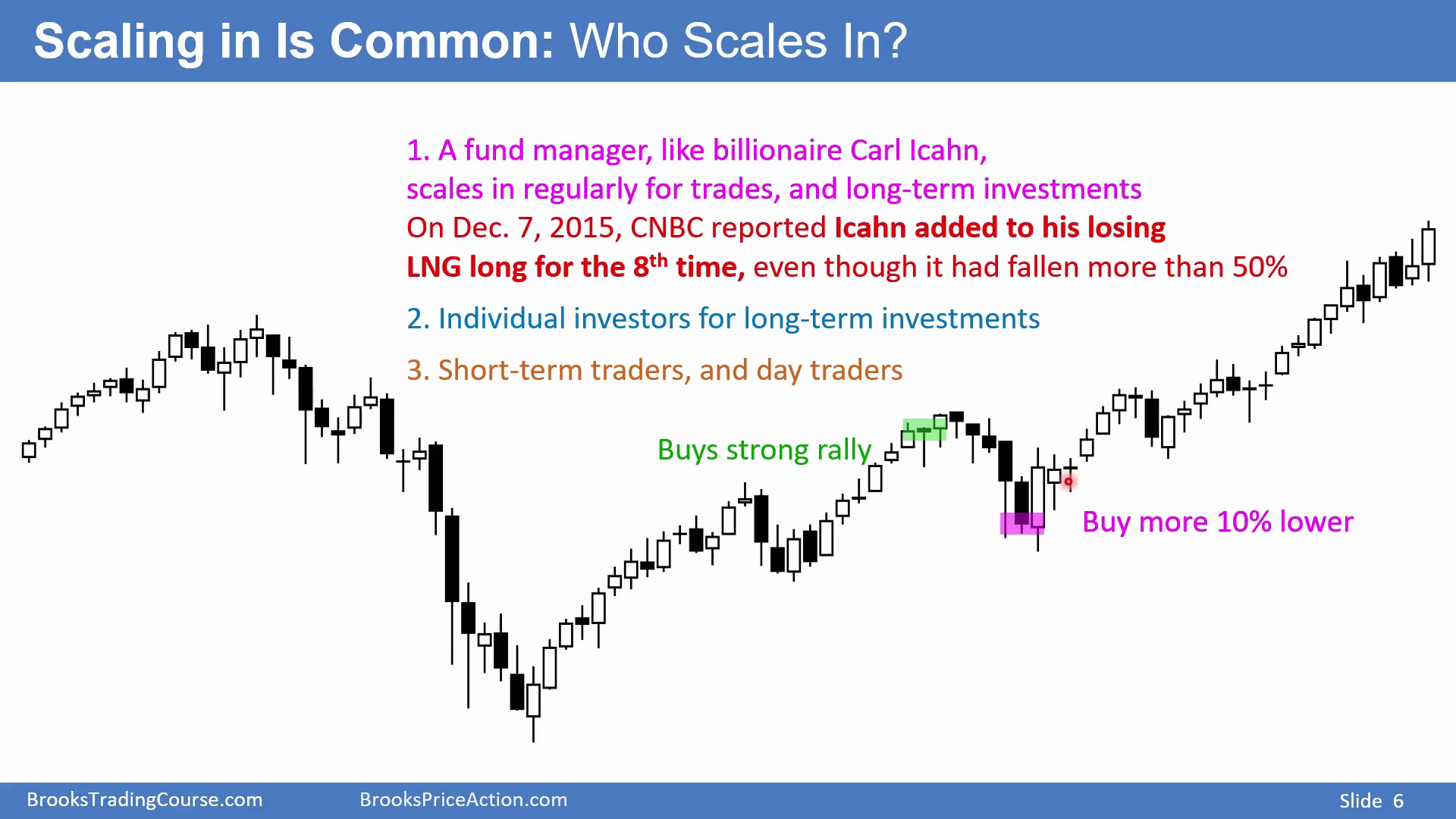
EN: Now, who scales in? Professional traders do it all the time.

ZH: 哪些交易者会加仓?其实职业的交易者一直都在这么做

14:47 - 14:52

EN: For example, a fund manager like billionaire Carl Icahn.

ZH: 例如,像亿万富翁卡尔·伊坎这样的基金经理 (注:Carl Icahn,身价约140亿美金)

14:52 - 14:56

EN: Warren Buffett, for that matter, might be scaling into positions.

ZH: 从分批入场的角度而言,股神巴菲特肯定也是这么做的

14:56 - 15:04

EN: As he’s trying to take over a company, he may increase his stake even

ZH: 当他想要控股某家公司的时候,他会在股价下跌时不断买入

15:00 - 15:04

EN: as the company loses money and loses value.

ZH: 当他想要控股某家公司的时候,他会在股价下跌时不断买入

15:06 - 15:09

EN: Here’s an example with Carl Icahn.

ZH: 这里有一个卡尔·伊坎的投资案例

15:09 - 15:16

EN: In December of 2015, CNBC reported that Icahn added to his losing position

ZH: 2015年12月,CNBC报道称, 卡尔·伊坎第八次亏损加仓LNG这只股票

15:16 - 15:23

EN: in LNG for the eighth time, even though it had fallen more than 50%.

ZH: 尽管它此时已经下跌了超过50%

15:24 - 15:26

EN: It kept falling and falling and falling,

ZH: 股价不断地下跌 (注2015年股价从$80跌到$30)

15:26 - 15:30

EN: but he believed it was undervalued and that it would reverse up.

ZH: 但他相信这支公司被低估了,会反转上涨的 (注:现在,即2025年,股价约$250)

15:30 - 15:43

EN: He added to his losing position eight times, but each addition did not increase

ZH: 他8次加仓,但始终都把仓位控制在舒适区中

15:39 - 15:43

EN: his position size to an uncomfortable level.

ZH: 他8次加仓,但始终都把仓位控制在舒适区中

15:43 - 15:45

EN: He was able to remain objective.

ZH: 他能够保持客观

15:48 - 15:51

EN: Individual investors also scale in.

ZH: 散户投资者也会分批入场

15:51 - 15:55

EN: If you ever watch Cramer on “Fast Money,” he’ll sometimes tell you,

ZH: 如果你看过“Fast Money”这个节目,主持人Cramer有时会说:

15:55 - 15:59

EN: buy part of your position now and then wait a few days and buy part more.”

ZH: “先买入部分仓位,然后等几天再买入更多。”

16:00 - 16:06

EN: And then you also hear about averaging down or dollar-cost averaging,

ZH: 你也会听到网格交易法,或平均成本投资法

16:06 - 16:13

EN: which is a very common, sensible approach to investing for individual investors.

ZH: 对于散户投资者来说是非常常见且明智的做法

16:13 - 16:16

EN: Like buy a tenth of your position this month and then,

ZH: 例如,这个月用10分之1的仓位买入某支股票

16:16 - 16:22

EN: no matter what the stock or market is doing,

ZH: 然后下个月,不管股票是涨是跌,再买10分之1

16:19 - 16:22

EN: buy a tenth more next month, and you do it for 10 months.

ZH: 然后下个月,不管股票是涨是跌,再买10分之1

16:22 - 16:24

EN: And that is scaling in.

ZH: 这就是分批入场 (注:定投——定期定额地加大投资)

16:24 - 16:25

EN: You might be scaling into a winning position;

ZH: 你可能是在盈利的时候加仓

16:25 - 16:28

EN: you might be scaling into a losing position.

ZH: 也可能在亏损的时候加仓

16:28 - 16:35

EN: But dollar-cost averaging is a common,

ZH: 对于长期投资地普通人来说, 平均成本定投是常见的、明智做法

16:30 - 16:35

EN: sensible way for long-term individual investors to enter the market.

ZH: 对于长期投资地普通人来说, 平均成本定投是常见的、明智做法

16:39 - 16:44

EN: And then another group of traders who scale in regularly are short-term traders

ZH: 另一个经常加仓的群体是短线交易者——

16:44 - 16:48

EN: - traders holding positions for a few days, a few weeks – and day traders.

ZH: 持仓几天、几周,或者日内交易

16:53 - 16:57

EN: Here we have a pretty strong rally, a very Tight Bull Channel.

ZH: 这里有相当强势的上涨——很窄的通道

16:57 - 16:59

EN: Probably the first reversal down will be limited.

ZH: 第1次下跌大概率只是回调

17:00 - 17:02

EN: Stop down here.

ZH: 多头的止损在这里

17:02 - 17:08

EN: If this is a bull trend, it should not fall below the bottom

ZH: 如果它真的是上涨趋势, 就不应该跌破最近一次强势突破的起涨点

17:06 - 17:08

EN: of the most recent strong bull breakout.

ZH: 如果它真的是上涨趋势, 就不应该跌破最近一次强势突破的起涨点

17:08 - 17:13

EN: Some traders might buy here with the intention of putting a stop below here,

ZH: 一些交易者会在这里买入,把止损放在下方

17:13 - 17:16

EN: and if it pulls back, they’ll buy more.

ZH: 如果回调,他们会买入更多

17:18 - 17:23

EN: One way to do it is you could buy with a limit order below that bear bar,

ZH: 一种方法是你可以在那根阴线下方挂限价买单

17:23 - 17:31

EN: betting will not fall below here, or they’ll simply buy more 10% lower

ZH: 押注不会跌破这个低点; 也可以在下方10%,或几个ticks的距离挂限价买单

17:28 - 17:31

EN: or a certain number of ticks or pips lower.

ZH: 押注不会跌破这个低点; 也可以在下方10%,或几个ticks的距离挂限价买单

17:33 - 17:35

EN: Or they’ll also buy on the reversal up.

ZH: 或者在反转向上时买入

17:35 - 17:40

EN: We have an ii bull flag after a strong reversal up from a Higher Low.

ZH: 低点抬高,强势反转上涨,后面是ii牛旗(买点)

17:45 - 17:47

EN: I mentioned dollar-cost averaging.

ZH: 我刚才提到了定投

Slide 007

Time: 17:45

Slide 007

Bilingual Transcript

17:48 - 17:52

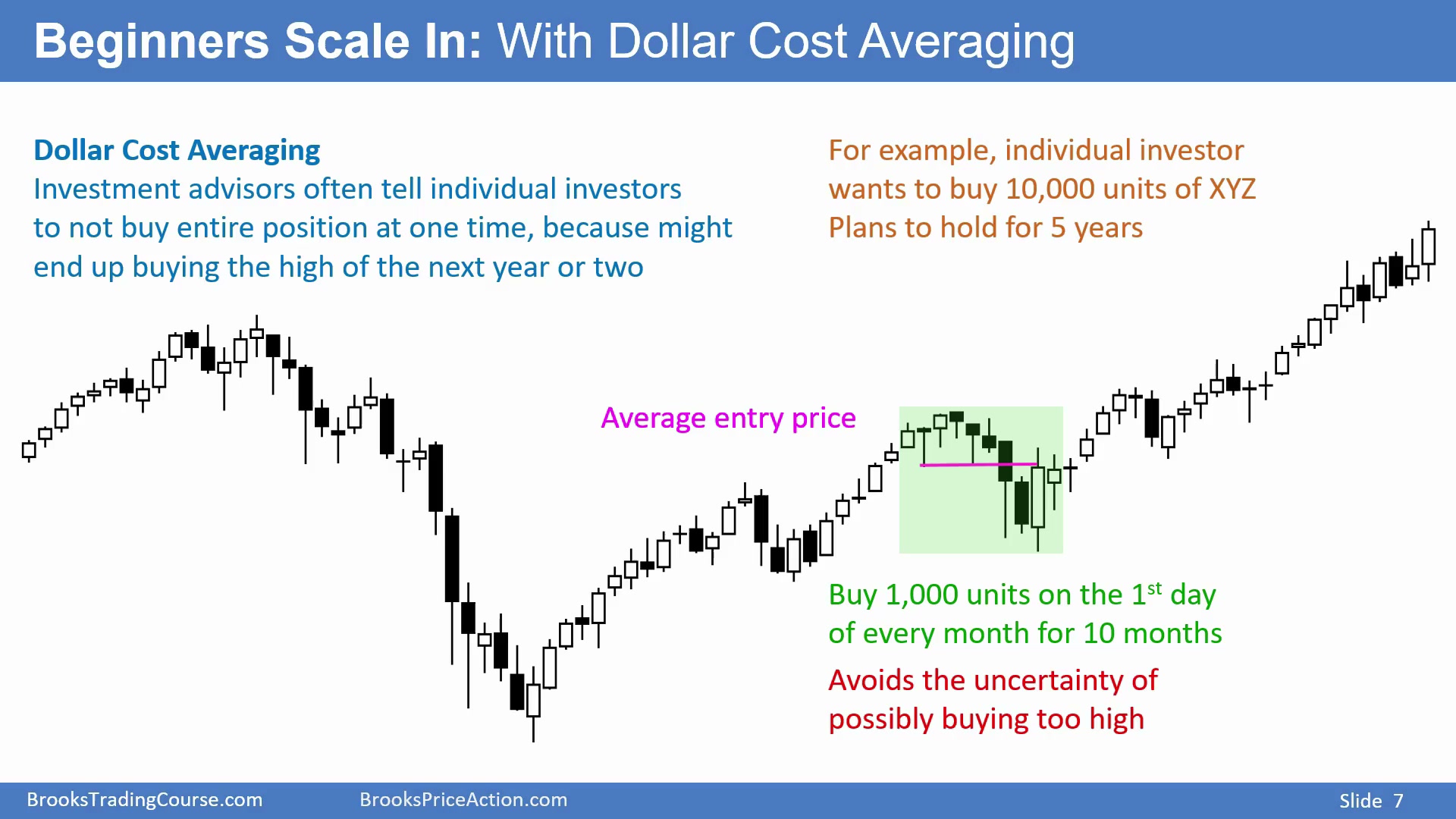
EN: Investment advisors often tell their individual clients,

ZH: 投资顾问经常告诉他们的客户

17:52 - 17:55

EN: do not buy the entire position at one time.

ZH: 不要一次性满仓买入

17:55 - 18:00

EN: Instead, divide your entire account up into pieces

ZH: 而是应该把账户分成很多部分

18:00 - 18:03

EN: - like for example, 10 pieces or 12 pieces

ZH: ——比如,分成10份,或12份

18:03 - 18:08

EN: - and then you buy each piece every month or so until you have your full position.

ZH: 然后每个月买入,逐渐加大仓位

18:10 - 18:14

EN: For example, if this were a stock – let’s say it’s XYZ stock,

ZH: 例如,假设这是某支股票,代码是XYZ

18:14 - 18:20

EN: and you wanted to buy 10,000 units of the stock or 10,000 units

ZH: 你想买入10,000股,或者你想买入10,000手外汇,

18:20 - 18:25

EN: of a Forex position, and you’re planning to hold for a number of years, 5 years.

ZH: 然后计划持有几年,比如5年

18:25 - 18:30

EN: Instead of buying all 10,000 units or shares or contracts all at once,

ZH: 不要一次性买入10,000股

18:31 - 18:34

EN: you might go ahead and buy right when you make your decision.

ZH: 一些人在下定决心的时候,会一下子买入很多

18:34 - 18:38

EN: So let’s say sometime in here, you’re deciding, yeah, I really want to own this

ZH: 假设在这里的某个时候,你决定:我非常想买入这只股票

18:38 - 18:44

EN: and I want to hold it for a long time, but I don’t want to buy

ZH: 我想长期持有; 但我不想一下子就买入10,000股

18:42 - 18:44

EN: the full 10,000 units right now

ZH: 我想长期持有; 但我不想一下子就买入10,000股

18:44 - 18:51

EN: because suppose it just keeps falling all the way down here.

ZH: 万一它一直跌到这里,比如说,跌20%

18:48 - 18:51

EN: Then – let’s say it falls 20%

ZH: 万一它一直跌到这里,比如说,跌20%

18:51 - 18:54

EN: - then it has to go back up 20% for me just to get breakeven.

ZH: 那么它要涨回去25%,我也才刚好打平而已

18:54 - 18:57

EN: So maybe I’ll just buy part of my position.

ZH: 所以我只会买入一部分

18:57 - 19:02

EN: If it goes up higher, I’ll buy a part more higher,

ZH: 如果它上涨,我可以追涨买入更多,买入更多

19:01 - 19:02

EN: I’ll buy a part more higher.

ZH: 如果它上涨,我可以追涨买入更多,买入更多

19:03 - 19:06

EN: And instead, if it goes down, I can add to my position,

ZH: 相反,如果它下跌,我也可以加仓,

19:06 - 19:09

EN: relying on my stop here or here.

ZH: 依赖这里或这里的止损

19:10 - 19:14

EN: As long as my premise is still valid that I think it’s going to go up,

ZH: 只要我的前提仍然有效,我仍然认为它会上涨

19:14 - 19:19

EN: I’ll be comfortable adding to my position.

ZH: 我就可以很舒服地加仓

19:20 - 19:29

EN: So let’s say he started buying right here, and then he bought another 1,000 here,

ZH: 所以,假设他一开始在这里买入1,000股, 然后在这里、这里、这里,每次加仓1,000股

19:24 - 19:29

EN: 1,000 here, 1,000 here, 1,000 here, all the way – every month he bought 1,000.

ZH: 所以,假设他一开始在这里买入1,000股, 然后在这里、这里、这里,每次加仓1,000股

19:29 - 19:33

EN: Here at 10 months, this would be his average entry price.

ZH: 10个月后,这是他的平均成本价

19:33 - 19:37

EN: Even though he started buying here, his average price now is here.

ZH: 尽管他一开始买在高位,现在他的平均价格在这里

19:39 - 19:42

EN: And that’s including after a selloff.

ZH: ——回调之后的平均入场价

19:42 - 19:44

EN: Now he’s got a selloff and a reversal,

ZH: 回调之后,开始恢复上涨

19:44 - 19:49

EN: and he has a reasonable entry price now that we have that reversal.

ZH: 所以他的成本是合理的,可以在上涨趋势中赚很多钱

19:52 - 19:58

EN: The advantage to the trader is he avoids the uncertainty possibly buying too high.

ZH: 这样做的优点是,他避免了买在高位被套牢的不确定性

20:00 - 20:03

EN: So he increases his probability of profit

ZH: 所以他增加了盈利的概率

20:03 - 20:08

EN: because he’s getting an average entry price, a price between the high

ZH: 因为他的平均成本在过去一年之内高点和低点之间,

20:08 - 20:15

EN: and the low over the next year instead of possibly buying the high

ZH: 而不是买在最高点,只能期待市场涨回来让他解套

20:12 - 20:15

EN: over the next year and hoping for it to go higher.

ZH: 而不是买在最高点,只能期待市场涨回来让他解套

Slide 008

Time: 20:18

Slide 008

Bilingual Transcript

20:21 - 20:22

EN: This is a common situation.

ZH: 这种情况很常见

20:22 - 20:26

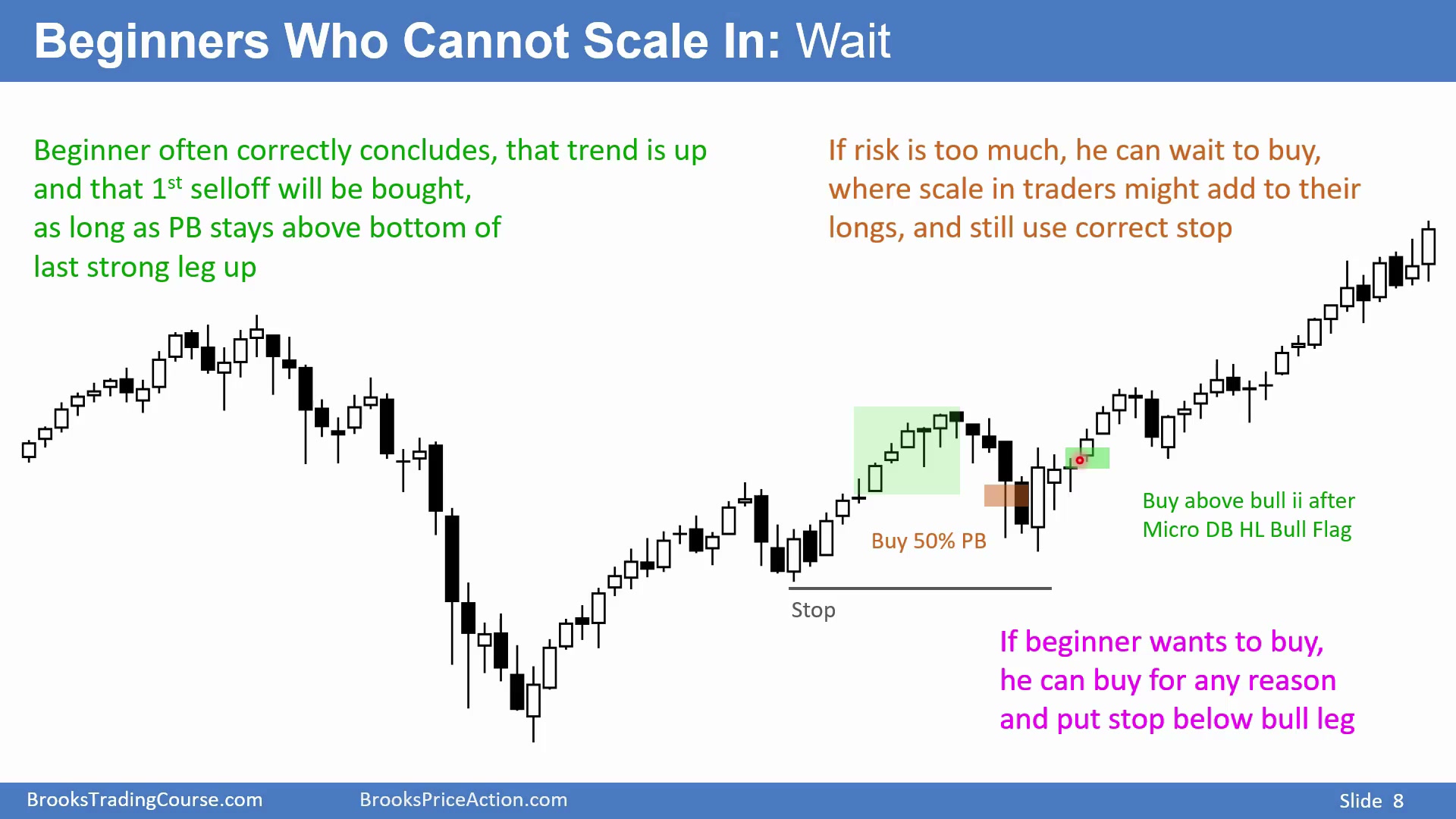
EN: Here we have a bull Micro Channel – 6, 7, 8 bars

ZH: 这里有一个上涨微通道——6、7、8根K线

20:26 - 20:29

EN: - and a beginner would look at that and say, “yeah, it’s going up”

ZH: 交易者看到了市场在不断上涨

20:31 - 20:38

EN: and he believes it’ll continue to go up as long as it stays above the bottom

ZH: 他相信,只要价格保持在最近的重要低点上方, 就还会继续上涨

20:35 - 20:38

EN: of the most recent strong last leg up.

ZH: 他相信,只要价格保持在最近的重要低点上方, 就还会继续上涨

20:43 - 20:47

EN: So let’s say he buys for any reason.

ZH: 假设他在某个地方买入了

20:47 - 20:51

EN: The sixth close, buys below that low, buys above this high,

ZH: 在它的收盘,或者在那个低点下方(挂限价买单), 或者在这个高点上方(用突破买单)

20:51 - 20:54

EN: buys a bear bar betting that the first reversal down will fail.

ZH: 或者在阴线收盘买入,押注第1次回调会失败,等等

20:55 - 20:56

EN: His stop goes down here.

ZH: 他的止损在这里

21:02 - 21:08

EN: If he’s looking to buy up here and the stop is too far away, he can wait to buy,

ZH: 如果想在这里上方买入,但是觉得止损太远了, 那么可以等待——

21:08 - 21:16

EN: where a scale-in trader might add to a position and still use that correct stop.

ZH: 在其它多头会逢低加仓的地方买入, 并且仍然使用这个正确的止损

21:18 - 21:24

EN: For example, he might say, “Well, I don’t want to buy up here.

ZH: 例如,他可能觉得:“我不想在这里追涨,风险太大了

21:22 - 21:24

EN: The risk is too great.

ZH: 例如,他可能觉得:“我不想在这里追涨,风险太大了

21:24 - 21:32

EN: I’ll buy a pullback, maybe a 50% pullback, so that my risk would be half

ZH: 我想等回调,比如50%回调,那么风险就减小了一半。” 这样是ok的

21:29 - 21:32

EN: of what it would be had I bought up here.” That’s okay.

ZH: 我想等回调,比如50%回调,那么风险就减小了一半。” 这样是ok的

21:32 - 21:36

EN: The only problem is, sometimes you don’t get the pullback.

ZH: 唯一的问题是,偶尔市场不回调,一直涨

21:36 - 21:40

EN: So let’s say right here you’re planning on buying, looking for a 50% pullback.

ZH: 假设在这里的时候,你打算在50%回调买入

21:40 - 21:43

EN: You don’t get any pullback until all the way up here,

ZH: 然而市场一直涨到这里,才开始回调

21:43 - 21:46

EN: which is a much worse price had you bought right here.

ZH: 比你在这里买入的价格要高得多

21:51 - 21:53

EN: He waits for his 50% pullback,

ZH: 这里,他等到了50%

21:53 - 21:56

EN: and now he sees a pretty good reversal from a Higher Low.

ZH: 而且低点抬高,强势地反转上涨

21:56 - 22:02

EN: Strong reversal bar – down, up, good reversal, ii with a bull bar,

ZH: 强势的反转大阳线——下跌,上涨,很强的反转, 有ii结构,而且有阳线

22:02 - 22:07

EN: and he can add to his position here after a Micro Double Bottom.

ZH: 他可以在ii的上方加仓,而且左边有一个小双底

22:07 - 22:10

EN: Down, up, down, up.

ZH: 下跌,上涨,下跌,上涨

22:10 - 22:12

EN: Micro Double Bottom with a strong reversal up.

ZH: 小双底之后,强势的反转上涨

Slide 009

Time: 22:15

Slide 009

Bilingual Transcript

22:19 - 22:24

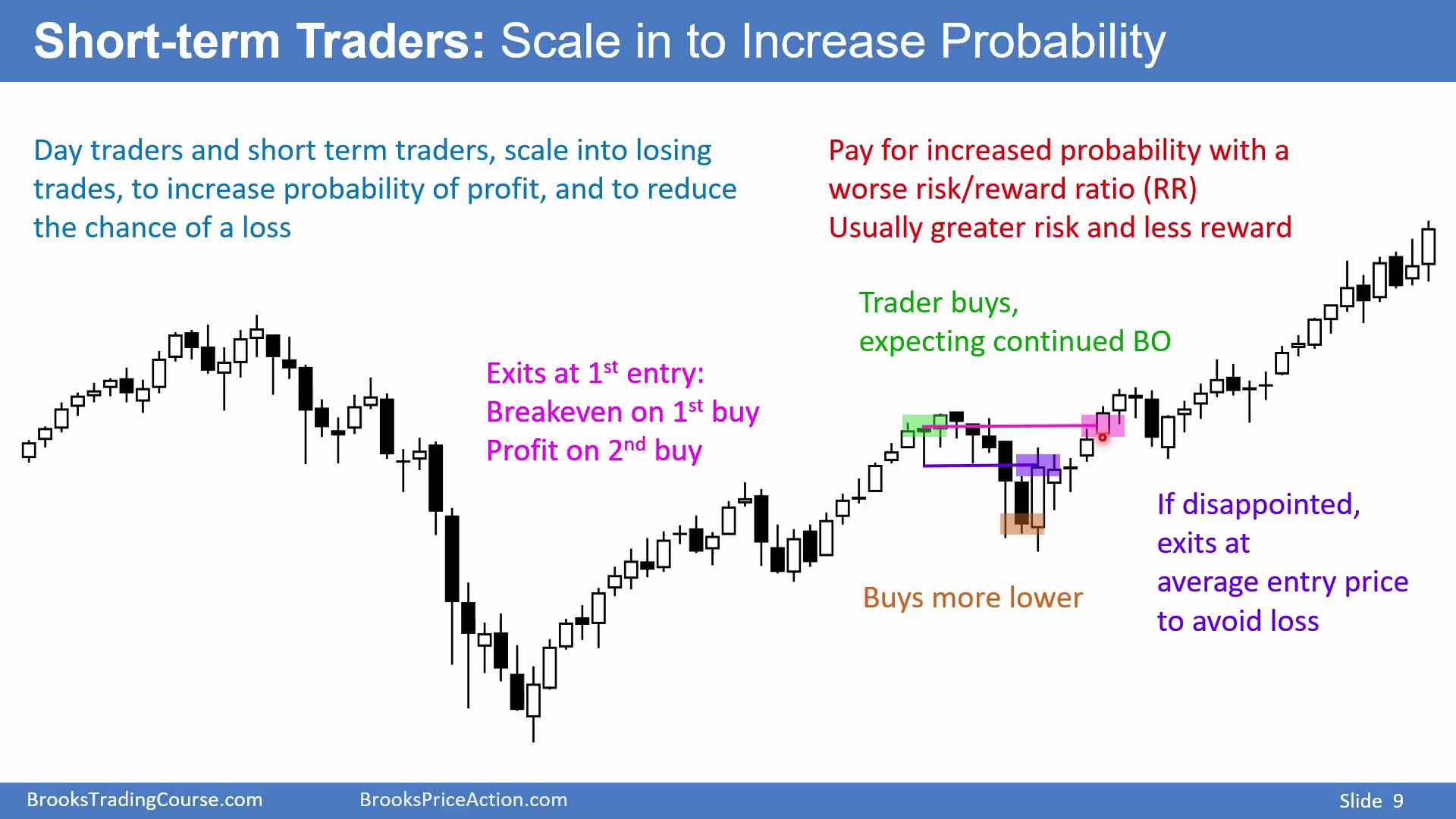
EN: Day traders, short-term traders, they’ll scale into losing trades to increase

ZH: 日内交易者、短线交易者,他们会在浮亏的时候加仓

22:24 - 22:29

EN: their probability of profit and reduce their chance of a loss.

ZH: 以此增加盈利的概率,减少亏损

22:31 - 22:37

EN: Again, whenever you try to increase your probability, you have to pay for it.

ZH: 然而我要再次强调,每当你尝试增加胜率的时候, 你必须为此付出代价

22:37 - 22:40

EN: Any time you’re going to get something good, you have to pay for it.

ZH: 任何时候你想要得到好处,都必须付出代价

22:40 - 22:47

EN: Nothing is free, and usually when you increase your probability,

ZH: 没有什么是免费的。 通常当你增加胜率的时候,你的风险也会增加

22:45 - 22:47

EN: you’re going to increase your risk.

ZH: 没有什么是免费的。 通常当你增加胜率的时候,你的风险也会增加

22:47 - 22:50

EN: You’re certainly going to reduce your risk/reward ratio.

ZH: 盈亏比肯定会变差

22:50 - 22:54

EN: Usually greater risk and sometimes less reward.

ZH: 通常是因为风险增加了,有时因为利润减小

22:58 - 23:01

EN: So let’s say a trader buys expecting a continued rally,

ZH: 假设一个交易者追涨了,期待继续上涨

23:01 - 23:08

EN: even if there is a deep pullback, as long as the pullback remains

ZH: 即使有深度回调,只要回调保持在最近一次突破的起涨点上方就没问题

23:06 - 23:08

EN: above the bottom of the most recent bull breakout.

ZH: 即使有深度回调,只要回调保持在最近一次突破的起涨点上方就没问题

23:08 - 23:11

EN: So that’s his premise: that it’s a bull trend

ZH: 所以他交易的前提是:这是一个上涨趋势

23:11 - 23:15

EN: as long as there’s not a credible top – this is not a credible top

ZH: 除非出现可靠的顶部——这不是一个可靠的顶部

23:15 - 23:21

EN: - and as long as any pullback, no matter how strong,

ZH: 不管回调多强,只要不跌破前期的重要低点, 那么他的前提就仍然成立

23:18 - 23:21

EN: remains above the bottom of the bull leg.

ZH: 不管回调多强,只要不跌破前期的重要低点, 那么他的前提就仍然成立

23:24 - 23:26

EN: He might buy here.

ZH: 假设他的初始仓位在这里买入

23:26 - 23:30

EN: He might buy this second consecutive strong bear close,

ZH: 他可以在连续第2根阴线的收盘加仓

23:30 - 23:32

EN: saying we got a bear breakout below these bars.

ZH: 价格跌破了这些低点

23:32 - 23:34

EN: We have a follow-through bar.

ZH: 然后有跟随的阴线

23:34 - 23:36

EN: Some bears will think this is Always In Short,

ZH: 一些空头会认为市场已经处于单边下跌

23:36 - 23:41

EN: but as long as it remains above this low, I’m going to bet

ZH: 但只要它保持在这个低点上方,

23:41 - 23:46

EN: that this breakout will fail and that it’s a bear trap,

ZH: 多头就会押注这个突破会失败,押注这是一个空头陷阱

23:46 - 23:55

EN: trapping bears into selling this close, selling what might turn out

ZH: 诱使空头在它的收盘卖出——这是上涨趋势中的回调, 诱使空头卖在回调的最低点

23:51 - 23:55

EN: to be the bottom of a pullback in a bull trend.

ZH: 诱使空头在它的收盘卖出——这是上涨趋势中的回调, 诱使空头卖在回调的最低点

23:56 - 24:02

EN: He might buy that close, knowing that weak bears will sell the close hoping

ZH: 所以多头会在它的收盘买入, 尽管会有空头在这里做空,押注价格向下跌破

24:00 - 24:04

EN: to break below here, but he still believes this trend is so strong,

ZH: 所以多头会在它的收盘买入, 尽管会有空头在这里做空,押注价格向下跌破 但多头仍然相信这是一个强上涨趋势

24:04 - 24:10

EN: any reversal attempt, even a strong one

ZH: 任何反转下跌的尝试都会失败, 哪怕看上去很吓人——连续的阴线收在最低

24:07 - 24:10

EN: - consecutive bear bars closing on its low – will fail.

ZH: 任何反转下跌的尝试都会失败, 哪怕看上去很吓人——连续的阴线收在最低

24:10 - 24:12

EN: So he’ll buy more lower.

ZH: 所以他会在低位买入更多

24:15 - 24:19

EN: If he’s sufficiently disappointed by the strength of this bear reversal,

ZH: 如果他对这么深的回调感到非常失望

24:19 - 24:24

EN: he might decide, “Okay, yeah, maybe we’re going to go sideways instead of up.

ZH: 他可能会决定:“好吧,也许市场要横盘了;

24:24 - 24:27

EN: Here’s my first entry price, here’s my second entry price,

ZH: 这是我的第1个入场价,这是第2个入场价

24:27 - 24:28

EN: here’s my average entry price.

ZH: 我的平均入场价在这里

24:28 - 24:31

EN: I’ll place a limit order to get out breakeven.”

ZH: 我在这里挂限价卖单,打平离场。”

24:31 - 24:38

EN: So if he buys here and immediately places a limit order at the midpoint

ZH: 所以在加仓之后,他立刻在两个入场价的中点挂了限价卖单,在这里离场

24:36 - 24:38

EN: of his two entries, he might get out here.

ZH: 所以在加仓之后,他立刻在两个入场价的中点挂了限价卖单,在这里离场

24:39 - 24:48

EN: In that case he would be averaging into his trade to avoid a loss

ZH: 在这种情况下,他加仓的目的是避免亏损,而不是为了盈利

24:45 - 24:48

EN: and not so much to make a profit.

ZH: 在这种情况下,他加仓的目的是避免亏损,而不是为了盈利

24:48 - 24:51

EN: However, he could hold and he would end up with a very nice profit.

ZH: 然而,他原本可以继续持有,最终赚很多钱

24:54 - 24:58

EN: Another alternative is he could buy that, buy more higher,

ZH: 另一种选择:同样是在这里买入,然后在下方加仓

24:58 - 25:03

EN: and then try to make a profit on his second entry

ZH: 他可以第1笔仓位打平,加仓的部分赚钱

25:01 - 25:03

EN: and get out breakeven on his first.

ZH: 他可以第1笔仓位打平,加仓的部分赚钱

25:03 - 25:06

EN: So he buys here and immediately places a limit order

ZH: 加仓之后,立刻在初始入场价格挂限价卖单

25:06 - 25:09

EN: to exit the entire position at his first entry.

ZH: 在这个地方平仓

25:09 - 25:14

EN: So he gets out breakeven on this trade and then with a profit on this trade.

ZH: 所以初始仓位打平,加仓的部分赚钱

25:14 - 25:17

EN: That’s another common approach that traders use.

ZH: 这是另一种交易者经常使用的方法

Slide 010

Time: 25:20

Slide 010

Bilingual Transcript

25:20 - 25:24

EN: Now I’m going to talk about scaling into a winning trade.

ZH: 接下来我要讲盈利加仓

Slide 011

Time: 25:26

Slide 011

Bilingual Transcript

25:28 - 25:29

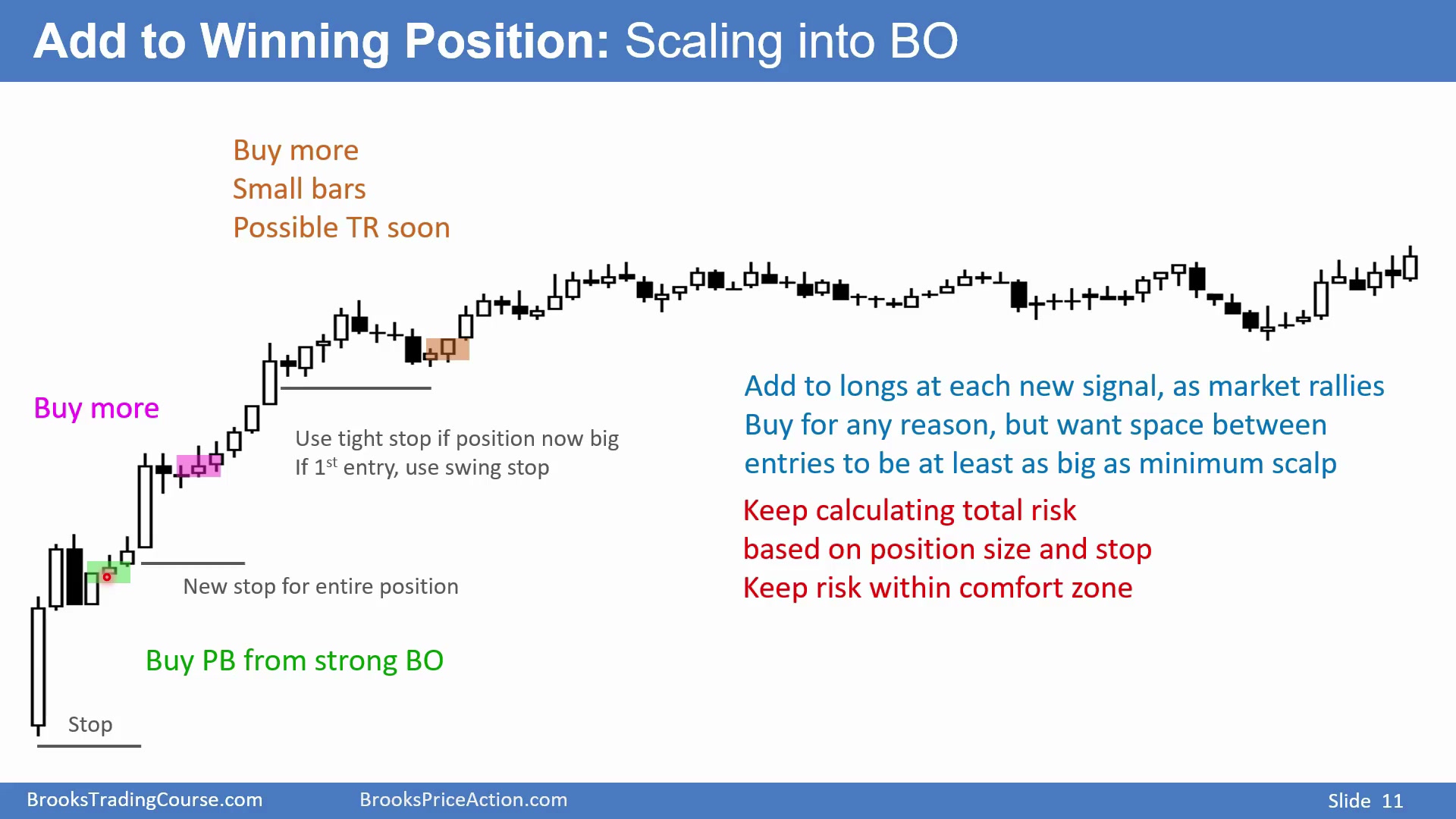
EN: Strong bull trend.

ZH: 强上涨趋势

25:30 - 25:32

EN: A bull might buy a pullback.

ZH: 多头会在回调时买入

25:33 - 25:37

EN: An attempt at a reversal, but then the reversal looks like it’s going to fail.

ZH: 尝试反转下跌,但随后看起来会失败

25:38 - 25:42

EN: The bull might buy the resumption up from the pullback,

ZH: 在回调结束,恢复上涨的时候,多头会买入

25:42 - 25:45

EN: so the breakout above the pullback bar.

ZH: ——在突破回调K线高点的时候买入

25:47 - 25:50

EN: Stop obviously at the bottom of the bull breakout,

ZH: 止损显然在多头突破的起涨点下方

25:51 - 25:55

EN: and he might add to his longs as the market continues to rally.

ZH: 随着市场继续上涨,他可以盈利加仓

25:55 - 25:56

EN: He could buy for any reason.

ZH: 他可以根据任何理由买入

25:57 - 26:01

EN: But he wants the space between each of his entries to be at least

ZH: 但他希望每次买入之间的间隔,

26:01 - 26:05

EN: as big as a minimum scalp, so he doesn’t want to buy

ZH: 至少距离一笔剥头皮交易的距离

26:05 - 26:08

EN: and then buy later at the same price.

ZH: 也就是说,他不想在同样的价格多次买入

26:08 - 26:10

EN: If he’s going to be buying as the market’s going up,

ZH: 如果他要在市场上涨时追涨,

26:10 - 26:17

EN: he wants the second entry to be at least the size of a scalp

ZH: 他加仓的位置至少要比前一个买点高出一定的距离

26:15 - 26:17

EN: more than the first entry,

ZH: 他加仓的位置至少要比前一个买点高出一定的距离

26:19 - 26:24

EN: and he has to keep calculating his total risk

ZH: 并且他必须根据新的仓位大小和新的止损距离, 不断计算他的总风险

26:22 - 26:31

EN: based upon the position size and his stop, and he has to make sure

ZH: 并且他必须根据新的仓位大小和新的止损距离, 不断计算他的总风险 他需要保证他的风险始终维持在舒适区之内

26:27 - 26:31

EN: that his risk remains within his comfort zone.

ZH: 他需要保证他的风险始终维持在舒适区之内

26:32 - 26:37

EN: Another bull flag, another bull breakout above the bull flag.

ZH: 再次回调(牛旗),向上突破牛旗, 可以加仓买入更多

26:36 - 26:37

EN: Buy more.

ZH: 再次回调(牛旗),向上突破牛旗, 可以加仓买入更多

26:38 - 26:40

EN: We have a bull breakout to a new high.

ZH: 向上突破创新高

26:40 - 26:46

EN: Put the stop below that new bull breakout, which is above his first entry price.

ZH: 把止损放在新的起涨点下方, 新的止损高于他的第1次入场价

26:46 - 26:48

EN: So now he’s entered twice.

ZH: 现在,他买入了两次

26:48 - 26:52

EN: His position is twice as big as it was initially,

ZH: 他的仓位是最初的两倍

26:52 - 26:56

EN: and his stop now is around his first entry.

ZH: 并且新的止损在第1次入场价格附近

26:58 - 27:06

EN: Another bull flag, a High 2 bull flag, two small legs down

ZH: 再次回调,高2牛旗,两段小的下跌—— 1,反弹,2——然后有阳线

27:03 - 27:06

EN: - one, pullback, two – and then we have a bull bar.

ZH: 再次回调,高2牛旗,两段小的下跌—— 1,反弹,2——然后有阳线

27:06 - 27:08

EN: Maybe he’ll buy more on the resumption up.

ZH: 他可以在恢复上涨的时候买入更多

27:12 - 27:16

EN: Here, this looks like we’re getting small bars, doji bars.

ZH: 这里开始出现很多小K线、小十字星

27:16 - 27:20

EN: We might be forming a Tight Trading Range, so his premise might change.

ZH: 正在进入窄震荡区间,所以他的前提可能发生了变化

27:20 - 27:22

EN: At this point he might be thinking,

ZH: 此时他可能会想:

27:22 - 27:27

EN: “Well maybe I’m buying a bull channel instead of a bull breakout.

ZH: “也许不再是突破阶段,而是已经进入了通道,

27:27 - 27:29

EN: Maybe I’ll start using a tighter stop,”

ZH: 现在用更窄的止损会更好一些。”

27:29 - 27:31

EN: especially if the position is getting big.

ZH: 尤其当仓位越来越大的时候(需要减小风险)

27:31 - 27:35

EN: If his premise is still valid that it’s now a bull channel instead

ZH: 如果他的前提仍然有效, 即使突破阶段结束,现在进入上涨通道

27:35 - 27:39

EN: of a bull breakout, it still should form Higher Lows.

ZH: 低点仍然应该不断抬高

27:39 - 27:43

EN: So this low should stay above that low, so he could use a tight stop,

ZH: 这个低点应该保持在那个低点上方, 所以他可以使用窄止损

27:43 - 27:48

EN: especially if he’s been adding on and now has a large position.

ZH: 尤其是因为他一直在加仓,现在的仓位已经很大

Slide 012

Time: 27:50

Slide 012

Bilingual Transcript

27:53 - 27:55

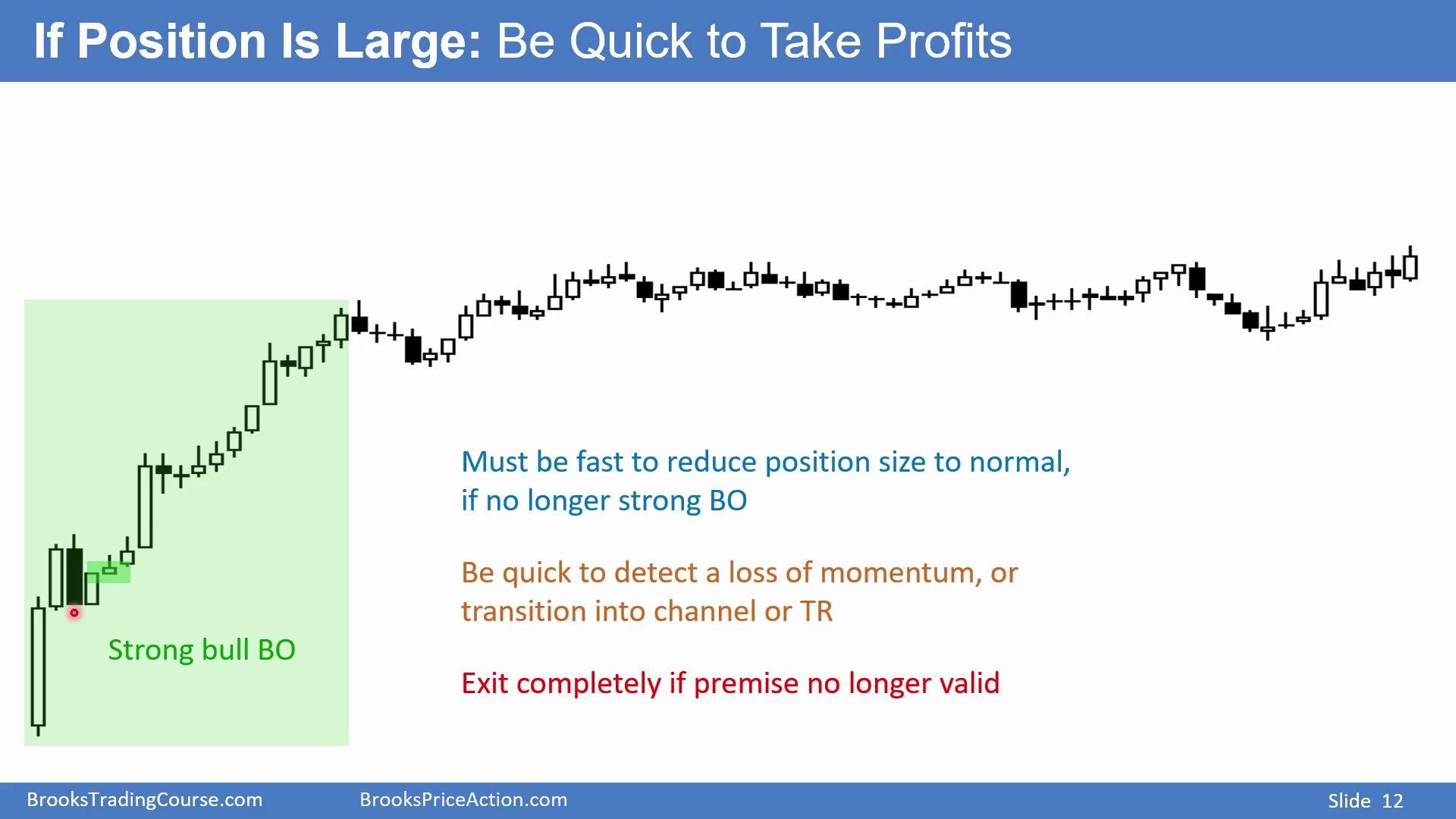
EN: Very strong bull breakout.

ZH: 之前是非常强势的多头突破

28:00 - 28:12

EN: Traders have to be very quick to reduce their position size

ZH: 但如果突破不再强势,而是开始转变到上涨通道或震荡区间,

28:05 - 28:12

EN: to a normal position size if the breakout is no longer a strong bull breakout,

ZH: 但如果突破不再强势,而是开始转变到上涨通道或震荡区间,

28:11 - 28:15

EN: if it starts to convert into something else

ZH: 但如果突破不再强势,而是开始转变到上涨通道或震荡区间, 交易者就必须非常迅速地把仓位减小到正常的规模

28:13 - 28:15

EN: like a bull channel or a Trading Range.

ZH: 交易者就必须非常迅速地把仓位减小到正常的规模

28:20 - 28:29

EN: An experienced trader will be very good at detecting a loss of momentum

ZH: 有经验的交易者很擅长察觉到上涨动能的消失, 知道市场可能要进入通道或震荡区间

28:25 - 28:29

EN: and a possible transition into a channel or a Trading Range.

ZH: 有经验的交易者很擅长察觉到上涨动能的消失, 知道市场可能要进入通道或震荡区间

28:32 - 28:35

EN: If at any point their premise is no longer valid,

ZH: 一旦他们的前提不再成立,

28:35 - 28:37

EN: they’ll exit their entire position.

ZH: 他们就会立刻全部离场

28:38 - 28:42

EN: So if they buy here and buy more here and buy more here,

ZH: 如果他们在这里买入,然后不断加仓、加仓

28:42 - 28:50

EN: they’re buying it on the premise that perhaps it’s a breakout

ZH: 他们买入的前提是,这个突破还会继续持续下去, 过一段时间再进入通道

28:46 - 28:50

EN: that may continue up much higher before it transitions into a channel.

ZH: 他们买入的前提是,这个突破还会继续持续下去, 过一段时间再进入通道

28:54 - 28:58

EN: However, if the market does something to make them question that premise

ZH: 然而,如果市场的价格行为让他们对这个前提产生怀疑,

Slide 013

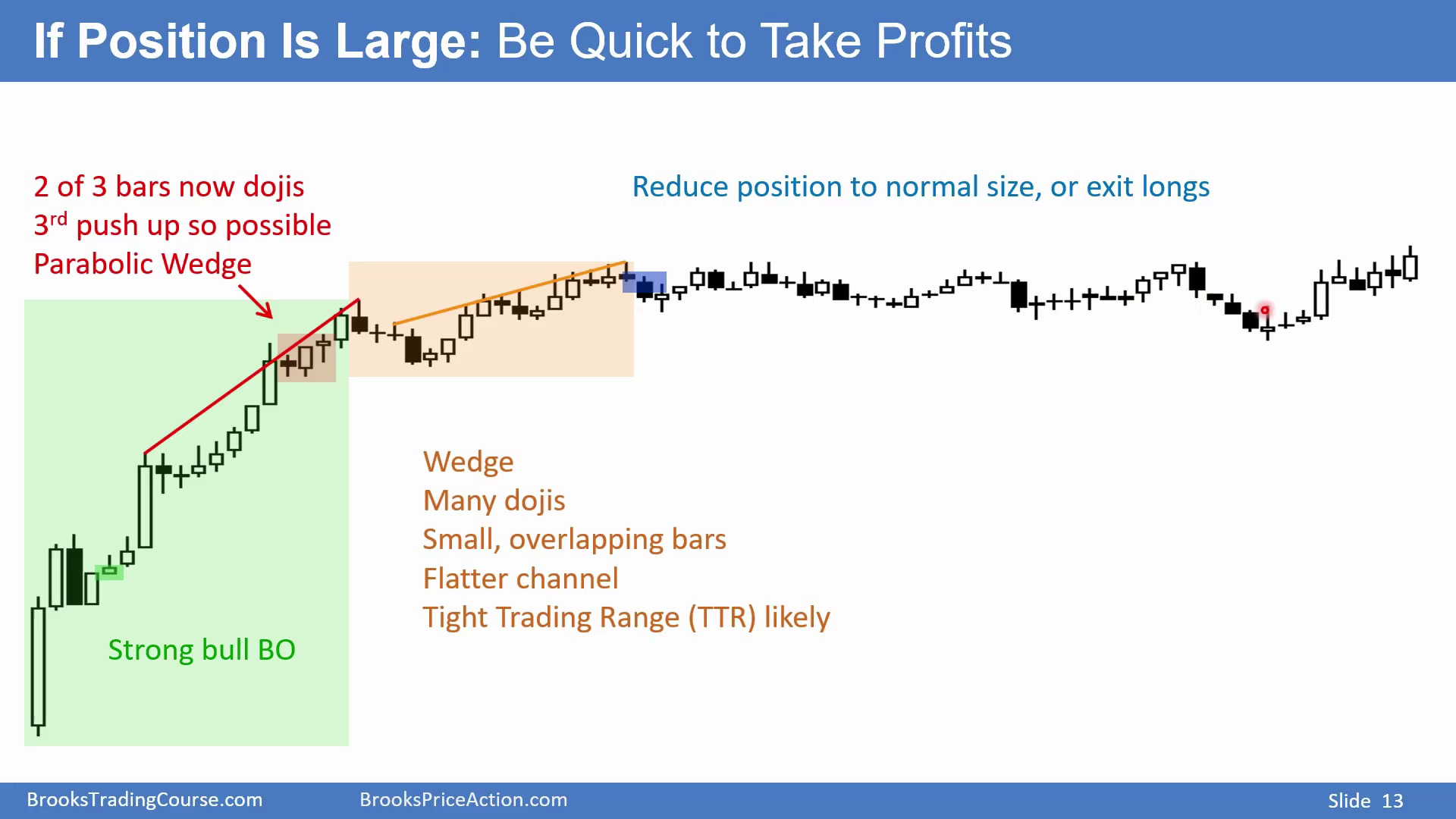
Time: 28:55

Slide 013

Bilingual Transcript

28:58 - 29:02

EN: that the breakout will continue a long time, they’ll be quick to get out.

ZH: 这个突破看上去不会持续下去,那么他们就会立刻离场

29:03 - 29:11

EN: Here, we have one push up, two pushes up, possibly three pushes up

ZH: 第1次上涨,第2次上涨, 这可能是第3推,变成抛物线楔形顶,有反转下跌的风险

29:07 - 29:11

EN: to a Parabolic Wedge Top, and we might reverse at that point.

ZH: 第1次上涨,第2次上涨, 这可能是第3推,变成抛物线楔形顶,有反转下跌的风险

29:12 - 29:15

EN: We got a doji here, a small bar here, a doji here.

ZH: 十字星,小K线,十字星

29:15 - 29:22

EN: That’s looking different from this, where we had consecutive bull bars,

ZH: 这和之前的价格行为不一样——连续的阳线, 连续的阳线,连续的阳线,

29:19 - 29:22

EN: consecutive bull bars, consecutive bull bars.

ZH: 这和之前的价格行为不一样——连续的阳线, 连续的阳线,连续的阳线,

29:23 - 29:24

EN: The market’s starting to look different.

ZH: 市场看上去不一样了

29:24 - 29:28

EN: We have a possible Buy Climax and a tail and a doji.

ZH: 这是潜在的抢购高潮,有上影线,然后是十字星

29:28 - 29:33

EN: A small bull bar and then a doji bar and then a possible Parabolic Wedge

ZH: 小阳线,十字星,

29:33 - 29:39

EN: - one, two, maybe we’ll just go up a little bit

ZH: 而且是潜在的抛物线楔形顶——1,2—— 可能还有一小段上涨,形成第3推,然后开始下跌

29:35 - 29:39

EN: and form three, and then start to reverse down.

ZH: 而且是潜在的抛物线楔形顶——1,2—— 可能还有一小段上涨,形成第3推,然后开始下跌

29:40 - 29:48

EN: When traders see that, they’re thinking that maybe the market is transitioning

ZH: 当交易者看到这些特征, 他们认为市场可能正在从强上涨趋势

29:46 - 29:54

EN: from a strong bull breakout phase into either a Trading Range or a channel.

ZH: 当交易者看到这些特征, 他们认为市场可能正在从强上涨趋势 转变成震荡区间,或者通道

29:54 - 29:57

EN: Again, look at the character of the bars.

ZH: 再仔细看一下这些K线

29:57 - 29:58

EN: A bear bar now.

ZH: 阴线收在最低

29:58 - 30:01

EN: We have not had a bear bar since here.

ZH: 从这根阴线开始,还没有出现过收在最低的阴线

30:01 - 30:02

EN: Small bar.

ZH: 小K线

30:02 - 30:05

EN: This bar is below that bar.

ZH: 这根K线低于那根K线

30:05 - 30:10

EN: Here we have been pulling back for 5 or 6 bars, a breakout with shrinking bodies,

ZH: 这里已经回调了5~6根K线, 向上突破,但是阳线的体积都很小

30:10 - 30:13

EN: and then a doji, small doji, doji, small bar.

ZH: 然后是十字星,小十字星,十字星,小K线

30:13 - 30:17

EN: So these bars over the past 10 bars are different from these bars,

ZH: 最近这10根K线,和之前的完全不一样

30:18 - 30:21

EN: so the premise of a strong breakout has changed.

ZH: 所以交易的前提已经发生了改变

30:21 - 30:23

EN: This is no longer a strong bull breakout.

ZH: 这不再是一个强势的多头突破

30:23 - 30:26

EN: It’s a bull channel, but it might also be a Trading Range.

ZH: 这是一个上涨通道,也可能是震荡区间

30:26 - 30:28

EN: We could easily trade back down here.

ZH: 价格很容易回调到这里

30:29 - 30:33

EN: When you start to see smaller bars, overlapping bars, the channel,

ZH: 当你开始看到更小的K线,重叠的K线,通道

30:33 - 30:38

EN: the slope of this is not as steeply up as is this.

ZH: 上涨的斜率不再像之前一样陡峭

30:39 - 30:43

EN: You’re getting Tight Trading Range price action here, here, here

ZH: 在这里、这里、这里出现窄震荡区间的价格行为

30:43 - 30:46

EN: - in fact, the entire thing might be part of a big Tight Trading Range.

ZH: 实际上,这一段可能就是整个窄震荡区间的一部分

30:50 - 30:56

EN: So at that point – now we have a Wedge,

ZH: 所以在这个时候——楔形顶,潜在的高点抬高的大反转

30:53 - 30:56

EN: possibly a Wedge Higher High Major Trend Reversal.

ZH: 所以在这个时候——楔形顶,潜在的高点抬高的大反转

30:56 - 30:58

EN: Bull trend, small breakout Wedge.

ZH: 上涨趋势,3次小的推动向上突破

30:58 - 31:01

EN: It’s still a Small Pullback Bull Trend at this point,

ZH: 这仍然是一个回调很小的上涨趋势

31:01 - 31:03

EN: but it’s no longer a breakout.

ZH: 但它不再是突破阶段

31:03 - 31:07

EN: A trader might want to reduce his position back down to a normal position size

ZH: 交易者最好要把仓位减小到正仓的规模

31:07 - 31:14

EN: at this point had he bought here and then added here,

ZH: 如果他在这里买入,然后在这里加仓,现在是两倍; 这里再次加仓,所以是3倍仓位

31:11 - 31:14

EN: so a double position, and then added here, so a triple position.

ZH: 如果他在这里买入,然后在这里加仓,现在是两倍; 这里再次加仓,所以是3倍仓位

31:15 - 31:22

EN: At this point he may cut back down

ZH: 此时他最好把仓位减小到正常规模,或者全部离场

31:17 - 31:22

EN: to a normal size position or he may exit entirely.

ZH: 此时他最好把仓位减小到正常规模,或者全部离场

31:22 - 31:27

EN: If he exited entirely, look at what happened over the next 30 or 40 bars.

ZH: 如果他没有离场,看看接下来的30或40根K线发生了什么?

31:27 - 31:28

EN: No profit.

ZH: 利润没有增加

31:28 - 31:31

EN: Exiting entirely would make sense.

ZH: 所以全部离场是合理的

Slide 014

Time: 31:35

Slide 014

Bilingual Transcript

31:35 - 31:37

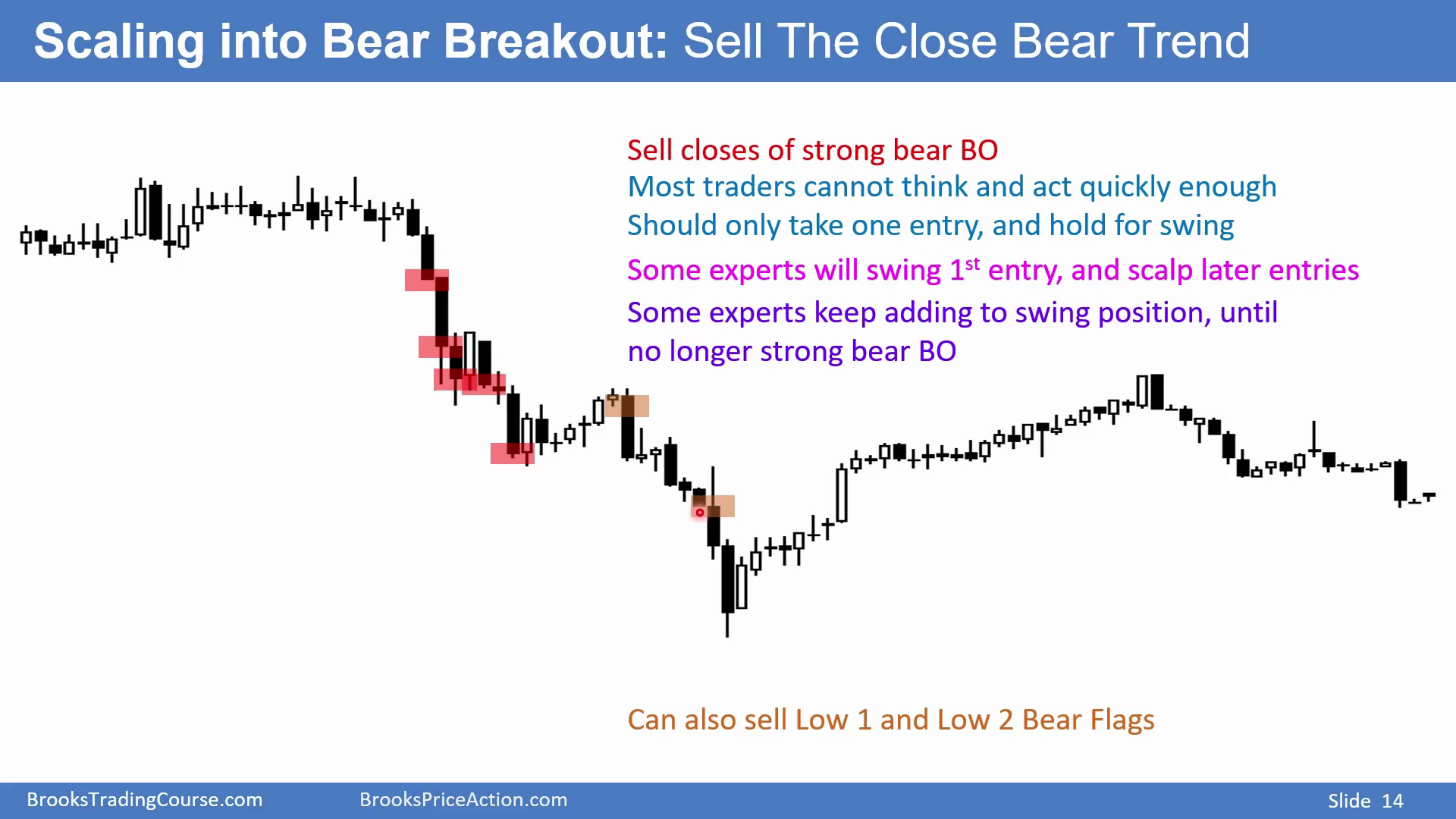
EN: Here we have a very strong bear trend.

ZH: 非常强的下降趋势

31:37 - 31:39

EN: It’s a Sell The Close bear trend.

ZH: 这是一个“卖收盘”的下降趋势

31:39 - 31:42

EN: At this point or that point it’s a Sell The Close bear trend.

ZH: 在这里或这里,已经变成了“卖收盘”的下降趋势

31:42 - 31:44

EN: Traders are selling.

ZH: 交易者在不断卖出

31:44 - 31:46

EN: They’ll sell that close, this close, this close.

ZH: 他们会在它、它、它的收盘卖出

31:46 - 31:47

EN: They’ll sell the bull close.

ZH: 他们也会在阳线的收盘卖出(押注反弹失败)

31:47 - 31:49

EN: They’ll sell that close, this close, this close.

ZH: 他们会在它、它、它的收盘卖出

31:54 - 31:58

EN: Here are examples of possible entries.

ZH: 这些都是合理的做空入场点

31:58 - 31:59

EN: They can add on.

ZH: 空头可以不断加仓

31:59 - 32:03

EN: They can just keep – they take a position here, sell more here, sell more here.

ZH: 初始入场点在这里,然后加仓,加仓

32:03 - 32:06

EN: You’re not going to sell more here if you sell here

ZH: 如果你在这里卖出了,就不要在这里加仓

32:06 - 32:10

EN: because this is not at least a scalp size below this.

ZH: 因为两者之间没有拉开距离

32:11 - 32:14

EN: A lot of traders will take one of these trades, maybe one or two.

ZH: 交易者可以在这些入场点中选择一个或两个 (注:并不是让你每个地方都去加仓)

32:14 - 32:18

EN: A lot of traders will take one, scalp out, and then take the next one.

ZH: 很多人入场之后会剥头皮离场,然后再次入场

32:19 - 32:22

EN: But let’s say you’re adding to your position and you take two or three of those.

ZH: 假设你加仓了,在其中的两三个地方加仓做空

32:25 - 32:26

EN: Then fine.

ZH: 这么做没有问题

32:26 - 32:34

EN: You’ve got to be trading small enough so that a stop up here will not create

ZH: 你的仓位必须足够小,不会因为上方的止损而感到压力, 导致无法正确地管理交易

32:32 - 32:34

EN: so much risk that you will not manage your trade properly,

ZH: 你的仓位必须足够小,不会因为上方的止损而感到压力, 导致无法正确地管理交易

32:34 - 32:40

EN: and so much risk that you have a greater risk than you have on any other trade.

ZH: 你在这一笔交易中所承担的风险,不应该超过平时的其它交易

32:41 - 32:46

EN: And most traders cannot think fast enough to sell – sell more, sell more,

ZH: 而且大多数交易者没有这么快的反应—— 不断地加仓、加仓、加仓

32:46 - 32:50

EN: sell more – and they should only take one of these entries.

ZH: 所以选择一个入场点就足够了

32:50 - 32:51

EN: Doesn’t matter which one.

ZH: 只要合理就可以

32:51 - 32:55

EN: Any one, and then use the appropriate stop and then just hold for a swing

ZH: 任何一个入场点都可以,设置正确的止损,

32:55 - 32:58

EN: until there’s a pretty strong reversal up and then get out down here.

ZH: 然后持有做波段交易,直到出现了强势的反转上涨—— 在这里离场

33:01 - 33:07

EN: Some traders will sell here or here, and then see these additional entries.

ZH: 一些交易者在这里或这里做空之后, 又看到了合理的入场点

33:07 - 33:11

EN: Instead of adding them to their swing position, they might scalp.

ZH: 他们可能会用新的入场点来剥头皮, 而不是全部一起做波段交易

33:11 - 33:14

EN: So you sell here, here’s another sell – I’ll sell this one for a scalp.

ZH: 比如,在这里做空之后,看到了新的入场点—— 做空剥头皮

33:14 - 33:17

EN: Here’s another sell – I’ll sell this one for a scalp.

ZH: 新的入场点——做空剥头皮

33:17 - 33:19

EN: Another sell, I’ll sell for a scalp.

ZH: 新的入场点——做空剥头皮

33:19 - 33:25

EN: So they hold their initial swing entry and then they scalp additional entries.

ZH: 也就是说,初始仓位一直持有,做波段交易; 然后一路上找机会剥头皮

33:27 - 33:31

EN: And then other traders, as I said, some experts will just keep adding

ZH: 另外一些交易者,就像前面所讲的,会继续加仓,

33:31 - 33:37

EN: to their position until they believe their premise is no longer valid.

ZH: 直到他们的前提不再成立为止

33:42 - 33:46

EN: Low 1, Low 2, so a Low 1 or a Low 2 bear flag.

ZH: 低1,低2,所以是低2熊旗

33:46 - 33:48

EN: Here we have a pause bar.

ZH: 这里有一个暂停K线

33:48 - 33:50

EN: We went above it, so this is a pullback,

ZH: 突破了前1根K线的高点,所以这是一次反弹

33:50 - 33:52

EN: and that makes this a Low 1 sell signal bar.

ZH: 所以它就变成了低1信号K

33:52 - 33:58

EN: So some traders will sell below the low of that bar on the reversal down.

ZH: 一些交易者会在它的低点下方卖出做空

33:59 - 34:03

EN: There are many ways to sell in a bear trend.

ZH: 在下降趋势中有很多卖出做空的方法

Slide 015

Time: 34:05

Slide 015

Bilingual Transcript

34:08 - 34:13

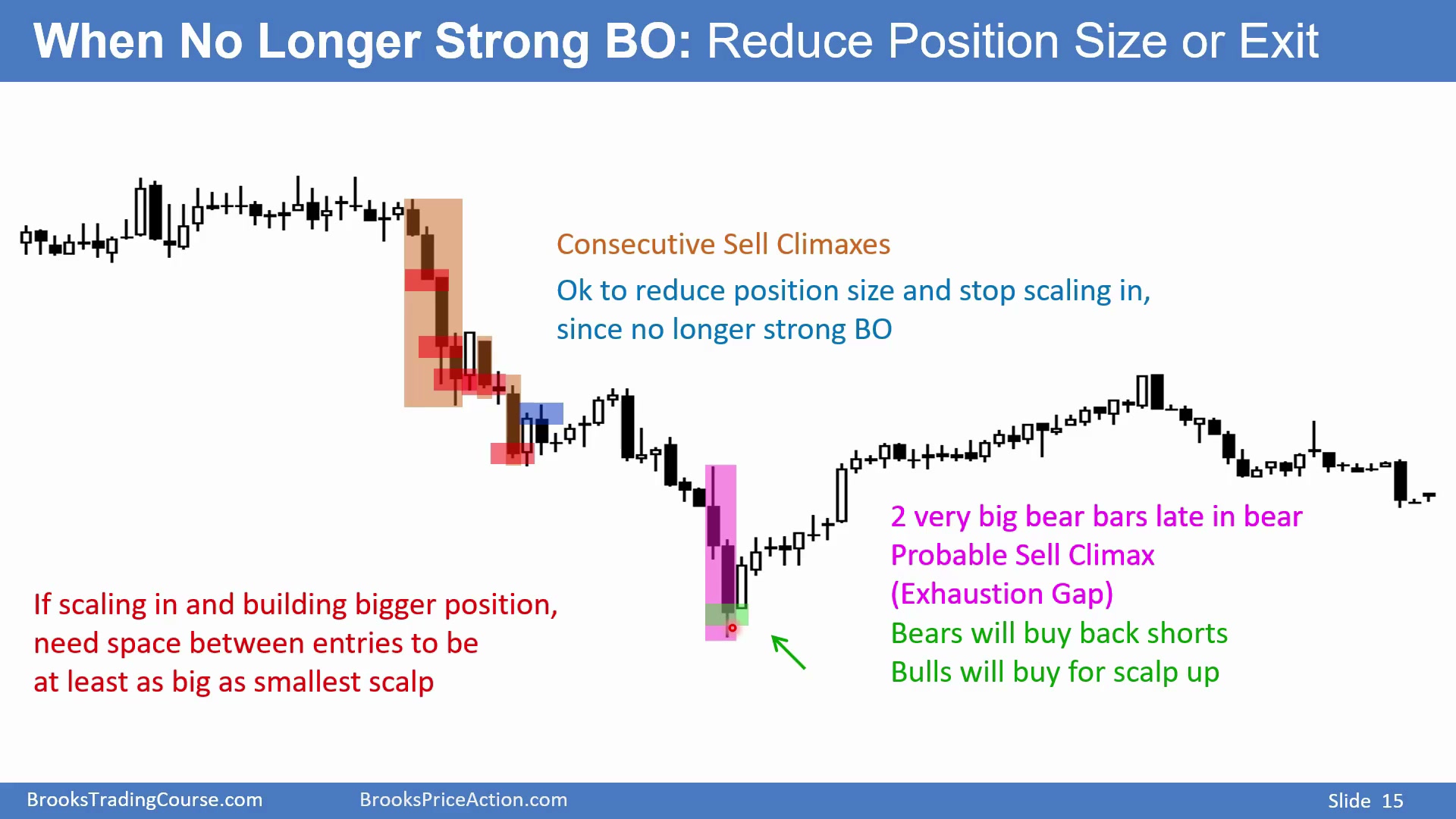
EN: As I said earlier, if you’re scaling into a winning trade,

ZH: 正如之前所说,如果你想盈利加仓

34:13 - 34:18

EN: you want the next entry to be at least a scalp below the first one.

ZH: 加仓的位置至少要间隔一笔剥头皮交易的规模

34:18 - 34:20

EN: So if a scalp in the Emini is 1 point,

ZH: 对于ES期货来说,剥头皮的最小规模是1个点 (注:当时只有2000点;现在最小规模是3~5个点)

34:20 - 34:25

EN: you don’t want to be selling again unless you’re 1 point lower.

ZH: 等市场下跌至少1个点之后,再盈利加仓

34:28 - 34:29

EN: Consecutive Sell Climaxes.

ZH: 连续抛售高潮

34:29 - 34:34

EN: Climax, big trend bar, so a climax, big trend bar, so a climax.

ZH: 大阴线,大阴线,所以是抛售高潮

34:37 - 34:41

EN: So if you were scaling in and you see consecutive Sell Climaxes,

ZH: 如果你加仓做空了,然后看到连续的抛售高潮

34:41 - 34:44

EN: you know there’s a risk of a pullback or maybe even a Trading Range.

ZH: 你就知道存在反弹的风险,甚至会开始进入震荡区间

34:45 - 34:50

EN: It’s a good time to reduce your position, or possibly even get out entirely

ZH: 这是减仓(保护利润)的好机会,甚至可以全部离场

34:50 - 34:53

EN: and then wait for another sell signal before selling again.

ZH: 然后耐心等待重新入场的机会 (注:比如等待TBTL的反弹结束再做空)

34:55 - 34:59

EN: We had a strong breakout and then we got consecutive Sell Climaxes,

ZH: 强势地向下跌破,然后出现连续的抛售高潮

34:59 - 35:02

EN: so the premise of a strong breakout is no longer valid.

ZH: 所以突破阶段已经结束

35:07 - 35:07

EN: Look at this.

ZH: 看这个

35:07 - 35:12

EN: The strongest pair of bear bars occurring 20 bars into a trend.

ZH: 趋势持续超过20根K线,再出现最大的两根阴线

35:12 - 35:17

EN: You have to be thinking about the possibility of an Exhaustion Gap,

ZH: 你必须考虑到它是竭尽型缺口的可能性

35:17 - 35:20

EN: a final Sell Climax and the end of the trend.

ZH: 是下降趋势末尾的抛售高潮(的可能性)

35:20 - 35:25

EN: So whenever you see the strongest pair of bear bars occurring late in a trend,

ZH: 每当你在趋势后期看到最强的大阴线

35:25 - 35:29

EN: you have to be thinking that 75% chance the gap

ZH: 你就必须考虑到,有75%的概率,

35:29 - 35:33

EN: between this close and this low will probably close.

ZH: 它和它之间的缺口会被回补

35:33 - 35:38

EN: It’s probably an Exhaustion Gap, not a Measuring Gap for a Measured Move down.

ZH: 这大概率是一个竭尽型缺口, 而不是还会下跌到MM目标位的测量型缺口

35:39 - 35:44

EN: So that is a good reason for bears to exit.

ZH: 所以这是空头止盈的好机会

35:45 - 35:48

EN: Smart bears will buy back their shorts here.

ZH: 聪明的空头会在这里平仓

35:48 - 35:50

EN: It’s no longer Sell The Close.

ZH: 这不再是“卖收盘”的下降趋势了

35:50 - 35:55

EN: We have consecutive Sell Climaxes – one, two, three, four, five, and then six,

ZH: 已经有连续的抛售高潮——1,2,3,4,5,然后6

35:55 - 35:59

EN: and we have a huge Sell Climax very late, 20 or more bars into the trend.

ZH: 趋势已经持续超过20根K线,巨大的抛售高潮

35:59 - 36:02

EN: The bears know it’s probably not going to go much further,

ZH: 空头知道不会再下跌太多了

36:02 - 36:05

EN: and in fact we’ll probably get a couple legs sideways to up.

ZH: 大概率会有两段横盘或上涨

36:05 - 36:11

EN: So a smart bear would buy back his shorts here, and a smart bull,

ZH: 所以一个聪明的空头会在这里止盈离场

36:11 - 36:13

EN: aggressive bull, would buy here.

ZH: 而一个聪明、激进的多头,会在这里买入

36:13 - 36:17

EN: Other bulls will wait to buy the reversal up, but they could buy here

ZH: 一些多头会等待,在反转上涨的时候买入; 但他们也可以在这里买入

36:17 - 36:22

EN: and then put a stop down here, maybe based upon a Measured Move down from here,

ZH: 然后设置宽止损,比如放在MM目标位的下方,

36:22 - 36:26

EN: thinking that it’s strong enough maybe we get a small second leg down.

ZH: 给市场留出第2段下跌的空间

36:26 - 36:30

EN: But if we do get a second leg down, we’ll probably then reverse

ZH: 就算有小的第2段下跌,大概率还是会反转上涨

36:30 - 36:36

EN: - either reverse here or here, or maybe we get one more small leg down

ZH: ——要么在这里就反转上涨; 要么在小的第2段下跌之后,再反转上涨

36:35 - 36:36

EN: and then we reverse.

ZH: ——要么在这里就反转上涨; 要么在小的第2段下跌之后,再反转上涨

Slide 016

Time: 36:40

Slide 016

Bilingual Transcript

36:41 - 36:50

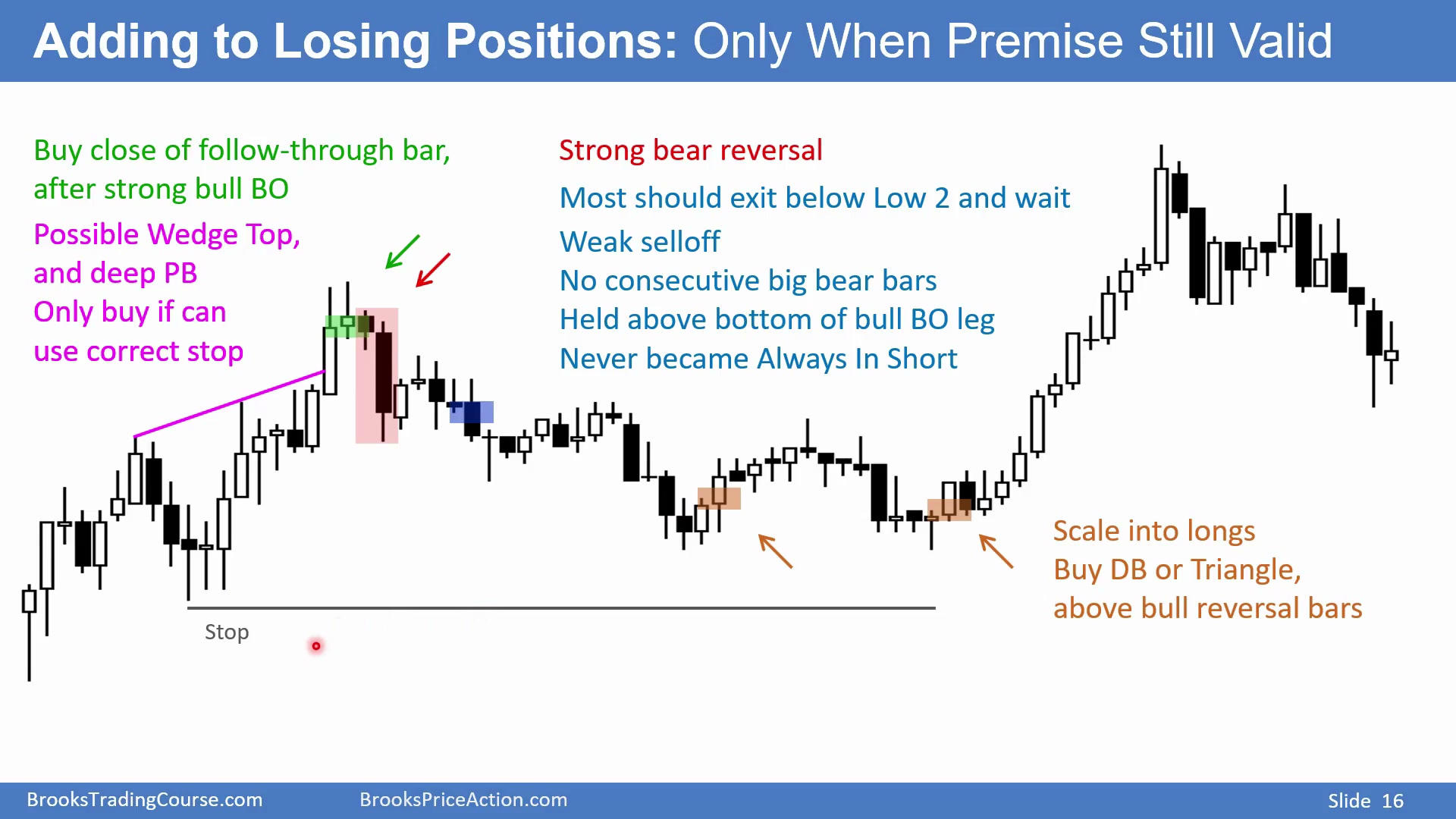
EN: If you’re adding to a losing position, you only want to add to your position

ZH: 如果你想在浮亏的时候加仓, 前提必须是:你相信这笔交易仍然成立

36:46 - 36:50

EN: if you believe that your original position is still valid.

ZH: 如果你想在浮亏的时候加仓, 前提必须是:你相信这笔交易仍然成立

36:51 - 36:55

EN: So let’s say you look at this and say, oh, it’s a Buy The Close bull trend.

ZH: 假设你看到这个行情,认为这是一个“买收盘”的上涨趋势

36:55 - 36:56

EN: It’s not all that strong.

ZH: 并不是特别强势

36:56 - 36:59

EN: We have tails, we have bear bars, tails.

ZH: 有上影线,有阴线,下影线

36:59 - 37:02

EN: This looks like a bull trend in what will end up as a Trading Range,

ZH: 看起来它最终会是震荡区间中的上涨波段

37:02 - 37:05

EN: but it may go up much higher before it begins the Trading Range.

ZH: 但在开始震荡前,它也许还能再涨一些

37:06 - 37:13

EN: It’s okay to buy here if you’re willing to put a stop all the way down

ZH: 如果你愿意把止损放在起涨点的下方, 在这里追涨是可以的

37:11 - 37:13

EN: below the bottom of the bull leg.

ZH: 如果你愿意把止损放在起涨点的下方, 在这里追涨是可以的

37:13 - 37:16

EN: Putting it down below the bottom of the Buy Climax is not good

ZH: 把止损放在抢购高潮的起点下方并不是最好的选择,

37:17 - 37:21

EN: because if this is a bull leg in what will become a Trading Range,

ZH: 因为如果它最终真的要变成震荡区间,

37:21 - 37:25

EN: it usually will fall below the bottom of the final Buy Climax.

ZH: 最后一次抢购高潮的起涨点很容易被跌破,然后立刻上涨

37:30 - 37:33

EN: A trader buying up here, he knows he’s buying in a weak rally

ZH: 在这里追涨的交易者,知道他是在一个弱趋势中买入

37:33 - 37:36

EN: that’s probably a bull leg in what will become a Trading Range.

ZH: 他知道这个上涨波段最终会变成震荡区间

37:36 - 37:38

EN: He sees the Wedge Top.

ZH: 他也看到了楔形顶

37:39 - 37:43

EN: He could buy hoping that we go up a little bit further and he could make a profit,

ZH: 他因为两个理由而追涨—— 再上涨一些,他可以剥头皮离场

37:43 - 37:48

EN: or he could buy knowing that we may pull back deeply

ZH: 或者,就算有深度的回调——

37:48 - 37:51

EN: - because if it’s a Trading Range, we could get a very deep pullback.

ZH: 因为是震荡区间,可能会有非常大的回调

37:51 - 37:55

EN: However, if it’s a Broad Bull Channel, the deep pullback should stay

ZH: 然而,如果这是一个宽上涨通道,

37:55 - 37:58

EN: above the bottom of the most recent leg up.

ZH: 回调就不应该跌破前期一个重要的低点

37:59 - 38:04

EN: A trader buying up here only buys up here if he’s going to put a stop down here.

ZH: 交易者不应该在这么高的位置追涨, 除非愿意把初始止损放在这里

38:06 - 38:08

EN: Strong bear reversal.

ZH: 强势的空头反转

38:08 - 38:12

EN: It’s possible that his premise is no longer valid,

ZH: 也许他的前提已经不再成立

38:12 - 38:15

EN: that we’re not in a Broad Bull Channel or any kind of a bull trend.

ZH: 也许并不是宽上涨通道,不再是上涨趋势

38:15 - 38:20

EN: Instead, we could be in a Trading Range or in a bear swing.

ZH: 而是变成了震荡区间,或者是下跌的波段

38:24 - 38:27

EN: Most traders – they got a bear breakout, a pullback,

ZH: 空头突破,(50%)反弹,

38:27 - 38:32

EN: and now we have a Low 2 short – Low 1, Low 2 – most traders should get out

ZH: 然后出现了低2做空入场点——低1,低2—— 大部分多头应该离场

38:32 - 38:35

EN: either on that close, above this bar, below that bar,

ZH: 要么在它的收盘,或者在它的上方(押注反弹失败) 或者在它的下方

38:35 - 38:37

EN: below this bar, and then just wait.

ZH: 或者在它的下方离场,然后等待

38:37 - 38:41

EN: But some traders will hold and put their stop down here

ZH: 但一些交易者会继续持有,把止损放在这里

38:41 - 38:43

EN: and then look to buy a reversal up lower.

ZH: 然后等着在向上反转的时候加仓

38:47 - 38:51

EN: Just like the rally had problems – it was weak – look at the selloff.

ZH: 就像之前的上涨有问题——趋势弱—— 这个下跌也是一样

38:51 - 38:56

EN: A big bear bar, but a disappointing follow-through bar and then a doji bar,

ZH: 大阴线,但是跟随令人失望,然后是十字星

38:56 - 39:00

EN: doji, doji, small bar, doji, doji.

ZH: 十字星,十字星,小K线,十字星,十字星

39:00 - 39:03

EN: Just like this looked like a bull leg in what would become a Trading Range,

ZH: 就像之前,看起来是震荡区间中的上涨波段

39:04 - 39:07

EN: this looks like a bear leg in a Trading Range

ZH: 这看起来也只是震荡区间中的下跌波段

39:07 - 39:09

EN: and not the start of a strong bear trend.

ZH: 而不是一个强下降趋势的开始

39:10 - 39:14

EN: A bull who bought here might hold long, stop down here.

ZH: 一些在这里追涨的多头,会选择继续持有,依赖初始止损

39:14 - 39:19

EN: Some traders don’t like to be getting in, getting out, getting in, getting out.

ZH: 因为有的人不喜欢反复入场、离场,进进出出

39:19 - 39:24

EN: They just buy and hold as long as their premise is still valid,

ZH: 只要前提仍然成立,他们买入之后就坚定持有,

39:24 - 39:27

EN: and they use an appropriate stop which is often very wide.

ZH: 依靠一个合理的止损——通常很宽

39:31 - 39:36

EN: The scale-in bull who bought here with the intention of scaling in lower

ZH: 分批买入的多头在这里入场之后,打算在更低的位置加仓

39:36 - 39:41

EN: as long as his premise was valid, he buys here with a stop down here,

ZH: 只要前提仍然成立,他就依赖这个初始止损

39:41 - 39:46

EN: but he’s buying small enough so that he can buy again on a reversal up

ZH: 但他的仓位非常小,所以可以在反转上涨时加仓

39:46 - 39:50

EN: above a bull bar or above here, a Double Bottom Higher Low.

ZH: 在阳线上方加仓,或者在这里——低点抬高的双底

39:51 - 39:56

EN: So he buys here and then buys more here or here, stop here, but he makes sure

ZH: 所以他在这里买入,然后在这里或这里买入更多, 止损放在这里

39:56 - 40:00

EN: that he’s trading small enough so that his combined position

ZH: 但是他会确保仓位足够小,

40:00 - 40:04

EN: does not create more risk than any other trade.

ZH: 不会比平时其它交易冒更大的风险

40:09 - 40:13

EN: So he bought here and he bought more here or here, stop down here.

ZH: 所以他在这里买入,在这里或者里加仓,止损在这里

Slide 017

Time: 40:10

Slide 017

Bilingual Transcript

40:16 - 40:19

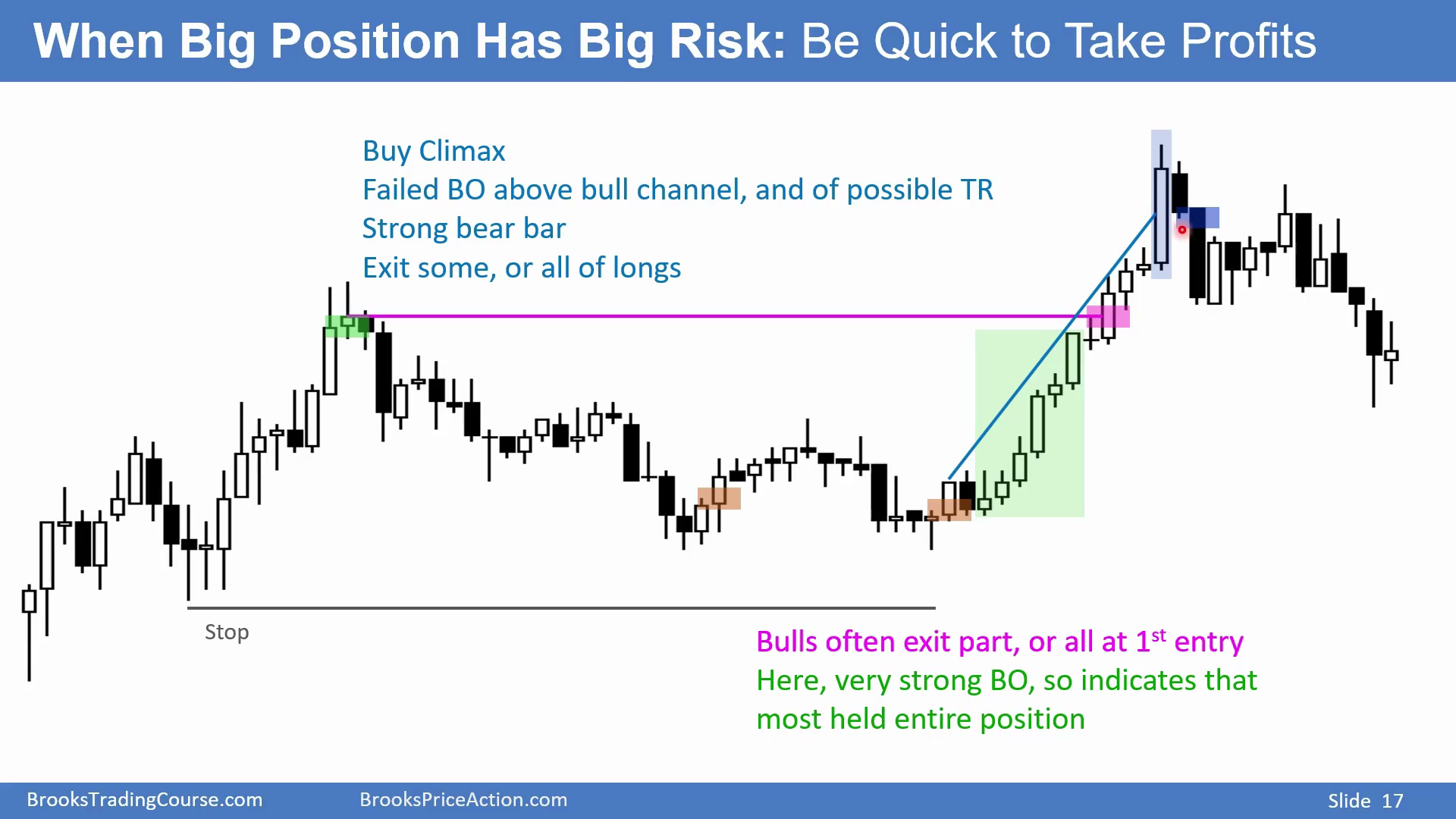
EN: As I said earlier, these scale-in bulls often exit

ZH: 正如之前所说,这些分批入场的多头

40:19 - 40:22

EN: the entire position back at their original entry.

ZH: 经常会在初始入场价格全部离场

40:22 - 40:25

EN: So they get out breakeven on their first entry

ZH: 所以他们的初始仓位打平

40:25 - 40:29

EN: and then with a profit on their second entry, whichever two it was.

ZH: 在下方加仓的部分可以赚钱——不管是在哪里加仓的

40:29 - 40:34

EN: However, a bull who buys here and he places his limit order to get out

ZH: 假设一个多头在这里加仓之后,原本在这里挂好了止盈的限价卖单

40:34 - 40:38

EN: of his entire position here, breakeven on the first, profit on the second,

ZH: 打算初始仓位打平、加仓的部分赚钱

40:38 - 40:42

EN: and then he sees this – it starts to become a Buy The Close bull trend

ZH: 但是他看到了这个——市场进入了“买收盘”的上涨趋势

40:42 - 40:46

EN: - he might decide to only exit half of his position here

ZH: 他可能会改变计划,只离场一部分

40:46 - 40:50

EN: because this is such a strong bull breakout, we’re probably going higher.

ZH: 因为这个突破这么强势,大概率还会再上一些

40:54 - 40:58

EN: Biggest bull bar in a rally that’s lasted more than 20 bars

ZH: 上涨趋势持续超过20根K线之后,再出现最大的大阳线

40:58 - 41:00

EN: - probably an Exhaustion Gap.

ZH: ——大概率是竭尽型缺口

41:00 - 41:04

EN: So the gap between this close and this high probably will close,

ZH: 所以它和这个高点之间的缺口大概率会被填补

41:04 - 41:07

EN: so we’ll probably reverse down below that high.

ZH: 大概率会回调到这个高点的下方

41:07 - 41:11

EN: And then we have a bear bar here and a Parabolic Wedge.

ZH: 抛物线楔形顶之后,出现了收在最低的阴线

41:11 - 41:14

EN: We have a bull breakout above a bull channel,

ZH: 尝试加速突破上涨通道

41:14 - 41:17

EN: probably going to fail and go at least sideways to down.

ZH: 大概率会失败(复习:75%的概率会在5根K线之内失败), 至少会有两段横盘或下跌

41:17 - 41:23

EN: So at this point the premise is no longer valid

ZH: 所以在这个时候,尽管看上去仍然是上涨趋势, 但是他的前提已经不再成立

41:20 - 41:23

EN: that the bull trend is still in effect.

ZH: 所以在这个时候,尽管看上去仍然是上涨趋势, 但是他的前提已经不再成立

41:25 - 41:29

EN: Most traders, if they bought for any reason, should be getting out of longs here

ZH: 大多数交易者,如果他们因为任何原因买入, 应该在这里离场

41:29 - 41:33

EN: because bears will be selling there, looking for at least two legs down.

ZH: 因为空头会在那里卖出,预期至少有两段下跌

41:38 - 41:40

EN: In this video I talked about traders who do scale in,

ZH: 这节课,我讲了哪些交易者会分批入场

Slide 018

Time: 41:40

Slide 018

Bilingual Transcript

41:40 - 41:48

EN: and that includes everyday individuals trading their own account

ZH: 这也包括做定期定额投资的散户交易者

41:45 - 41:48

EN: at home when they do dollar-cost averaging.

ZH: 这也包括做定期定额投资的散户交易者

41:49 - 41:53

EN: Next I moved on and talked about scaling into winning trades.

ZH: 然后我讲了如何盈利加仓

41:57 - 41:58

EN: This is Al Brooks.

ZH: 我是阿尔·布鲁克斯

41:58 - 42:00

EN: Thank you for watching the Brooks Trading Course.

ZH: 感谢观看布鲁克斯交易课程

42:00 - 42:08

EN: This is the end of Video 35A: Scaling In.

ZH: 加仓的第1节课(35A)就先讲到这里 (注:下节课讲亏损加仓)

42:04 - 42:08

EN: This is the first of three videos on scaling into a trade.

ZH: 加仓的第1节课(35A)就先讲到这里 (注:下节课讲亏损加仓)