Skip to content
Price Action Encyclopedia Index

al-brooks-course

50B - Scalping

Raw transcript and slide notes for 50B - Scalping.

Overview

  • Slides: 12
  • Transcript segments: 401
  • Status: 自动按 slide 时间线归档;核心概念和长期笔记可以在每个 slide 的 Study Notes 下继续整理。

Source Media

Transcript 001

Time: 00:02

Bilingual Transcript

00:02 - 00:03

EN: I’m Al Brooks.

00:03 - 00:05

EN: Thank you for watching the Brooks Trading Course.

00:05 - 00:09

EN: This is the second of five videos on scalping.

Slide 001

Time: 00:11

Slide 001

Bilingual Transcript

00:13 - 00:16

EN: I want to make the important point that beginners should avoid scalping.

00:16 - 00:19

EN: It’s just way too easy to lose money.

00:19 - 00:22

EN: They have to win at a very high percentage rate,

00:22 - 00:25

EN: and that’s impossible for a beginner to do.

00:26 - 00:29

EN: Some scalpers use two timeframes.

00:29 - 00:32

EN: They look for the setup on one timeframe,

00:32 - 00:36

EN: and then they look for an earlier entry on a smaller timeframe.

Slide 002

Time: 00:37

Slide 002

Bilingual Transcript

00:39 - 00:41

EN: Why do you think beginners scalp?

00:41 - 00:44

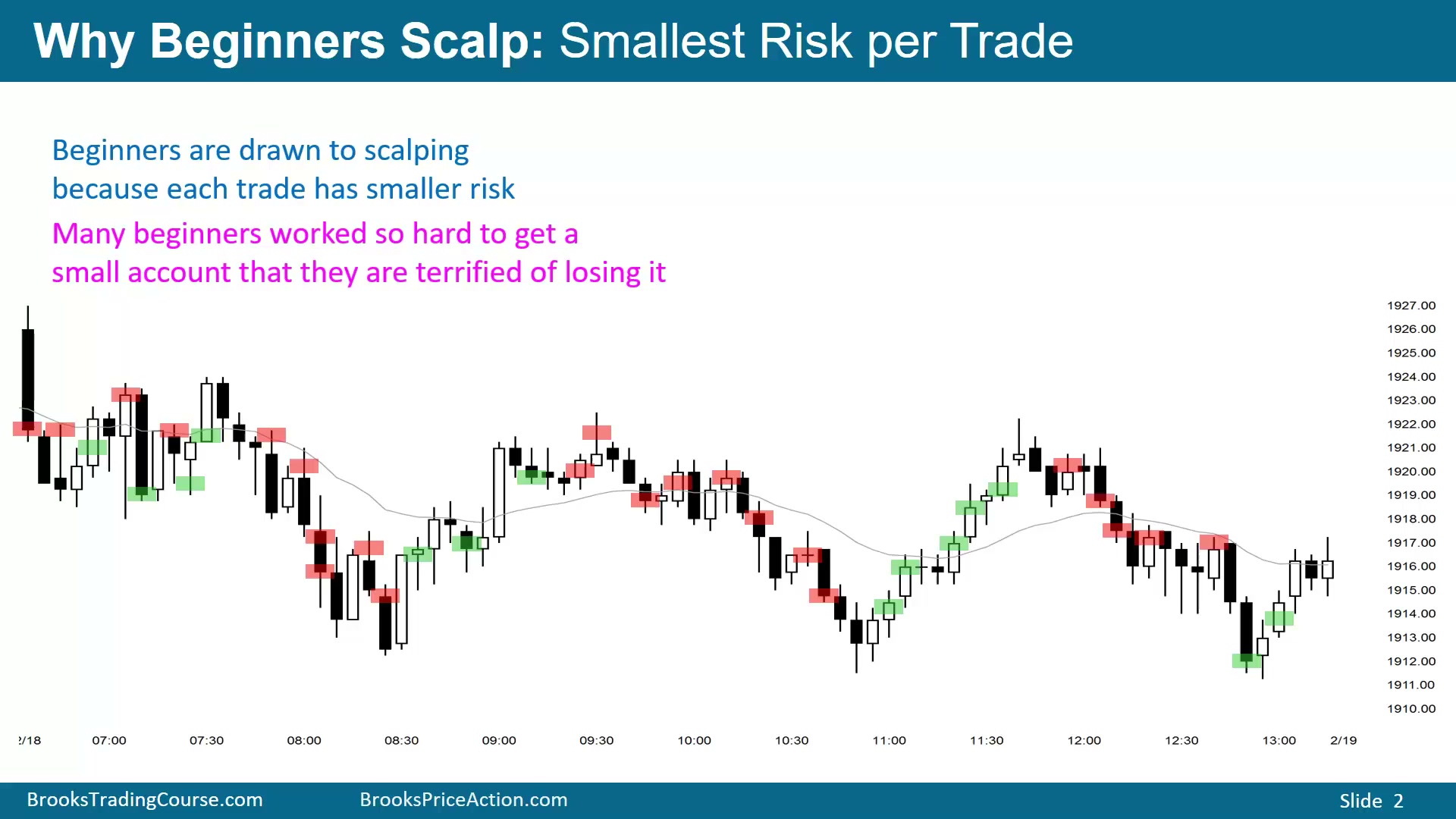
EN: It’s because it’s the smallest risk per trade.

00:44 - 00:46

EN: They focus on risk.

00:46 - 00:49

EN: They work very hard to get an account that allows them to trade,

00:49 - 00:53

EN: hoping to become a profitable trader, hoping for a career change,

00:53 - 00:56

EN: and they want to consistently make money.

00:56 - 00:57

EN: They want to make a lot of money.

00:58 - 01:01

EN: However, they usually start with a small account,

01:01 - 01:03

EN: and they had to work very hard to get that account,

01:03 - 01:07

EN: and then there are also family pressures – your spouse, your kids.

01:07 - 01:11

EN: You have to take care of them and you have to be very protective of the money.

01:11 - 01:14

EN: You don’t want to lose a lot of money quickly.

01:15 - 01:19

EN: As a result, beginners naturally focus on risk.

01:20 - 01:23

EN: That’s a problem because there are three variables

01:23 - 01:26

EN: that they have to consider: risk, reward, and probability.

01:27 - 01:29

EN: Whenever a trader structures a trade,

01:29 - 01:33

EN: he has to make sure the combination of three variables makes sense.

01:34 - 01:37

EN: He has to make sure that the Trader’s Equation is positive.

01:37 - 01:42

EN: That means that the probability of winning times the expected reward

01:42 - 01:44

EN: has to be significantly greater than the probability

01:44 - 01:46

EN: of losing times the expected risk.

01:47 - 01:51

EN: But you hear in that equation three variables: probability, risk, and reward.

01:52 - 01:56

EN: The problem that beginners have is they focus on risk.

01:56 - 02:00

EN: They should be focusing on risk/reward ratios compared to probability.

02:02 - 02:03

EN: These are all reasonable scalps.

02:03 - 02:07

EN: Every red rectangle is an entry price for a short.

02:07 - 02:10

EN: Every green rectangle is a reasonable scalp buy.

02:11 - 02:12

EN: This is the Emini chart.

02:12 - 02:15

EN: Minimum scalp size, 1 point.

02:16 - 02:20

EN: You can look at some of these bars and say, why would anyone ever buy this close?

02:21 - 02:24

EN: We have consecutive bear bars, trying to break out below a Trading Range.

02:25 - 02:27

EN: The reason why traders buy that close

02:27 - 02:30

EN: is the bears need 1 or 2 more bars to take control.

02:31 - 02:33

EN: They have not clearly broken below the range,

02:33 - 02:35

EN: and they do not have a follow-through bar yet.

02:36 - 02:40

EN: As a result, bulls buy the close betting that the bears will fail,

02:40 - 02:43

EN: knowing that most Trading Range breakouts fail.

02:48 - 02:50

EN: Beginners spend too much time worrying about risk,

02:51 - 02:53

EN: and if you only look at one variable,

02:53 - 02:57

EN: you’re going to ignore the other two variables, reward and probability,

02:57 - 03:02

EN: and you’ll lose money because every trade has to have all three lined up

03:02 - 03:04

EN: in a way that makes sense mathematically.

03:08 - 03:11

EN: Beginners, they’re just very afraid of losing their dream.

03:11 - 03:14

EN: It’s the death of their dream if they lose their account

03:14 - 03:19

EN: - or if the account falls to a level that is too small to meet margin requirements.

03:19 - 03:21

EN: That’s called a blown account.

Slide 003

Time: 03:25

Slide 003

Bilingual Transcript

03:26 - 03:29

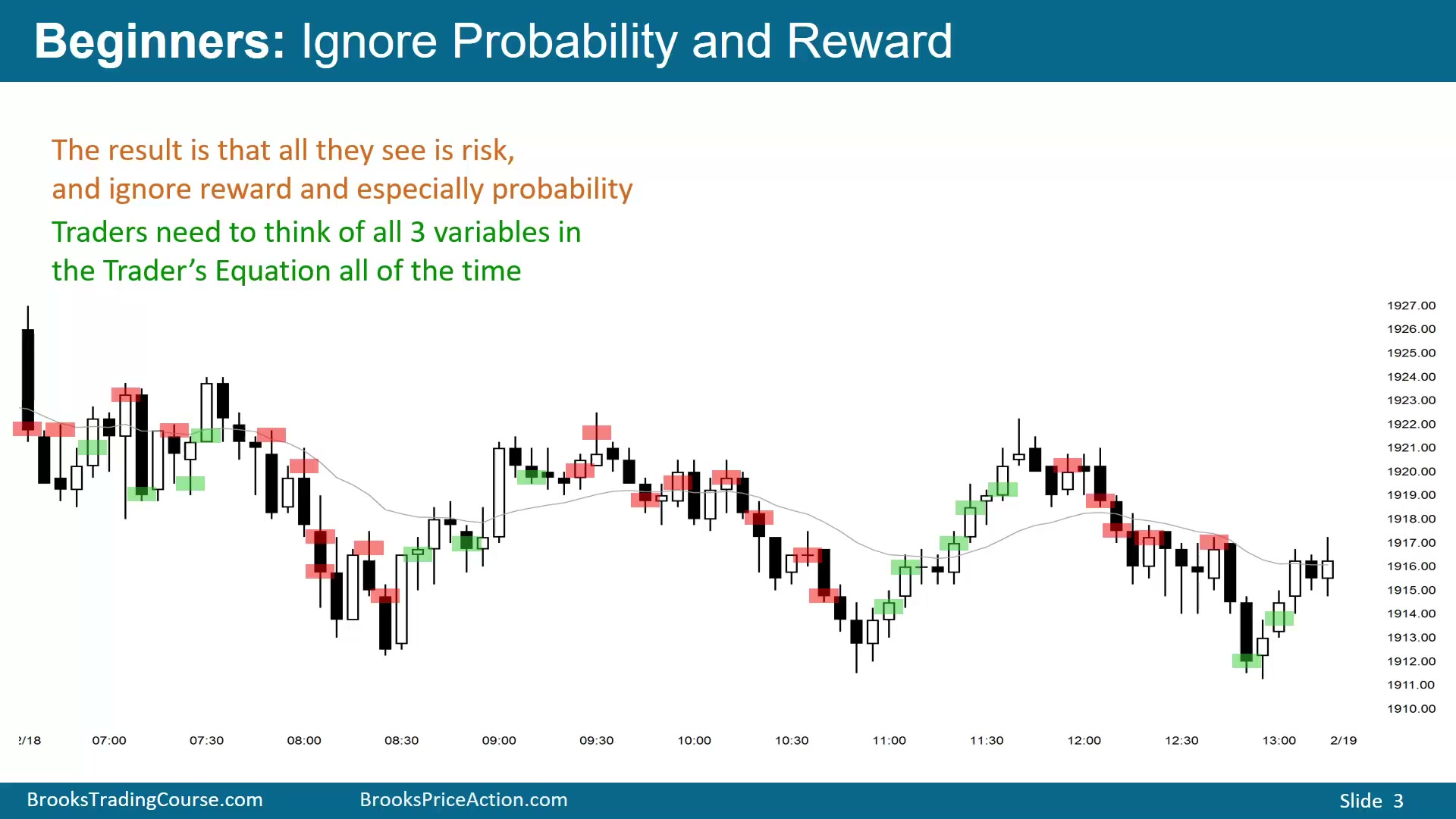
EN: Consequently, beginners only look at risk, as I said,

03:29 - 03:33

EN: and they ignore reward, and they especially ignore probability.

Slide 004

Time: 03:45

Slide 004

Bilingual Transcript

03:46 - 03:48

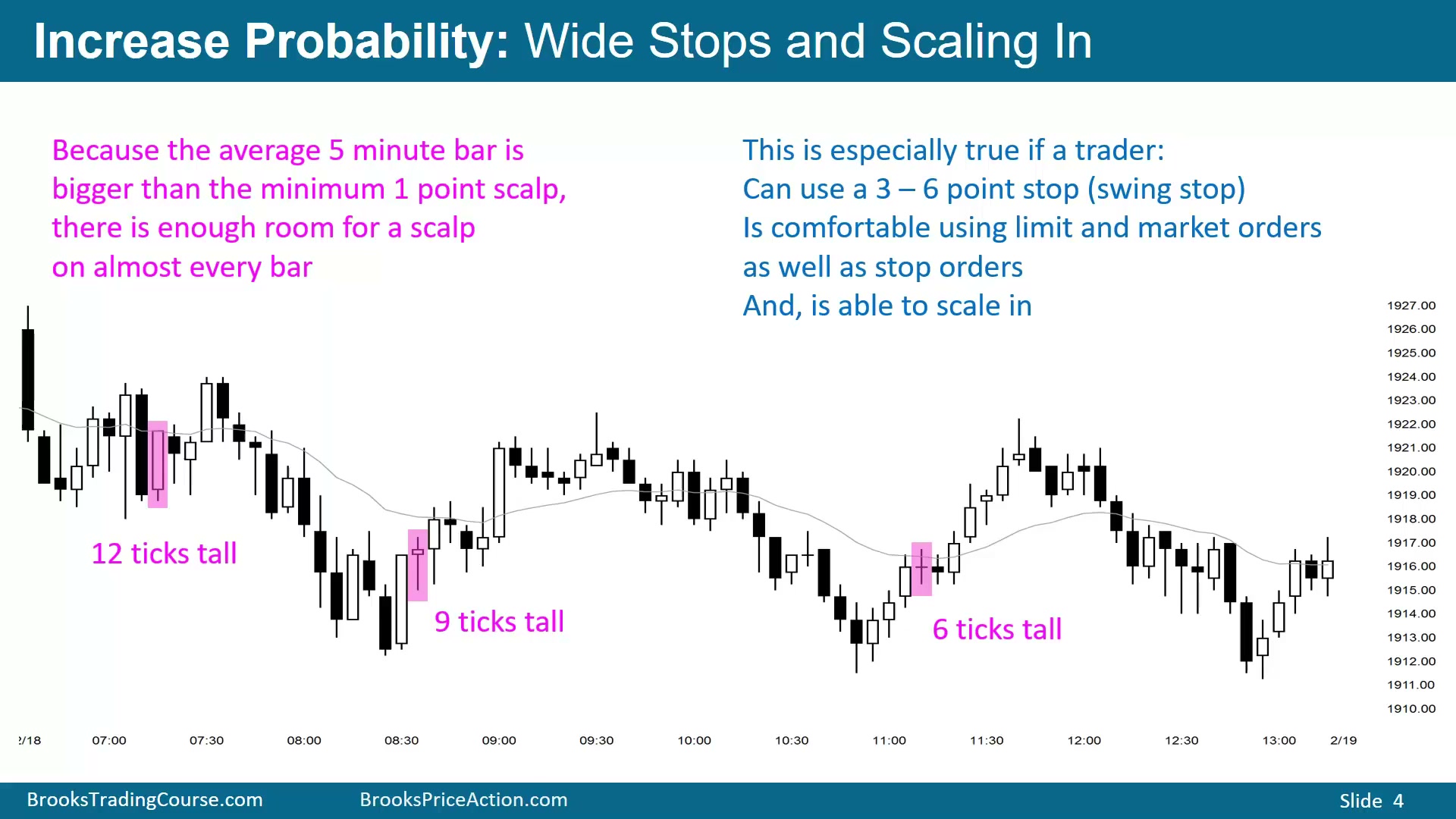
EN: An average 5-minute Emini chart,

03:49 - 03:53

EN: the average bar is bigger than a minimum scalp size.

03:53 - 03:55

EN: Minimum scalp size, 1 point.

03:55 - 03:58

EN: That means there’s enough room for a scalp on almost every bar,

03:59 - 04:04

EN: and a really experienced trader can see potential entries on every bar.

04:04 - 04:06

EN: That does not mean he takes every entry,

04:06 - 04:08

EN: but it means he sees lots of opportunities.

04:08 - 04:12

EN: He only has a matter of minutes, sometimes seconds, to process risk, reward,

04:12 - 04:18

EN: and probability, and if he feels like he’s not satisfied with his conclusion,

04:18 - 04:19

EN: he does not take the trade.

04:19 - 04:23

EN: 81 bars per day (5-minute chart, Emini).

04:23 - 04:26

EN: At least 40 reasonable 1-point scalps.

04:26 - 04:31

EN: Most experienced scalpers take between 10 and 20 scalps a day.

04:34 - 04:37

EN: These are average looking bars in this area.

04:37 - 04:40

EN: This is 12 ticks tall, maybe a little bit bigger than average.

04:40 - 04:43

EN: Here, an average height bar, 9 ticks tall.

04:43 - 04:46

EN: And this bar, one of the smallest bars on the screen,

04:46 - 04:50

EN: is still 6 ticks tall, which is 50% bigger than a minimum scalp.

04:50 - 04:52

EN: 4 ticks, 1 point.

04:52 - 04:56

EN: Even a small bar like this has opportunities for scalpers.

04:56 - 04:59

EN: For example, after 3 consecutive bull bars,

04:59 - 05:02

EN: reversal up from the bottom of a range, they’ll buy the close,

05:02 - 05:04

EN: and they’ll try to buy more at the low of the bar.

05:04 - 05:06

EN: They did not get filled.

05:06 - 05:08

EN: The market tried to get there once,

05:08 - 05:11

EN: tried to reverse down twice, failed twice, and reversed up.

05:11 - 05:14

EN: The bull scalper will then take his profit somewhere up in here.

05:23 - 05:28

EN: It’s very difficult to win 90% of the trades unless you are willing

05:28 - 05:31

EN: to use wide stops and scale into your position.

05:31 - 05:35

EN: Even then, it’s difficult to do, but most skilled scalpers

05:35 - 05:39

EN: are willing to scale into a position, and a lot of them will use wide stops.

05:40 - 05:44

EN: By doing that, they’re increasing their risk – the stop is further away.

05:44 - 05:48

EN: They’re increasing their position size, which increases their risk as well.

05:48 - 05:50

EN: Their reward is fixed.

05:50 - 05:51

EN: They’re looking for a scalp.

05:51 - 05:53

EN: In the Emini, 1, 2, 3 points.

05:53 - 05:58

EN: But what they’re doing is in exchange for accepting more risk,

05:58 - 06:01

EN: they’re getting a much higher probability of success.

06:03 - 06:06

EN: Remember, probability is the flipside of risk/reward.

06:07 - 06:11

EN: You cannot have a great risk/reward trade with a very high probability of success.

06:12 - 06:15

EN: There has to be an institution willing to take the other side of your trade,

06:16 - 06:19

EN: and that means constantly there’s always a problem

06:19 - 06:21

EN: with either probability or risk or reward.

06:21 - 06:23

EN: If you’re trying to get higher probability,

06:23 - 06:27

EN: you have to pay for it with a worse risk/reward ratio.

06:27 - 06:32

EN: The institution taking the opposite side of your trade has to get something

06:32 - 06:34

EN: in return for giving you higher probability.

Slide 005

Time: 06:40

Slide 005

Bilingual Transcript

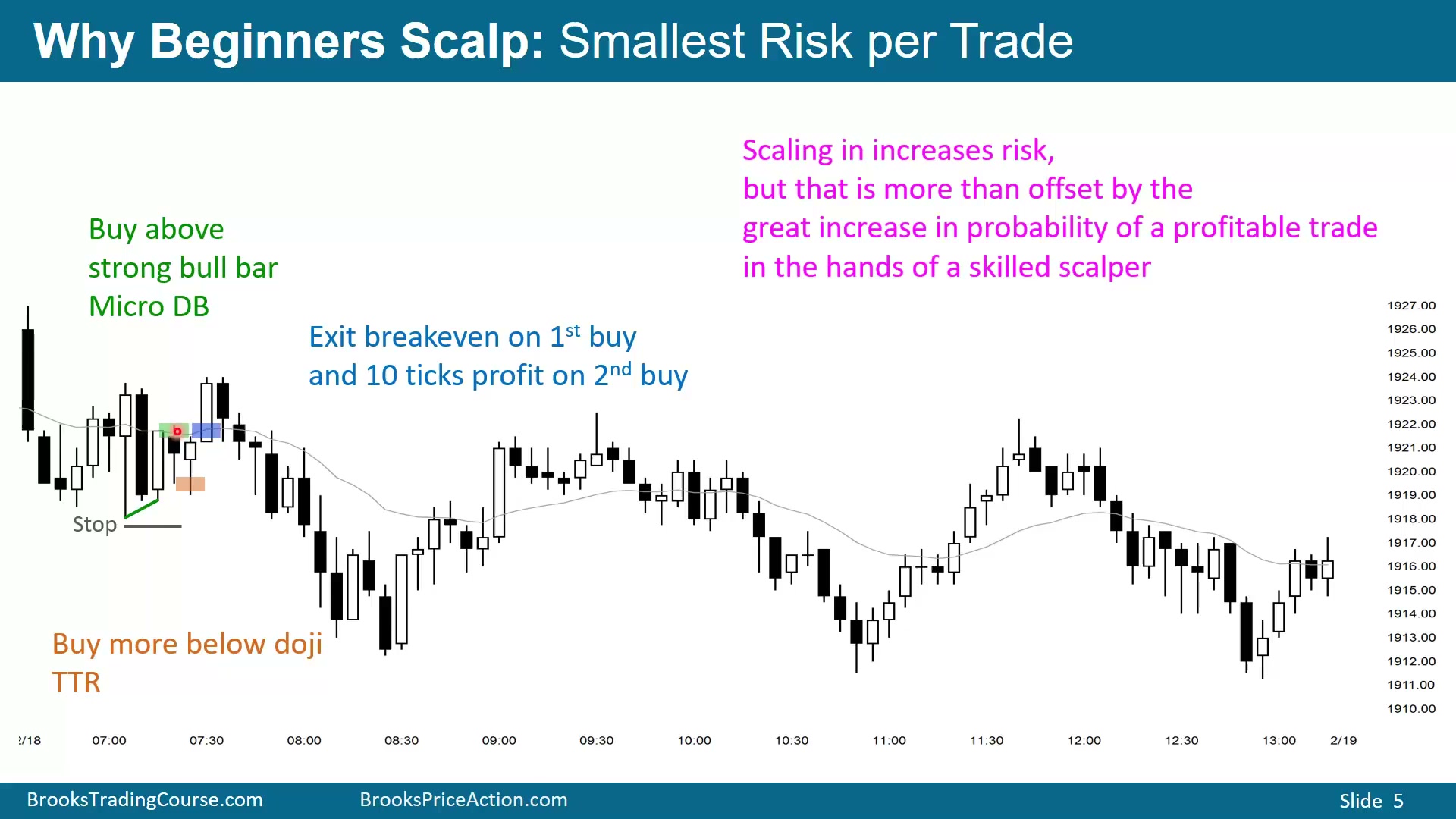
06:42 - 06:44

EN: When a trader scales in, he increases his risk,

06:45 - 06:48

EN: but he also increases the probability of making money,

06:48 - 06:52

EN: and that’s the main reason why skilled traders often scale in.

06:52 - 06:56

EN: They’ll use wide stops and scale in to increase their probability of success.

06:56 - 06:58

EN: The market’s in a Trading Range here.

06:58 - 07:02

EN: On any chart, in general 90% of the bars are either

07:02 - 07:04

EN: in a Trading Range or in a channel.

07:05 - 07:10

EN: When that’s the case, a trader can make money buying or selling at any time,

07:10 - 07:13

EN: as long as he manages his trade properly.

07:17 - 07:21

EN: For example, the market is in a tight range, reversing repeatedly in here.

07:21 - 07:26

EN: The bulls have a pretty good bull bar here, and a second good bull bar here.

07:26 - 07:28

EN: Trying to reverse up from the bottom of a range.

07:28 - 07:30

EN: It’s reasonable for a trader to buy

07:30 - 07:35

EN: on a stop just above the high of this bar, looking for a scalp.

07:35 - 07:38

EN: But he has to use a stop below the bottom of the range.

07:38 - 07:40

EN: The market reversed up, reversed up again.

07:40 - 07:44

EN: Now has a Micro Double Bottom in addition to this Double Bottom.

07:44 - 07:48

EN: It’s reasonable to buy here if a trader can put his stop down here,

07:49 - 07:50

EN: just below the bottom of the range.

07:50 - 07:51

EN: Here’s the stop.

07:56 - 08:01

EN: Many skilled traders will look to buy more 1 or 2 points lower,

08:01 - 08:04

EN: expecting that the reversal down will fail.

08:05 - 08:07

EN: Think about it from the perspective of a bear.

08:07 - 08:10

EN: Does he really want to sell below the low of this bear bar?

08:10 - 08:12

EN: He’s selling at the bottom of a Tight Trading Range,

08:12 - 08:15

EN: where the market reversed up, up, up.

08:15 - 08:18

EN: Probably going to reverse up again, especially given

08:18 - 08:21

EN: that this bear bar has a very big tail.

08:21 - 08:23

EN: It’s a bad looking sell setup,

08:23 - 08:26

EN: and therefore it’s probably a decent looking buy setup.

08:27 - 08:28

EN: Experienced traders know that,

08:28 - 08:32

EN: and if they bought on a stop above the high of this bar,

08:32 - 08:37

EN: they might buy more at the low of this bar, scaling into the trade.

08:42 - 08:46

EN: If a bull did that, he would try to exit breakeven

08:46 - 08:49

EN: if the market gets back to his original entry price,

08:49 - 08:54

EN: and then he’ll end up with a 10 tick scalp on his second entry.

08:56 - 08:59

EN: He buys here, just above this bull bar.

08:59 - 09:02

EN: Buys more at the low of this bar, which is 10 ticks lower,

09:02 - 09:04

EN: and then when it gets back above the high of this bar,

09:04 - 09:06

EN: he gets out breakeven on his first entry

09:06 - 09:09

EN: and then with 10 ticks profit on his second buy.

09:14 - 09:17

EN: I want to talk a little bit about trading on two timeframes.

Slide 006

Time: 09:15

Slide 006

Bilingual Transcript

09:18 - 09:21

EN: Some traders like to find setups on one timeframe

09:21 - 09:24

EN: and then entries on a smaller timeframe,

09:24 - 09:29

EN: hoping to get in as early as possible, thereby reducing risk.

09:29 - 09:32

EN: For example, some traders will look at a 60-minute chart,

09:32 - 09:34

EN: and then when they think they have a setup,

09:34 - 09:38

EN: they’ll look at a 5-minute chart to see if they can enter with smaller risk.

09:38 - 09:43

EN: Likewise, a trader looking for patterns on a 5-minute chart might try to enter

09:43 - 09:48

EN: on a smaller chart, like a 3-minute chart, a 2-minute chart, or a 1-minute chart.

09:48 - 09:53

EN: In general, most skilled traders trading on the 5-minute chart

09:53 - 09:56

EN: will rarely ever use a 1-minute chart for entries.

09:56 - 09:59

EN: Maybe 10% of the time or less.

Slide 007

Time: 10:00

Slide 007

Bilingual Transcript

10:02 - 10:05

EN: I talked about this buy setup where traders buy that high,

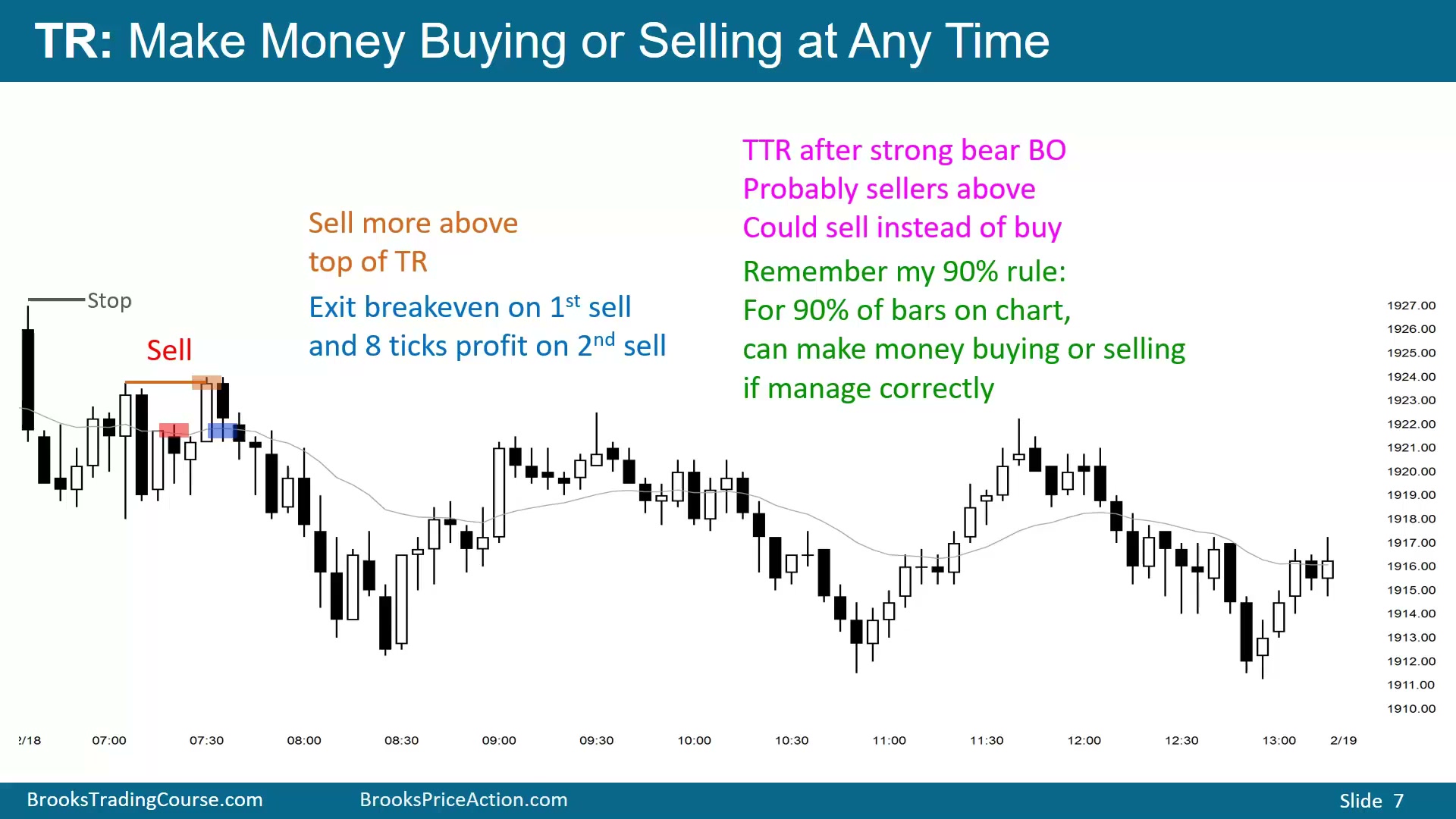
10:05 - 10:07

EN: scale in more, and exit.

10:08 - 10:11

EN: But I also said that a trader could sell there as well,

10:11 - 10:14

EN: and if he manages his trade correctly, he would make money.

10:20 - 10:23

EN: It’s a Tight Trading Range, and therefore if a trader sells

10:23 - 10:28

EN: and sells more higher using a wide stop, he probably will make money.

10:32 - 10:35

EN: Let’s say he places a limit order to sell at the high of that bar.

10:35 - 10:36

EN: He’ll get filled here.

10:36 - 10:38

EN: It fell more than 2 points.

10:38 - 10:40

EN: He could’ve scalped out.

10:41 - 10:43

EN: Let’s say for some reason he did not exit.

10:43 - 10:48

EN: Let’s say maybe he was hoping for a swing down, and then we got the reversal here.

10:48 - 10:50

EN: He then would conclude that instead of a swing down,

10:50 - 10:54

EN: it’s in a Trading Range, and he’s going to switch to scalping mode.

10:57 - 11:00

EN: No matter what he’s doing, if he’s taking this short his stop belongs

11:00 - 11:02

EN: above the top of the most recent selloff.

11:02 - 11:03

EN: Strong selloff.

11:03 - 11:06

EN: 3 consecutive bear bars, 2 of them pretty big.

11:12 - 11:15

EN: And then he gets disappointed by this reversal up.

11:15 - 11:18

EN: He might decide that instead of a swing down,

11:18 - 11:21

EN: it’s going to stay in a Tight Trading Range instead.

11:21 - 11:23

EN: He’ll then look to scale into his shorts

11:24 - 11:28

EN: - for example, sell at the prior high using that original stop.

11:29 - 11:34

EN: So he sells here at the high of this bar and then sells more at this high

11:34 - 11:37

EN: as long as it’s at least the size of a scalp higher.

11:37 - 11:41

EN: In this particular case, it’s 8 ticks higher, so it’s 2 points higher,

11:42 - 11:44

EN: and that’s twice as big as a minimum scalp.

11:44 - 11:46

EN: 8 ticks is 2 points.

11:52 - 11:55

EN: When the market comes back to his original entry price,

11:55 - 11:57

EN: he can exit breakeven at his first sell

11:57 - 12:00

EN: and then with a 2 point profit on his second sell.

12:01 - 12:03

EN: Remember my 90% rule.

12:03 - 12:08

EN: 90% of the bars on a chart are in Trading Ranges or channels,

12:08 - 12:11

EN: and a skilled trader can make money buying or selling

12:11 - 12:13

EN: if he manages his trade correctly

12:13 - 12:16

EN: - which usually means scaling in and using a wide stop.

Slide 008

Time: 12:18

Slide 008

Bilingual Transcript

12:20 - 12:23

EN: Here’s a 5-minute chart and a 1-minute chart.

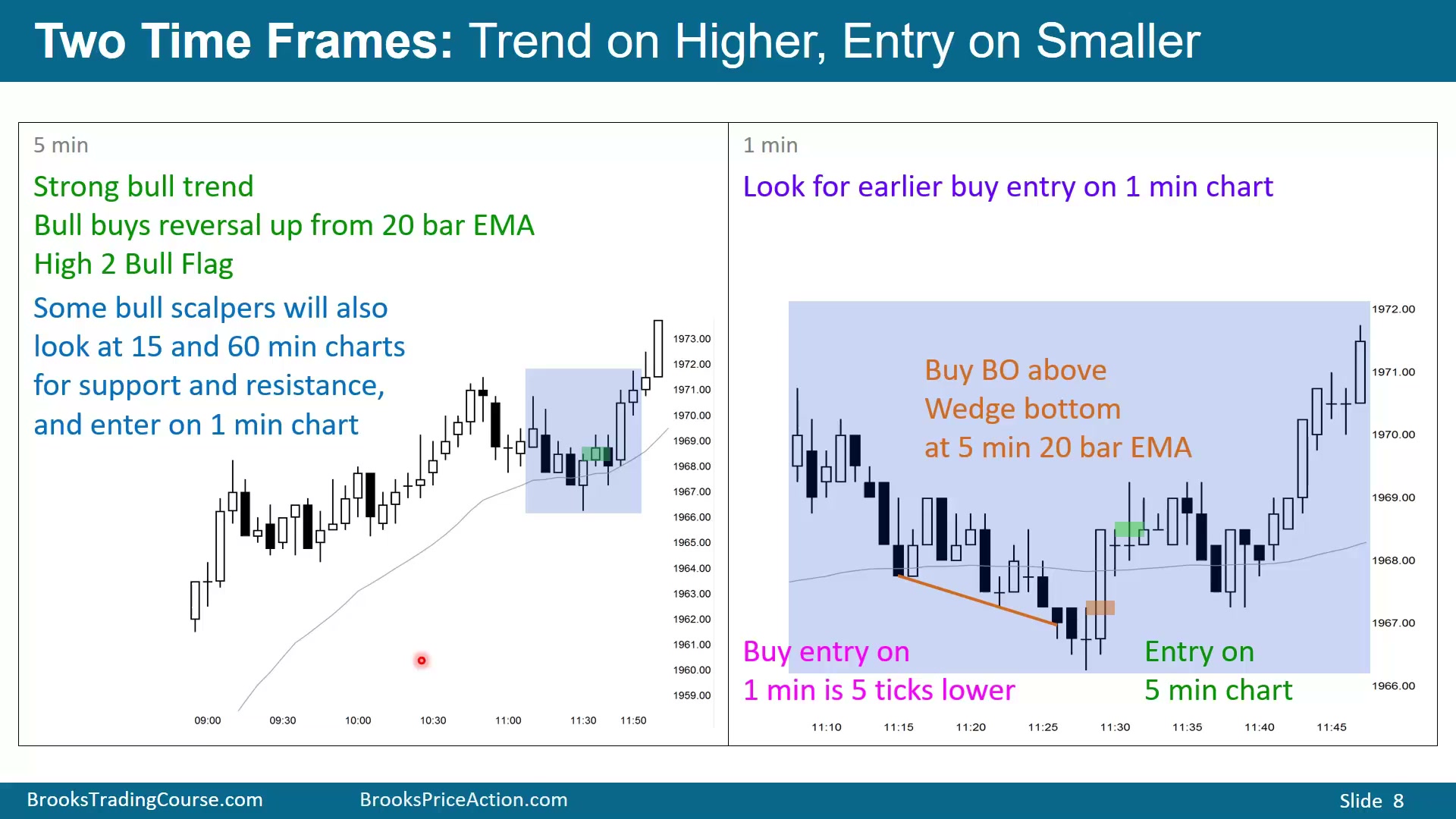
12:24 - 12:26

EN: This blue area is right here.

12:26 - 12:29

EN: This is the entire blue area right there.

12:29 - 12:30

EN: This is the 1-minute chart.

12:30 - 12:34

EN: A lot of traders will look for a trend on one timeframe

12:35 - 12:38

EN: and then look for an entry on a smaller timeframe,

12:38 - 12:41

EN: hoping to get in earlier (reduce risk).

12:46 - 12:49

EN: For example, we have two legs down – one, pullback, two.

12:49 - 12:52

EN: Arguably three pushes down – one and then up

12:52 - 12:55

EN: and then two and then up and then three and then up.

12:56 - 12:57

EN: It’s reasonable to buy this.

12:57 - 12:59

EN: It’s about a 50% pullback.

12:59 - 13:01

EN: We have a spike, pullback, channel.

13:01 - 13:03

EN: It’s a pullback to a slightly Higher Low.

13:03 - 13:06

EN: We had about 7 or 8 bars up without a bear body,

13:06 - 13:08

EN: and we’re pulling back to the Moving Average,

13:08 - 13:11

EN: plus there’s a very good-looking bull bar.

13:12 - 13:15

EN: It’s reasonable to buy on a stop just above the high of this bar,

13:15 - 13:18

EN: and you get filled right here, 1 tick above the high of that bar,

13:19 - 13:20

EN: looking for trend resumption up.

13:25 - 13:29

EN: Most traders look at this as a pullback and not the start of a bear trend,

13:29 - 13:32

EN: and a pullback means you expect trend resumption up.

13:32 - 13:36

EN: You expect it to become a bull flag, and therefore some traders

13:36 - 13:39

EN: will look for as early an entry as they possibly can get.

13:44 - 13:49

EN: For example, if a trader, instead of placing an entry based on the 5-minute chart,

13:49 - 13:55

EN: zoomed in and looked at the 1-minute chart, this area here is this area here.

13:55 - 13:59

EN: He’d see a spike, pullback, second push, pullback,

13:59 - 14:01

EN: third push, and then a reversal attempt.

14:01 - 14:04

EN: He would buy above the high of that 1-minute bar,

14:04 - 14:07

EN: and he’d get filled somewhere down here instead of up here.

14:10 - 14:12

EN: This is the entry on the 5-minute chart.

14:12 - 14:14

EN: That green box is right here.

14:18 - 14:22

EN: And a trader using the 1-minute chart would enter 5 ticks lower.

14:29 - 14:31

EN: The same is true with higher timeframe charts as well.

14:32 - 14:36

EN: Some bull scalpers will look at 15- or 60-minute charts for setups.

14:36 - 14:38

EN: They look for support and resistance,

14:38 - 14:41

EN: and then enter on a 1-minute chart or a 5-minute chart.

14:41 - 14:46

EN: In general, I think traders should not be entering on a 1-minute chart.

14:46 - 14:49

EN: I think it’s perfectly reasonable to look for a pattern,

14:49 - 14:52

EN: a test of support or resistance, on a 60-minute chart,

14:52 - 14:54

EN: and then entering on a 5-minute chart.

14:54 - 14:58

EN: I think it’s much harder to be trading on a 5-minute chart,

14:58 - 15:02

EN: looking for patterns on a 5-minute chart, and then entering on the 1-minute chart.

15:02 - 15:05

EN: You don’t have much time to make decisions, and you’ll make too many mistakes,

15:05 - 15:08

EN: and you’ll find yourself only looking at the 1-minute chart

15:08 - 15:11

EN: and not paying enough attention to the 5-minute chart.

15:13 - 15:16

EN: Therefore, most traders should not be doing this

15:16 - 15:19

EN: with a 1-minute chart except in rare circumstances.

15:28 - 15:31

EN: Remember, the trader on the 1-minute chart is trying to reduce his risk.

15:32 - 15:35

EN: If he buys above the high of this bar, he gets filled here.

15:35 - 15:36

EN: His stop is a little bit below.

15:36 - 15:41

EN: If he buys on the 5-minute chart, his entry is here and his stop is further below.

15:43 - 15:46

EN: Whenever you do something to improve your risk/reward ratio,

15:46 - 15:49

EN: you pay for it with reduced probability.

15:50 - 15:54

EN: The 1-minute chart, it’s a less reliable chart.

15:54 - 15:59

EN: The probability of trading it well and the probability of setups working is lower.

Slide 009

Time: 15:55

Slide 009

Bilingual Transcript

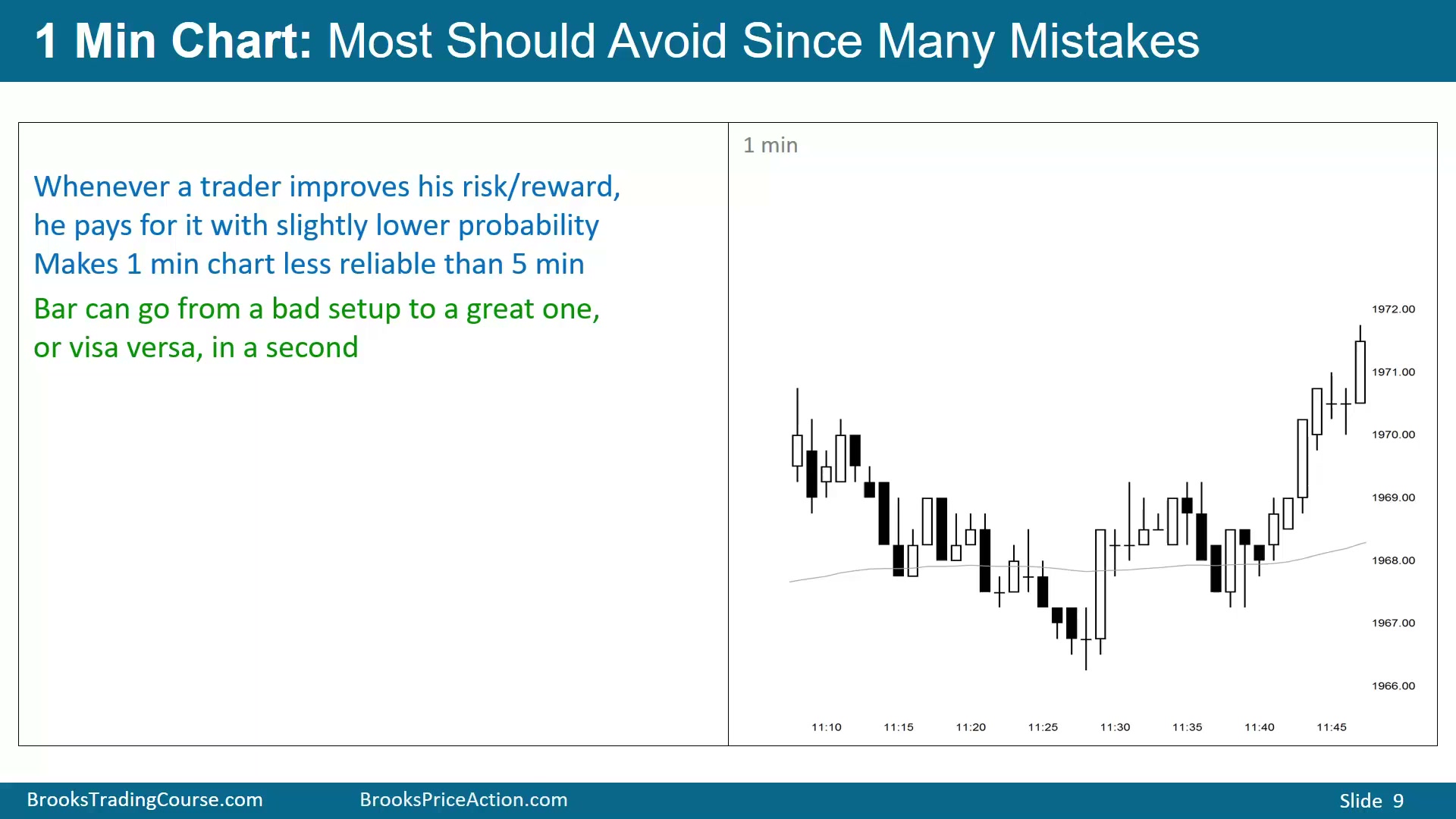
15:59 - 16:03

EN: For example, here, if you buy above the high of this bar on the 1-minute chart,

16:03 - 16:06

EN: you’re buying after 5 bars without a bull body,

16:06 - 16:09

EN: and 3 of the bars are bear bars, 2 closing on their lows.

16:09 - 16:12

EN: This is not a strong buy setup on the 1-minute chart,

16:12 - 16:19

EN: even though it’s a Wedge – one, two, three or one, two, three.

16:19 - 16:21

EN: This is not a high probability buy.

16:27 - 16:28

EN: Another problem is time.

16:29 - 16:32

EN: On a 1-minute chart you could have a great looking setup become

16:32 - 16:35

EN: a very bad looking setup in a second or less than a second.

16:36 - 16:37

EN: Or the opposite can happen.

16:37 - 16:40

EN: You can have a terrible looking setup become a very great setup

16:40 - 16:44

EN: in a second or less, before you have time to act on it.

16:47 - 16:50

EN: Also, if you’re trading really well, if you’re a good trader,

Slide 010

Time: 16:50

Slide 010

Bilingual Transcript

16:50 - 16:53

EN: you’re not going to make significantly more money

16:53 - 16:56

EN: by going down to a 1- or 2-minute chart.

16:56 - 17:00

EN: If you’re trading well, you can make a lot of money on a 5-minute chart.

17:06 - 17:10

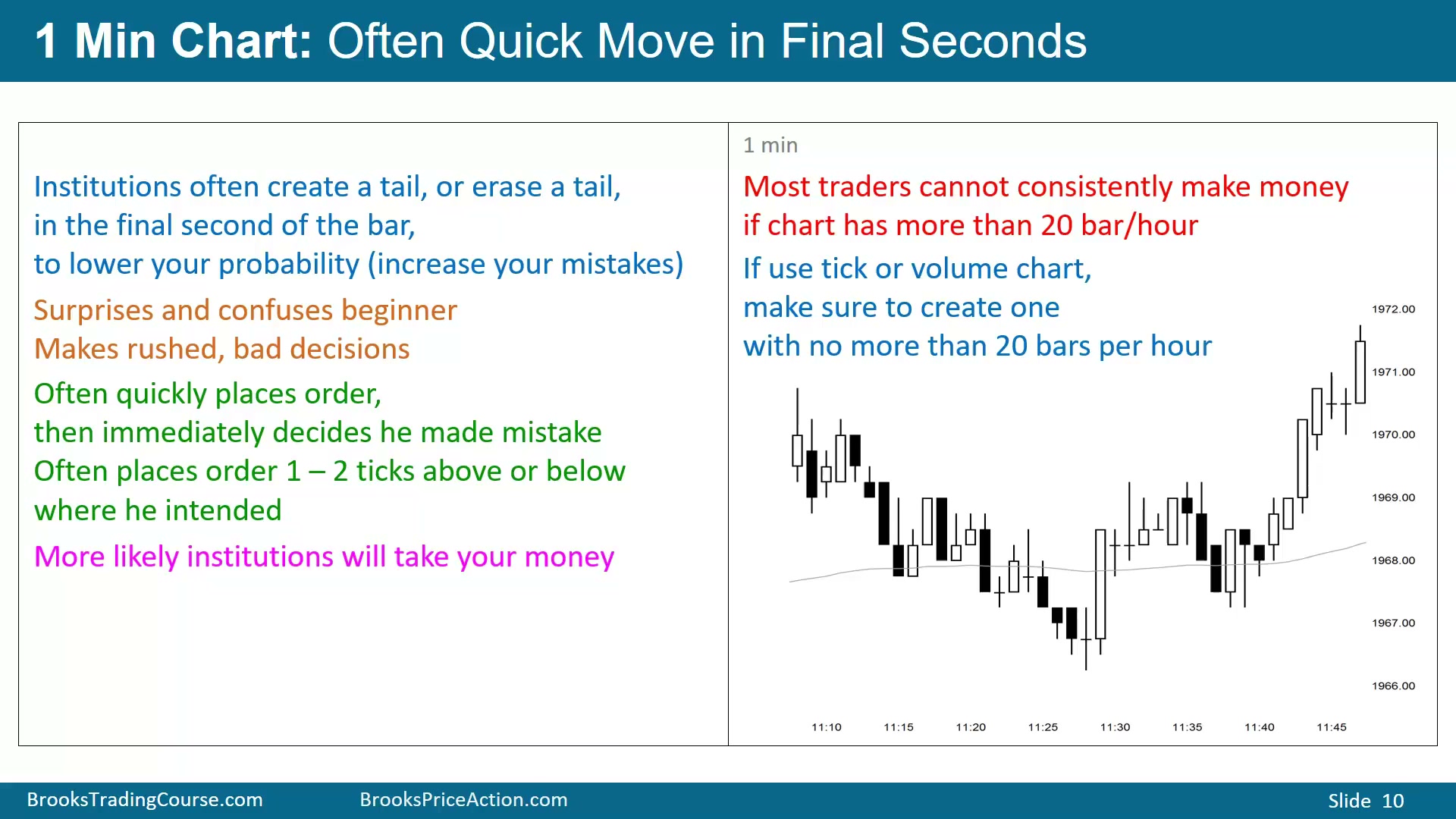
EN: Very often at the very final second or two of a chart

17:10 - 17:15

EN: - a 1-minute chart, for example – the institutions can quickly create a tail,

17:15 - 17:17

EN: a reversal, or erase a tail.

17:17 - 17:22

EN: You had a reversal and then it becomes a trend bar in the final second of the bar.

17:22 - 17:23

EN: For example, look at this bar.

17:23 - 17:25

EN: It’s a strong bear bar closing on its low.

17:25 - 17:29

EN: We don’t know for a fact, but it might’ve been a bull bar

17:29 - 17:33

EN: with a 1 tick bull body and a big tail below until the final half-second,

17:33 - 17:35

EN: and then it did that in the final half-second.

17:35 - 17:39

EN: That does not give you much time to think about what to do next.

17:44 - 17:46

EN: If you’re a beginner, you’re not accustomed

17:46 - 17:49

EN: to thinking of the exact opposite within a second.

17:50 - 17:52

EN: You’re looking to buy and all of a sudden it becomes a sell,

17:52 - 17:55

EN: or you’re looking to sell and all of a sudden it becomes a buy,

17:55 - 18:00

EN: and you end up making decisions without giving the decision enough thought.

18:01 - 18:04

EN: You end up making too many bad decisions and you lose money.

18:05 - 18:09

EN: There’s just not enough time for most traders to make good decisions,

18:09 - 18:11

EN: and then physically to place orders.

18:11 - 18:14

EN: You have to place your order, you’ve got to place a stop,

18:14 - 18:15

EN: you’ve got to place a bracket order.

18:15 - 18:19

EN: You’ve got to make sure you do it correctly, and there’s just not enough time.

18:27 - 18:31

EN: Another common problem with 1-minute charts is you quickly decide

18:31 - 18:33

EN: that you’re going to buy or you’re quickly going to sell,

18:33 - 18:38

EN: and you’re so eager to get in just for that instant that you enter at the market,

18:38 - 18:44

EN: and the order gets filled 1 or 2 ticks above or below where you wanted it

18:44 - 18:48

EN: to get filled, and that means that if you think the profit target

18:49 - 18:53

EN: was based upon your original entry price and you got filled a tick or two worse,

18:53 - 18:56

EN: all of a sudden you’re getting less reward and increased risk.

18:57 - 18:59

EN: The math becomes bad.

19:03 - 19:07

EN: Whenever the math is bad, institutions are going to take your money.

19:07 - 19:08

EN: You’re going to lose money.

19:13 - 19:17

EN: One guideline that I use is traders should not be trading on any chart

19:17 - 19:20

EN: that has more than 20 bars per hour.

19:20 - 19:24

EN: So for example, if you’re trading on a time chart, that’s a 3-minute chart.

19:24 - 19:27

EN: A 3-minute chart has 20 bars per hour.

19:27 - 19:30

EN: So I think most traders should not be trading charts

19:30 - 19:33

EN: less than 3 minutes, 3-minute charts.

19:33 - 19:37

EN: Then the same is true if you’re trading on charts based upon ticks or volume.

19:38 - 19:41

EN: I think you should not be trading any chart

19:41 - 19:43

EN: where you have more than 20 bars per hour.

19:49 - 19:52

EN: Very often, at the beginning of the day – let’s say you’re trading the Emini

19:52 - 19:56

EN: and you’re using a chart that has 5,000 ticks per bar.

19:56 - 20:02

EN: Early in the day, 5,000 ticks per bar might be 30 or 40 bars per hour.

20:02 - 20:07

EN: I think that is too many bars, and I think you should not be trading that.

20:07 - 20:11

EN: Later in the day, from maybe 9:00 to 10:00 or 11:00,

20:11 - 20:14

EN: 5,000 ticks per bar could be fine.

20:14 - 20:16

EN: You may only get 10 bars per hour.

20:16 - 20:20

EN: That’s another problem with using charts that are based upon ticks or volume;

20:21 - 20:23

EN: the number of bars per hour fluctuates a lot,

20:23 - 20:27

EN: and I personally like to be thinking about time.

20:27 - 20:29

EN: I think all the time about time,

20:30 - 20:35

EN: and I don’t like the bars having a different time before they close.

20:35 - 20:37

EN: If you’re using a tick or volume chart,

20:37 - 20:40

EN: sometimes a bar will last a matter of seconds.

20:40 - 20:42

EN: Other times it’ll last 10 or 15 minutes.

20:42 - 20:46

EN: I like to know when a bar is about to close.

Slide 011

Time: 20:50

Slide 011

Bilingual Transcript

20:54 - 20:58

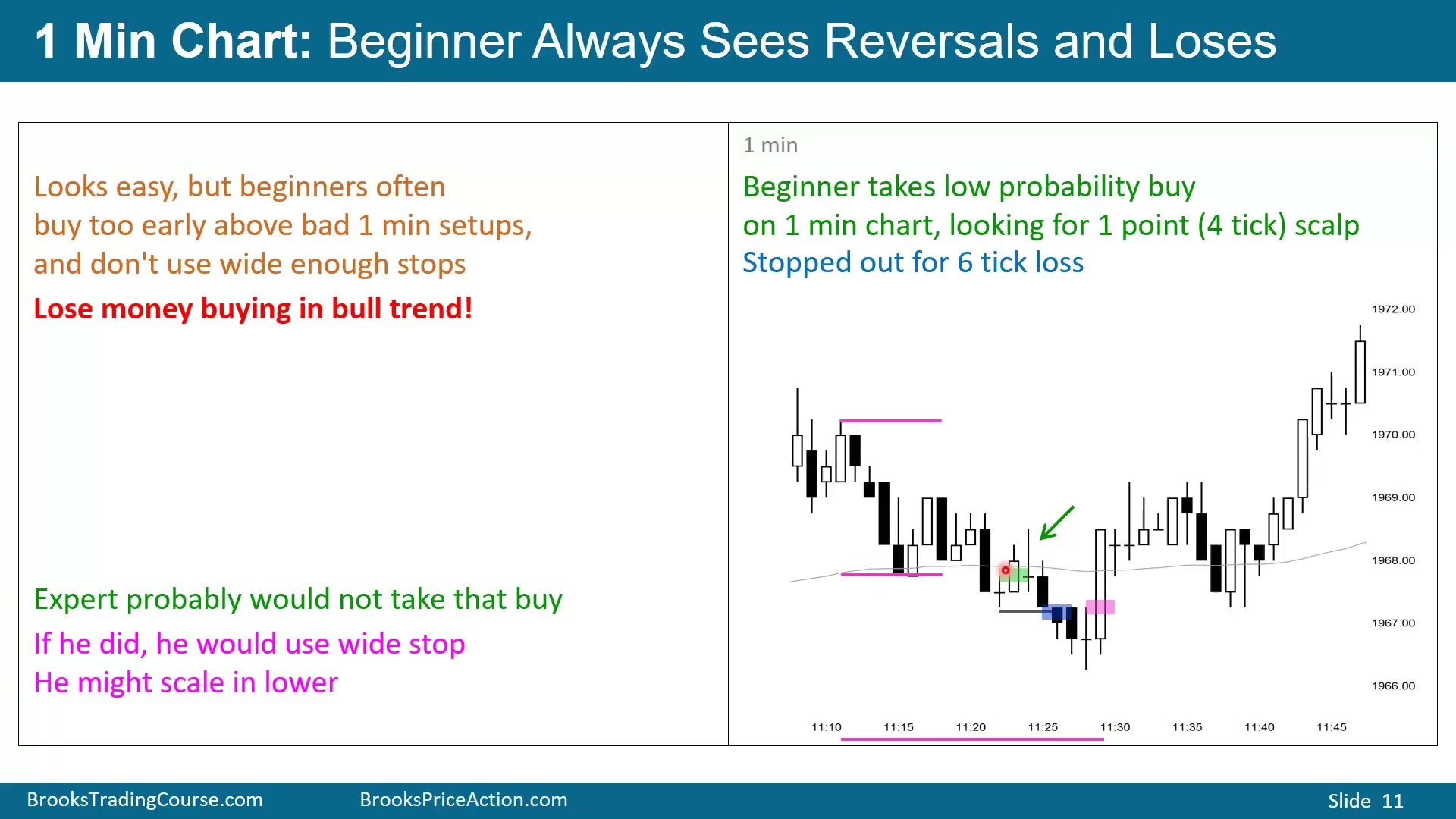
EN: When you look at the chart – this 1-minute chart of the Emini – it looks easy.

20:58 - 21:03

EN: But you often end up buying early, above bad signals.

21:03 - 21:06

EN: For example, you might buy above here for a High 2,

21:06 - 21:07

EN: and then you argue, oh, it’s a Wedge.

21:07 - 21:10

EN: Three pushes – one, two, three – and you quickly buy there,

21:10 - 21:12

EN: and you use too tight a stop.

21:12 - 21:14

EN: You get stopped out here instead of using a wider stop

21:14 - 21:16

EN: and looking to scale in lower.

21:18 - 21:20

EN: A lot of setups just don’t look good enough,

21:21 - 21:24

EN: and you have very little time to make up your mind,

21:24 - 21:27

EN: and a lot of times you’ll take the trade and not use a wide enough stop,

21:27 - 21:30

EN: and you get stopped out, and then the trade goes your way.

21:30 - 21:33

EN: That’s another common problem with 1-minute charts.

21:36 - 21:38

EN: You can end up losing money buying in a bull trend.

21:38 - 21:41

EN: For example, let’s say you buy above the high of this bar

21:41 - 21:44

EN: and then you got a bear bar, a bear bar closing on its low,

21:44 - 21:45

EN: another bear bar closing on its low.

21:45 - 21:47

EN: 3 consecutive bear bars.

21:47 - 21:51

EN: You may end up exiting, and it turned out to be a bull trend.

21:52 - 21:53

EN: The same with here.

21:53 - 21:56

EN: You can end up losing money selling in a bear trend.

21:56 - 22:00

EN: You sell below a Low 2 here, and then you get a reversal

22:00 - 22:03

EN: and you exit here or you exit here, above your entry price.

22:09 - 22:14

EN: Beginners have very little time to decide, and they see a Wedge – one, two, three.

22:14 - 22:14

EN: “I’ve got to buy.

22:14 - 22:16

EN: There’s a small ii.

22:16 - 22:21

EN: Maybe it’s an ii small Final Flag, Triangle – up, down, up, down, up

22:21 - 22:24

EN: - and maybe we’ll go up, a Wedge with a Triangle Final Flag.

22:24 - 22:30

EN: Maybe I’ll buy above that bar.” It’s just really too easy to make bad decisions,

22:30 - 22:33

EN: and you end up taking trades where the probability is too low,

22:33 - 22:36

EN: and you do not use a wide enough stop that would allow you

22:36 - 22:40

EN: to increase your probability, especially if you’re able to scale in.

22:44 - 22:48

EN: Let’s say you buy on a stop above this bar, you get stopped out below its low.

22:48 - 22:54

EN: You end up losing 5 or 6 ticks on that, even though the market ended up going up.

22:58 - 23:04

EN: Would an expert trader take this buy, arguing Wedge – one, two, three?

23:05 - 23:06

EN: Probably not.

23:06 - 23:10

EN: But again, even an expert trader does not have much time to make the decision.

23:10 - 23:15

EN: He would be ready to buy, but he would like to be buying above a bull bar,

23:15 - 23:18

EN: or he’d like to be buying at the close of a big bull bar

23:18 - 23:21

EN: or on the follow-through after a big bull bar.

23:22 - 23:26

EN: If he did buy this, he would probably use a 4 or a 5 point stop

23:26 - 23:28

EN: and look to scale in lower.

23:28 - 23:32

EN: Instead of getting stopped out below the signal bar,

23:32 - 23:35

EN: he might buy more below the signal bar or at the low of the signal bar,

23:35 - 23:39

EN: using a 3 or 4 point stop, betting that the bear breakout would fail.

23:41 - 23:44

EN: If he’s looking to buy on the 5-minute chart and he sees this

23:44 - 23:49

EN: as a probable bull flag, a bear leg in what will become a bull flag,

23:49 - 23:51

EN: he’s going to be willing to use a wider stop.

23:51 - 23:56

EN: Again, as you can tell, I’m recommending not using a 1-minute chart.

24:00 - 24:05

EN: An experienced trader who does look for the early entry on the 1-minute chart

24:05 - 24:08

EN: will use a wider stop – 4 points, 5 points, maybe 6 points,

24:08 - 24:10

EN: depending on the size of the day’s range

24:10 - 24:13

EN: - and he probably would be willing to scale in lower.

24:16 - 24:17

EN: How far a stop?

24:17 - 24:21

EN: Well, we have a reasonably good bear breakout here,

24:21 - 24:24

EN: so maybe use a stop just below the Measured Move down.

24:24 - 24:25

EN: Here’s the Measured Move down.

24:25 - 24:27

EN: Maybe put a stop just below that.

24:27 - 24:31

EN: It might be 2 or 3 points down below the original entry.

Slide 012

Time: 24:35

Slide 012

Bilingual Transcript

24:36 - 24:40

EN: I made the important point that beginners should avoid scalping

24:41 - 24:42

EN: because it’s just too easy to lose.

24:42 - 24:46

EN: They’ll focus only on risk and they’ll ignore probability and reward.

24:46 - 24:50

EN: They’ll especially ignore probability, and whenever you trade,

24:50 - 24:53

EN: you have to consider risk/reward and probability.

24:53 - 24:57

EN: If you only look at one of the variables, you are going to lose money.

24:58 - 25:02

EN: Finally, traders sometimes like to use two timeframes.

25:02 - 25:04

EN: They look for a setup on one timeframe,

25:04 - 25:08

EN: and then an earlier entry on a smaller timeframe.

25:08 - 25:12

EN: While it sounds good – for example, trading on the 5-minute chart,

25:12 - 25:15

EN: looking for an earlier entry on the 1-minute chart

25:15 - 25:18

EN: - I think most traders who do that will rarely do it,

25:18 - 25:22

EN: and it rarely ever significantly improves their profitability.

25:22 - 25:28

EN: If a good bull scalper takes 10 or 15 trades a day, he might do that once a day,

25:28 - 25:31

EN: and the rest of the time he’ll simply rely on a 5-minute chart.

25:31 - 25:35

EN: He might dial down to a 2- or 3-minute chart occasionally,

25:35 - 25:38

EN: but he’s going to base most of his trades on the 5-minute chart.

25:43 - 25:44

EN: I’m Al Brooks.

25:44 - 25:46

EN: Thank you for watching the Brooks Trading Course.

25:46 - 25:50

EN: This is the second of five videos on scalping.