Skip to content
Price Action Encyclopedia Index

al-brooks-course

09 - Scalping series- #01 Rules for Scalping

Raw transcript and slide notes for 09 - Scalping series- #01 Rules for Scalping.

Overview

  • Slides: 21
  • Transcript segments: 405
  • Status: 自动按 slide 时间线归档;核心概念和长期笔记可以在每个 slide 的 Study Notes 下继续整理。

Source Media

Transcript 001

Time: 00:02

Bilingual Transcript

00:02 - 00:02

EN: Hi, everyone.

00:02 - 00:03

EN: I’m Al Brooks.

00:03 - 00:05

EN: Thank you so much for your attention.

00:05 - 00:08

EN: I’m creating a series of videos on scalping.

00:08 - 00:12

EN: The first video is going to be about the rules for scalping,

00:12 - 00:15

EN: and then the other videos in the series will be about how to scalp.

00:15 - 00:18

EN: I hope that you find the material useful.

00:21 - 00:25

EN: This is the first of a series of videos that I created on scalping.

00:25 - 00:27

EN: In this first video,

00:27 - 00:30

EN: I want to talk about some general rules that scalpers should follow.

Slide 001

Time: 00:32

Slide 001

Bilingual Transcript

00:34 - 00:36

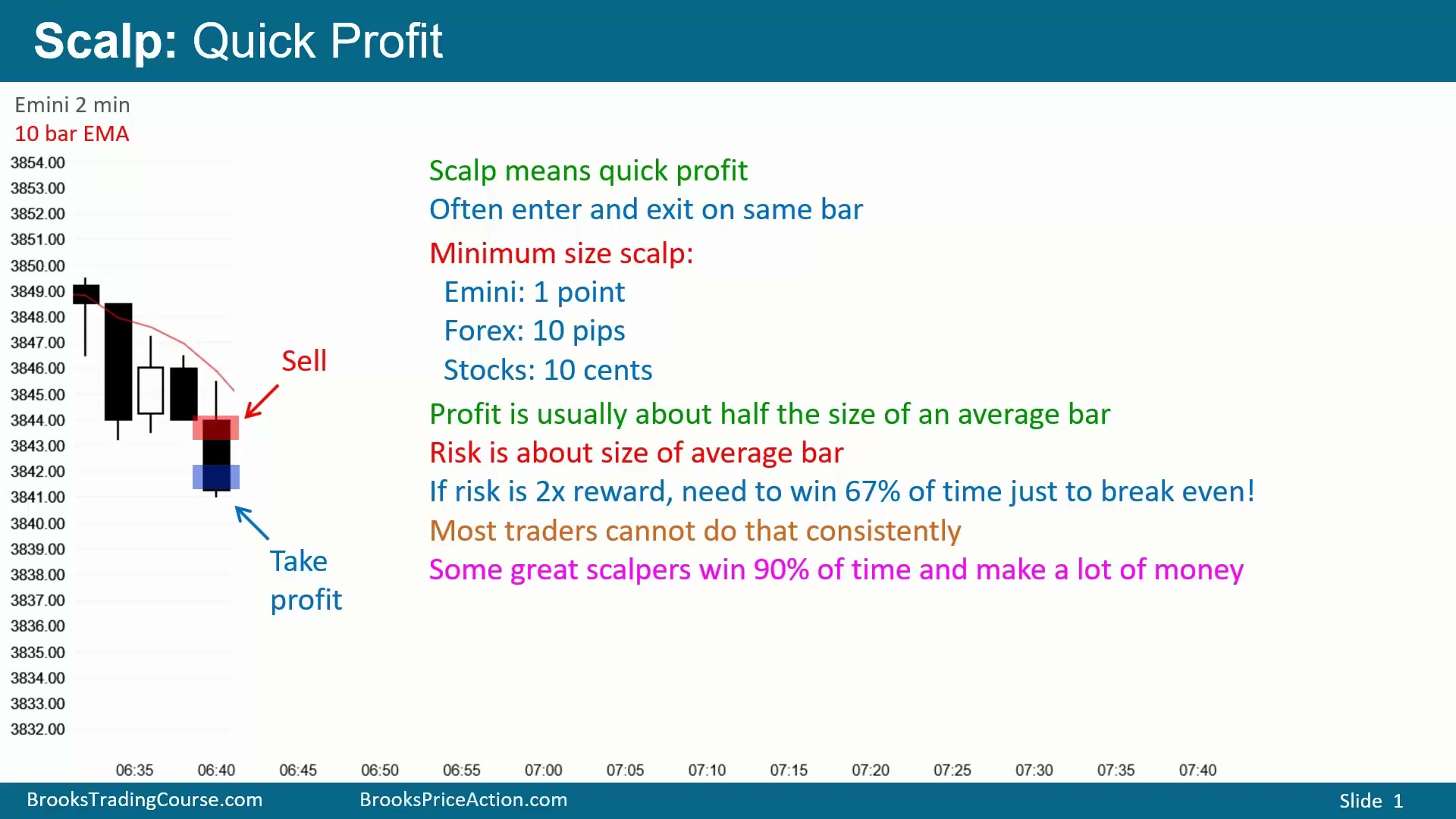
EN: Today I’m trading with a 2-minute chart.

00:36 - 00:38

EN: Every bar is 2 minutes.

00:38 - 00:40

EN: This is 2 minutes later, 2 minutes later,

00:40 - 00:44

EN: and the red line is a 10-bar Exponential Moving Average.

00:44 - 00:48

EN: When I’m scalping, I often put up a 10-bar Exponential Moving Average

00:48 - 00:51

EN: instead of my usual 20-bar Exponential Moving Average.

00:54 - 00:56

EN: A scalp, it simply is a quick profit,

00:57 - 00:59

EN: and you often enter and exit on the same bar.

01:01 - 01:03

EN: For example, if you sold with a stop 1 tick

01:03 - 01:07

EN: below the low of that bar, you’d get filled right there.

01:07 - 01:12

EN: If you were scalping, you might have a limit order to exit with a 2-point profit.

01:13 - 01:16

EN: And if you did, you would’ve been filled right here,

01:16 - 01:20

EN: 2 points below your entry, all within the same 2-minute bar.

01:23 - 01:26

EN: Can you scalp for 1 tick? No.

01:26 - 01:28

EN: You’ll certainly lose money.

01:28 - 01:32

EN: These are minimum sizes that traders should use when scalping.

01:32 - 01:35

EN: You should never scalp for less than 1 point in the Emini.

01:35 - 01:39

EN: In the Forex market, you should never scalp for fewer than 10 pips.

01:39 - 01:43

EN: And for the stock market, you should never scalp for less than 10 cents.

01:49 - 01:53

EN: In general, the profit that you’re going to make as a scalper

01:53 - 01:55

EN: is about half the size of an average bar,

01:55 - 01:58

EN: and the risk is about the size of an average bar.

01:59 - 02:01

EN: If you sold below the low of this bar,

02:01 - 02:03

EN: you might have a stop above the high of the bar.

02:03 - 02:06

EN: Now, if the risk is twice the reward,

02:07 - 02:11

EN: you have to be right 67% of the time just to break even,

02:11 - 02:14

EN: and that’s excluding commissions and mistakes.

02:15 - 02:19

EN: You really need to be right 70% or more of the time just to break even,

02:19 - 02:22

EN: and most traders cannot do that consistently.

02:22 - 02:28

EN: But a great scalper can win 90% of the time, and he can make a lot of money.

Slide 002

Time: 02:30

Slide 002

Bilingual Transcript

02:31 - 02:36

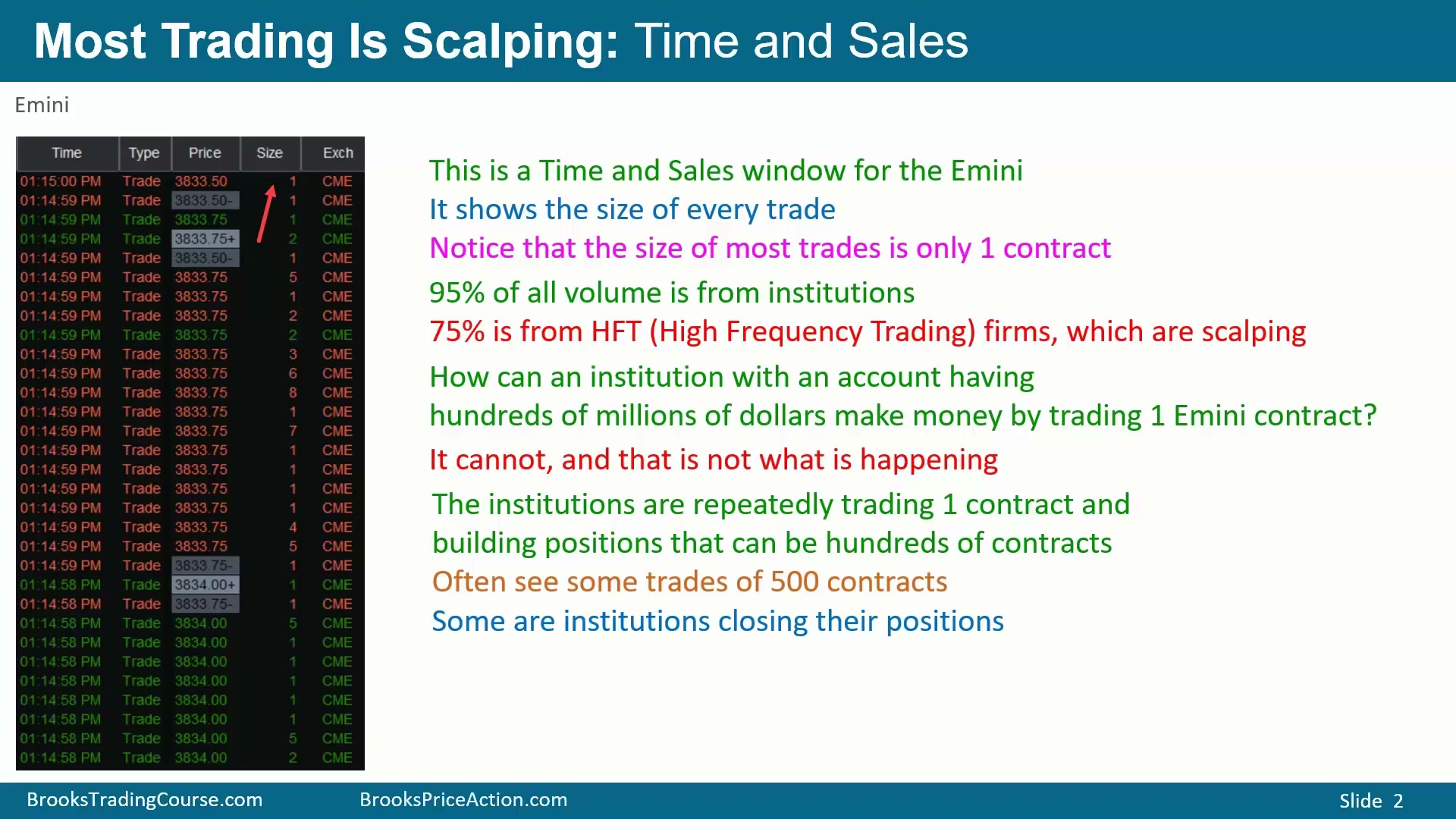
EN: This is a time & sales window for the Emini, and I want you to focus on the size.

02:37 - 02:40

EN: You’ll see that most of the position sizes are small.

02:40 - 02:44

EN: This is a 2-second period between here and here.

02:44 - 02:48

EN: That’s 2 seconds, and this is sampled data.

02:48 - 02:51

EN: This is not all the trades that took place in 2 seconds.

02:51 - 02:53

EN: Far more trades took place.

02:53 - 02:56

EN: However, it shows the point that I want to make:

02:56 - 03:00

EN: that most of the trading is done with very small position sizes.

03:04 - 03:10

EN: You know that 95% of all of the volume traded in the Emini is done by institutions,

03:10 - 03:15

EN: and 75% of it is done by high frequency trading firms, which are scalping,

03:15 - 03:19

EN: and they might scalp for 1 tick, or 2 ticks, or 3 ticks.

03:22 - 03:26

EN: How can an institution with hundreds of millions of dollars in the account

03:26 - 03:30

EN: or in the fund make any money by trading one contract?

03:31 - 03:32

EN: Well, they can’t.

03:32 - 03:34

EN: But that’s not what’s happening.

03:34 - 03:37

EN: It might look like that’s what’s happening, but that’s not what’s happening.

03:40 - 03:45

EN: The institution is repeatedly trading one contract and building a position.

03:45 - 03:48

EN: Very often, the position will be several hundred contracts,

03:48 - 03:51

EN: maybe even thousands of contracts big.

03:51 - 03:55

EN: You’ll sometimes see a very large position – maybe 407 contracts

03:55 - 03:59

EN: or 809 contracts – being traded, and some of that

03:59 - 04:02

EN: is from institutions closing their positions.

Slide 003

Time: 04:05

Slide 003

Bilingual Transcript

04:09 - 04:13

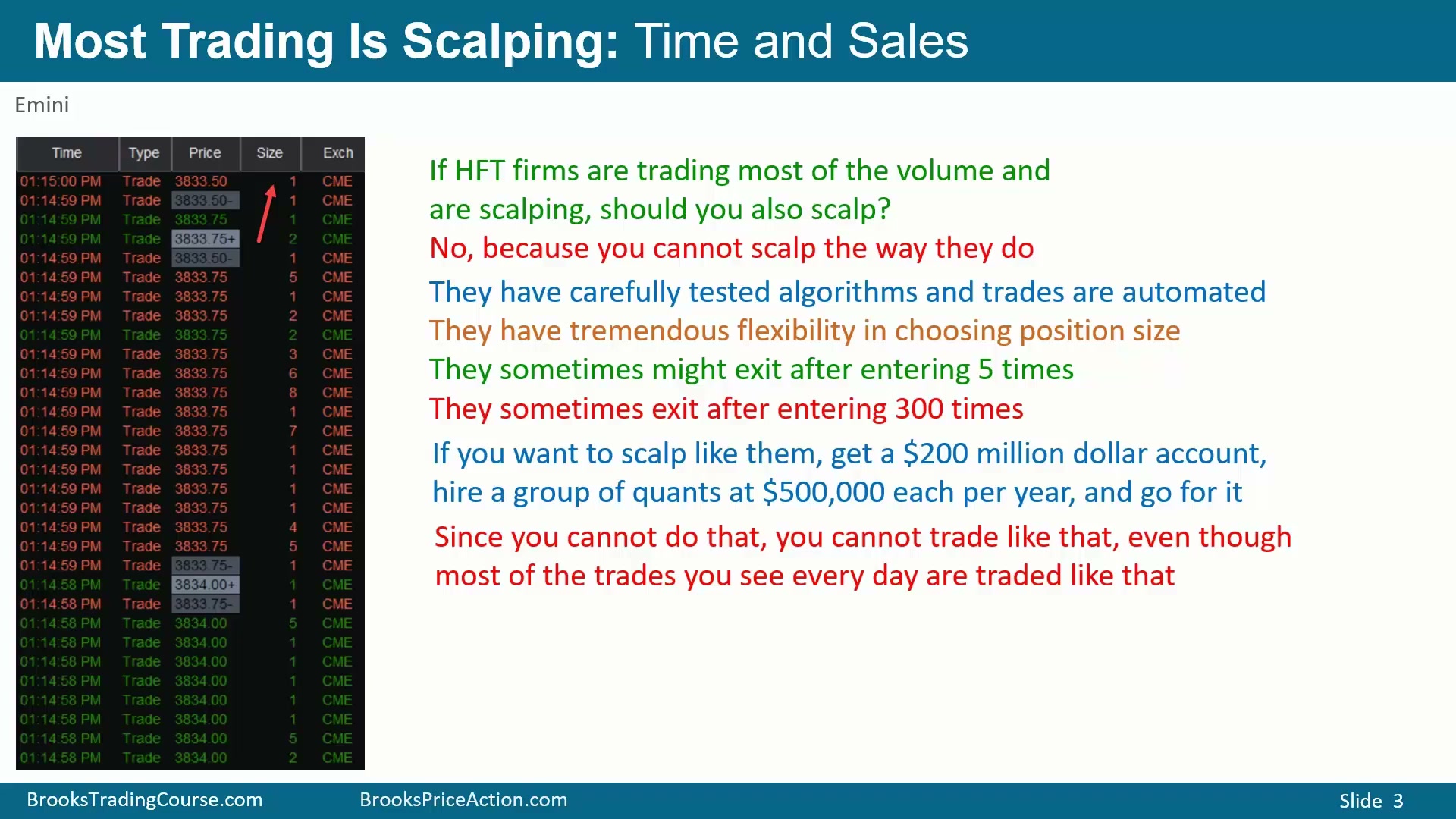
EN: If high frequency trading firms are trading most of the volume

04:13 - 04:16

EN: and most of them are scalping, shouldn’t you be scalping as well?

04:16 - 04:17

EN: You know they’re making money.

04:18 - 04:22

EN: No, you cannot do that because you cannot scalp the way that they do.

04:26 - 04:30

EN: They have carefully tested algorithms, all their trades are automated,

04:30 - 04:33

EN: they have tremendous flexibility in choosing their position size.

04:34 - 04:40

EN: For example, a trade might end after just five entries, five contracts.

04:40 - 04:45

EN: The computer may determine that the algorithm is no longer valid and it will exit.

04:45 - 04:48

EN: At other times, the trade may go on a long time.

04:48 - 04:53

EN: They may enter 300 times or even 1,000 times before they take profits.

04:53 - 04:57

EN: So a huge variation in position size.

04:57 - 04:58

EN: You cannot do that.

05:02 - 05:06

EN: If you want to trade like a high frequency trading firm, fine.

05:06 - 05:08

EN: Get a $200 million account,

05:08 - 05:12

EN: hire a group of quantitative analysts to write your software,

05:12 - 05:14

EN: pay them $500,000 each a year,

05:15 - 05:17

EN: and then you can trade like a high frequency trading firm.

05:18 - 05:22

EN: Obviously that’s not realistic, and you cannot trade like that,

05:22 - 05:26

EN: even though most of the trades that you see taking place are traded that way.

Slide 004

Time: 05:29

Slide 004

Bilingual Transcript

05:30 - 05:32

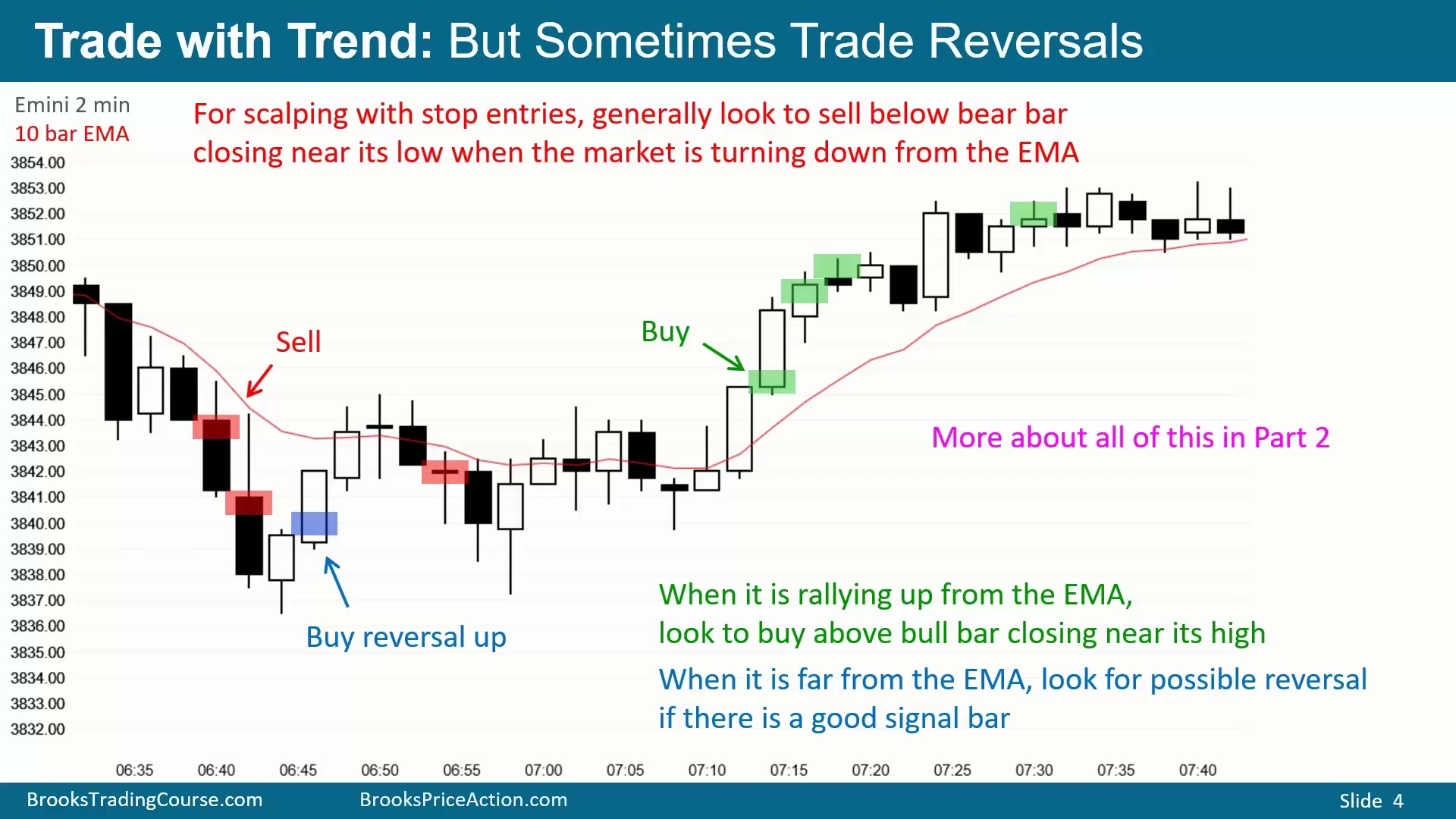
EN: This is a couple hours of trading.

05:32 - 05:34

EN: The Emini, 2-minute chart.

05:38 - 05:41

EN: In general, if you’re looking for a stop entry,

05:41 - 05:44

EN: you’re looking to trade in the direction of the trend.

05:44 - 05:49

EN: If the market’s below the Moving Average and you have a bar closing on its low,

05:49 - 05:51

EN: turning down from below the Moving Average,

05:51 - 05:55

EN: it’s reasonable to look to sell on a stop 1 tick below the low of that bar.

05:55 - 05:58

EN: Here’s another bar turning down from the Moving Average.

05:58 - 06:00

EN: You sell below the low of that bar.

06:00 - 06:04

EN: Here’s a third one, and you could sell below the low of this bar.

06:04 - 06:07

EN: I’m not going to go into the reasons why the probability is less,

06:07 - 06:11

EN: but if you did sell below that bar, you’d get filled here.

06:11 - 06:14

EN: You could scale into shorts, selling more as it goes up

06:14 - 06:19

EN: as long as it does not go above that bar or the ii, consecutive inside bars.

06:19 - 06:23

EN: You could take your profit when the market fell back to your original entry price.

06:23 - 06:27

EN: You could get out around breakeven on your first sell and then,

06:27 - 06:30

EN: if you scaled in, you’d make a profit on your higher sells.

06:34 - 06:37

EN: If you’re looking to buy with a stop,

06:37 - 06:40

EN: what you want to see is the market above the Moving Average.

06:40 - 06:43

EN: You want to see a bull bar turning up from the Moving Average,

06:43 - 06:46

EN: and you want the bar to be closing on its high.

06:46 - 06:48

EN: Then you’ll buy 1 tick above the high of that bar.

06:48 - 06:50

EN: Several more examples.

06:50 - 06:53

EN: Here we tried to reverse, but it’s going back up.

06:53 - 06:57

EN: A bull bar closing near its high, turning up from around the Moving Average.

06:57 - 07:00

EN: You buy above the high of that bar and get filled right there.

07:04 - 07:08

EN: Sometimes the market is far from the Moving Average and it reverses.

07:09 - 07:12

EN: Sometimes you can take a reversal trade.

07:12 - 07:15

EN: An ii, consecutive inside bars, in a bear trend.

07:15 - 07:19

EN: Often the final bear flag, which means you’ll soon get a reversal.

07:19 - 07:23

EN: And here we have a decent size bull bar closing on its high.

07:23 - 07:27

EN: You could buy on a stop 1 tick above the high of that bar, and then get filled here.

07:31 - 07:34

EN: I’m going to talk more about these types of trades

07:34 - 07:37

EN: in Part 2 of this series of videos on scalping.

Slide 005

Time: 07:40

Slide 005

Bilingual Transcript

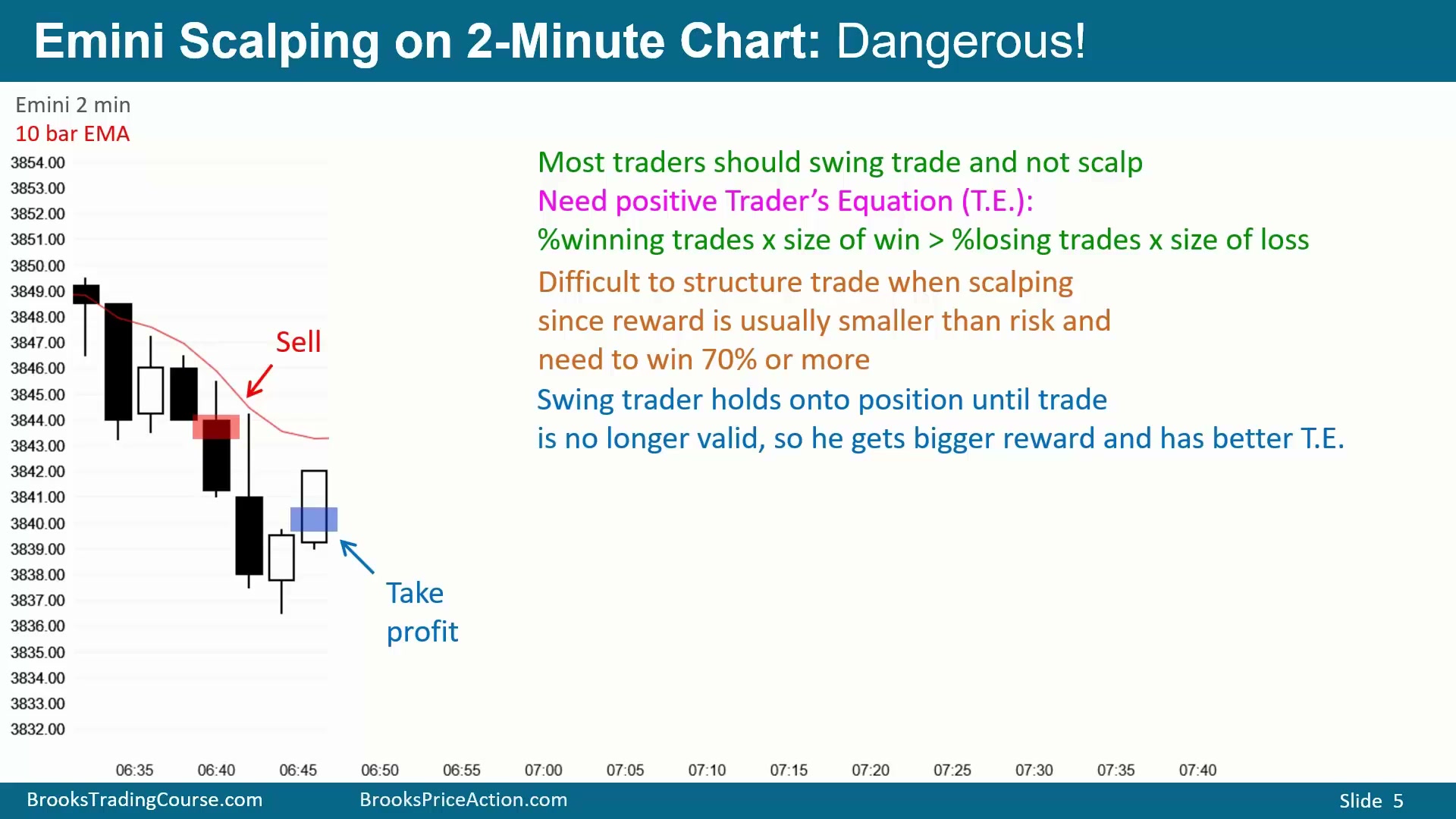
07:43 - 07:49

EN: Now, this is a video on scalping, but most traders should swing trade and not scalp.

07:49 - 07:53

EN: You need a positive Trader’s Equation, and by Trader’s Equation,

07:53 - 07:57

EN: what I mean is your percentage of winning trades times

07:57 - 08:00

EN: the size of your average win has to be greater

08:00 - 08:04

EN: than the percentage of your losing trades times the size of your average loss.

08:05 - 08:08

EN: You’re not going to be calculating that every time you put on a trade,

08:08 - 08:10

EN: but you have to be aware of it.

08:16 - 08:20

EN: It’s difficult to structure a trade with a positive Trader’s Equation

08:20 - 08:23

EN: when you’re scalping because the reward is usually less than the risk,

08:23 - 08:27

EN: and therefore you need to win more than 70% of the time.

08:27 - 08:31

EN: In fact, a good scalper is going to be winning 80% to 90% of the time.

08:35 - 08:37

EN: It’s easier just to swing trade.

08:37 - 08:41

EN: If you take that short, you hold onto the trade until the trade is no longer valid.

08:41 - 08:44

EN: You have a credible buy signal here and you’d get out there.

08:45 - 08:50

EN: This is a small profit, but sometimes swing trades result in very big profits.

08:50 - 08:53

EN: Reward’s much, much bigger than the risk,

08:53 - 08:59

EN: and therefore you can win 40% of the time, 30% of the time, and still make money.

Slide 006

Time: 09:05

Slide 006

Bilingual Transcript

09:06 - 09:09

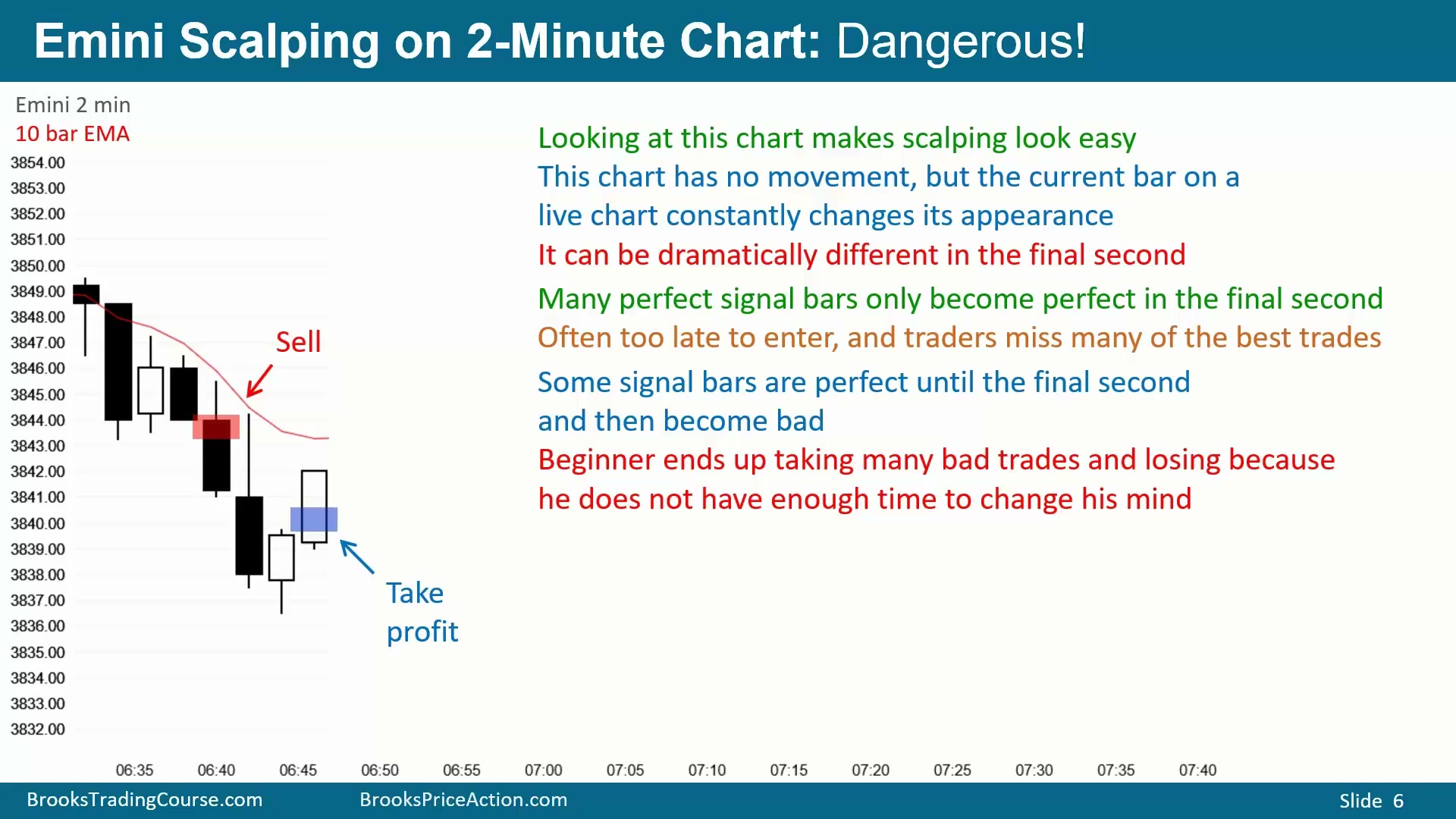
EN: When you look at this chart, it looks like, “Gosh, it’s easy.

09:09 - 09:14

EN: I sell here, I exit with 2 points here or above this bar, and I’ll make money,

09:14 - 09:18

EN: and I just keep doing that all day long.” This is 1 bar.

09:18 - 09:19

EN: Every bar is 2 minutes.

09:19 - 09:23

EN: This is just a few minutes later, and you’d make a pretty good profit.

09:24 - 09:26

EN: However, when you look at this chart, nothing’s moving.

09:27 - 09:29

EN: This is a picture of the market,

09:30 - 09:35

EN: and a picture can be very different from your experience in real time.

09:36 - 09:42

EN: For example, this really good-looking buy signal bar may have been a bear bar,

09:42 - 09:45

EN: and then in the final second, suddenly closed on its high.

09:45 - 09:47

EN: And this bear bar closing on its low,

09:47 - 09:50

EN: may have been a doji bar with a close in the middle.

09:50 - 09:54

EN: It may even have been a bull bar, and then in the final couple seconds,

09:54 - 09:56

EN: suddenly closed on the low of the bar.

09:56 - 09:58

EN: If you’re looking to place an order below the low of this bar

09:58 - 10:02

EN: and the market is falling quickly, you don’t know exactly

10:02 - 10:05

EN: where the low of the bar will be until the bar closes,

10:05 - 10:09

EN: and by then the market may be several ticks below the low of the bar.

10:13 - 10:16

EN: I’m highlighting perfect looking signal bars,

10:16 - 10:19

EN: but many of them only became perfect in the final second,

10:19 - 10:22

EN: and it then becomes too late to take the trade,

10:22 - 10:24

EN: so you’ll end up missing a lot of the very best trades.

10:28 - 10:31

EN: Also, you sometimes have signal bars

10:31 - 10:36

EN: that are perfect until the final second, and then they become bad.

10:36 - 10:39

EN: So the opposite happens, and you don’t have enough time to think

10:39 - 10:42

EN: that the market is no longer doing what you thought it will do.

10:43 - 10:47

EN: For example, you might be looking to sell below the low of a bar.

10:47 - 10:50

EN: The bar is closing on its low, and then in the final second,

10:50 - 10:53

EN: it closes several ticks above the low of the bar,

10:53 - 10:57

EN: and then you take the short and you end up taking a bad trade.

10:57 - 11:00

EN: You did not have enough time to change your mind

11:00 - 11:02

EN: about what you were planning to do.

Slide 007

Time: 11:05

Slide 007

Bilingual Transcript

11:05 - 11:06

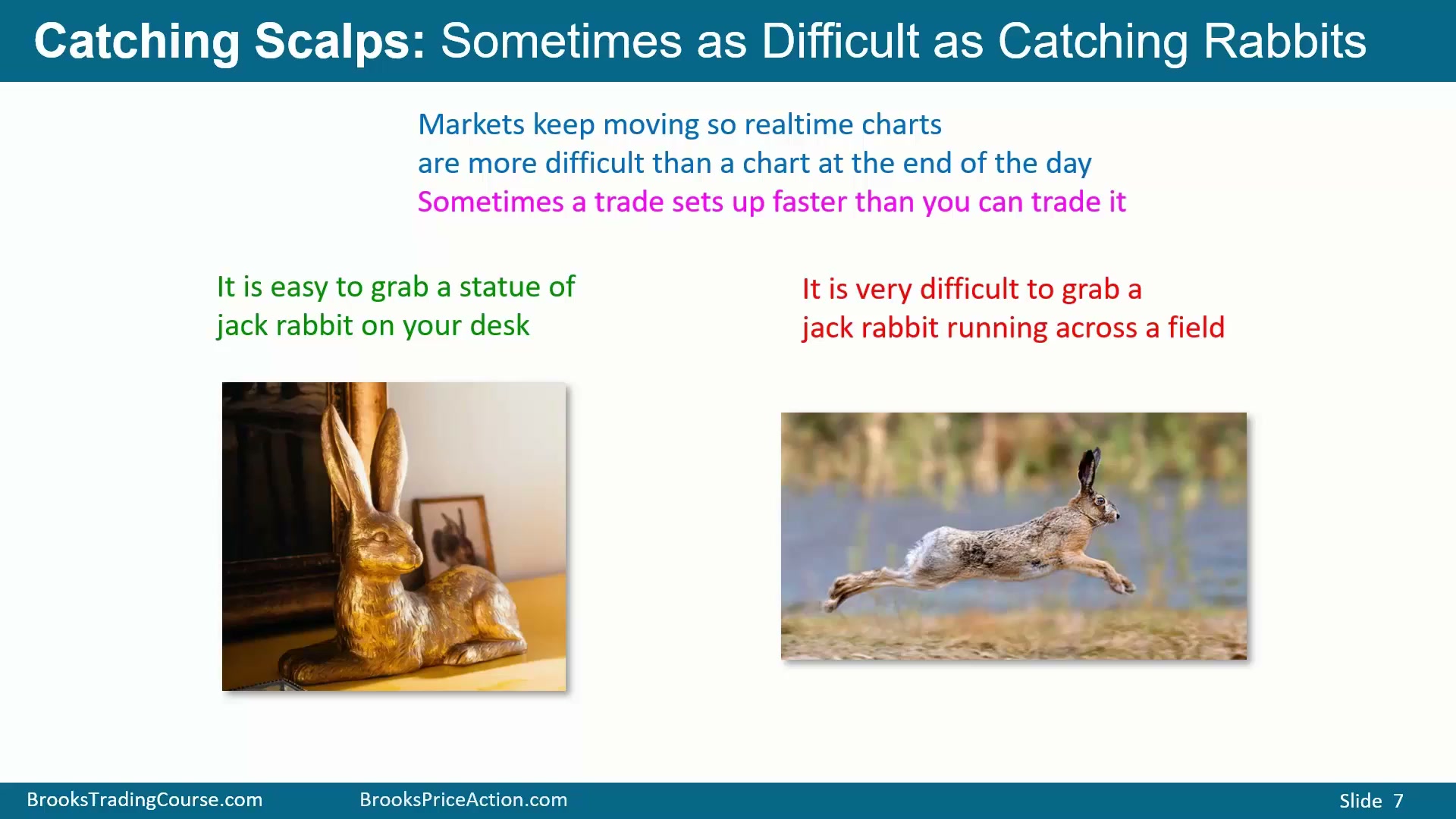
EN: Here’s an analogy.

11:07 - 11:11

EN: Here’s a little statue of a jackrabbit sitting on your desk,

11:11 - 11:14

EN: and here is a jackrabbit in real life.

11:15 - 11:19

EN: This is what it’s like when you’re looking at a chart at the end of the day.

11:19 - 11:23

EN: It’s easy to grab a trade because the bars are not moving.

11:23 - 11:27

EN: But in real time, it’s like trying to catch that jackrabbit.

11:29 - 11:33

EN: It’s easy to grab a jackrabbit when it’s a statue on your desk,

11:33 - 11:37

EN: but it’s not so easy to grab a jackrabbit when it’s running across a field,

11:37 - 11:40

EN: and it’s not so easy to trade when the bars

11:40 - 11:43

EN: are actually changing constantly as you’re trying to place a trade.

Slide 008

Time: 11:45

Slide 008

Bilingual Transcript

11:47 - 11:51

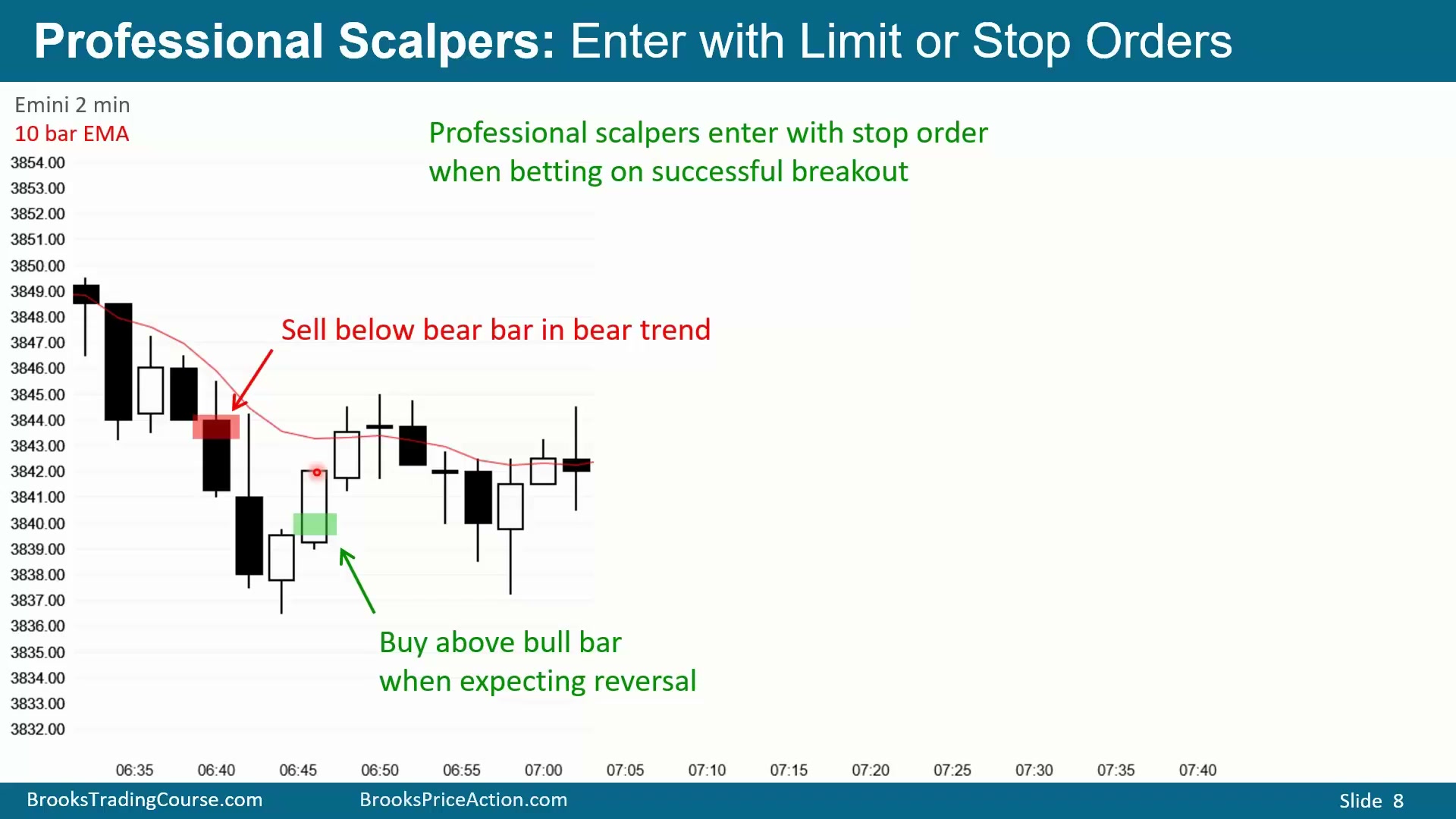
EN: A professional scalper, he’s going to enter with a stop order

11:51 - 11:55

EN: when he’s betting on a successful breakout, when he’s looking for a trend.

11:58 - 12:01

EN: For example, we’re below the Moving Average.

12:01 - 12:02

EN: We have an ii.

12:02 - 12:04

EN: We have a bear bar closing on its low.

12:04 - 12:07

EN: The trader will sell with a stop below the low of that bar,

12:07 - 12:09

EN: betting that we’re going to go down quite a bit.

12:09 - 12:13

EN: So he’s betting that the breakout below this bar will be successful,

12:14 - 12:16

EN: that the market will fall enough for him to make a profit.

12:16 - 12:18

EN: But that doesn’t always happen.

12:21 - 12:24

EN: When he’s buying with a stop, he’s expecting

12:24 - 12:27

EN: that the market will go far enough above the high of the bar – in other words,

12:27 - 12:29

EN: that the new trend will continue far enough

12:29 - 12:31

EN: – for him to be able to scalp out with a profit.

12:32 - 12:35

EN: So he’s betting on a successful breakout.

12:35 - 12:37

EN: But not all breakouts are successful.

Slide 009

Time: 12:40

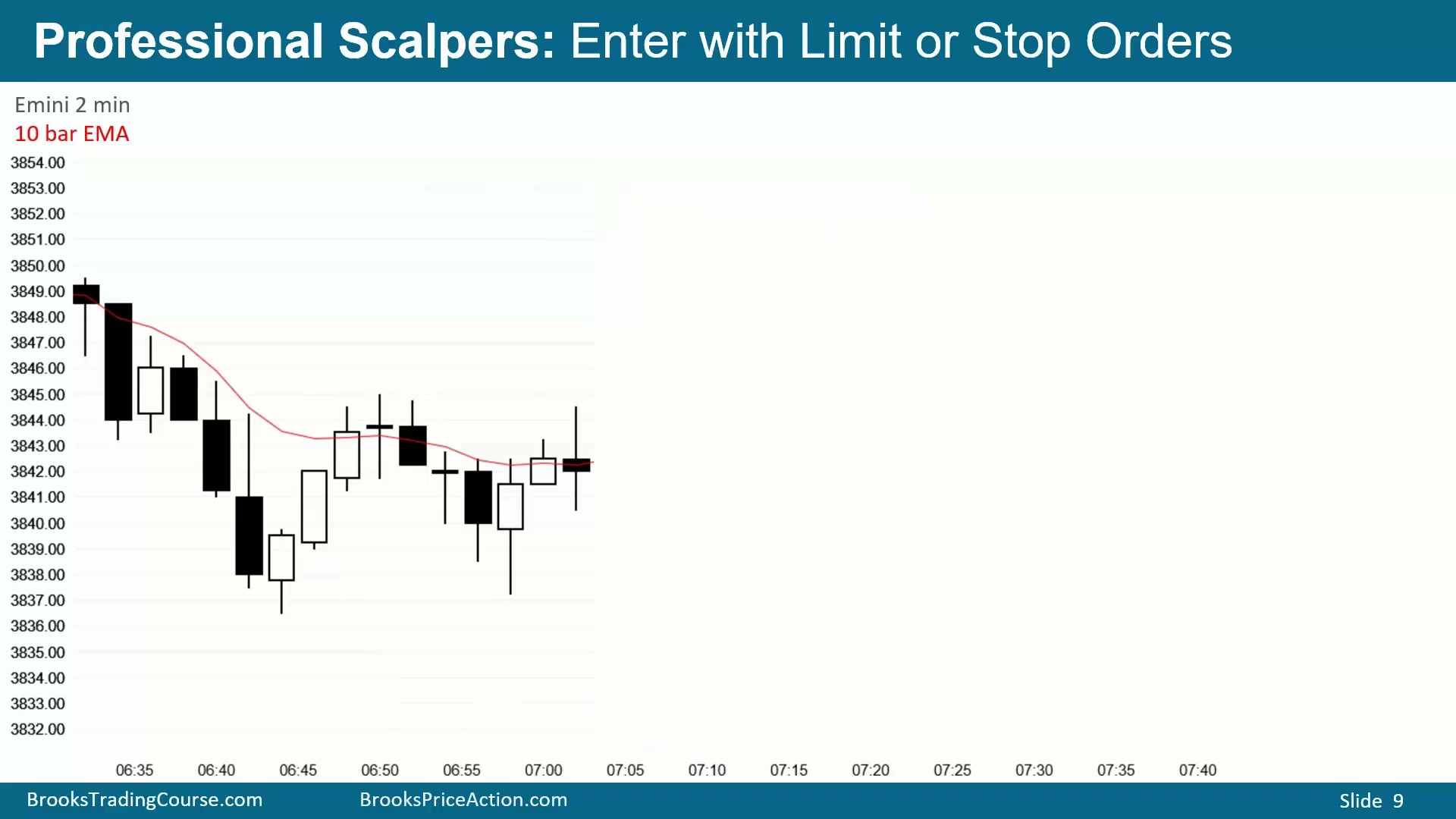
Slide 009

Bilingual Transcript

12:44 - 12:50

EN: Sometimes a trader will expect a breakout not to go very far, and instead reverse.

Slide 010

Time: 12:45

Slide 010

Bilingual Transcript

12:50 - 12:53

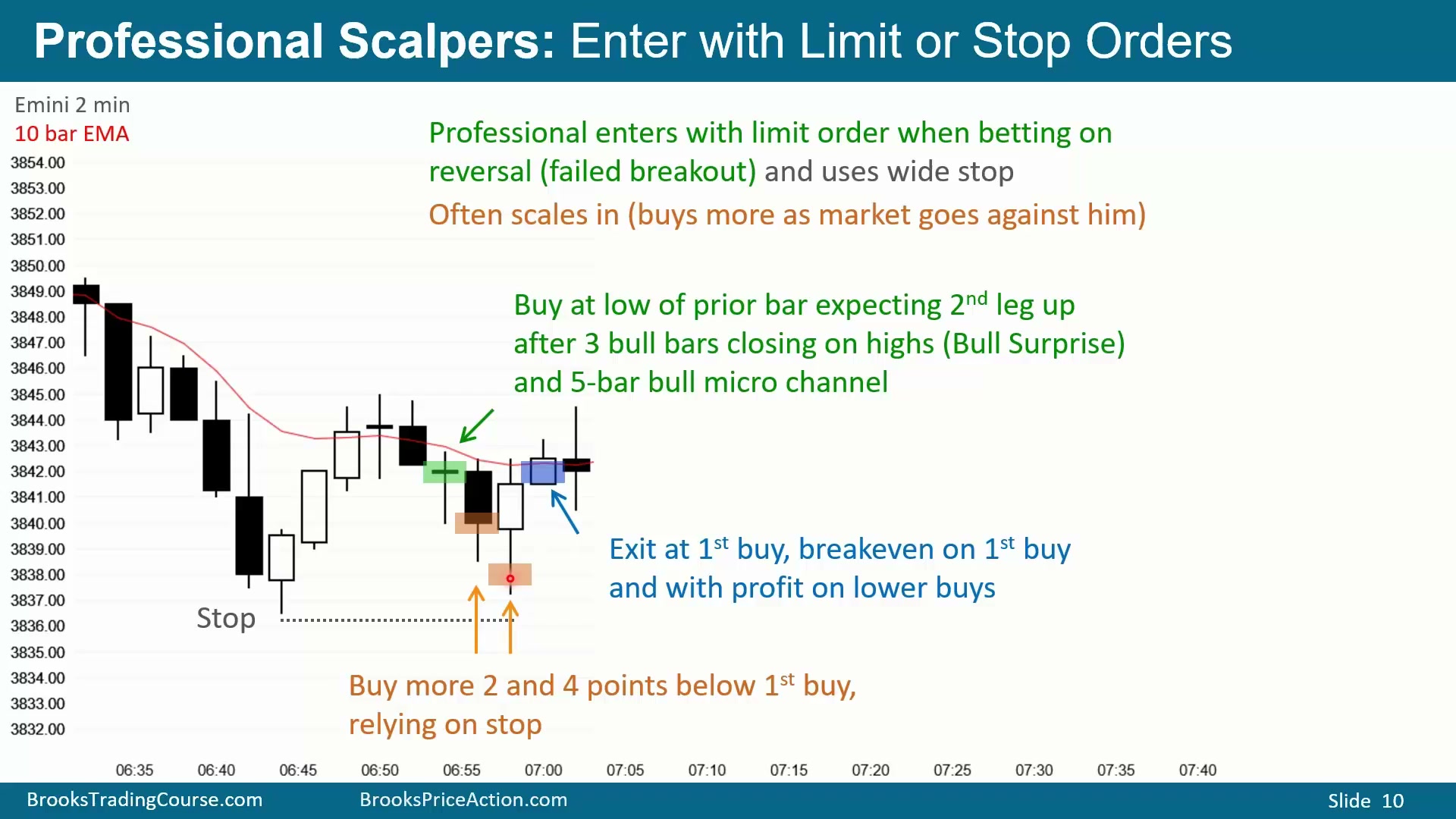
EN: In that case, he’s going to be entering with a limit order,

12:53 - 12:55

EN: which is the opposite of a stop order.

12:55 - 12:58

EN: A stop order, you’re betting the trend will continue.

12:58 - 13:01

EN: You buy above this bar, betting we’re going to go up.

13:01 - 13:04

EN: A limit order is betting that the breakout will fail,

13:04 - 13:06

EN: so you might sell at the high of this bar,

13:06 - 13:10

EN: betting that it’s not going to continue up and instead it’s going to reverse.

13:12 - 13:15

EN: Limit order traders often have to use wide stops,

13:15 - 13:19

EN: and they also often scale in after their position.

13:25 - 13:28

EN: So, for example, we have a good reversal up,

13:29 - 13:32

EN: a big enough bull surprise so that traders

13:32 - 13:35

EN: will expect at least a small second leg up.

13:35 - 13:39

EN: And therefore, even though this is a credible sell signal, some traders,

13:39 - 13:44

EN: instead of selling with a stop below that low, looking for a trend down,

13:44 - 13:47

EN: will buy with a limit order at that low,

13:47 - 13:50

EN: betting that it will go only a little bit below the bar

13:50 - 13:51

EN: and then have a second leg up.

13:51 - 13:56

EN: Or it’ll go lower, they can buy more, and then we’ll get the second leg up.

13:56 - 14:00

EN: So the limit order, bulls betting on a second leg up after this,

14:00 - 14:04

EN: are betting that if we do go down, we’ll have a second leg up

14:04 - 14:07

EN: before the selloff makes a new low.

14:07 - 14:11

EN: So, he’ll put a stop below the low of that bar, this line here.

14:11 - 14:15

EN: He’ll buy with a limit order at the low of that bar and he’ll buy more lower,

14:15 - 14:19

EN: maybe 1 point lower, 2 points lower, 3 points, 4 points lower,

14:19 - 14:21

EN: betting that we’ll get a second leg up.

14:23 - 14:27

EN: As I said, he’ll often buy more as the market goes against him.

14:28 - 14:32

EN: He might buy 2 points below his first entry and then 2 points below that.

14:32 - 14:38

EN: So, he buys here, he buys more 2 points lower, and then 2 points lower again.

14:42 - 14:45

EN: And then when it gets back to his first price,

14:45 - 14:49

EN: he can get out breakeven on his first entry and with a profit here,

14:49 - 14:51

EN: 2 points, and with a profit here, 4 points.

14:51 - 14:56

EN: Or he may hold part or all of his position, hoping that we begin a trend up.

Slide 011

Time: 15:00

Slide 011

Bilingual Transcript

15:03 - 15:07

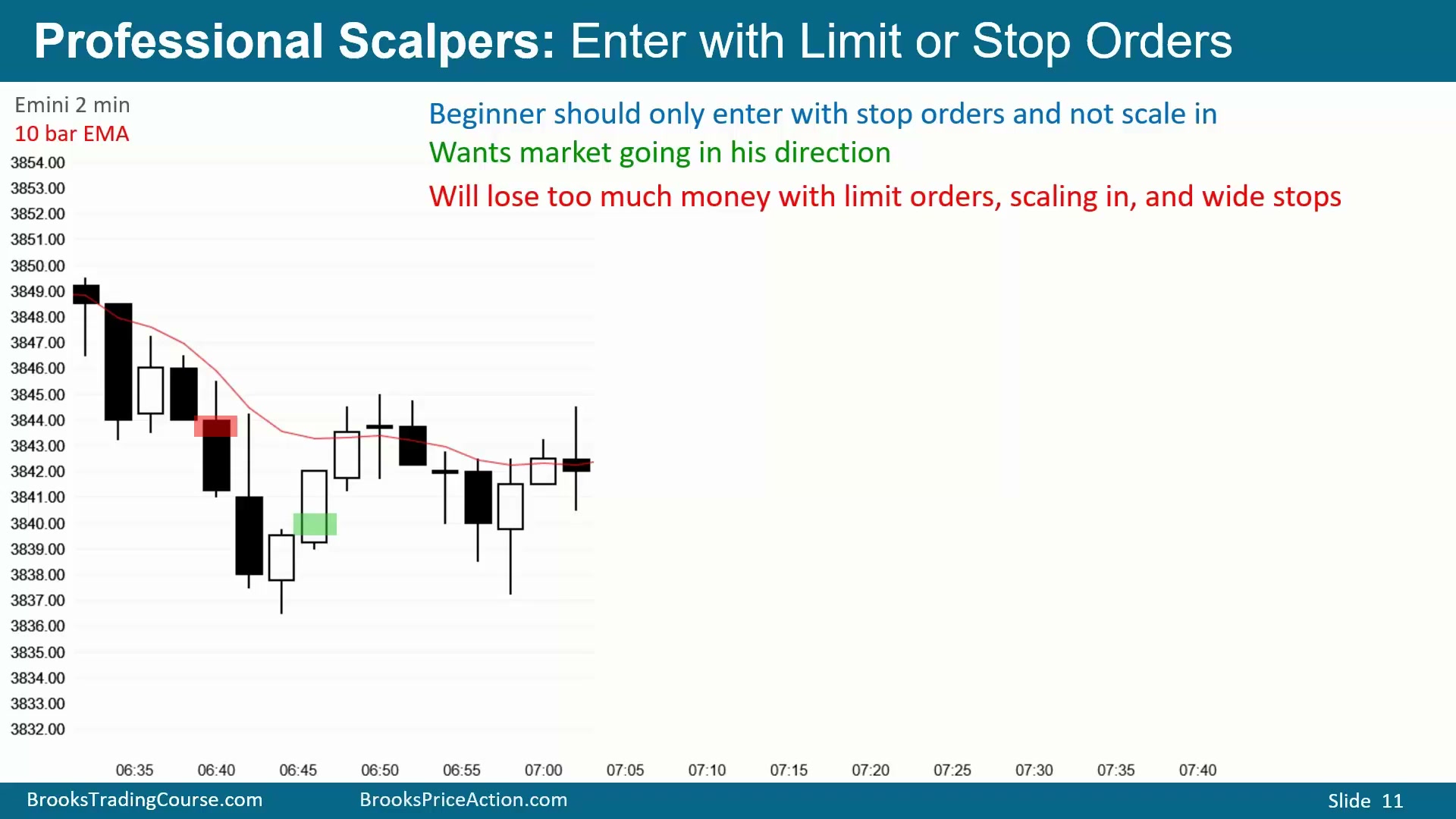
EN: Beginners should only be trading with stop orders and not scale in.

15:07 - 15:10

EN: Most traders, in fact, should always be trading with stop orders

15:10 - 15:12

EN: and they should not be scaling in.

15:12 - 15:14

EN: You want the market to be going in your direction.

15:14 - 15:16

EN: You’ll have a better chance of making money.

15:19 - 15:22

EN: Example: you sell below that bear bar

15:22 - 15:25

EN: or you buy above this bull bar, looking for a reversal up.

15:28 - 15:34

EN: You will lose too much money with limit orders scaling in and using wide stops,

15:34 - 15:36

EN: even though professional scalpers often do that.

Slide 012

Time: 15:40

Slide 012

Bilingual Transcript

15:41 - 15:46

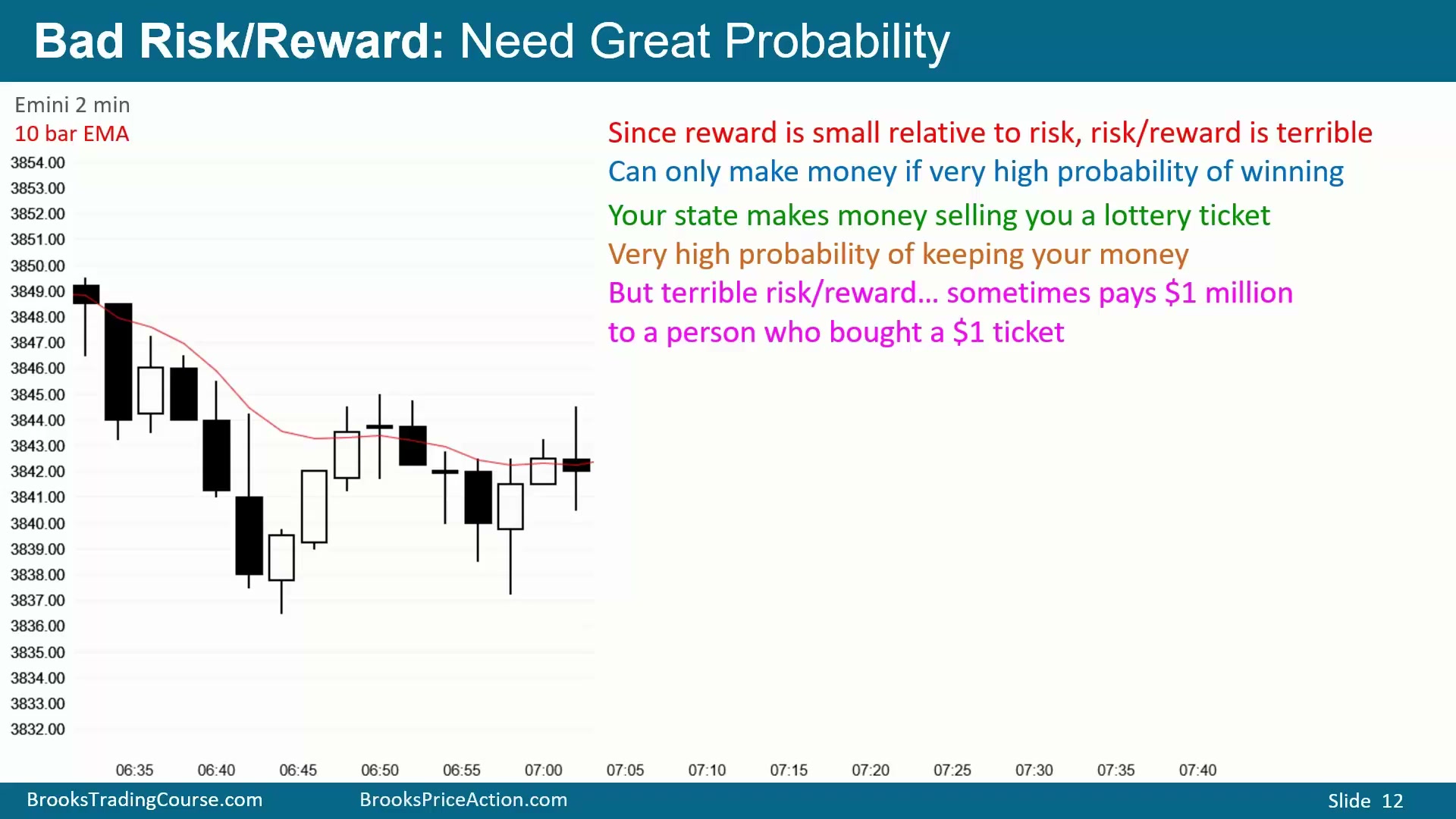
EN: As a scalper, your reward is small relative to your risk.

15:46 - 15:49

EN: That means you have terrible risk/reward.

15:49 - 15:55

EN: Every trade has three variables: risk, reward, and probability.

15:56 - 16:00

EN: Those three variables are what you need to consider when you’re placing a trade.

16:01 - 16:04

EN: You can look at risk/reward as a single variable

16:04 - 16:07

EN: and probability as the second variable.

16:07 - 16:11

EN: As a trader, in general you’re either going to have a trade

16:11 - 16:15

EN: with really good risk/reward which always has bad probability,

16:15 - 16:20

EN: or a trade with really good probability which always has bad risk/reward.

16:20 - 16:26

EN: A scalper, he has bad risk/reward, so he needs very high probability.

16:31 - 16:33

EN: Look at the lottery, for example.

16:33 - 16:36

EN: Your state makes money by selling you a lottery ticket.

16:37 - 16:41

EN: They have a very high probability of being able to keep your one dollar,

16:41 - 16:44

EN: but they have terrible risk/reward.

16:44 - 16:47

EN: Sometimes they have to pay a million dollars

16:47 - 16:49

EN: to a person who bought a ticket for one dollar.

16:54 - 16:58

EN: A scalper has more risk than reward.

Slide 013

Time: 16:55

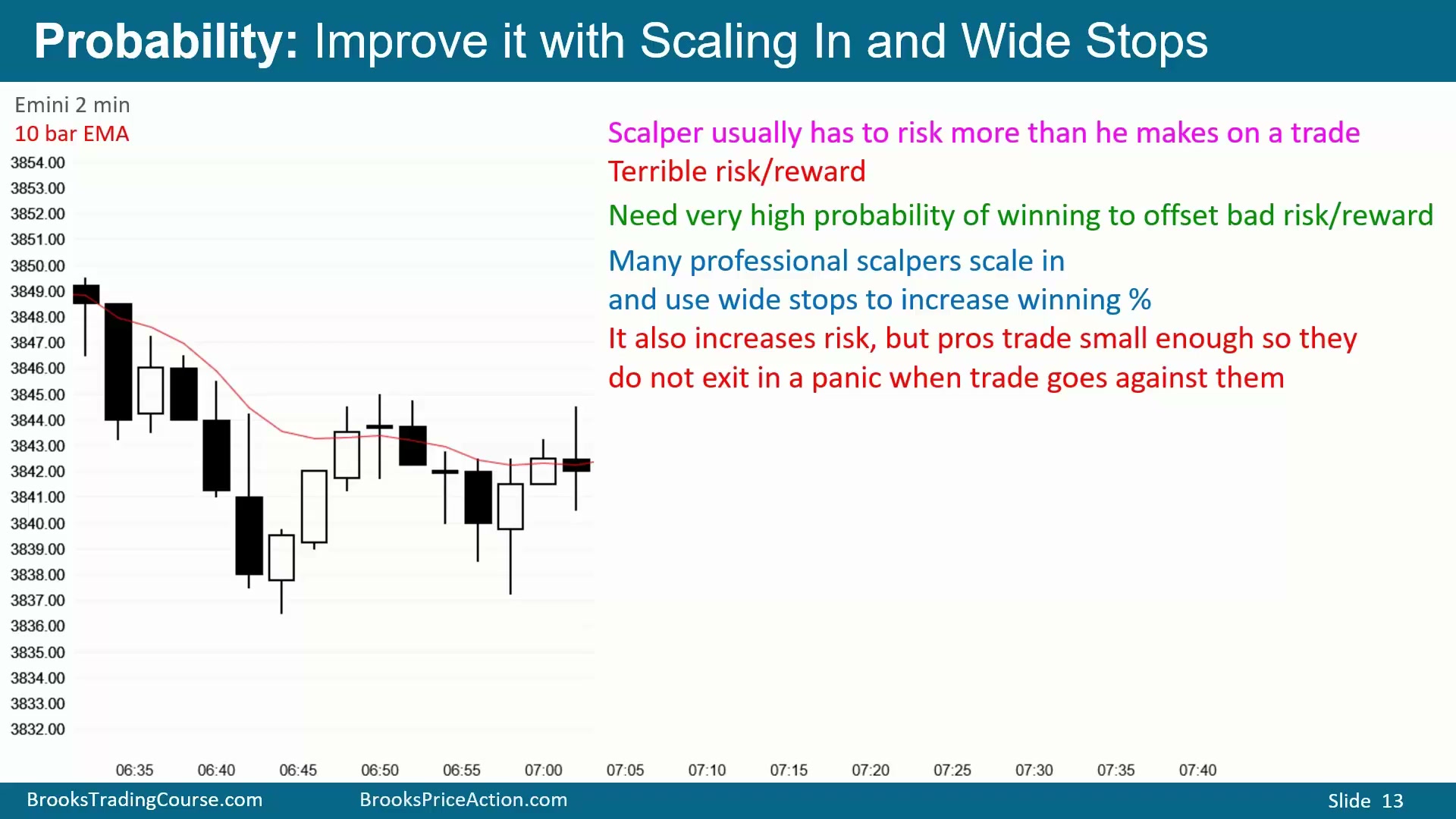
Slide 013

Bilingual Transcript

16:58 - 17:00

EN: He has terrible risk/reward.

17:01 - 17:04

EN: He can only make money if he has a very high probability.

17:04 - 17:08

EN: There are things he can do to increase his probability.

17:15 - 17:20

EN: The two that scalpers most often use are they scale into trades

17:20 - 17:25

EN: – they add to their trade as it goes against them – and they use a very wide stop.

17:25 - 17:27

EN: Some scalpers don’t even use stops at all

17:27 - 17:29

EN: if they’re very confident about their position.

17:30 - 17:34

EN: Scaling in and wide stops increases your risk;

17:34 - 17:38

EN: however, it greatly increases your probability.

17:38 - 17:41

EN: Professional scalpers, they trade small.

17:41 - 17:45

EN: Very small, so that if the market goes quickly far against them,

17:45 - 17:49

EN: they’re not going to lose more on that trade, than they would on any other trade,

17:49 - 17:53

EN: and they also will not panic if the market goes far against them.

Slide 014

Time: 17:55

Slide 014

Bilingual Transcript

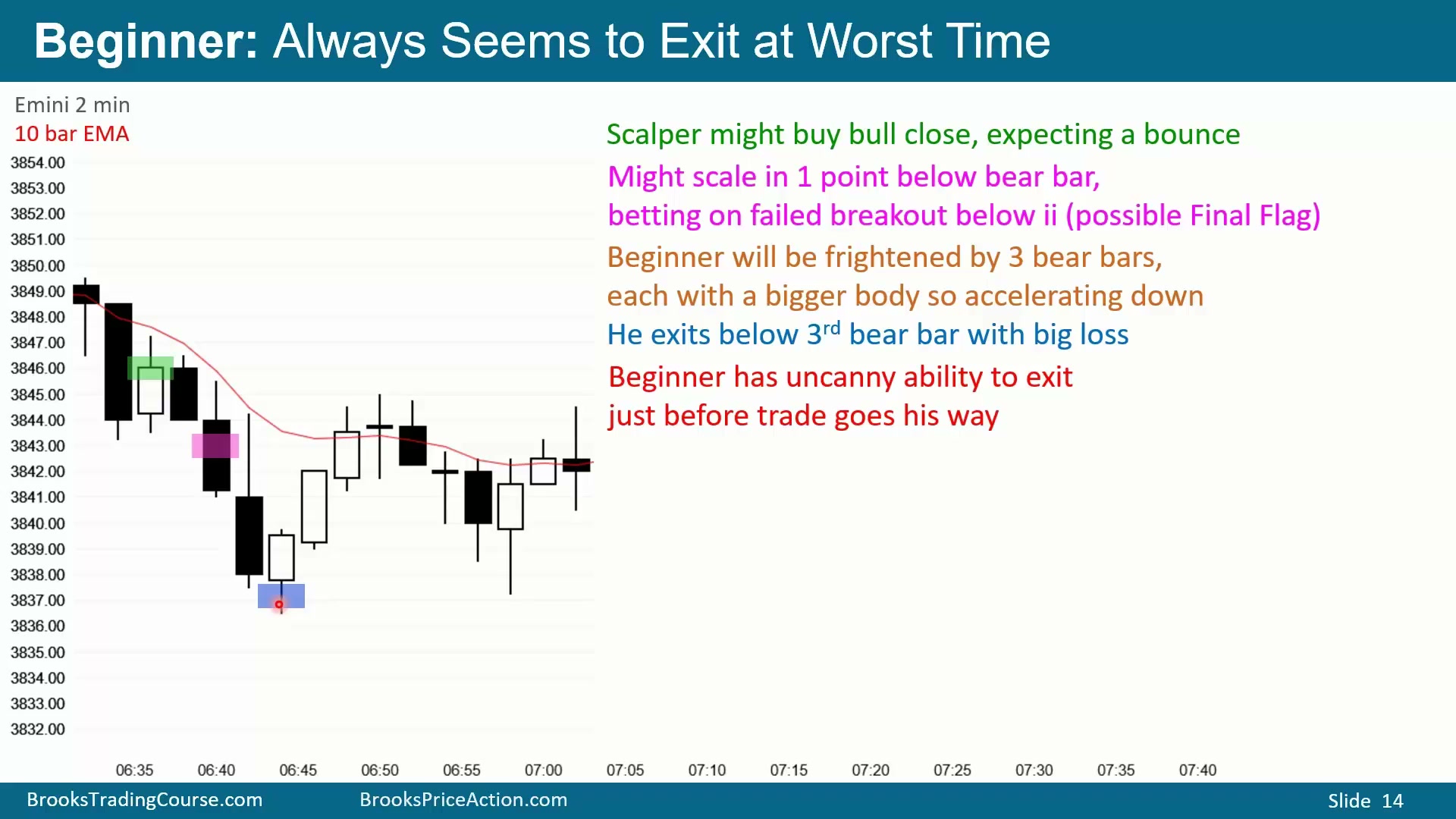
17:59 - 18:03

EN: For example, let’s say the scalper thought this was a Sell Climax,

18:03 - 18:05

EN: and that this was the start of a reversal up.

18:05 - 18:08

EN: He might buy the close of that bull bar,

18:08 - 18:13

EN: but he might want to use a wide stop or no stop at all and scale in.

18:16 - 18:19

EN: He might buy more a point below that bear bar,

18:19 - 18:24

EN: betting that this will be the final bear flag and that we will not fall very far.

18:27 - 18:31

EN: But what will happen with the beginner? He’ll see 3 bear bars.

18:31 - 18:34

EN: This body is bigger than that body.

18:34 - 18:38

EN: This body is bigger than that body, and he’s afraid the market’s going to crash.

18:38 - 18:42

EN: He’s seeing the market accelerate down and he can’t take the pain.

18:42 - 18:45

EN: After a few bear bars, he will exit right here

18:45 - 18:48

EN: and take a very big loss on this position.

18:51 - 18:55

EN: Beginners, they have an incredible talent at exiting

18:55 - 18:58

EN: right before a trade goes their way.

18:58 - 18:59

EN: That’s just the reality.

18:59 - 19:02

EN: They’re weak traders.

19:02 - 19:06

EN: Weak traders usually exit right when the market is about to reverse.

19:06 - 19:09

EN: Once all the weak traders have exited,

19:09 - 19:12

EN: there’s no one left to make the market go down.

19:12 - 19:16

EN: As the market’s going down, the weak bulls are selling, selling, selling,

19:16 - 19:18

EN: and then once you have a very big bar,

19:18 - 19:21

EN: the final bulls give up and there’s no one left to sell.

19:21 - 19:24

EN: No more weak traders left, and the market goes the other way.

Slide 015

Time: 19:30

Slide 015

Bilingual Transcript

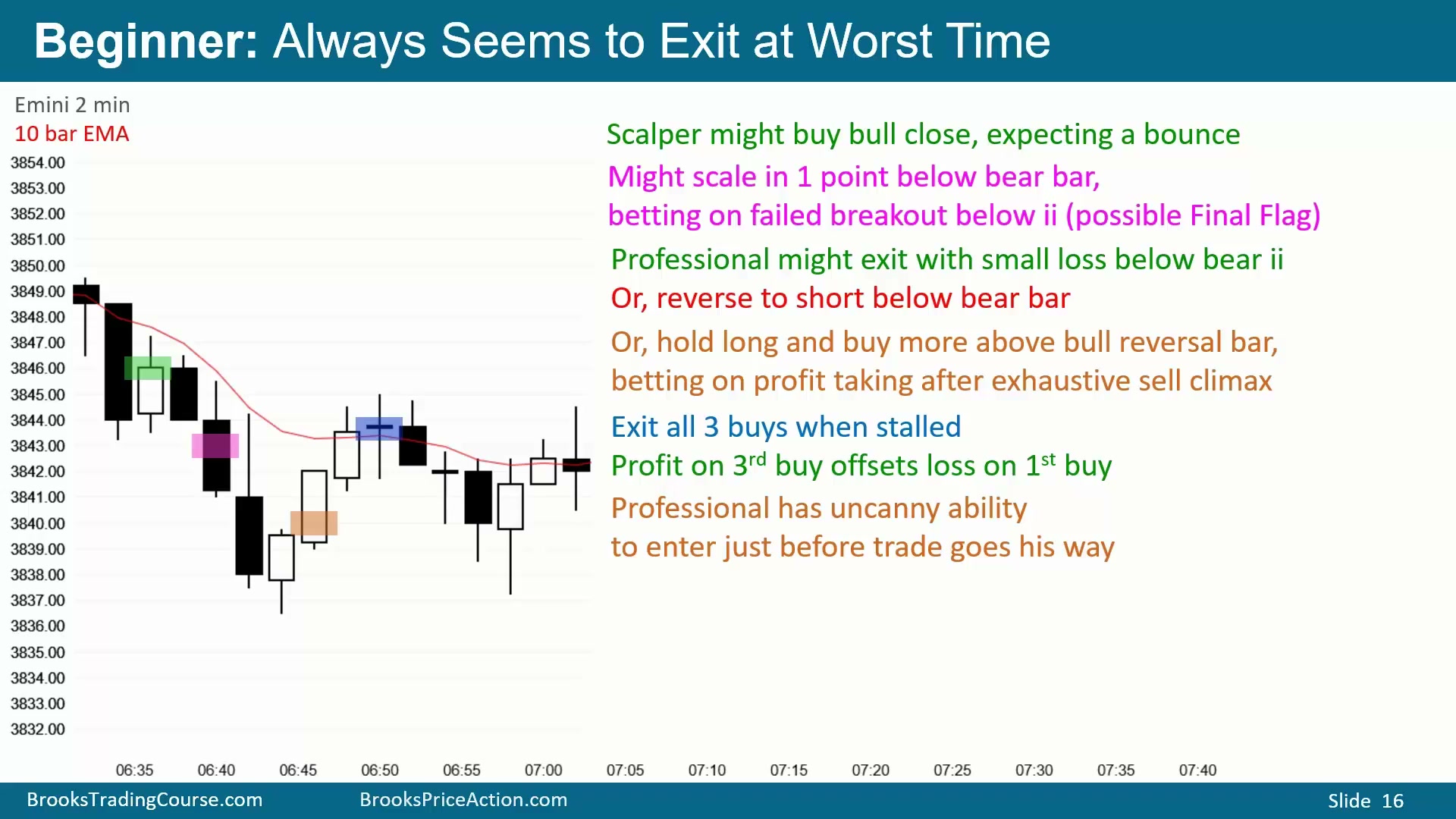
19:33 - 19:36

EN: Now, what would a professional trader do if he bought that close?

19:36 - 19:40

EN: Well, he’d see the ii, bear bar closing on its low.

19:40 - 19:43

EN: He knows it’s probably going to go at least a little bit down.

19:43 - 19:45

EN: He might exit below the low of that bar

19:45 - 19:49

EN: or he might even reverse – reverse to short.

19:52 - 19:55

EN: Alternatively, he might be confident

19:55 - 20:00

EN: that an ii is a Triangle on a smaller timeframe chart.

20:00 - 20:04

EN: If you have a Triangle late in a bear trend, and you get a bear breakout,

20:04 - 20:07

EN: the market’s probably going to come back to that Triangle later on,

20:07 - 20:10

EN: so he might hold onto his position and then wait

20:10 - 20:13

EN: for a bull bar closing near its high, a reversal,

20:13 - 20:16

EN: and then buy more above the high of that bull bar.

20:19 - 20:22

EN: And then when the rally gets back to around his original entry price

20:22 - 20:28

EN: or below that bear bar, or if the bars start to stall, he might get out.

20:28 - 20:32

EN: If he did that, he’d have a loss on that entry,

20:32 - 20:34

EN: he’d be out around breakeven on this entry,

20:35 - 20:37

EN: and he’d make a profit on this lower entry.

20:38 - 20:41

EN: Basically, the whole trade would be a scratch trade.

20:41 - 20:42

EN: He’d have a small profit.

20:42 - 20:46

EN: However, by not panicking during a big selloff

20:46 - 20:49

EN: and being able to do the right thing – buy more,

20:49 - 20:54

EN: betting on the reversal – a scalper is able to avoid a loss on a bad trade

20:54 - 20:56

EN: and sometimes he’ll make money.

21:00 - 21:05

EN: Professional traders, just like beginners have an uncanny ability

21:05 - 21:09

EN: to get out exactly at the wrong time, professional traders

21:09 - 21:14

EN: are very good at entering just before the trade goes their way.

Slide 016

Time: 21:20

Slide 016

Bilingual Transcript

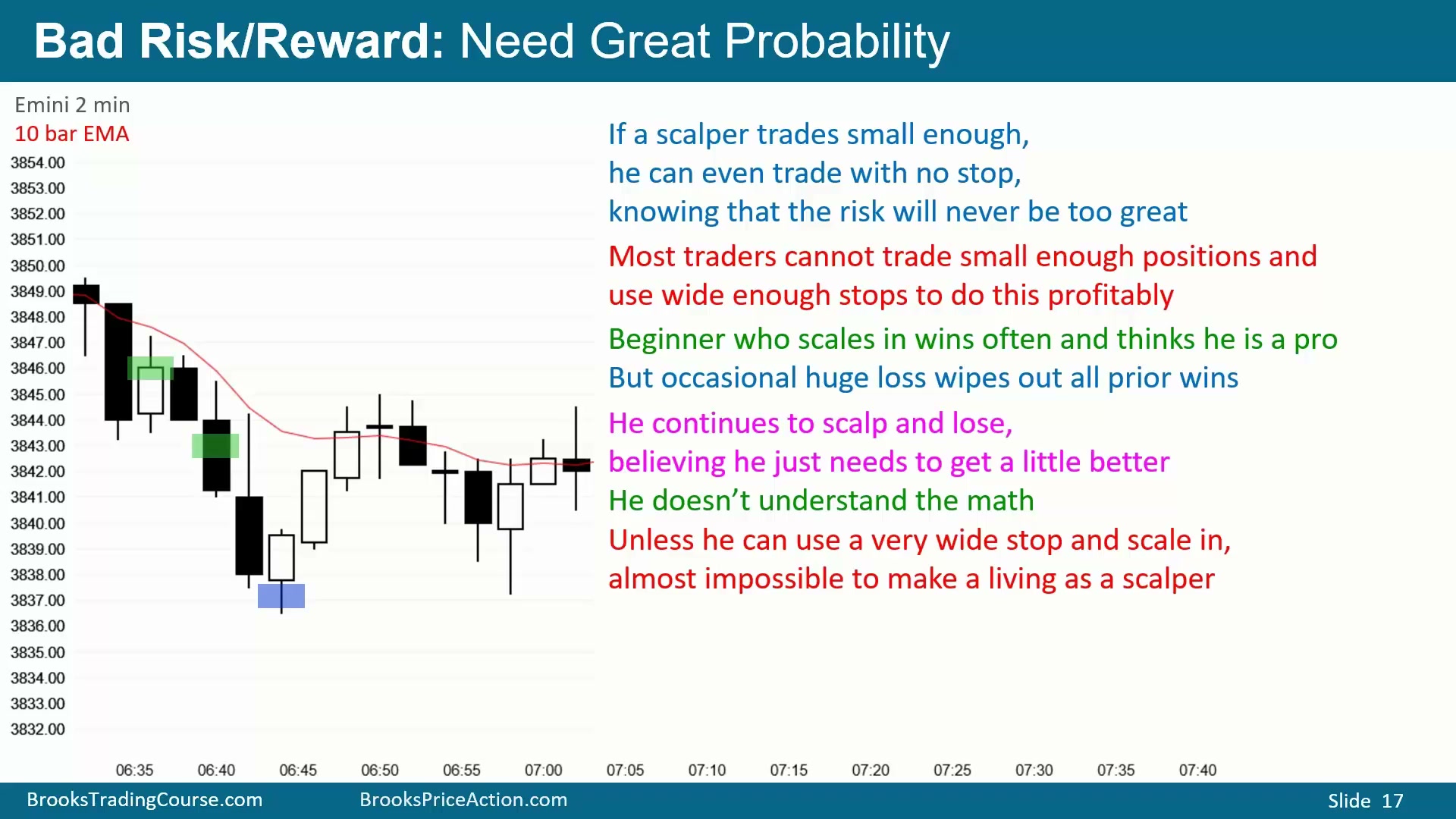
21:21 - 21:25

EN: I mentioned that some scalpers are confident about their position

21:25 - 21:28

EN: and they’ll trade even without a stop.

21:28 - 21:31

EN: This is because they’re trading small enough; therefore,

21:31 - 21:34

EN: the risk will never be too great.

21:37 - 21:41

EN: Most traders cannot trade small enough position sizes,

21:41 - 21:44

EN: and they cannot use wide enough stops to do that profitably.

21:44 - 21:48

EN: Therefore, that’s really not an option for most traders.

21:51 - 21:53

EN: Remember that beginner.

21:53 - 21:55

EN: He bought here, he bought here.

21:55 - 22:00

EN: At some point he has to get out, and 3 big bear bars – a lot of beginners

22:00 - 22:02

EN: would get out below that third bear bar.

22:03 - 22:07

EN: Remember, this beginner has been scalping for 2 points, and here,

22:07 - 22:11

EN: he’s going to lose – what is that? 8 or 9 points on that,

22:11 - 22:14

EN: and then he’ll lose 6 or 7 points on that,

22:14 - 22:19

EN: so he’ll lose 13, 14 points on one trade, and he’s been scalping for 2 points.

22:19 - 22:23

EN: So that one trade wipes out six or seven good trades.

22:29 - 22:33

EN: A lot of scalpers, when they’re starting out, think that all they need to do

22:33 - 22:37

EN: is get a little bit better, but they really don’t understand the math.

22:37 - 22:42

EN: Unless they can use wide stops and scale in and greatly increase their probability,

22:42 - 22:45

EN: it’s impossible to make a living as a scalper.

Slide 017

Time: 22:50

Slide 017

Bilingual Transcript

22:53 - 22:55

EN: As you know, I trade mostly the 5-minute chart.

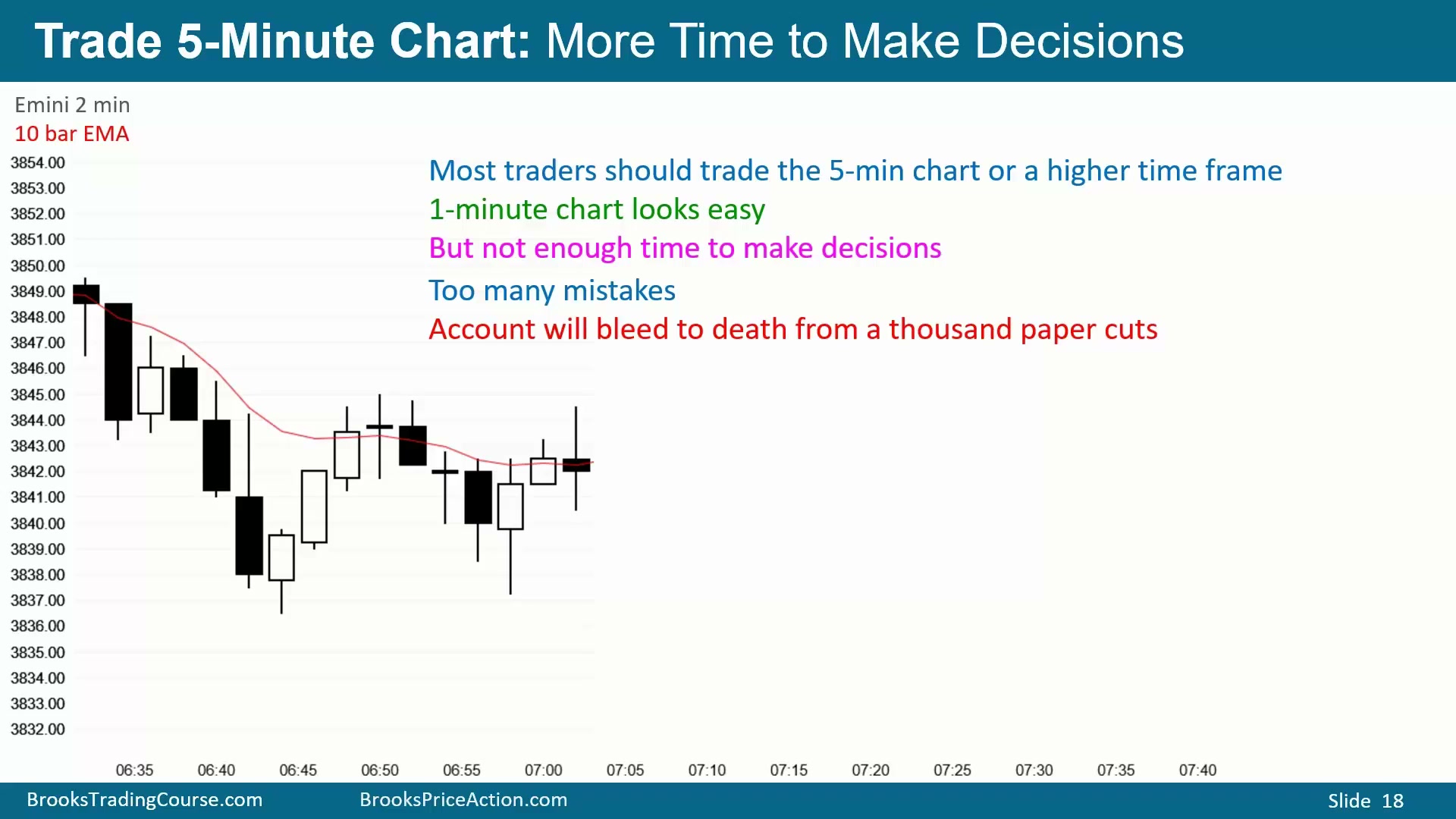
22:56 - 22:59

EN: Now, what about scalping on a 1-minute chart?

22:59 - 23:02

EN: The problem is you don’t have enough time to make decisions.

23:02 - 23:06

EN: Just like on this 2-minute chart, everything looks easy.

23:06 - 23:09

EN: You see the close here, you see the close here.

23:09 - 23:14

EN: Real time, the bars often look very different before they close.

23:14 - 23:18

EN: But if you print out a chart at the end of the day, everything looks perfect.

23:18 - 23:20

EN: But if you’re trading a 1-minute chart,

23:20 - 23:23

EN: even a 2-minute chart, most traders cannot do it.

23:23 - 23:25

EN: They don’t have enough time to make decisions

23:25 - 23:27

EN: and they’ll end up making too many mistakes.

23:31 - 23:34

EN: And yes, your stops are not too far away.

23:34 - 23:36

EN: You might lose 2, 3, or 4 points.

23:36 - 23:41

EN: However, your account will bleed to death from a thousand papercuts.

Slide 018

Time: 23:45

Slide 018

Bilingual Transcript

23:47 - 23:50

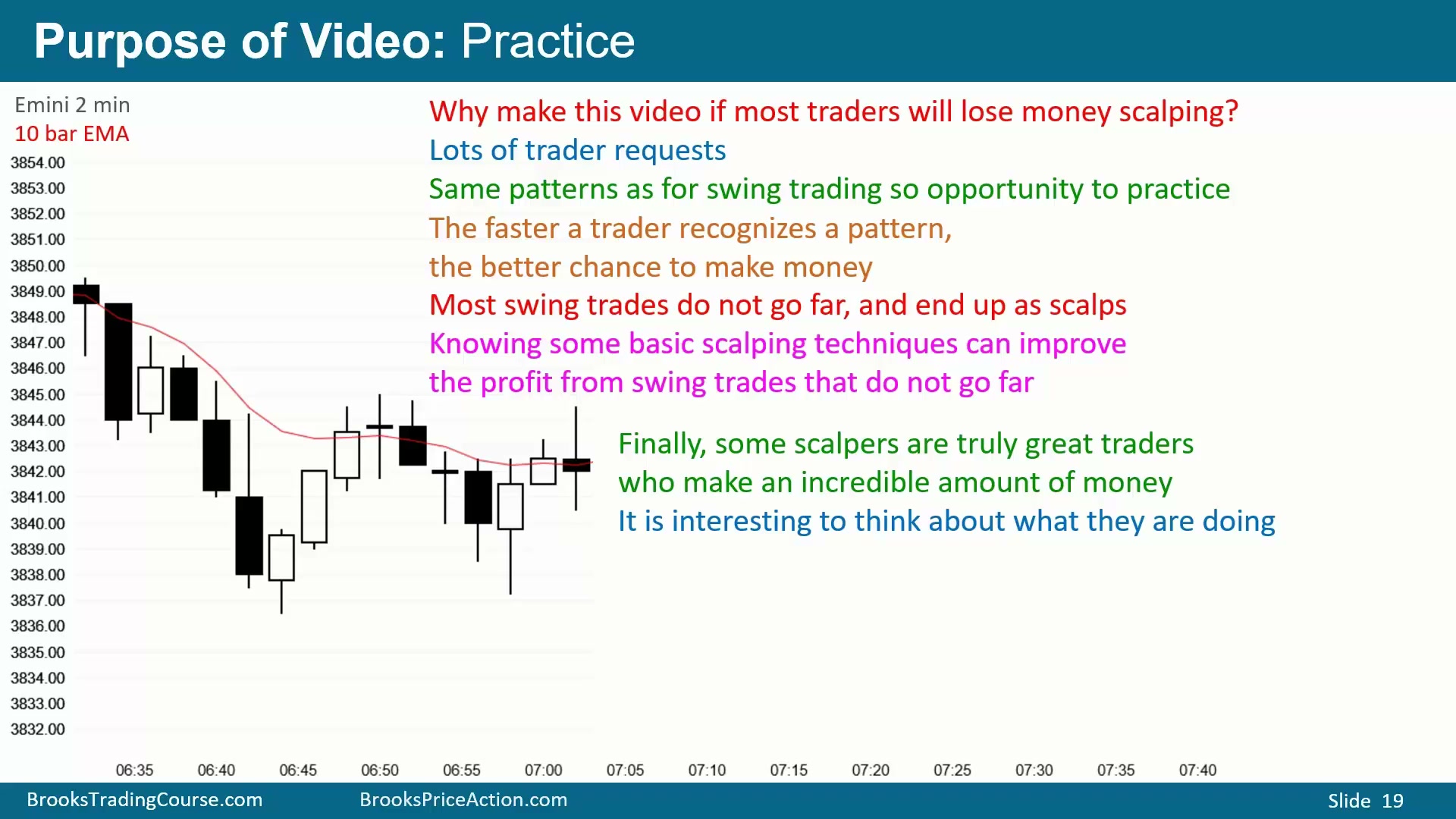
EN: Now, why am I making this video if most traders

23:50 - 23:52

EN: are going to lose money if they scalp?

23:52 - 23:57

EN: Well, first of all, I get a lot of requests to make videos on scalping.

23:58 - 24:01

EN: Also, the patterns that you’re looking for when you’re scalping,

24:01 - 24:03

EN: are the same as the patterns that you’re looking

24:03 - 24:07

EN: for when you’re swing trading, so it’s an opportunity to practice.

24:08 - 24:11

EN: The faster you get at recognizing a pattern,

24:11 - 24:13

EN: the better chance you have to make money.

24:13 - 24:15

EN: So, it’s good to practice.

24:19 - 24:23

EN: It’s important to realize that most swing trades do not go very far.

24:23 - 24:26

EN: Most of them end up as scalps, and therefore,

24:26 - 24:30

EN: if you know some basic scalping techniques, you can improve the profit

24:30 - 24:33

EN: that you make from the swing trades that do not go very far.

24:38 - 24:40

EN: Finally, some scalpers are truly great traders

24:40 - 24:43

EN: and they make an incredible amount of money.

24:43 - 24:45

EN: It’s interesting to think about what they’re doing.

24:45 - 24:50

EN: In fact, one of the traders in my chatroom – he’s been in the chatroom for years

24:50 - 24:54

EN: – he runs a hedge fund and he’s an extremely good scalper.

24:54 - 24:59

EN: I’ve seen some of his results, and I’m confident

24:59 - 25:03

EN: that he makes 20 or more points trading the Emini everyday scalping.

25:03 - 25:08

EN: So, it’s interesting and fun to think about what successful scalpers are doing.

Slide 019

Time: 25:10

Slide 019

Bilingual Transcript

25:15 - 25:18

EN: I want to go back to the point that I keep making.

25:18 - 25:20

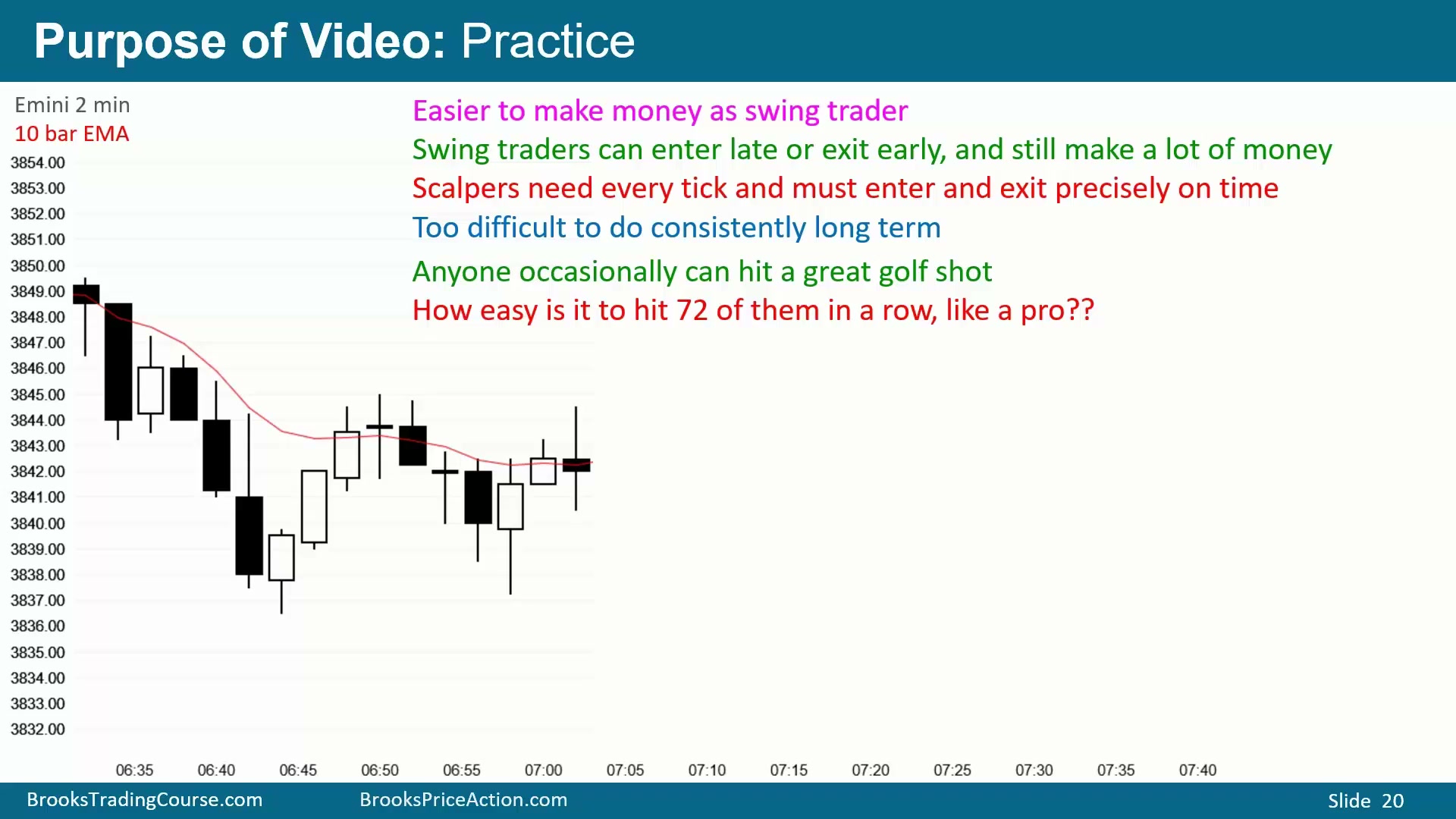
EN: It’s easier to make money as a swing trader.

25:20 - 25:24

EN: Swing traders, they can enter a little late, they can enter a little early,

25:24 - 25:27

EN: they can exit a little late, they can exit a little early.

25:27 - 25:31

EN: They don’t have to trade perfectly, and they can still make a lot of money.

25:31 - 25:33

EN: A scalper, every tick matters.

25:34 - 25:37

EN: They must enter and exit precisely at the right time.

25:37 - 25:40

EN: They cannot make mistakes, and it’s really too difficult

25:40 - 25:42

EN: to do that long term for most people.

25:46 - 25:50

EN: If you play golf, anybody can hit a great shot occasionally,

25:50 - 25:54

EN: but it’s really hard to hit 72 of them in a row like a pro.

Slide 020

Time: 26:00

Slide 020

Bilingual Transcript

26:01 - 26:04

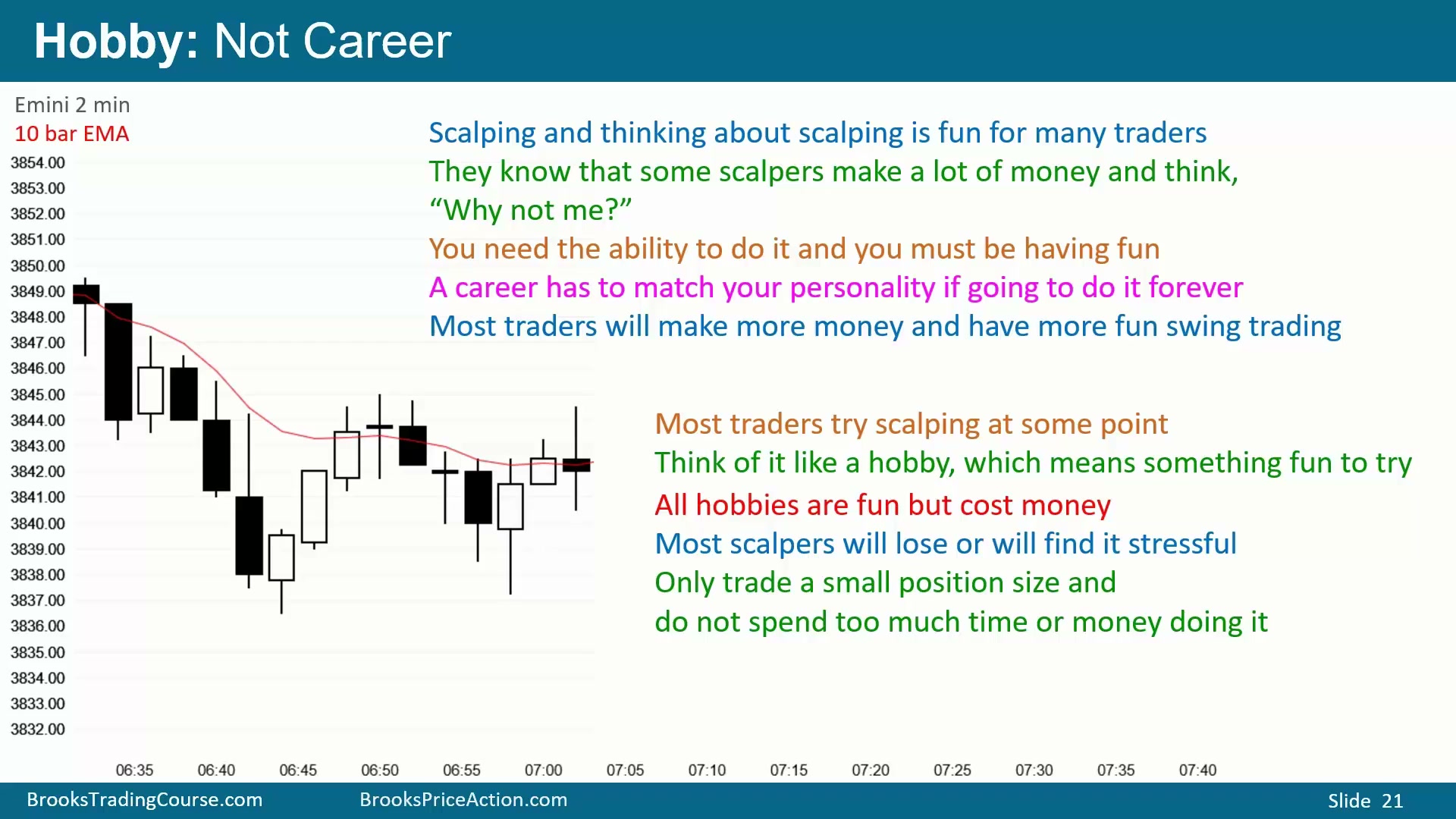
EN: Scalping and thinking about scalping, it can be fun.

26:04 - 26:07

EN: Everybody knows that scalpers make a lot of money,

26:07 - 26:10

EN: and it’s reasonable to think, “Hey, why not me?”

26:14 - 26:17

EN: Well, first of all, you need the ability to do it, and it’s difficult.

26:17 - 26:19

EN: Most traders do not have that ability.

26:19 - 26:23

EN: And then equally important is you have to be having fun.

26:23 - 26:28

EN: Your career has to match your personality if you’re going to do it forever.

26:28 - 26:33

EN: As I said, most traders will make more money and have more fun swing trading.

26:37 - 26:39

EN: Everybody tries scalping at some point.

26:40 - 26:44

EN: However, you should look at it as a hobby, which means something fun to try.

26:48 - 26:52

EN: Hobbies cost money, and most scalpers will lose money,

26:52 - 26:55

EN: or they’ll find it too stressful, not fun.

26:55 - 26:58

EN: If you do it, only trade a small position size,

26:58 - 27:02

EN: and do not spend too much time or too much money doing it.

27:02 - 27:05

EN: Remember, your career is as a swing trader,

27:05 - 27:08

EN: and that’s where you should be focusing your energy.

Slide 021

Time: 27:10

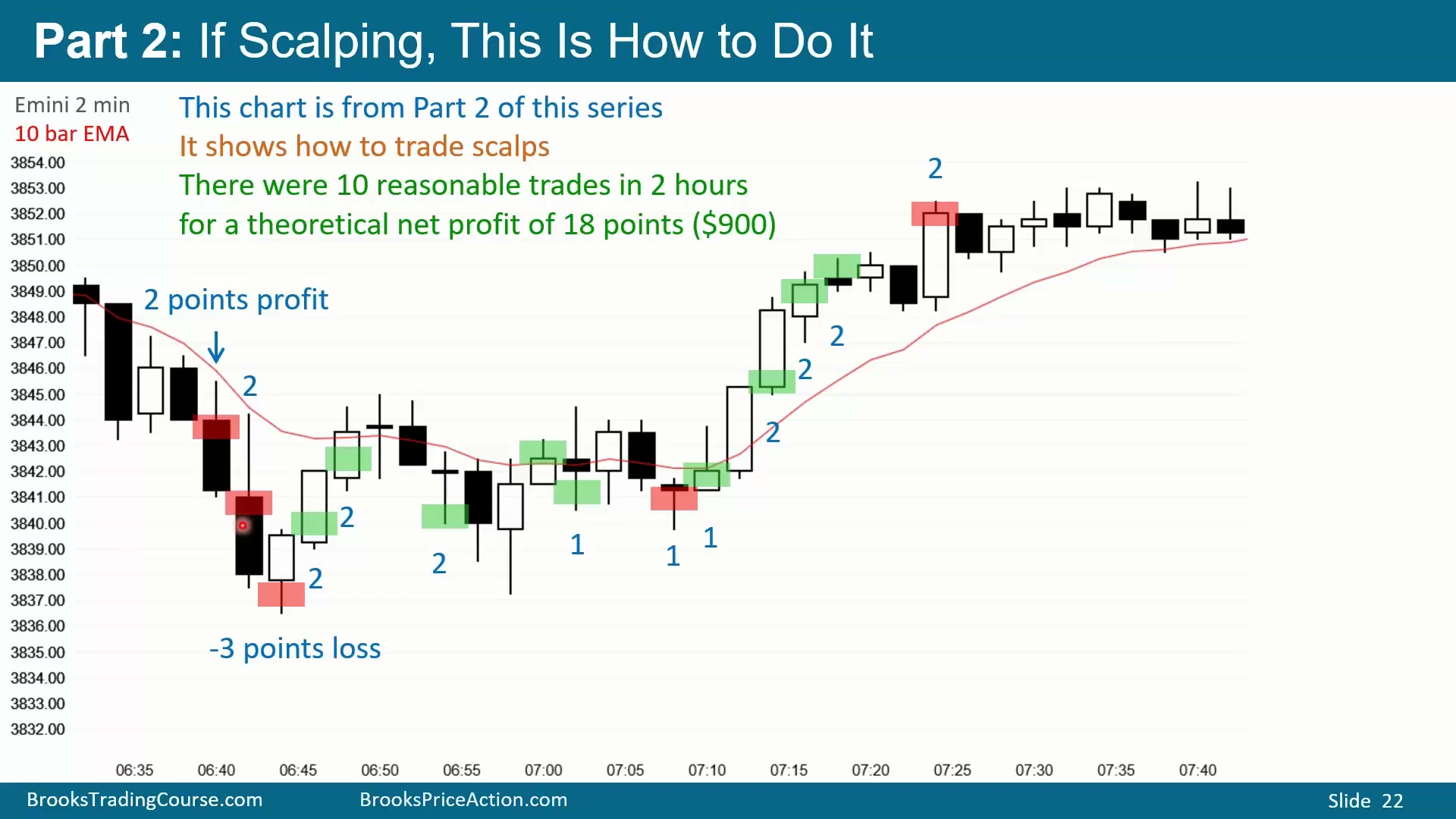
Slide 021

Bilingual Transcript

27:11 - 27:12

EN: Look at this chart.

27:12 - 27:16

EN: It’s an example of scalps over the course of a couple of hours,

27:16 - 27:19

EN: and on this scalp you can make 2 points, on that one you can make 2 points.

27:19 - 27:22

EN: If you sold below here, you’d lose 3 points.

27:23 - 27:27

EN: But when you add all of that up, you’d make about 18 points,

27:27 - 27:31

EN: $900 per contract in a couple of hours.

27:37 - 27:41

EN: In Part 2 of this series, I’m going to go through every one of these trades

27:41 - 27:43

EN: and explain what is going on.

27:48 - 27:50

EN: Again, I’m Al Brooks.

27:50 - 27:52

EN: I want to thank you so much for your attention.

27:52 - 27:55

EN: I hope that you found this information about scalping useful.

27:55 - 27:58

EN: I also wish you the best of luck in your trading.