al-brooks-course
51B - Losing Because of Mistakes
Raw transcript and slide notes for 51B - Losing Because of Mistakes.
Overview
- Slides: 17
- Transcript segments: 538
- Status: 自动按 slide 时间线归档;核心概念和长期笔记可以在每个 slide 的
Study Notes下继续整理。
Source Media
Transcript 001
Time: 00:02
Bilingual Transcript
00:02 - 00:03
EN: This is Al Brooks.
00:03 - 00:05
EN: Thank you for watching the Brooks Trading Course.
00:05 - 00:10
EN: This is the second of four videos on losing because of mistakes.
Slide 001
Time: 00:13
Bilingual Transcript
00:14 - 00:18
EN: I’m going to focus on bad management in this particular video,
00:18 - 00:21
EN: which is a major cause of losing money.
Slide 002
Time: 00:22
Bilingual Transcript
00:30 - 00:33
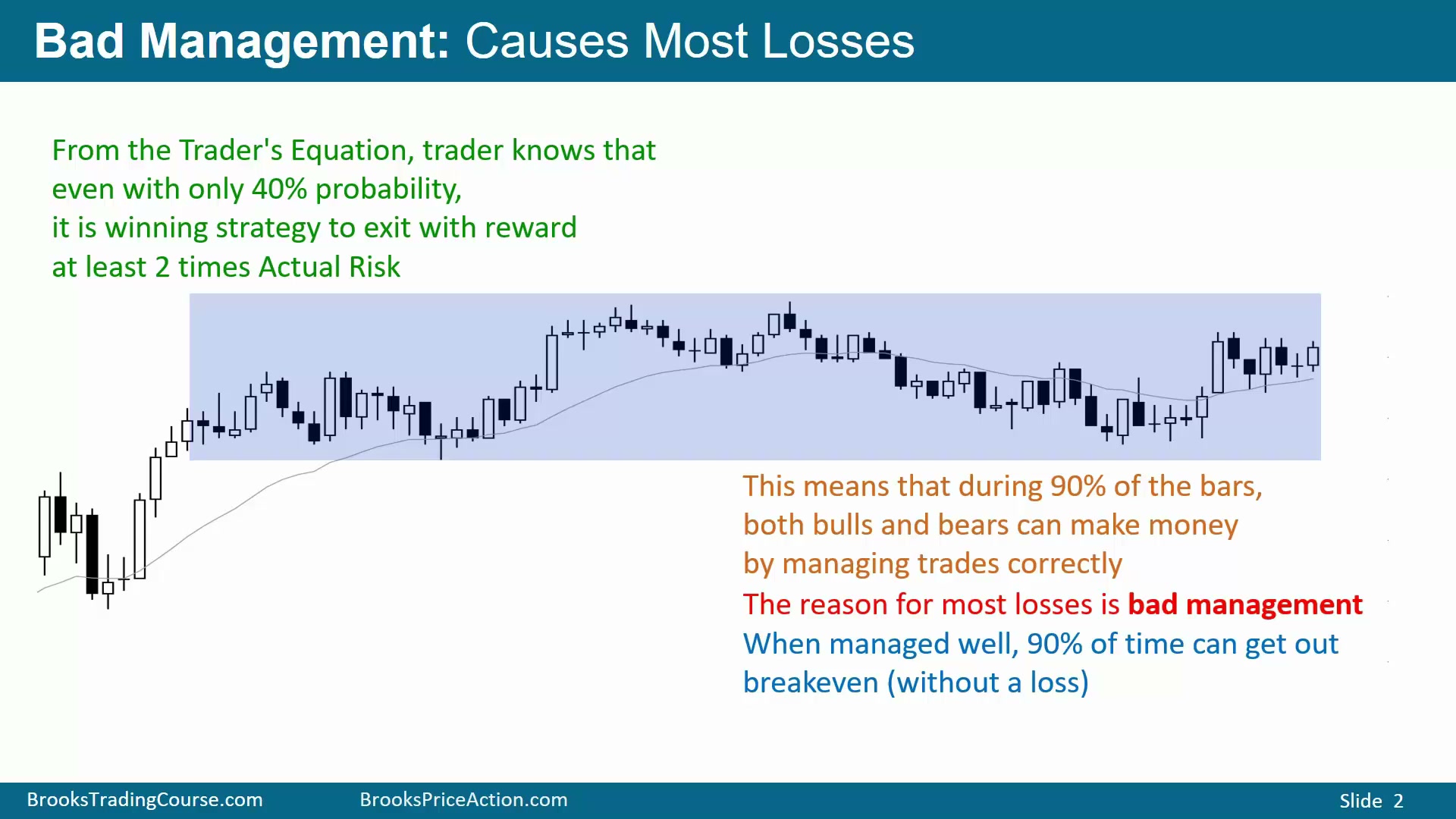
EN: From the Trader’s Equation, traders know that even
00:33 - 00:37
EN: if you only have a 40% probability of achieving your goal,
00:37 - 00:41
EN: it’s a profitable strategy if you exit with a reward two times your risk.
00:42 - 00:47
EN: Reward twice risk, even with a probability of only 40%,
00:47 - 00:49
EN: is a profitable strategy.
00:54 - 00:56
EN: Since only 10% of the bars on any chart
00:56 - 00:59
EN: are in a strong breakout, 90% of them are not.
00:59 - 01:03
EN: 90% of the bars are either in a bull channel or a bear channel
01:03 - 01:08
EN: or a Trading Range, and during these bars – 90% of the bars on the chart
01:08 - 01:12
EN: - bulls and bears can make money by managing trades correctly
01:13 - 01:17
EN: because the probability is between 40% and 60%
01:17 - 01:21
EN: for any time in here for bulls or bears.
01:21 - 01:23
EN: Selling at the low, selling at the high.
01:23 - 01:25
EN: Buying at the high, buying at the low.
01:25 - 01:29
EN: If you can manage your trade correctly – for example, scaling in,
01:29 - 01:33
EN: using appropriate stops – you can make money.
01:37 - 01:40
EN: The reason why most traders lose money is
01:40 - 01:42
EN: because they do not manage their trades well.
01:42 - 01:45
EN: A lot of times they’ll come in with a plan to do something,
01:45 - 01:49
EN: and they honestly believe they’re going to execute their plan,
01:49 - 01:52
EN: but when it comes time to make a decision, they don’t do it.
01:52 - 01:56
EN: They don’t have the emotional ability to do what they know is right,
01:56 - 01:58
EN: and the result is they lose money.
02:02 - 02:06
EN: 90% of the time if you manage your trade well, you can get out
02:06 - 02:10
EN: without a loss or with only a small loss, or you make money.
Slide 003
Time: 02:15
Bilingual Transcript
02:18 - 02:22
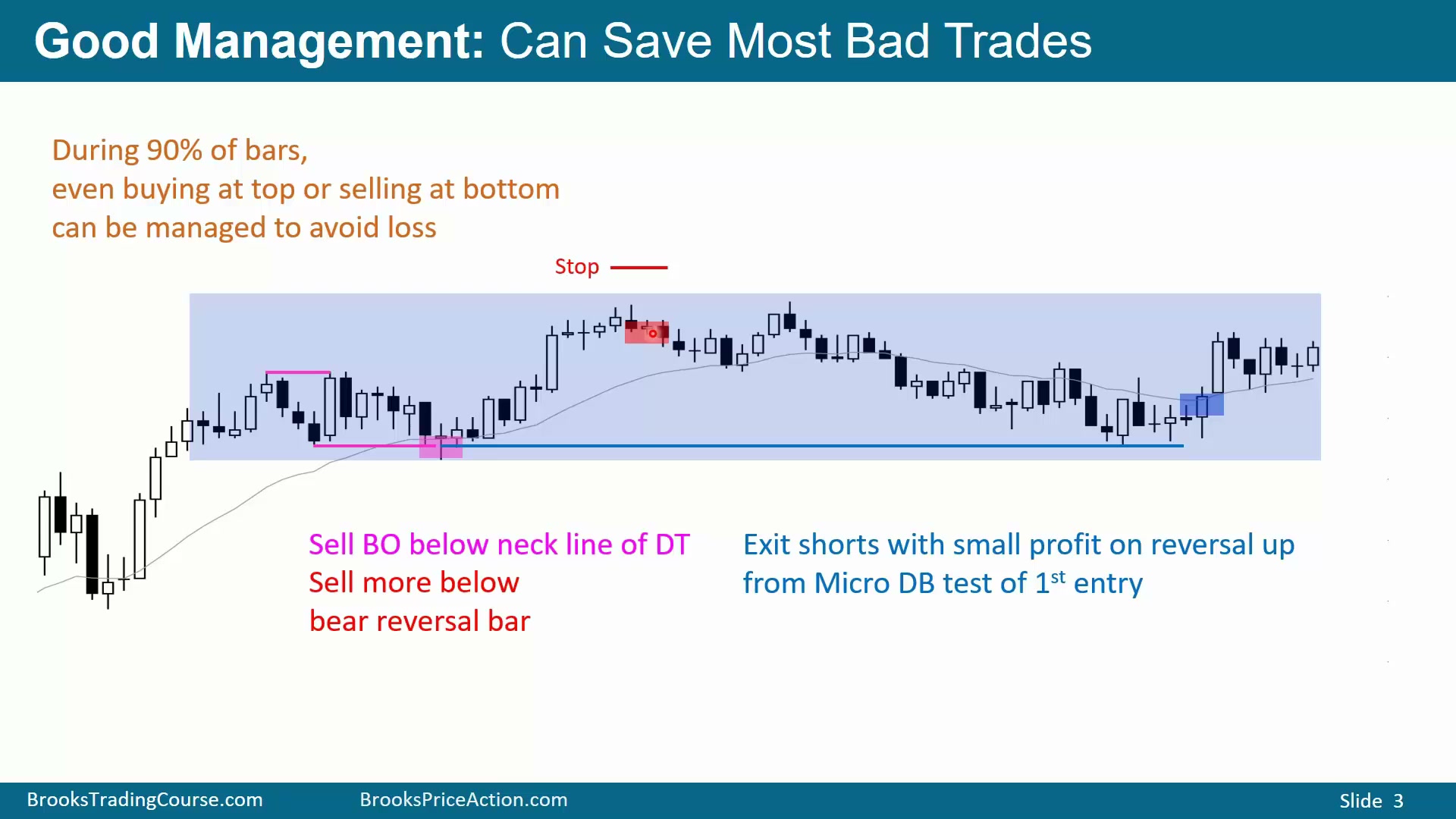
EN: If you manage your trade well, you can save even a bad trade.
02:22 - 02:25
EN: You can buy at the top of a Trading Range,
02:25 - 02:28
EN: sell at the bottom of the Trading Range, and if you manage properly,
02:28 - 02:31
EN: you can either avoid a loss or make money.
02:32 - 02:35
EN: Again, that’s during 90% of the bars.
02:35 - 02:39
EN: If you’re selling in a strong breakout, you’re probably going to lose money
02:39 - 02:42
EN: because there’s a 70% chance the market’s going higher.
02:42 - 02:47
EN: Whereas in here, there’s only a 60% chance that the market is going higher
02:47 - 02:51
EN: after a rally, and only a 60% chance it’s going to go lower, at most.
02:51 - 02:55
EN: The probabilities for the most part are between 40% and 60%.
02:59 - 03:03
EN: For example, let’s say you sold below the neckline of this Double Top.
03:03 - 03:05
EN: We have a Double Top; here’s the neckline.
03:05 - 03:10
EN: If you sell with a stop just below this low, you’d get filled right here.
03:15 - 03:18
EN: If you use a wide stop – maybe a Measured Move up based upon the height
03:18 - 03:22
EN: of this first leg up – and then waited for a bear bar
03:22 - 03:24
EN: and sold more below the low of that bear bar,
03:24 - 03:28
EN: and then from there used a fairly wide stop,
03:28 - 03:31
EN: you should be able to make money or at least avoid a loss.
03:37 - 03:41
EN: Traders who sold here, sell more with a stop here,
03:41 - 03:45
EN: are hoping that the market comes back to their entry price at this low
03:45 - 03:48
EN: so they can get out breakeven on their first sell
03:48 - 03:50
EN: and with a profit on their second sell.
03:50 - 03:53
EN: You want the second sell to be at least two to three times the size
03:53 - 03:56
EN: of a minimum scalp above the first entry
03:56 - 03:59
EN: so that if it comes down to your target,
03:59 - 04:02
EN: you’ll make two to three times the size of a minimum scalp.
04:02 - 04:05
EN: Here the market got down to the target late in the session.
04:05 - 04:09
EN: Did not fill it, had to go 1 tick below that low for you
04:09 - 04:11
EN: to get out breakeven on this sell.
04:11 - 04:13
EN: It reversed up again a second time.
04:14 - 04:15
EN: You’re getting late in the session.
04:15 - 04:18
EN: Reasonable to get out – and if you did that,
04:18 - 04:21
EN: you would have lost a small amount on your first sell
04:21 - 04:23
EN: and you would have made a bigger amount on your second sell,
04:24 - 04:27
EN: and you would have made a small net profit
04:27 - 04:31
EN: even though you were selling at the bottom of a bull flag in a bull trend.
04:33 - 04:36
EN: If you’re a beginner, would you have done that? Of course not.
04:37 - 04:40
EN: You probably would have sold the reversal, even though it’s a bull trend.
04:40 - 04:44
EN: However, you probably would have gotten out maybe here
04:44 - 04:47
EN: - this is a Give-up Bar, a sign that the weak bears are giving up
04:47 - 04:50
EN: - and you would never have been able to add to your position.
04:50 - 04:52
EN: Also, your account size is probably too small,
04:52 - 04:55
EN: and you probably are trading too large of a position
04:55 - 04:58
EN: to add on here and use the appropriate stop.
04:59 - 05:02
EN: So your intention was good, thinking that “I’ll sell here;
05:02 - 05:06
EN: if it goes higher I’ll sell more,” but when it actually goes higher,
05:06 - 05:08
EN: emotionally you’re scared of losing too much money,
05:08 - 05:12
EN: and you get out here instead of managing your trade appropriately.
05:13 - 05:18
EN: You had an unrealistic goal for where you were emotionally as a trader
05:18 - 05:21
EN: and for the size of your account, and you probably were trading
05:21 - 05:25
EN: too big of a position to allow you to execute that goal.
05:25 - 05:27
EN: You cared too much.
05:27 - 05:29
EN: You were thinking too much about losing money,
05:29 - 05:33
EN: and the result was you could not manage the trade properly.
Slide 004
Time: 05:35
Bilingual Transcript
05:40 - 05:43
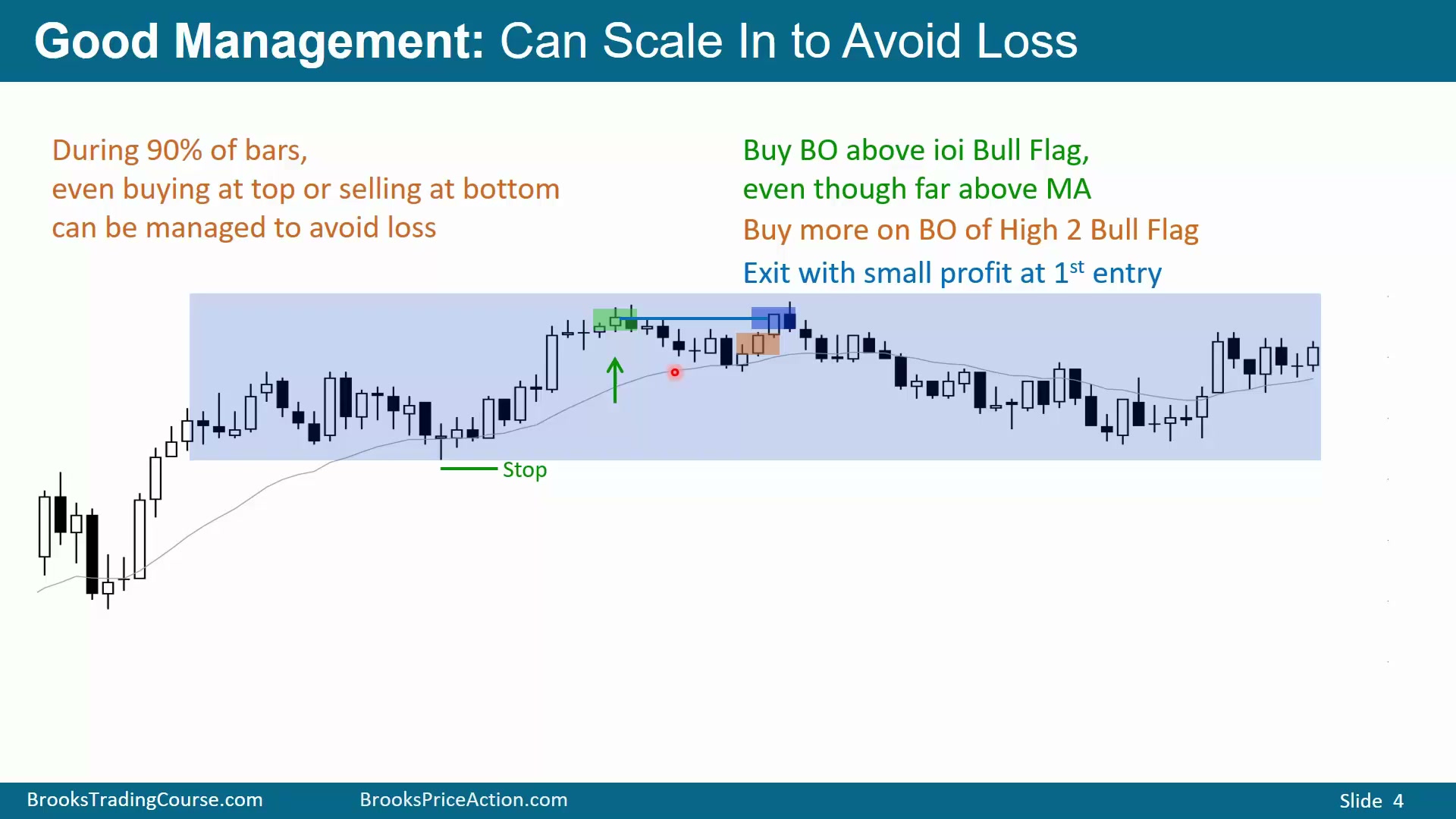
EN: We’re in a bull trend, and let’s say you bought here.
05:43 - 05:46
EN: You got a small bull flag, and you put your stop appropriately
05:46 - 05:48
EN: below the most recent major Higher Low.
05:48 - 05:52
EN: Here you are buying what turned out to be just about the high of the day.
05:52 - 05:54
EN: If you manage your trade correctly,
05:54 - 05:59
EN: 90% chance you’ll either make a little money or you’ll avoid a loss.
06:03 - 06:06
EN: The market sold off for a couple legs – one, pullback, two
06:06 - 06:08
EN: - and you have a bull bar closing on its high.
06:08 - 06:11
EN: You’re pulling back to the Moving Average.
06:11 - 06:13
EN: Traders can buy more on a stop above that bull bar
06:13 - 06:17
EN: as long as this is at least two to three times
06:17 - 06:19
EN: the size of a scalp below the first entry.
06:20 - 06:22
EN: In a strong bull trend like this, a lot of traders will buy
06:22 - 06:26
EN: even if it’s only one times the size of a minimum scalp.
06:26 - 06:29
EN: So let’s say this is a Forex market.
06:29 - 06:33
EN: A trader will buy as long as it’s 10 pips below his first entry.
06:33 - 06:37
EN: If it’s the Emini, he’ll buy as long as it’s 1 point below his first entry.
06:42 - 06:45
EN: He’s disappointed by the extent of the selloff, and now he’s thinking
06:45 - 06:47
EN: that maybe it’s a Trading Range instead of a bull trend.
06:48 - 06:50
EN: If it’s a Trading Range, he does not want to be buying high,
06:50 - 06:53
EN: so he’s looking to exit on his first entry breakeven
06:53 - 06:56
EN: and get out with a scalp on his second entry.
06:57 - 06:58
EN: He avoided a loss.
06:58 - 07:00
EN: In fact, he made a small profit
07:00 - 07:03
EN: - even buying at the high of what became a Trading Range.
07:04 - 07:06
EN: It sounds easy to do, but these things are things
07:06 - 07:09
EN: that beginners simply cannot do.
07:10 - 07:11
EN: Over time you can do it.
07:11 - 07:14
EN: You don’t get emotional about the market going against you.
07:14 - 07:17
EN: You know as long as it stays above this low,
07:17 - 07:19
EN: it’s either a bull trend and you’ll make a quick profit,
07:19 - 07:23
EN: or it’ll be a Trading Range and you’ll be able to avoid a loss.
07:24 - 07:27
EN: That sounds good, but it’s very difficult for a beginner to do.
07:27 - 07:30
EN: He knows it’s the right thing to do, but he’s thinking so much
07:30 - 07:33
EN: about money that he cannot do it.
07:33 - 07:37
EN: If you cannot manage a trade correctly, you cannot take the trade.
07:37 - 07:42
EN: You cannot buy here, put a stop below here, and then plan to add on here
07:42 - 07:45
EN: if you’re going to be afraid, if it’s too much money.
07:45 - 07:48
EN: If you cannot take the trade and manage it properly,
07:48 - 07:52
EN: simply wait for a trade that you can manage properly.
Slide 005
Time: 07:55
Bilingual Transcript
08:02 - 08:05
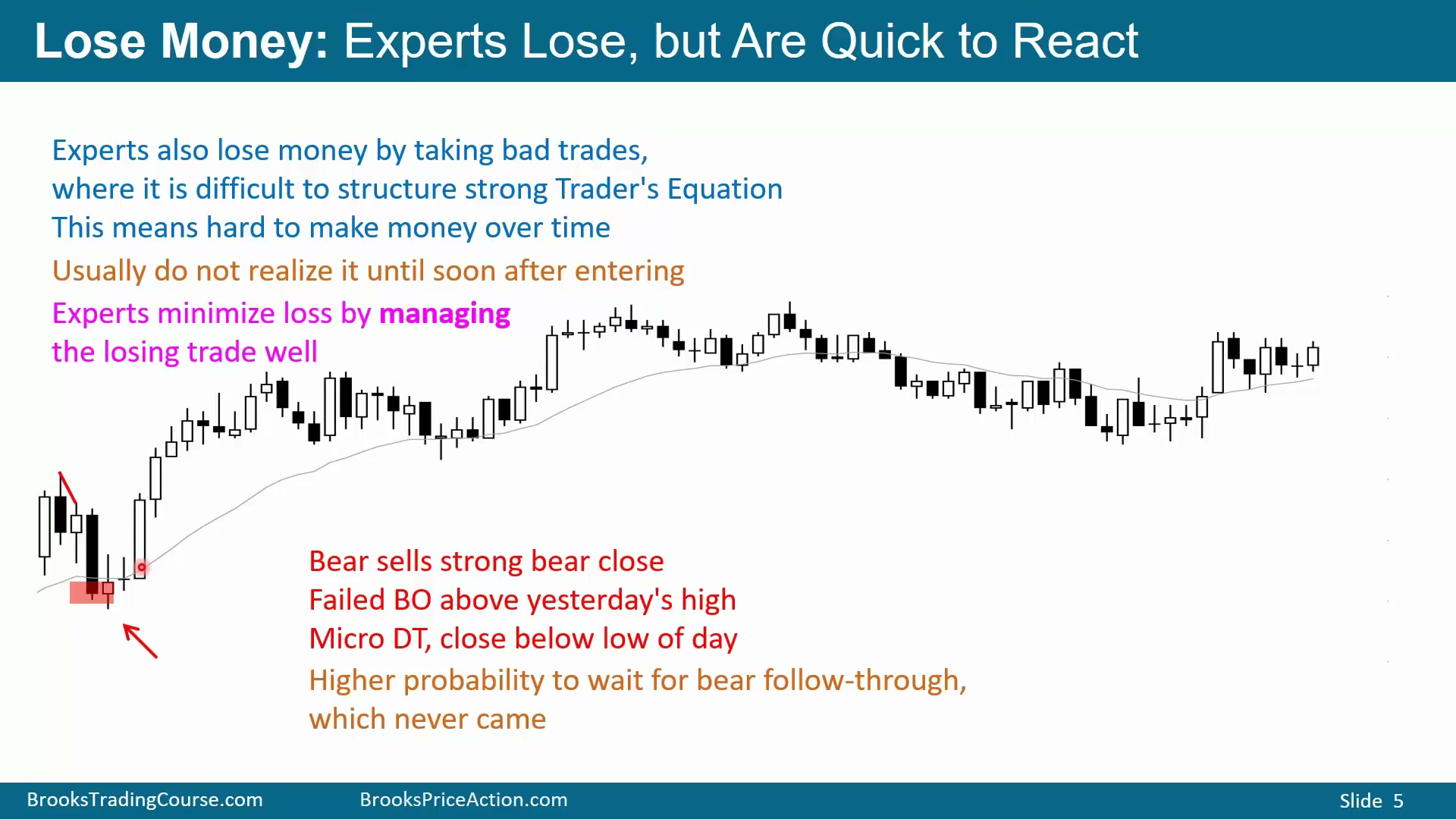
EN: Experts also lose money by taking bad trades.
08:06 - 08:08
EN: However, they don’t take bad trades very often,
08:08 - 08:11
EN: and they usually get out pretty quickly,
08:11 - 08:12
EN: as soon as they decide it’s a bad trade.
08:14 - 08:17
EN: Some trades are simply very difficult to structure profitably.
08:17 - 08:21
EN: It’s very difficult to structure a profitable Trader’s Equation.
08:23 - 08:26
EN: One is selling in a strong bull breakout.
08:26 - 08:27
EN: That’s a mistake.
08:27 - 08:32
EN: Another is buying in a Tight Trading Range, especially with a stop order.
08:32 - 08:35
EN: If you do something and you, within the next minute,
08:35 - 08:38
EN: decide you made a mistake – or at any time you decide you made a mistake
08:38 - 08:41
EN: - it’s usually better just to get out and take the loss.
08:46 - 08:49
EN: That’s part of trade management, and that’s what expert traders do.
08:49 - 08:54
EN: They manage their trades well, so when they get a loss, the loss is not too big.
09:00 - 09:03
EN: Let’s say you see a Micro Double Top.
09:03 - 09:06
EN: The market went up and then down, and then up again,
09:06 - 09:09
EN: and we’re breaking below the Micro Double Top.
09:09 - 09:10
EN: You can call it a Double Bottom.
09:10 - 09:13
EN: We’re breaking below the Double Bottom, and you have a very big bear bar.
09:13 - 09:17
EN: Let’s say you’re an experienced trader and you sold this close.
09:17 - 09:19
EN: Most traders would not do that.
09:19 - 09:22
EN: They would wait for one more bear close, which did not happen.
09:22 - 09:24
EN: We have a bull close on this bar.
09:29 - 09:30
EN: You never got the bear close.
09:30 - 09:35
EN: If you decided once you took this sell and then you saw this bull close that,
09:35 - 09:38
EN: oops, you made a mistake, you simply get out.
09:38 - 09:41
EN: You can get out on the close of this bar or above its high.
09:41 - 09:45
EN: Look at the open of this bar and the close of this bar.
09:45 - 09:49
EN: What do you know? The open of this bar is above the close of this bar,
09:49 - 09:52
EN: and that tells you that a lot of the bears who sold here
09:52 - 09:55
EN: did not like the bull close, and as soon as they saw this bar close
09:55 - 09:58
EN: with a bull body, they hit “Buy the Market” to get out
09:58 - 10:00
EN: as soon as they saw this bull close.
10:00 - 10:04
EN: There were so many traders buying the close of this bull bar,
10:04 - 10:07
EN: the open of this bar was above the close of this bar.
10:08 - 10:10
EN: That’s a warning that a lot of traders were buying.
10:10 - 10:13
EN: A lot of them were bears deciding it was a bad trade,
10:13 - 10:16
EN: and here’s where the final bears gave up.
Slide 006
Time: 10:20
Bilingual Transcript
10:23 - 10:26
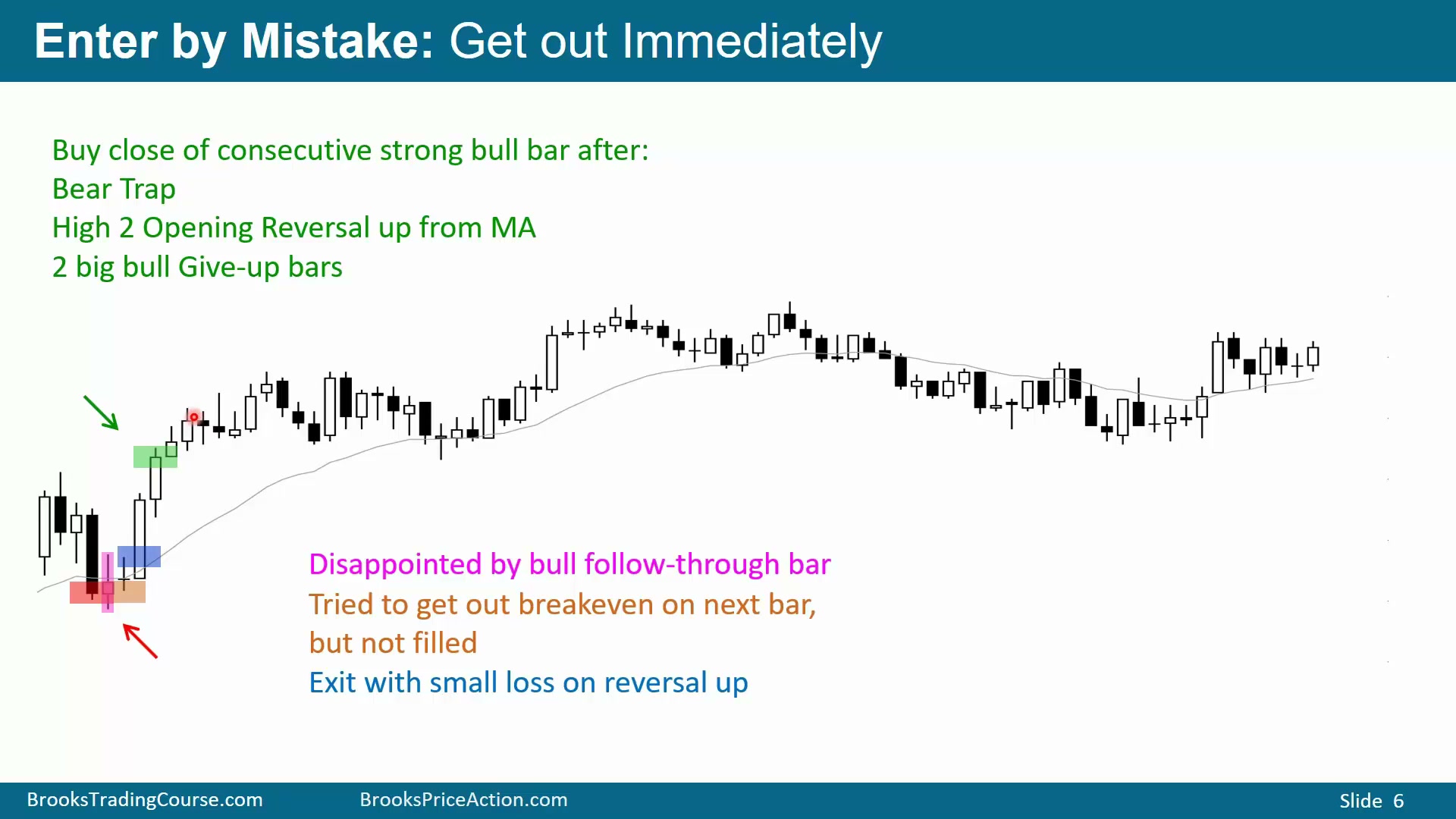
EN: The bears who sold that close or sold below this Double Bottom
10:26 - 10:28
EN: are disappointed by the follow-through bar.
10:28 - 10:29
EN: They wanted immediate follow-through.
10:29 - 10:32
EN: Look at the bulls who bought this close or that close.
10:32 - 10:35
EN: They have follow-through, and that increased the chances
10:35 - 10:36
EN: that they would get higher prices.
10:36 - 10:39
EN: Here you have a bear breakout, but a reversal bar,
10:39 - 10:41
EN: a bull bar for the follow-through.
10:41 - 10:46
EN: Bad follow-through makes it unlikely that it’s going to go much lower.
10:50 - 10:53
EN: If you sold that close and you were disappointed by this bull bar,
10:53 - 10:55
EN: you might place a limit order to get out breakeven.
10:56 - 11:00
EN: To get out, you need the market to trade back below that close.
11:00 - 11:01
EN: Look at the low of this bar.
11:02 - 11:06
EN: It did not get below that bear close, and therefore if you had an order
11:06 - 11:08
EN: to get out breakeven, you would not have been filled.
11:09 - 11:13
EN: Some traders instead would place the order to get out just a little bit
11:13 - 11:16
EN: above that close, thinking that there may be so many traders
11:16 - 11:19
EN: trying to buy that close, it may not get to that close.
11:19 - 11:21
EN: It has to go below this close to get filled.
11:22 - 11:24
EN: Those traders were able to get out.
11:24 - 11:28
EN: The ones who tried to get out with zero loss, who tried to get out
11:28 - 11:33
EN: with a limit order at this close, were trapped, and you can see what happened.
11:33 - 11:35
EN: They bought back their shorts here.
11:35 - 11:36
EN: They were giving up.
11:36 - 11:40
EN: The bulls saw that the bears were trapped, and they were ready to buy as well.
11:44 - 11:47
EN: The experienced trader, if he could not get out, he’s going to get out maybe
11:47 - 11:50
EN: at the close of this bar or on a stop above that bull bar,
11:50 - 11:53
EN: and he’ll get out here with a small loss.
11:53 - 11:56
EN: That will allow him to start doing the right thing and buy
11:56 - 11:59
EN: and make a lot more profit than what he lost
11:59 - 12:01
EN: when he managed his trade correctly by getting out quickly.
12:01 - 12:03
EN: He took a bad entry.
12:03 - 12:06
EN: If he gets out quickly, he’s fine.
12:06 - 12:09
EN: He can take buys and more than make up for the loss.
12:17 - 12:20
EN: For example, he could wait for 2 big bull bars closing on their highs.
12:20 - 12:22
EN: Now there’s a high probability the market’s going up
12:22 - 12:25
EN: for at least a Measured Move based upon the open
12:25 - 12:27
EN: of this bar to the close of that bar.
12:27 - 12:29
EN: Maybe 70% chance we’ll go up.
12:30 - 12:32
EN: A reasonable Buy The Close situation.
12:32 - 12:35
EN: Or buy the close of any of these bars, even this bear bar.
12:35 - 12:38
EN: The odds are after this much of a reversal,
12:38 - 12:39
EN: we’re going at least a little higher.
Slide 007
Time: 12:45
Bilingual Transcript
12:54 - 12:55
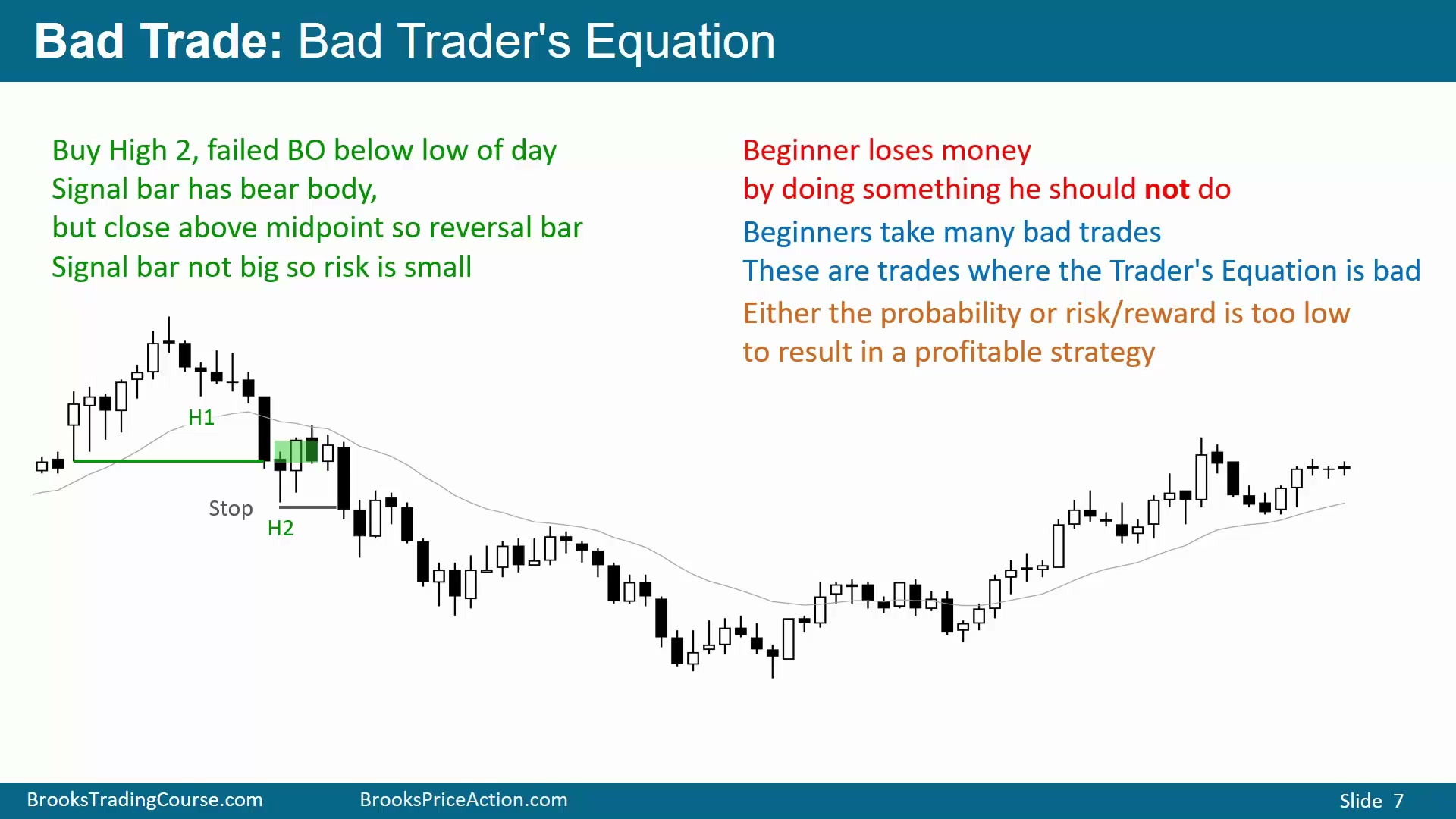
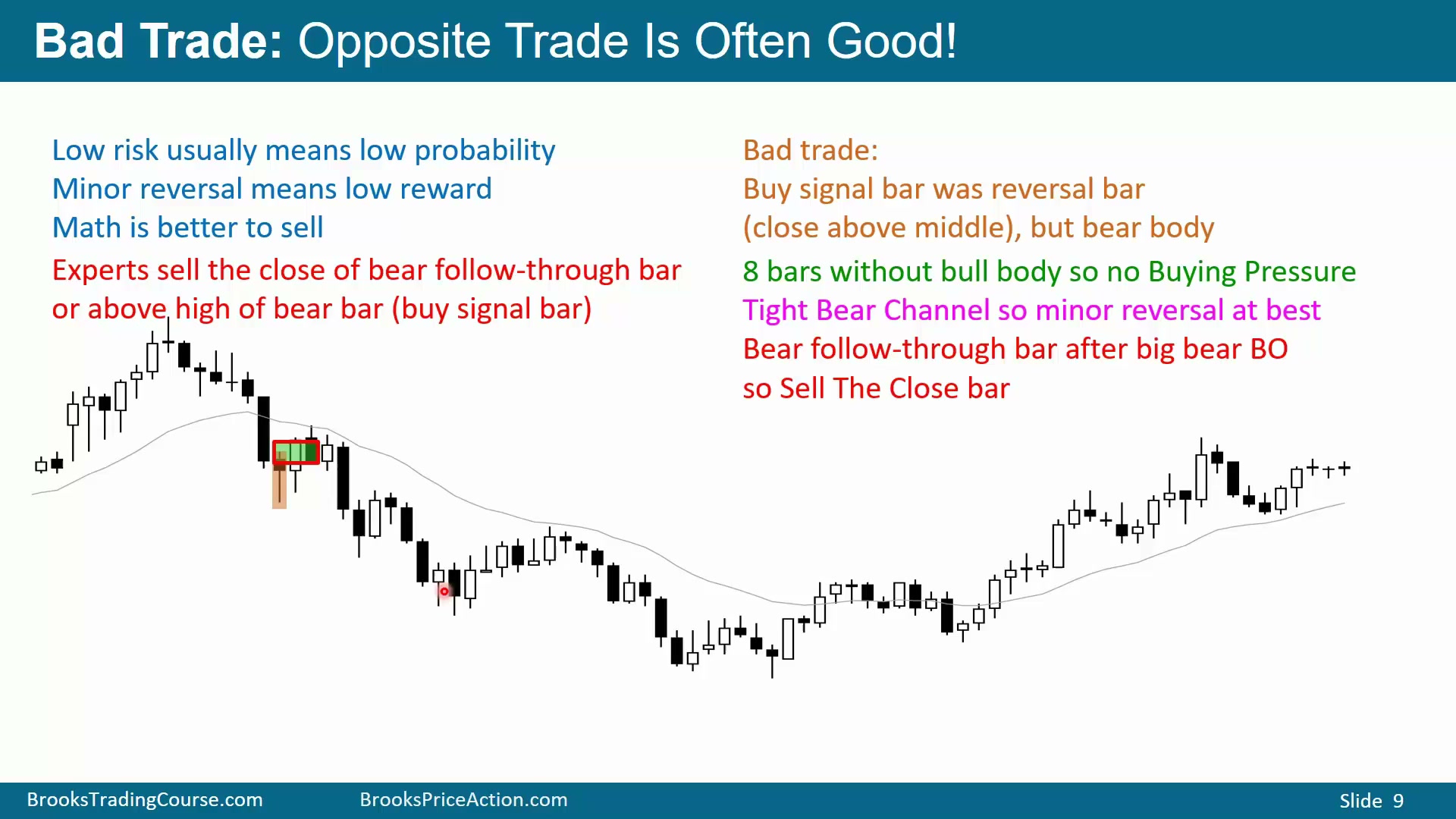
EN: We have a Double Bottom.
12:56 - 12:58
EN: We went up; we’re trying to go up again.
12:58 - 13:01
EN: Can you buy above this bar, hoping for a Double Bottom?
13:01 - 13:05
EN: It’s also a High 2 – High 1, pullback, High 2.
13:05 - 13:09
EN: We have a reversal bar – the close of this bar is above the middle,
13:09 - 13:12
EN: so it’s a reversal bar – but it has a bear body.
13:12 - 13:16
EN: It’s also following a lot of bars without a bull body,
13:16 - 13:17
EN: and it’s following a big bear breakout.
13:18 - 13:21
EN: This is a big bear breakout bar and a follow-through bar.
13:21 - 13:23
EN: The odds are we’re going at least a little lower.
13:24 - 13:25
EN: This is a bad buy.
13:26 - 13:29
EN: If you take this as a High 2 and a Double Bottom,
13:29 - 13:33
EN: it’s a low probability bet after this many bars without a bull body.
13:34 - 13:36
EN: The Trader’s Equation is bad.
13:37 - 13:41
EN: The probability of making money is probably 30% or less.
13:41 - 13:45
EN: This is a strong enough breakout to have a 70% chance of at least lower prices.
13:46 - 13:50
EN: You’re taking a buy that is probably a minor reversal
13:50 - 13:54
EN: - a very Tight Bear Channel, unlikely to lead to a major reversal
13:54 - 13:58
EN: - and therefore a minor reversal means profit potential is small.
13:58 - 14:02
EN: You’re taking a low probability buy with very little reward
14:03 - 14:06
EN: and relatively big risk compared to the reward.
14:06 - 14:09
EN: So bad risk/reward and bad probability.
14:09 - 14:11
EN: That tells you this is a bad buy.
14:11 - 14:13
EN: In fact, there probably are more sellers
14:13 - 14:16
EN: at the high of this bar than there are buyers.
14:19 - 14:21
EN: Beginners do this all the time.
14:21 - 14:23
EN: All they see is a High 2 and a Double Bottom.
14:23 - 14:24
EN: They’re eager to trade.
14:24 - 14:25
EN: They take the buy.
14:30 - 14:35
EN: Beginners take a lot of bad trades – trades where the Trader’s Equation is bad
14:36 - 14:39
EN: - and it’s usually better to do the exact opposite.
14:39 - 14:42
EN: Expert traders see this breakout and this reversal down,
14:42 - 14:44
EN: and they’re eager to sell.
14:44 - 14:48
EN: When they see this bear bar, they know the odds of a reversal up are small.
14:48 - 14:51
EN: They’re selling with a limit order above the high of this bear bar
14:51 - 14:55
EN: or with a stop below the low of this bear bar, expecting a trend down.
15:02 - 15:07
EN: In this particular case, the probability and the risk/reward are bad,
15:07 - 15:10
EN: and therefore taking this bet is the wrong thing to do.
15:10 - 15:12
EN: You should be doing the exact opposite.
15:12 - 15:16
EN: It’s a bad trade, but beginners do that all the time.
15:18 - 15:21
EN: Whenever you take any trade, if the probability is especially low
15:21 - 15:26
EN: or the risk/reward is especially bad, it’s very difficult to make money.
Slide 008
Time: 15:30
Bilingual Transcript
15:35 - 15:40
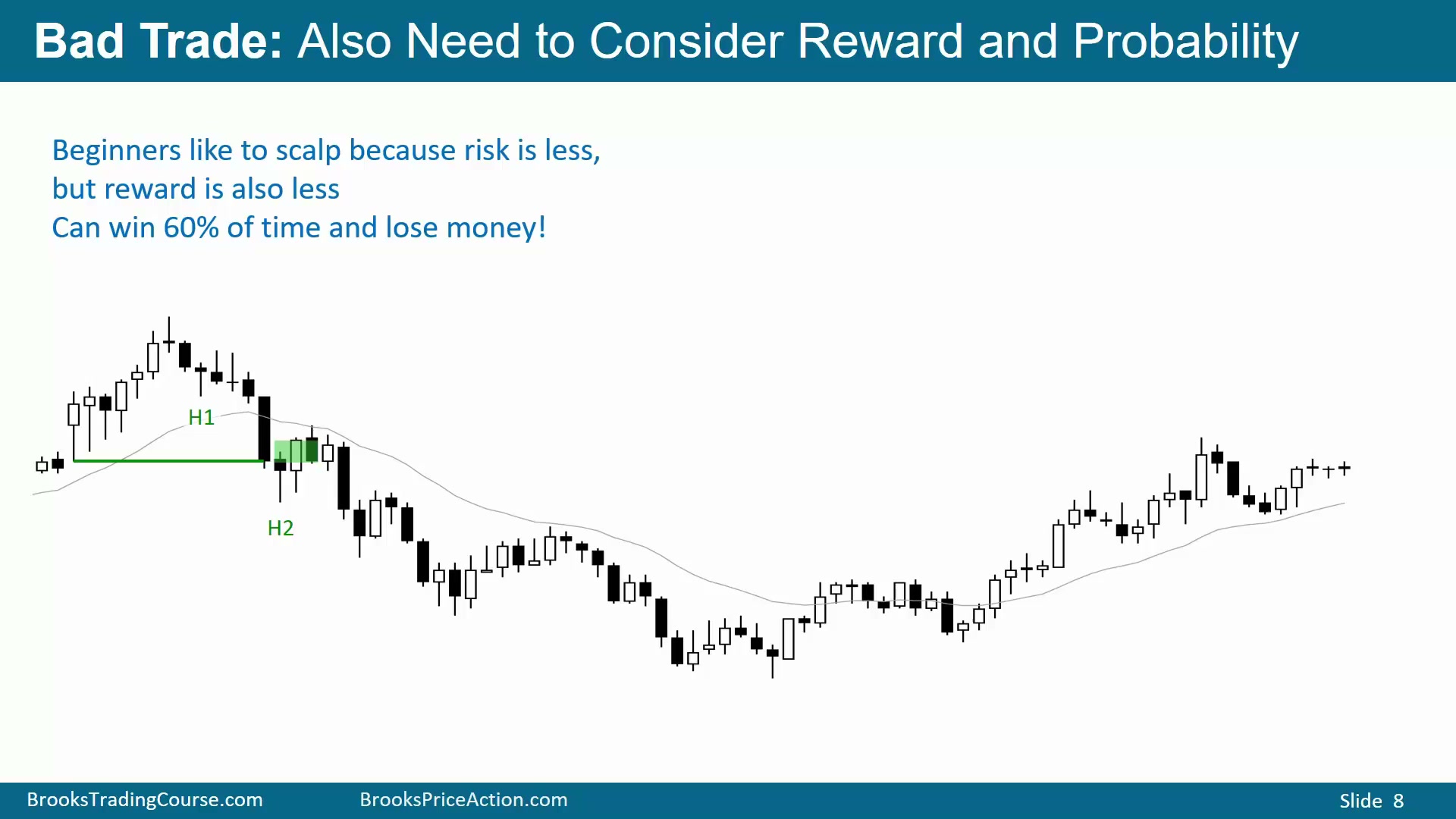
EN: Beginners tend to focus only on risk because they’re afraid
15:40 - 15:44
EN: of losing their account, which would mean the death of their dream as a trader.
15:44 - 15:45
EN: So they focus on risk.
15:46 - 15:49
EN: They therefore like to trade trades that have very low risk.
15:49 - 15:51
EN: If they’re taking a trade with very low risk,
15:51 - 15:54
EN: they tend to go for quick profits as well.
15:54 - 15:56
EN: As soon as they get any profit, they’re happy,
15:56 - 15:58
EN: and that means they tend to scalp.
15:58 - 16:03
EN: However, you’re going for a small reward relative to risk.
16:03 - 16:06
EN: Let’s say your reward is only one times your risk.
16:06 - 16:10
EN: Even if you win 60% of the time, you’re going to lose money.
16:10 - 16:14
EN: If you’re going for a reward where the risk is slightly greater
16:14 - 16:18
EN: than your reward, you have to win 70% or 80% of the time to break even,
16:18 - 16:21
EN: and close to 90% of the time to consistently make money.
16:22 - 16:24
EN: That’s just not going to happen if you’re a beginner.
16:24 - 16:28
EN: If you’re a beginner, you’ll be happy to win 40% of the time,
16:28 - 16:31
EN: and this is a mistake that beginners make all the time.
16:31 - 16:34
EN: They just focus on risk and they want small profit.
16:34 - 16:35
EN: Any profit will make them happy.
16:36 - 16:39
EN: By doing that, it’s a horrible Trader’s Equation
16:39 - 16:41
EN: and they’re going to lose money.
16:41 - 16:44
EN: Yes, they will not lose much money on any one trade,
16:44 - 16:47
EN: but if you do it three or four times a day,
16:47 - 16:48
EN: you start to lose money pretty quickly.
16:48 - 16:50
EN: It adds up to a lot.
16:57 - 17:00
EN: Whenever the risk on any trade is greater than the reward,
17:01 - 17:05
EN: 60% probability is just not enough to have a good Trader’s Equation.
17:05 - 17:09
EN: You have to be winning 70%, 80%, 90% of the time
17:09 - 17:12
EN: - and you have to manage all those trades very, very well.
17:13 - 17:16
EN: That’s simply impossible for a person starting out.
17:16 - 17:19
EN: Therefore, beginners should not scalp.
17:27 - 17:30
EN: Think about this: if you have a low-risk trade,
17:30 - 17:33
EN: then you have a very good risk/reward situation.
17:34 - 17:36
EN: Low risk means good risk/reward.
17:37 - 17:39
EN: However, there always has to be a reason
17:39 - 17:42
EN: for an institution to take the opposite side of your trade.
17:42 - 17:48
EN: If you have fantastic risk/reward, that institution has fantastic probability.
Slide 009
Time: 17:45
Bilingual Transcript
17:48 - 17:50
EN: In other words, he has a high probability of winning
17:50 - 17:52
EN: if you have great risk/reward.
17:52 - 17:56
EN: If he has a high probability of winning, you have a low probability of winning.
17:56 - 17:59
EN: That means you’re probably going to lose.
18:01 - 18:04
EN: If you’re buying in a Tight Bear Channel with no bull bars,
18:04 - 18:08
EN: it’s a very low probability trade and it’s a minor reversal,
18:08 - 18:12
EN: which means it’s either a bear flag or it’s part of a Trading Range.
18:12 - 18:13
EN: Your reward is going to be low.
18:14 - 18:18
EN: Therefore if you’re looking to trade, you can only look to sell.
18:18 - 18:22
EN: You cannot be looking to buy when the trade you’re considering has low reward
18:22 - 18:26
EN: - in other words, bad risk/reward – and low probability.
18:26 - 18:27
EN: It’s better to do the opposite.
18:34 - 18:35
EN: It’s a bad trade.
18:35 - 18:39
EN: You have a reversal bar, but it’s a bear body and it’s following a big bear bar.
18:48 - 18:51
EN: You have 8 bars without a bull body, so there’s no Buying Pressure.
18:51 - 18:55
EN: You have a Tight Bear Channel, so the only reversal
18:55 - 18:57
EN: you’ll get is minor, which means a small reward.
18:58 - 19:01
EN: And that bear body, even though it’s a reversal bar,
19:01 - 19:06
EN: it’s a bear body after a bear breakout, and therefore it confirms the breakout
19:06 - 19:10
EN: and it means there’s a 70% chance we’re going at least a little bit lower.
19:10 - 19:11
EN: And you’re buying.
19:11 - 19:12
EN: You cannot do that.
19:19 - 19:21
EN: An experienced trader will do the opposite.
19:21 - 19:23
EN: He’ll say, “Wow, that’s a good breakout,
19:23 - 19:26
EN: a bear body for follow-through, decent follow-through.
19:26 - 19:28
EN: It should go down.
19:28 - 19:31
EN: I’m going to sell with a limit order above the high of that bar,”
19:31 - 19:33
EN: and that’s exactly where you’re looking to buy.
19:33 - 19:35
EN: The expert trader is doing the opposite.
Slide 010
Time: 19:40
Bilingual Transcript
19:43 - 19:47
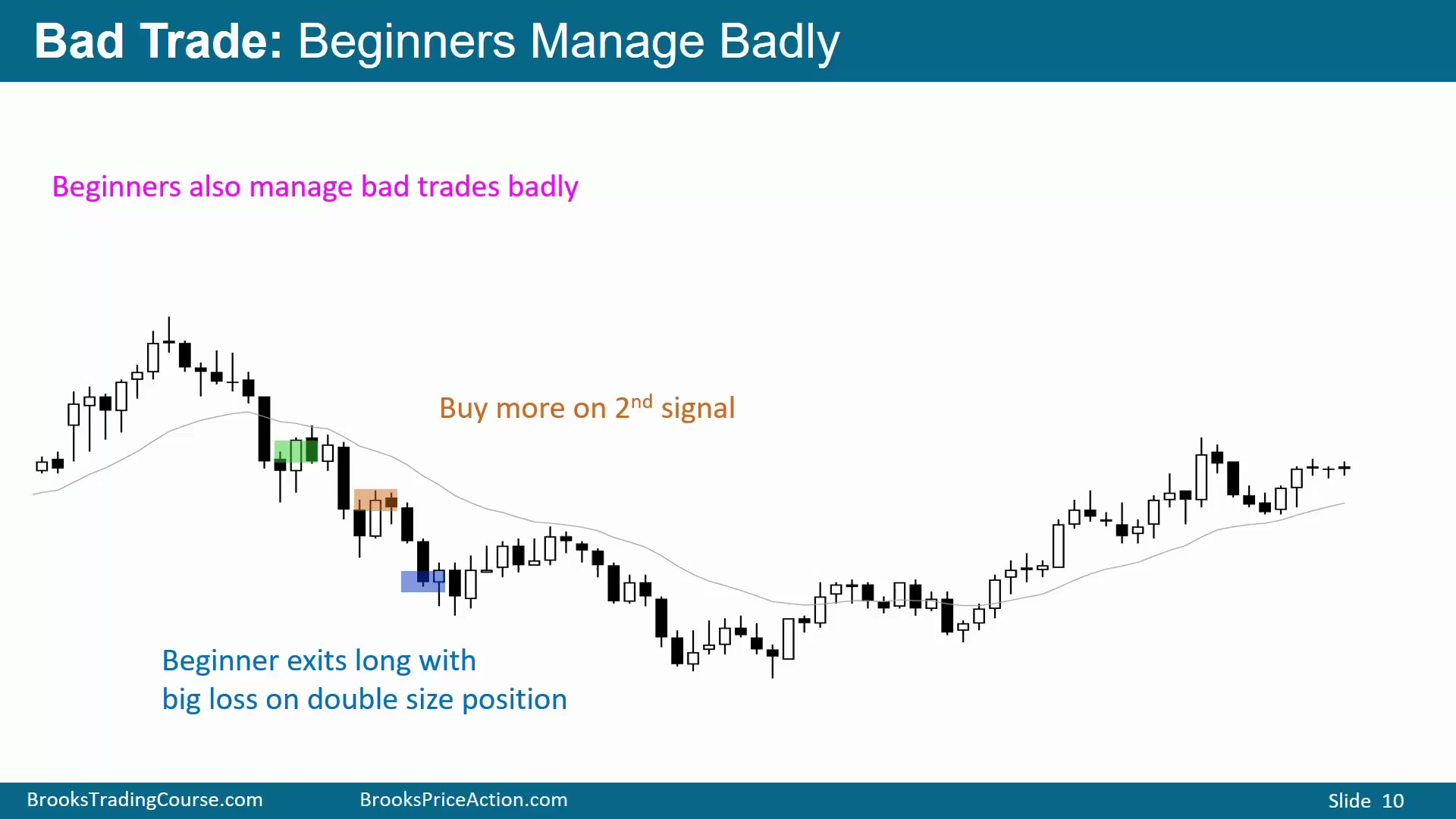
EN: In addition to taking bad trades, beginners manage their trades badly.
19:50 - 19:51
EN: For example, he’ll buy here and he’ll think,
19:51 - 19:57
EN: “Oh, if I scale in and buy more lower, I increase my probability of success.”
19:57 - 20:01
EN: That is true, but you also increase your risk,
20:01 - 20:04
EN: and you’re buying in a very Tight Bear Channel.
20:04 - 20:06
EN: Probably a Small Pullback Bear Trend.
20:06 - 20:09
EN: The chance of making money buying for any reason,
20:09 - 20:12
EN: even if you add on, is horrible.
20:13 - 20:14
EN: The beginner buys here.
20:14 - 20:17
EN: He hears somebody on television say “buy, buy, buy.”
20:17 - 20:20
EN: Do you buy more lower? Terrible idea.
20:20 - 20:22
EN: He buys more here.
20:22 - 20:23
EN: His position size is too big.
20:23 - 20:27
EN: He cannot handle the appropriate stop that would allow him to sit
20:27 - 20:31
EN: through this selloff and get out breakeven on the reversal,
20:31 - 20:35
EN: and he ends up losing a lot more money than he should ever lose.
20:36 - 20:40
EN: Scaling into a trade makes sense if the trade is good to start with,
20:40 - 20:42
EN: and if you can manage correctly.
20:42 - 20:46
EN: For example, use a wide stop and scale in appropriately.
20:46 - 20:50
EN: It’s a disastrous idea if you cannot use a wide enough stop,
20:50 - 20:53
EN: if you cannot take the appropriate additional positions,
20:54 - 20:57
EN: if you cannot add on at the right time,
20:57 - 21:01
EN: if you do add on at the wrong time, and if you’re taking a bad trade
21:01 - 21:05
EN: (if you’re buying in a very strong bear trend, a Small Pullback Bear Trend).
21:10 - 21:12
EN: The beginner who buys here, buys more here,
21:12 - 21:14
EN: thinking he’s trading like a professional
21:14 - 21:17
EN: - eventually he gives up and takes a loss here.
21:18 - 21:20
EN: The loss on the combined position is far greater
21:20 - 21:23
EN: than he ever wants to take on any trade.
21:24 - 21:27
EN: His account is too small to add on, his stop is too far
21:27 - 21:30
EN: for a double position size, and he ends up losing
21:30 - 21:34
EN: four or five times more than his average win.
21:34 - 21:37
EN: That means he has to win five trades over the next week
21:37 - 21:39
EN: or so to make up for this one mistake.
21:39 - 21:42
EN: A terrible thing, but beginners do that regularly.
Slide 011
Time: 21:45
Bilingual Transcript
21:52 - 21:56
EN: Another mistake that beginners often make is they see the trend,
21:56 - 21:59
EN: they know it’s going down, and they want to get short.
21:59 - 22:03
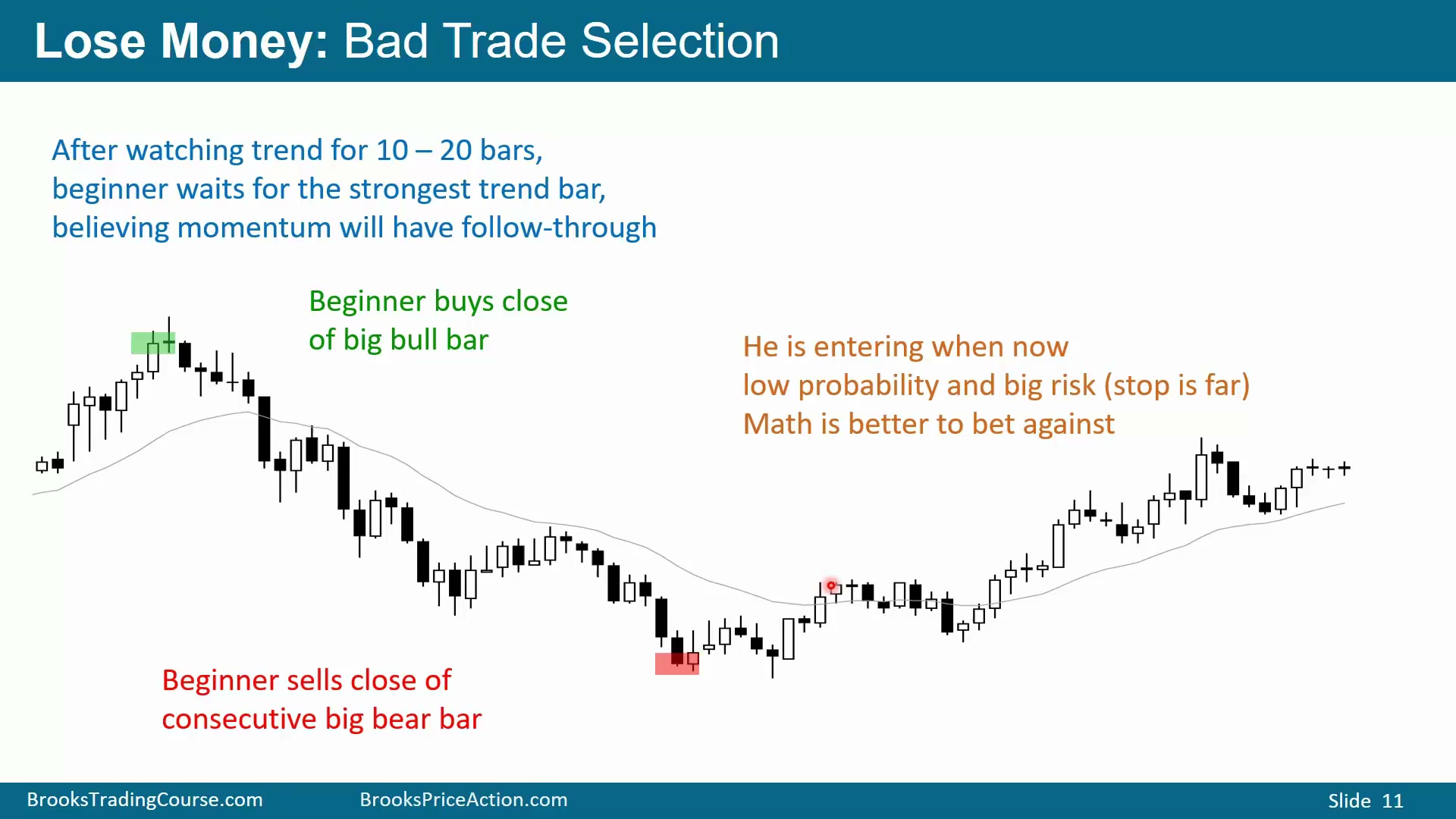
EN: What they’ll often do is wait for a very strong bar,
22:03 - 22:06
EN: a very big trend bar, believing that the momentum
22:06 - 22:09
EN: will result in follow-through and you can make money.
22:09 - 22:11
EN: In other words, he’s entering late
22:11 - 22:15
EN: in a trend once the trend has become climactic.
22:18 - 22:19
EN: Here’s the open of the session.
22:19 - 22:21
EN: We’ve got a couple big tails on the bottoms of the bars,
22:21 - 22:25
EN: a bull bar closing on its high, a small bar, and now a big bar.
22:25 - 22:27
EN: The market looks like it’s accelerating up.
22:27 - 22:29
EN: Let’s say the beginner buys this close,
22:29 - 22:32
EN: hoping for a Buy The Close rally – which could it be.
22:32 - 22:34
EN: It’s reasonable to do.
22:34 - 22:37
EN: However, he’d have to be disappointed by this bear bar,
22:37 - 22:40
EN: and he has to understand what took place right here.
22:41 - 22:44
EN: If he does not understand, he’s in big trouble.
22:45 - 22:48
EN: Bulls who bought this close, disappointed by this bear bar,
22:48 - 22:49
EN: tried to get out breakeven.
22:49 - 22:51
EN: Placed a limit order to get out at that close,
22:51 - 22:54
EN: or they placed a limit order a little bit below it,
22:54 - 22:56
EN: and you can see what happened when this bar got near that close.
22:56 - 23:01
EN: It sold off, and this is caused by a lot of bulls deciding this was a bad buy.
23:03 - 23:06
EN: This bar tried again to get above that close.
23:06 - 23:08
EN: It could not even get above this high.
23:08 - 23:12
EN: That tells you that the bulls who did not get out here lowered their limit order
23:12 - 23:16
EN: to take an even bigger loss, and a lot of them did not get filled here.
23:16 - 23:19
EN: The market’s going down, and ultimately the bulls give up.
23:24 - 23:27
EN: Alternatively, a trader who watched the Small Pullback Bear Trend
23:27 - 23:29
EN: and then you get the Wedge bear flag.
23:29 - 23:34
EN: Three pushes up – one, pause, two, pause, three – and he’s got a selloff here,
23:34 - 23:37
EN: and now the market is accelerating downward.
23:37 - 23:40
EN: He thinks it’s going to be a new stronger leg down.
23:40 - 23:42
EN: He doesn’t realize that this could be the final bear flag
23:42 - 23:45
EN: and this could be a climactic end of the trend.
23:46 - 23:50
EN: So he waits the entire time, doesn’t take any of the trades that were there,
23:50 - 23:52
EN: and now when the market’s starting to accelerate down,
23:52 - 23:55
EN: he’s finally deciding that he’s going to sell.
23:56 - 23:59
EN: He has to be disappointed by the bull bar and then several bull bars.
24:00 - 24:04
EN: An experienced trader who took that sell would say, “Huh, that’s not good.
24:04 - 24:06
EN: I’d better try to get out breakeven.
24:06 - 24:07
EN: I’m going to place a limit order to buy back
24:07 - 24:10
EN: at my original price,” and he gets filled here.
24:11 - 24:12
EN: The beginner does not.
24:12 - 24:15
EN: He ends up getting out here or up here.
24:16 - 24:20
EN: He was waiting to sell, and he ends up selling way too late in the trend,
24:20 - 24:21
EN: when it’s at a Sell Climax.
24:21 - 24:25
EN: He was waiting to buy; he bought too late, at a Buy Climax.
24:31 - 24:34
EN: Selling down here, what do you think about the Trader’s Equation?
24:35 - 24:38
EN: The stop is up here, so now the risk is great.
24:38 - 24:41
EN: Probably not much profit left in this leg,
24:41 - 24:46
EN: and the probability after a climactic breakout late in a trend,
24:46 - 24:49
EN: after a possible Final Flag – the probability is not all that high either.
24:50 - 24:53
EN: The math is actually better to bet on the opposite.
24:53 - 24:55
EN: You’re taking a low probability sell
24:55 - 24:58
EN: where the risk is big and the reward is small.
24:58 - 25:01
EN: It makes more sense to be doing the opposite.
25:01 - 25:03
EN: As a beginner you cannot do the opposite,
25:03 - 25:05
EN: but an experienced trader might do that.
25:05 - 25:08
EN: He might place with a limit order to buy at that close,
25:08 - 25:11
EN: get filled here, or buy on the reversal up
25:11 - 25:15
EN: - or at this point, a potential Higher Low Major Trend Reversal.
25:15 - 25:20
EN: Bear trend, Double Bottom, reasonable Buying Pressure on this minor reversal.
25:20 - 25:22
EN: Maybe the next reversal will be major.
25:22 - 25:25
EN: So the bull would buy above that bar.
Slide 012
Time: 25:27
Bilingual Transcript
25:31 - 25:36
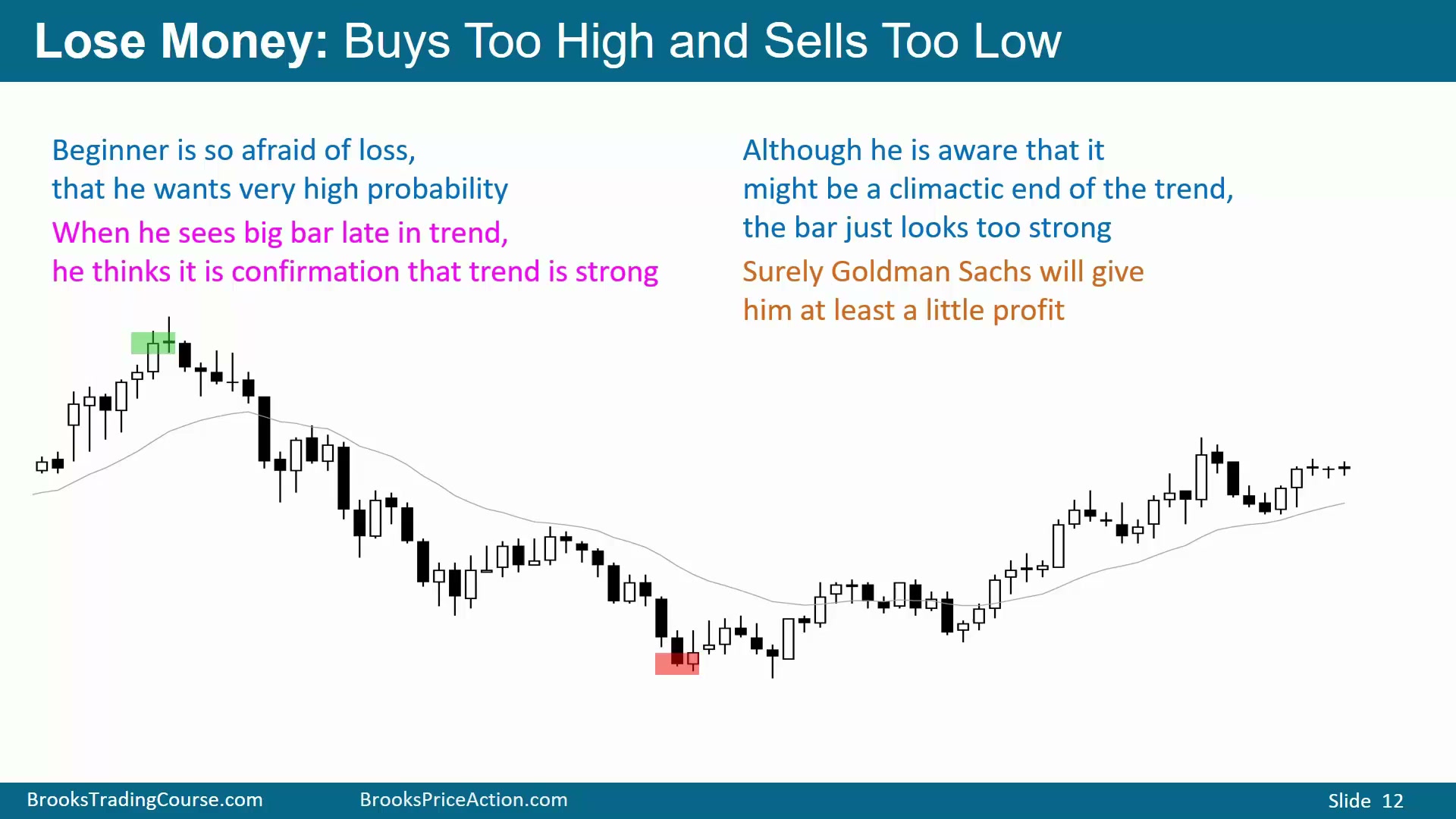
EN: Beginners want low risk, and they also want very high probability,
25:36 - 25:39
EN: and they equate momentum with probability.
25:40 - 25:42
EN: Bull bars, good momentum.
25:42 - 25:44
EN: Maybe high probability.
25:44 - 25:45
EN: It can be high probability.
25:45 - 25:47
EN: Bear bars, good momentum.
25:47 - 25:49
EN: Maybe high probability.
25:49 - 25:51
EN: It can be, but not this late in the trend.
25:51 - 25:53
EN: It’s high probability here and maybe here,
25:54 - 25:57
EN: but when you get this much strength late in a trend,
25:57 - 26:01
EN: 20 or more bars into the trend, it’s more likely an exhaustive end of the trend,
26:01 - 26:04
EN: and the trend is probably transitioning into a Trading Range.
26:13 - 26:15
EN: Beginners, all they see is this bar.
26:15 - 26:19
EN: They just only see the bar that just closed, and maybe the bar in front of it,
26:19 - 26:23
EN: and they’ll say, “Wow, bear trend, 2 big bear bars. It has to go down.”
26:23 - 26:26
EN: He’s not thinking about that it could be a climactic end of the trend.
26:26 - 26:28
EN: All he’s looking at is these 2 bars.
26:28 - 26:31
EN: He’s not looking at this, and he has to.
26:31 - 26:32
EN: He has to look at everything.
26:37 - 26:40
EN: He’s thinking, “Well, the institutions aren’t going to take my money.
26:40 - 26:43
EN: I have enough momentum down, surely they’ll give me
26:43 - 26:45
EN: at least a little bit of money.” They don’t care.
26:45 - 26:46
EN: They don’t even know you exist.
26:46 - 26:48
EN: They don’t care that you exist.
26:48 - 26:50
EN: You don’t have enough money for them to take.
26:50 - 26:53
EN: They’re not going to waste their time taking money from you.
26:53 - 26:55
EN: Goldman Sachs wants to take money from Morgan Stanley
26:55 - 26:59
EN: or from Bank of America or from some Japanese bank.
27:00 - 27:05
EN: Your money is just too small, so nobody cares about what you’re doing,
27:05 - 27:07
EN: and they certainly don’t care about helping you.
27:07 - 27:08
EN: Nobody cares.
27:08 - 27:11
EN: You’re invisible when you trade, and that’s how you should think about it.
27:11 - 27:14
EN: Nobody knows what you’re doing, nobody cares what you’re doing,
27:14 - 27:17
EN: nobody’s trying to take your money, and nobody’s trying to help you.
Slide 013
Time: 27:20
Bilingual Transcript
27:23 - 27:25
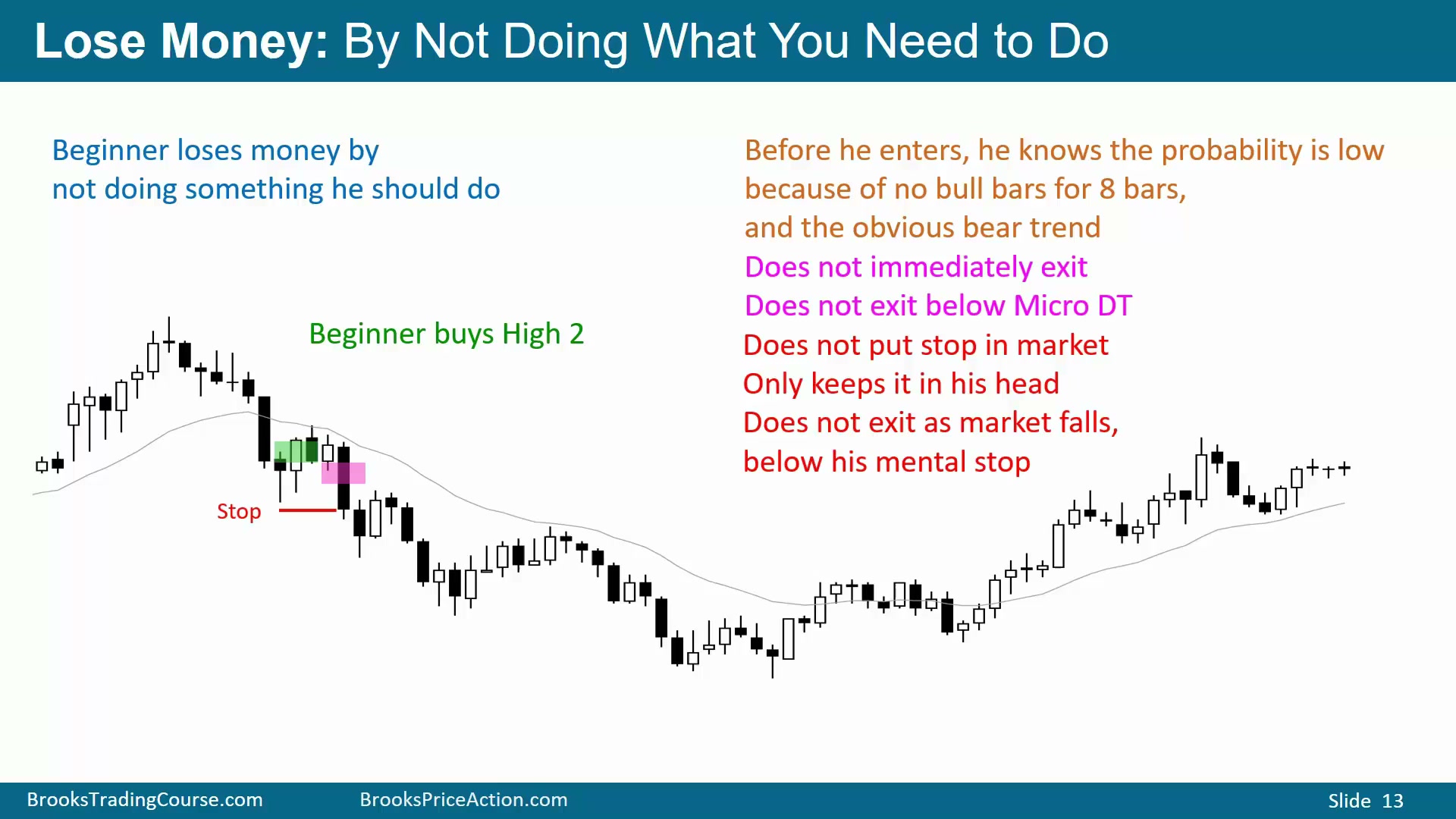
EN: Another mistake that the beginners do
27:25 - 27:29
EN: is instead of a mistake of commission (doing something bad),
27:29 - 27:33
EN: it’s a mistake of omission (not doing what he needs to do).
27:36 - 27:41
EN: Let’s say this beginner buys the High 2 – one, two, and a Double Bottom.
27:48 - 27:49
EN: He knows the probability is low.
27:49 - 27:53
EN: He’s got 8 bear bars and he’s got a bear sell signal bar
27:53 - 27:57
EN: and no bull bar for 8 bars, and an obvious bear trend.
28:01 - 28:03
EN: We have a Micro Double Top.
28:03 - 28:06
EN: We went up on this bar, down and up on this bar,
28:06 - 28:08
EN: and we have a bear bar closing on its low.
28:09 - 28:11
EN: He knows he should get out below this bear bar
28:11 - 28:13
EN: or below this bull bar for the Micro Double Top.
28:13 - 28:17
EN: He knows that’s the right thing to do, but he does not exit.
28:17 - 28:21
EN: He does not want to take the loss because he doesn’t want to feel like a loser.
28:21 - 28:25
EN: He wants to win a high percentage of the time, and he’s taking a chance.
28:25 - 28:28
EN: “Maybe it’ll go down a little bit and then come my way,
28:28 - 28:29
EN: and maybe I can get out breakeven.”
28:29 - 28:33
EN: He knows it’s the wrong thing to do, but he just can’t do it.
28:33 - 28:35
EN: He cannot take the loss.
28:41 - 28:42
EN: He doesn’t put a stop in the market.
28:42 - 28:46
EN: He keeps the stop in his head, so he does not have a stop down here.
28:46 - 28:49
EN: Stops are to protect you against you.
28:49 - 28:51
EN: They’re not to protect you against the market.
28:51 - 28:53
EN: A lot of times the beginner will decide,
28:53 - 28:56
EN: “Well, maybe this time I’ll cancel my stop and just try
28:56 - 28:59
EN: to work my way out of the trade, the way experts do.”
28:59 - 29:01
EN: That’s not what experts do.
29:01 - 29:03
EN: When they do something stupid, they take the loss.
29:10 - 29:12
EN: Sometimes a beginner will take a great trade
Slide 014
Time: 29:10
Bilingual Transcript
29:12 - 29:15
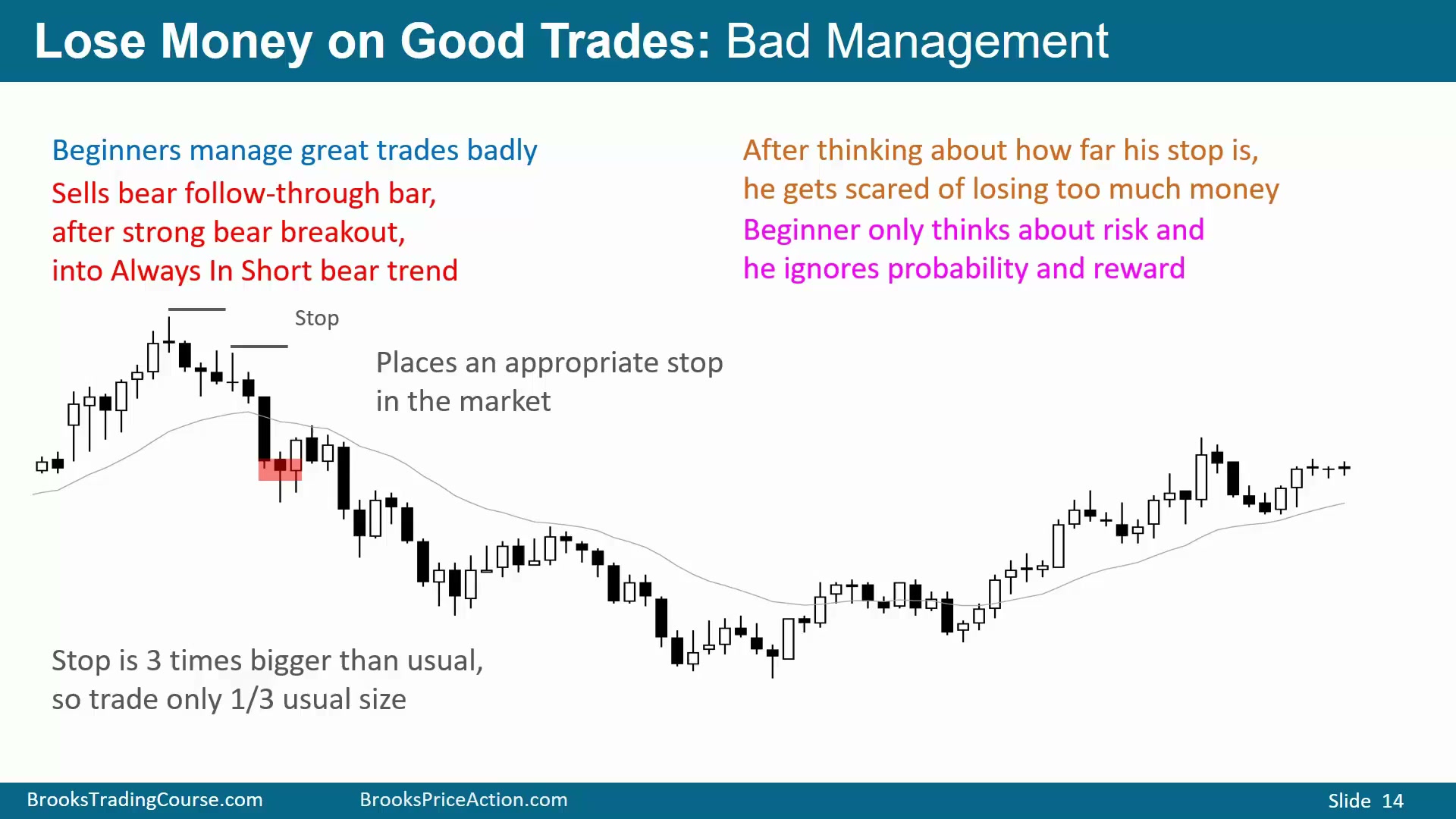
EN: and lose money because he manages it badly.
29:19 - 29:22
EN: For example, we have a bear breakout, good follow-through.
29:22 - 29:24
EN: 8 consecutive bear bars.
29:24 - 29:28
EN: It’s reasonable to sell the close, expecting at least a small second leg down
29:28 - 29:30
EN: and maybe a spike, pullback, channel down.
29:34 - 29:39
EN: He knows the appropriate stop is either above the top of this bear leg
29:39 - 29:42
EN: or above the top of the entire bear trend.
29:42 - 29:46
EN: If he’s taking this trade, he’s selling low in a bear trend.
29:46 - 29:50
EN: He has to use a wide stop because one of two things will happen:
29:50 - 29:53
EN: either the market will go down and he’ll make money,
29:53 - 29:55
EN: or the market will go up and it’ll be a Trading Range.
29:56 - 30:00
EN: If he manages his trade well, he’ll avoid a loss
30:00 - 30:03
EN: because he knows the market will come back and let him out breakeven.
30:09 - 30:10
EN: The stop is wide.
30:10 - 30:14
EN: If it’s let’s say three times bigger than what he usually uses,
30:14 - 30:17
EN: he has to trade one-third his normal position size.
30:17 - 30:21
EN: If he cannot reduce his position size, he cannot take the trade.
30:21 - 30:24
EN: He just has to wait for a trade that he can trade.
30:29 - 30:32
EN: The beginners tend to think about risk, and they know the stop
30:32 - 30:37
EN: is much further away than what they typically use, and therefore he’s afraid.
30:44 - 30:48
EN: He ignores the other parts of the Trader’s Equation, reward and probability.
Slide 015
Time: 30:45
Bilingual Transcript
30:48 - 30:51
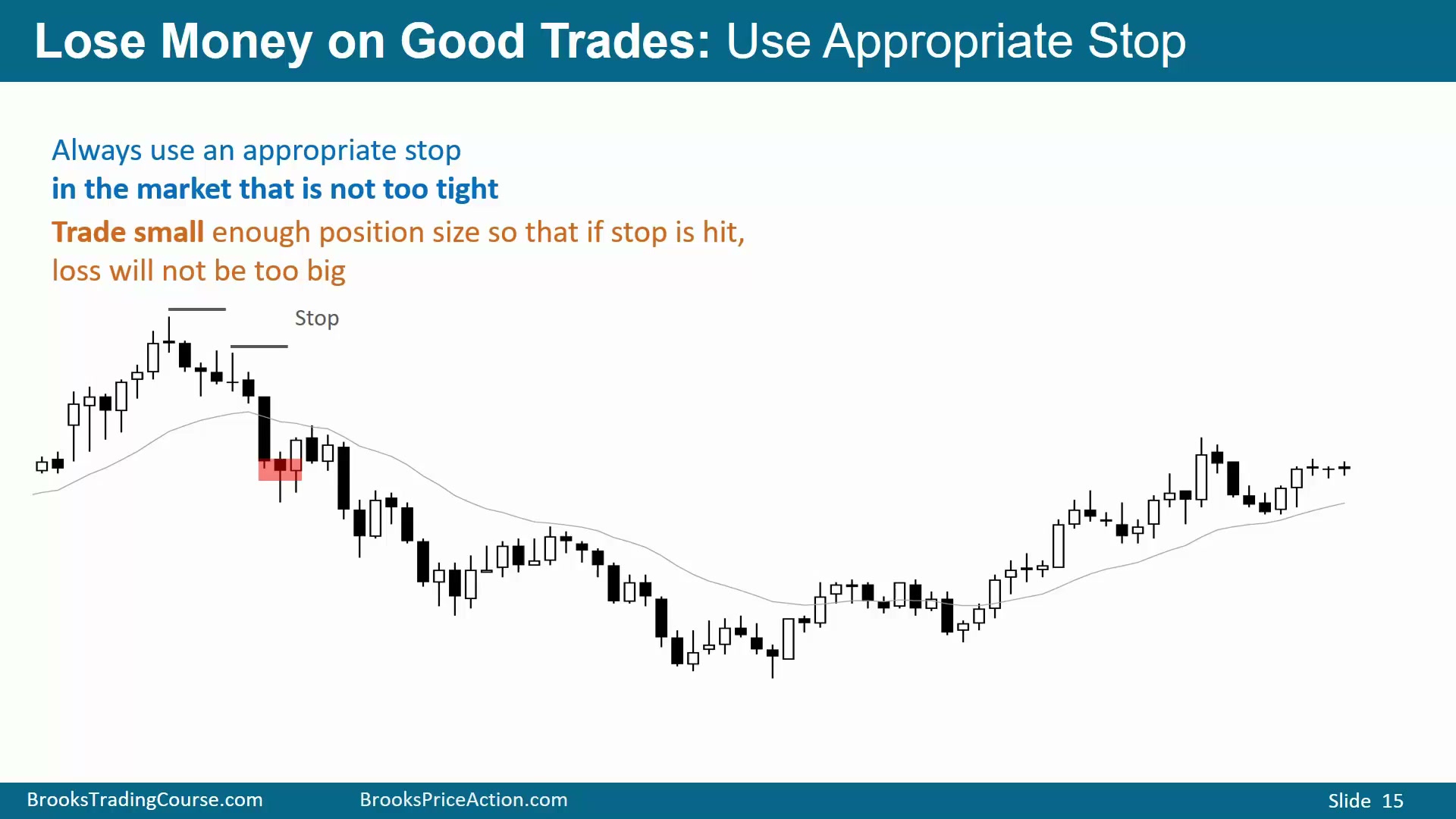
EN: The probability is high that he’s going to make money.
30:51 - 30:53
EN: Probably some kind of a Measured Move down.
30:53 - 30:57
EN: That means the probability is high that he’ll probably make a lot of money.
30:57 - 31:00
EN: But it requires him to use the appropriate stop.
31:01 - 31:05
EN: One thing a beginner can do is take the trade, use the appropriate stop,
31:05 - 31:09
EN: and then go for a walk and come back in a half hour or an hour
31:09 - 31:10
EN: and see what the market is doing.
31:10 - 31:12
EN: If he does that, he’ll discover
31:12 - 31:15
EN: that it’s an actually pretty profitable strategy.
31:20 - 31:23
EN: You always have to use a reasonable stop, and that means a stop
31:23 - 31:24
EN: that’s not too tight,
31:28 - 31:29
EN: and you have to trade small enough
31:29 - 31:34
EN: so that if your stop is hit, your loss is no bigger than on any other trade.
Slide 016
Time: 31:40
Bilingual Transcript
31:42 - 31:45
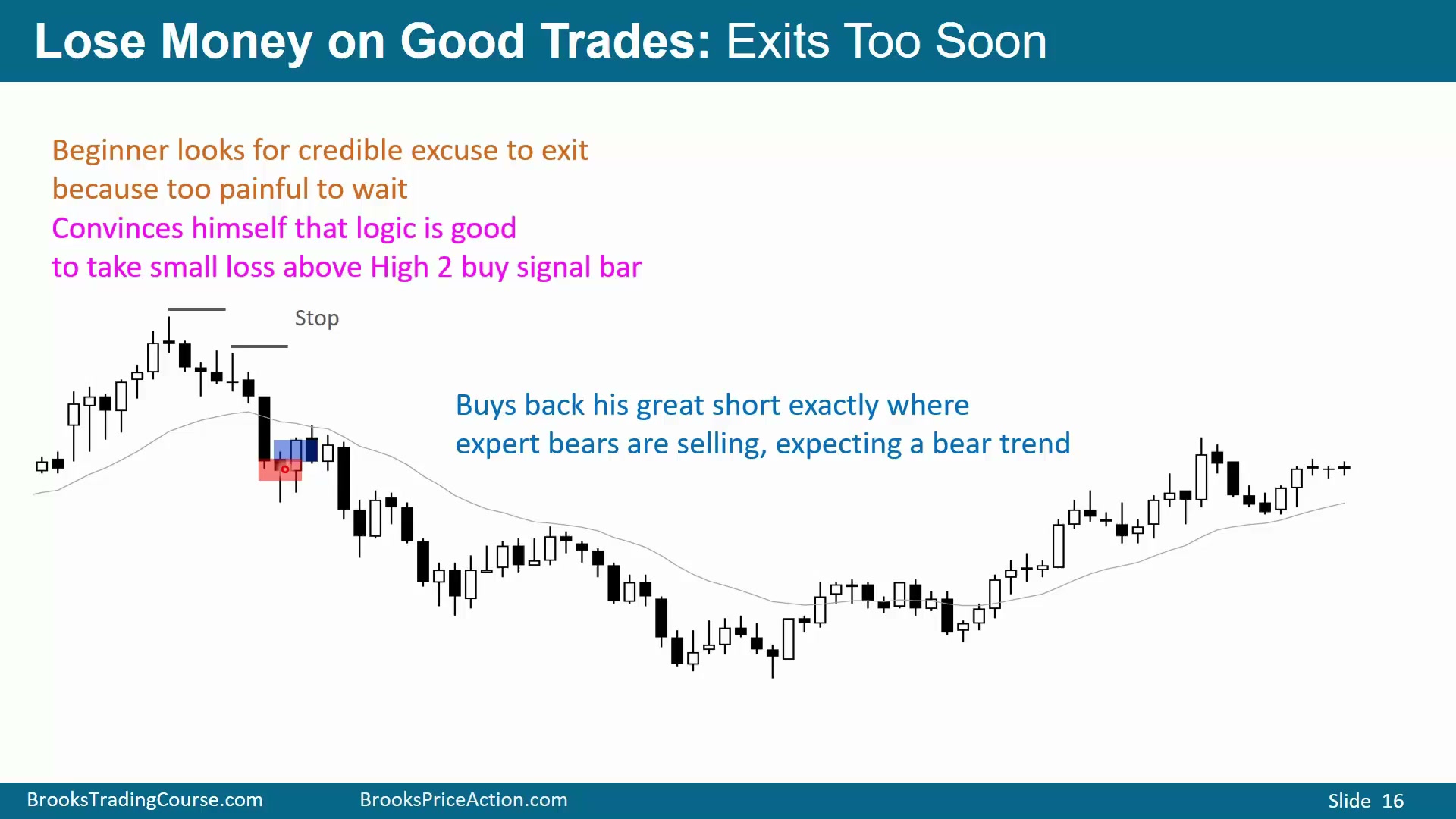
EN: Beginners get so anxious when they’re in a trade
31:45 - 31:47
EN: that they’re looking for any reason to get out.
31:47 - 31:50
EN: It’s painful, emotionally painful.
31:55 - 31:57
EN: In this particular case he sold this close,
31:57 - 32:00
EN: and now he’s thinking, “Uh oh, maybe it’s a High 2 buy.
32:00 - 32:01
EN: Maybe it’s a Double Bottom.
32:01 - 32:03
EN: We have a bull bar closing on its high.
32:03 - 32:05
EN: Maybe this is a reversal up.”
32:11 - 32:15
EN: He ends up buying back his short above the high of this bear bar,
32:15 - 32:17
EN: exactly where strong bears are selling,
32:17 - 32:20
EN: or above the high of this bull bar for a small loss.
32:20 - 32:21
EN: He’s got a great short.
32:21 - 32:25
EN: His idea was right, but he did not manage it correctly.
32:25 - 32:29
EN: He could not handle losing that much money if the trade were to go against him.
32:30 - 32:34
EN: You cannot take the trade unless you can manage it appropriately.
32:34 - 32:37
EN: If the stop is too far, you cannot take the trade.
32:38 - 32:42
EN: Decide before you sell that the stop is too far.
32:42 - 32:44
EN: Don’t decide after you sell.
32:49 - 32:52
EN: In this video I talked about a very common cause of loss,
Slide 017
Time: 32:50
Bilingual Transcript
32:52 - 32:53
EN: and that’s bad management.
32:53 - 32:56
EN: Management can come from taking bad trades.
32:56 - 33:00
EN: It can come from using inappropriate stops.
33:00 - 33:02
EN: It can come from scaling in inappropriately.
33:02 - 33:05
EN: It can come from trading too big a position.
33:05 - 33:09
EN: It can come from scaling into too big a position with too much risk.
33:14 - 33:15
EN: I’m Al Brooks.
33:15 - 33:17
EN: Thank you for watching the Brooks Trading Course.
33:17 - 33:21
EN: This is the second of four videos on losing because of mistakes.