Skip to content
Price Action Encyclopedia Index

al-brooks-course

52A - Losing When Good Trade Goes Bad

Raw transcript and slide notes for 52A - Losing When Good Trade Goes Bad.

Overview

  • Slides: 19
  • Transcript segments: 409
  • Status: 自动按 slide 时间线归档;核心概念和长期笔记可以在每个 slide 的 Study Notes 下继续整理。

Source Media

Transcript 001

Time: 00:02

Bilingual Transcript

00:02 - 00:03

EN: This is Al Brooks.

00:03 - 00:05

EN: Thank you for watching the Brooks Trading Course.

00:05 - 00:10

EN: This is the first of two videos on losing when a good trade goes bad.

Slide 001

Time: 00:12

Slide 001

Bilingual Transcript

00:14 - 00:16

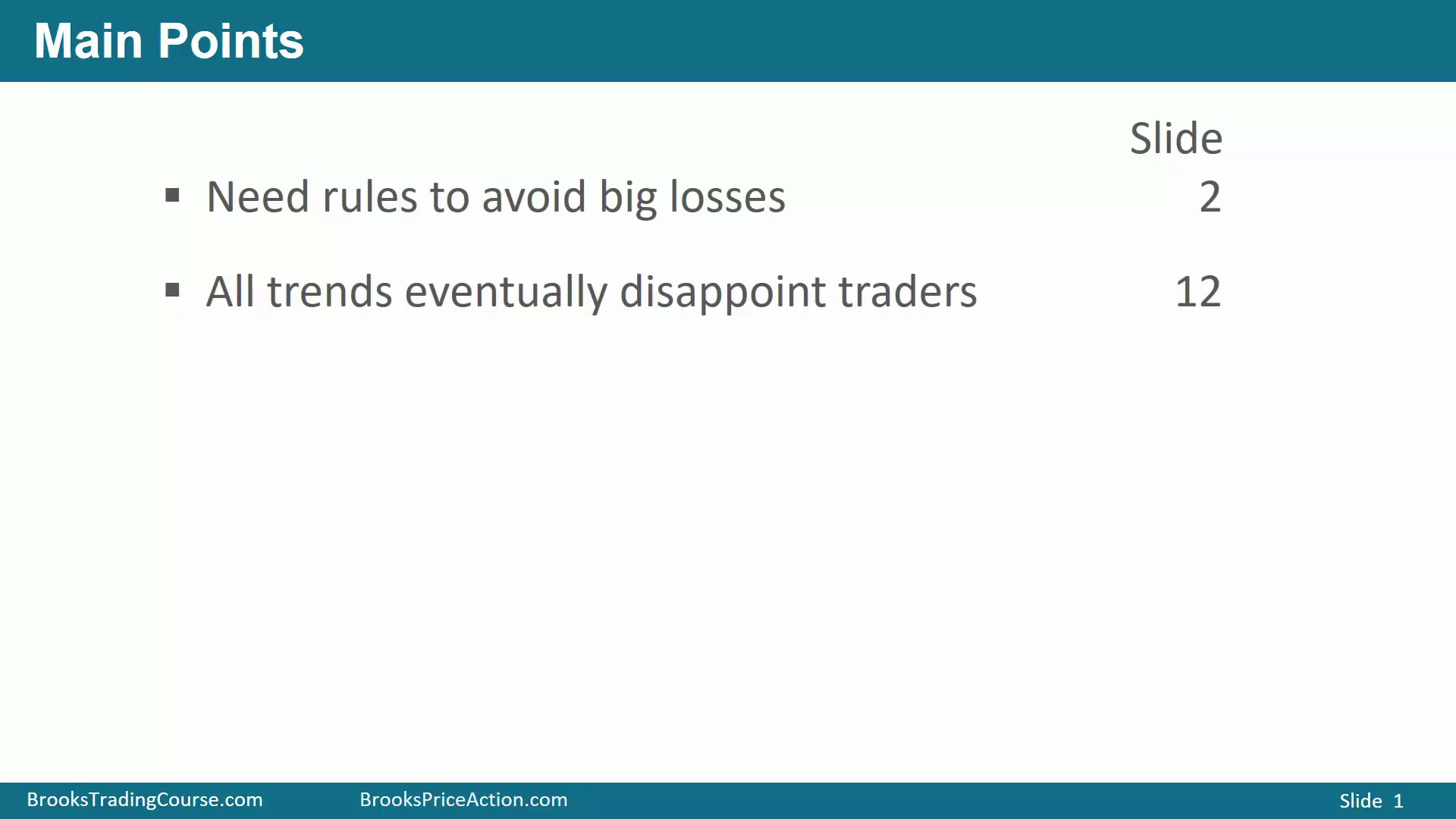
EN: I want to begin by talking about some rules that traders

00:16 - 00:21

EN: can use to help avoid big losses, and I also want to make the obvious point

00:21 - 00:24

EN: that all trends eventually disappoint traders,

00:24 - 00:29

EN: and therefore you have to make decisions when you do see some disappointment.

Slide 002

Time: 00:30

Slide 002

Bilingual Transcript

00:38 - 00:42

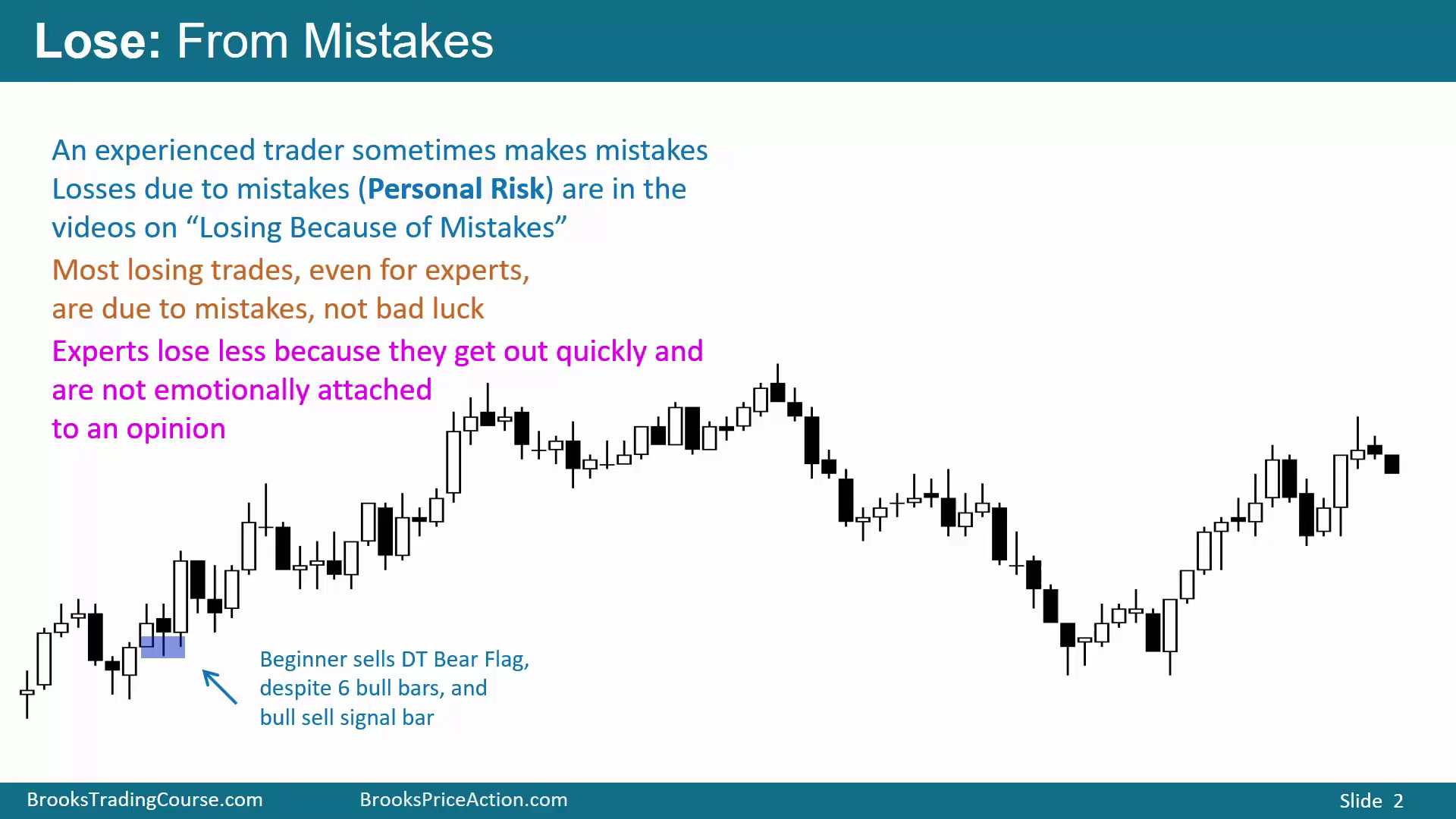
EN: Every trader sometimes makes mistakes, and I talk about losses

00:42 - 00:46

EN: that are due to mistakes in the videos on losing because of mistakes.

00:52 - 00:55

EN: For example, let’s say a beginner saw this as a Double Top

00:55 - 00:58

EN: and he sold on a stop below this bar.

00:58 - 00:59

EN: He got filled right here.

00:59 - 01:03

EN: Despite 6 bull bars in the past 8 bars, he still took the short

01:03 - 01:07

EN: and the sell signal bar had a bull body closing above its midpoint.

01:07 - 01:10

EN: That is a mistake to take that short.

01:15 - 01:20

EN: Most losing trades, even for experts, are due to mistakes and not bad luck.

01:20 - 01:24

EN: Every trade has a probability that you’re going to win and a probability

01:24 - 01:27

EN: that you’re going to lose, and therefore even experienced traders

01:27 - 01:30

EN: are going to lose simply because of luck.

01:34 - 01:38

EN: A big difference between an expert and a beginner is that an expert tends

01:38 - 01:41

EN: to get out very quickly when he makes a mistake.

01:41 - 01:42

EN: He loses less.

01:42 - 01:45

EN: He’s not emotionally attached to a position.

01:45 - 01:49

EN: He doesn’t feel a need to prove that he’s right – for example,

01:49 - 01:53

EN: holding onto a bad trade, hoping that eventually he’ll be proven right.

01:53 - 01:55

EN: If he’s wrong, he gets out.

Slide 003

Time: 02:00

Slide 003

Bilingual Transcript

02:01 - 02:04

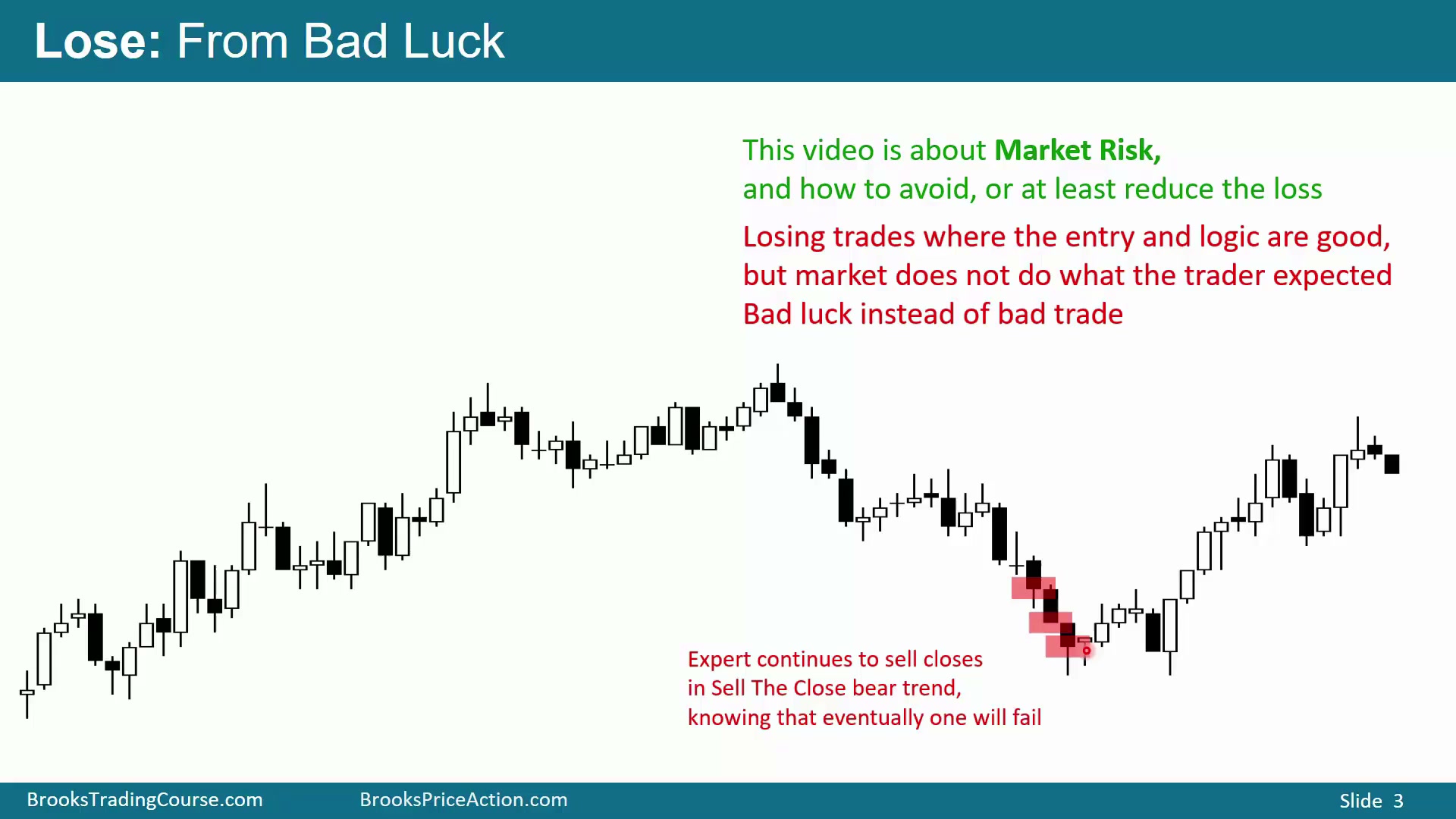
EN: I want to talk in this video about market risk

02:04 - 02:06

EN: and how to minimize it or how to avoid it.

02:07 - 02:09

EN: That’s risk beyond your personal control.

02:09 - 02:12

EN: Personal risk, that means you made mistakes.

02:13 - 02:15

EN: Market risk is things that you cannot control.

02:15 - 02:18

EN: The market is doing something that you thought was not likely.

02:25 - 02:29

EN: It’s fairly common that you’ll take a trade where the entry is good,

02:29 - 02:34

EN: the logic is good, but the market does not do what you think was most likely.

02:34 - 02:37

EN: That’s bad luck instead of a bad trade.

02:37 - 02:38

EN: It’s a good trade that went bad.

02:45 - 02:47

EN: For example, we have a Sell The Close market down here.

02:47 - 02:50

EN: Traders are selling closes, selling closes, selling closes.

02:51 - 02:54

EN: He knows that eventually one is going to be the final one

02:54 - 02:57

EN: and that the market will reverse and he’ll lose money.

02:57 - 03:01

EN: Nobody’s going to sell all these closes, but traders will sell at least one.

03:01 - 03:03

EN: Let’s say you sold this one,

03:03 - 03:06

EN: and then immediately you see a bull bar and then 3 other bull bars.

03:07 - 03:10

EN: At that point the trade is no longer a Sell The Close bear trend,

03:10 - 03:12

EN: and you have to change how you’re trading.

03:12 - 03:16

EN: One thing you might do is sell more higher and then try to get out breakeven

03:16 - 03:19

EN: on your first entry and then with a profit on your higher entry.

Slide 004

Time: 03:25

Slide 004

Bilingual Transcript

03:26 - 03:31

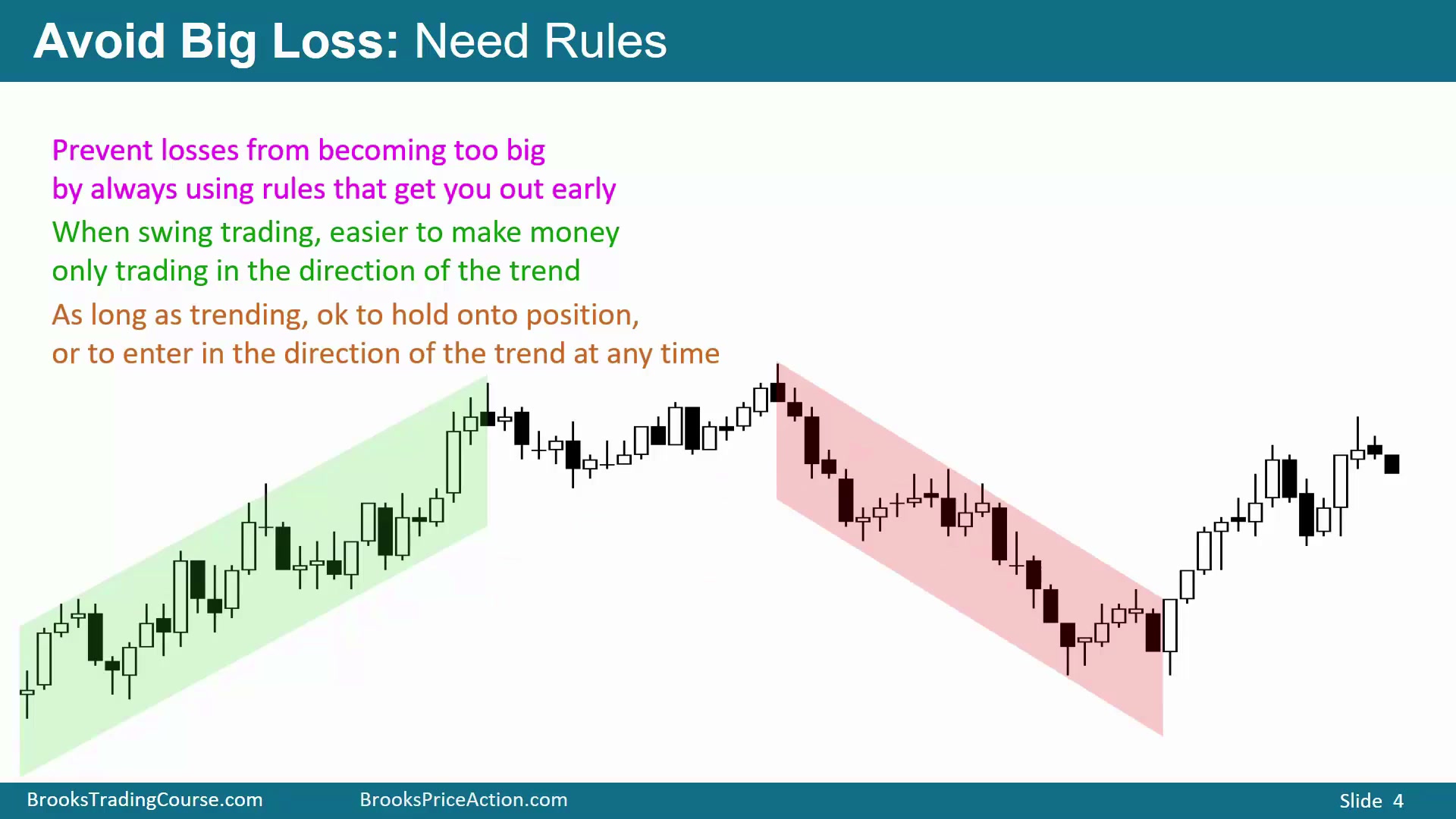
EN: You need some rules to prevent bad trades from becoming very big losses.

03:36 - 03:39

EN: When the market is swing trading, it’s fairly easy

03:39 - 03:41

EN: to make money trading in the direction of the trend.

03:41 - 03:43

EN: Market’s going up, you buy.

03:43 - 03:45

EN: Market’s going down, you sell.

03:50 - 03:54

EN: As long as it’s continuing to trend, it’s okay to hold onto your position

03:54 - 03:56

EN: or to enter at any time in the direction of the trend

03:56 - 03:59

EN: - buying here or selling here.

Slide 005

Time: 04:05

Slide 005

Bilingual Transcript

04:06 - 04:10

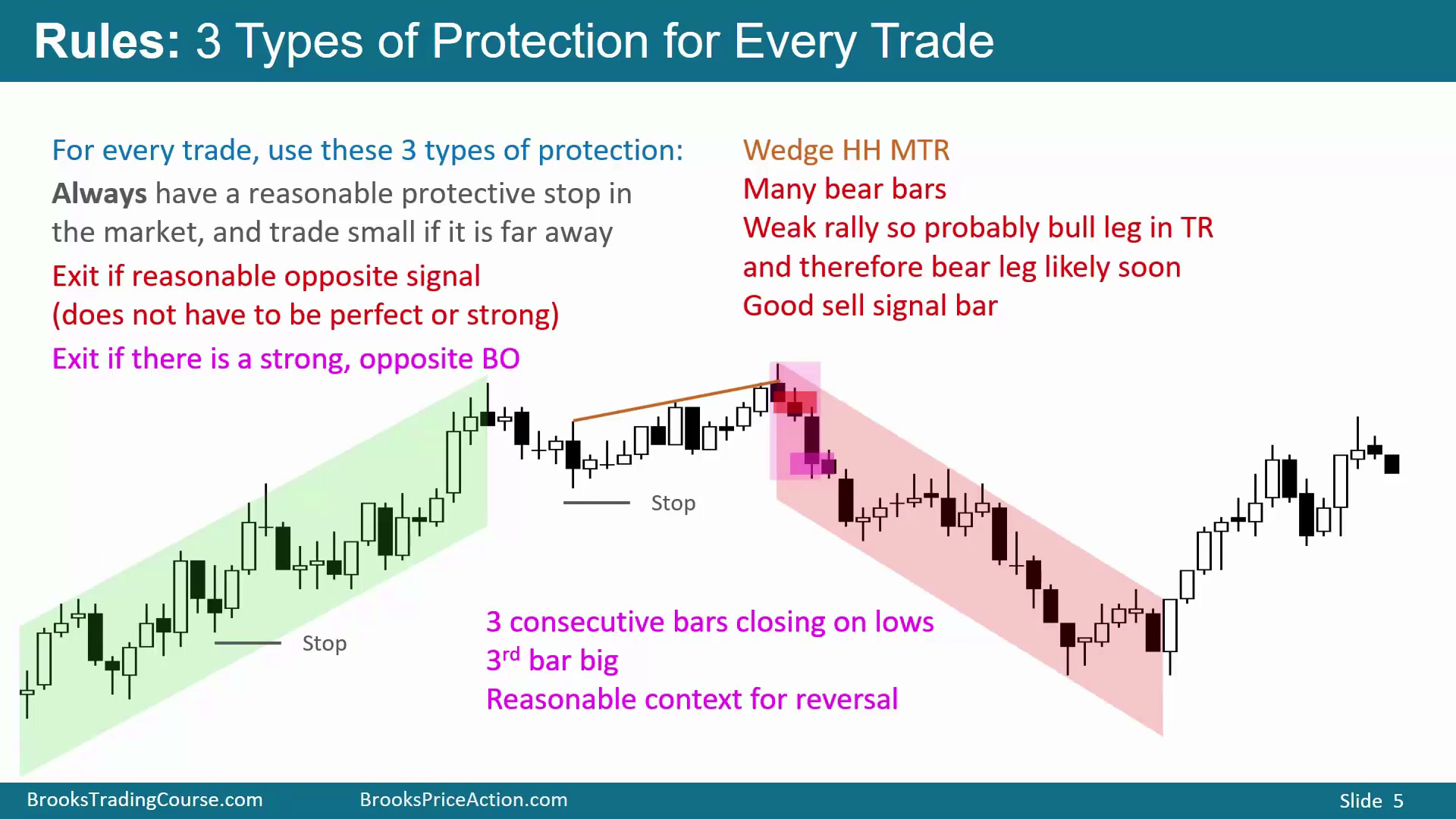
EN: If you’re long, there are three ways to protect yourself.

04:15 - 04:17

EN: First of all, you always need a protective stop.

04:17 - 04:20

EN: After every strong breakout to a new high,

04:20 - 04:23

EN: you can trail your stop to the most recent major Higher Low.

04:23 - 04:25

EN: Here, a breakout to a new high.

04:26 - 04:28

EN: You can trail your stop to below this low.

04:29 - 04:32

EN: If the stop is far away you have to reduce your position size,

04:32 - 04:36

EN: or if you’re entering at a time when the stop is going to be very far away,

04:36 - 04:37

EN: you simply have to trade small.

04:42 - 04:45

EN: Any time there’s a reasonable opposite signal

04:45 - 04:48

EN: - it does not have to be a perfect signal as long as it’s reasonable

04:48 - 04:51

EN: - it’s reasonable for you to get out of your trade.

04:57 - 04:59

EN: For example, we have a slight Higher High.

05:00 - 05:03

EN: We have a bull trend, Trading Range, and a Higher High.

05:03 - 05:07

EN: Therefore it’s a Higher High Major Trend Reversal and it’s a Wedge rally.

05:07 - 05:09

EN: We went up here, we went down.

05:09 - 05:10

EN: Up here and then down.

05:10 - 05:13

EN: Up here, and now we have a bear bar closing on its low.

05:14 - 05:17

EN: Reasonable to get out of longs if you’re still long at this point.

05:17 - 05:20

EN: You get out on a stop below the low of that bear bar.

05:21 - 05:23

EN: It’s a weak rally, it’s a Wedge rally,

05:23 - 05:25

EN: and it’s a potential Higher High Major Trend Reversal.

05:25 - 05:30

EN: You’ve got to be thinking that the market is no longer in a bull channel.

05:30 - 05:34

EN: It’s now either in a Trading Range or in a bear trend.

05:37 - 05:40

EN: In addition to exiting if there’s a reasonable opposite signal

05:40 - 05:45

EN: or if your stop is hit, you exit if there’s a strong opposite breakout.

05:50 - 05:53

EN: It can be a single big bear bar if you’re long,

05:53 - 05:57

EN: or it could be 3 or more bear bars with moderate size bodies,

05:57 - 06:00

EN: especially if they’re closing on or near their lows.

06:00 - 06:01

EN: Here we have 3 bear bars.

06:01 - 06:05

EN: This one became big, all 3 closing at or near their lows.

06:05 - 06:07

EN: Reasonable to get out at the market.

06:07 - 06:11

EN: As soon as you see that third close, you simply exit at the market.

06:11 - 06:12

EN: You sell out of your long.

06:12 - 06:16

EN: It doesn’t matter if you bought here or if you bought down here;

06:16 - 06:19

EN: you get out here if you did not already get out.

Slide 006

Time: 06:25

Slide 006

Bilingual Transcript

06:27 - 06:32

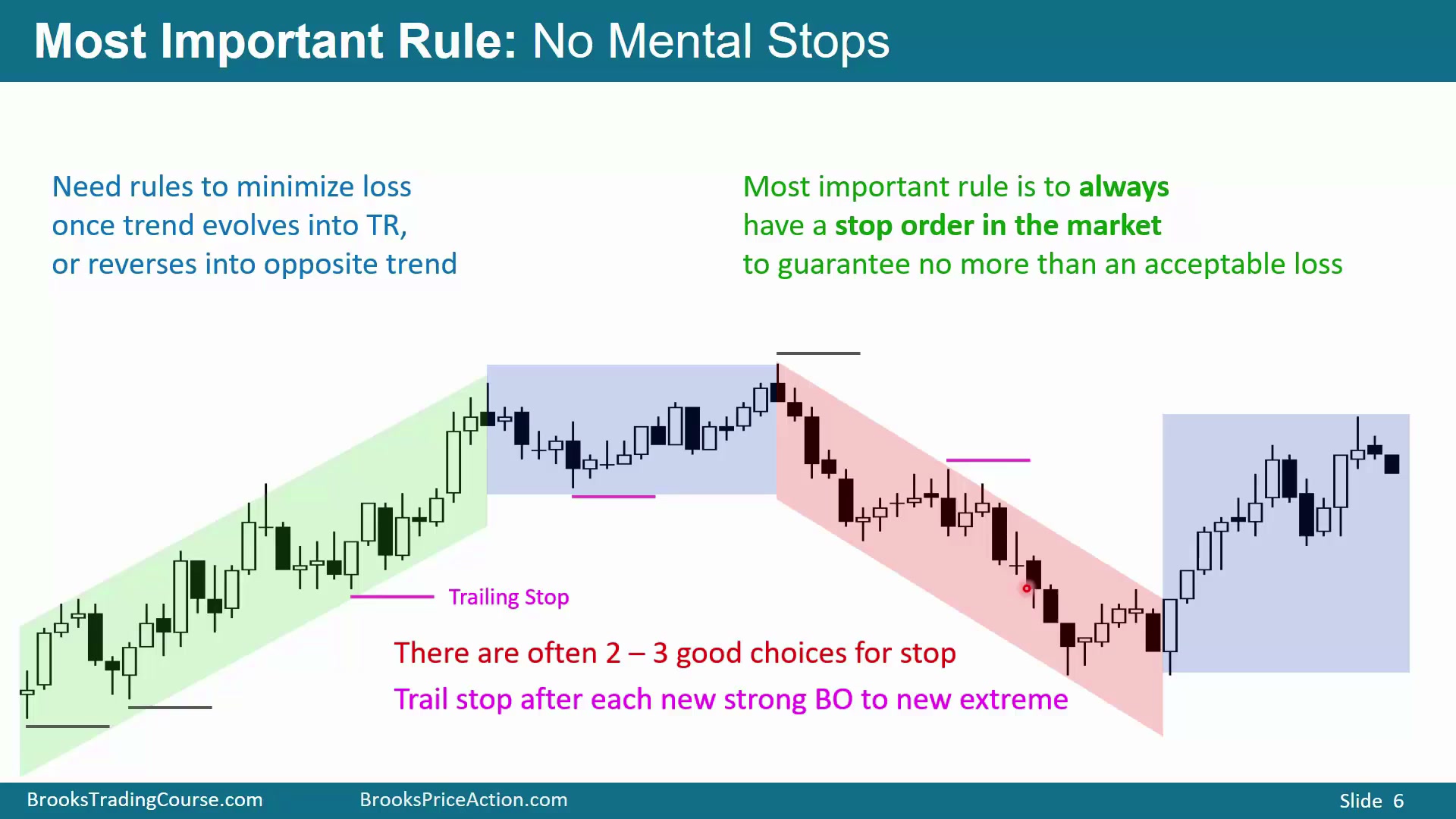
EN: Every channel eventually stops, and usually it becomes a Trading Range.

06:33 - 06:34

EN: We have a bull channel.

06:34 - 06:35

EN: It became a Trading Range.

06:35 - 06:37

EN: We have a bear channel, and we have a bull breakout,

06:38 - 06:41

EN: and it became a bull leg in a larger Trading Range.

06:47 - 06:52

EN: The single most important rule to protect yourself is having a stop in the market.

06:52 - 06:55

EN: Not a mental stop, not a stop in your head.

06:55 - 06:57

EN: If the stop is in the market, it’s a guarantee

06:57 - 07:01

EN: that you will lose no more than an acceptable loss.

07:04 - 07:07

EN: There are often several choices for a reasonable stop.

07:07 - 07:11

EN: For example, bulls who bought any time in here could have

07:11 - 07:15

EN: a stop below the bottom of this leg or below the bottom of the bull trend,

07:16 - 07:19

EN: and bears who sold any time in here, it’s reasonable

07:19 - 07:22

EN: to put their stop above the top of the bear reversal.

07:27 - 07:32

EN: After every strong breakout to a new high, it’s reasonable to trail your stop.

07:32 - 07:37

EN: If you bought anywhere in here and then the market breaks out here

07:37 - 07:40

EN: to a new high and you have several decent bull bars,

07:40 - 07:42

EN: it’s reasonable to put your stop below this low.

07:43 - 07:46

EN: For the bears, you have a strong bear breakout, stop up here,

07:46 - 07:50

EN: and then once it starts to break out again, you can trail your stop.

07:50 - 07:54

EN: Lower your stop down to the most recent major Lower High, which is right here.

07:54 - 07:56

EN: Put your stop just above.

Slide 007

Time: 08:00

Slide 007

Bilingual Transcript

08:02 - 08:05

EN: A great scalper can win 90% of the time.

08:05 - 08:08

EN: That means he’s losing 10% of the time.

08:12 - 08:16

EN: He needs rules to prevent his losses from getting very big.

08:20 - 08:25

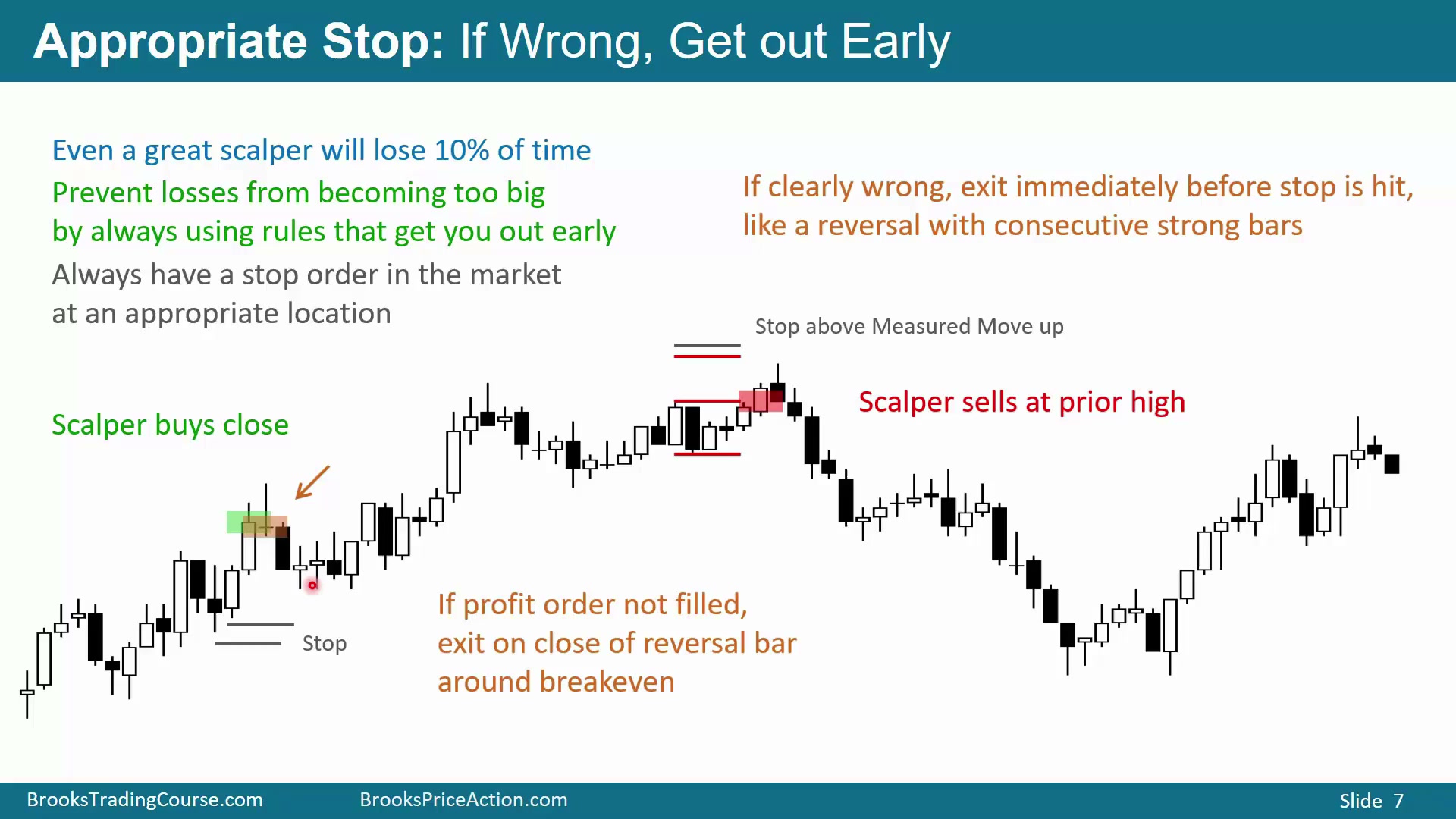
EN: The first obvious one is always have an appropriate stop in the market.

08:27 - 08:30

EN: For example, let’s say you’re a scalper and you think

08:30 - 08:31

EN: - we have one push up, down.

08:31 - 08:32

EN: Up, down.

08:32 - 08:36

EN: Maybe the third push will be a Wedge and a reversal.

08:36 - 08:38

EN: Market’s transitioning to a Trading Range.

08:38 - 08:41

EN: He might sell with a limit order at this high,

08:41 - 08:46

EN: betting that the third leg up will fail and reverse down enough to make a scalp.

08:48 - 08:50

EN: Different ways to calculate where to put a stop,

08:50 - 08:53

EN: but one might be just beyond a Measured Move up

08:53 - 08:55

EN: based upon the height of this small Tight Trading Range.

08:59 - 09:01

EN: Let’s say a trader bought this close,

09:01 - 09:03

EN: thinking that it’s a strong enough pair of bars

09:03 - 09:07

EN: so that the market’ll probably have at least one more leg up.

09:08 - 09:12

EN: Reasonable stop below the 2 bar breakout or below the bottom of the leg.

09:13 - 09:16

EN: Some scalpers would even put a stop down here or here,

09:16 - 09:20

EN: thinking that maybe the market will have a deep pullback into a Trading Range.

09:20 - 09:22

EN: They can buy more lower,

09:22 - 09:26

EN: confident that we’ll come back here after 2 pretty good bull bars.

09:31 - 09:35

EN: If you’re clearly wrong, it’s usually better just to exit immediately

09:35 - 09:37

EN: and don’t wait for your stop to be hit.

09:42 - 09:46

EN: For example, if a bull bought this close and the next bar looked like that,

09:46 - 09:50

EN: a reversal bar closing near its low – it’s a doji bar, but it’s also a Wedge

09:50 - 09:53

EN: - one, two, three – if the trader is now concerned

09:53 - 09:57

EN: that we may get a couple legs sideways to down and he’s a scalper,

09:57 - 09:59

EN: he’s going for a small profit.

09:59 - 10:01

EN: He does not want to have a big risk.

10:01 - 10:04

EN: Therefore, it’s reasonable for him to get out just below the low of this bar

10:04 - 10:06

EN: and not wait for his stop to get hit.

Slide 008

Time: 10:10

Slide 008

Bilingual Transcript

10:14 - 10:19

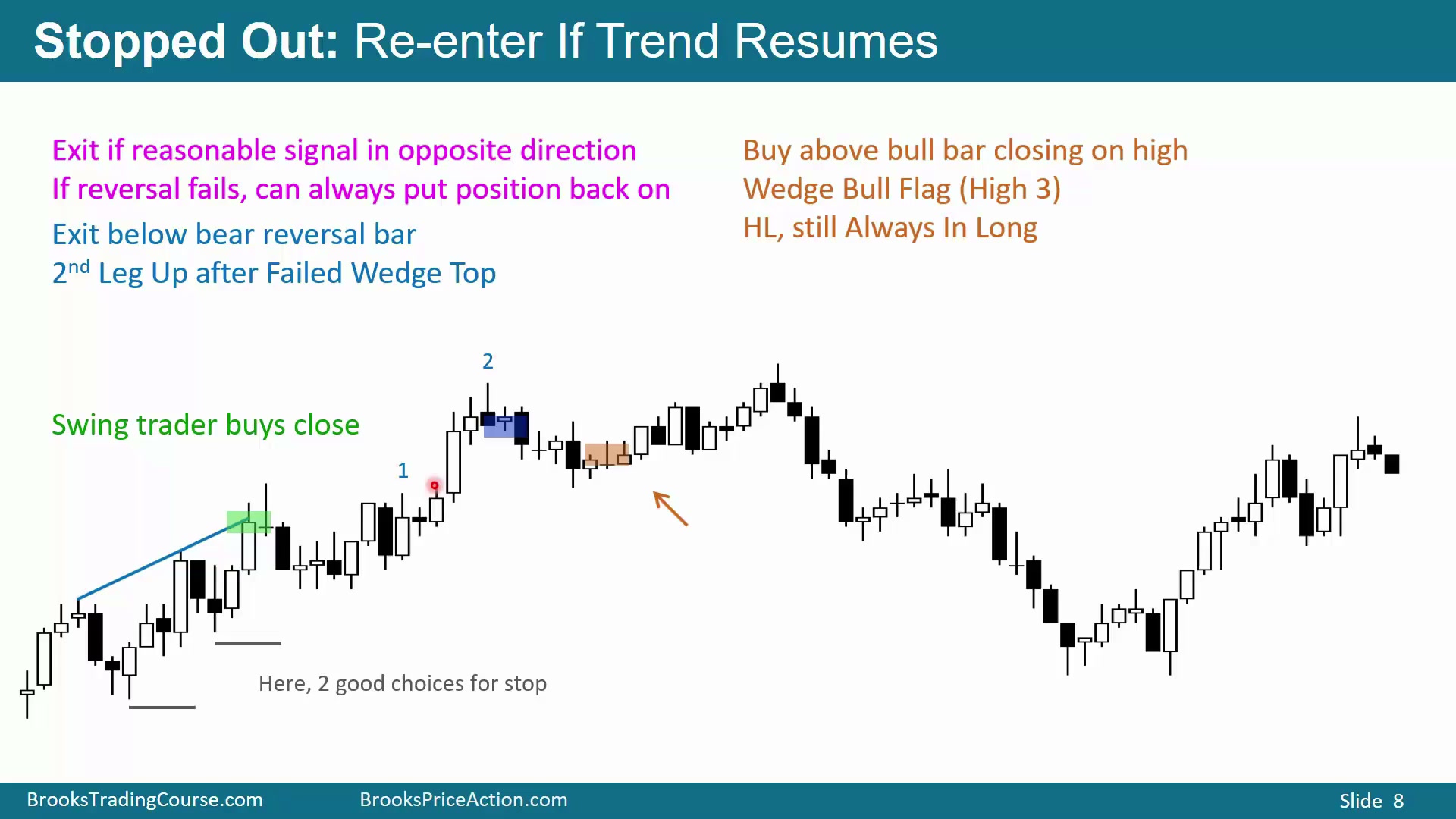
EN: Any time there’s a reasonable opposite signal, it’s reasonable to get out.

10:19 - 10:23

EN: If the opposite signal does not lead to a reversal

10:23 - 10:27

EN: and it simply becomes a flag and the trend resumes, you can always get back in.

10:30 - 10:32

EN: For example, let’s say you bought this close,

10:32 - 10:34

EN: hoping that the bull trend will continue,

10:38 - 10:41

EN: and then on the next bar you see that reversal

10:41 - 10:45

EN: - yet you want to hold and use a reasonable stop, here or here.

10:50 - 10:53

EN: If you did get out, you could always buy again above a bull bar,

10:54 - 10:57

EN: especially a second entry buy above a bull bar closing on its high.

10:58 - 11:05

EN: Reasonable to get out here, a large High 2 rally – one, pullback, two – nested.

11:05 - 11:07

EN: There’s a smaller one – one, pullback, two.

11:07 - 11:08

EN: Consecutive tops.

11:08 - 11:12

EN: We have a Wedge Top here, maybe a Wedge Top here.

11:12 - 11:15

EN: One or one and then two, pause, and three.

11:15 - 11:17

EN: Good bear bar.

11:24 - 11:28

EN: If you get out, again, if the market’s still Always In Long – and it is

11:28 - 11:31

EN: - you can look to buy again after two or three legs sideways to down

11:31 - 11:35

EN: - one, pullback, two, pullback, three.

11:35 - 11:37

EN: A bull bar.

11:37 - 11:40

EN: Reasonable to buy above this bull bar and put your trade back on.

11:40 - 11:43

EN: If you get out below here, you buy again above here.

11:43 - 11:48

EN: If you get out below here, you can buy again above that bull bar.

Slide 009

Time: 11:50

Slide 009

Bilingual Transcript

11:56 - 11:58

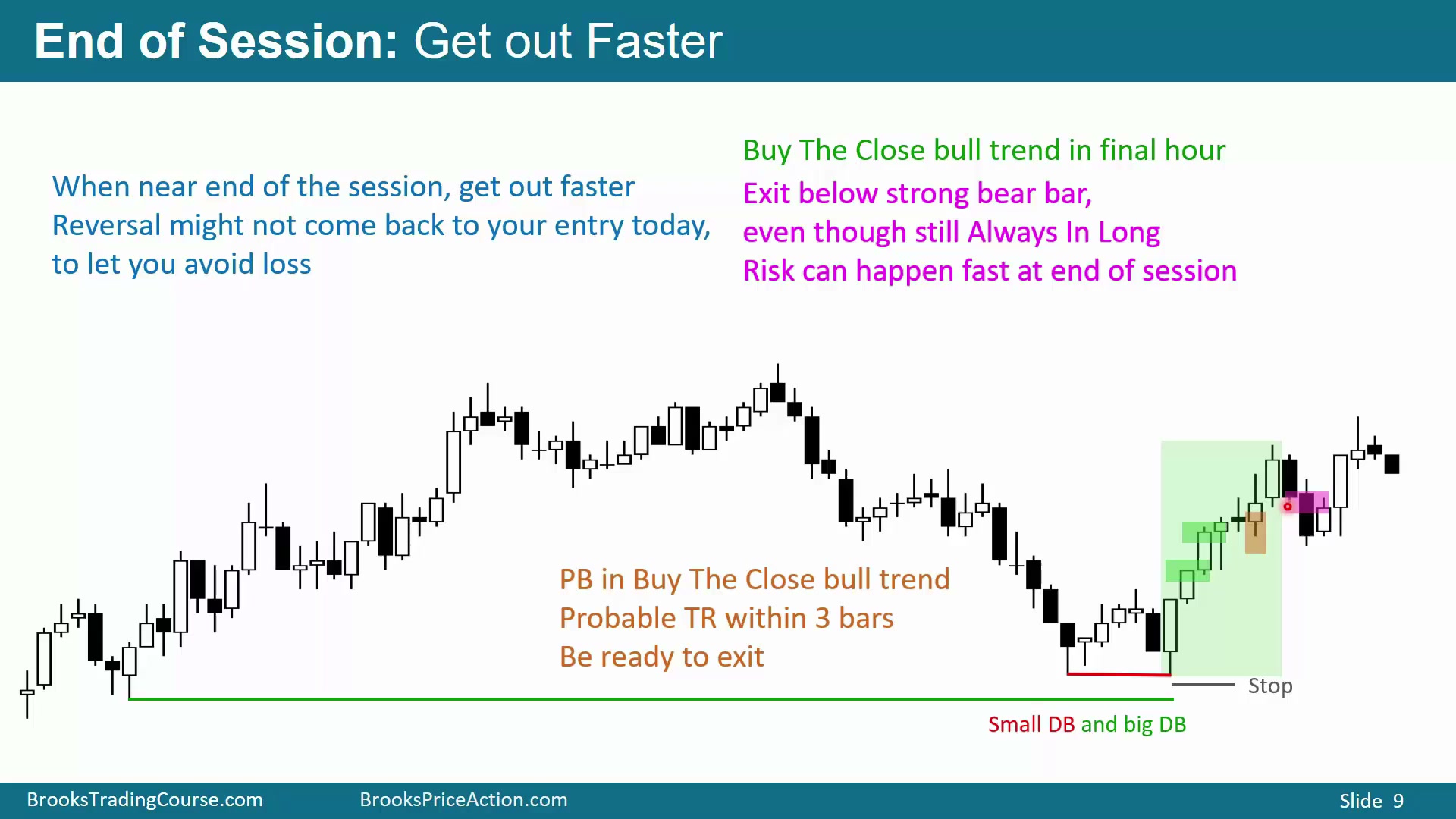
EN: When the market’s near the end of the session,

11:58 - 12:00

EN: you have to be prepared to get out faster,

12:00 - 12:03

EN: because sometimes a reversal may not come back

12:03 - 12:05

EN: to your entry to let you avoid a loss.

12:09 - 12:12

EN: We have a bear swing, but a slightly Higher Low,

12:12 - 12:14

EN: and then we have a small Double Bottom.

12:14 - 12:18

EN: Bull bar here, a better bull bar here, and this Double Bottom

12:18 - 12:21

EN: is forming a Double Bottom with this Double Bottom,

12:21 - 12:24

EN: so it’s a big Double Bottom with this low and this pair of lows,

12:24 - 12:27

EN: and it subdivided into a smaller Double Bottom.

12:31 - 12:33

EN: Reasonable to be buying above this bar

12:33 - 12:37

EN: or buying closes once it becomes a Buy The Close bull trend.

12:37 - 12:41

EN: But it’s a Buy The Close bull trend late in the session or late in the day.

12:42 - 12:46

EN: Whenever that’s the case, it’s usually good to get out below any bear bar

12:46 - 12:51

EN: that closes near its low or 3 or 4 ticks or 3 or 4 pips below any bar,

12:51 - 12:53

EN: bull bar or bear bar.

12:56 - 13:00

EN: When you’re buying these closes, your stop is here below the low,

13:04 - 13:08

EN: and you have to get out, I think, below a bear bar closing near its low.

13:08 - 13:09

EN: So you can get out here.

13:10 - 13:14

EN: A lot of bulls will not get out below this bear doji

13:14 - 13:16

EN: because it has only a small bear body.

13:16 - 13:19

EN: The odds are it’s going to go up a little bit higher.

13:20 - 13:23

EN: However, once you’ve had 3 or 4 bars

13:23 - 13:27

EN: in a Buy The Close trend at the end of a session or the end of the day,

13:27 - 13:31

EN: you have to be prepared to get out because usually a Buy The Close rally

13:31 - 13:35

EN: at the end of a session will only last 4, 5, or 6 bars.

13:35 - 13:38

EN: So once you’ve had five or six closes in your direction,

13:38 - 13:42

EN: you have to be prepared for a reversal, and therefore be ready to get out.

Slide 010

Time: 13:45

Slide 010

Bilingual Transcript

13:47 - 13:50

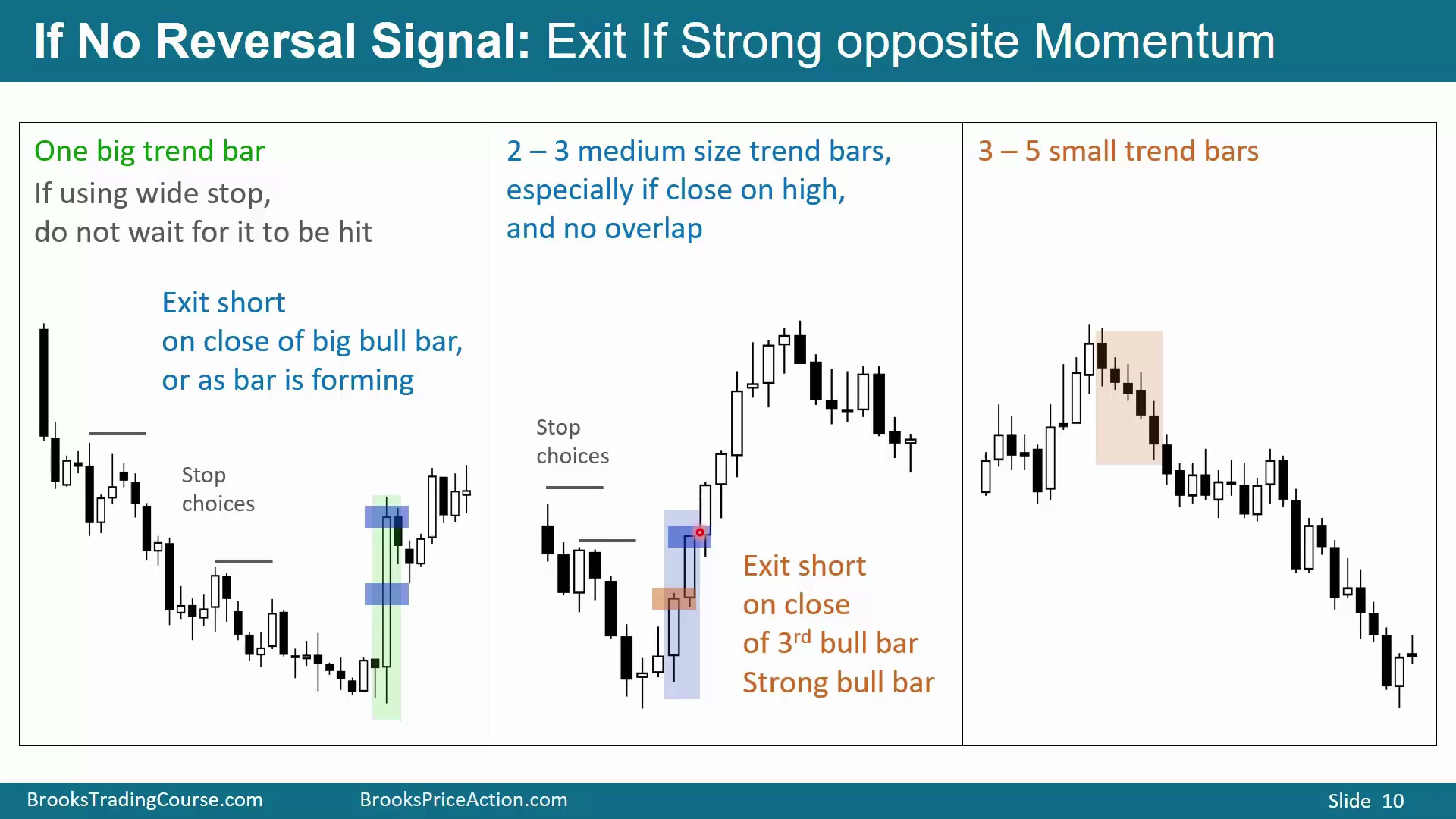
EN: Sometimes there’s no good opposite signal to get you out,

13:50 - 13:53

EN: but you still need some method to get out.

13:55 - 13:58

EN: For example, one big trend bar is enough to make bears

13:58 - 14:00

EN: get out before their stop gets hit.

14:04 - 14:08

EN: Let’s say you’re using a wide stop up here at the top of this Tight Bear Channel

14:09 - 14:12

EN: and you’re short for any reason, and then you see a big bull bar like this.

14:12 - 14:14

EN: This is a surprise bar.

14:15 - 14:21

EN: A surprise bar has at least a 60% or 70% chance of at least one more leg up

14:21 - 14:23

EN: and probably some kind of a Measured Move up.

14:24 - 14:26

EN: Therefore, once you see this bar, get out at the market.

14:26 - 14:28

EN: Don’t wait for your stop to get hit.

14:29 - 14:32

EN: If the market is reversing up strongly even here,

14:32 - 14:36

EN: you’re going to get out at the market before a tight stop here is hit.

14:37 - 14:40

EN: Once you believe your premise is wrong, get out of your position.

14:40 - 14:42

EN: Don’t rely on your stop.

14:46 - 14:49

EN: If you’re short, get out as the big bar is forming

14:49 - 14:51

EN: or certainly on the close of the big bar.

14:51 - 14:54

EN: Whenever you have an exceptional bar like that,

14:54 - 14:57

EN: there’s going to be follow-through, so don’t rely on your stop.

15:03 - 15:05

EN: Instead of 1 big bull bar,

15:05 - 15:08

EN: if you’re short sometimes you’ll see 2 medium size bull bars.

15:09 - 15:12

EN: In that case usually it’s good to get out on the close of the second bar,

15:12 - 15:14

EN: which would be right here.

15:14 - 15:18

EN: This is also 4 bull bars, but 2 of them have pretty good bodies

15:18 - 15:19

EN: and they’re closing on their highs.

15:19 - 15:23

EN: So, reasonable to get out there and don’t rely on a stop to be hit.

15:26 - 15:30

EN: If you had your stop up here, you’re not at the stop,

15:30 - 15:33

EN: but this is strong enough up we’re probably going higher,

15:33 - 15:36

EN: and therefore your stop is probably going to get hit.

15:36 - 15:38

EN: If you’re short, it’s better just to get out.

15:38 - 15:41

EN: Buy at the market as soon as this bar closes.

15:46 - 15:50

EN: A lot of traders will simply exit if there are 3 consecutive bull bars

15:50 - 15:55

EN: and 1 or more of them has a good size body closing on or near its high.

15:55 - 15:59

EN: If a trader is short, this is a reasonable place to get out as well.

16:03 - 16:07

EN: If you’re long and you see 3, 4, or 5 small bars,

16:07 - 16:10

EN: you’ll get out on the close of one of the bars,

16:10 - 16:12

EN: especially if 2 or 3 of them are closing near the low.

16:13 - 16:17

EN: Bulls who are long here get out on the third or fourth or fifth close,

16:17 - 16:20

EN: just sell out of their longs at the market.

16:20 - 16:23

EN: One big bar against you is a good reason to get out,

16:23 - 16:28

EN: 2 medium size bars against you are reasonable reason to get out,

16:28 - 16:34

EN: and 3, 4, or 5 small bars against you are reasonable reason to exit.

16:36 - 16:37

EN: Don’t wait for your stop to be hit.

16:38 - 16:42

EN: Once you’ve seen 3, 4, or 5 bars against you if you’re long,

16:42 - 16:46

EN: your stop is going to get hit, so just get out before your stop is hit.

16:51 - 16:55

EN: Exit on the third or fourth close, especially the fourth close here, a bigger bar.

16:55 - 16:57

EN: We’re starting to accelerate down,

17:02 - 17:04

EN: and now we’re getting a series of bigger bars.

17:04 - 17:06

EN: This is the bulls giving up.

17:06 - 17:10

EN: The market’s now reversing this rally, so big up, big down,

17:10 - 17:13

EN: and the bars are getting good bodies.

17:13 - 17:14

EN: The bulls are giving up.

17:14 - 17:15

EN: The bears are taking control.

17:15 - 17:18

EN: The market is probably going to go lower.

17:18 - 17:19

EN: It’s Always In Short.

17:24 - 17:27

EN: Every trend eventually ends,

Slide 011

Time: 17:25

Slide 011

Bilingual Transcript

17:27 - 17:31

EN: and every trend eventually disappoints traders hoping that the trend will continue.

Slide 012

Time: 17:32

Slide 012

Bilingual Transcript

17:38 - 17:40

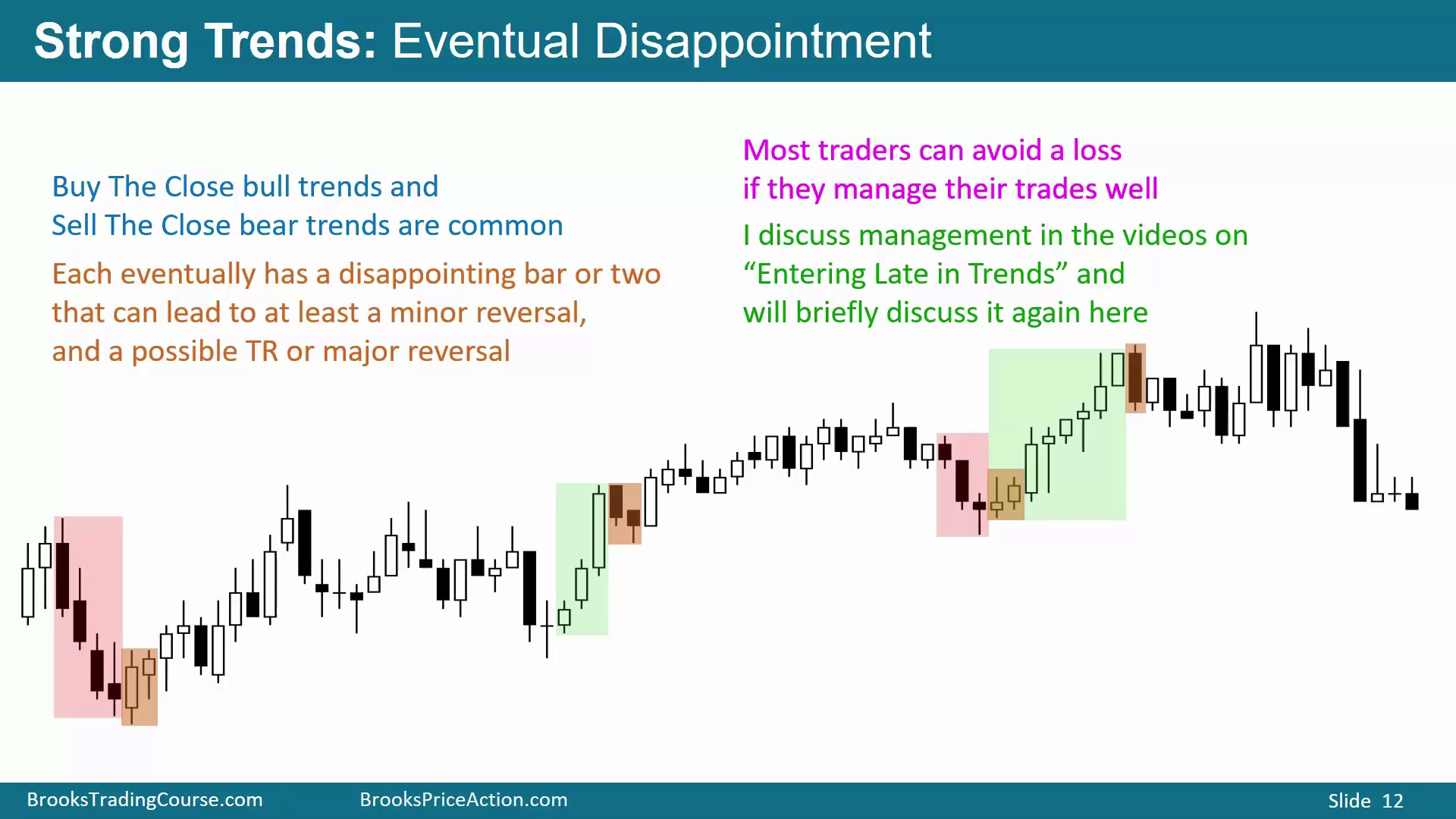
EN: Sell The Close bear trend.

17:40 - 17:42

EN: You get a bull bar closing near its high.

17:42 - 17:44

EN: You’ve got to get out just above the high of the bull bar.

17:45 - 17:46

EN: A Buy The Close bull trend.

17:46 - 17:48

EN: Disappointed bulls.

17:48 - 17:49

EN: Reasonable to get out here.

17:49 - 17:51

EN: Sell The Close bear trend.

17:51 - 17:54

EN: Well, not really, but if you’re a bear, you’re certainly disappointed

17:54 - 17:58

EN: that the breakout is not bigger, the reversal down is not bigger,

17:58 - 18:00

EN: and the follow-through is not bigger.

18:00 - 18:01

EN: Buy The Close bull trend.

18:02 - 18:03

EN: It’s disappointing all the way up.

18:03 - 18:06

EN: We have bars with big tails, small bodies.

18:06 - 18:08

EN: Probably not going to last all that much longer,

18:08 - 18:12

EN: and then you’re certainly going to be disappointed by that big bear bar.

18:18 - 18:20

EN: Sell The Close bear trend.

18:20 - 18:21

EN: Disappointment bars.

18:21 - 18:22

EN: Bull bars.

18:22 - 18:24

EN: Buy The Close bull trend.

18:24 - 18:25

EN: Disappointment.

18:25 - 18:28

EN: Bear bars, especially bear bars closing on or near their lows.

18:29 - 18:31

EN: An attempt at a bear reversal.

18:31 - 18:33

EN: Not convincing, but in any case,

18:33 - 18:36

EN: if you’re a bear you’re disappointed by bull bars.

18:37 - 18:38

EN: Bull trend.

18:38 - 18:42

EN: Even though it’s about 8 bull bars, it’s not very strong,

18:42 - 18:44

EN: and you’re certainly going to be concerned

18:44 - 18:46

EN: by a big bear bar closing near its low.

18:46 - 18:50

EN: It’s disappointing, and it makes you think that the bull trend is ending

18:50 - 18:52

EN: and the market might be entering a Trading Range.

18:56 - 19:01

EN: Usually a good trader can avoid his loss if he manages his trade well.

19:05 - 19:09

EN: I talk about this in the videos on entering late in trends,

19:09 - 19:11

EN: and I’m going to talk a little bit more about it right here.

Slide 013

Time: 19:15

Slide 013

Bilingual Transcript

19:17 - 19:20

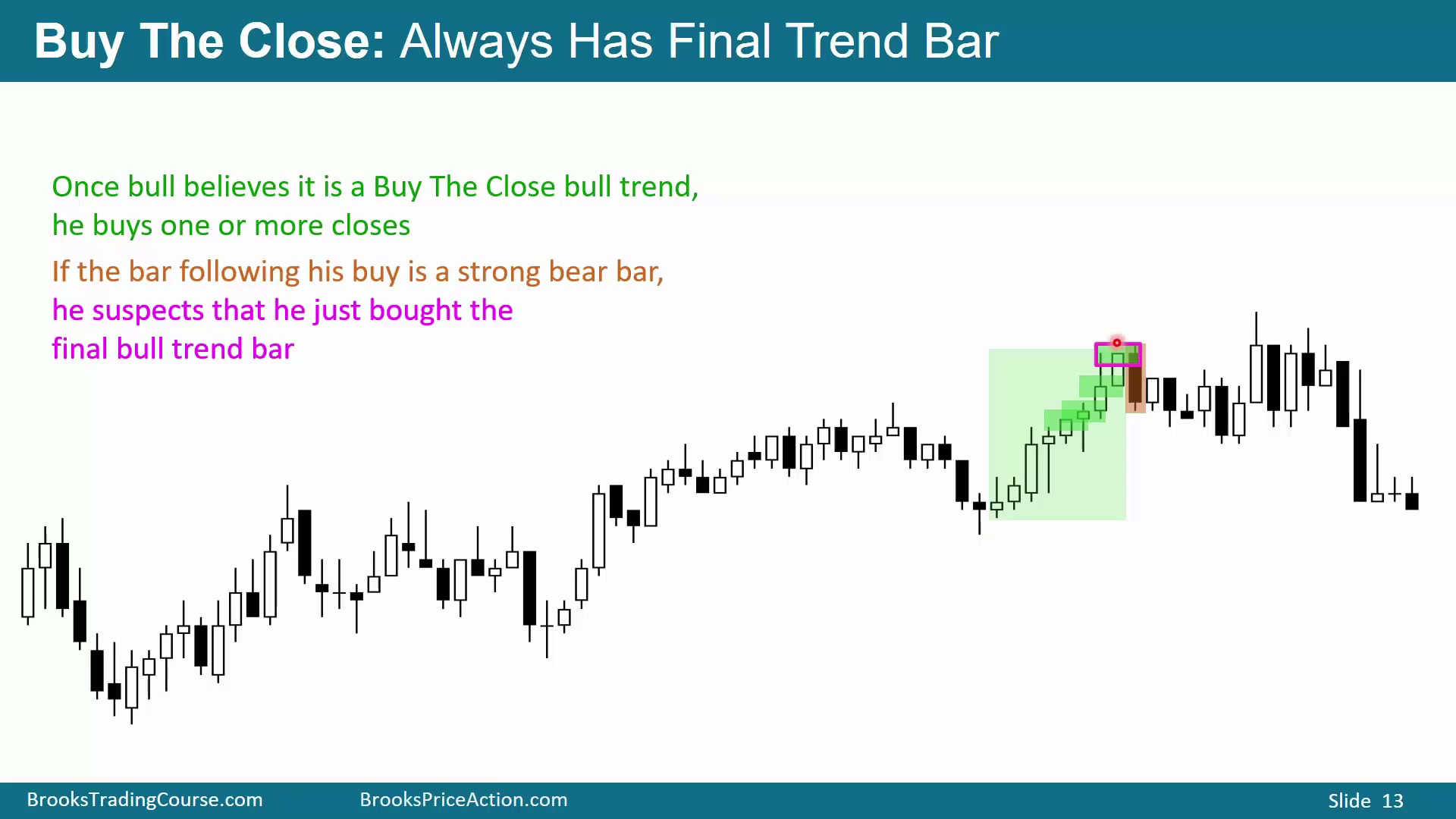
EN: For example, let’s say you were treating this like a Buy The Close bull trend,

19:20 - 19:22

EN: and you bought one or more of these closes,

19:22 - 19:25

EN: either for a scalp or a swing, and then you see this bear bar.

19:26 - 19:27

EN: We’re in a bull channel.

19:27 - 19:30

EN: You look to the left, bears who sold this high made money.

19:31 - 19:34

EN: Bears who sold this high maybe made a little bit of money.

19:34 - 19:37

EN: Bears were selling above highs all the way up, not making much,

19:37 - 19:39

EN: but a pretty good pullback here.

19:39 - 19:42

EN: If we go to a new high, maybe we’ll get another pullback.

19:42 - 19:45

EN: Bears who sold this high made money.

19:45 - 19:46

EN: They sell that high, they sell more higher,

19:47 - 19:49

EN: and they get out breakeven at their first entry

19:49 - 19:50

EN: and with a profit on their second.

19:51 - 19:53

EN: Very Tight Bull Channel.

19:53 - 19:57

EN: Probably a minor reversal, meaning either a bull flag or a Trading Range.

19:57 - 20:01

EN: However, if you happened to buy that close,

20:01 - 20:04

EN: you knew that we’ve pulled back every time we’ve broken out to a new high.

20:04 - 20:06

EN: We’re in a channel.

20:06 - 20:07

EN: We’re going to pull back soon.

20:07 - 20:11

EN: If you see this bear bar, you have to be disappointed.

20:18 - 20:21

EN: You may have bought the high close of the bull trend.

20:21 - 20:24

EN: More likely you bought the high close of the current leg in the bull trend.

20:25 - 20:27

EN: We have 8 consecutive bull bars.

20:27 - 20:31

EN: First reversal probably minor, but you have to make decisions on what to do.

Slide 014

Time: 20:35

Slide 014

Bilingual Transcript

20:40 - 20:42

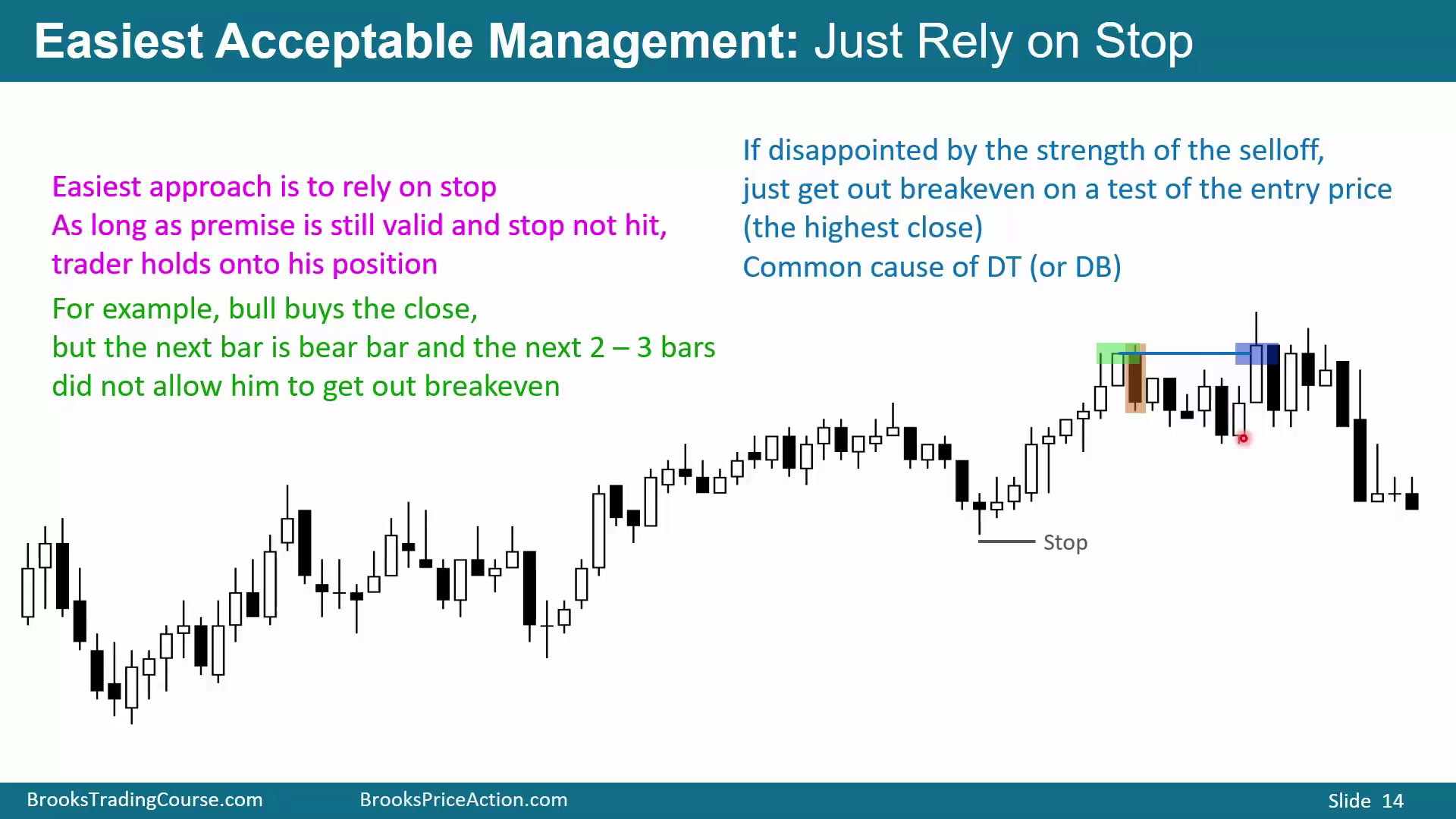
EN: The easiest approach is to just rely on your stop,

20:42 - 20:47

EN: and as long as your stop has not been hit and your premise is still good,

20:47 - 20:48

EN: you can hold onto your position.

20:48 - 20:50

EN: Strong breakout, new high.

20:51 - 20:52

EN: This is a major Lower High.

20:52 - 20:55

EN: Reasonable to keep your stop right here.

21:02 - 21:06

EN: If you bought this close after you saw the disappointment bar,

21:06 - 21:08

EN: you might’ve placed an order to get out breakeven,

21:08 - 21:11

EN: and you were unable, unable, unable.

21:11 - 21:13

EN: Several bars unable to get out breakeven.

21:13 - 21:17

EN: Buying this close was a reasonable thing to do.

21:17 - 21:20

EN: Usually if you do something reasonable and you rely on your stop

21:20 - 21:25

EN: and scale in lower, you can avoid a loss and possibly make a profit.

21:32 - 21:37

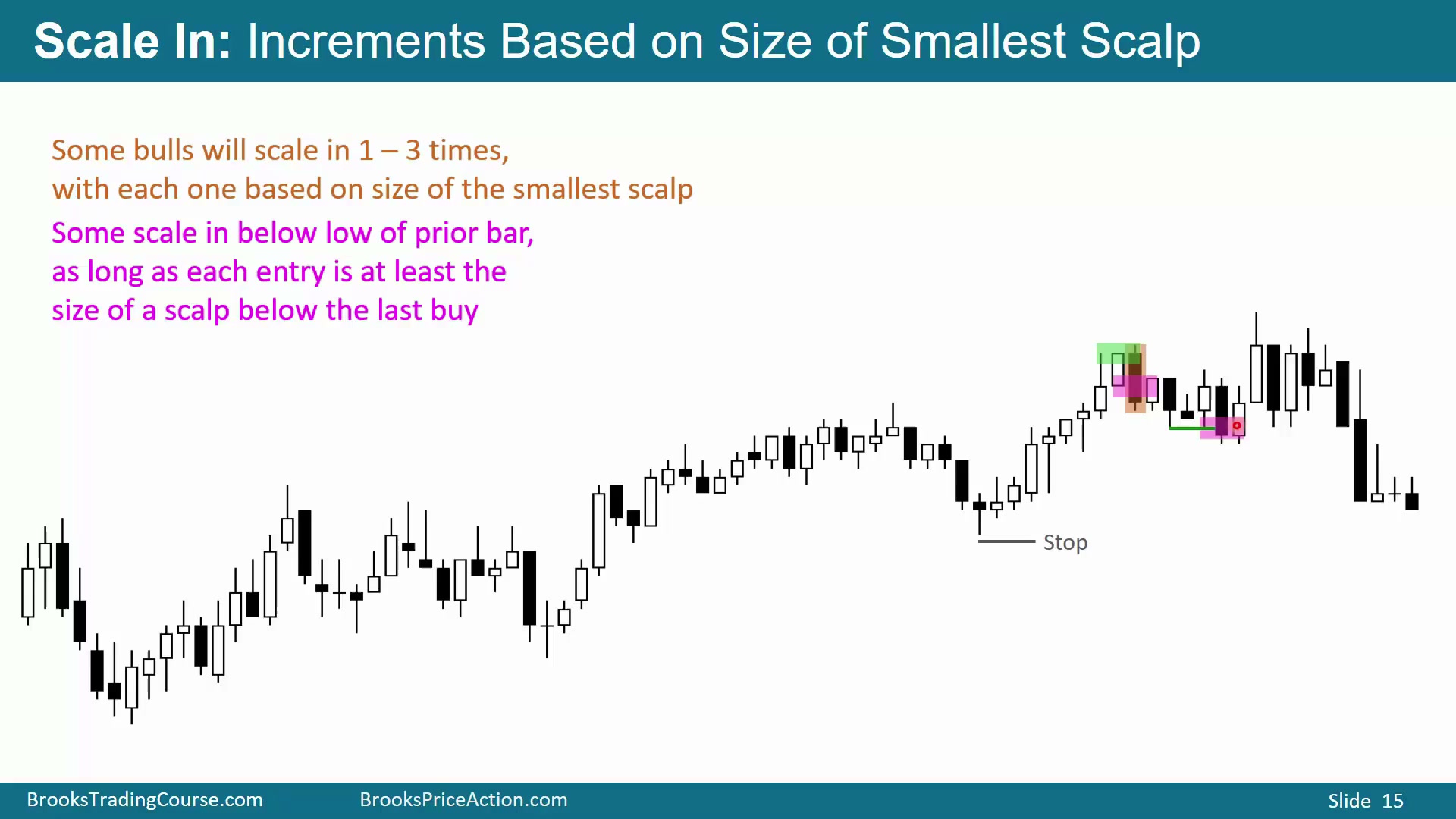
EN: One thing to do is rely on your stop, place a limit order to get out breakeven.

21:37 - 21:40

EN: Another thing is to buy more the size of a scalp

21:40 - 21:43

EN: or two to three times the size of a scalp below your first entry,

21:43 - 21:47

EN: rely on your stop, and then get out breakeven on your first trade

21:47 - 21:49

EN: with a profit on your lower trade.

21:51 - 21:52

EN: We’re getting late in the day.

21:52 - 21:56

EN: A lot of the bulls who did buy here and sat through this are concerned

21:56 - 21:58

EN: that we might not go much higher.

21:58 - 22:01

EN: They simply sell out of their longs at their original entry price.

22:02 - 22:03

EN: Reasonable.

Slide 015

Time: 22:05

Slide 015

Bilingual Transcript

22:10 - 22:15

EN: Some bulls, as I said, will scale in one times or two times or three times

22:15 - 22:18

EN: the size of a minimum scalp, rely on their stop,

22:18 - 22:21

EN: and then look to get out with a profit on their lower entries

22:21 - 22:24

EN: and get out breakeven at their first entry.

22:24 - 22:26

EN: You can only do this if you’re trading small enough

22:26 - 22:29

EN: so that your entire position does not expose you

22:29 - 22:33

EN: to any more risk using the stop than any other trade.

22:33 - 22:36

EN: If your position is too big to allow you to scale in

22:36 - 22:38

EN: and use that stop, don’t scale in.

Slide 016

Time: 22:45

Slide 016

Bilingual Transcript

22:50 - 22:51

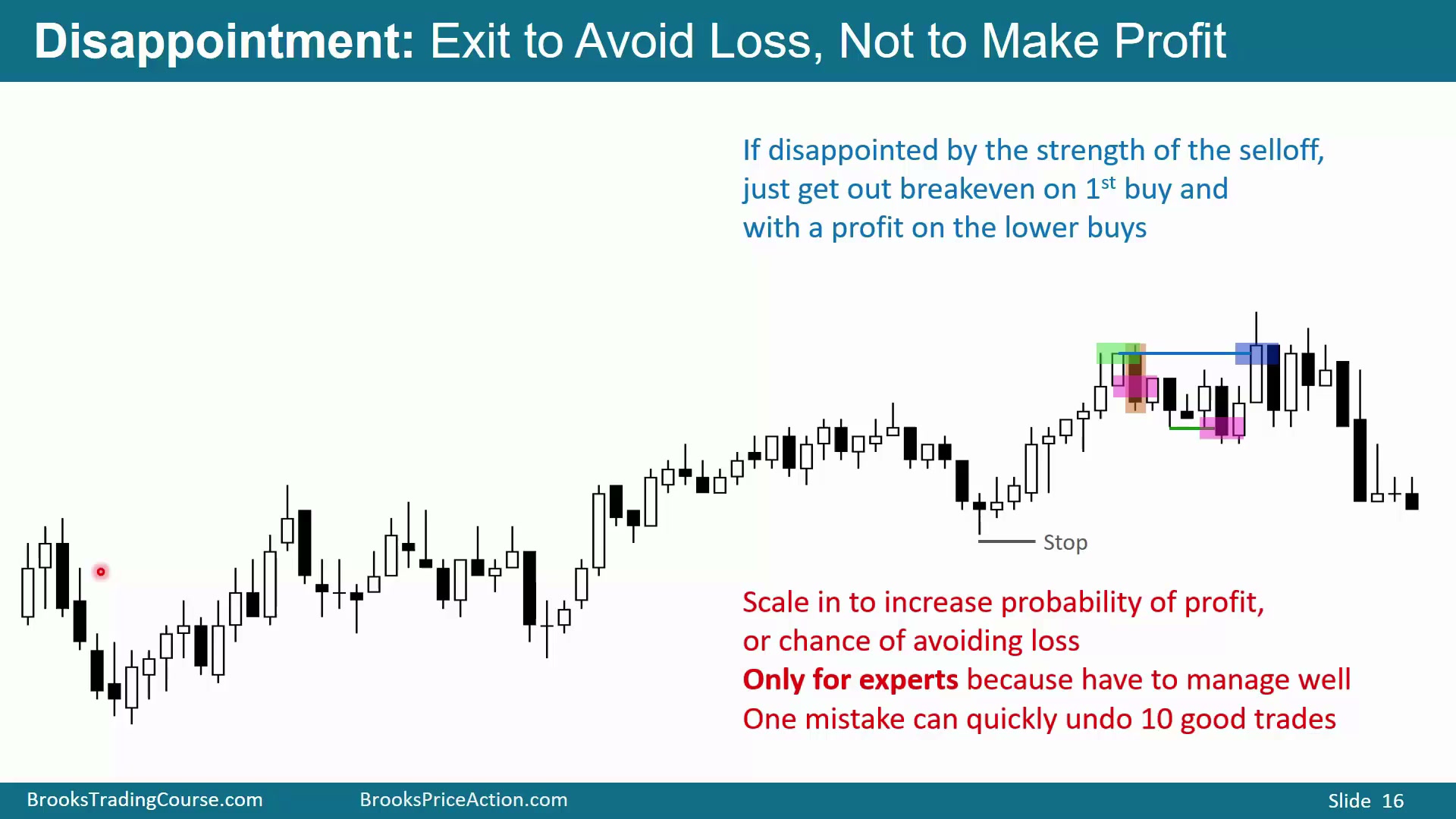
EN: Disappointment.

22:51 - 22:55

EN: You get out breakeven on your first entry, and if you added on,

22:55 - 22:57

EN: you get out with a small profit on your lower entry.

23:05 - 23:10

EN: Traders scale in for one reason: to increase the probability of a profit

23:10 - 23:14

EN: or to increase the chance of avoiding a loss.

23:14 - 23:16

EN: It’s a thing that experts do.

23:16 - 23:20

EN: Beginners should never do it because invariably

23:20 - 23:23

EN: their position will be too big for the stop that they need.

23:23 - 23:26

EN: They buy here thinking that they’re going to scale in.

23:26 - 23:29

EN: They scale in thinking that they can hold and rely on the stop,

23:29 - 23:31

EN: and then they do the math and decide that,

23:31 - 23:34

EN: “Wow, I didn’t think I was going to be risking that much money,”

23:35 - 23:37

EN: and they end up selling with a loss

23:37 - 23:40

EN: rather than managing the trade as they originally planned.

23:41 - 23:44

EN: They had an unreasonable plan given their skill level,

23:44 - 23:47

EN: their ability to tolerate the market going against them,

23:47 - 23:50

EN: and their position size was way too big.

Slide 017

Time: 23:55

Slide 017

Bilingual Transcript

23:57 - 24:01

EN: A lot of bulls who are looking to scale in will only scale in once.

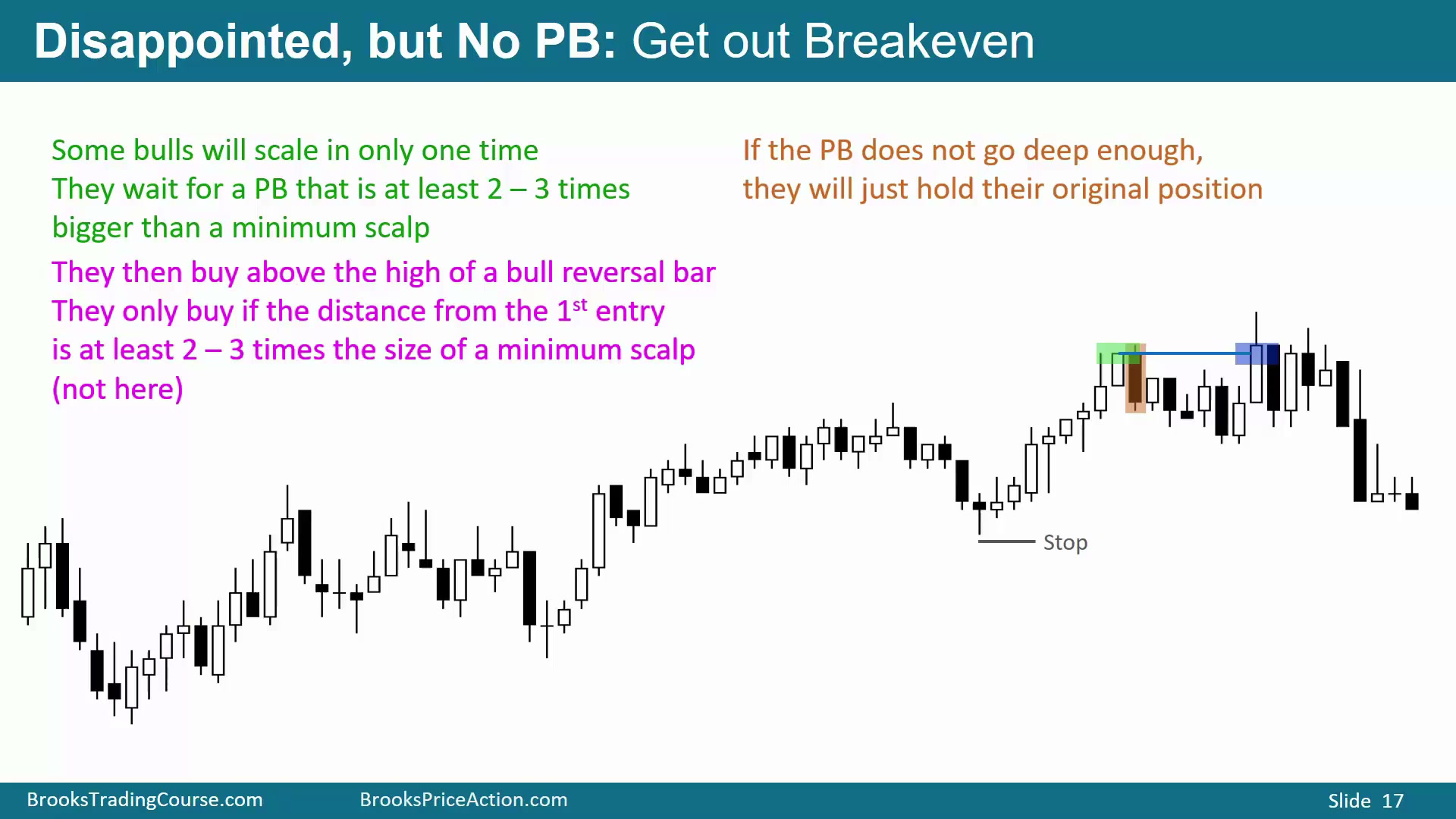
24:02 - 24:06

EN: They like to wait for a pullback that is at least two to three times

24:06 - 24:08

EN: bigger than the minimum scalp size,

24:16 - 24:19

EN: and a lot of them prefer to buy above a decent bull bar.

24:19 - 24:24

EN: So for example, a bull might buy here and hope that once it starts to sell off,

24:24 - 24:29

EN: he gets to buy more 2 to 3 points or 10 or 20 pips,

24:29 - 24:33

EN: 30 pips below this first entry, but above a bull bar.

24:33 - 24:35

EN: For example, this is a good-looking bull bar,

24:35 - 24:40

EN: but it’s probably not two to three times the size of a minimum scalp.

24:46 - 24:49

EN: If a trader bought here thinking that he’s disappointed,

24:49 - 24:53

EN: he wants to buy more lower, and it does not go low enough,

24:53 - 24:57

EN: he simply holds onto his position in case it goes lower and then adds on.

24:58 - 25:01

EN: If instead it does not go low enough to scale in,

25:01 - 25:05

EN: he simply gets out breakeven at his original entry.

Slide 018

Time: 25:10

Slide 018

Bilingual Transcript

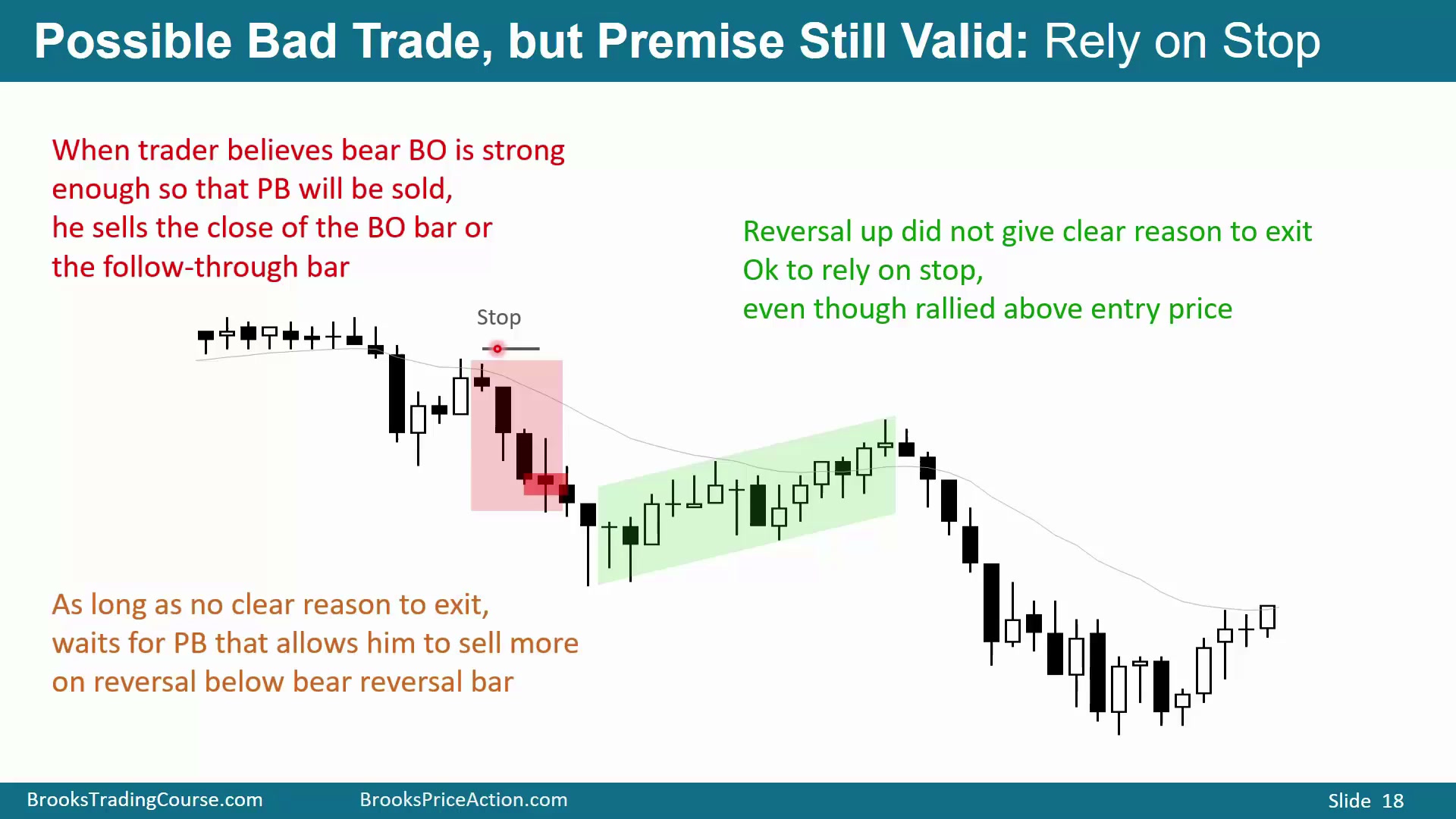
25:17 - 25:22

EN: We have a bear breakout, a pullback, and then a strong bear breakout,

25:23 - 25:25

EN: a pair of bear bars closing below the low,

25:25 - 25:28

EN: and a follow-through bear bar – a doji, not all that good.

25:28 - 25:31

EN: But good enough breakout, good enough follow-through,

25:31 - 25:35

EN: probably at least a little bit more down, and maybe a lot more down.

25:37 - 25:39

EN: If the bear sells at this close,

25:39 - 25:43

EN: his stop is above the top of the most recent major Lower High.

25:43 - 25:45

EN: A major Lower High.

25:45 - 25:48

EN: We broke to a new low and there’s a reasonably strong breakout,

25:48 - 25:49

EN: 4 consecutive bear bars.

25:49 - 25:51

EN: A good location for the stop.

25:57 - 26:01

EN: Then he sees this: a Micro Double Bottom, a bull bar, and it’s starting to go up.

26:01 - 26:04

EN: Here we have 5 bars up without a pullback.

26:04 - 26:06

EN: But is his premise wrong?

26:06 - 26:10

EN: Is this now Always In Long, or is it still Always In Short?

26:10 - 26:13

EN: This is not enough to make it Always In Long.

26:13 - 26:15

EN: This is not enough to make it Always In Long,

26:15 - 26:19

EN: and therefore it’s Always In Short still and has not hit his stop,

26:19 - 26:22

EN: so it’s reasonable to stay short.

26:22 - 26:26

EN: You sell here and you sit through this because there’s no clear,

26:26 - 26:29

EN: obvious buy setup – this is not a convincing obvious buy setup

26:30 - 26:33

EN: - and the reversal never had 3 or 4 strong bull bars.

26:33 - 26:36

EN: You have 3 bull bars here, not particularly big.

26:36 - 26:39

EN: If you want you could get out on the close of this bar,

26:39 - 26:41

EN: but if you do, the premise is still valid.

26:41 - 26:45

EN: You look for a bear bar and you get short again below that low.

26:52 - 26:55

EN: Even though the reversal up lasted about a dozen bars,

26:56 - 26:59

EN: the market never clearly became Always In Long,

26:59 - 27:02

EN: and therefore it’s reasonable to rely on your stop

27:02 - 27:05

EN: even though the market is now above your entry price.

Slide 019

Time: 27:10

Slide 019

Bilingual Transcript

27:10 - 27:14

EN: All traders need rules to avoid big losses,

27:14 - 27:17

EN: and the single most important rule is to rely

27:17 - 27:19

EN: on a protective stop that’s in the market.

27:20 - 27:22

EN: Every trend eventually ends,

27:22 - 27:25

EN: and that means how you’re trading has to change as well.

27:30 - 27:31

EN: This is Al Brooks.

27:31 - 27:35

EN: This is the first of two videos on losing when a good trade goes bad.