al-brooks-course
08 - 5 Thoughts on Psychology – Part 1
Raw transcript and slide notes for 08 - 5 Thoughts on Psychology – Part 1.
Overview
- Slides: 30
- Transcript segments: 946
- Status: 自动按 slide 时间线归档;核心概念和长期笔记可以在每个 slide 的
Study Notes下继续整理。
Source Media
Transcript 001
Time: 00:03
Bilingual Transcript
00:03 - 00:05
EN: I’ll tell you, I want to talk a little bit about psychology,
00:05 - 00:10
EN: which is something I do in my chatroom, but I rarely talk about it.
Slide 001
Time: 00:10
Bilingual Transcript
00:11 - 00:14
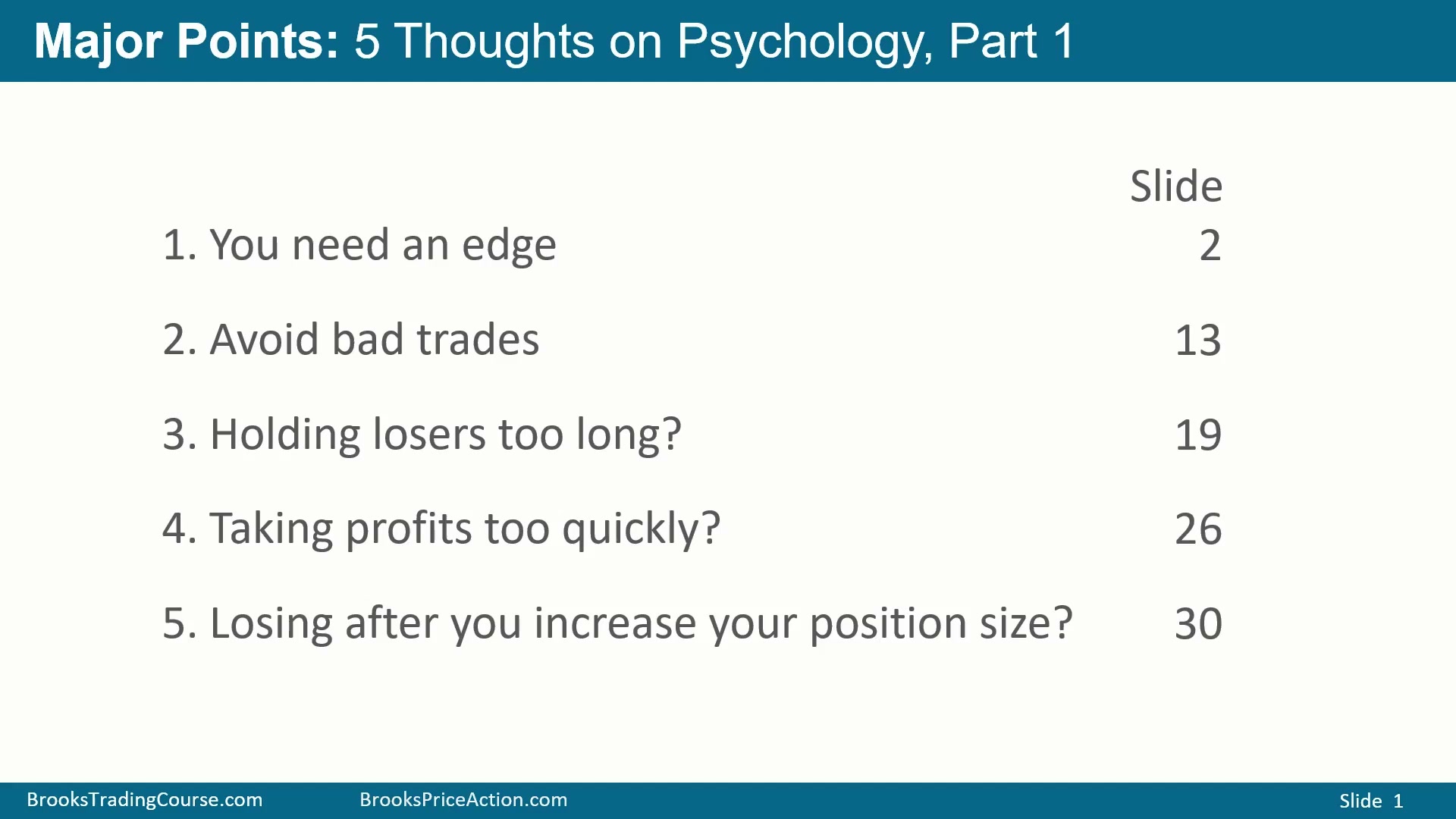
EN: I want to talk about 5 points.
00:14 - 00:18
EN: First of all, whenever you take a trade, you need an edge.
00:18 - 00:24
EN: An edge is a mathematical advantage, and that means not only taking a trade
00:24 - 00:26
EN: that makes sense, but more importantly,
00:26 - 00:29
EN: managing the trade in a way that makes sense.
00:29 - 00:32
EN: Without that, you cannot make money.
00:32 - 00:34
EN: One of the biggest problems I think that traders have,
00:34 - 00:37
EN: especially starting out, is avoiding bad trades.
00:38 - 00:41
EN: If you’ve traded for a month or two or a year or two
00:41 - 00:43
EN: and you’re still losing money and you look back at your trades,
00:43 - 00:46
EN: you’ll see that you took a lot of really good trades.
00:46 - 00:51
EN: The key to making money is to get rid of the bad trades.
00:51 - 00:54
EN: If you can get rid of those bad trades,
00:54 - 00:59
EN: you’ll have had enough winners so that you will be a profitable trader.
00:59 - 01:02
EN: Another problem I think that a lot of traders have,
01:02 - 01:04
EN: especially early in their careers,
01:04 - 01:09
EN: is they tend to hold onto losers too long, and they get emotional.
01:09 - 01:13
EN: They think, “Well, a professional would just scale in more as it goes against me,
01:13 - 01:18
EN: as it goes against him, and therefore I can hold and scale in.”
01:18 - 01:22
EN: That is – that’s really a horrible mistake.
01:22 - 01:27
EN: Yes, professionals do scale in, but they do it calmly and when it makes sense.
01:27 - 01:30
EN: Simply holding onto a loser because you’re afraid
01:30 - 01:34
EN: to take a loss is going to result in losers getting very, very big.
01:35 - 01:39
EN: Another problem that traders often have, and it’s related to the problem
01:39 - 01:42
EN: that I just said, is that they tend to take profits too quickly.
01:42 - 01:45
EN: For example, if you just lost two or three trades
01:45 - 01:47
EN: and now you finally have a small profit,
01:48 - 01:51
EN: a lot of traders will just take the profit just
01:51 - 01:54
EN: so that they can have a winner and break the losing streak.
01:54 - 02:00
EN: That’s a mistake, and that is not managing the trade properly.
02:00 - 02:04
EN: You never look back at your prior trades when you’re trading.
02:04 - 02:06
EN: All you can do is think about the current trade.
02:06 - 02:11
EN: And then a very common problem is that when traders start to trade well,
02:11 - 02:14
EN: they want to increase their position size,
02:14 - 02:17
EN: and they discover that they’re starting to lose money
02:17 - 02:22
EN: as they’re increasing their position size, and I’ll talk about that today.
02:24 - 02:26
EN: I want to begin by talking about an edge.
02:26 - 02:29
EN: An edge is a mathematical advantage.
Slide 002
Time: 02:29
Bilingual Transcript
02:30 - 02:31
EN: By the way, I do not gamble.
02:31 - 02:32
EN: I like Vegas.
02:32 - 02:37
EN: I like the energy, I like the shows, but I personally do not gamble.
02:39 - 02:44
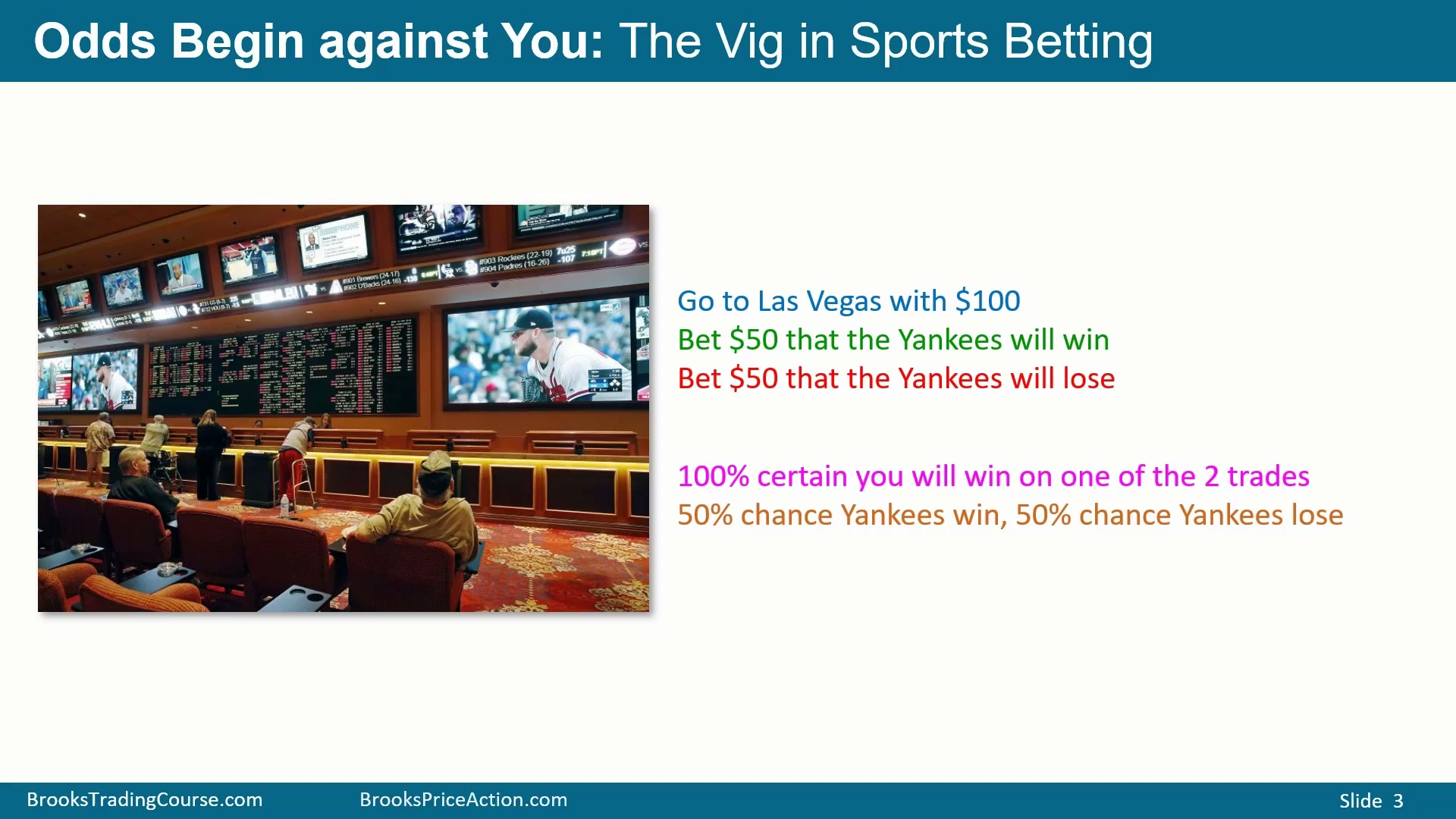
EN: So if you go to Las Vegas with $100 and you do some sports betting
02:44 - 02:47
EN: and you bet $50 that the Yankees will win and you bet $50
02:47 - 02:49
EN: that the Yankees will lose, you think that,
02:49 - 02:52
EN: okay, you’re going to get out breakeven.
02:52 - 02:53
EN: Well, that’s not true.
02:53 - 02:59
EN: You’re 100% certain that one of the two trades will make money.
02:59 - 03:01
EN: There’s a 50% chance that the Yankees will win
03:01 - 03:04
EN: and there’s a 50% chance that the Yankees will lose.
Slide 003
Time: 03:05
Bilingual Transcript
03:07 - 03:11
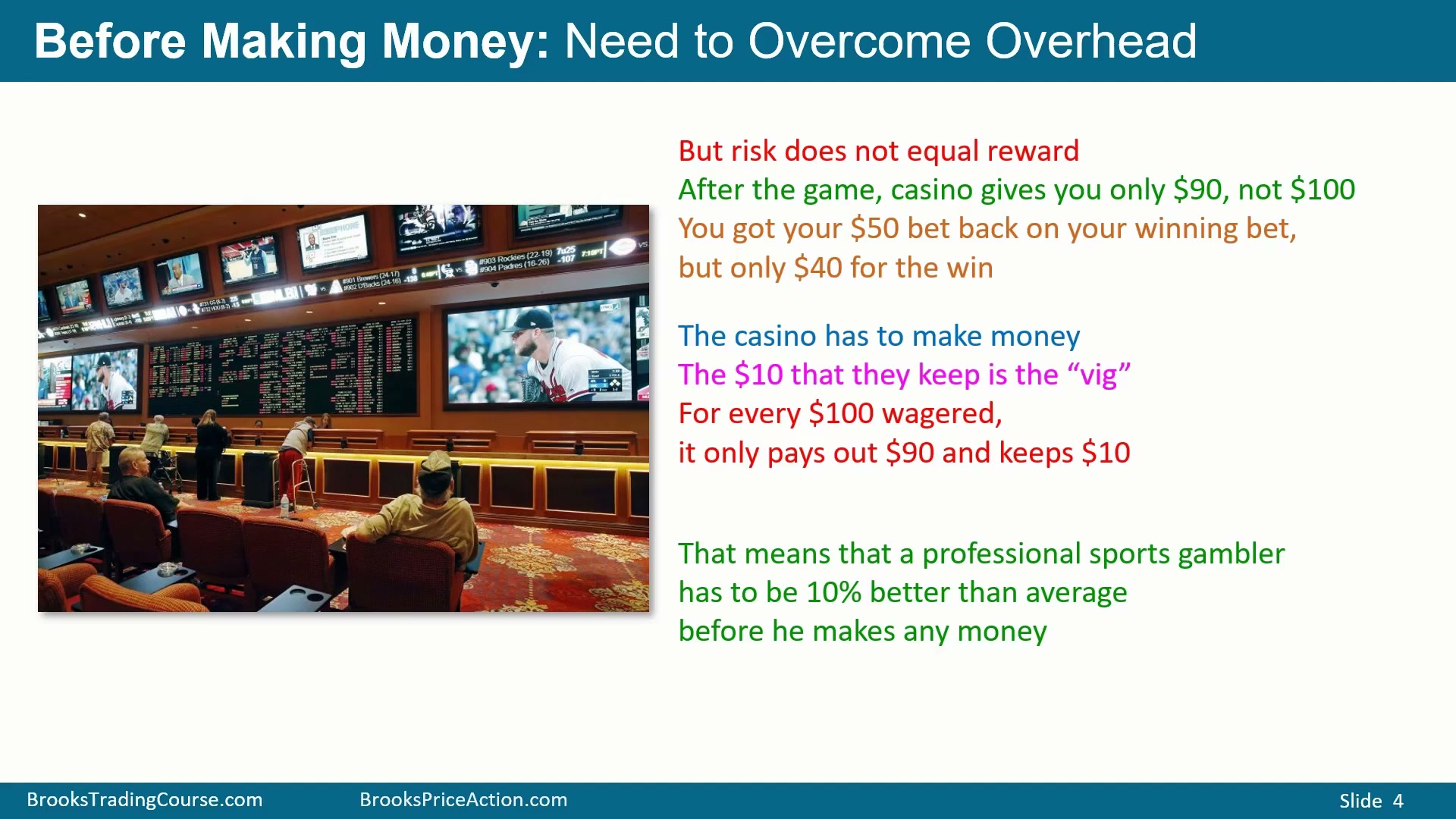
EN: But risk does not equal reward because at the end of the game,
03:12 - 03:15
EN: you’ll have bet $100, $50 on a win, $50 on a loss,
03:15 - 03:19
EN: and the casino will give you back $90, not $100.
03:19 - 03:23
EN: You get your $50 bet back, but only $40 for the win.
03:23 - 03:27
EN: And that difference is what the casino keeps to stay in business.
03:27 - 03:28
EN: That’s the vig.
03:28 - 03:32
EN: So for every $100 that people wager,
03:32 - 03:36
EN: the casino probably pays out about $90 and keeps 10%.
03:36 - 03:41
EN: That’s the cost that you have to give to them for them to stay in business.
03:43 - 03:47
EN: And there are professional sports gamblers who make money,
03:48 - 03:51
EN: but you have a 10% overhead that you have to overcome,
03:51 - 03:56
EN: so you have to be better than 10%, better than average, to make money.
03:56 - 04:00
EN: You have that overhead that you have to overcome, and that’s true with trading.
Slide 004
Time: 03:59
Bilingual Transcript
04:00 - 04:02
EN: There’s overhead as well.
04:04 - 04:07
EN: I want to talk about the mathematical advantage.
04:07 - 04:09
EN: I talked about you need an edge,
04:09 - 04:13
EN: and one way to look at it is with the Trader’s Equation.
04:13 - 04:15
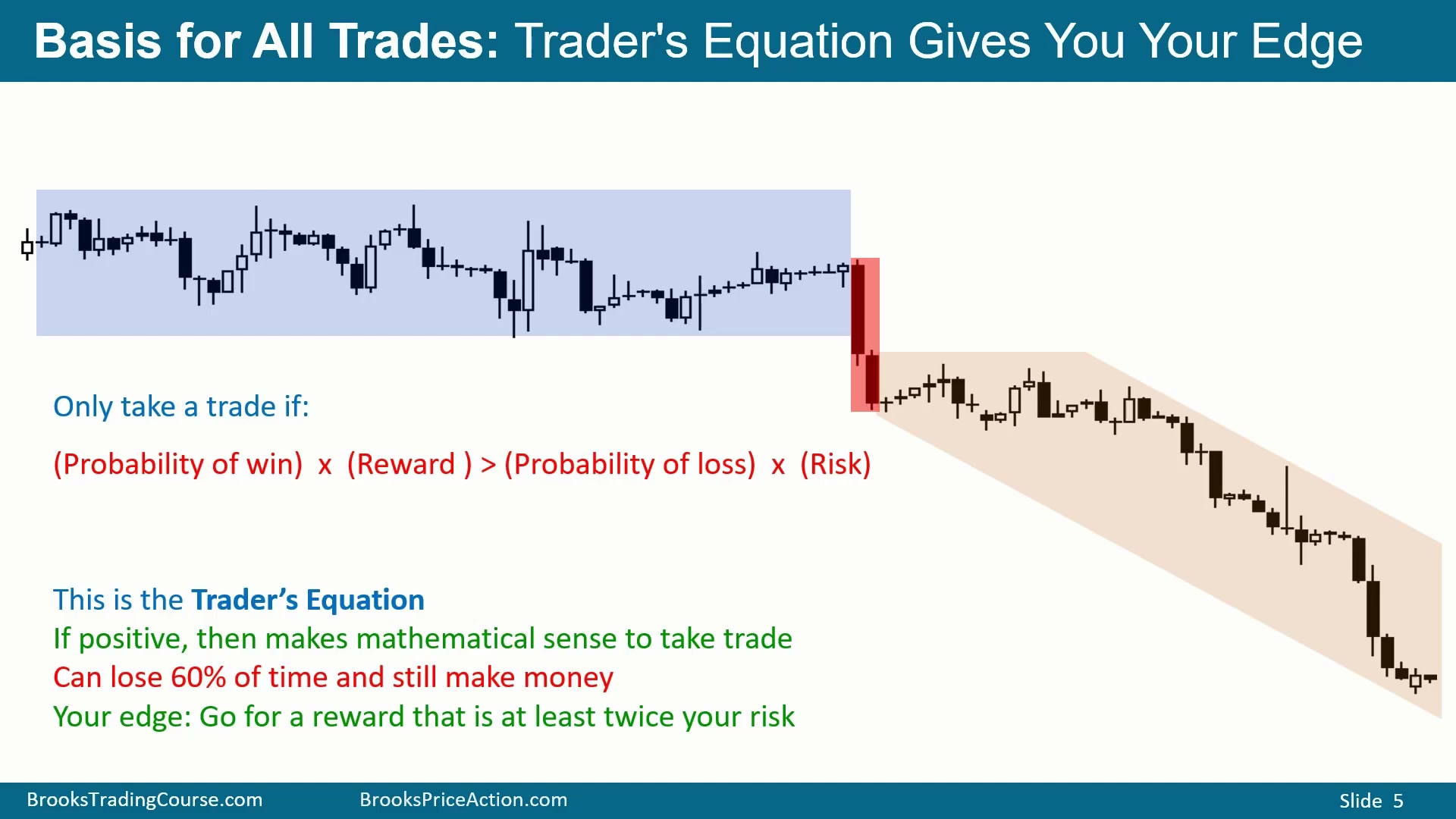
EN: And that equation is you only take a trade
04:15 - 04:18
EN: if the probability of winning times the reward
04:18 - 04:22
EN: that you would get from the win is greater than the probability
04:22 - 04:27
EN: of losing times the loss, the risk that you would get if you lose.
04:29 - 04:32
EN: If the Trader’s Equation is positive,
04:32 - 04:36
EN: then it makes mathematical sense to take the trade.
04:37 - 04:39
EN: Now, there are several variables here.
04:39 - 04:42
EN: We’ve got probability, reward, and risk.
04:42 - 04:49
EN: You can lose 60% of the time – in other words, have a probability of only 40%
04:49 - 04:54
EN: - and still make money if the reward is sufficiently bigger than the risk.
04:56 - 04:57
EN: What’s your edge?
04:57 - 05:01
EN: Most traders, their edge should be going for a reward
05:01 - 05:05
EN: that’s at least twice as big as the risk and not worry about probability.
05:05 - 05:07
EN: Finding high probability trades
05:07 - 05:11
EN: or structuring high probability trades is difficult to do.
05:11 - 05:11
EN: Scalpers do it.
05:11 - 05:13
EN: I tend to scalp a lot.
05:13 - 05:17
EN: But for most traders, it’s too stressful, it’s not fun,
05:17 - 05:19
EN: and it’s very hard to do it consistently well.
05:19 - 05:23
EN: You’re trading with, in general, risk that’s greater than reward,
05:24 - 05:27
EN: so you have to make sure you have a very high probability,
05:27 - 05:29
EN: and that’s very difficult to do.
05:29 - 05:32
EN: So most traders should just look for any reasonable trade
05:32 - 05:37
EN: and not exit until they have a reward that is twice their risk,
05:37 - 05:40
EN: or until the trade no longer makes sense.
Slide 005
Time: 05:43
Bilingual Transcript
05:43 - 05:45
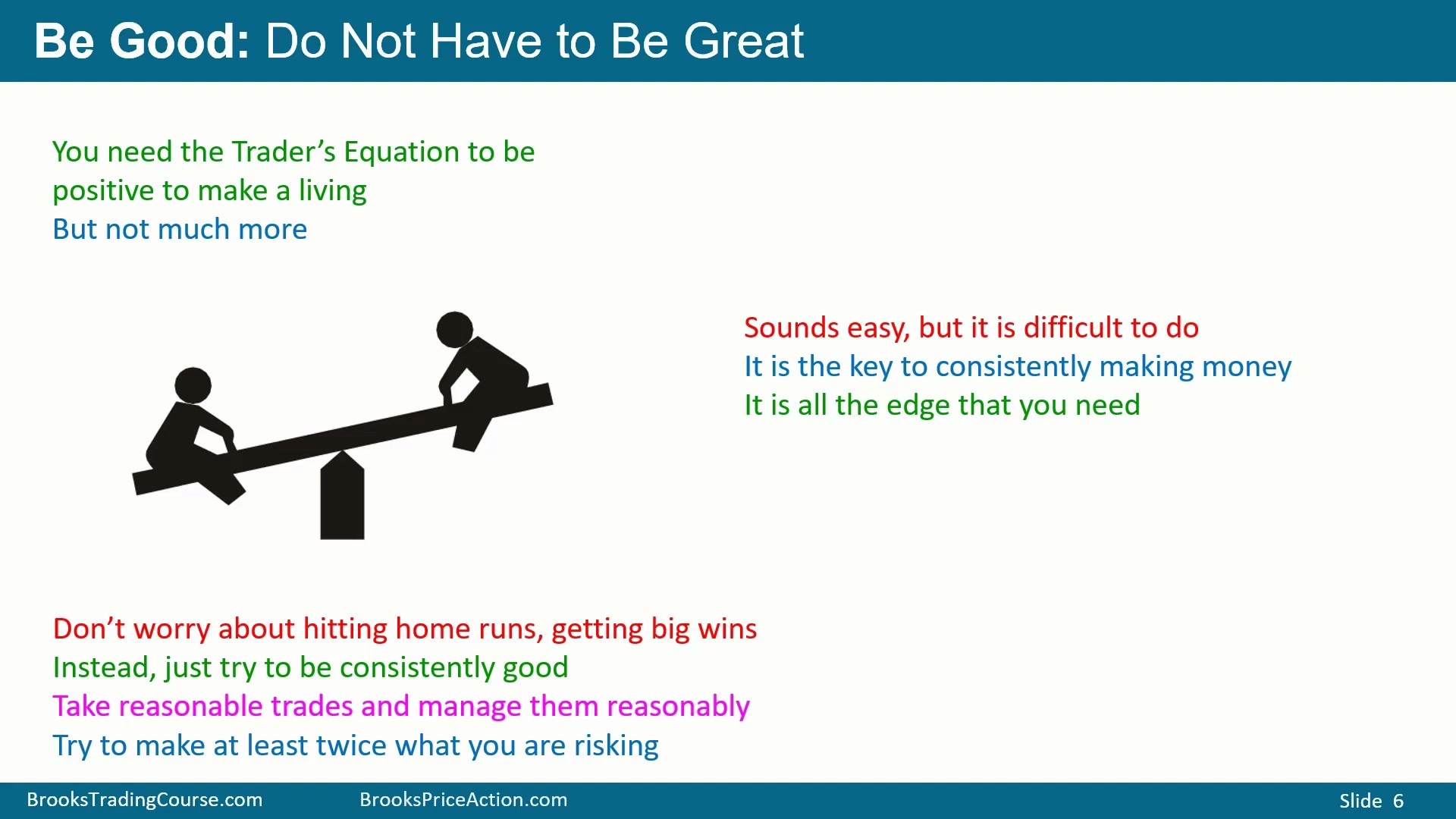
EN: To make a living as a trader,
05:45 - 05:49
EN: you need the Trader’s Equation to be positive, but you don’t need much more.
05:49 - 05:51
EN: You don’t have to be perfect.
05:51 - 05:53
EN: You don’t have to worry about trying
05:53 - 05:56
EN: to hit homeruns every day, going for big wins.
05:56 - 05:58
EN: Instead, all you have to do is be consistently good.
05:58 - 06:02
EN: What you have to do is look for reasonable trades and manage them well,
06:02 - 06:06
EN: and the most important point is when you’re taking a trade,
06:06 - 06:11
EN: go in with the intention of going for a reward that is twice your risk,
06:11 - 06:16
EN: so a risk/reward ratio where the reward is at least twice the risk.
06:16 - 06:19
EN: 40% of the time, you’ll get that.
06:19 - 06:22
EN: 60% of the time, you’ll have a small loss or a small win
06:22 - 06:24
EN: and they’ll cancel each other out.
06:24 - 06:27
EN: But that 40% of the time is what you need
06:27 - 06:29
EN: to become a consistently profitable trader.
06:32 - 06:35
EN: It sounds easy, but it’s really difficult to do.
06:35 - 06:40
EN: But it’s the key to making money, and that is all the edge that you need.
06:40 - 06:43
EN: There are other edges that you can have – for example,
06:43 - 06:46
EN: if you’re very good at structuring high probability trades,
06:46 - 06:47
EN: you can take those and scalp.
06:47 - 06:51
EN: But for the 99% of traders, the single best edge
06:51 - 06:56
EN: that they can use is take a reasonable trade and then go for a reward
06:56 - 06:58
EN: that is at least twice as big as the risk.
07:00 - 07:03
EN: Here’s a price chart.
Slide 006
Time: 07:00
Bilingual Transcript
07:03 - 07:08
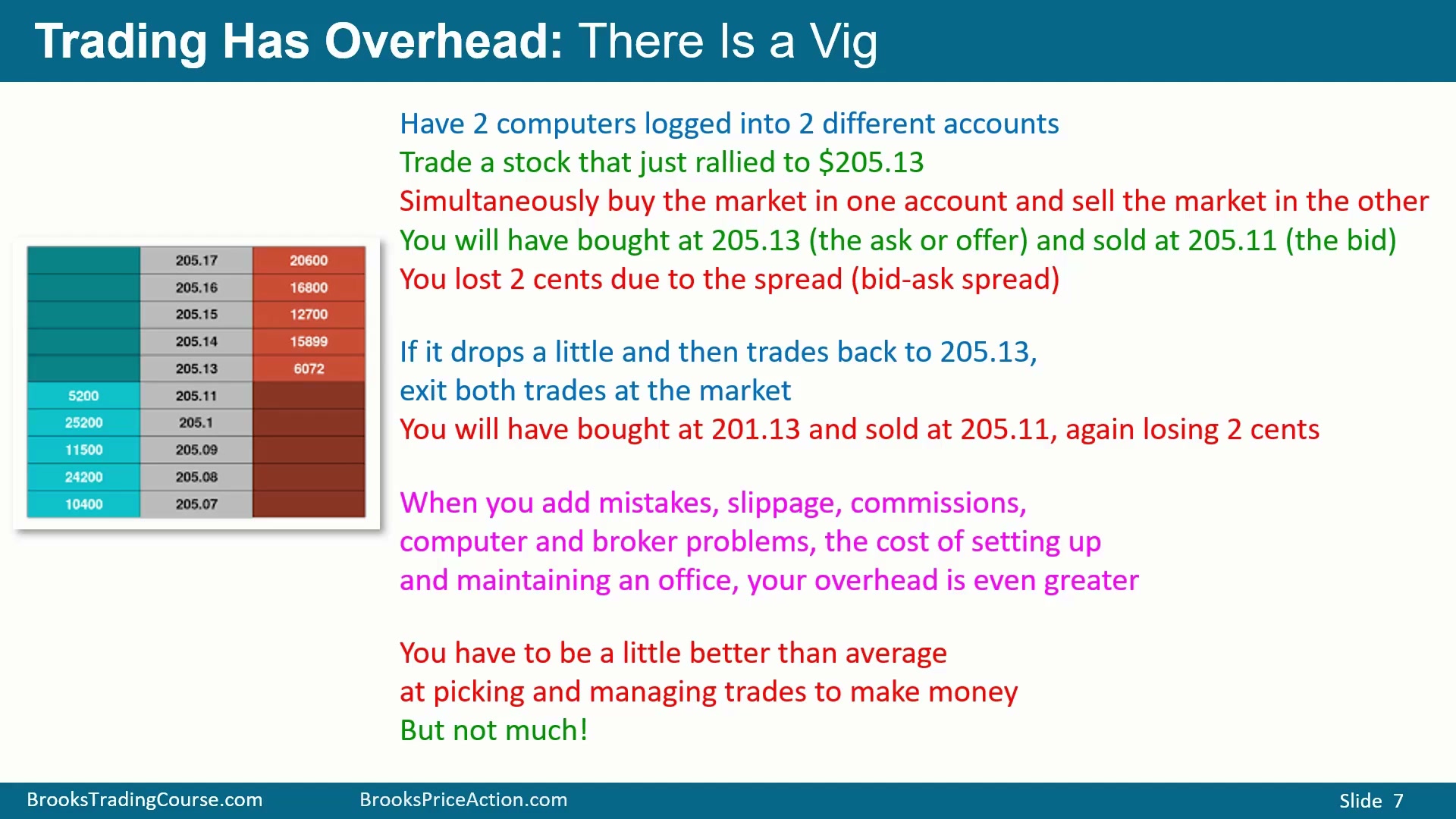
EN: Let’s say you have two different computers logged in to two different accounts.
07:08 - 07:11
EN: Let’s say you’ve got a stock trading right here,
07:11 - 07:18
EN: and the stock just rallied to 205.13, 205.13 right there.
07:18 - 07:22
EN: Let’s say you simultaneously buy at the market in one account
07:22 - 07:24
EN: and sell at the market in the other account.
07:24 - 07:29
EN: You’re going to find that the fill on your buy is at the offer, the ask,
07:29 - 07:34
EN: the higher of the two prices, and the fill on your sell is going to be
07:34 - 07:36
EN: at the lower of the two prices,
07:36 - 07:40
EN: and that spread here – it’s two cents – that is the bid/ask spread.
07:40 - 07:44
EN: So just putting the trade on, you’re already down two cents.
07:45 - 07:47
EN: Let’s say the market drops a little bit more
07:47 - 07:53
EN: and comes exactly back up to that 205.13 and you decide to exit.
07:53 - 07:58
EN: Well, the account that you bought at 205.13,
07:58 - 08:01
EN: when you go to sell, you’re going to sell here.
08:01 - 08:02
EN: You’re going to lose two cents.
08:02 - 08:06
EN: And the account where you sold here and you place an order to get out at the market,
08:06 - 08:09
EN: you’re going to get filled here and you’ll lose two cents.
08:09 - 08:11
EN: So you again lose two cents.
08:11 - 08:16
EN: So even though you bought and sold at one price
08:16 - 08:18
EN: and then you exited at exactly the same price,
08:18 - 08:22
EN: you did not get filled exactly where you thought you were going to get filled.
08:22 - 08:23
EN: So that is overhead.
08:26 - 08:32
EN: When you add up mistakes, slippage, commissions, computer and broker problems,
08:32 - 08:34
EN: the cost of setting up and maintaining an office,
08:34 - 08:36
EN: those all go into your overhead,
08:36 - 08:42
EN: and you have to overcome all of those expenses before you can begin to make money.
08:44 - 08:47
EN: Again, all you have to do is be a little bit better
08:47 - 08:50
EN: than average at picking the trades and managing the trades.
08:50 - 08:55
EN: You don’t have to be great; you just have to be good and consistently good.
08:59 - 09:01
EN: Traders need an edge, okay?
Slide 007
Time: 09:00
Bilingual Transcript
09:01 - 09:06
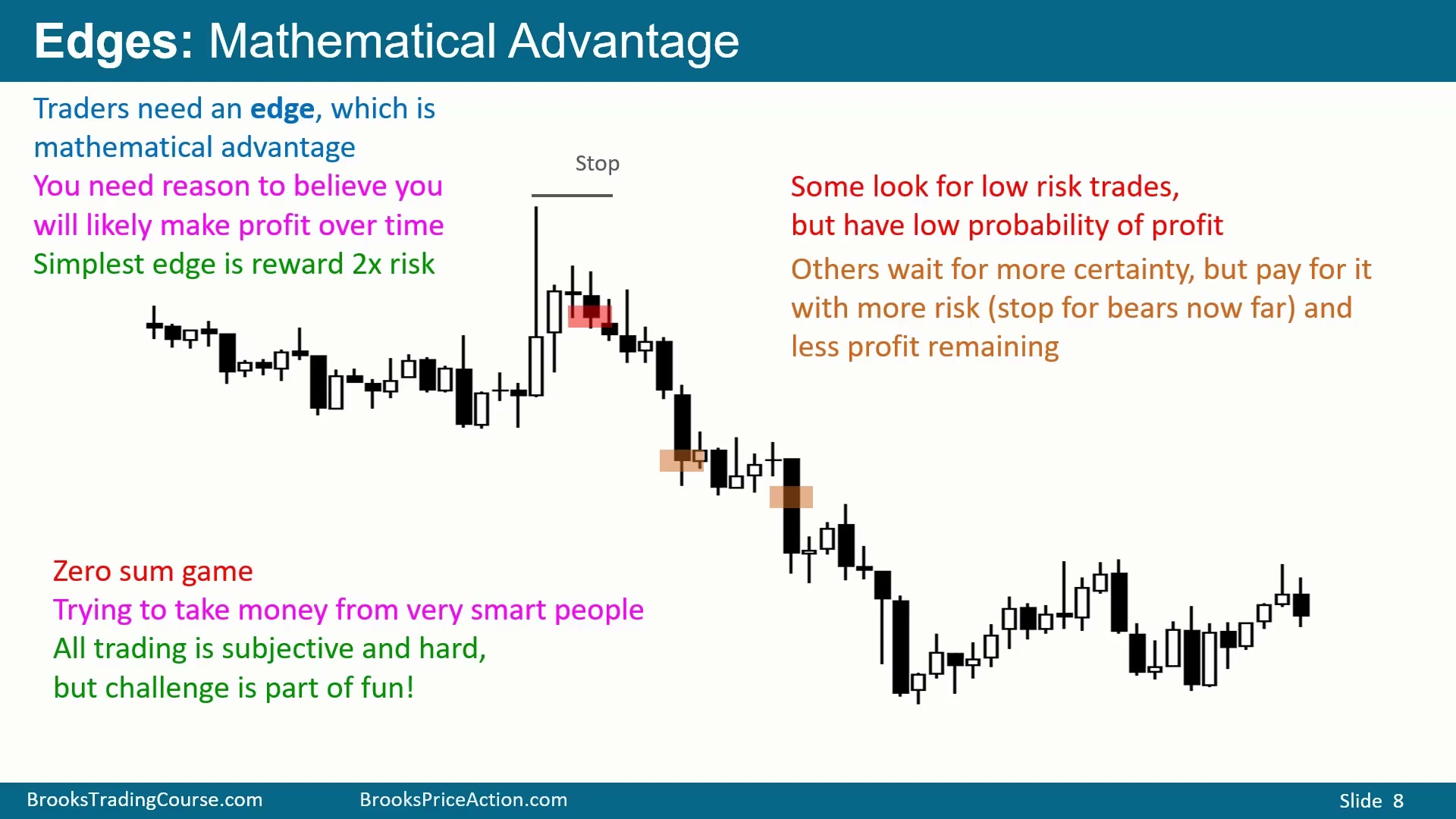
EN: The simplest edge is going for a reward that’s two times the risk.
09:07 - 09:11
EN: Let’s say you sold below this little doji bar
09:11 - 09:13
EN: and got filled right here, this red rectangle.
09:13 - 09:15
EN: You put your stop up here.
09:16 - 09:18
EN: Risk is not particularly great.
09:18 - 09:21
EN: You have tremendous profit potential,
09:21 - 09:25
EN: so the reward is far greater than the risk.
09:25 - 09:27
EN: It’s three or four times greater than the risk,
09:27 - 09:29
EN: but it’s really not that high probability a trade.
09:29 - 09:33
EN: We have a bull breakout, we have a bull inside bar closing on its high.
09:33 - 09:35
EN: It’s more likely that there’ll be buyers below that bar
09:35 - 09:39
EN: and that we’ll continue higher, so it’s a low probability bet.
09:39 - 09:43
EN: But it’s still okay because the reward is so much bigger than the risk.
09:44 - 09:48
EN: On the other hand, if you wait for a pair of big bear bars closing on their lows
09:48 - 09:52
EN: and then sell, all of a sudden the probability goes up,
09:52 - 09:54
EN: but your stop is either here or here,
09:54 - 09:57
EN: so the risk is greater and there’s less reward.
09:57 - 10:00
EN: So the risk/reward is less.
10:00 - 10:04
EN: Whenever you wait for a trade to become a high probability trade,
10:05 - 10:07
EN: the risk/reward is always going to be less.
10:07 - 10:11
EN: You cannot have both high probability and good risk/reward.
10:11 - 10:15
EN: There has to be a reason for an institution to take the other side of your trade.
10:15 - 10:20
EN: If you want high probability, the institution is going to get good risk/reward.
10:20 - 10:22
EN: You’re going to get bad risk/reward.
10:24 - 10:26
EN: Zero sum game.
10:26 - 10:30
EN: You’re trying to take money from very smart people, and it’s subjective.
10:30 - 10:32
EN: I’m a discretionary trader.
10:32 - 10:35
EN: I don’t like trading using automated systems.
10:35 - 10:38
EN: I’ve done it in the past, and I just sit here in front of my computer,
10:38 - 10:41
EN: getting stressed out because I keep seeing reasons
10:41 - 10:44
EN: to override what the computer is telling me to do.
10:49 - 10:54
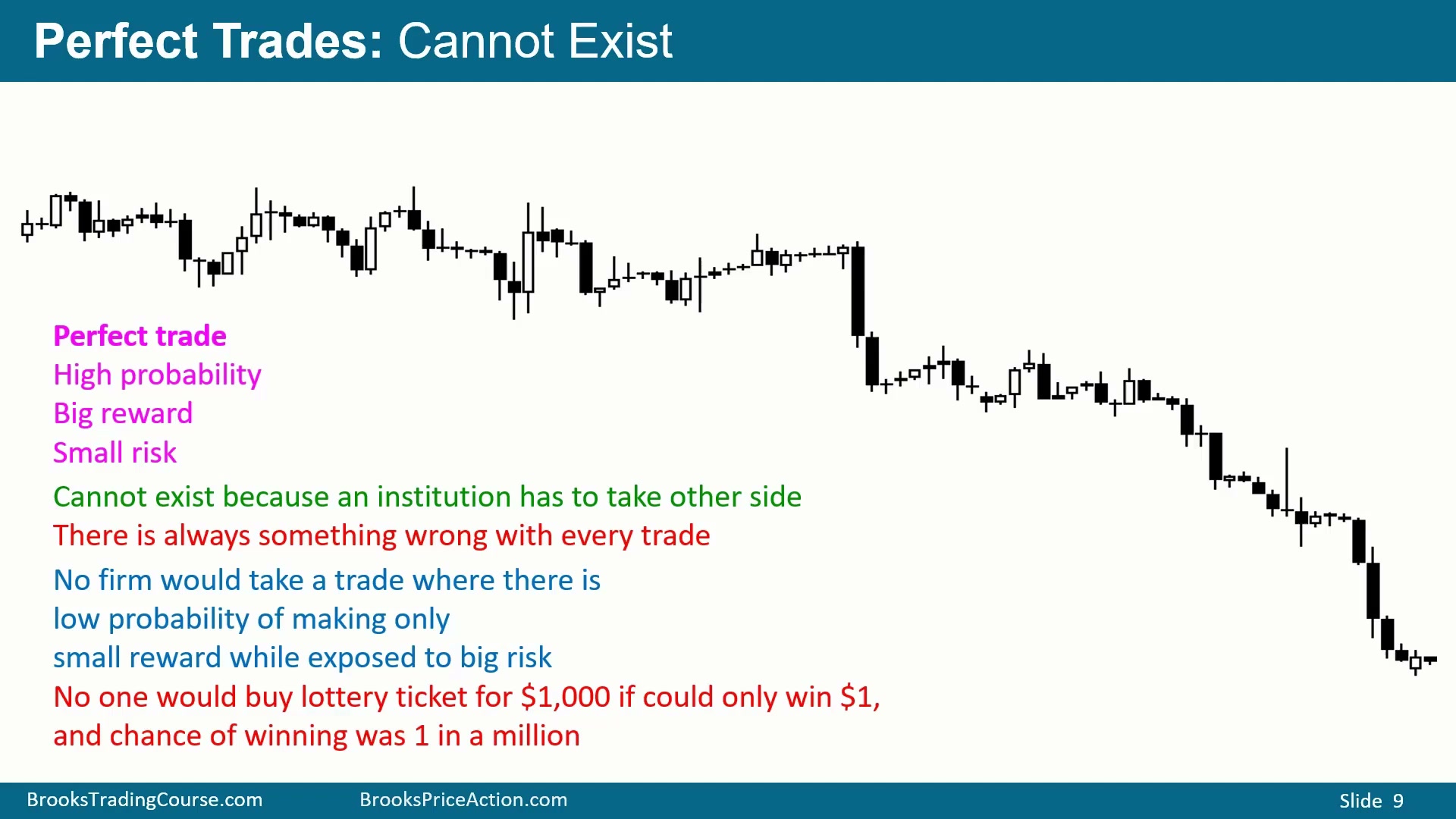
EN: A perfect trade, a high probability of making a lot of money with very little risk,
Slide 008
Time: 10:50
Bilingual Transcript
10:55 - 10:59
EN: cannot exist because theoretically an institution
10:59 - 11:02
EN: is taking the other side of the trade, and there’s always going
11:02 - 11:04
EN: to be something wrong with every trade.
11:04 - 11:07
EN: No firm is going to take the opposite of this.
11:07 - 11:11
EN: No firm is going to take a low probability of making just a small reward
11:11 - 11:14
EN: while exposing themselves to a big risk.
11:14 - 11:16
EN: No one is going to pay $1,000 for a lottery ticket
11:16 - 11:20
EN: where the prize is $1 (small reward)
11:20 - 11:24
EN: and the chance of winning is one in a million (very low probability).
11:29 - 11:31
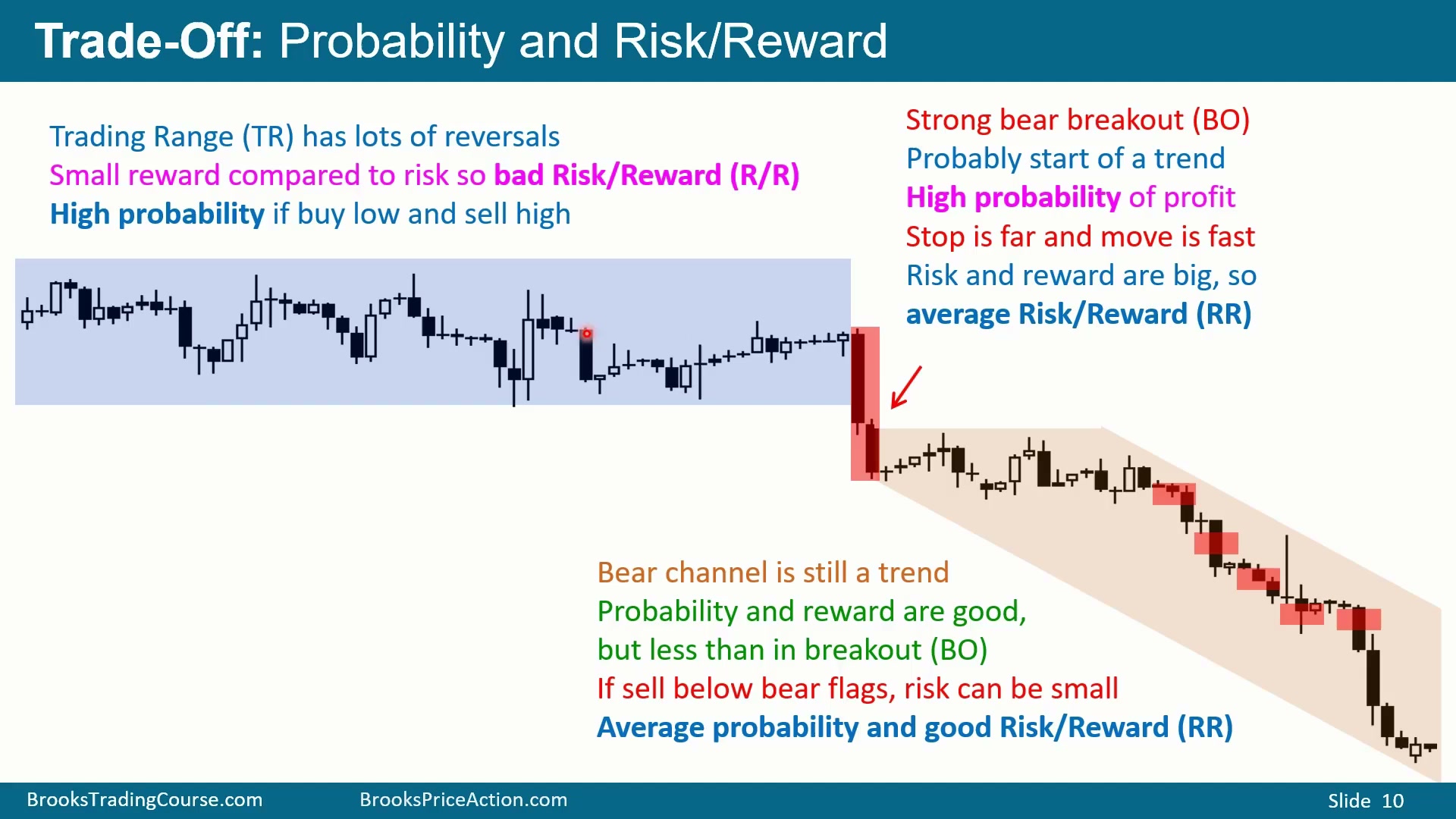
EN: We have a fairly Tight Trading Range here.
Slide 009
Time: 11:30
Bilingual Transcript
11:31 - 11:35
EN: Lots of reversals, and reward is small.
11:35 - 11:38
EN: You can’t make much money buying or selling.
11:38 - 11:40
EN: So the risk/reward is not very good.
11:40 - 11:42
EN: You’ve got bad risk/reward.
11:42 - 11:45
EN: However, the probability is high if you’re buying low and selling high,
11:45 - 11:48
EN: especially if you’re using wide stops and scaling in.
11:48 - 11:53
EN: So bad risk/reward but high probability if you manage the trade correctly.
11:54 - 11:56
EN: When you have a big breakout like this,
11:56 - 11:58
EN: you have a high probability of making money,
11:59 - 12:05
EN: but very often the stop is far away, so the risk is fairly big.
12:05 - 12:06
EN: The reward is big.
12:07 - 12:09
EN: So big risk, big reward.
12:09 - 12:12
EN: Neutral risk/reward, but high probability.
12:15 - 12:16
EN: Bear channel.
12:17 - 12:21
EN: The probability and reward are good – selling in a bear trend,
12:21 - 12:24
EN: probability is you’ll make money – and the reward is good,
12:25 - 12:29
EN: but the probability is less than in a breakout.
12:33 - 12:35
EN: Risk can be small.
12:35 - 12:39
EN: If you sell below bear bars closing on their lows, right,
12:39 - 12:42
EN: and just put your stop above the most recent bear breakout
12:43 - 12:46
EN: - so average probability of making money certainly
12:46 - 12:50
EN: less than the probability of a breakout, and decent risk/reward.
12:51 - 12:54
EN: So different risk/reward/probability profiles
12:54 - 12:57
EN: for Trading Range, breakout, and channels.
12:58 - 12:59
EN: And you can take any of those trades.
12:59 - 13:01
EN: The math is good.
Slide 010
Time: 13:00
Bilingual Transcript
13:04 - 13:10
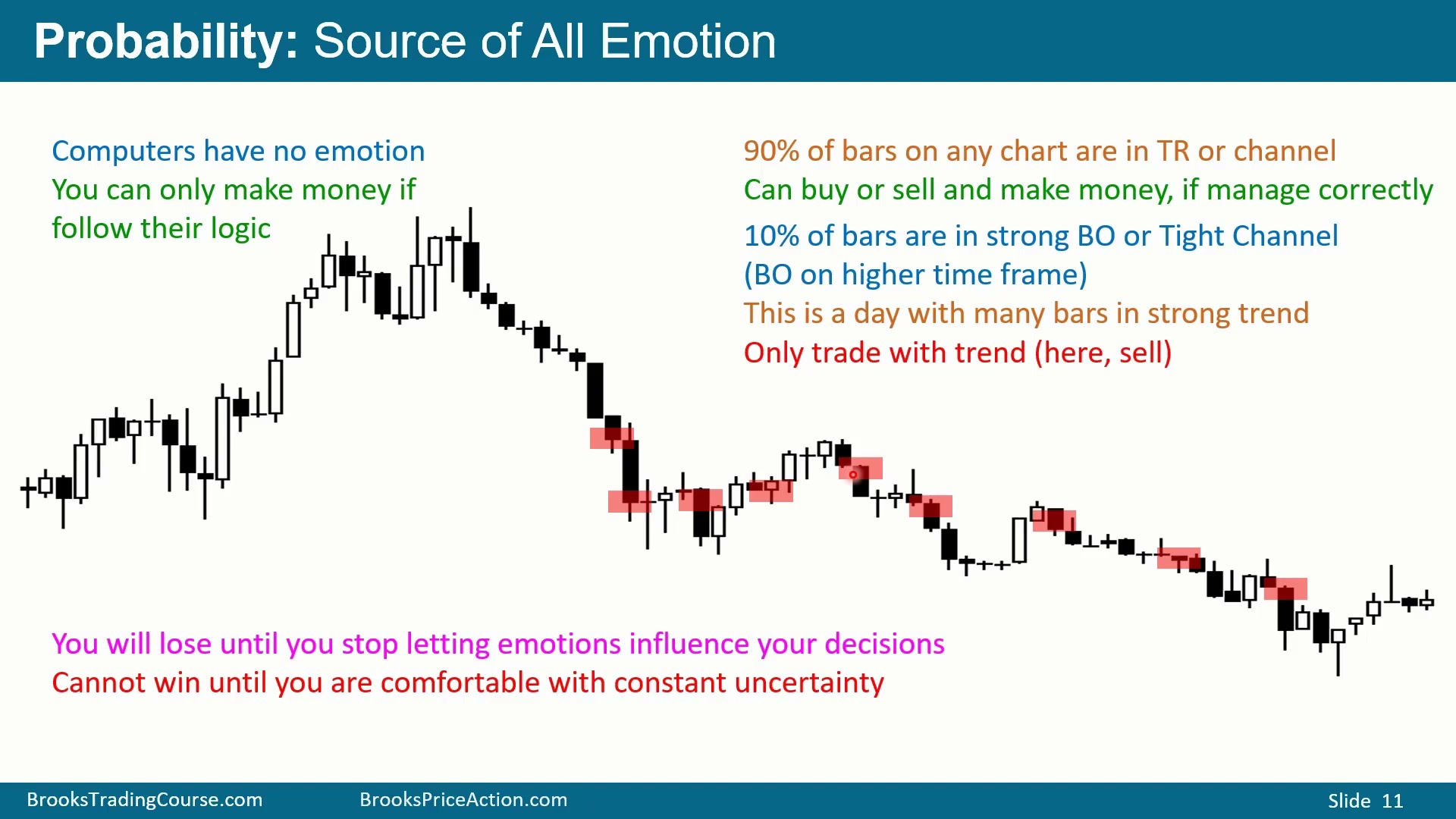
EN: Okay, I think the source of all emotion in trading is probability, uncertainty.
13:11 - 13:13
EN: Computers have no emotions.
13:13 - 13:15
EN: The market has no emotion.
13:16 - 13:19
EN: You can only make money if you can get rid of your emotions,
13:19 - 13:20
EN: or at least minimize them.
13:21 - 13:27
EN: 90% of bars on every chart are either in a Trading Range or in a channel,
13:27 - 13:32
EN: and when that’s the case, you can buy or sell and make money
13:32 - 13:34
EN: if you trade – if you manage the trades correctly.
13:35 - 13:38
EN: Only 10% of the bars on a chart are strongly breaking out
13:38 - 13:39
EN: to the upside, up or down.
13:42 - 13:47
EN: 10% of the bars in a chart, the market is in a fairly strong trend,
13:47 - 13:51
EN: and when it is in a trend – here we have a breakout
13:51 - 13:54
EN: - it’s better only to trade in the direction of the trend.
13:55 - 13:57
EN: One way to do it is sell the close of a bear bar
13:57 - 14:00
EN: or sell below the low of the prior bar, especially
14:00 - 14:03
EN: if the prior bar is a bear bar closing near its low.
14:09 - 14:13
EN: Another thing is you have to be comfortable with uncertainty.
14:13 - 14:16
EN: Whenever you take a trade, you’re always wondering,
14:16 - 14:17
EN: “Is it going to go up a little bit more?
14:17 - 14:19
EN: Am I going to make money?
14:19 - 14:22
EN: Is it going to go down far?” You just have to be comfortable with the uncertainty.
14:22 - 14:25
EN: That’s just part of the game, and that’s part of the excitement.
14:25 - 14:26
EN: It’s part of the fun.
14:30 - 14:35
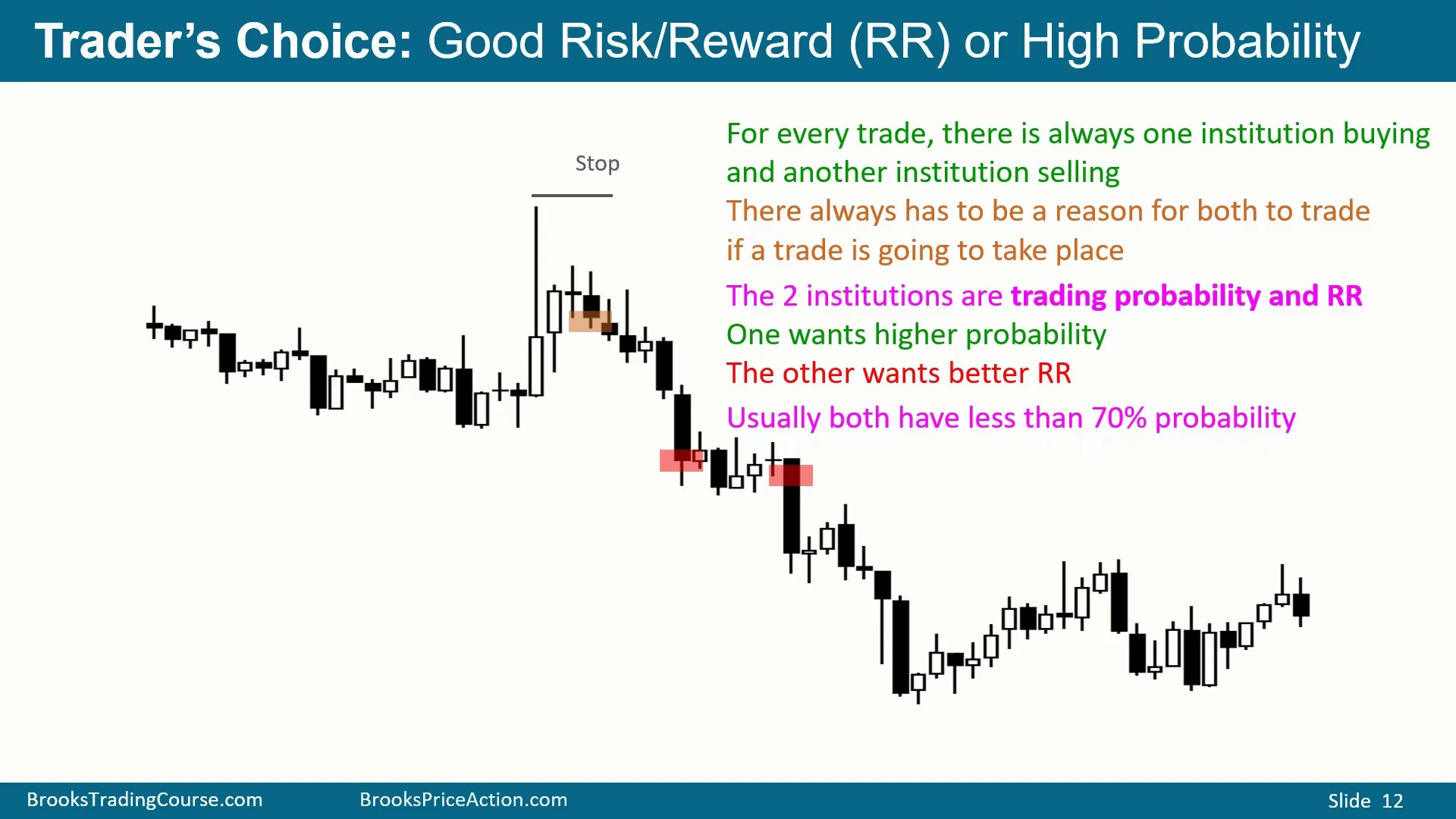
EN: Okay, as I said, you should think of every trade as one institution buying
Slide 011
Time: 14:30
Bilingual Transcript
14:35 - 14:37
EN: and another institution selling.
14:37 - 14:43
EN: 95% of the buying in the Emini and most stocks is being conducted by institutions.
14:44 - 14:46
EN: That means there’s going to be one buying and one selling.
14:50 - 14:54
EN: The two institutions are trading probability and risk/reward.
14:55 - 14:59
EN: Sometimes both probability and risk/reward are neutral;
14:59 - 15:01
EN: sometimes one is higher probability.
15:01 - 15:03
EN: That means less risk/reward.
15:03 - 15:05
EN: The other side has to get something.
15:05 - 15:08
EN: So if you’re taking the high probability trade,
15:08 - 15:11
EN: the institution doing the other side is going to be getting
15:11 - 15:13
EN: a good risk/reward and vice versa.
15:16 - 15:19
EN: Probability – 95% of the time,
15:19 - 15:25
EN: the probability is between 40% and 60% of anything, buy or sell.
15:25 - 15:28
EN: During strong breakouts, the probability can be 70%
15:28 - 15:30
EN: that the breakout will continue.
15:30 - 15:35
EN: But for 90+ bars on the chart, at any instant,
15:36 - 15:39
EN: there’s between a 40% and 60% chance
15:39 - 15:42
EN: that the market will soon go up or soon go down.
15:45 - 15:48
EN: Okay, which variable do you choose?
15:48 - 15:50
EN: Do you want the high probability trade?
15:50 - 15:53
EN: If you do, the other side gets good risk/reward.
15:53 - 15:55
EN: Do you want good risk/reward?
15:55 - 15:57
EN: Then the other side gets high probability.
15:57 - 15:58
EN: In other words, you have low probability.
15:58 - 16:00
EN: Less – it’ll be more like a 40% trade.
16:00 - 16:05
EN: And you can get good risk/reward with small risk or with big reward.
16:08 - 16:13
EN: So the edge, the best edge is take a reasonable trade
16:13 - 16:17
EN: and go for a reward that is at least two times your risk.
16:17 - 16:21
EN: As I said, it’s really important to avoid bad trades.
Slide 012
Time: 16:21
Bilingual Transcript
16:23 - 16:28
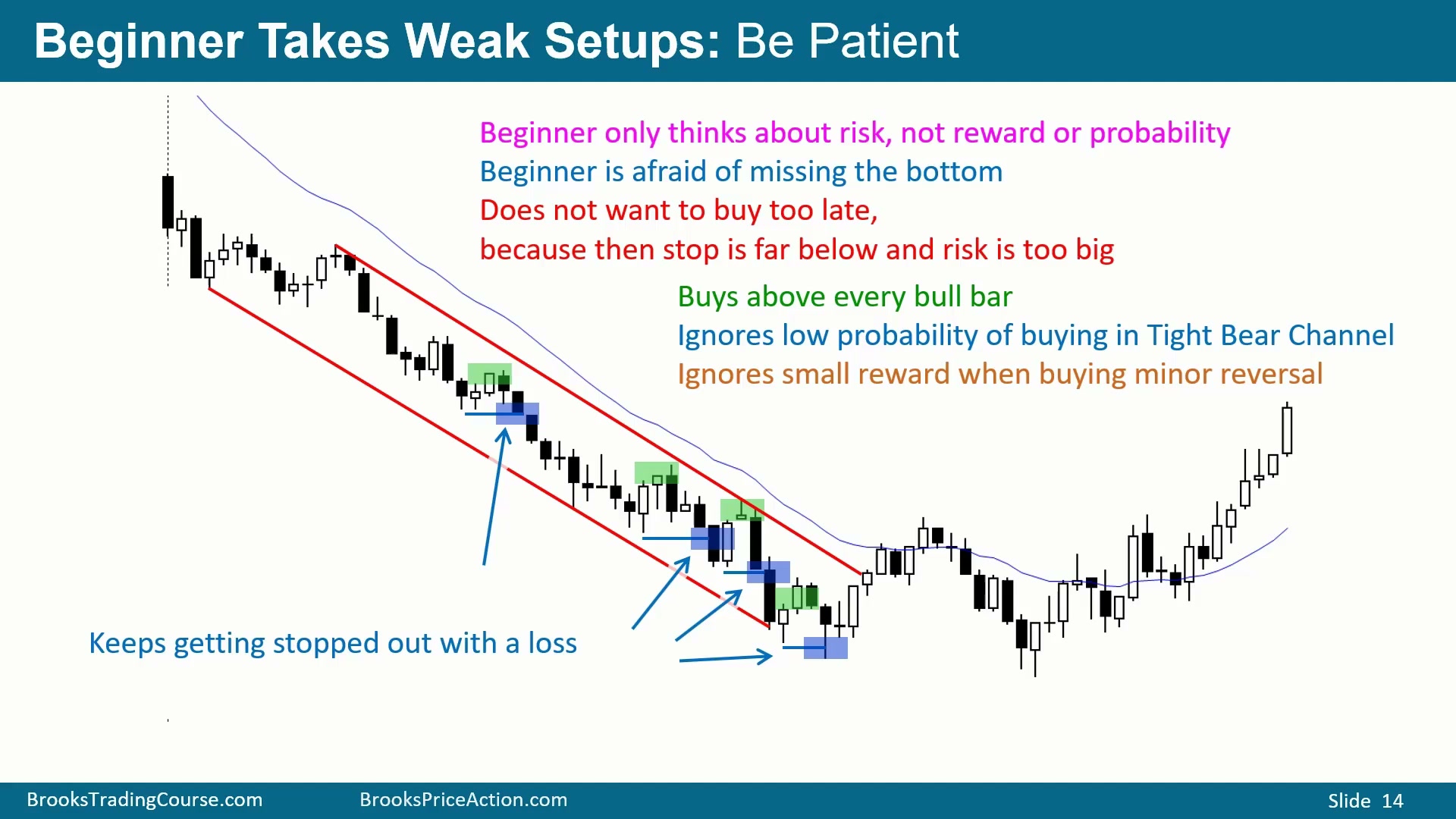
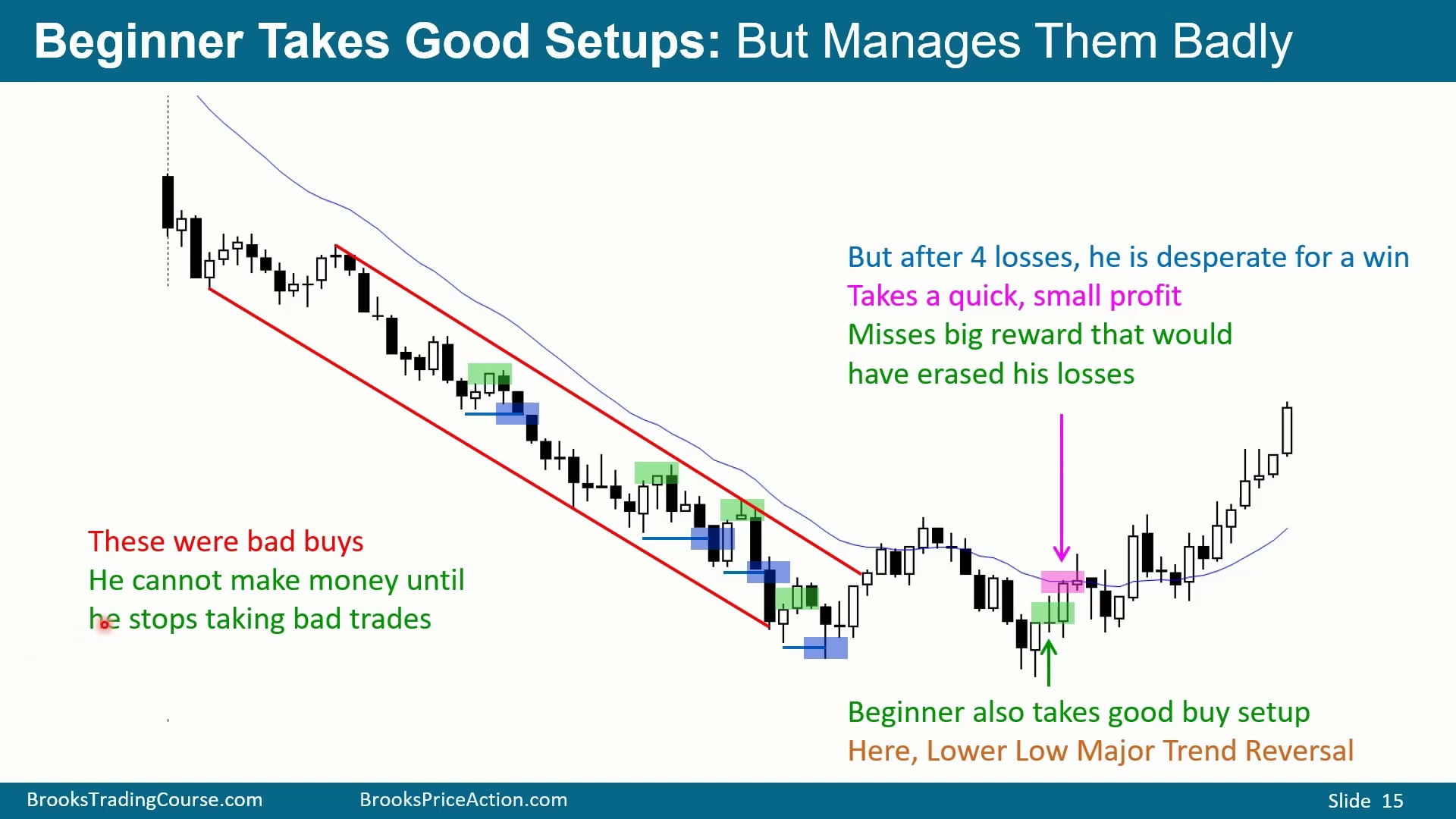
EN: What often happens is the beginner only thinks about one variable.
16:28 - 16:30
EN: There are three: risk, reward, and probability.
16:30 - 16:32
EN: Beginners only think about risk.
16:33 - 16:35
EN: They don’t want to lose money.
16:35 - 16:36
EN: Their account is small.
16:36 - 16:39
EN: They’re dreaming of having a career as a trader,
16:39 - 16:43
EN: and if their account gets too small, they cannot meet margin requirements
16:43 - 16:46
EN: and it’s the death of their dream.
16:47 - 16:52
EN: So beginners are always trying to buy reversals because buying reversals,
16:52 - 16:58
EN: the stop is not very far away and the result is your risk is small.
17:00 - 17:02
EN: For example, we’re trying to reverse.
17:02 - 17:03
EN: You buy.
17:03 - 17:04
EN: Bull bar, buy.
17:04 - 17:05
EN: Bull bar, buy.
17:05 - 17:06
EN: Bull bar, buy.
17:06 - 17:10
EN: Every one of those trades was a loss, but a beginner takes them
17:10 - 17:12
EN: because they’re hoping that maybe this time
17:12 - 17:14
EN: it’ll be the start of a huge bull trend.
17:14 - 17:19
EN: A Tight Bear Channel only rarely will go directly into a bull trend.
17:19 - 17:23
EN: The first reversal up is probably going to be minor,
17:23 - 17:26
EN: and the bulls will need a second reversal up to get a major reversal.
17:27 - 17:28
EN: But beginners don’t care.
17:28 - 17:29
EN: They just think, “Risk, risk, risk.
17:29 - 17:33
EN: I need small risk,” and they’ll take these small risk trades,
17:33 - 17:35
EN: and they all have very low probability.
17:36 - 17:38
EN: In other words, they’re bad trades.
17:41 - 17:45
EN: So the beginner buys above this bar, puts his stop below, gets stopped out.
17:45 - 17:48
EN: Buys above this bar, puts his stop below, gets stopped out.
17:48 - 17:49
EN: So four losing trades.
17:50 - 17:56
EN: He never had much reward potential because the first reversal up is not going
17:56 - 17:59
EN: to go all that far, so the reward is small.
18:00 - 18:03
EN: The risk is small, the reward is small, but the probability is very low.
18:03 - 18:07
EN: You’re betting on a big win buying in a bear channel.
18:07 - 18:09
EN: That’s a very low probability bet.
Slide 013
Time: 18:10
Bilingual Transcript
18:11 - 18:12
EN: Bad buys.
18:12 - 18:16
EN: You cannot make money if you’re taking trades like this,
18:16 - 18:18
EN: so you have to stop taking bad trades.
18:20 - 18:23
EN: But also, then happens is the beginner now says,
18:23 - 18:26
EN: “Okay, gosh, we’ve got a breakout above the bear channel
18:26 - 18:28
EN: and now we’re getting a second reversal.
18:28 - 18:32
EN: This is possibly a major reversal that could lead to a bull trend.”
18:32 - 18:36
EN: So the beginner then takes this trade, but he just lost four trades in a row.
18:36 - 18:39
EN: So what’s he going to do after he takes that buy?
18:40 - 18:43
EN: He’s going to say, “Ah, gosh, I need a win.
18:43 - 18:46
EN: I’m just going to exit right here,” right?
18:46 - 18:49
EN: After losing four times in a row, he’s desperate for a win
18:49 - 18:52
EN: and he ends up exiting with a very small profit.
18:53 - 18:54
EN: Cannot do that.
18:54 - 18:57
EN: Again, you should be going for swing trades
18:57 - 18:59
EN: where the reward is at least twice the risk.
18:59 - 19:04
EN: And as a general rule, a swing trade should last 10 or more bars.
19:04 - 19:09
EN: So if you’re taking a swing trade and it reverses 2 bars later,
19:09 - 19:12
EN: 5 or 6 bars later, it’s better to rely on your stop
19:12 - 19:14
EN: because it’s probably not the end of the trend.
Slide 014
Time: 19:15
Bilingual Transcript
19:20 - 19:24
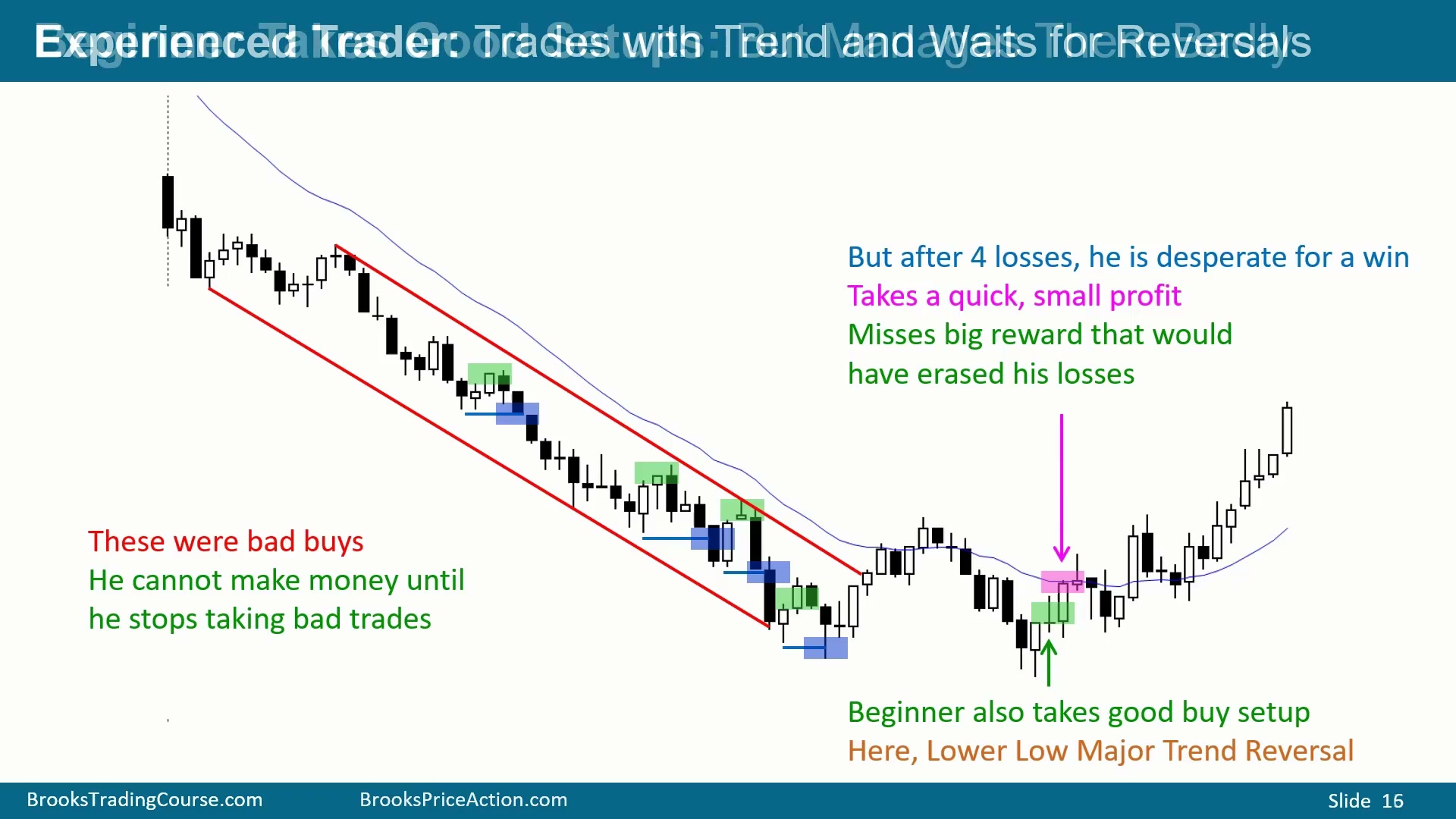
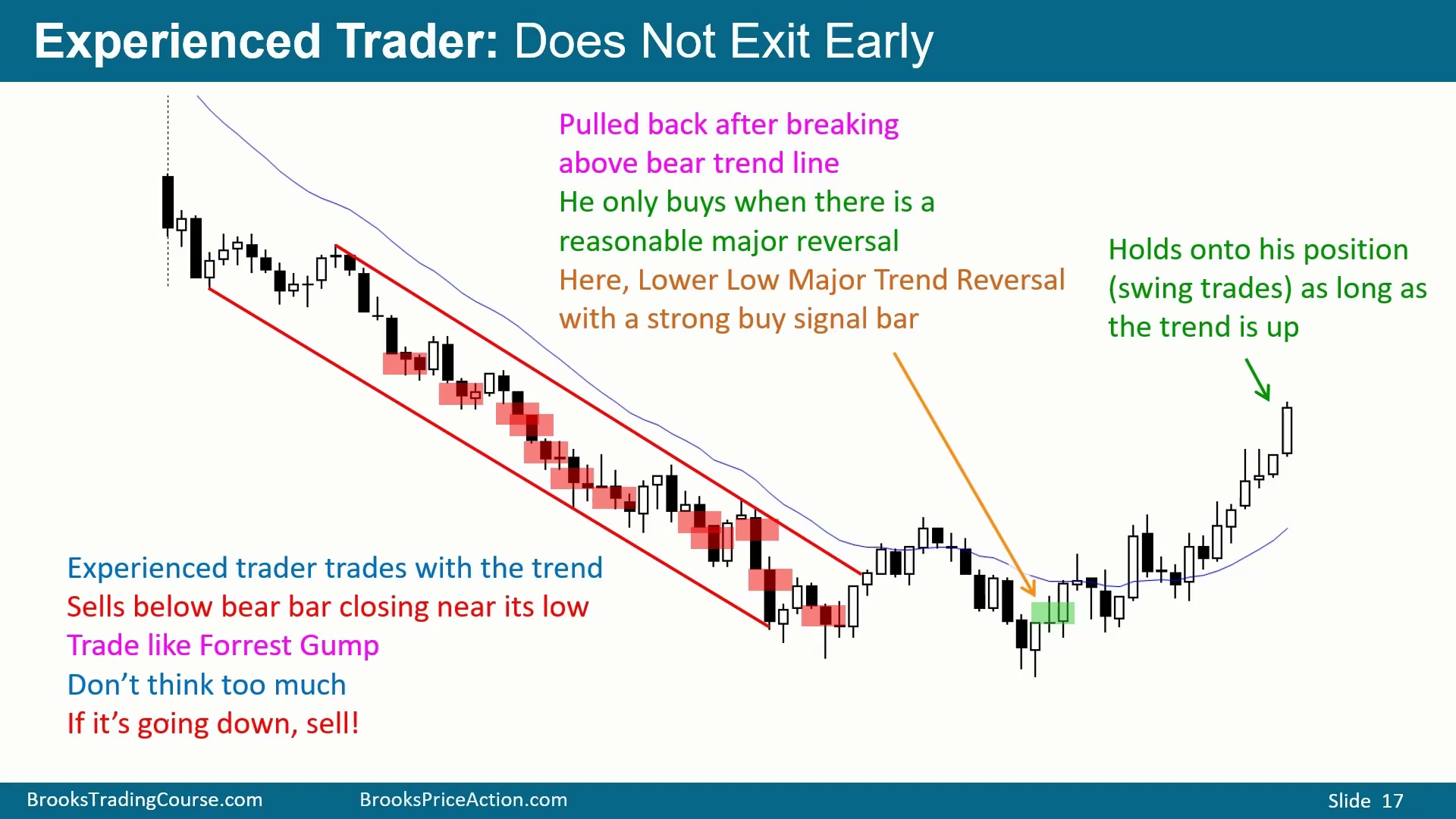
EN: An experienced trader, he’s not buying above all those bull bars.
Slide 015
Time: 19:20
Bilingual Transcript
19:24 - 19:25
EN: He’s selling below bear bars.
19:25 - 19:28
EN: So he’ll sell here and put a stop up here.
19:28 - 19:34
EN: So he’s risking a lot, but he’s also going for a big reward
19:34 - 19:35
EN: and the probability is pretty good.
19:35 - 19:37
EN: He’s selling in a bear trend.
19:37 - 19:41
EN: So every time he sees a reversal up, he looks for a bear bar
19:41 - 19:45
EN: and sells below the low of the bear bar, betting that the reversal up is minor,
19:45 - 19:48
EN: a bear flag, and that the trend will continue.
19:49 - 19:53
EN: I sometimes talk about trading like Forrest Gump versus Albert Einstein.
19:54 - 19:59
EN: I do think Forrest Gump has a better chance of making money than Albert Einstein.
19:59 - 20:02
EN: You don’t have to be a genius to trade well.
20:02 - 20:04
EN: Don’t think too much.
20:04 - 20:08
EN: You can get paralyzed by too much analysis, analysis paralysis, right?
20:08 - 20:11
EN: Forrest Gump looks at this and says, “Oh, it’s going down.
20:11 - 20:12
EN: I bet it’s going to go lower.
20:12 - 20:16
EN: I’m going to sell.” Don’t try to come up with all kinds of formulas
20:16 - 20:18
EN: that tell you that it’s time to buy,
20:18 - 20:21
EN: that some oscillator is diverging and therefore you buy.
20:21 - 20:23
EN: It’s going down, just sell.
20:23 - 20:26
EN: Every time it starts going up, assume it’s minor.
20:26 - 20:29
EN: Look at a bear bar, place a stop to go short below the bear bar.
20:29 - 20:31
EN: That’s what the experienced traders are doing.
20:33 - 20:35
EN: And then what do we have here?
20:35 - 20:37
EN: This is a second reversal up.
20:37 - 20:41
EN: You can call it a Lower Low, you can call it a Lower Low Double Bottom.
20:41 - 20:44
EN: In any case, it has the potential for a swing up.
20:44 - 20:47
EN: All of these buys in here were minor.
20:47 - 20:50
EN: This could be a major reversal into a swing up.
20:50 - 20:54
EN: It’s a Lower Low Major Trend Reversal and a reasonable buy.
20:54 - 20:56
EN: But take it for a swing trade.
20:56 - 21:02
EN: Hold onto it until the end of the day or until the trend is no longer going up.
21:02 - 21:07
EN: You can see the reward here is many times greater than the risk.
21:07 - 21:12
EN: You buy there, risk here, stop, and this is four or five times the risk.
21:13 - 21:16
EN: You do that, even – a big win like this,
21:16 - 21:21
EN: even 30% of the time it’s going to make you a profitable trader.
Slide 016
Time: 21:25
Bilingual Transcript
21:26 - 21:32
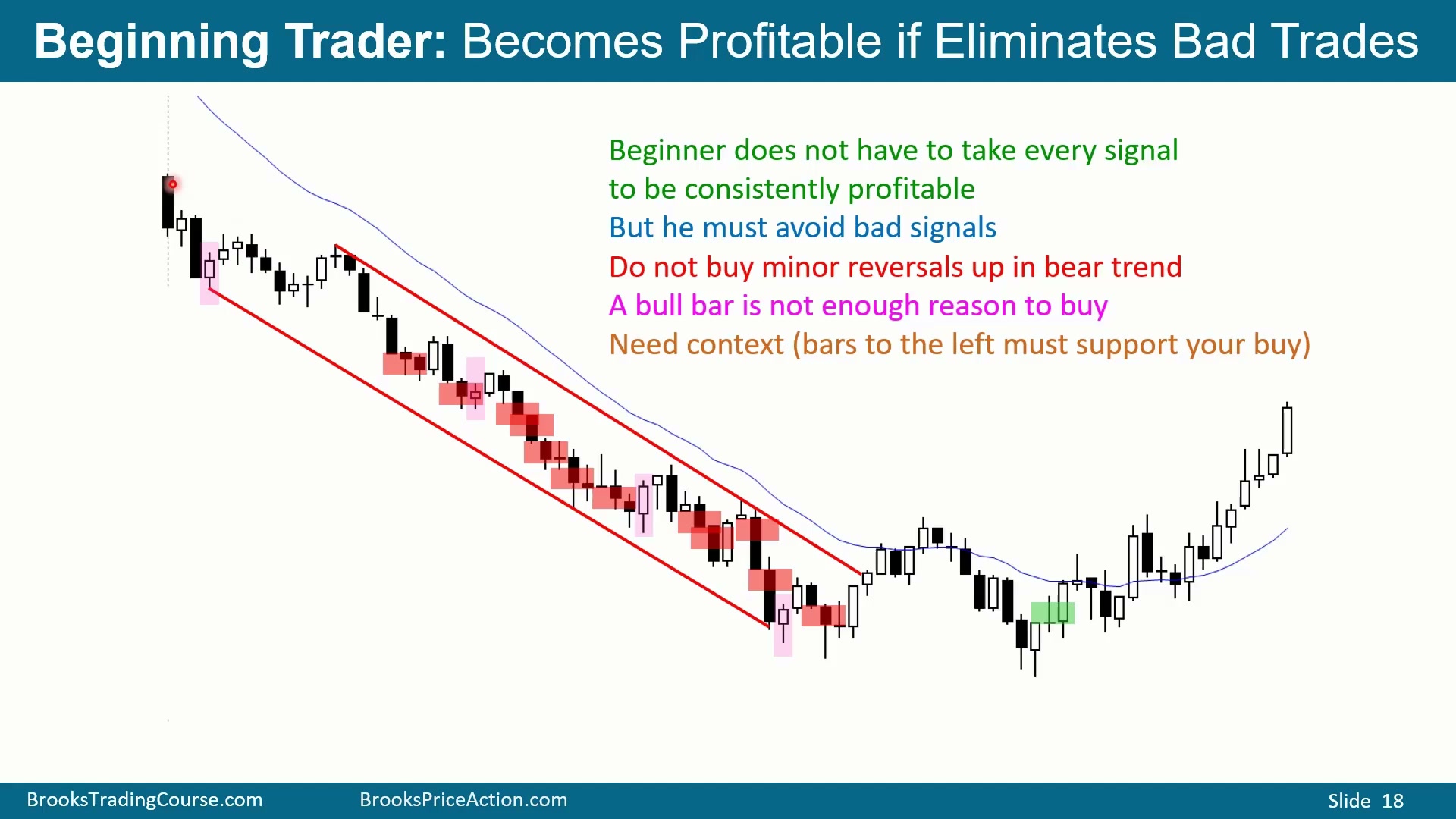
EN: Okay, as I said, the key to becoming a profitable trader is avoiding bad trades.
21:32 - 21:36
EN: So even if you don’t take all of these shorts,
21:36 - 21:40
EN: as long as you don’t take those terrible buys and you do take this buy,
21:40 - 21:43
EN: you’ll end up being a profitable trader.
21:43 - 21:45
EN: So you’ve got to get rid of the bad trades.
21:45 - 21:47
EN: Don’t take bad trades.
21:47 - 21:50
EN: Look at all three variables – risk, reward, and probability.
21:50 - 21:55
EN: Don’t simply look at, “Oh, if I take this buy, my stop is not very far.”
21:55 - 21:59
EN: If you’re buying in a Tight Channel, it’s a low probability trade.
21:59 - 22:00
EN: Cannot do that.
22:00 - 22:05
EN: If you’re buying a Double Bottom after a strong reversal up above
22:05 - 22:10
EN: the bear trend line, then the probability is better for a swing up.
22:13 - 22:17
EN: So a bull bar is not a reason enough to buy.
22:17 - 22:21
EN: If the market’s in a Tight Bear Channel, you cannot be buying.
22:21 - 22:24
EN: You have to look at the context.
22:24 - 22:26
EN: The context means the bars to the left.
22:26 - 22:28
EN: So buying here, what’s the context?
22:28 - 22:33
EN: A Tight Bear Channel here within a bigger bear channel, so not buy.
22:37 - 22:41
EN: Common problem with beginners is they’ll hold onto losers too long.
Slide 017
Time: 22:39
Bilingual Transcript
22:41 - 22:45
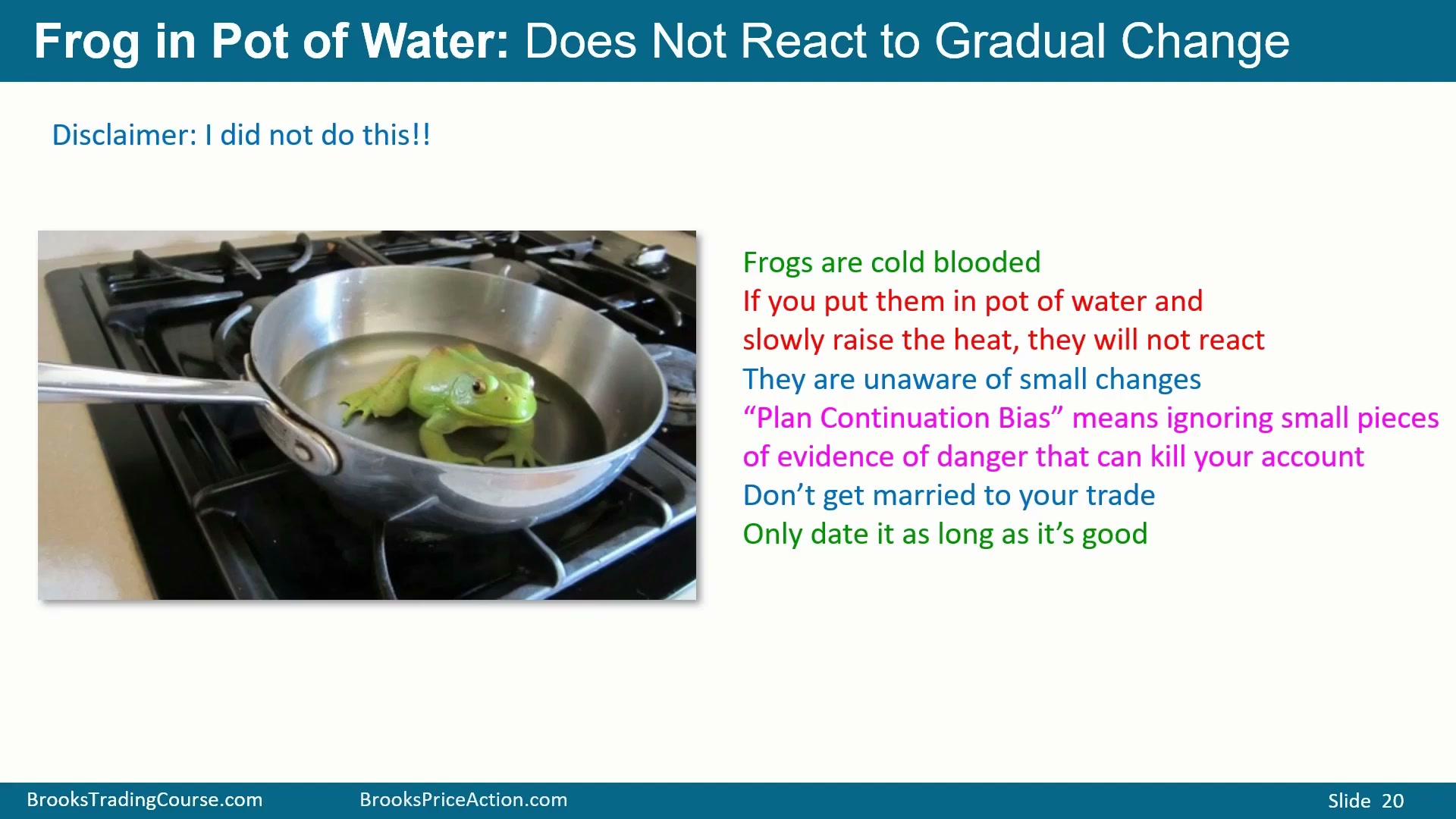
EN: I want to start with a disclaimer, okay?
22:45 - 22:46
EN: I did not do that.
22:46 - 22:48
EN: That is not my frog, not my pan, not my stove.
22:48 - 22:49
EN: I did not do this.
22:49 - 22:51
EN: I stole the picture on the internet.
22:54 - 22:58
EN: The point I’m making here is that frogs are cold-blooded.
22:58 - 23:02
EN: If you put them in a pot of water and slowly raise the heat, they will not react.
23:02 - 23:04
EN: They are unaware of the small changes.
23:04 - 23:08
EN: There’s a concept called planned continuation bias.
23:09 - 23:15
EN: It means ignoring evidence that your plan is no longer valid.
23:16 - 23:19
EN: If you keep ignoring pieces of evidence
23:19 - 23:22
EN: that what you’re doing is wrong, it can kill your account.
23:22 - 23:27
EN: So you’ve got to pay attention to things that tell you that your trade is wrong.
Slide 018
Time: 23:25
Bilingual Transcript
23:27 - 23:30
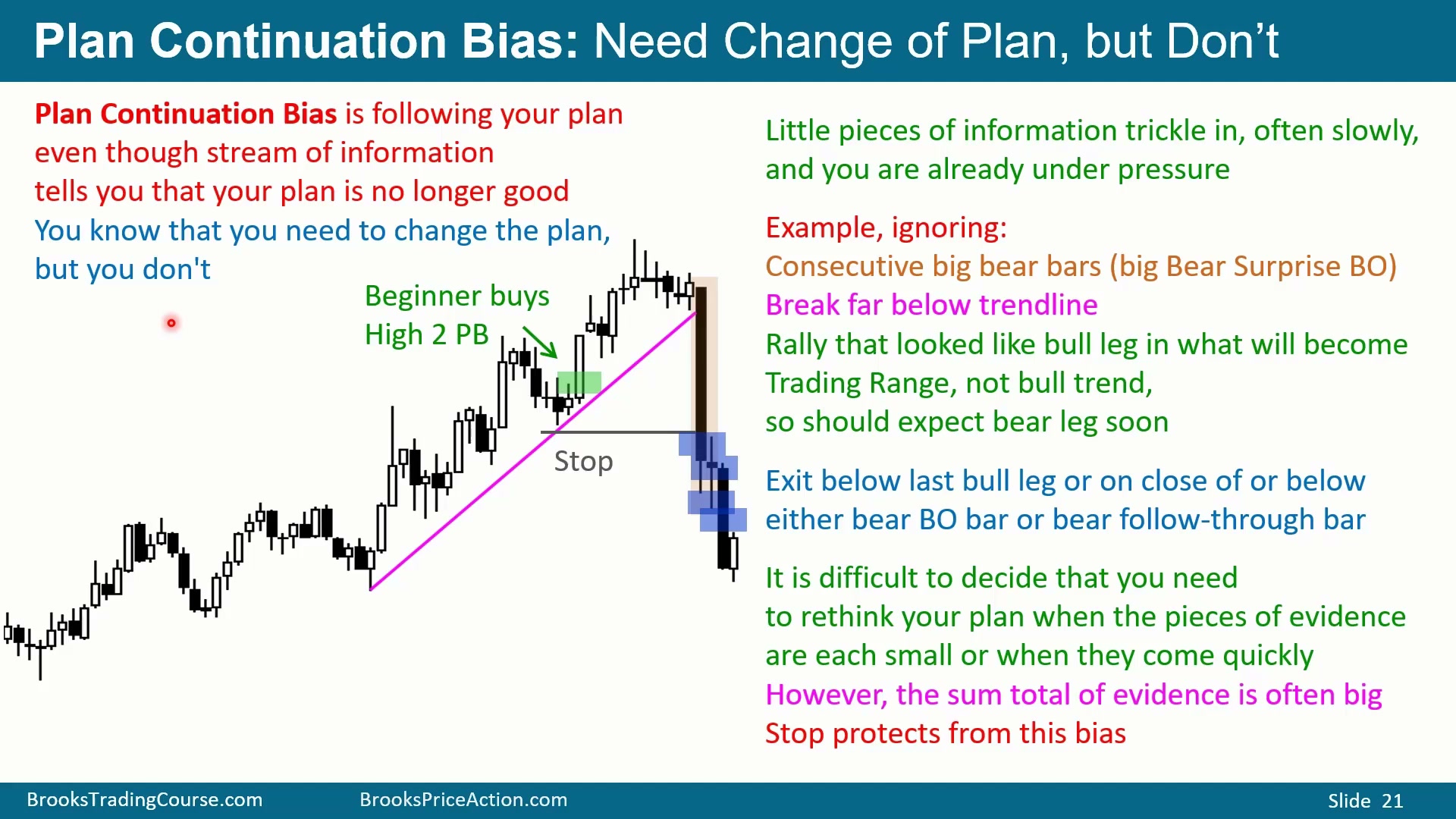
EN: Let’s say for example you have a bull trend.
23:30 - 23:35
EN: Let’s say you bought here, a High 2 pullback, two legs down – one, pause, two.
23:35 - 23:36
EN: High 1, High 2.
23:36 - 23:40
EN: Let’s say you bought that and you’re hoping the bull trend continues all day.
23:41 - 23:44
EN: If you buy it and it starts to break out, you’re going to put your stop here.
23:44 - 23:47
EN: When you buy it initially, you might have your stop here.
23:47 - 23:51
EN: But if it starts to break to a new high, you raise your stop to here
23:51 - 23:55
EN: and you can get stopped out right here if you do not get out higher.
23:57 - 23:59
EN: Planned continuation bias, right?
23:59 - 24:06
EN: Your plan is to hold onto the buy because it’s a bull trend.
24:06 - 24:11
EN: But if there’s evidence that it’s no longer a bull trend, you have to get out.
24:15 - 24:21
EN: For example, the market breaking below the bull trend line,
24:21 - 24:24
EN: and you have a huge bear bar.
24:24 - 24:25
EN: It hits your stop.
24:25 - 24:28
EN: If it hits your stop, you get out.
24:28 - 24:32
EN: What some beginners do is as it’s starting to fall, they think,
24:32 - 24:35
EN: “Ah, it might hit my stop and then reverse back up.
24:35 - 24:39
EN: I’m going to get rid of my stop and put it down here.” Can’t do that.
24:39 - 24:44
EN: If you see evidence that your original premise is no longer good,
24:44 - 24:45
EN: you’ve got to get out.
24:45 - 24:49
EN: You bought a bull channel hoping for a bull trend.
24:49 - 24:51
EN: This one bar, especially a bear bar
24:51 - 24:55
EN: and follow-through bear bar – even a bear doji – a second bar
24:55 - 24:59
EN: after a big bear breakout, if it has even a small bear body,
24:59 - 25:03
EN: is enough to make it likely high probability that we’re going lower.
25:03 - 25:08
EN: So if you do cancel your stop as it’s forming and you get this big bear bar,
25:08 - 25:12
EN: you should get out on the close of the bar or below the low of the bar,
25:12 - 25:14
EN: and absolutely if the next bar has a bear body,
25:14 - 25:17
EN: you’ve got to get out on the close of that bear bar
25:17 - 25:19
EN: because we’re probably going lower.
25:19 - 25:22
EN: This is probably a spike, and then this is a pause,
25:22 - 25:23
EN: and we’re probably going to channel down.
25:23 - 25:27
EN: So if you don’t get out here, you’re going to be sitting through a big bear trend.
25:27 - 25:29
EN: The probability is high that you’re going lower.
25:32 - 25:34
EN: So lots of opportunities to get out.
25:34 - 25:38
EN: Yes, you bought here and you get out here, a loss,
25:38 - 25:41
EN: plus you gave back all of this, but it’s reasonable.
25:41 - 25:42
EN: The loss is not terrible.
25:42 - 25:46
EN: So if you bought here and got stopped out here, you’d have a small loss.
25:46 - 25:47
EN: That’s what you do.
25:49 - 25:51
EN: That’s what experienced traders do.
25:51 - 25:53
EN: A lot of traders would’ve gotten out here.
25:53 - 25:58
EN: Possible Wedge – one, two, three – and a second reversal – one and then two.
25:58 - 26:01
EN: Or they would’ve gotten out as this bar was forming.
26:04 - 26:10
EN: So, lots of evidence that your idea of a bull trend is no longer good,
26:10 - 26:15
EN: so if the reason you took the trade is no longer in existence, you have to get out.
26:17 - 26:22
EN: Remember, stops – the purpose of a stop is really to protect you against yourself,
26:23 - 26:27
EN: and you’re putting it there so that you’ll get out.
26:27 - 26:32
EN: One of the problems beginners have, I think sometimes, is they move their stops.
Slide 019
Time: 26:30
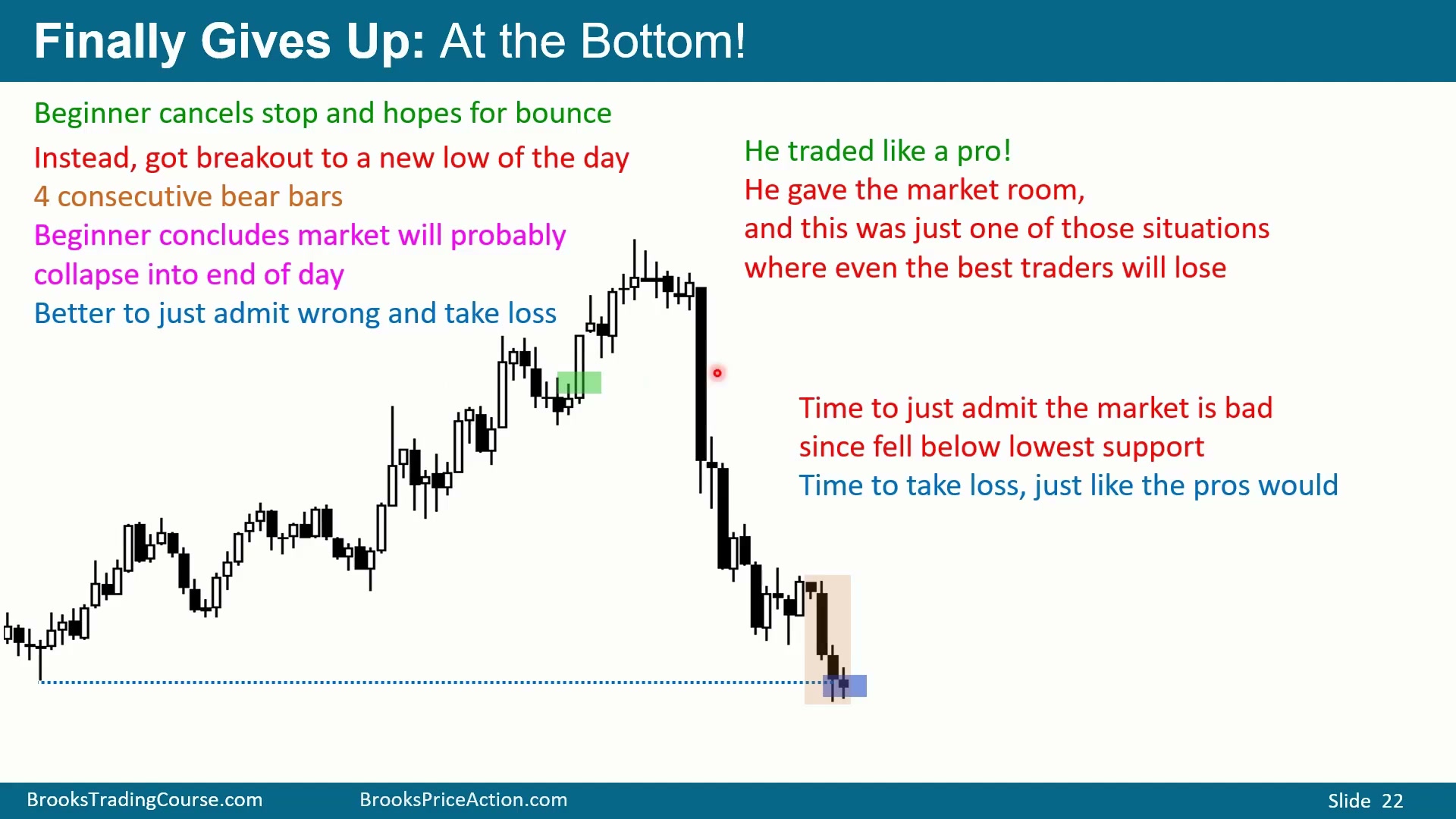
Bilingual Transcript
26:34 - 26:38
EN: So as it’s going down, the beginner cancels his stop or moves it way down here,
26:38 - 26:42
EN: hoping that it’ll bounce and maybe he can get out breakeven over here.
26:46 - 26:48
EN: Yet it just keeps going lower.
26:48 - 26:53
EN: Let’s say the beginner put his stop all the way down below the low of the day.
26:53 - 27:00
EN: Now he lost from here to here, a huge loss, instead of getting out here, small loss.
27:03 - 27:07
EN: The beginner, he watches it go down another leg, another leg, and he’s thinking,
27:07 - 27:11
EN: “Okay, the pros, they would get out at some point.
27:11 - 27:14
EN: The pros, maybe they’ll get out here,” and that’s just totally wrong.
27:16 - 27:20
EN: The pros would’ve gotten out up here or over here, and they’d be short.
27:20 - 27:24
EN: They’re not looking to get out of longs here.
27:24 - 27:25
EN: They’re already out of longs.
27:25 - 27:26
EN: They’re short now.
27:27 - 27:31
EN: So the beginner thinking that he’s trading like a pro by using a wide stop
27:31 - 27:34
EN: and holding on, hoping for a bounce, he’s not.
27:34 - 27:35
EN: He’s trading like a beginner.
27:36 - 27:39
EN: The beginner is thinking, “Okay, new low of the day.
27:39 - 27:41
EN: That’s worst case scenario stop.
27:41 - 27:44
EN: I’ve got to get out, just like what the pros would do.”
27:44 - 27:45
EN: That’s not what the pros would do.
27:45 - 27:48
EN: The pros might get out of their shorts because they’d be shorting,
27:48 - 27:53
EN: but the pros who bought here are not going to be holding on here.
Slide 020
Time: 27:55
Bilingual Transcript
27:57 - 28:00
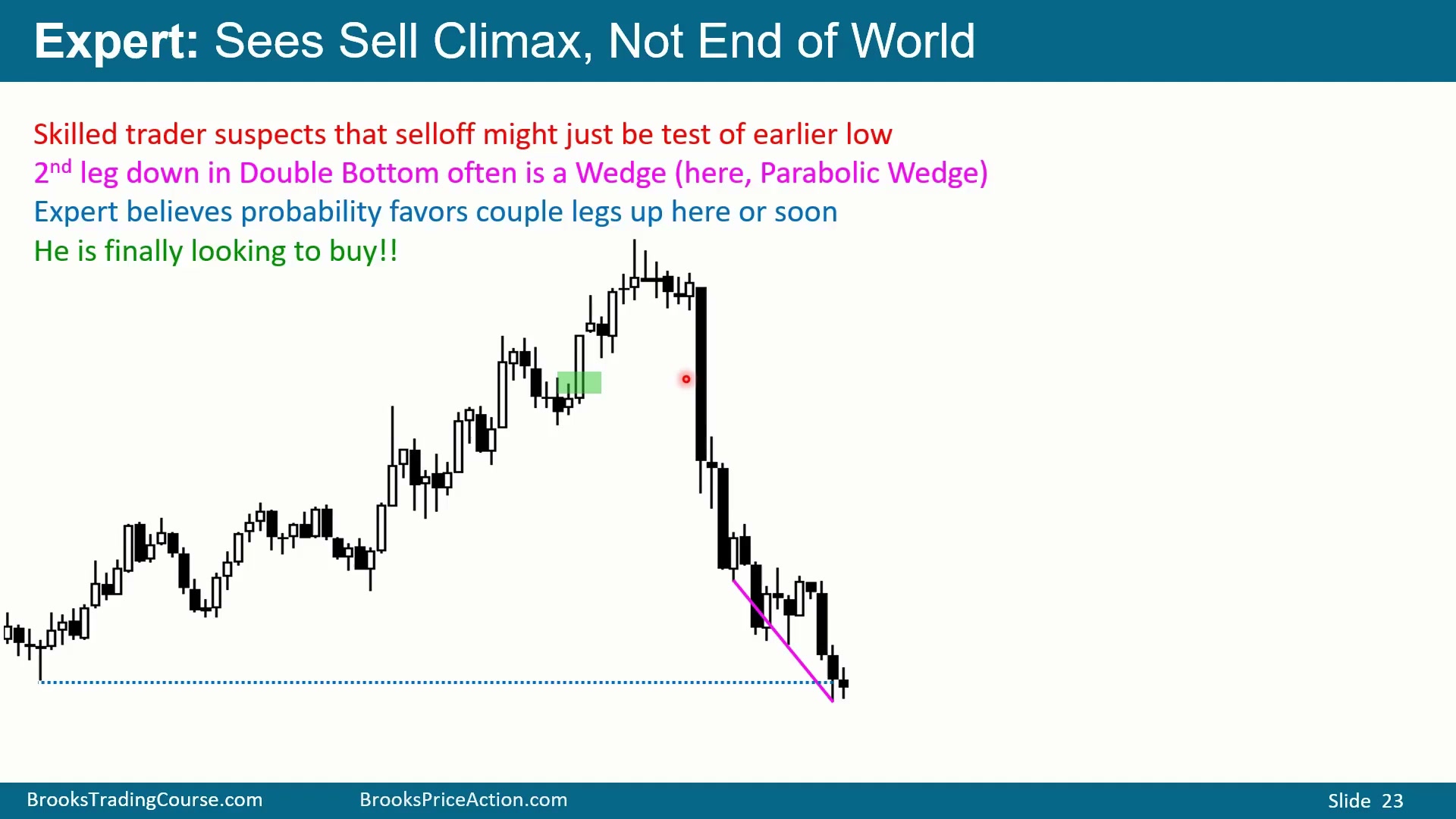
EN: The pros, what they’re going to see is a spike and a channel.
28:00 - 28:03
EN: Three legs down – one, two, three – and a Lower Low Double Bottom,
28:03 - 28:05
EN: slightly below that low.
28:05 - 28:07
EN: Whenever you have a Wedge selloff to a Double Bottom,
28:07 - 28:10
EN: you’re probably going to get a reversal, a bounce,
28:10 - 28:12
EN: maybe to the start of the channel here, maybe up here.
28:12 - 28:16
EN: So the pros are not getting out of bad longs from here.
28:17 - 28:18
EN: They’re looking to buy down here.
28:18 - 28:23
EN: So that beginner who let the market pass through his original stop
28:23 - 28:27
EN: and then he gets stopped out down here, that’s not where you get stopped out.
28:27 - 28:28
EN: This is where to buy.
Slide 021
Time: 28:30
Bilingual Transcript
28:34 - 28:38
EN: So three legs down, a Wedge, and a Double Bottom.
28:38 - 28:39
EN: Common reversal.
28:39 - 28:43
EN: By the way, that’s one of the things that causes divergence in a Double Bottom.
28:43 - 28:46
EN: Lower Low, Double Bottom, a Wedge.
28:46 - 28:51
EN: It’s a weaker selloff, so indicators like stochastics, RSI,
28:51 - 28:54
EN: are less oversold and you get divergence.
28:54 - 28:57
EN: Anyway, a bull, he’s looking to buy a reversal up.
28:57 - 28:59
EN: He might wait for a second reversal, here,
28:59 - 29:01
EN: and he would like to be buying above a bull bar.
29:01 - 29:06
EN: This bar has a small bull body, and he’d be buying a Sell Climax,
29:06 - 29:10
EN: looking for a couple legs up, a swing up, 10 bars or more.
29:10 - 29:11
EN: So one, pullback, two.
29:11 - 29:15
EN: So the experienced trader is buying down here
29:15 - 29:18
EN: and getting out at the end of the session.
29:18 - 29:21
EN: The beginner who lowered his stop and got out down here
29:21 - 29:25
EN: was doing the exact opposite of what experienced traders will do.
29:25 - 29:28
EN: Experienced traders are looking to buy, not get out of bad longs.
29:30 - 29:35
EN: So beginners, they tend to hold onto bad trades too long.
Slide 022
Time: 29:35
Bilingual Transcript
29:36 - 29:37
EN: Okay, another example.
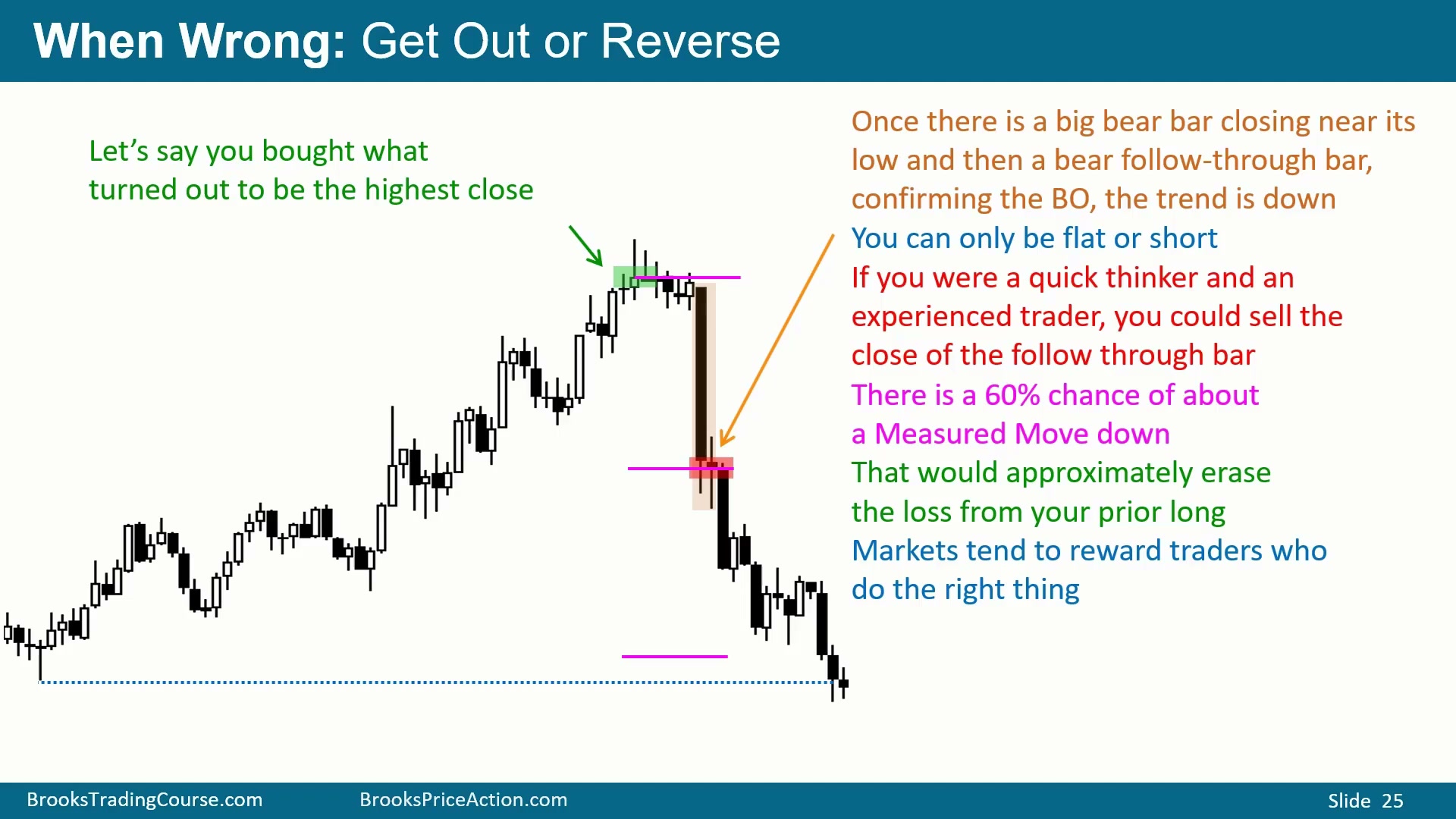
29:37 - 29:38
EN: We’ve got a bull trend.
29:38 - 29:40
EN: I said you could buy above bull bars closing at their highs.
29:40 - 29:42
EN: Let’s say you bought above that bull bar.
29:45 - 29:48
EN: And let’s say you did not get out up here.
29:48 - 29:54
EN: Let’s say you held long and you got stopped out somewhere down here, okay?
29:54 - 29:58
EN: A huge bar like that, it’s a bear surprise.
29:59 - 30:02
EN: Let’s say you bought up here and you get out down here.
30:02 - 30:07
EN: My general rule is if you get a big bear surprise after a reasonable buy,
30:07 - 30:10
EN: you’re probably going to fall for about a Measured Move down,
30:10 - 30:14
EN: and you’ll probably make up your loss from up here.
30:14 - 30:18
EN: So if you bought here and you see this, you go short down here.
30:18 - 30:22
EN: You should assume that it’s going to fall about
30:22 - 30:25
EN: as far as it did from your original entry.
30:25 - 30:31
EN: So if you buy, exit, sell, you’ll probably make about what you just lost.
30:31 - 30:33
EN: I want to make one other point about this.
30:33 - 30:36
EN: If you bought above this high and you see three dojis like that,
30:36 - 30:38
EN: you’re disappointed, right?
30:38 - 30:43
EN: Experienced traders are going to say, “Oh, this is disappointing.
30:43 - 30:46
EN: I’m going to get out around breakeven,” and that’s what was taking place here.
30:46 - 30:49
EN: More and more bulls were disappointed by every new bar forming.
30:49 - 30:52
EN: Here we got a bear bar, a warning bar,
30:52 - 30:55
EN: so bulls are very disappointed they bought here.
30:55 - 30:57
EN: They’ll place a limit order to get out around their entry.
30:57 - 31:03
EN: On this little bounce, the bulls will see that and they’ll get out breakeven.
31:03 - 31:05
EN: So experienced traders will be getting out up here.
31:06 - 31:11
EN: But if you did buy there and held through this, you could sell down here,
31:11 - 31:15
EN: expecting that whatever you lost, you’ll make up on the downside.
31:22 - 31:26
EN: Okay, so you bought up here and you get out let’s say
31:26 - 31:30
EN: on the close of the follow-through bar, the bear bar after that bar.
31:30 - 31:34
EN: You’d expect it to fall for about as much as what you lost on your long.
31:36 - 31:39
EN: Traders who do the right thing, they tend to make money.
31:39 - 31:42
EN: The market tends to reward people who do reasonable things
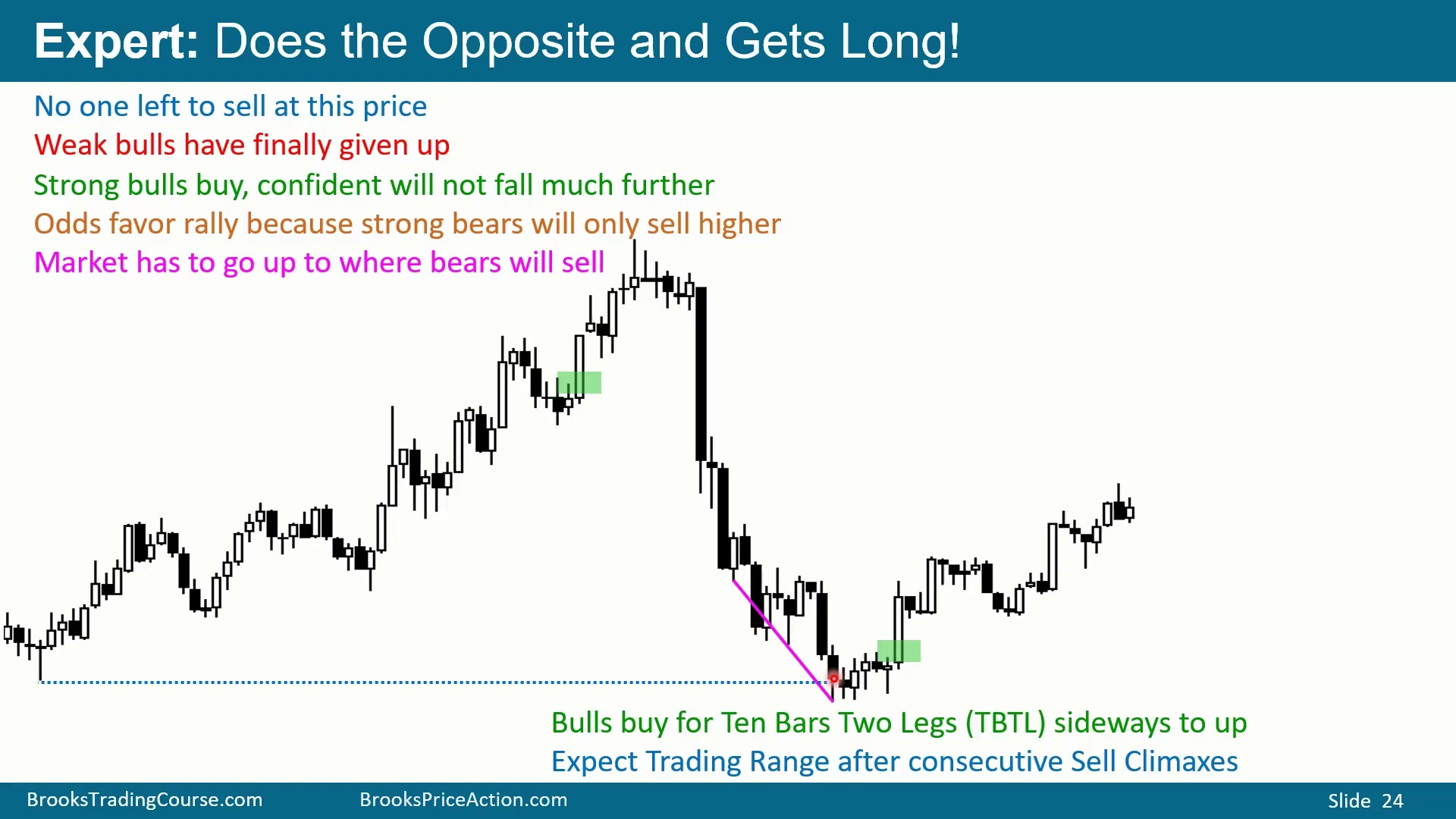
31:42 - 31:44
EN: and manage their trades well.
31:45 - 31:48
EN: Taking profits too quickly, common problem for beginners.
Slide 023
Time: 31:47
Bilingual Transcript
31:51 - 31:52
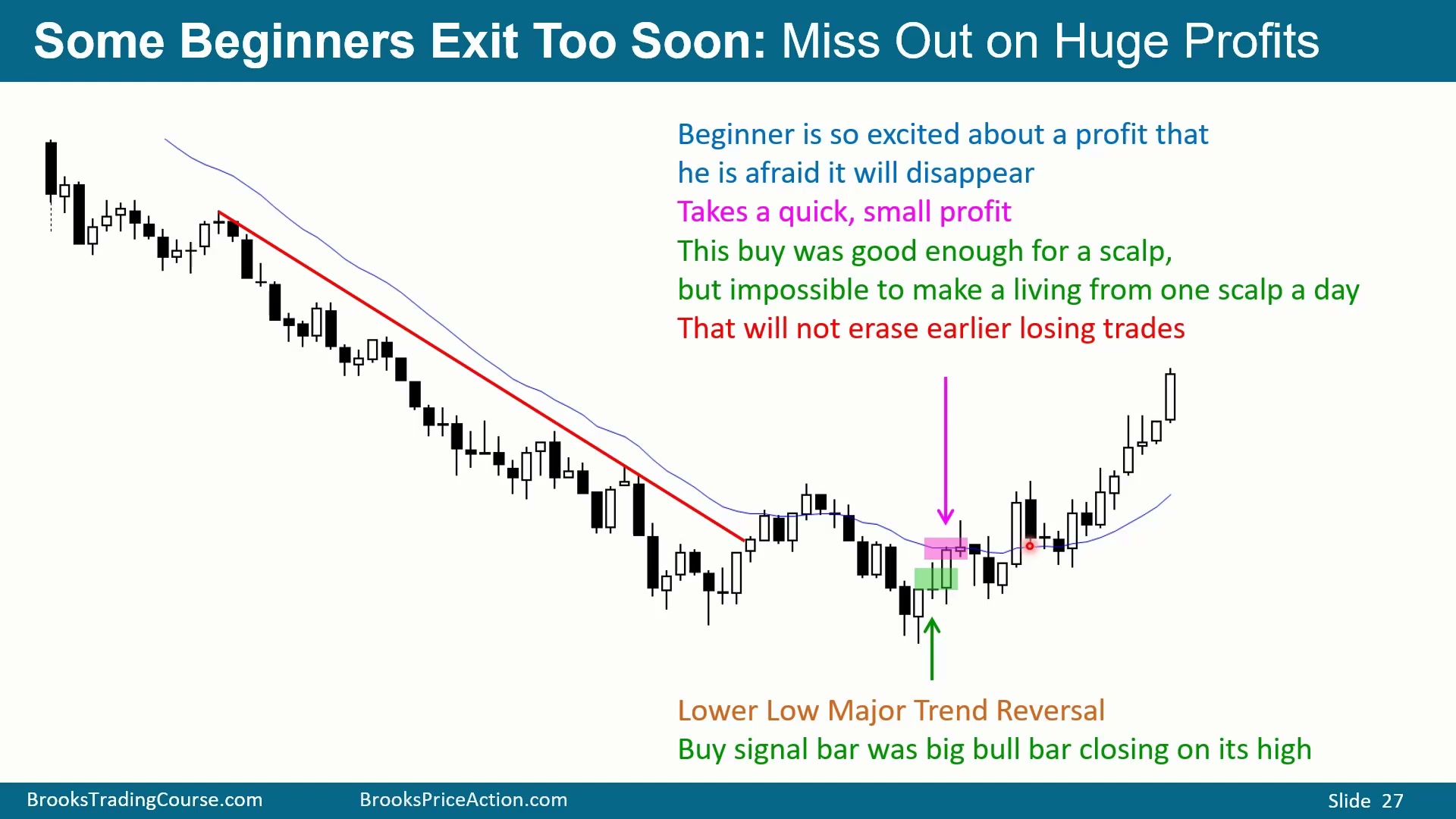
EN: I talked about this earlier.
31:52 - 31:55
EN: We have a Lower Low Major Trend Reversal.
31:55 - 31:56
EN: Major Trend Reversal.
31:56 - 31:59
EN: We had a bull break above the bear channel.
31:59 - 32:03
EN: If we get a second reversal up, there’s a 40% chance you’ll get a swing up,
32:03 - 32:06
EN: where the reward will be at least twice the risk.
32:06 - 32:08
EN: So this is potentially a major reversal.
32:09 - 32:13
EN: And therefore you don’t want to be scalping out and taking a quick profit.
32:14 - 32:15
EN: Pullback to the Moving Average.
32:15 - 32:17
EN: Maybe we’ll get another leg down.
32:17 - 32:22
EN: Now, if you’re taking this buy, you’re putting a stop below the low of the bar,
32:22 - 32:26
EN: and you hold until there’s a reasonable evidence that you’re wrong.
32:26 - 32:30
EN: Maybe you get out below here, but with these 2 big bull bars,
32:30 - 32:35
EN: my inclination would be to rely on my stop and see if we go up higher.
32:35 - 32:40
EN: It’s very common in a trend reversal that the market will do something
32:40 - 32:45
EN: within the first 10 bars to make you think that the bear trend is resuming.
32:45 - 32:51
EN: But remember, you’re looking for both two legs – one, two – and 10 or more bars.
32:51 - 32:57
EN: This is not 10 or more bars, so chances are this is going to be a bear trap,
32:57 - 33:01
EN: trapping bears into a bad short, trapping bulls out of a good long.
33:01 - 33:04
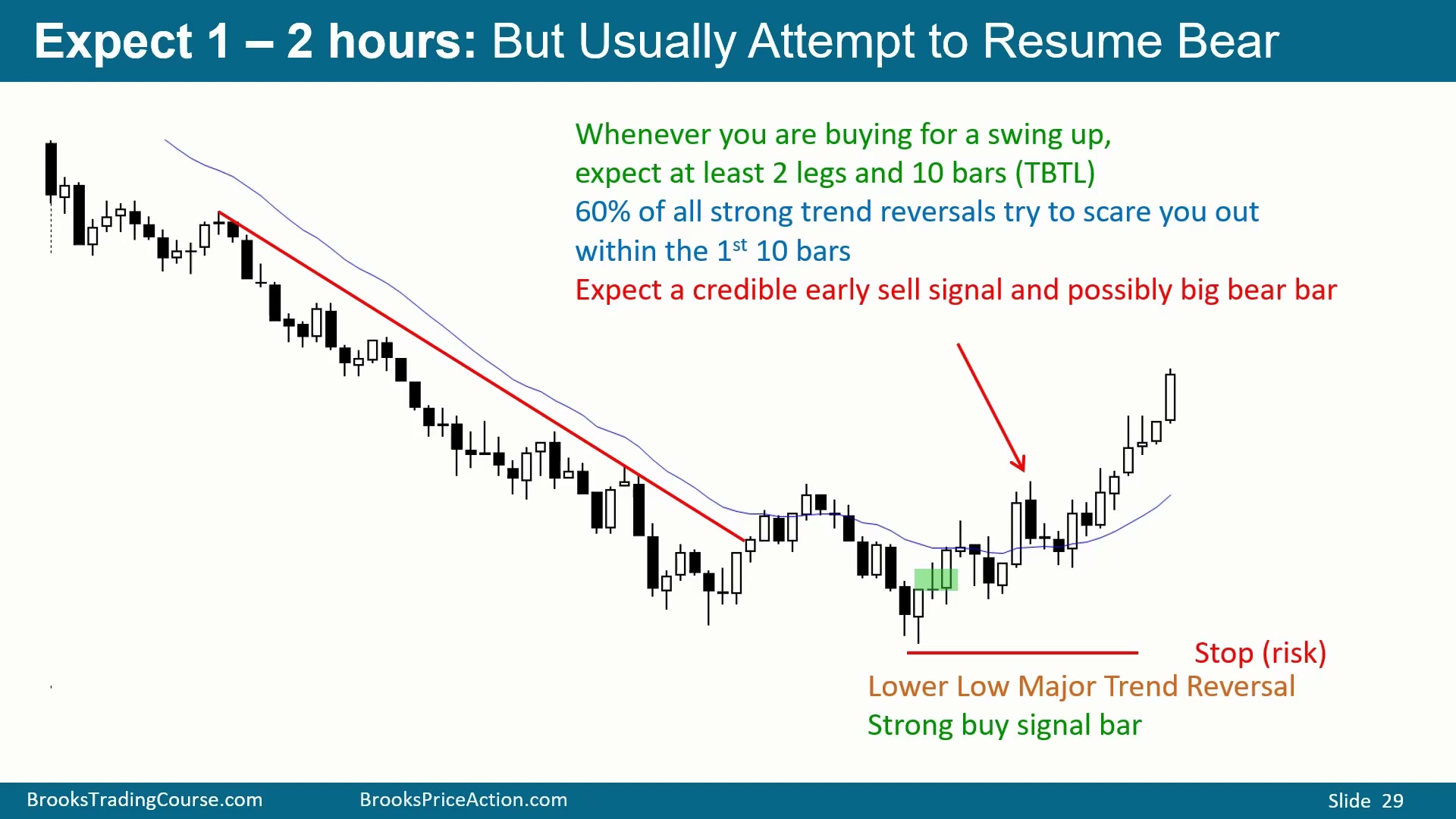
EN: So if you’re able to, just rely on your stop and hold
33:04 - 33:07
EN: and hope that you get a big move up out of it.
Slide 024
Time: 33:10
Bilingual Transcript
33:11 - 33:13
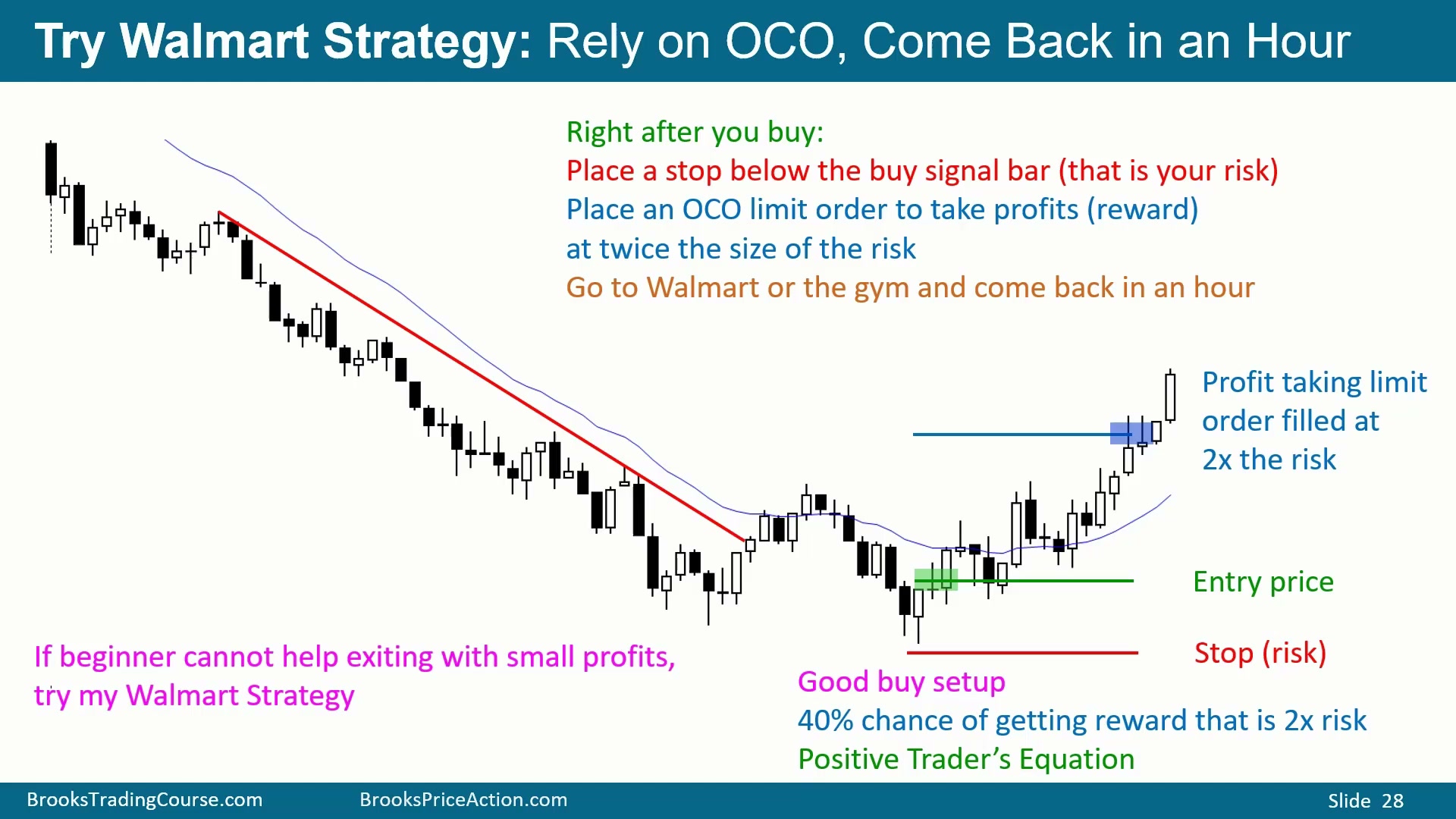
EN: I have a suggestion.
33:13 - 33:17
EN: If you do buy above that and you’re always taking a quick scalp profit,
33:17 - 33:20
EN: there’s something I call my Walmart strategy.
33:21 - 33:24
EN: What you do is you take the buy, you see where the stop belongs,
33:24 - 33:29
EN: so you put a stop here, and you want a reward that’s at least twice your risk,
33:29 - 33:34
EN: so you place a limit order to get out with a reward that’s at least twice
33:34 - 33:38
EN: that risk – or you just come back in an hour and see where the market is.
33:38 - 33:41
EN: If your stop is not hit, maybe the market will be up here,
33:41 - 33:44
EN: and then you can get out at the end of the session.
33:44 - 33:48
EN: So Walmart strategy: if you’re taking profits too quickly,
33:48 - 33:54
EN: if you’re scalping trades that should be swing trades, just place your stop
33:55 - 34:00
EN: and have it OCO with a profit-taking order two, three, four times greater
34:00 - 34:04
EN: than your risk, and then go for a walk, go for a jog, go to the gym,
34:04 - 34:06
EN: go to Walmart, and then come back after an hour.
34:06 - 34:09
EN: Force yourself to stay out for at least 30 minutes,
34:09 - 34:15
EN: an hour or so before you come back, and you’ll find that 40% of the time,
34:15 - 34:18
EN: you’ll be making at least twice your risk.
34:18 - 34:20
EN: I think it’s a profitable strategy.
34:24 - 34:30
EN: So if you buy here and your risk is below that, two times your risk is up here.
34:30 - 34:36
EN: So you take that buy, you put a stop here, you place an order cancel order,
34:36 - 34:40
EN: limit order to get out up here, and then go to Walmart
34:40 - 34:41
EN: and you come back at the end of the day and say
34:41 - 34:46
EN: “Oh, I made twice my risk,” and that’s a very big profit.
34:46 - 34:47
EN: That’s a very good trade.
34:50 - 34:55
EN: In general, if you’re taking a reasonable Major Trend Reversal trade,
34:55 - 35:00
EN: 40% chance you’re going to get a reward that is at least twice your risk.
Slide 025
Time: 35:05
Bilingual Transcript
35:06 - 35:08
EN: I mentioned that it’s very common,
35:08 - 35:11
EN: 60% of the time when you’re early in a swing trade,
35:11 - 35:16
EN: the market will do something that makes you think the old trend is resuming.
35:17 - 35:21
EN: So you can either rely on your stop or get out below the bear bar
35:21 - 35:23
EN: and then look for a bull bar and buy above the bull bar
35:23 - 35:25
EN: for a resumption of the bull trend.
35:32 - 35:37
EN: A common problem that people have is they start trading well,
Slide 026
Time: 35:33
Bilingual Transcript
35:37 - 35:40
EN: and they want to increase their position size.
35:41 - 35:45
EN: When they start to increase their position size, they start to lose money.
35:45 - 35:50
EN: They think, “Oh my gosh, I’m trying to do exactly what I was doing last week
35:50 - 35:55
EN: when I was making money, and now that I’m trading two Eminis instead of one Emini,
35:55 - 35:56
EN: I’m losing all the time.”
35:56 - 36:00
EN: And that’s because you’re thinking about money, you’re thinking about risk.
36:00 - 36:05
EN: Just like a beginner, you’re back to worrying about risk instead of thinking
36:05 - 36:08
EN: about the whole package – risk, reward, and probability.
36:09 - 36:13
EN: Until you get to the point where you can not focus on risk,
36:13 - 36:15
EN: it’s really hard to make money.
Slide 027
Time: 36:20
Bilingual Transcript
36:21 - 36:26
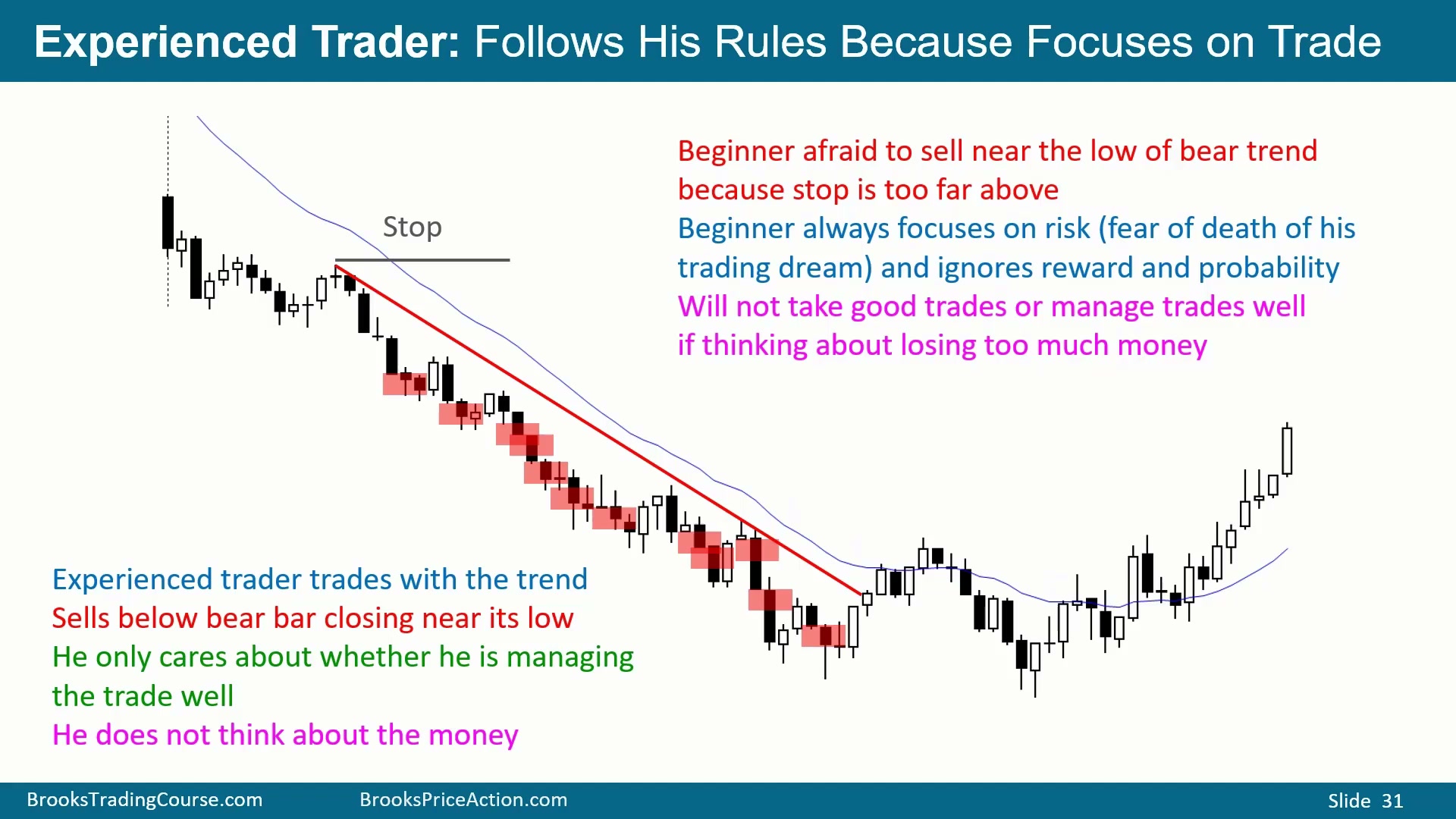
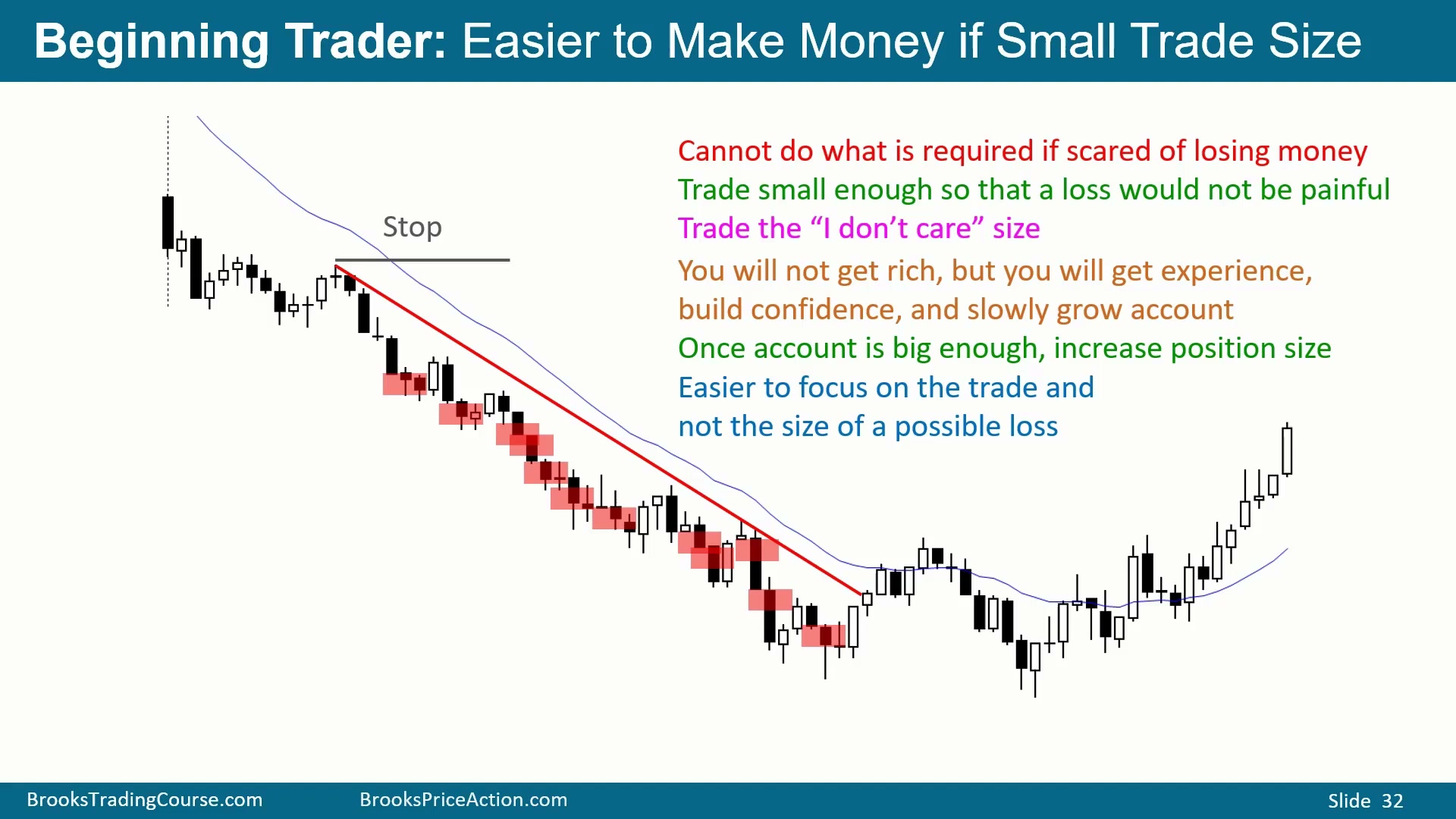
EN: Okay, and one of my solutions – I talked about the Forrest Gump trading.
36:26 - 36:29
EN: I talked about the Walmart strategy.
36:29 - 36:33
EN: A third thing is trading the “I don’t care” size.
36:35 - 36:37
EN: Trade a small enough position size
36:37 - 36:40
EN: so that you really don’t care if you lose money.
36:40 - 36:47
EN: So if you’re trading one Emini contract and all you’re doing is sitting there,
36:47 - 36:51
EN: paralyzed, afraid of losing money, then trade a Micro Emini, one-tenth the size.
36:52 - 36:57
EN: I know you’re not going to get rich trading one or two Micro Emini contracts,
36:57 - 37:00
EN: but what you will get is practice doing the right thing,
37:00 - 37:03
EN: not worrying about money, and instead looking
37:03 - 37:05
EN: at the entire trade and managing it correctly.
Slide 028
Time: 37:10
Bilingual Transcript
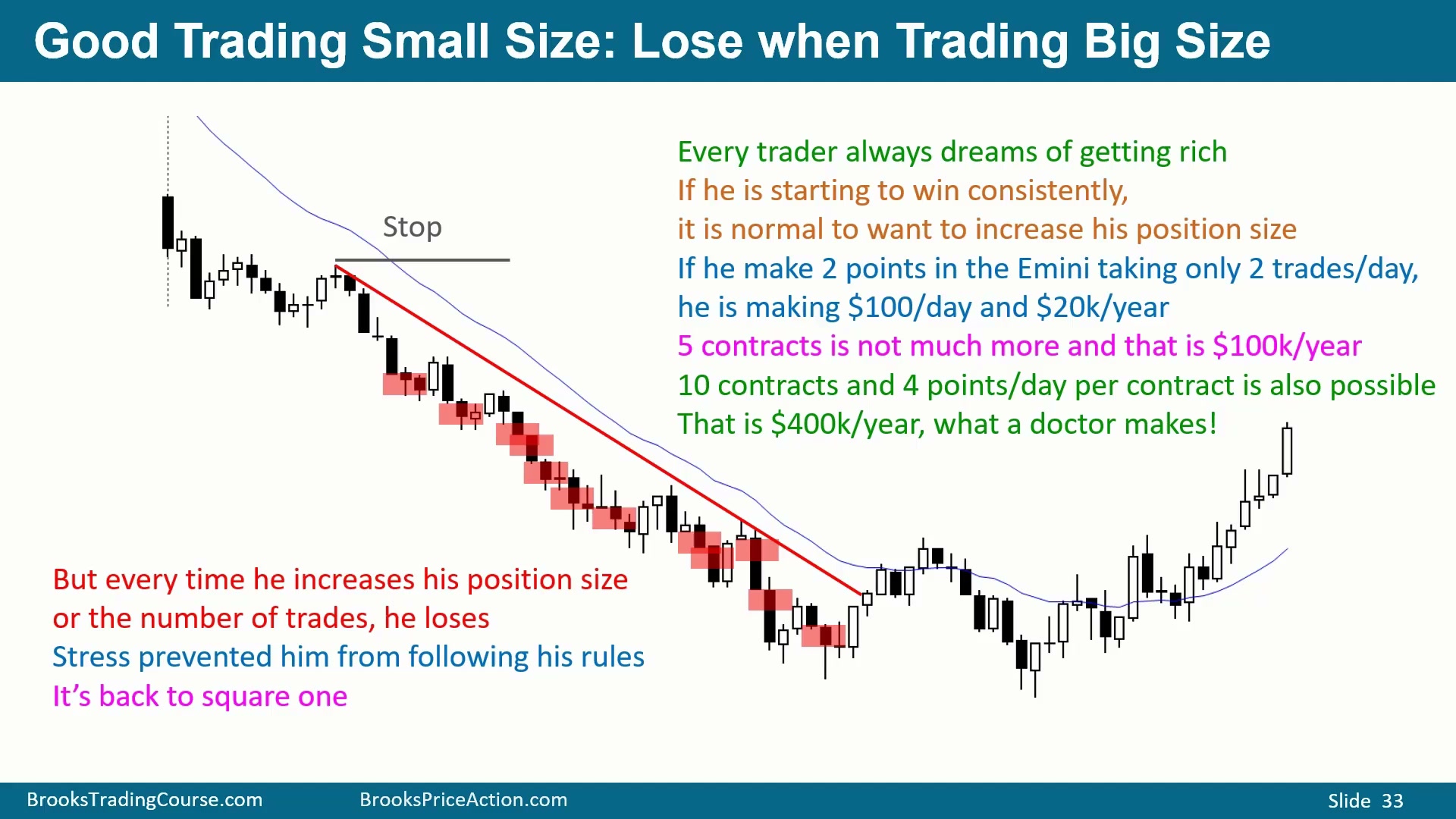
37:10 - 37:13
EN: Everybody wants to get rich, right?
37:13 - 37:15
EN: If you’re starting to win consistently,
37:16 - 37:18
EN: of course you want to increase your position size.
37:19 - 37:21
EN: So let’s say you’re trading the Emini
37:21 - 37:24
EN: and you’re consistently averaging 2 points’ profit a day
37:24 - 37:27
EN: and you’re taking maybe only a couple trades a day.
37:27 - 37:29
EN: Then you’re making $20,000 a year,
37:30 - 37:34
EN: and instead of trading one contract – this is trading one contract
37:34 - 37:36
EN: – let’s say you increase it to five contracts.
37:36 - 37:37
EN: Not much more.
37:37 - 37:40
EN: Instead of $20,000 a year, you make $100,000 a year.
37:40 - 37:43
EN: Let’s say you increase it to ten contracts,
37:43 - 37:45
EN: and instead of 2 points, you’re averaging 4 points a day.
37:45 - 37:48
EN: Now you’re making $400,000 a year.
37:49 - 37:51
EN: Those are not big steps.
37:51 - 37:53
EN: I mean, they’re big psychologically,
37:53 - 37:56
EN: but if you’re a consistently profitable trader,
37:56 - 37:59
EN: you can make those steps inside of a couple years.
38:02 - 38:04
EN: You can have a very good living doing it.
38:05 - 38:10
EN: But if you find yourself losing money every time you increase your position size,
38:10 - 38:13
EN: it can be really frustrating and really upsetting.
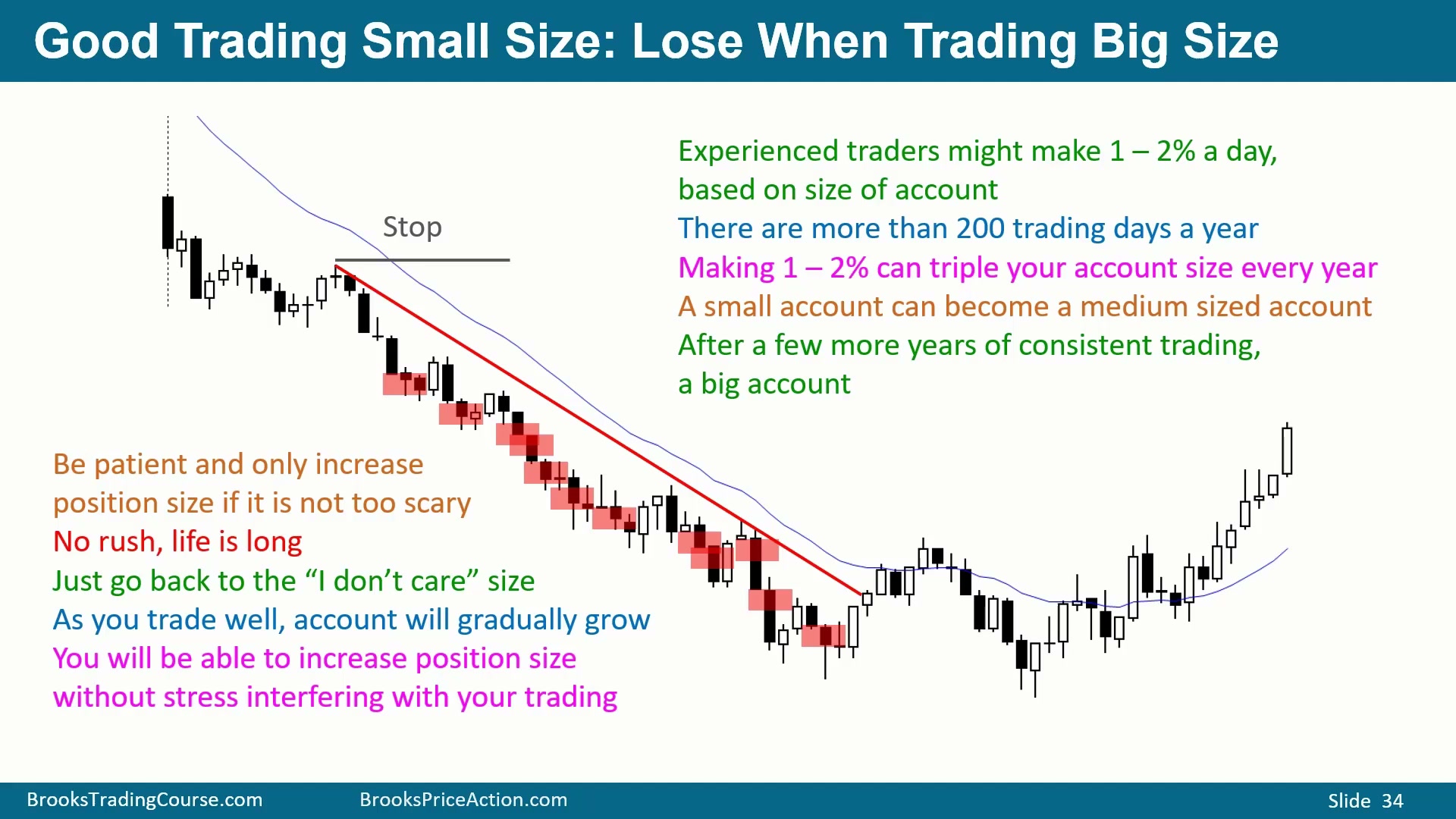
Slide 029
Time: 38:15
Bilingual Transcript
38:16 - 38:21
EN: Let’s say an experienced trader makes 1% to 2% based on his account every day,
38:22 - 38:25
EN: and there are 200 trading days a year, about.
38:25 - 38:28
EN: Maybe a little bit more; if you take vacations, maybe a little bit less.
38:28 - 38:35
EN: If you’re making only 1% or 2% profit per day – so you have a $10,000 account,
38:35 - 38:37
EN: 1% is $100, 2 points in the Emini.
38:37 - 38:39
EN: That is not unreasonable.
38:40 - 38:42
EN: If you make only 1%, 2% a day,
38:42 - 38:45
EN: your account size will triple at the end of the year.
38:46 - 38:51
EN: And at the end of a year or two, a small account can be a medium account,
38:52 - 38:54
EN: and a few more years trading,
38:55 - 38:58
EN: all of a sudden you start to have a pretty good size account.
39:01 - 39:02
EN: Okay?
39:02 - 39:08
EN: The goal is to become consistently profitable and slowly grow your account,
39:08 - 39:12
EN: and a good way to do that is trade the “I don’t care” size.
39:12 - 39:16
EN: If you increase your position size – let’s say you trade two Micro Eminis
39:16 - 39:18
EN: and you increase to three or four
39:18 - 39:22
EN: and you’re starting to lose more, more often – go back to two.
39:22 - 39:28
EN: Do not increase until you can trade as comfortably as you did before.
39:28 - 39:30
EN: There’s always going to be a little bit of stress,
39:30 - 39:33
EN: but as long as you’re reasonably comfortable and as long
39:33 - 39:37
EN: as you’re not focusing on money, you can gradually increase your positon size.
39:37 - 39:42
EN: It takes a few years to get from a small account to a decent size account
39:42 - 39:44
EN: where you can trade one or two Emini contracts,
39:44 - 39:49
EN: but once you’re there, it can be life-changing.
39:49 - 39:52
EN: It can be pretty dramatically life-changing pretty quickly.
39:55 - 39:59
EN: I began by talking about needing an edge, a mathematical advantage,
Slide 030
Time: 39:55
Bilingual Transcript
39:59 - 40:04
EN: and the single best edge that people should consider
40:04 - 40:08
EN: is going for a reward that is twice the risk.
40:08 - 40:10
EN: There are other things you can do.
40:10 - 40:12
EN: Good scalpers can go for high probability.
40:12 - 40:16
EN: For most traders, they should simply look for a reasonable trade,
40:16 - 40:18
EN: see where the stop goes,
40:18 - 40:23
EN: and look to take part or all of their profit at two times their risk.
40:24 - 40:29
EN: And then the single most important thing, I think, is avoiding bad trades.
40:29 - 40:31
EN: If you look – let’s say you’ve been trading for several months
40:31 - 40:33
EN: and you’ve taken 100 trades.
40:33 - 40:38
EN: You’ll notice that you’ve probably taken 10 or 15 really pretty good trades,
40:38 - 40:41
EN: and you probably took 30 or 40 really stupid trades.
40:41 - 40:45
EN: If you can avoid the bad trades, you’ll find out
40:45 - 40:49
EN: that you’re already making enough money to be consistently profitable.
40:49 - 40:51
EN: You’ve got to get rid of the bad trades.
40:52 - 40:56
EN: Another problem: holding losers too long, in denial.
40:56 - 41:00
EN: Market’s going against you, you don’t want to take the loss.
41:00 - 41:03
EN: Small losses grow quickly into very big losses,
41:03 - 41:07
EN: so it’s better just to take the loss and then look for the next trade.
41:08 - 41:12
EN: People who do lose a lot, they tend to take profits too quickly.
41:12 - 41:15
EN: Beginners tend to take profits too quickly.
41:15 - 41:18
EN: They tend to think, “Oh my gosh, I finally have a winner.
41:18 - 41:23
EN: I’ve got to take my profit,” and that’s that Walmart strategy that I talked about.
41:23 - 41:28
EN: Place your stop, place a limit order so that the reward is twice your risk,
41:29 - 41:33
EN: and if you have to, go out and take a walk for 30 minutes, an hour.
41:33 - 41:34
EN: Go to the grocery store.
41:34 - 41:36
EN: The Walmart strategy.
41:36 - 41:39
EN: And then finally, if you find that you’re losing money
41:39 - 41:42
EN: when you’re trying to increase your position size, be patient.
41:42 - 41:47
EN: Make sure that you’re always trading the “I don’t care” size.
41:47 - 41:52
EN: So you want to be trading small enough so that you really don’t care if you lose,
41:52 - 41:56
EN: and that “I don’t care” size will increase over time.
41:56 - 42:00
EN: Within 2 or 3 years, you might find that you’re trading
42:00 - 42:04
EN: a really decent size position and you’re making a pretty good living as a trader.
42:10 - 42:15
EN: Terry, if you have some questions that you can read, I can answer some questions.
42:16 - 42:19
EN: Give me a second and I’ll go through them.
42:20 - 42:23
EN: “On a Trading Range day, how do you look for areas
42:23 - 42:27
EN: where bulls or bears might be taking profit (say one to two times their risk)
42:27 - 42:32
EN: and use this information in addition to the price action that develops
42:32 - 42:36
EN: (maybe a strong reversal bar) in order to take a trade in the opposite direction?”
42:37 - 42:42
EN: Whenever the market’s in a Trading Range, nothing feels right, nothing looks right.
42:42 - 42:48
EN: The bars, you get bad looking buy signal bars, bad looking sell signal bars.
42:48 - 42:51
EN: Sometimes the buy bars are too big, so you’re forced to buy up in the middle;
42:51 - 42:54
EN: the sell bars are too big, you’re forced to sell down in the middle,
42:54 - 42:56
EN: and you don’t want to be taking trades in the middle.
42:56 - 42:58
EN: You want to be taking profits in the middle.
42:59 - 43:01
EN: If I’m being forced to buy in the middle,
43:01 - 43:07
EN: I typically don’t do it unless I’m buying in a very strong leg up.
43:07 - 43:09
EN: I want to be buying in the bottom third
43:09 - 43:12
EN: and I want to be taking profits or selling in the top third.
43:12 - 43:14
EN: I typically don’t buy in the bottom third
43:14 - 43:17
EN: and then hold for a swing up to the top third.
43:17 - 43:20
EN: If a Trading Range is let’s say 5 or 6 points tall,
43:20 - 43:22
EN: I might try to buy the bottom third.
43:22 - 43:25
EN: I might scalp out with 1 point, 2 points.
43:25 - 43:28
EN: If the Trading Range is 10 points tall, I’ll be going for 2 point scalps.
43:28 - 43:33
EN: So I want to buy in the bottom, sell at the top, and if things are not clear,
43:33 - 43:36
EN: I’ll often wait for a Micro Double Bottom
43:36 - 43:40
EN: to buy at the bottom or a Micro Double Top to sell at the top.
43:40 - 43:42
EN: But one of the things in Trading Ranges
43:42 - 43:44
EN: is you have to assume that everything is bad.
43:44 - 43:49
EN: Nothing looks right, and nothing goes as far as you want it to go.
43:49 - 43:52
EN: The market tends to look most bullish at the top.
43:52 - 43:55
EN: You should be thinking about selling, not buying.
43:55 - 43:57
EN: It tends to look most bearish at the bottom.
43:57 - 44:00
EN: You should be thinking about buying, not selling.
44:01 - 44:02
EN: Okay.
44:03 - 44:08
EN: “What do you recommend: exiting when disappointed by consecutive bars
44:08 - 44:10
EN: or relying on a price action stop?”
44:11 - 44:14
EN: Everyone’s default should be to rely on a price action stop.
44:14 - 44:18
EN: If you’re buying at the low and you’re buying a reversal up,
44:18 - 44:21
EN: most traders should just put a stop right below the low.
44:22 - 44:24
EN: You can also use money stops.
44:24 - 44:30
EN: Let’s say $100 or 2 points or some other thing.
44:30 - 44:35
EN: But if ever I’m in a trade and the market is – let’s say I buy
44:35 - 44:39
EN: and the market’s going up, and it has not hit my stop,
44:39 - 44:44
EN: but it’s doing something to make me think that the trade is no longer valid
44:44 - 44:47
EN: and that, in fact, an opposite trade is setting up.
44:47 - 44:49
EN: I will get out.
44:49 - 44:53
EN: I don’t want to let my stop get hit, especially if my stop is far away.
44:53 - 44:57
EN: Let’s say I buy and the market has rallied for 7 or 8 bars.
44:57 - 45:00
EN: I really am not going to let my stop get hit.
45:00 - 45:02
EN: I’m going to get out before it gets hit,
45:02 - 45:06
EN: so I’ll get out below a bear bar closing on its low or a Micro Double Top,
45:06 - 45:09
EN: or if there’s a big bear bar reversing down strongly,
45:09 - 45:12
EN: I’ll get out on the close of that bar or below that bar.
45:13 - 45:16
EN: So ideally, you don’t want your stop to get hit.
45:16 - 45:20
EN: You want to be getting out with a limit order at your profit target
45:20 - 45:24
EN: or on a reversal down, but before your stop gets hit.
45:26 - 45:26
EN: Okay.
45:27 - 45:29
EN: He says “Hi, Dr. Brooks, thank you for the webinar.
45:29 - 45:32
EN: What are your thoughts on traders using order flow,
45:32 - 45:34
EN: tape reading, footprint charts, etc.
45:34 - 45:36
EN: to improve their entry price?”
45:36 - 45:38
EN: Personally, I don’t like it.
45:38 - 45:39
EN: There are people who do it.
45:39 - 45:43
EN: I play tennis up here, and there are two young guys – I say young;
45:43 - 45:47
EN: they’re 40 years old – and that’s how they trade.
45:48 - 45:52
EN: To me, I don’t like that because I feel like I’m not connected to the market.
45:52 - 45:54
EN: It’s like working too much under a Microscope.
45:55 - 45:57
EN: Also, I would not try to make life complicated.
45:57 - 46:01
EN: I would either trade using order flow – order flow,
46:01 - 46:05
EN: which I would not do – or using price action.
46:05 - 46:07
EN: I think that is the better way to trade.
46:07 - 46:11
EN: I think using order flow is kind of a depressing existence.
46:11 - 46:17
EN: I’ve tried it, and I feel like I’m not – I’m not really a player.
46:17 - 46:19
EN: I feel like I’m not really part of the market.
46:20 - 46:23
EN: I like seeing prices going up and down and patterns forming.
46:23 - 46:24
EN: I enjoy that.
46:24 - 46:29
EN: But I would pick one style of trading and not try to combine them.
46:29 - 46:35
EN: I would pick one chart, one timeframe, one market if you’re a day trader,
46:35 - 46:38
EN: just specialize in one thing and don’t worry about everything else.
46:38 - 46:43
EN: So if you’re trading the Emini, for example, don’t go looking at the NASDAQ.
46:43 - 46:44
EN: Don’t go look at the cash index.
46:44 - 46:46
EN: If you’re trading a 5-minute chart,
46:46 - 46:49
EN: don’t go look at a 1-minute chart or a 60-minute chart.
46:49 - 46:51
EN: Just trade the chart that’s in front of you.
46:52 - 46:55
EN: Indicators, I don’t use indicators
46:55 - 46:59
EN: because I can see – I can see what the market’s doing.
46:59 - 47:02
EN: An indicator – I’ve written all kinds of indicators,
47:02 - 47:04
EN: and they’re based upon the bars.
47:05 - 47:06
EN: I don’t need to look at the indicator.
47:06 - 47:08
EN: I can look at the bars and I know what the indicators are doing.
47:08 - 47:10
EN: So I just keep it simple.
47:11 - 47:12
EN: Okay.
47:12 - 47:17
EN: He says, “What do you do when the two times Actual Risk
47:17 - 47:19
EN: becomes greater than your original profit target?
47:19 - 47:24
EN: Exit at the original profit target or the two times Actual Risk?”
47:24 - 47:25
EN: It depends on circumstances.
47:25 - 47:27
EN: Let’s say you buy.
47:27 - 47:30
EN: Let’s say the buy signal bar is pretty small,
47:30 - 47:34
EN: so the risk is small, but the context is very good.
47:34 - 47:36
EN: The resistance is very far above.
47:37 - 47:40
EN: In that case, I’m not going to be getting out at two times risk.
47:40 - 47:47
EN: I’ll look to get out at resistance, a test of a prior Lower High for example.
47:48 - 47:51
EN: For me it’s not hard and fast.
47:51 - 47:54
EN: On an average trade, an average pattern,
47:54 - 48:00
EN: I might get out 100% at two times risk or about two times risk.
48:01 - 48:05
EN: But there are circumstances, if you have a really good setup
48:05 - 48:08
EN: and you’re expecting a really big reversal,
48:08 - 48:10
EN: it’s better just to use price action exits.
48:10 - 48:14
EN: You just hold until the market gets near resistance
48:14 - 48:17
EN: or reverses near resistance and then get out.
48:18 - 48:19
EN: Okay.
48:19 - 48:23
EN: “How much time outside of the U.S. session do you spend watching the markets,
48:23 - 48:25
EN: and what activities do you recommend for a trader
48:25 - 48:28
EN: when they’re not actively trading?”
48:29 - 48:36
EN: For me, I’m here – I’ve probably watched more ticks than anybody in the universe.
48:37 - 48:39
EN: I’ve been doing this for almost 35 years,
48:39 - 48:43
EN: and I’ve watched pretty much every tick for 35 years.
48:43 - 48:46
EN: Also, a lot of times when I’m on vacation,
48:46 - 48:50
EN: I have my computers with me and I’ll trade for a couple hours or so.
48:51 - 48:53
EN: I like – I like trying to see if I can pay
48:53 - 48:57
EN: for the entire vacation when I’m on vacation.
48:58 - 49:05
EN: And I remember years ago, when I was young, I would trade 1-minute charts
49:05 - 49:09
EN: or tick charts based with a small number of ticks,
49:09 - 49:13
EN: and I could never understand how someone could sit there
49:13 - 49:15
EN: and watch a 5-minute chart all day.
49:15 - 49:20
EN: And then about 20 years ago, I started to realize that a 5-minute chart
49:20 - 49:24
EN: has an incredible amount of information going on.
49:24 - 49:27
EN: On every tick there’s something to think about.
49:27 - 49:33
EN: So for me, today, I really like watching the market tick by tick.
49:34 - 49:36
EN: If you don’t have that kind of a personality that you want
49:36 - 49:41
EN: to sit there all the time, what you can try to do is anticipate turning points
49:41 - 49:47
EN: or anticipate where pullbacks will end and the trend will resume.
49:48 - 49:52
EN: And as far as what to do in the meantime, I had a friend that I traded
49:52 - 49:56
EN: with online about 20 years ago – maybe 15, 20 years ago
49:56 - 49:59
EN: – and he used to watch movies.
49:59 - 50:04
EN: So he’d sit there trading all day long, and he’d be watching a movie.
50:04 - 50:08
EN: He’d keep looking at the chart, looking for setups,
50:08 - 50:11
EN: and then when a setup is starting to set up,
50:12 - 50:15
EN: he’ll pause the movie and then take his trade.
50:15 - 50:18
EN: But I don’t have an answer for what to do while waiting.
50:18 - 50:24
EN: I know I personally sometimes will go to news sites and read news.
50:24 - 50:27
EN: If it looks like the market’s in a very tight range
50:27 - 50:30
EN: and I don’t want to trade it, I might read news stories.
50:31 - 50:33
EN: But I’m always keeping my eye on the chart.
50:33 - 50:37
EN: So I’m probably not answering your question the way you want,
50:37 - 50:41
EN: but I think if you’re a trader, you have to be looking for trades.
50:41 - 50:46
EN: You don’t have to watch every tick, but it’s good to keep the screen up
50:46 - 50:52
EN: and look at it occasionally, trying to anticipate things before they get started.
50:54 - 50:55
EN: Okay.
50:55 - 50:59
EN: “How do you approach the task of increasing your trading size?
50:59 - 51:02
EN: Do you regularly increase it or do something else,
51:02 - 51:06
EN: or have you been at a certain trading size for several years?”
51:06 - 51:10
EN: I had a friend that I traded with who was a very good trader years ago,
51:10 - 51:14
EN: and I traded with him – I traded with him online.
51:14 - 51:19
EN: I never met him, but he and I traded together every day for years.
51:19 - 51:22
EN: We’d talk occasionally on the phone.
51:22 - 51:23
EN: He was a very good trader.
51:24 - 51:26
EN: He used to trade four Emini contracts.
51:26 - 51:29
EN: I don’t know how many points he was averaging a day.
51:29 - 51:31
EN: Maybe 15 or 20 points a day.
51:31 - 51:33
EN: I used to get frustrated with him.
51:33 - 51:36
EN: I used to call him and say to him, “Why aren’t you trading more?
51:36 - 51:37
EN: You’re making four.
51:37 - 51:38
EN: What happens if you trade 100?
51:38 - 51:41
EN: You’d be making $10 million a year.”
51:41 - 51:46
EN: He’d say, “You know, Al, I make plenty of money trading this size, and I’m happy.
51:46 - 51:51
EN: I’m relaxed, and if I increase my size, I’ll be stressed out.
51:51 - 51:52
EN: I don’t need that.
51:52 - 51:54
EN: I’m already making enough money.”
51:54 - 51:56
EN: That’s pretty much my answer.
51:56 - 52:02
EN: I’m comfortable with what I’m doing right now, and if I was 30 years old,
52:02 - 52:07
EN: I probably would open a hedge fund and manage money.
52:07 - 52:11
EN: But where I am right now, every day I’m happy.
52:11 - 52:13
EN: I love being in front of the screen.
52:13 - 52:15
EN: I love trading.
52:15 - 52:17
EN: I love seeing things unfold.
52:17 - 52:20
EN: I’m happy, and I don’t want to add stress.
52:20 - 52:22
EN: I have a lot of accounts.
52:22 - 52:27
EN: Maybe I have 10 accounts, and I could greatly increase my position size,
52:28 - 52:31
EN: but trading would not be fun.
52:31 - 52:34
EN: So at some point you’d say, “I’m making enough money doing what I’m doing.
52:34 - 52:36
EN: I don’t need the stress.”
52:36 - 52:40
EN: But as I said, if I was 30 years old or 25 years old,
52:40 - 52:43
EN: something like that, I’d want the stress.
52:43 - 52:45
EN: But that’s not where I am at this point in life.
52:45 - 52:49
EN: I could retire right now and have a very comfortable life.
52:49 - 52:51
EN: But I enjoy what I’m doing.
52:51 - 52:54
EN: I don’t want to add something to what I’m doing
52:54 - 52:57
EN: that would create stress and make my life less fun.
52:59 - 52:59
EN: Okay.
52:59 - 53:02
EN: We’re getting long on time, so we’ll make this the last question.
53:03 - 53:05
EN: He says, “Do you ever check when the news announcements
53:05 - 53:07
EN: are going to happen during the day?
53:07 - 53:10
EN: I see that these news announcements can make the market move suddenly
53:11 - 53:13
EN: in the 5-minute chart and take us by surprise.”
53:14 - 53:17
EN: You know, 30 years ago when I started trading,
53:17 - 53:20
EN: news announcements just dominated the trading.
53:20 - 53:22
EN: It was horrible.
53:22 - 53:25
EN: Back then, you had to call in your order.
53:25 - 53:26
EN: You could not place your order online,
53:26 - 53:29
EN: so you’d pick up the phone, you’d dial the phone.
53:29 - 53:33
EN: Speed dial was a great advance, so you’d get speed dial and you’d call the broker.
53:33 - 53:35
EN: The broker writes out a ticket.
53:35 - 53:39
EN: You say, “I want to buy at the market.” Broker writes out a ticket.
53:39 - 53:42
EN: He hands it to another guy called the runner.
53:42 - 53:48
EN: The runner runs to the pit, hands it to a third guy in the pit,
53:48 - 53:50
EN: the guy flashing his hands, trying to get the thing filled.
53:50 - 53:56
EN: He gets it filled, he gives it back to the runner, they write down the trade,
53:56 - 53:59
EN: they give it back to the guy on the phone,
53:59 - 54:02
EN: and the guy on the phone gives you the fill.
54:03 - 54:05
EN: I’m sorry, I lost my train of thought.
54:05 - 54:07
EN: Read the question again so I make sure I’m answering it correctly?
54:09 - 54:10
EN: “He was talking about news.
54:10 - 54:13
EN: Do you pay attention to when news announcements are happening?“
54:13 - 54:16
EN: One of the issues with news is back then,
54:16 - 54:19
EN: the guys on the floor had a huge advantage.
54:19 - 54:22
EN: They see the news instantaneously on the boards.
54:23 - 54:27
EN: Here I am, having to go through all these steps to get a fill.
54:27 - 54:31
EN: Now everything is done electronically, and if you’re trading on the floor,
54:31 - 54:35
EN: I think you’re at a disadvantage because you cannot see the big picture.
54:35 - 54:36
EN: You cannot see the charts.
54:36 - 54:39
EN: You can see the momentum of the past few seconds, but that’s it.
54:39 - 54:43
EN: News, I don’t pay any attention to news except for one thing.
54:44 - 54:49
EN: Tomorrow at 11 pm Pacific Time, the FOMC announcement comes out.
54:49 - 54:54
EN: So usually if there’s some obvious big news event, I will stop trading.
54:54 - 54:58
EN: Sometimes FOMC minutes can move the market.
54:58 - 55:00
EN: Also at 11:00 Pacific Time.
55:01 - 55:05
EN: So for tomorrow, while I think of it, I think it’s good
55:05 - 55:10
EN: to get out of any day trades before the report comes out – 10 minutes before,
55:10 - 55:14
EN: 30 minutes before – and not trade for the first 10 minutes
55:14 - 55:15
EN: after the report comes out.
55:16 - 55:20
EN: The reason I say not for 10 minutes is 70% of the time,
55:20 - 55:25
EN: in the first several minutes, the market makes a big move up and a big move down.
55:25 - 55:27
EN: Either one can come first.
55:27 - 55:32
EN: But after an FOMC report, 70% of the time it’s a big move up and down,
55:32 - 55:35
EN: and you don’t know which one will win.
55:35 - 55:40
EN: So it’s very easy to get whipsawed into big losses if you trade right away.
55:40 - 55:42
EN: So I would wait for 10 minutes,
55:42 - 55:47
EN: at least 10 minutes after the report comes out, to place your trade.
55:47 - 55:50
EN: But beyond that, 7:00 Pacific Time,
55:50 - 55:54
EN: there’s often some kind of a news event or a report,
55:54 - 55:59
EN: and a lot of times you’ll see a big move on the 7:00 bar lasting a few seconds.
55:59 - 56:01
EN: I don’t pay any attention to that now.
56:01 - 56:03
EN: I mean, I pay minimum attention to 7:00.
56:03 - 56:09
EN: I tend to be more careful placing a trade at 6:59 and 58 seconds
56:09 - 56:11
EN: because in the final second or two,
56:11 - 56:15
EN: that bar right before the report can start to move quickly.
56:16 - 56:19
EN: Beyond that, I don’t pay any attention to news.
56:19 - 56:23
EN: If there’s a big move up or down, there’s news.
56:23 - 56:25
EN: People are going to say it was caused by the news.
56:25 - 56:26
EN: I don’t care.
56:27 - 56:32
EN: If there’s a report coming out, FOMC report, I don’t care what the report is.
56:32 - 56:35
EN: All I care about is whether the market’s going up or down.
56:35 - 56:38
EN: So I never look up, at the time I’m trading,
56:38 - 56:41
EN: I never look up to see what the news is that made the market move.
56:42 - 56:44
EN: But if the market’s going up quickly, I’m buying.
56:44 - 56:45
EN: If it’s going down quickly, I’m selling.
56:45 - 56:47
EN: I don’t care what the reason is.
56:47 - 56:49
EN: All I care about is Forrest Gump.
56:49 - 56:50
EN: It’s going down, I’d better sell.
56:50 - 56:52
EN: It’s going up, I’d better buy.
56:53 - 56:54
EN: Okay.
56:54 - 56:56
EN: Thank you for the webinar and information
56:56 - 56:59
EN: and for spending some time with us this evening, Al.
56:59 - 57:00
EN: I appreciate it, Terry.
57:00 - 57:04
EN: Thank you for having me, and I appreciate everyone listening in.
57:04 - 57:06
EN: I want to thank Big Mike as well.