al-brooks-course
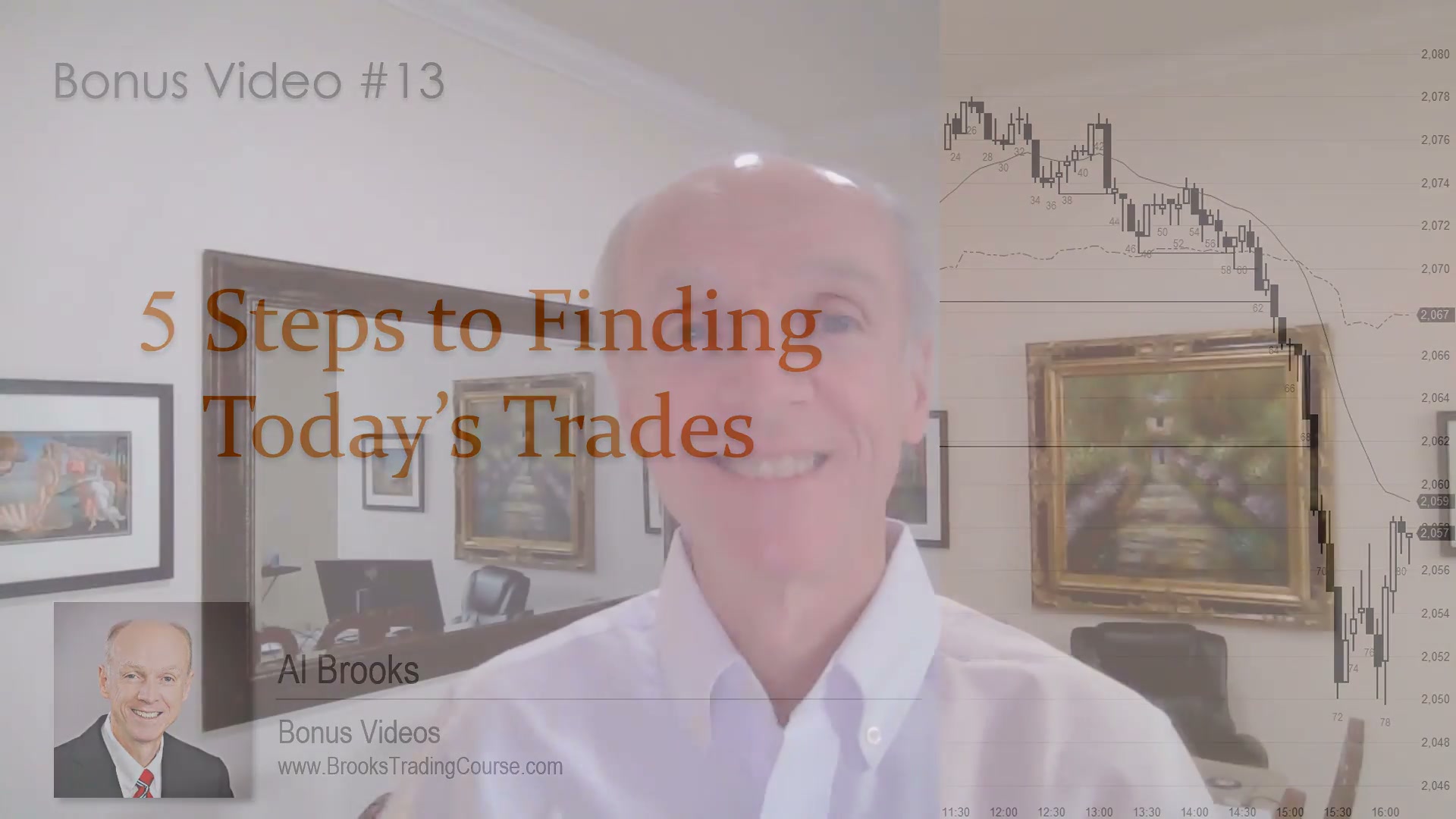
13 - 5 Steps to Finding Today’s Trades
Raw transcript and slide notes for 13 - 5 Steps to Finding Today’s Trades.
Overview
- Slides: 29
- Transcript segments: 469
- Status: 自动按 slide 时间线归档;核心概念和长期笔记可以在每个 slide 的
Study Notes下继续整理。
Source Media
Transcript 001
Time: 00:01
Bilingual Transcript
00:01 - 00:02
EN: Hi, I’m Al Brooks.
00:02 - 00:04
EN: Thank you for watching this video.
00:04 - 00:06
EN: I want to share with you today an approach
00:06 - 00:08
EN: that I’ve had for more than three decades.
00:08 - 00:12
EN: At the end of every day, I look at my chart and I mark it up.
00:12 - 00:13
EN: I draw lines on it.
00:13 - 00:17
EN: I think about possible entries, possible exits, how to manage trades.
00:17 - 00:21
EN: What I’m trying to do is recognize patterns so that when I see them tomorrow
00:21 - 00:27
EN: or next week or next month, real time, I can anticipate what will follow
00:27 - 00:30
EN: and I can structure a trade and then manage my trade successfully.
00:30 - 00:33
EN: I have the same routine, and I’ve been doing it for 30 years,
00:33 - 00:34
EN: and I want to go through it.
00:34 - 00:37
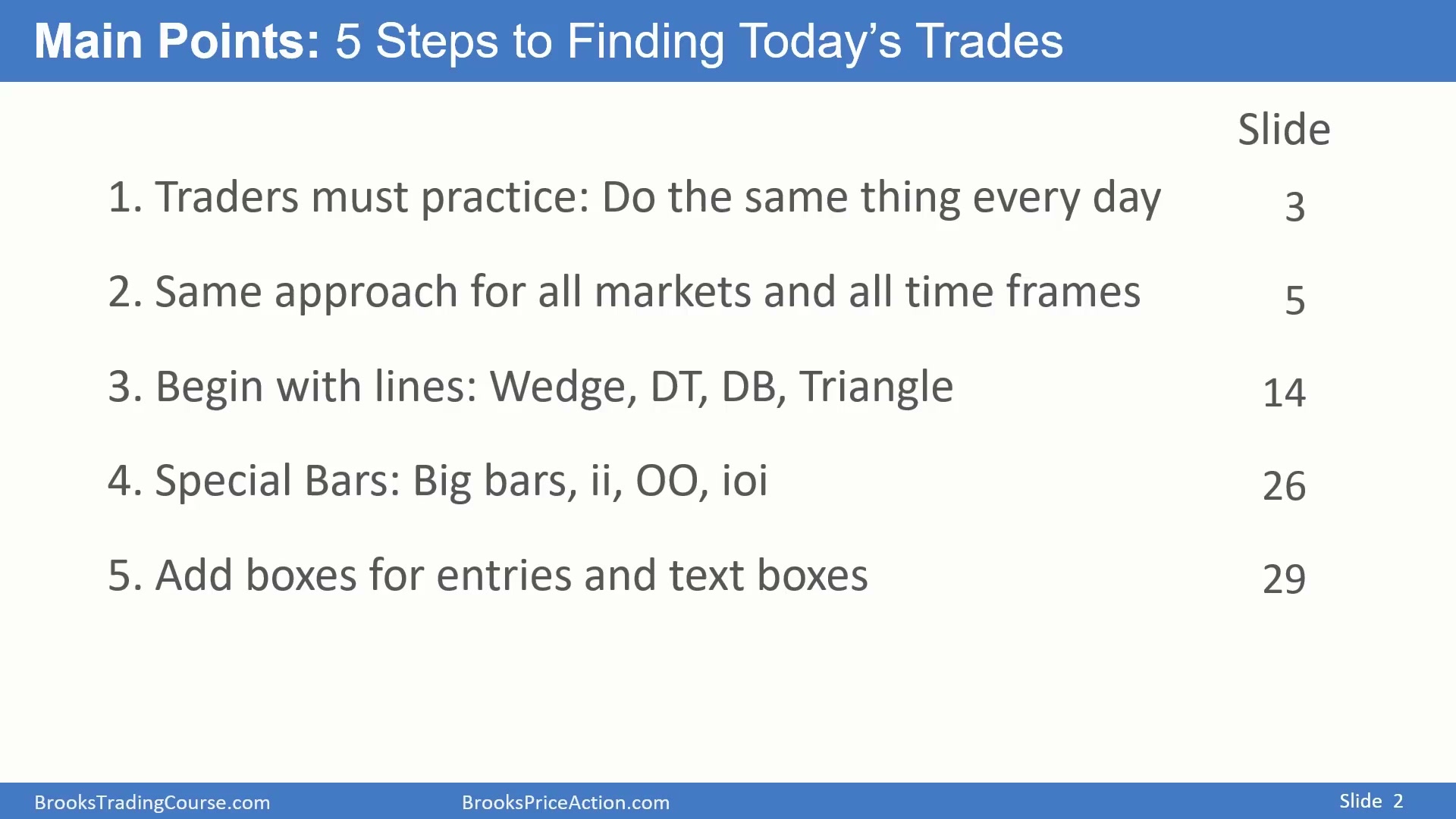
EN: I’ll give you the 5 steps that I use every day,
00:37 - 00:38
EN: and I hope that you find it useful.
00:38 - 00:39
EN: Thank you.
00:45 - 00:47
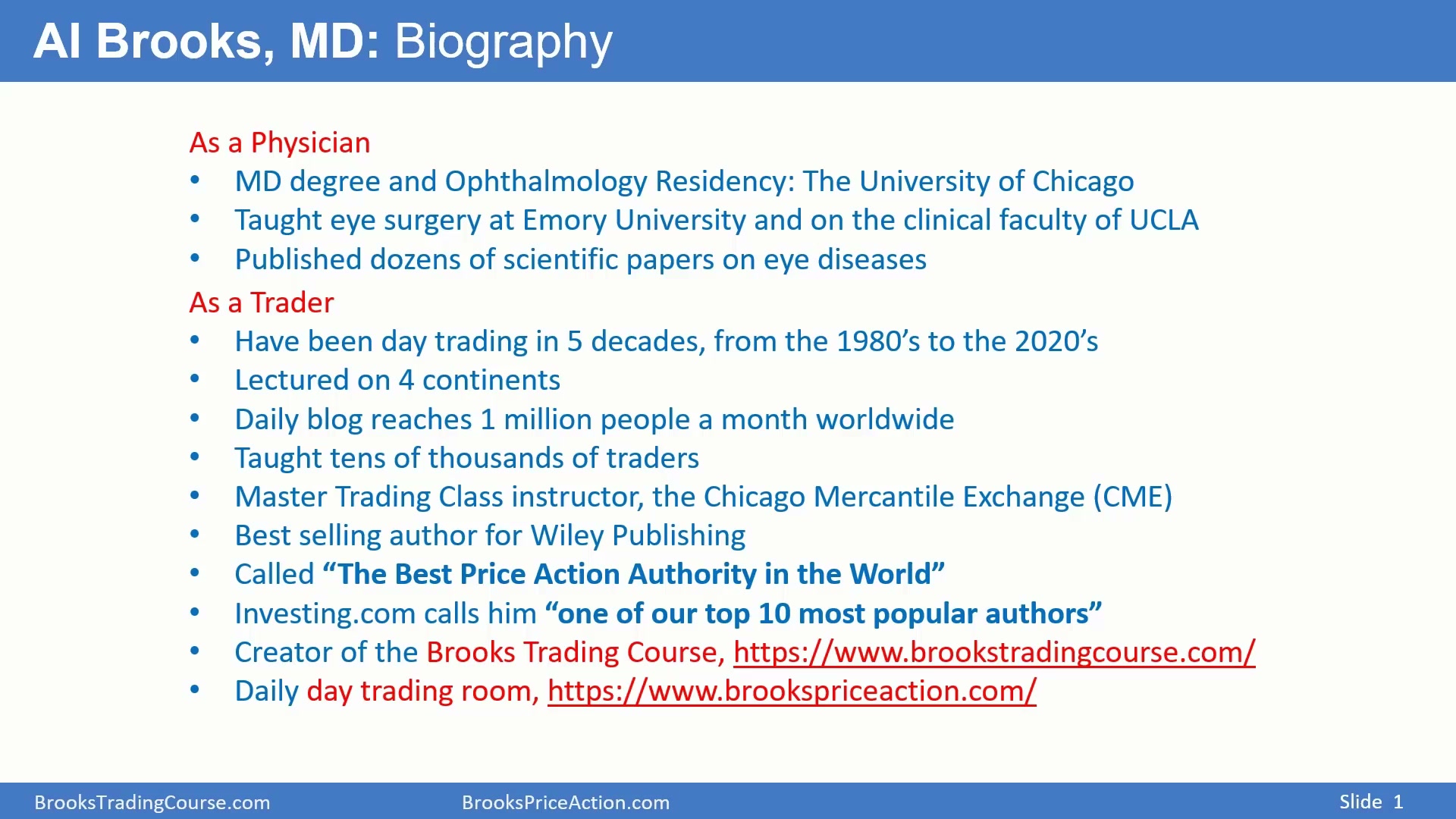
EN: As many of you know, I’m a physician.
00:47 - 00:49
EN: I got my medical degree
00:49 - 00:53
EN: and I did my ophthalmology residency at the University of Chicago.
00:53 - 00:56
EN: I taught eye surgery at Emory University,
00:56 - 00:59
EN: and I was on the clinical faculty at UCLA.
00:59 - 01:05
EN: I published dozens of scientific papers on eye diseases way back in the 1980s.
01:05 - 01:09
EN: As a trader, I’ve been day trading in five decades since the 1980s.
01:10 - 01:12
EN: I’ve lectured on four continents.
01:12 - 01:17
EN: I write a daily blog, which reaches about a million people a month worldwide.
01:18 - 01:22
EN: And I am a Master Trading Class instructor
Slide 001
Time: 01:20
Bilingual Transcript
01:22 - 01:25
EN: at the Chicago Mercantile Exchange (the CME).
01:25 - 01:30
EN: I’m also an author, and I’ve received some nice compliments from people
01:30 - 01:34
EN: who run very big platforms in the trading world.
01:34 - 01:40
EN: I created the Brooks Trading Course, which is available at brookstradingcourse.com,
01:40 - 01:45
EN: and I also speak daily in a trading room at brookspriceaction.com.
01:49 - 01:52
EN: I think it’s really important as a trader
Slide 002
Time: 01:50
Bilingual Transcript
01:52 - 01:55
EN: to do the same thing every day, to develop a routine.
01:56 - 01:58
EN: I want to talk about the routine that I use.
01:58 - 02:03
EN: You may have seen many charts from me, either in books or on websites
02:03 - 02:08
EN: or on my daily blog, or on my daily blog on other websites.
02:08 - 02:11
EN: You’ll see lines and boxes and textboxes.
02:11 - 02:15
EN: I want to talk today about how I create all of that.
02:16 - 02:21
EN: It’s important to approach every market and every timeframe the same.
02:21 - 02:25
EN: When you think about trading, trading is exactly that: it’s trading.
02:25 - 02:29
EN: You’re buying and somebody else is selling; you’re selling, somebody else is buying.
02:29 - 02:32
EN: It’s rational human behavior.
02:32 - 02:37
EN: Every chart is just a portrayal of rational human behavior,
02:37 - 02:39
EN: and it doesn’t matter what market it is.
02:39 - 02:42
EN: Doesn’t matter if you’re trading fruit in Africa.
02:42 - 02:46
EN: It doesn’t matter if you’re trading property in Europe.
02:46 - 02:49
EN: Buying an apartment, selling an apartment.
02:49 - 02:52
EN: It doesn’t matter if you’re doing stocks or commodities.
02:52 - 02:54
EN: It’s all the same.
02:54 - 02:56
EN: It doesn’t matter on the timeframe, either.
02:57 - 03:02
EN: Therefore, when I look at a chart, a map of interaction between humans,
03:02 - 03:04
EN: it doesn’t matter what the market is.
03:04 - 03:05
EN: It doesn’t matter what the timeframe is.
03:05 - 03:07
EN: It’s all going to be the same.
03:07 - 03:10
EN: It’s based upon the same rational human behavior.
03:11 - 03:16
EN: When I look at a chart and I’m going to mark it up, put lines on it,
03:16 - 03:21
EN: and try to look for patterns, I typically begin with the lines.
03:21 - 03:24
EN: I look for channels, Wedges.
03:24 - 03:26
EN: I look for Double Tops, Double Bottoms, and Triangles,
03:27 - 03:29
EN: and I draw lines to highlight those things.
03:30 - 03:33
EN: Next I look at unusual bars, special bars.
03:33 - 03:35
EN: Very big bars.
03:35 - 03:39
EN: A bar that is small, its low above the low of the prior bar,
03:39 - 03:42
EN: its high below the high of the prior bar.
03:42 - 03:43
EN: An inside bar.
03:43 - 03:45
EN: Consecutive inside bars.
03:45 - 03:46
EN: An outside bar.
03:46 - 03:49
EN: A big bar followed by a bigger big bar.
03:49 - 03:52
EN: And then a combination of an inside-outside-inside bar.
03:52 - 03:53
EN: Things like that.
03:53 - 03:55
EN: I’ll talk about those as we go on.
03:55 - 04:01
EN: Then finally, after I’ve highlighted the lines and the special bars,
04:01 - 04:06
EN: I next draw red and green boxes for where I would enter
04:06 - 04:08
EN: or where I think an ideal entry is.
04:08 - 04:11
EN: Then finally, I add textboxes.
04:12 - 04:16
EN: I have hundreds of patterns that I rely on when I’m trading.
04:16 - 04:19
EN: I’ve developed them over the years.
04:19 - 04:20
EN: I’ve been watching pretty much every tick
04:20 - 04:23
EN: in the stock market now for well over 30 years.
04:24 - 04:29
EN: When you do that for such a long time, you tend to notice things.
04:29 - 04:30
EN: I have names for things.
04:30 - 04:31
EN: I classify things.
04:31 - 04:36
EN: I have an Encyclopedia of Chart Patterns available to traders on my website.
04:36 - 04:38
EN: I have things categorized.
04:39 - 04:41
EN: I look for those patterns to repeat every day,
04:42 - 04:47
EN: and I know what the market will tend to do once it starts to develop a pattern,
04:47 - 04:49
EN: and that helps me structure a trade.
04:50 - 04:55
EN: When I’m marking up a chart at the end of the day for other people to study,
04:55 - 05:00
EN: I put the names of the patterns and some information about the pattern
05:00 - 05:02
EN: to help traders understand what they should do
05:02 - 05:04
EN: the next time they come across that pattern.
05:07 - 05:10
EN: Traders must practice.
Slide 003
Time: 05:11
Bilingual Transcript
05:12 - 05:15
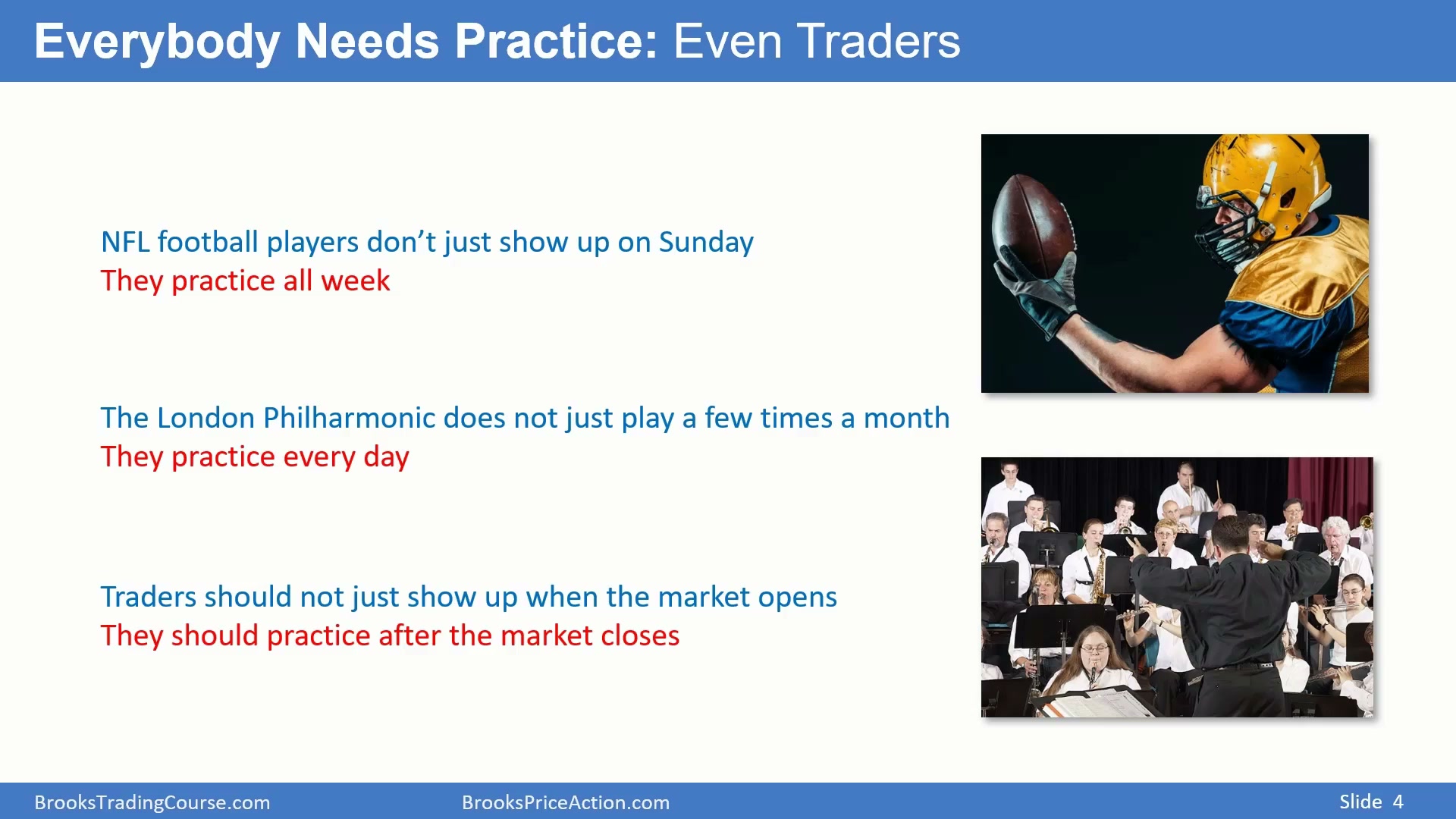
EN: If you’re a professional football player, you play on Sunday.
05:16 - 05:19
EN: You’re not staying home watching TV the rest of the week.
05:19 - 05:21
EN: You’re practicing every day.
05:24 - 05:27
EN: If you’re a professional musician and play for a major symphony orchestra,
05:27 - 05:29
EN: you’re going to practice as well.
05:29 - 05:34
EN: You may perform a few times a month, but you’re going to be practicing every day.
05:36 - 05:41
EN: Traders should not just show up when the market opens and expect to do well.
05:41 - 05:43
EN: They should practice after the market closes.
05:44 - 05:48
EN: Spend some time reviewing the day’s price action on the charts
05:48 - 05:50
EN: that you trade and look for patterns.
05:51 - 05:54
EN: Think about what you did and what you could have done.
05:57 - 06:02
EN: I said I use the same approach for all markets and all timeframes, and that’s true.
Slide 004
Time: 06:03
Bilingual Transcript
06:05 - 06:08
EN: What’s the key to practicing as a trader?
06:08 - 06:12
EN: It’s simply looking at charts and trying to find patterns.
06:12 - 06:14
EN: It’s obvious.
06:14 - 06:16
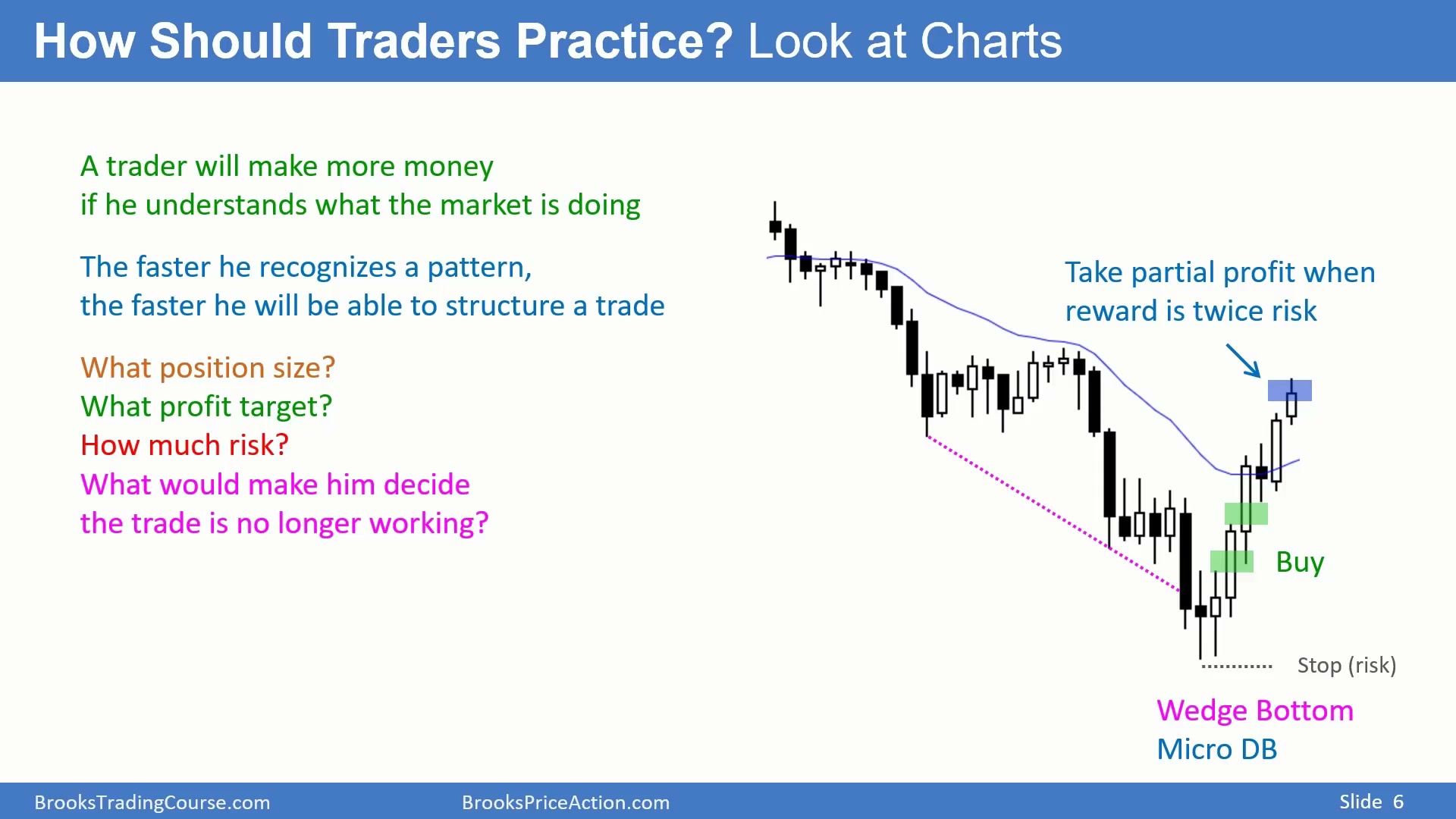
EN: The more you understand about what the market is doing
06:16 - 06:20
EN: and the better able you are to anticipate what it’s about to do,
06:20 - 06:22
EN: the more money you stand to make.
06:26 - 06:29
EN: The quicker you recognize a pattern,
06:29 - 06:31
EN: the faster you’ll be able to structure a trade.
06:31 - 06:33
EN: Here we’ve got a bear channel
06:33 - 06:37
EN: and we have a line drawn in across the top, but we’re trending down.
06:37 - 06:38
EN: We have a channel.
06:38 - 06:40
EN: We’re breaking below the channel and we are reversing up.
06:40 - 06:43
EN: We have three legs in a channel – one, two, and three.
06:43 - 06:44
EN: It’s a Wedge.
06:44 - 06:47
EN: Also, on this bar, we went down, we went up.
06:47 - 06:50
EN: On this bar, we went down and we went up.
06:50 - 06:51
EN: That’s a Micro Double Bottom.
06:52 - 06:57
EN: I call it a Micro Double Bottom because it takes place over 2, 3, or 4 bars.
06:57 - 06:59
EN: If you were looking at a much smaller timeframe chart,
06:59 - 07:01
EN: it would be an actual Double Bottom.
07:02 - 07:05
EN: The lows could be 10 or 20 bars apart depending
07:05 - 07:07
EN: on what timeframe that you looked at.
07:07 - 07:09
EN: So it’s important to recognize this.
07:09 - 07:12
EN: You have a Wedge Bottom and a Micro Double Bottom,
07:12 - 07:15
EN: and now you have a bull bar closing on its high,
07:15 - 07:17
EN: and it’s a second consecutive bull bar.
07:17 - 07:19
EN: The odds are we’re going higher.
07:19 - 07:23
EN: It’s reasonable to buy on a stop 1 tick above the high of that bar.
07:23 - 07:24
EN: So you’d get filled on this bar.
07:30 - 07:35
EN: At a minimum, you should always be trying to go for a profit
07:35 - 07:37
EN: that is at least twice your risk.
07:37 - 07:41
EN: If you buy on a stop above this bar and you put your stop just below it,
07:41 - 07:44
EN: this is two times your risk.
07:44 - 07:47
EN: So your risk is from your entry price to your stop,
07:47 - 07:49
EN: and that’s twice that distance.
07:49 - 07:52
EN: Therefore, your reward is twice your risk.
07:53 - 07:56
EN: If you do that, you’ll have structured a good trade.
07:56 - 07:58
EN: And if you do that consistently,
07:58 - 08:02
EN: you have a very good chance of being a consistently profitable trader.
08:02 - 08:04
EN: When I talk about structuring a trade,
08:04 - 08:07
EN: I’m talking about thinking about your position size.
08:07 - 08:09
EN: Where’s your profit target?
08:09 - 08:10
EN: How much risk?
08:10 - 08:13
EN: How likely is it that you’re going to make your profit?
08:15 - 08:19
EN: You also have to be aware of what the market would do that
08:19 - 08:23
EN: would make you decide your plan is no longer valid.
08:23 - 08:25
EN: You should get out early sometimes.
Slide 005
Time: 08:29
Bilingual Transcript
08:30 - 08:32
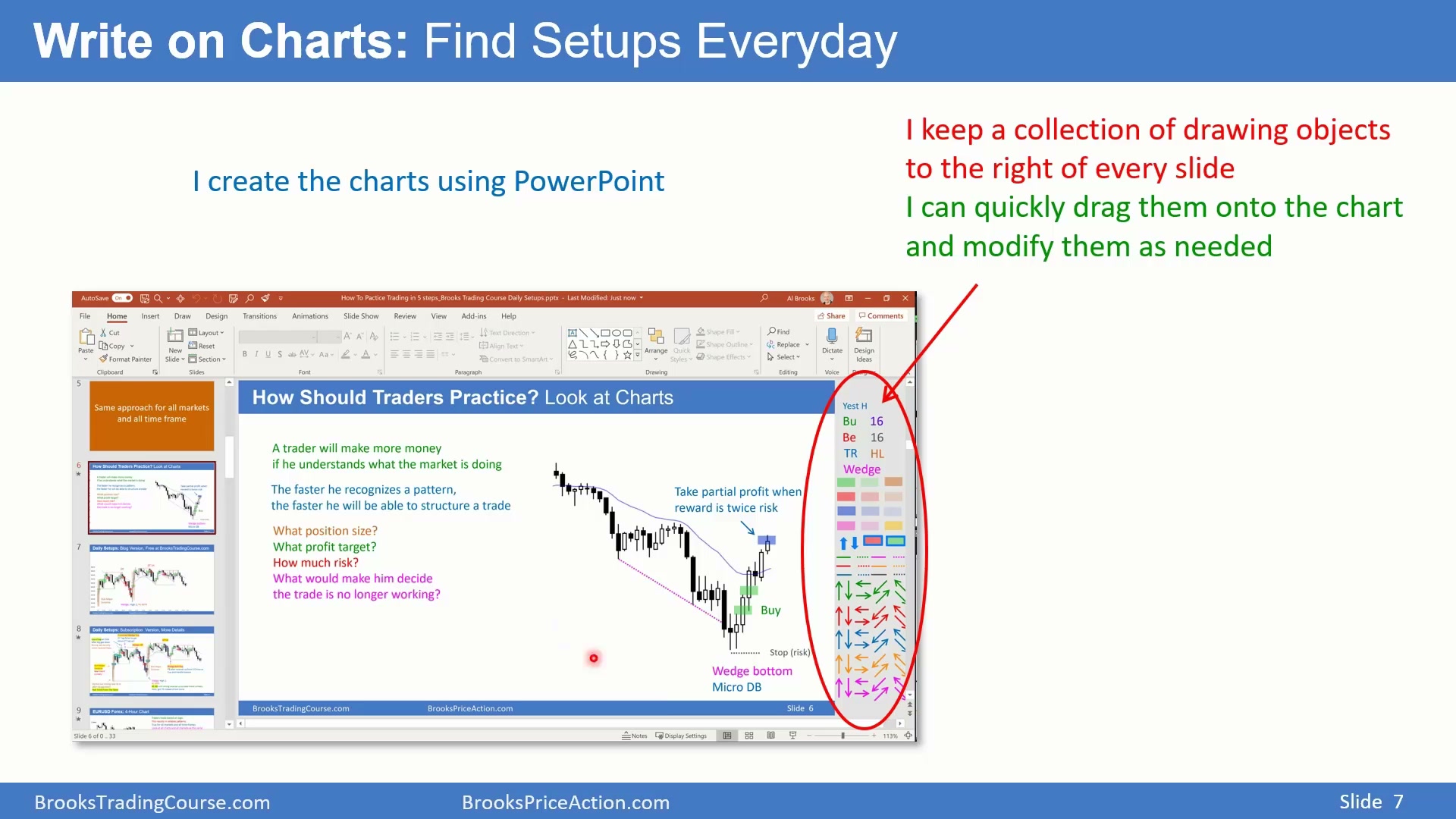
EN: I create my charts in PowerPoint.
08:32 - 08:35
EN: What I do is I use a capture program,
08:35 - 08:39
EN: like Snagit or the Windows snipping program.
08:39 - 08:43
EN: On my trading platform, I just capture the chart,
08:44 - 08:48
EN: and then I paste it into a slide on PowerPoint.
08:48 - 08:54
EN: Then I add the lines and the entry boxes, sometimes the exit boxes.
08:55 - 08:59
EN: Then I add text with the reason for my behavior.
08:59 - 09:01
EN: Then look on the right over here.
09:01 - 09:03
EN: I have a bunch of objects,
09:05 - 09:08
EN: and I have that on all the slides in my PowerPoint.
09:08 - 09:11
EN: What I did was I created a bunch of little objects,
09:11 - 09:15
EN: and they allow me to quickly mark up a chart.
09:15 - 09:16
EN: So I have a small line.
09:16 - 09:20
EN: I can just hold the Control key, grab that line, move it over here,
09:20 - 09:24
EN: and then I can change its orientation, its starting point, its end point.
09:24 - 09:29
EN: A textbox, if I want to create a textbox, I just grab this,
09:29 - 09:33
EN: hold the Control key, drag it down here, and then just change the text.
09:33 - 09:36
EN: If I want to change the color of the text,
09:36 - 09:39
EN: I just click on this and then over here,
09:39 - 09:42
EN: the format painter, and then drag it through the text.
09:42 - 09:45
EN: That’s how I create these charts.
Slide 006
Time: 09:50
Bilingual Transcript
09:50 - 09:52
EN: I create charts every day.
09:52 - 09:53
EN: You’ll see them on my blog.
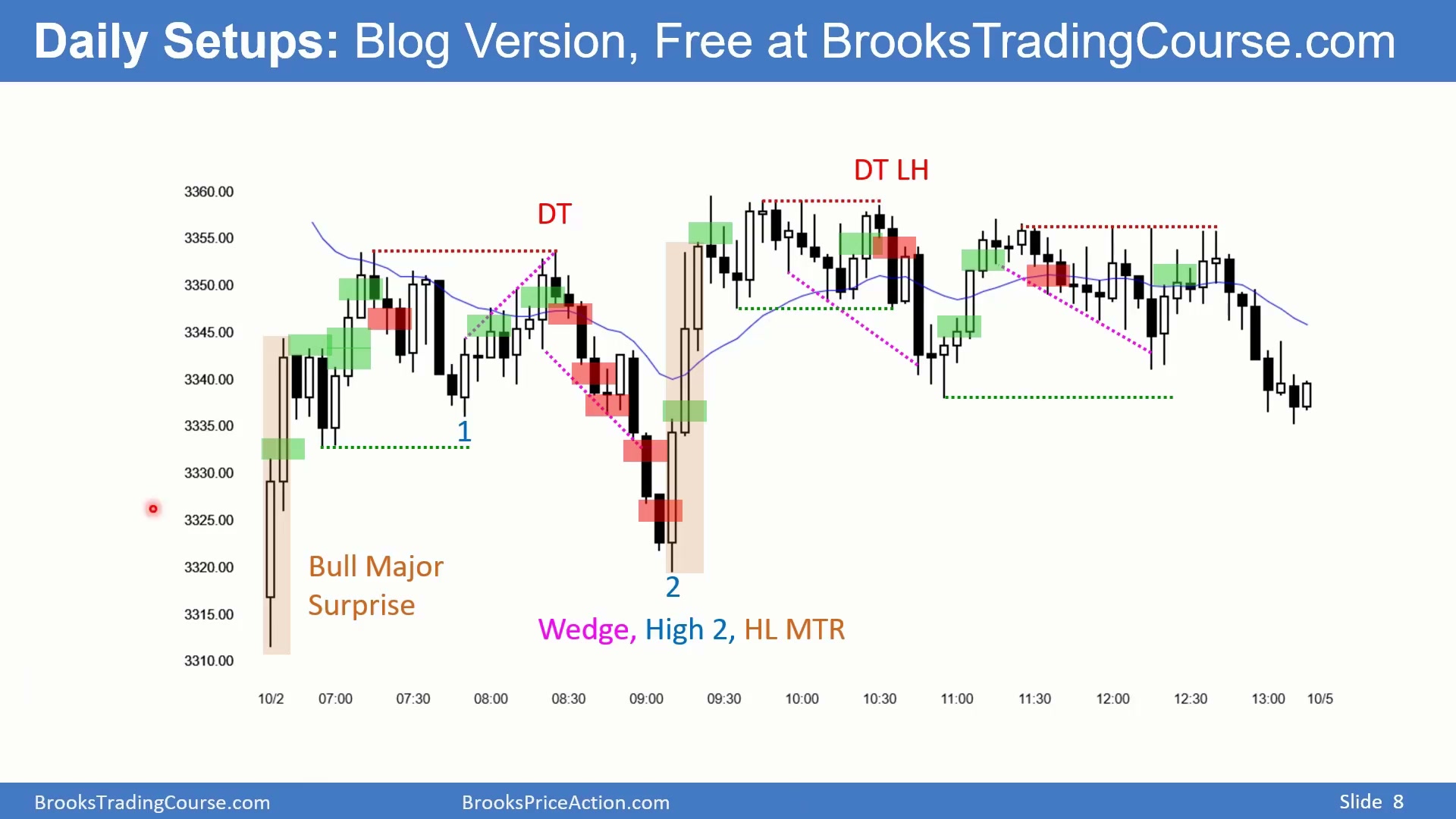
09:54 - 09:56
EN: I call them my Daily Setups.
09:56 - 09:59
EN: In my blog, it’s free.
09:59 - 10:00
EN: Anybody can look at them.
10:00 - 10:06
EN: This is a sample of a Daily Setup chart that is on my blog for anyone to see.
10:06 - 10:09
EN: It’s for the Emini, a 5-minute chart.
10:09 - 10:12
EN: I have price over here, I have time over here.
10:12 - 10:18
EN: I have lines, I have boxes, I have big things highlighted.
Slide 007
Time: 10:20
Bilingual Transcript
10:20 - 10:25
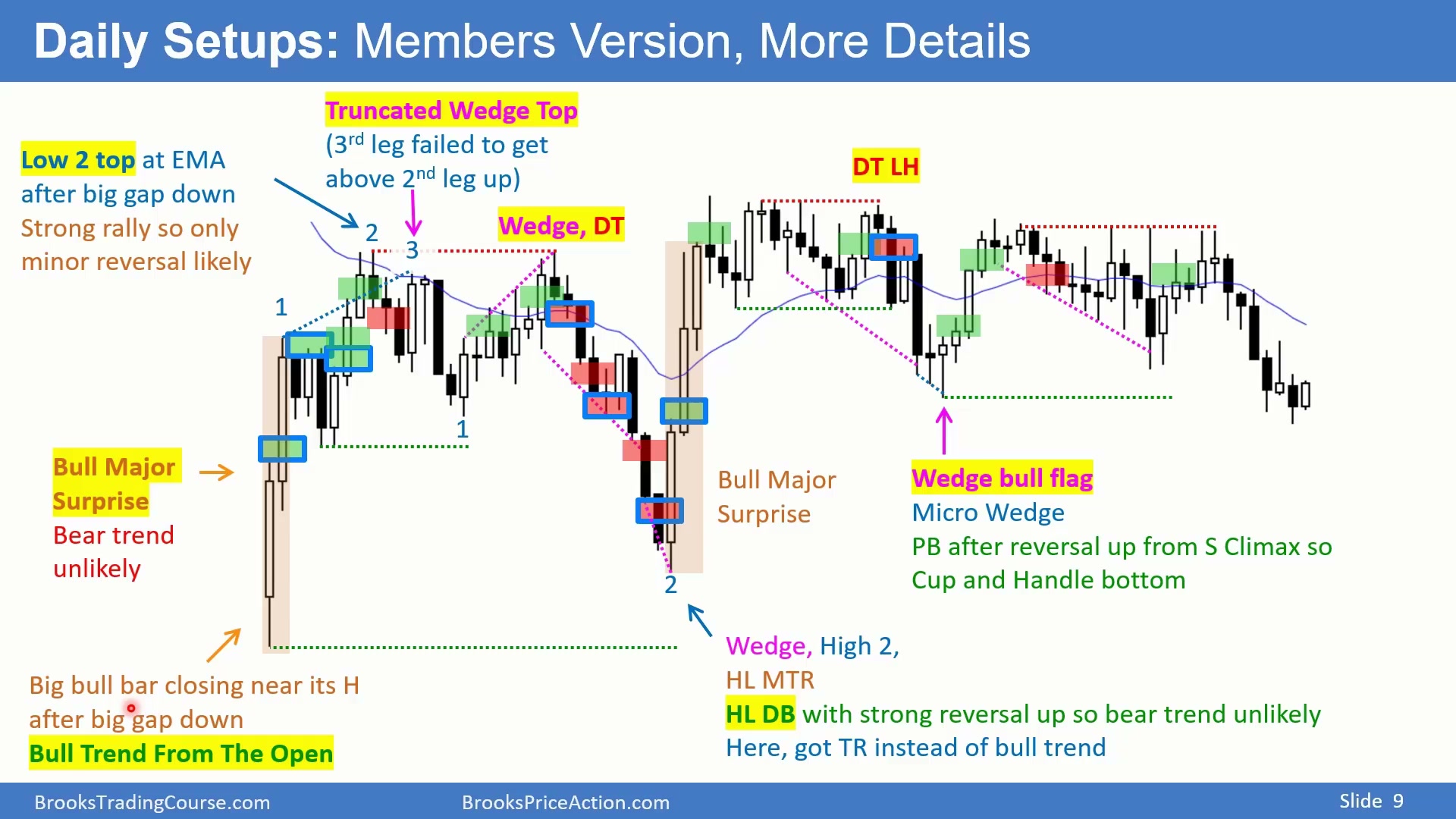
EN: And then for people who subscribe to my charts – I have a service
10:25 - 10:29
EN: that they can subscribe to – I have much more information
10:30 - 10:32
EN: about what’s going on on the chart.
10:32 - 10:35
EN: Some people prefer the extra detail.
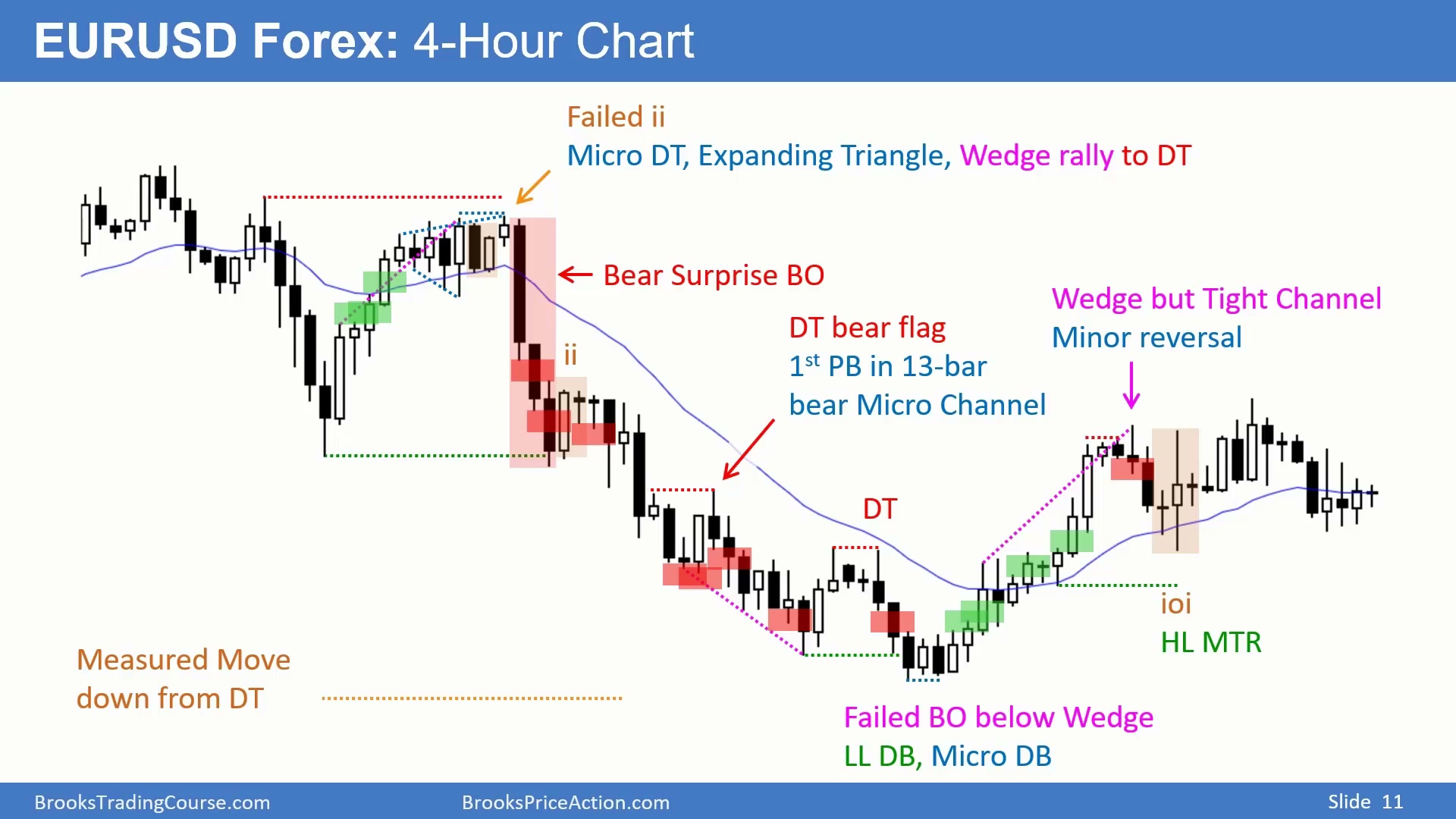
10:38 - 10:42
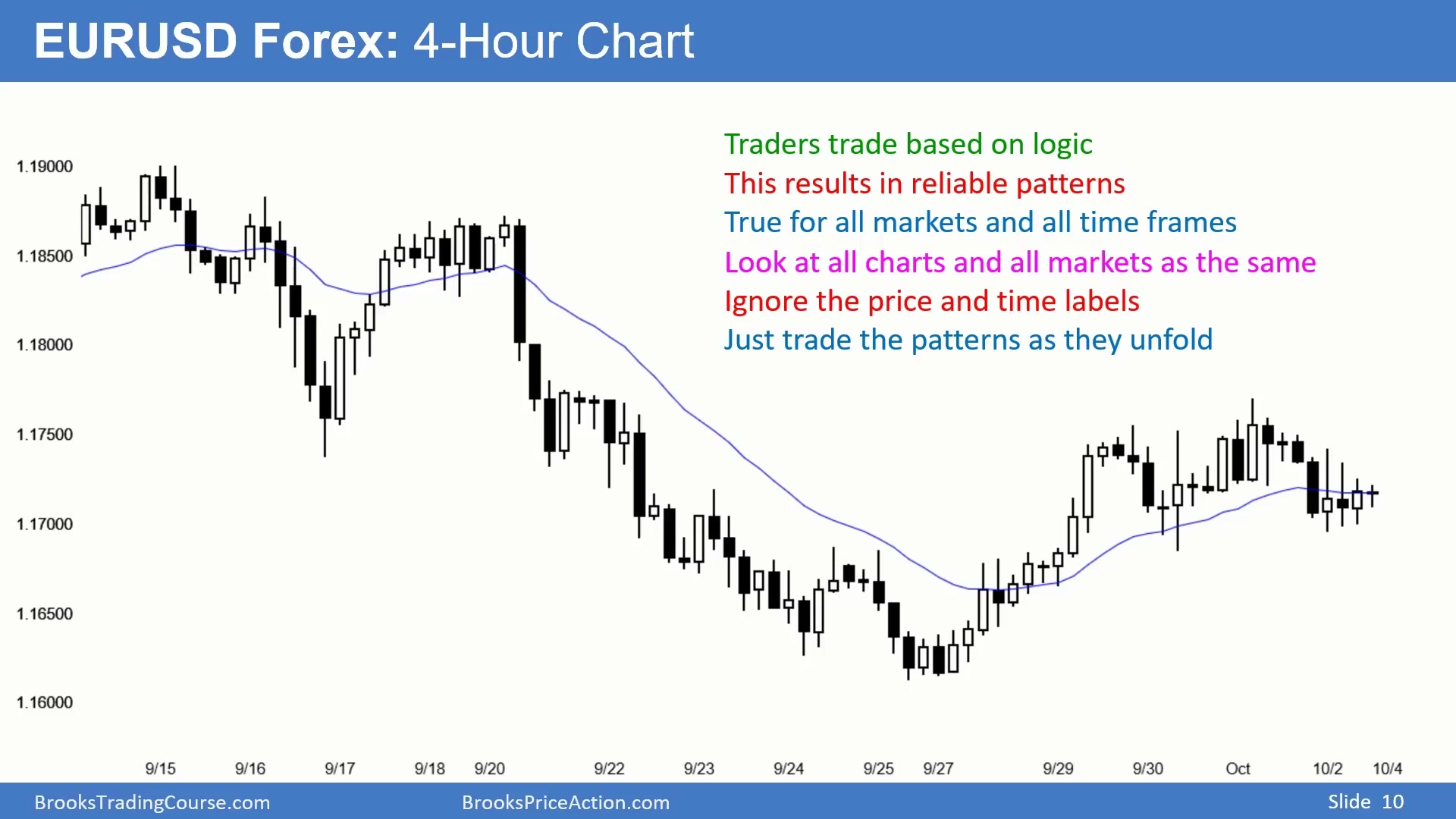
EN: This is a 4-hour chart of the euro versus the dollar, Forex market.
Slide 008
Time: 10:40
Bilingual Transcript
10:42 - 10:45
EN: So every bar is 4 hours.
10:45 - 10:47
EN: Here’s price here, here’s time here.
10:50 - 10:53
EN: I said before that traders trade based upon logic.
10:56 - 10:58
EN: It results in reliable patterns.
10:58 - 11:01
EN: People use the same logic in everything they do,
11:01 - 11:08
EN: and the result is that the patterns are present on all markets and all timeframes.
11:12 - 11:16
EN: And therefore, traders look at all charts and all markets the same.
11:17 - 11:20
EN: I don’t pay attention to price.
11:20 - 11:22
EN: I don’t pay attention to time.
11:22 - 11:23
EN: I just look at the charts.
11:23 - 11:27
EN: If you watch TV and you see professional traders talk
11:27 - 11:31
EN: about a chart – they’ll sometimes talk about gold, crude oil, stocks,
11:31 - 11:34
EN: stock index futures – you never hear them say,
11:34 - 11:37
EN: “Oh, this is Apple, and therefore I’m going to trade it differently
11:37 - 11:41
EN: from how I trade gold or stock index futures.”
11:41 - 11:44
EN: They don’t say that, because they understand
11:44 - 11:48
EN: that the chart is just a representation of rational human behavior,
11:48 - 11:52
EN: and it’s going to be the same for all markets and all timeframes.
Slide 009
Time: 11:55
Bilingual Transcript
11:57 - 12:01
EN: If I were to mark up this 4-hour chart of the euro versus the dollar,
12:01 - 12:02
EN: I would do it something like this.
12:03 - 12:05
EN: If you did not know it was a Forex chart,
12:06 - 12:09
EN: you would not be able to tell that it was a Forex chart.
12:09 - 12:12
EN: It could also be a stock index futures chart, an Emini chart.
12:12 - 12:13
EN: It could be gold.
12:13 - 12:17
EN: Because all charts look the same, and patterns are the same.
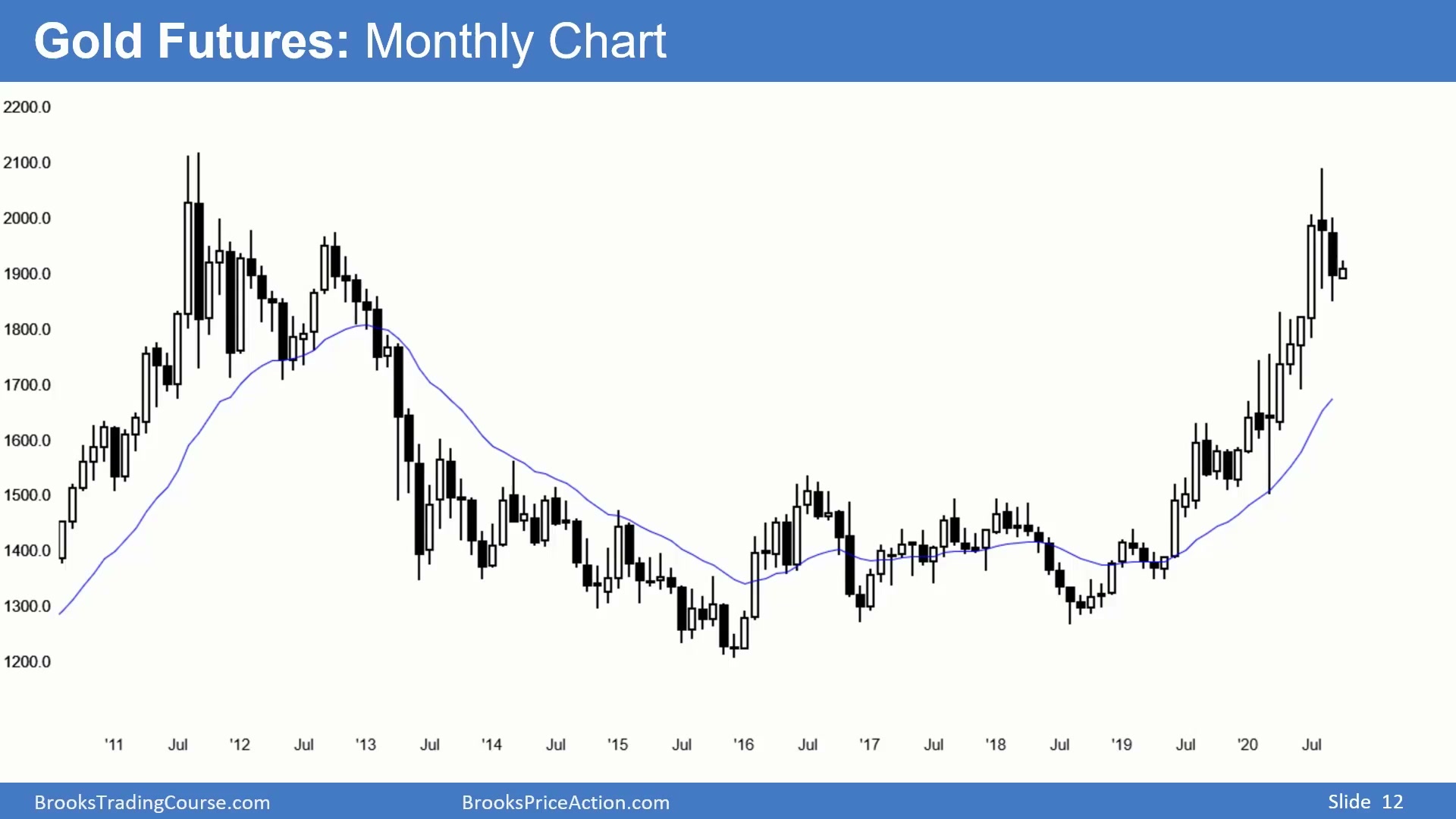
12:20 - 12:23
EN: Here’s a gold futures chart, and it’s a monthly chart.
Slide 010
Time: 12:20
Bilingual Transcript
No transcript segment aligned to this slide.
Slide 011
Time: 12:25
Bilingual Transcript
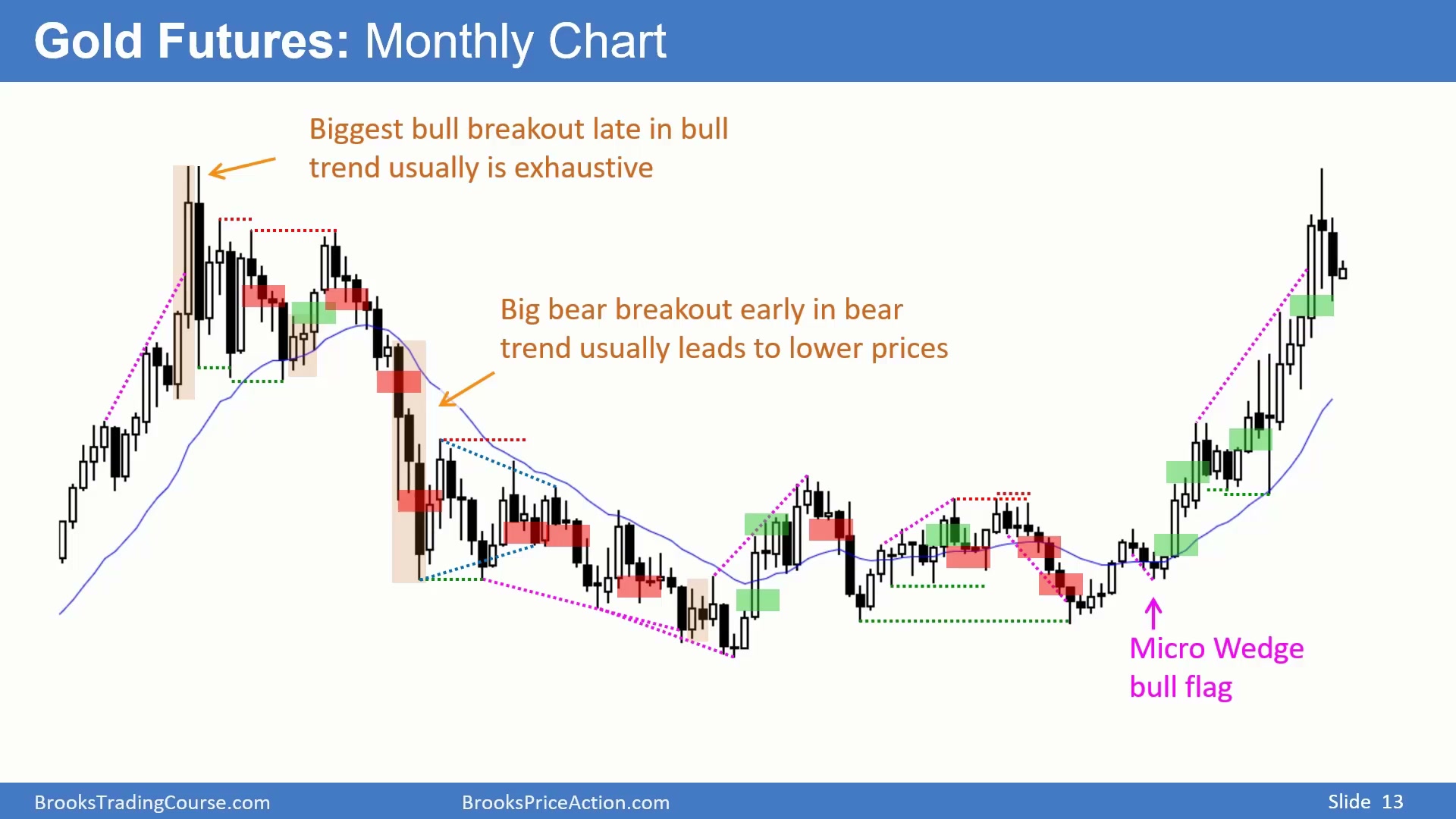
12:26 - 12:30
EN: If I remove the price and time and mark up the chart,
12:30 - 12:33
EN: it looks the same as any other market and any other timeframe.
12:33 - 12:36
EN: Again, this is the monthly chart, but it has the same patterns
12:36 - 12:40
EN: that you see on any other chart and any other timeframe.
12:44 - 12:48
EN: When I’m marking up any chart, I’m always beginning with lines.
Slide 012
Time: 12:50
Bilingual Transcript
12:52 - 12:55
EN: As I said, I think it’s really important to develop routines
12:55 - 13:01
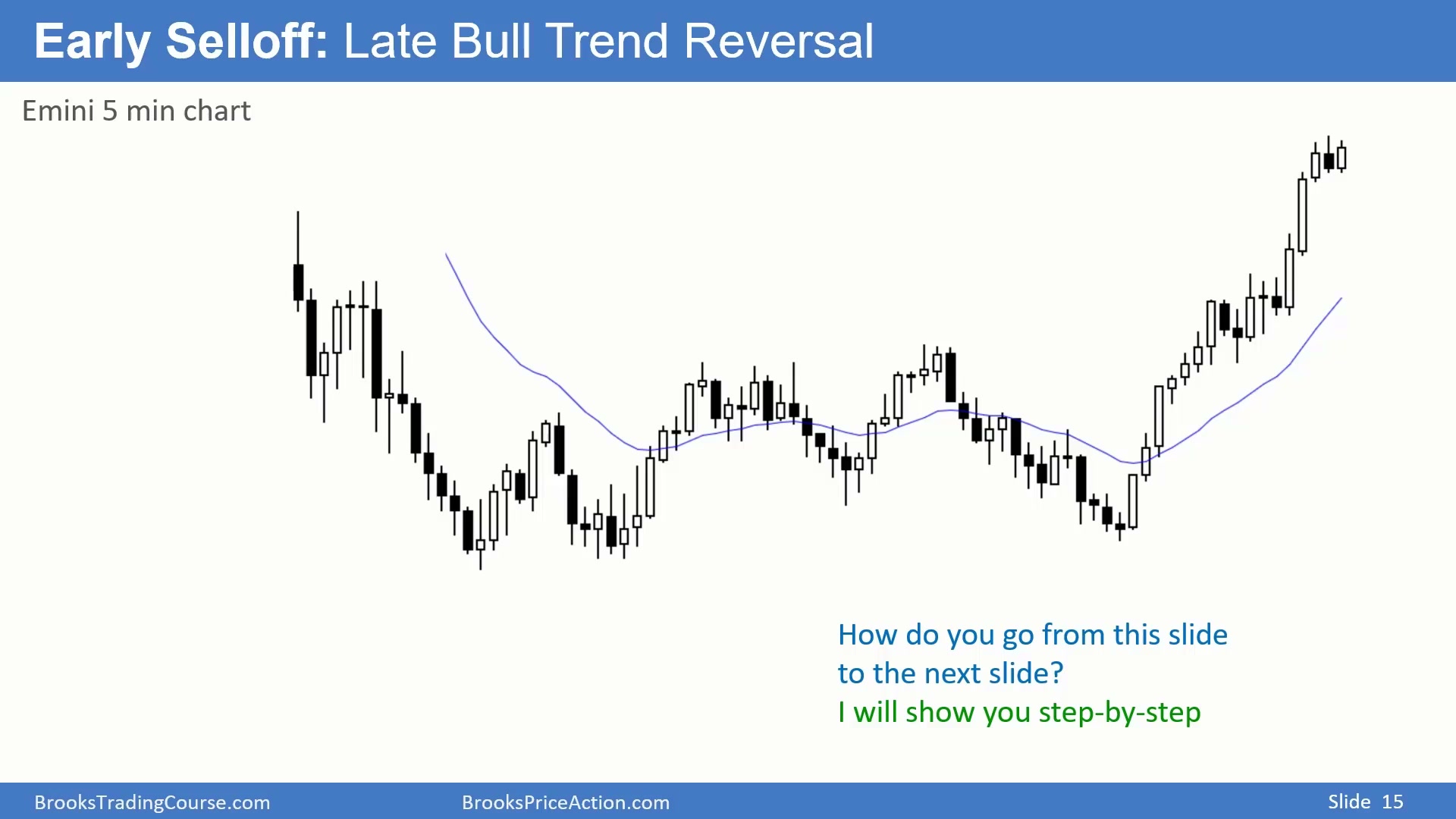
EN: to do the same things every time, and I want to talk to you about my daily routine.
13:01 - 13:04
EN: How do I go from this slide to the next slide?
13:04 - 13:06
EN: I’m going to show you step by step.
13:06 - 13:10
EN: I start with this slide, a slide with nothing on it
13:10 - 13:14
EN: other than a 20-bar Exponential Moving Average – again,
13:14 - 13:16
EN: this is a 5-minute Emini chart.
13:16 - 13:19
EN: 81 bars to the day session.
Slide 013
Time: 13:20
Bilingual Transcript
13:21 - 13:24
EN: At the end of the day, when I’m marking up the chart,
13:24 - 13:27
EN: this is what I have, and that’s the end of my practice.
13:27 - 13:29
EN: I have everything drawn in.
13:29 - 13:35
EN: I have a lot of textboxes explaining why I would do certain things.
13:36 - 13:39
EN: This is an example of a typical Daily Setup chart
13:39 - 13:42
EN: that is available for traders on my website.
Slide 014
Time: 13:45
Bilingual Transcript
13:45 - 13:48
EN: All right, let’s talk about how I got there.
13:48 - 13:51
EN: First of all, I have a chart with nothing on it.
13:55 - 13:57
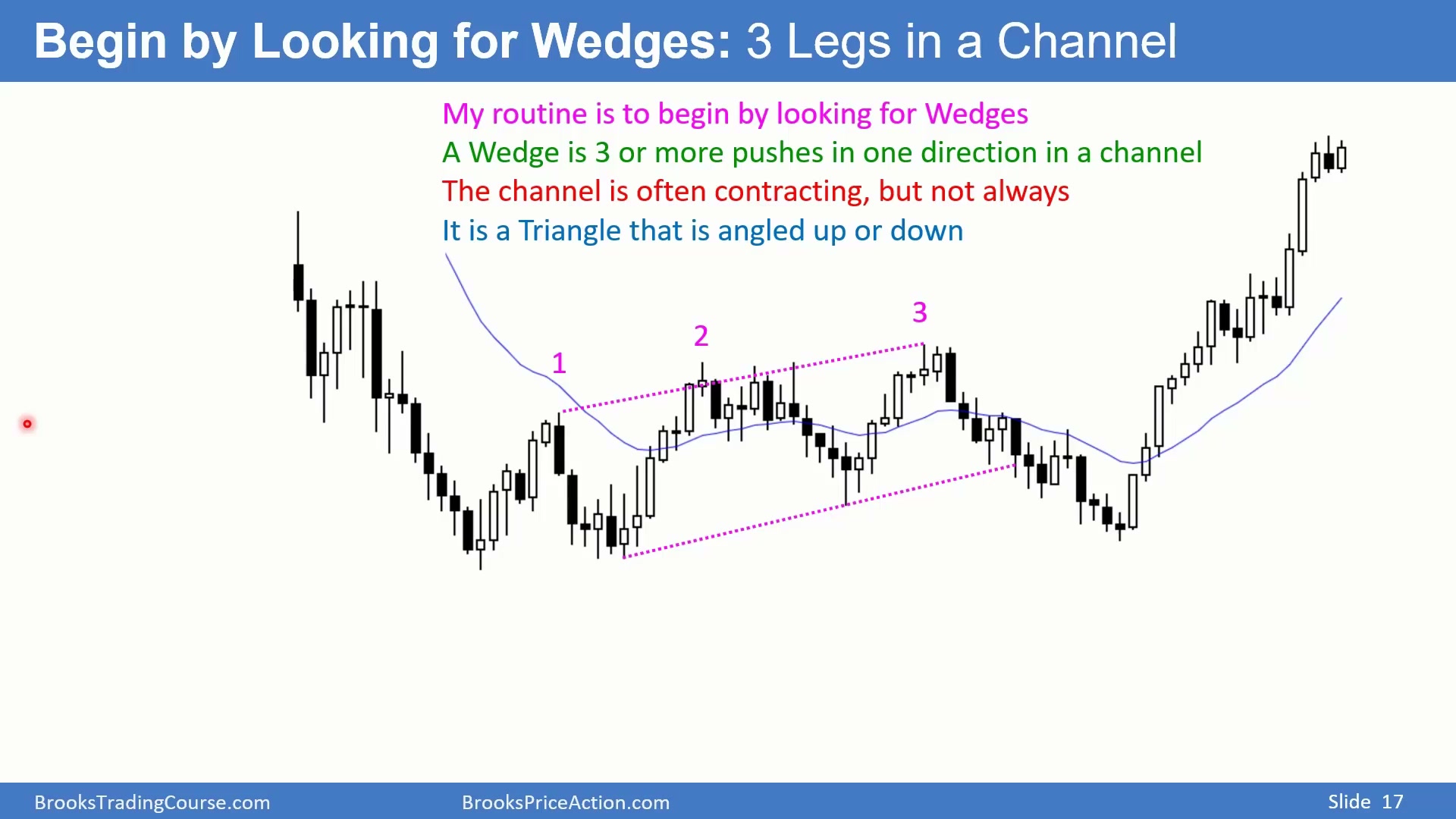
EN: Then I look for channels, Wedges.
13:58 - 14:02
EN: A Wedge is a channel, and it has three or more points.
14:02 - 14:05
EN: I can draw a channel up like this.
14:05 - 14:08
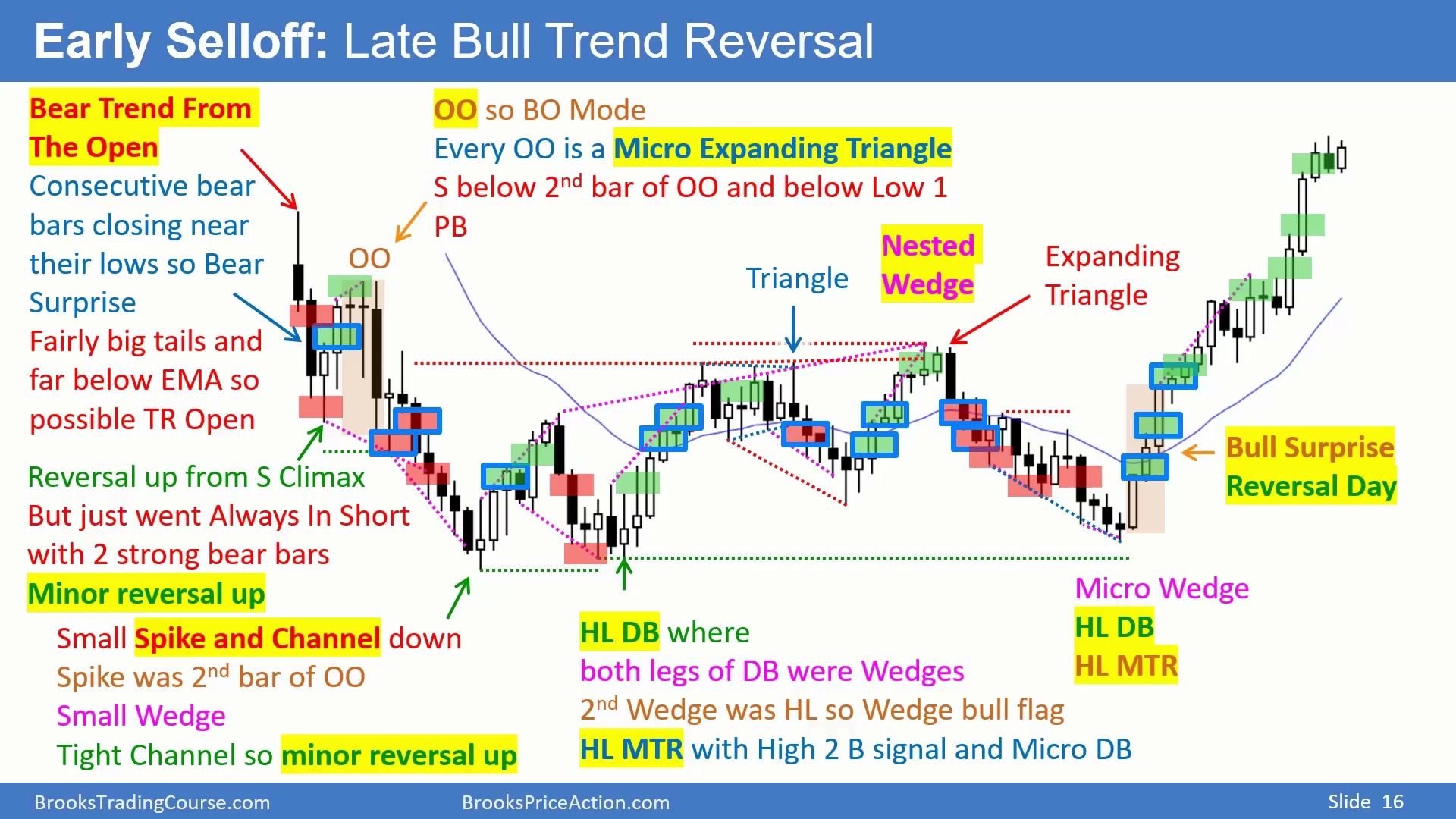
EN: There’s Point 1, Point 2, and Point 3.
14:10 - 14:14
EN: Sometimes Wedges are contracting; sometimes they’re not.
14:14 - 14:18
EN: This one’s fairly parallel, maybe a little bit contracting the way I have it drawn.
Slide 015
Time: 14:20
Bilingual Transcript
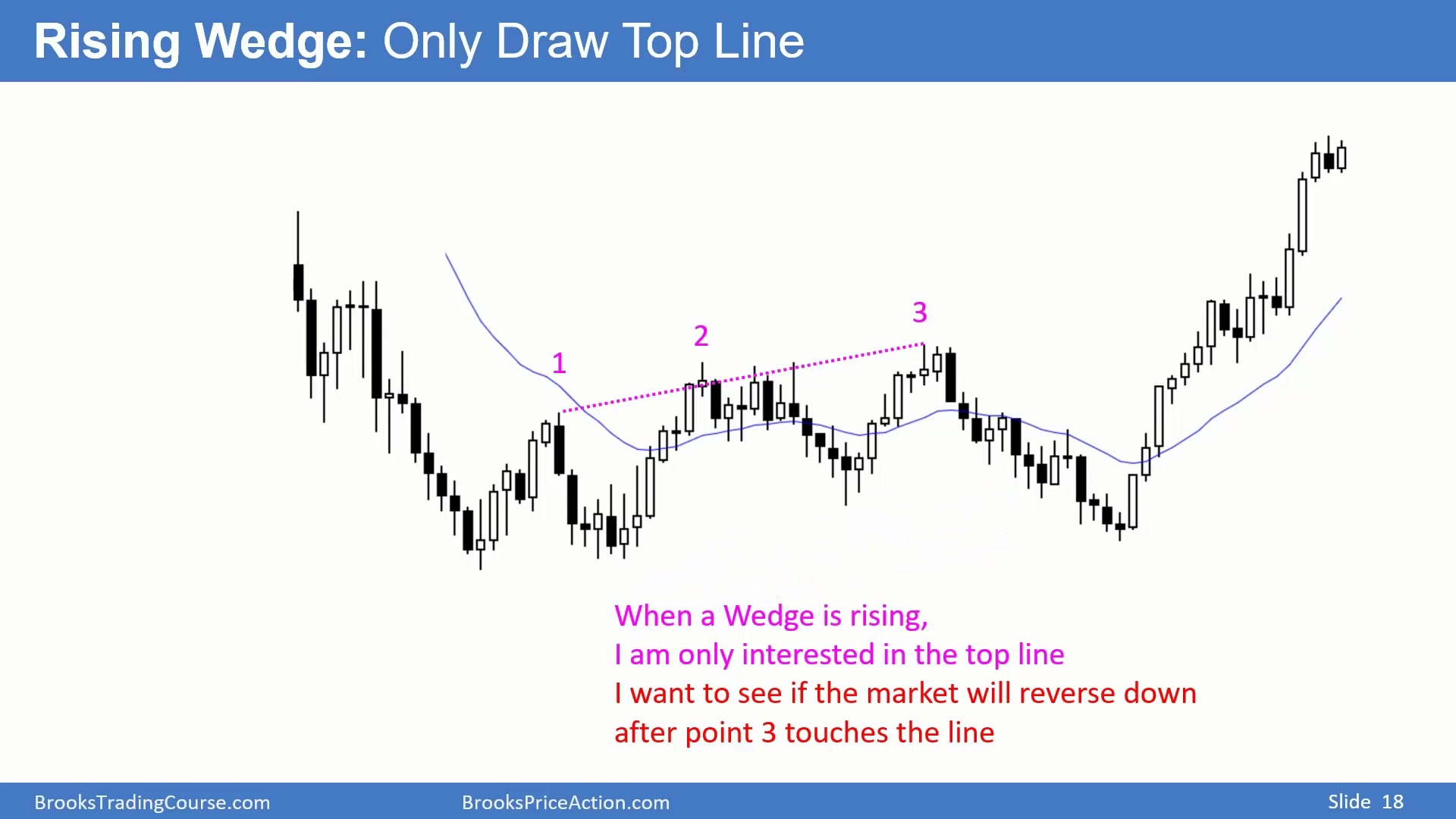
14:24 - 14:28
EN: When a Wedge is rising, I’m looking for a reversal down,
14:28 - 14:30
EN: so I’m really only interested in the top line.
14:30 - 14:33
EN: I don’t want too many things on my chart,
14:35 - 14:37
EN: so I don’t even draw that bottom line.
Slide 016
Time: 14:40
Bilingual Transcript
14:42 - 14:44
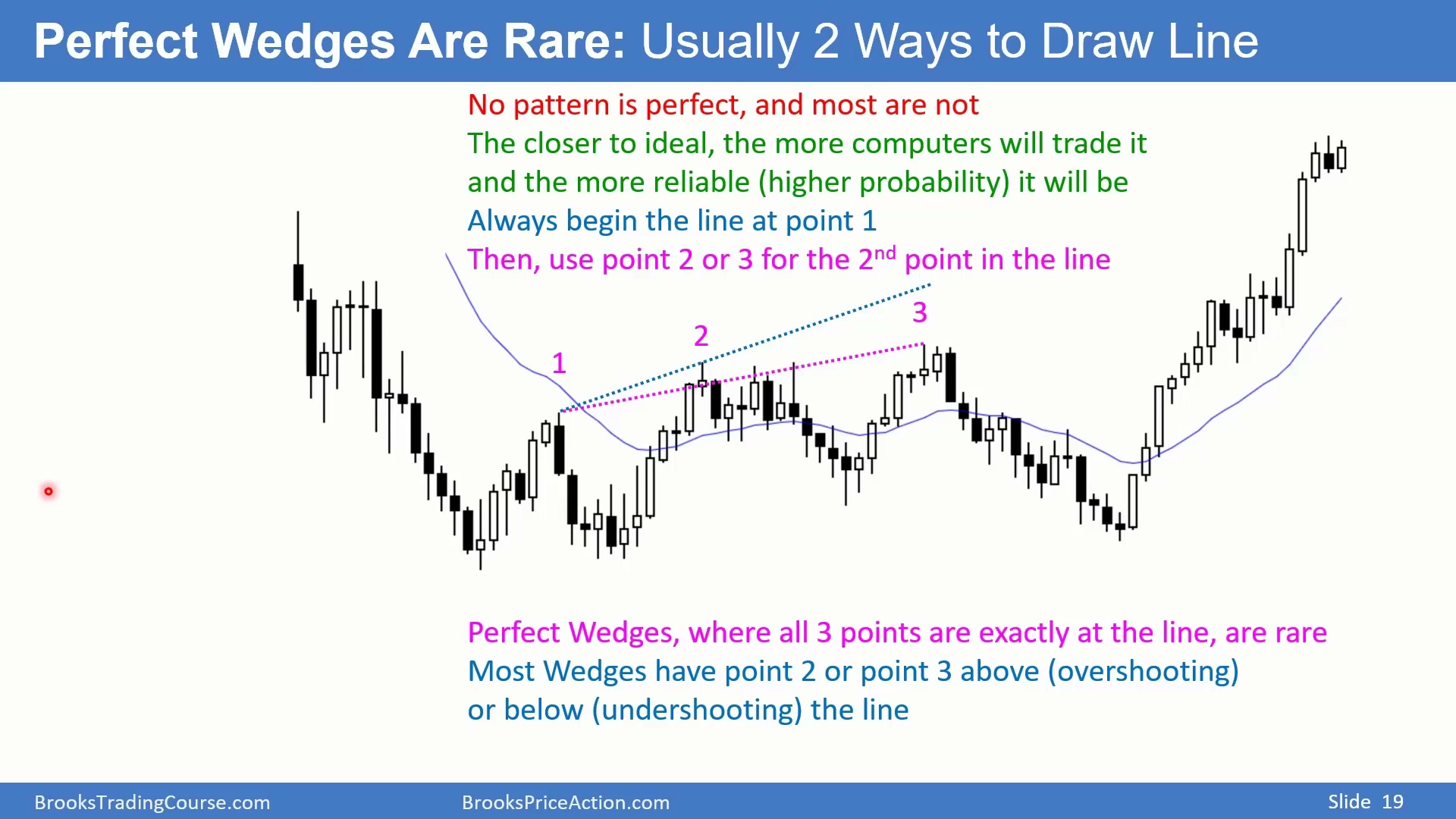
EN: No pattern is perfect.
14:44 - 14:46
EN: Most patterns are not perfect,
14:46 - 14:51
EN: and therefore I would not expect the three points to be exactly at the line.
14:51 - 14:56
EN: One of the two points here or here is going to be above the line.
14:57 - 15:01
EN: The more perfect a pattern is, the more computers will find it,
15:01 - 15:05
EN: the more computers will trade it, and the more reliable the pattern will be.
15:05 - 15:10
EN: The higher the probability it will unfold the way you want it to unfold.
15:13 - 15:19
EN: I always start with Point 1, and then I could draw a line using Point 2,
15:19 - 15:20
EN: and the line would be there.
15:20 - 15:24
EN: Or I could use Point 3 to draw the line.
15:24 - 15:25
EN: Point 1 and Point 3.
15:25 - 15:27
EN: So there are two ways to draw the line.
15:27 - 15:30
EN: All lines start with Point 1,
15:30 - 15:34
EN: and I can either create a line using Point 2 or Point 3.
15:40 - 15:44
EN: It’s rare to have a perfect Wedge where the three points are on the line.
15:44 - 15:50
EN: Almost all Wedges have either one of the two points above the line,
15:51 - 15:54
EN: or one of the two points below the line.
15:54 - 15:57
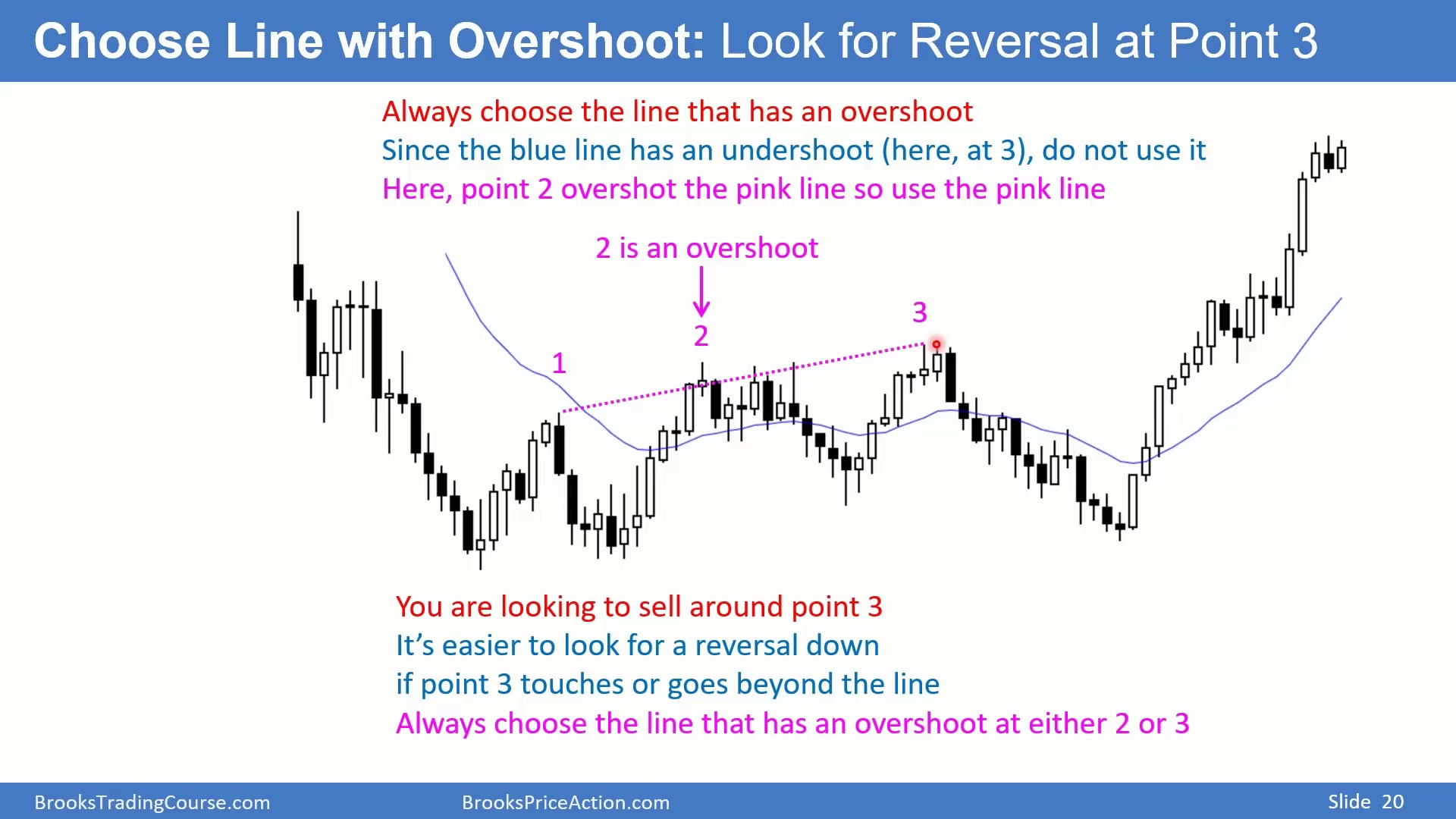
EN: The blue line, Point 3 is below, but the pink line,
15:57 - 16:00
EN: Point 2 is above the pink line.
16:00 - 16:02
EN: Point 2 overshot the pink line.
16:02 - 16:05
EN: Point 3 undershot the blue line.
Slide 017
Time: 16:10
Bilingual Transcript
16:11 - 16:17
EN: My routine is to always choose the line where there’s an overshoot.
16:17 - 16:19
EN: I like overshoots.
16:19 - 16:23
EN: Since the blue line has an undershoot, I’m not going to use the blue line.
16:23 - 16:27
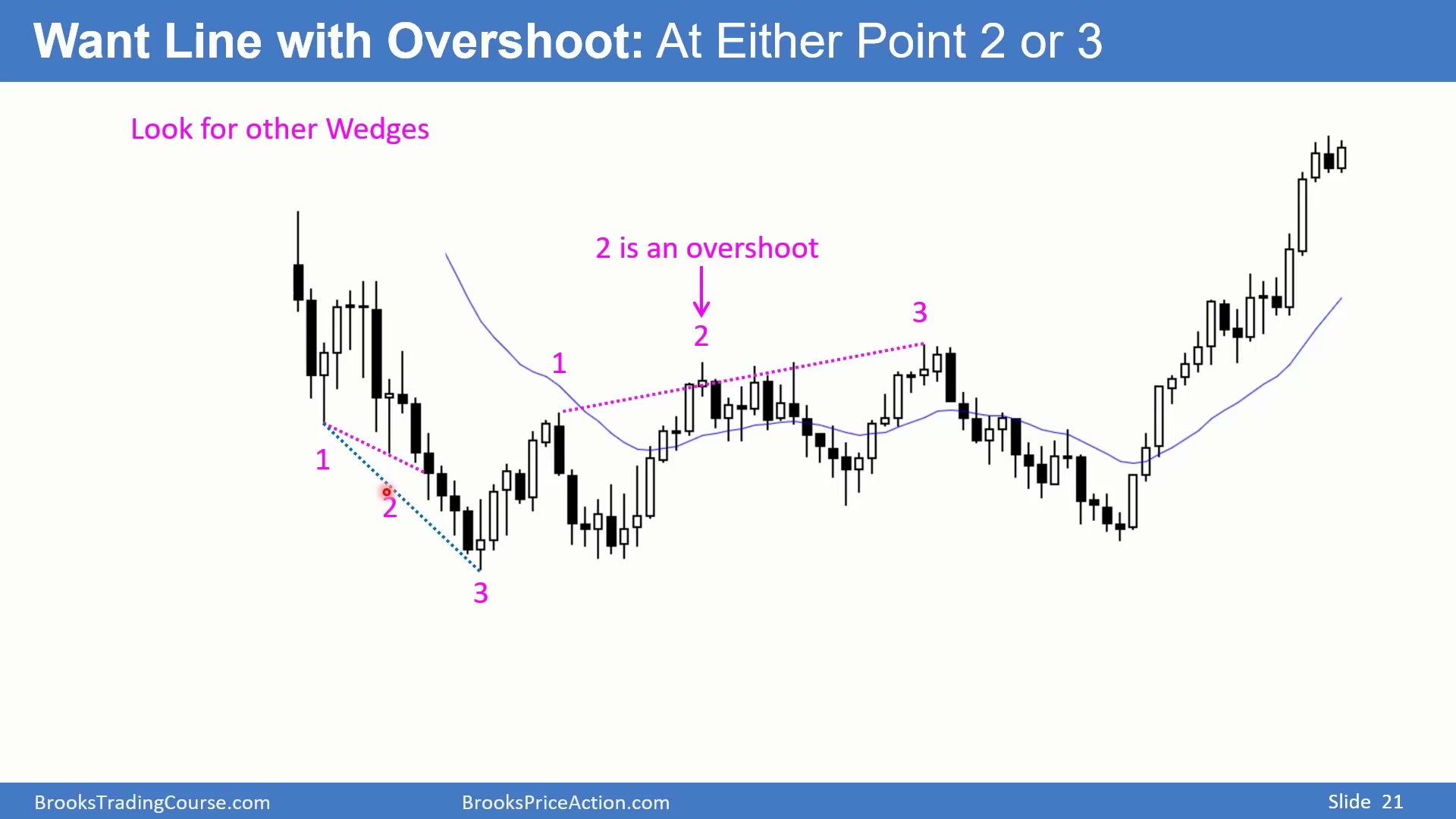
EN: The pink line, here, Point 2, is an overshoot,
16:27 - 16:30
EN: and I want an overshoot either at Point 2 or Point 3.
16:30 - 16:33
EN: So I’m going to use the pink line and get rid of the blue line.
16:43 - 16:47
EN: I’m looking to sell a reversal down from the top of a channel.
16:47 - 16:53
EN: If we start to reverse somewhere around a possible line using 1 or 2,
16:53 - 16:56
EN: I’m going to look to sell a reversal down,
16:56 - 17:01
EN: especially below a bear bar closing on its low, expecting lower prices.
Slide 018
Time: 17:05
Bilingual Transcript
17:06 - 17:09
EN: After I draw the first line, I then look for other channels,
17:09 - 17:11
EN: other Wedges, and there are many varieties.
17:11 - 17:16
EN: I have an Encyclopedia of Chart Patterns that talks about all the different ways
17:16 - 17:19
EN: that patterns can unfold and appear.
17:20 - 17:22
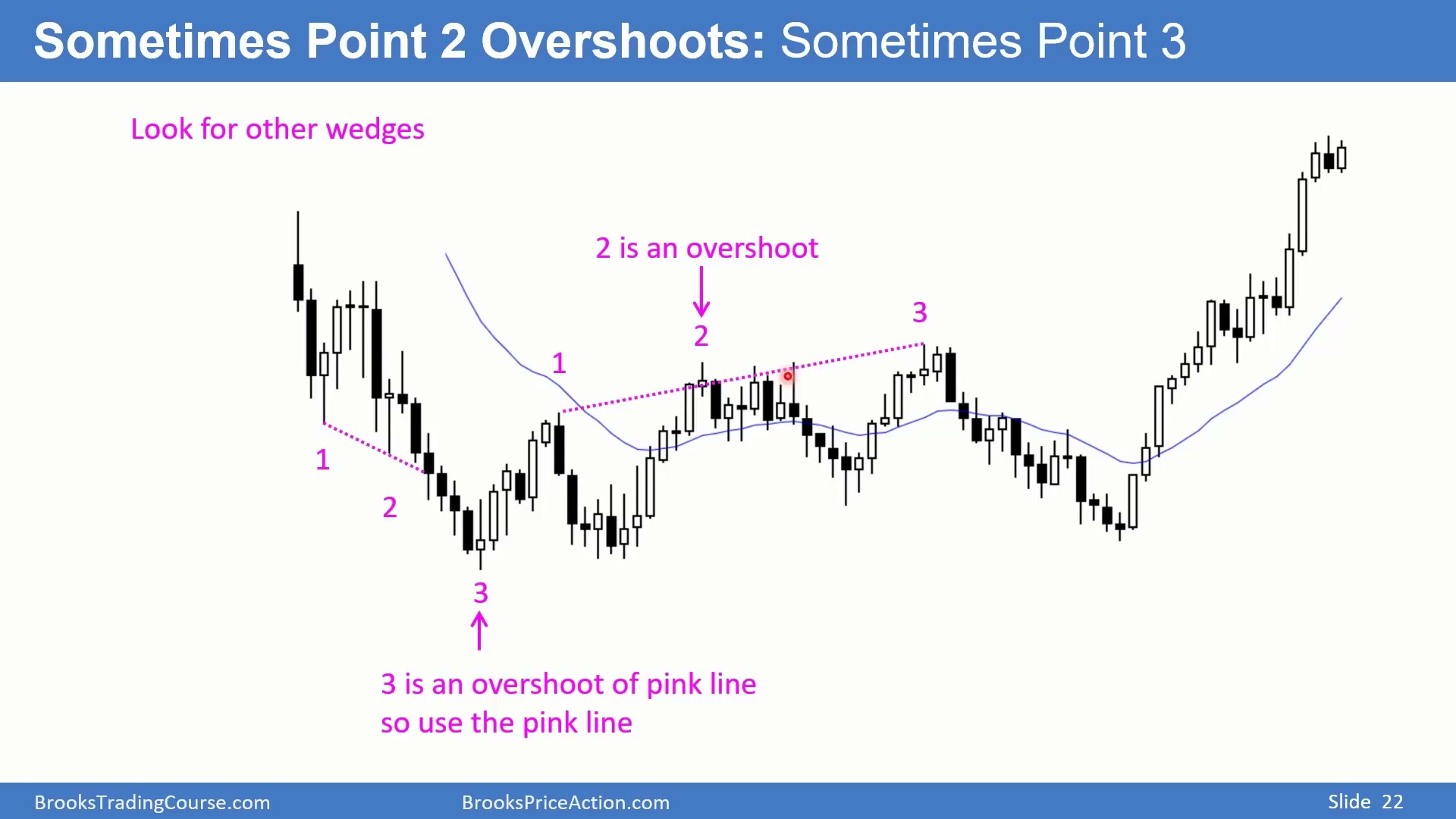
EN: For example, we have another channel here.
17:22 - 17:28
EN: This is a bear channel, and we’ve got three or more points – one, two, and three.
17:28 - 17:31
EN: You can draw the line using Point 1 and Point 3.
17:31 - 17:35
EN: You can draw the line using Point 1 and Point 2.
17:35 - 17:39
EN: If I do that, Point 3 overshot the line.
17:39 - 17:42
EN: And remember, I want lines that overshoot.
17:42 - 17:44
EN: Here, Point 2 overshot.
17:45 - 17:47
EN: Here, Point 3.
17:47 - 17:50
EN: Point 2 here undershot the line.
17:50 - 17:53
EN: I don’t want lines that undershoot; I want lines that overshoot.
17:54 - 17:57
EN: So, I’ll get rid of the blue line.
17:59 - 18:03
EN: This is an example of a channel where the line
Slide 019
Time: 18:00
Bilingual Transcript
18:03 - 18:07
EN: from Point 1 to Point 2 created an overshoot at Point 3.
18:08 - 18:15
EN: Here’s an example of a line using Point 1 and 3 as an overshoot at Point 2,
18:15 - 18:20
EN: and therefore I’m going to choose 1 and 3 to draw the line here,
18:20 - 18:24
EN: but I’m going to choose 1 and 2 to draw the line there.
18:28 - 18:31
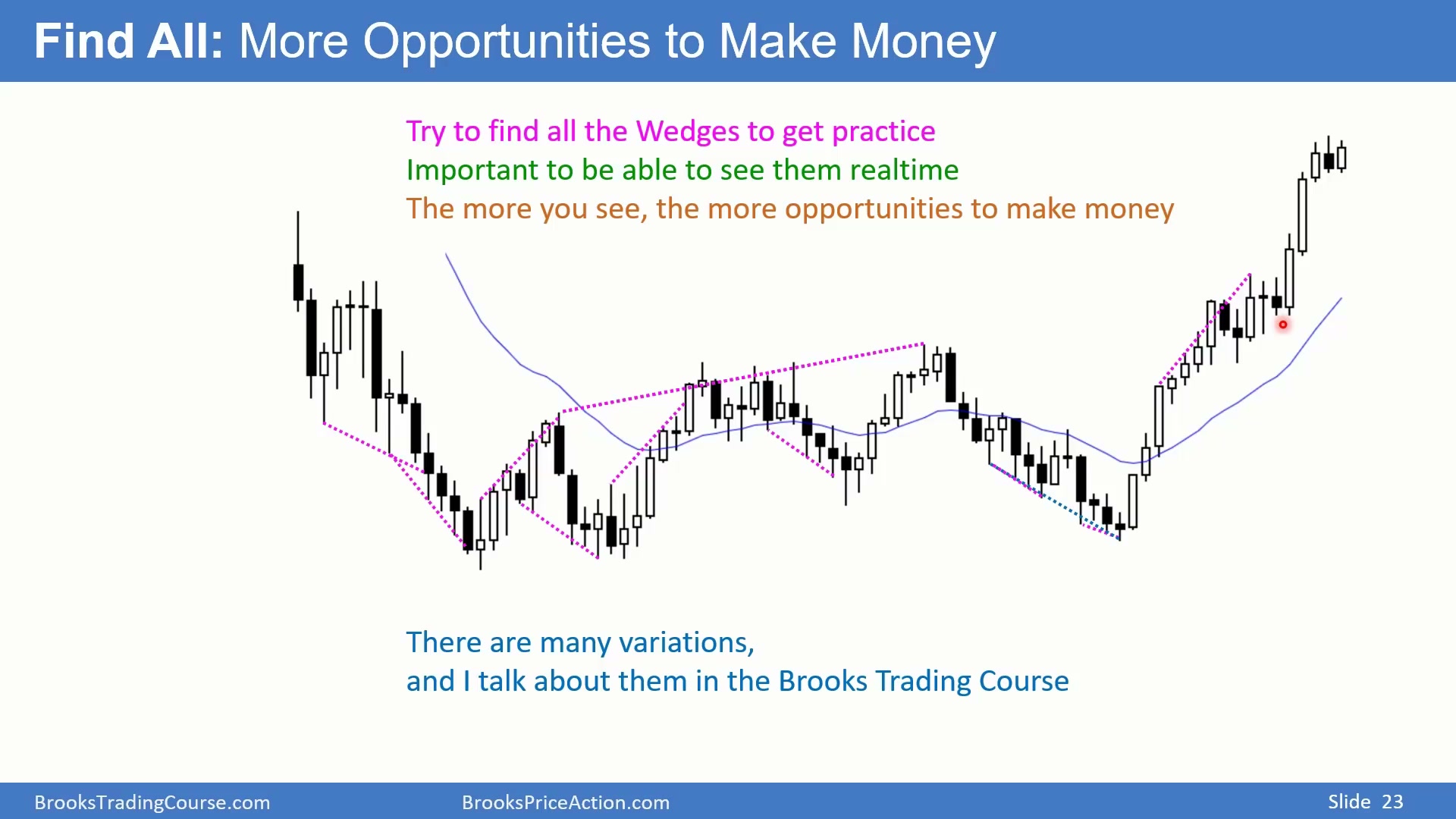
EN: There were many other Wedges on this chart as well,
Slide 020
Time: 18:30
Bilingual Transcript
18:31 - 18:35
EN: and I just keep adding lines for every conceivable Wedge.
18:35 - 18:37
EN: Some of them are hard to see.
18:38 - 18:41
EN: For example, there are three pushes down here – one, two, three.
18:41 - 18:43
EN: I have a little pink line there.
18:43 - 18:44
EN: It’s hard to see.
18:44 - 18:48
EN: And here, there are three points down – one, two, and three.
18:48 - 18:51
EN: When the pattern is small, it’s a Micro Wedge.
18:51 - 18:56
EN: And then here, I could also use one, two, three or four.
18:56 - 18:58
EN: Remember, a Wedge is at least three lines.
18:58 - 19:01
EN: So we have a channel with at least three points in it,
19:01 - 19:06
EN: so that blue line is another way to draw a Wedge, and I’m looking for a reversal.
19:06 - 19:07
EN: We’ve got a reversal.
19:07 - 19:10
EN: I want to buy above a bull bar that closes near its high,
19:10 - 19:13
EN: hoping that we get a trend up.
19:13 - 19:15
EN: Sometimes patterns fail.
19:15 - 19:18
EN: We got a push up here, big bar, and then a small bar.
19:18 - 19:23
EN: Then a big bar, a second push up, and then a bear bar, and then a third push up.
19:23 - 19:26
EN: So we have a Wedge and a very Tight Channel.
19:26 - 19:27
EN: I would call that a Parabolic Wedge.
19:27 - 19:30
EN: But we did not get a reversal down below the bear bar.
19:30 - 19:32
EN: Instead we get an upside breakout.
19:32 - 19:35
EN: So I would look to buy above the high of this bar,
19:35 - 19:37
EN: betting that the Wedge Top has failed.
Slide 021
Time: 19:40
Bilingual Transcript
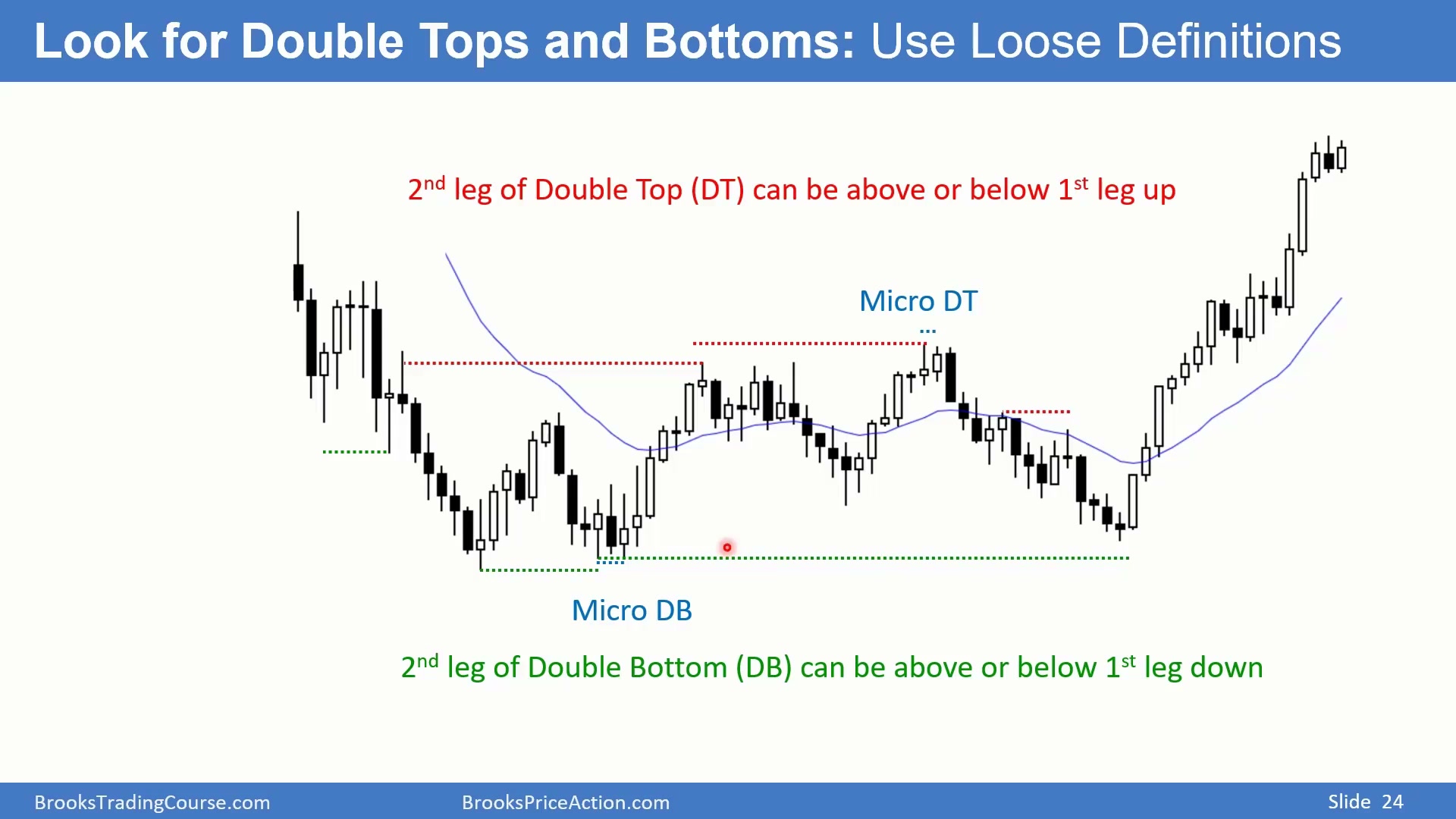
19:44 - 19:48
EN: Next I’m going to look for Double Tops and Double Bottoms.
19:48 - 19:51
EN: Double Tops and Double Bottoms are rarely perfect.
19:51 - 19:56
EN: If you look for a perfect pattern, you’re not going to find many setups
19:56 - 19:58
EN: and you’re not going to trade very much.
19:58 - 19:59
EN: It’s better to be flexible.
19:59 - 20:05
EN: The more perfect something is, the more likely it will lead to a profitable trade.
20:06 - 20:07
EN: Here we’re rallying.
20:07 - 20:09
EN: We broke above this high.
20:09 - 20:12
EN: But I always look to the left to see the context.
20:13 - 20:17
EN: If there’s a possible Double Top, we might get a reversal down.
20:17 - 20:21
EN: Here, we rallied, and it looks like we’re turning down.
20:21 - 20:26
EN: I’d be inclined to sell below this bar depending on reasons.
20:26 - 20:28
EN: I’ll look to the left to see if there’s a Double Top.
20:29 - 20:32
EN: This high might simply be a test of these highs,
20:32 - 20:34
EN: so it might be a Double Top with these highs.
20:34 - 20:38
EN: Remember, I also had a Wedge here – one, two, three.
20:38 - 20:42
EN: So it’s a Wedge and possibly a Double Top with that high,
20:42 - 20:44
EN: maybe a Lower High Double Top with that high.
20:44 - 20:50
EN: So a Wedge and a Double Top is an added reason to look for a reversal down,
20:50 - 20:53
EN: selling below a bear bar closing near its low.
20:53 - 20:55
EN: There’s also a Micro Double Top here.
20:55 - 21:00
EN: This bar went up and down, and this bar went up, and here we’re going down.
21:00 - 21:03
EN: So we have a Micro Double Top, a Double Top, and a Wedge.
21:03 - 21:06
EN: So there are several things going on here
21:06 - 21:09
EN: that would make me more inclined to take that short.
21:09 - 21:10
EN: Here’s another Double Top.
21:10 - 21:15
EN: The market tried to reverse up, but it failed in the neighborhood of that high.
21:15 - 21:17
EN: So it’s a Double Top bear flag.
21:20 - 21:22
EN: I also want to look for Double Bottoms.
21:22 - 21:27
EN: The second low of a Double Bottom can be below the low of the first low.
21:27 - 21:29
EN: Here we tried to get a Double Bottom.
21:29 - 21:31
EN: Did not go very far.
21:31 - 21:33
EN: And here we have a Higher Low Double Bottom.
21:33 - 21:35
EN: Here’s a Lower Low Double Bottom.
21:35 - 21:39
EN: This low is below that low, and here, this low is above that low.
21:39 - 21:41
EN: So it’s a Higher Low Double Bottom.
21:41 - 21:43
EN: Again, a Micro Double Bottom.
21:43 - 21:48
EN: We went down here, we went up, we went down, and now we’re trying to go up again.
21:48 - 21:52
EN: You could buy above this bar or above a bar buying on its high.
21:53 - 21:55
EN: Here we have a very big Double Bottom
21:55 - 21:59
EN: and it’s a Higher Low above the bottom of the bear trend.
21:59 - 22:03
EN: So it’s a Double Bottom Higher Low, and that has the possibility
22:03 - 22:07
EN: of being a Major Trend Reversal into a bull trend.
Slide 022
Time: 22:09
Bilingual Transcript
22:12 - 22:16
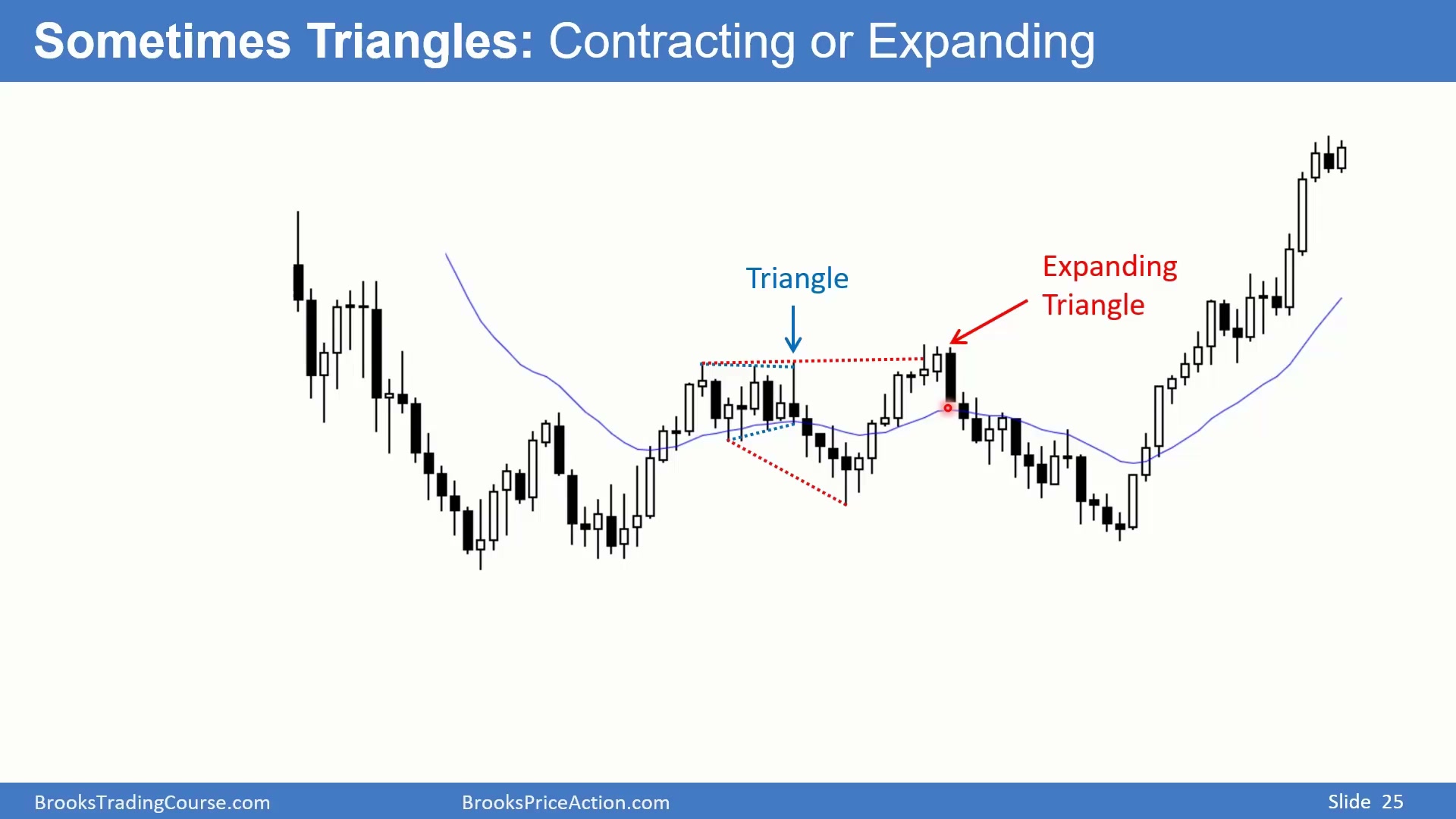
EN: There are often Triangles on charts, and again, they’re rarely perfect.
22:16 - 22:21
EN: We have rising lows here and we’re basically sideways here.
22:21 - 22:24
EN: We tried to break to the upside and that reversed down.
22:24 - 22:27
EN: So that’s a contracting Triangle.
22:29 - 22:31
EN: Sometimes Triangles are expanding.
22:31 - 22:35
EN: Here we have this high above that high, and this high is above that high.
22:35 - 22:39
EN: So we’re going up, and then here we’re going down.
22:39 - 22:43
EN: So an Expanding Triangle, five points – one, two, three, four, five
22:43 - 22:46
EN: – and we keep getting false breakouts.
22:46 - 22:48
EN: A new low, new high, new low, new high.
22:48 - 22:49
EN: Again, a reversal pattern.
22:49 - 22:51
EN: I’ll sell below that bar.
22:55 - 23:01
EN: I also look for special bars, big bars or small bars, inside bars or outside bars.
Slide 023
Time: 23:03
Bilingual Transcript
23:08 - 23:10
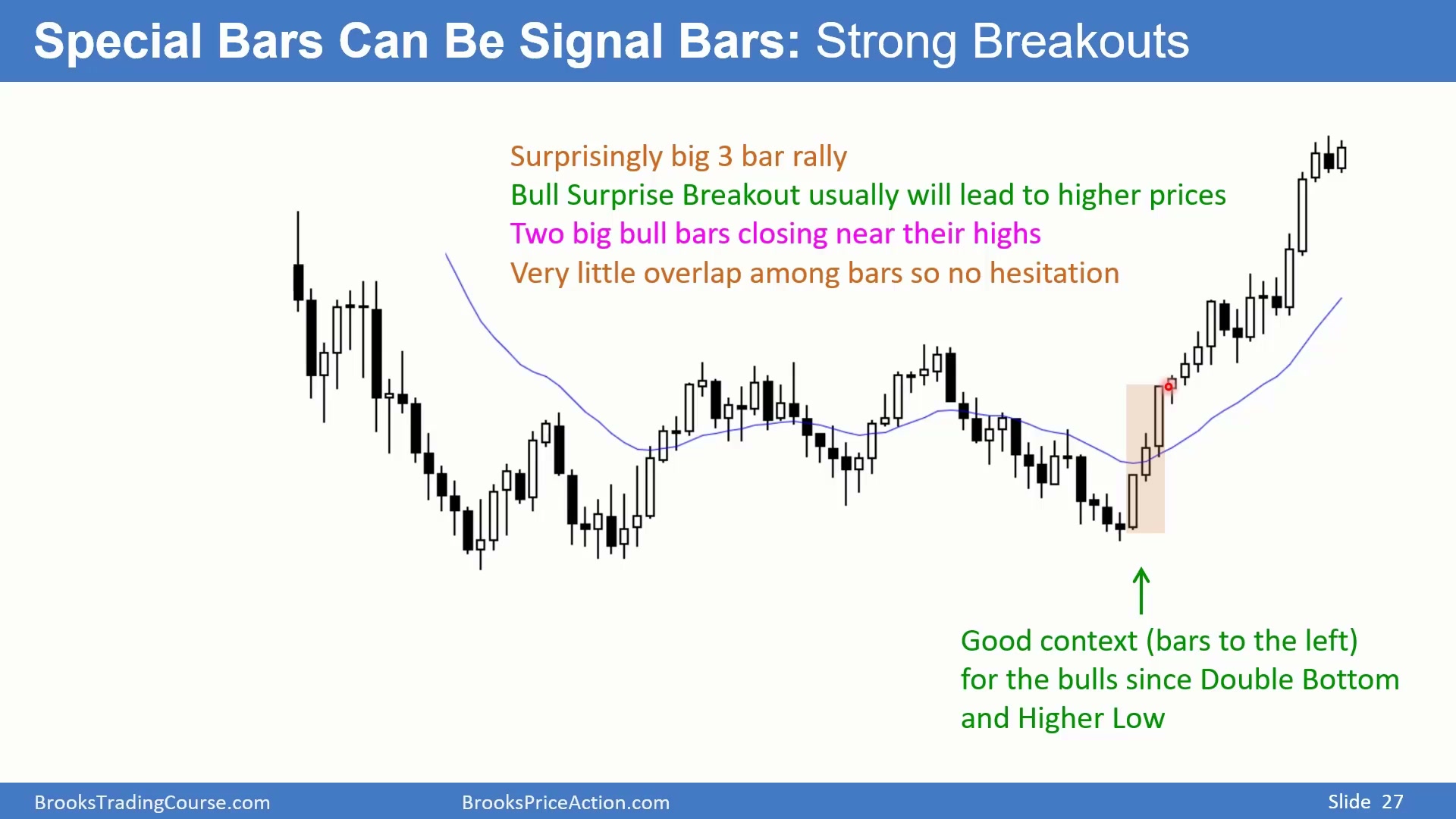
EN: Here we have 3 consecutive bull bars.
23:10 - 23:14
EN: Not much overlap, and this bar was closing on its high,
23:14 - 23:16
EN: this bar was closing on its high.
23:16 - 23:20
EN: So this is sustained, strong buying, and the context is good.
23:20 - 23:24
EN: Remember, it’s possibly a Double Bottom with this low,
23:24 - 23:27
EN: and the Double Bottom is above that low, so it’s possibly
23:27 - 23:29
EN: a Double Bottom Higher Low Major Trend Reversal.
23:29 - 23:31
EN: It’s a surprisingly strong rally.
23:31 - 23:37
EN: It’s a bull surprise rally, and bull surprises tend to have higher prices.
Slide 024
Time: 23:40
Bilingual Transcript
23:42 - 23:43
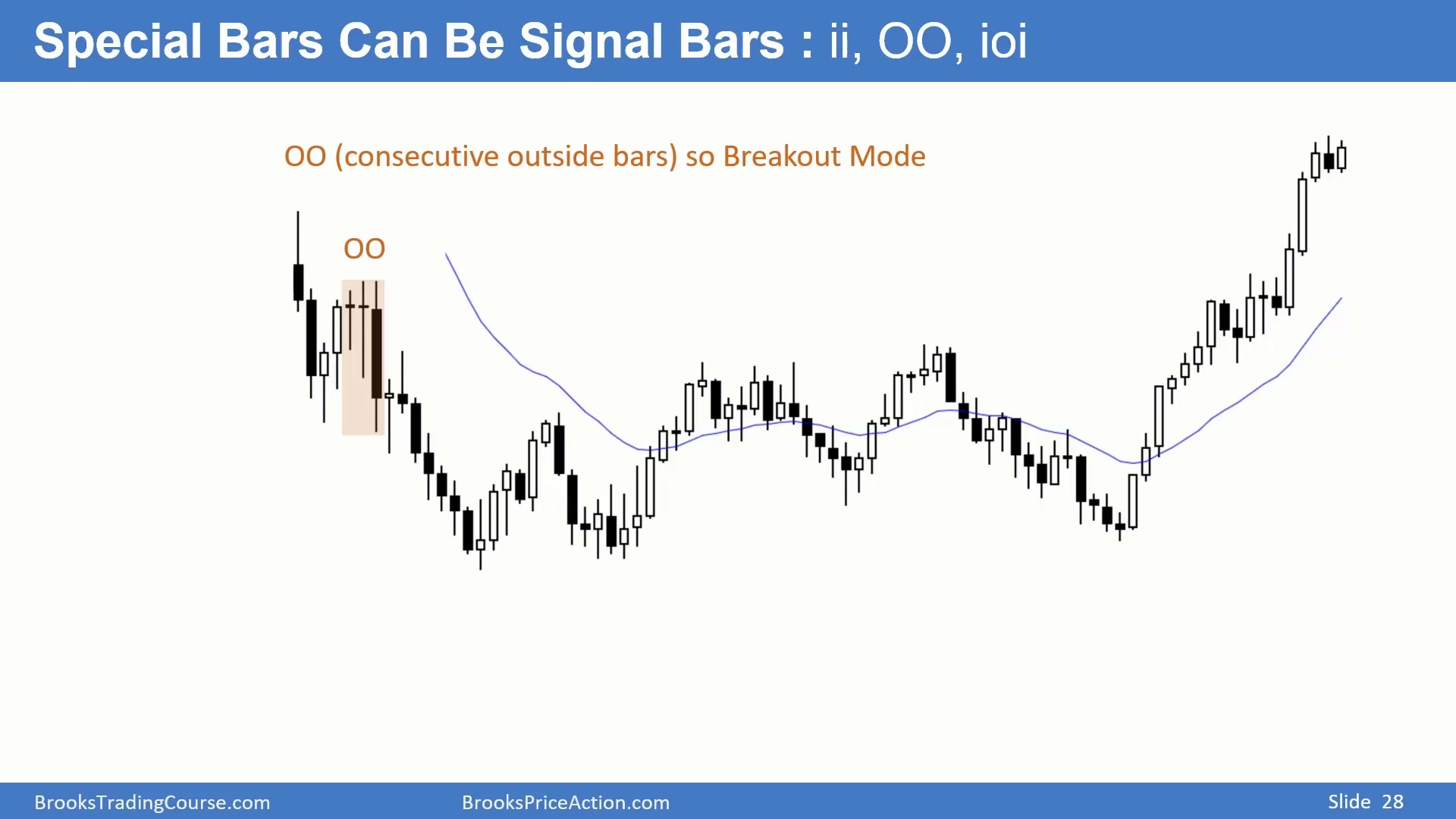
EN: What took place here?
23:44 - 23:48
EN: This bar, its high is at the high of that bar; its low is below.
23:48 - 23:51
EN: So that’s a variation of an outside bar.
23:51 - 23:53
EN: Look at the bar before it, this bar.
23:53 - 23:58
EN: Its high is above that bar; its low is below that bar,
23:58 - 24:02
EN: and therefore it’s an outside bar, and this is a bigger outside bar.
24:02 - 24:05
EN: So outside-outside, consecutive outside bars.
24:05 - 24:06
EN: It’s a BreakOut Mode pattern.
24:06 - 24:11
EN: Traders will buy if the market goes above, and they’ll sell if it goes below.
24:11 - 24:13
EN: So I’m looking for an OO,
24:13 - 24:16
EN: and I would sell below the low of that bar and below that bar.
24:16 - 24:19
EN: A bear bar closing near its low, I’d sell below that bar as well.
Slide 025
Time: 24:24
Bilingual Transcript
24:26 - 24:29
EN: Here is the chart with all those lines drawn in
24:29 - 24:31
EN: and with the special boxes drawn in.
24:32 - 24:34
EN: Next, I’m looking for entries.
24:34 - 24:37
EN: If I’m looking to buy, I want to buy above a bull bar,
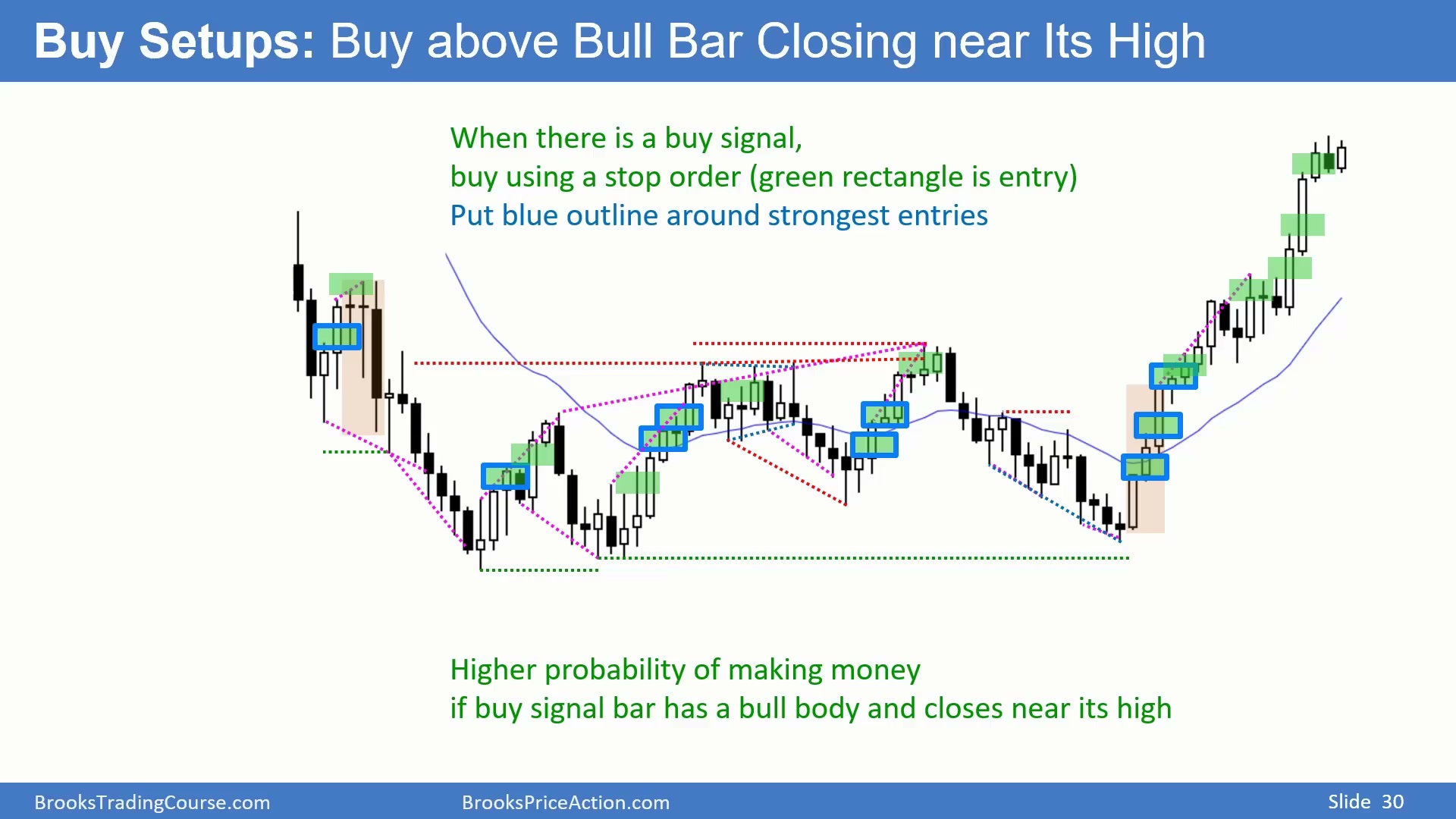
24:37 - 24:39
EN: preferably one that is closing near its high.
24:39 - 24:43
EN: If I’m looking to sell, I want to sell below a bear bar,
24:43 - 24:46
EN: preferably one that’s closing near its low.
24:50 - 24:52
EN: Theoretically we have consecutive bull bars here.
24:52 - 24:54
EN: It’s reasonable to take that buy.
24:55 - 24:57
EN: However, it turned out to be a failure, and I would get out
24:57 - 25:00
EN: either below this outside bar or certainly below that,
25:00 - 25:02
EN: because at this point there’s a sell.
25:03 - 25:07
EN: Sometimes I’ll put an outline around a green box or a red box,
25:08 - 25:13
EN: and when I do that, I’m trying to highlight setups that are particularly good.
25:13 - 25:17
EN: They’re ones that a person starting out should try to take.
25:17 - 25:19
EN: Nobody’s going to take all of these setups.
25:20 - 25:23
EN: What you’re trying to do is take as many as you possibly can.
25:24 - 25:25
EN: Stuff happens.
25:25 - 25:28
EN: You could be trading on the markets, you have to go to the bathroom,
25:28 - 25:31
EN: you’ve got to eat lunch, you could get a phone call.
25:31 - 25:33
EN: All kinds of things happen.
25:33 - 25:36
EN: It’s hard to watch every tick all day long.
25:36 - 25:38
EN: If this was a daily chart, it would be easier.
25:38 - 25:41
EN: You could simply look at the chart at the end of the day
25:41 - 25:44
EN: and place your orders for the open of the next day.
25:44 - 25:48
EN: But if you’re day trading and if this is a 5-minute chart – in this case,
25:48 - 25:52
EN: it is a 5-minute chart – it’s very easy to miss a lot of setups.
Slide 026
Time: 25:55
Bilingual Transcript
26:00 - 26:06
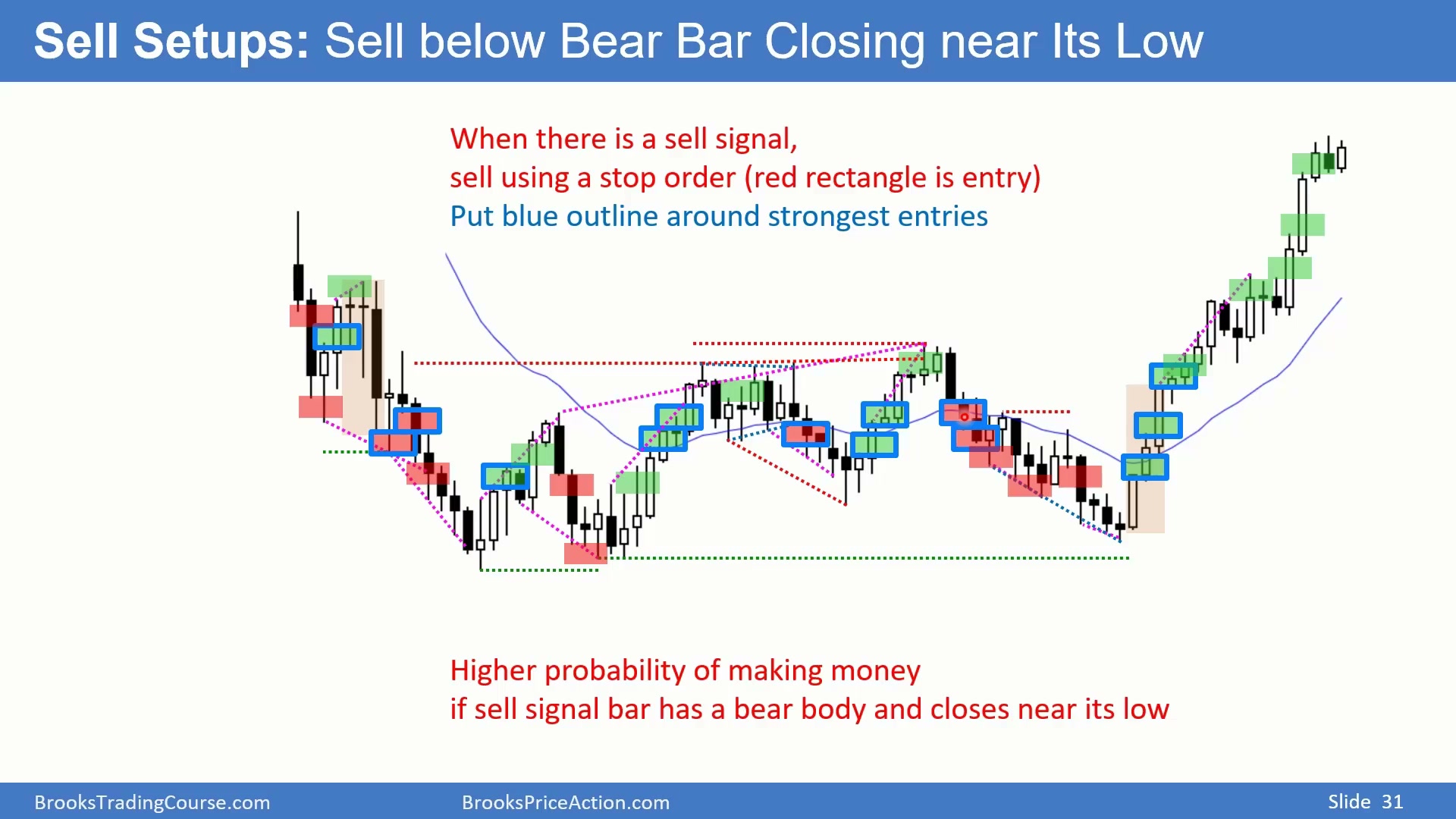
EN: After I draw in the buy entries, I then draw in the red boxes, or sell setups.
26:06 - 26:09
EN: So this bar, reasonable to sell below.
26:09 - 26:13
EN: And here we have an OO pattern below the Moving Average.
26:14 - 26:16
EN: It’s an especially good sell, so I would sell below that
26:16 - 26:18
EN: or I’d sell the first pullback.
26:18 - 26:21
EN: And then here we have a whole bunch of things.
26:21 - 26:25
EN: We have an Expanding Triangle, a Micro Double Top, possibly a Double Top here,
26:25 - 26:28
EN: and we have a Wedge rally to a Double Top, and it’s nested.
26:28 - 26:32
EN: We have a smaller Wedge here and a bigger Wedge here.
26:32 - 26:34
EN: So this is a very good sell.
26:34 - 26:37
EN: We have a second consecutive bear bar closing on its low.
26:37 - 26:42
EN: That’s also a higher probability sell, so I put a blue outline around the red box.
Slide 027
Time: 26:45
Bilingual Transcript
26:48 - 26:53
EN: Then I add textboxes so people can understand
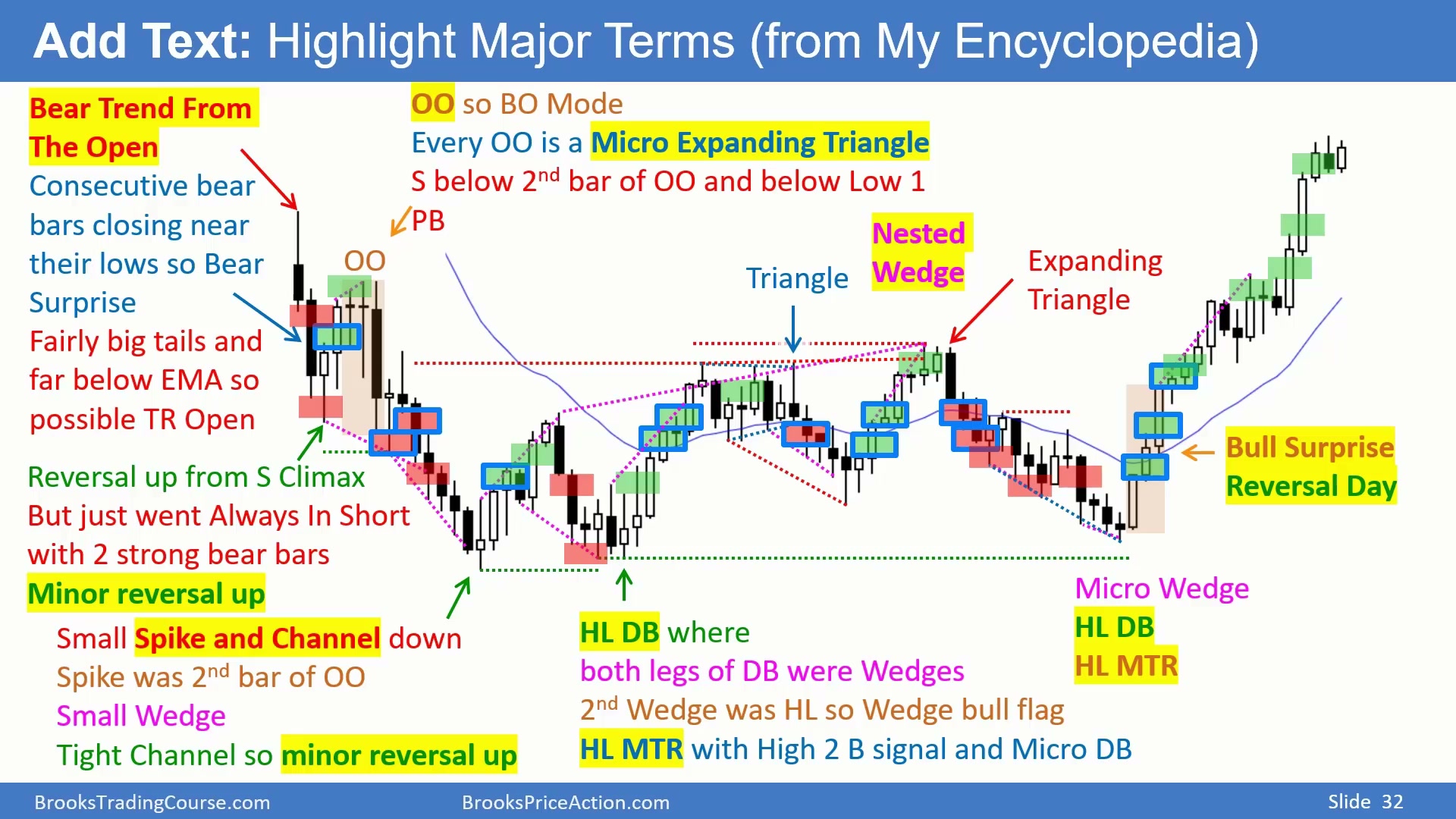
26:53 - 26:57
EN: some of the rationale for why I’m taking the trades.
26:59 - 27:03
EN: This is something you should consider doing every day at the end of the day,
27:03 - 27:04
EN: marking up your charts.
27:04 - 27:06
EN: You don’t have to write the textboxes in,
27:06 - 27:11
EN: but I would certainly draw lines and highlight special bars.
27:12 - 27:16
EN: If you do this for several months, you’ll begin to recognize patterns
27:16 - 27:21
EN: unfold during the day, and that will allow you to anticipate trades,
27:21 - 27:24
EN: and then when the trade triggers, you’ll be able to take it
27:24 - 27:26
EN: and you’ll be able to manage it well.
27:26 - 27:29
EN: That is what I mean by practicing trading.
Slide 028
Time: 27:32
Bilingual Transcript
27:33 - 27:38
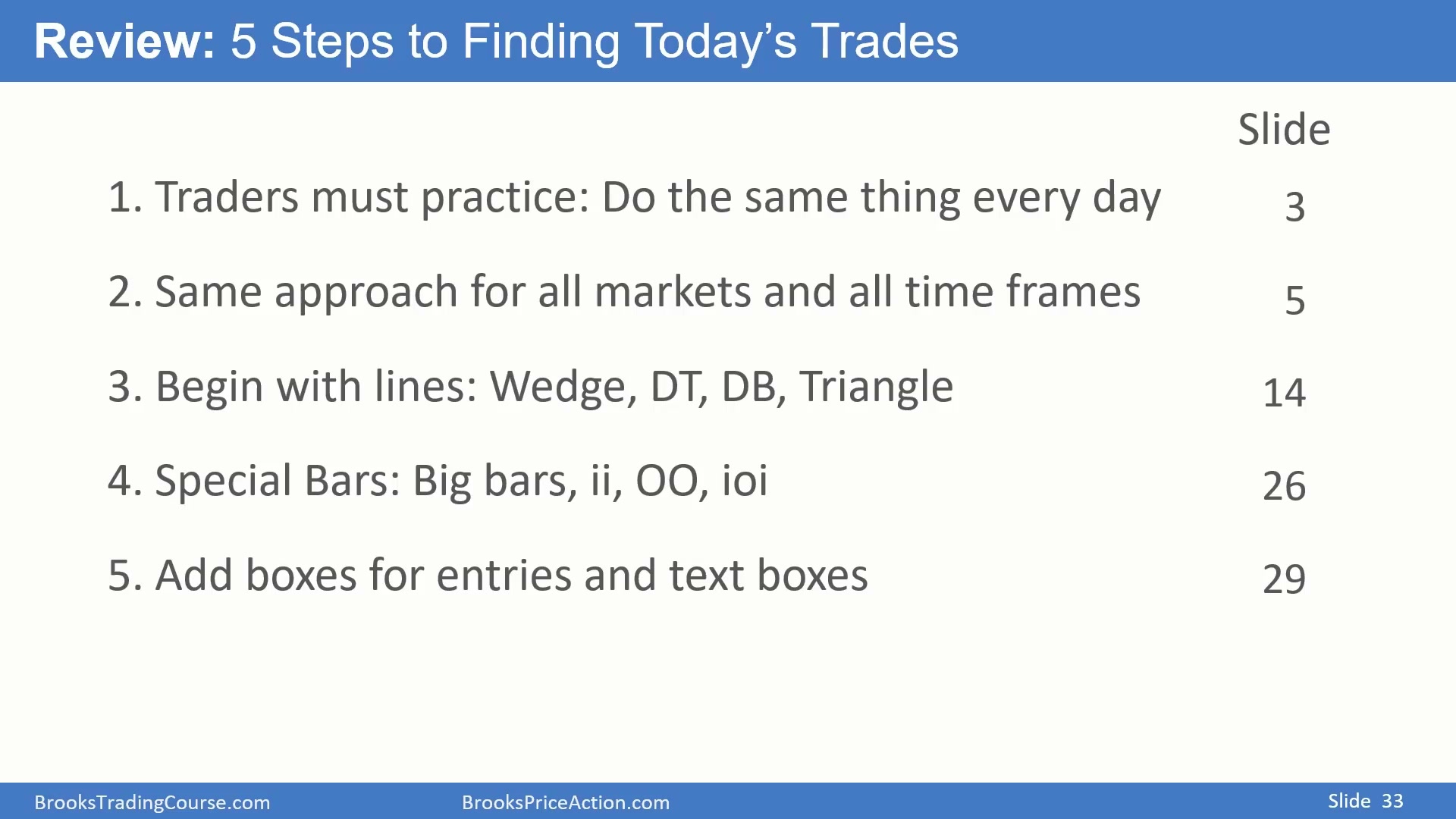
EN: Again, it’s important as a trader to do the same thing every day, have routines.
27:38 - 27:43
EN: One routine is to mark up a chart at the end of every day to practice
27:43 - 27:49
EN: so that you’ll develop a lot of experience in your ability to recognize patterns.
27:51 - 27:55
EN: Second, use the same approach for every market and every timeframe.
27:56 - 27:58
EN: When I’m marking up a chart, I begin with lines.
27:58 - 28:01
EN: I usually begin looking for channels, Wedges,
28:01 - 28:04
EN: and then Double Tops, Double Bottoms, and Triangles.
28:05 - 28:09
EN: After that I’m looking for unusual bars – for example,
28:09 - 28:13
EN: big bars or a series of big bars, Surprise Bars.
28:14 - 28:17
EN: I also look for small patterns like consecutive inside bars
28:17 - 28:22
EN: or consecutive outside bars, or an outside bar followed by an inside bar.
28:22 - 28:24
EN: That is an ioi pattern.
28:25 - 28:29
EN: Finally, on my daily charts that I mark up for my website,
28:29 - 28:34
EN: I add boxes for buy entries and for sell entries, and then finally,
28:34 - 28:41
EN: I add textboxes that explain why I think something is a good buy or a good sell.
Slide 029
Time: 28:46
Bilingual Transcript
28:47 - 28:51
EN: Again, this is Al Brooks, and I want to thank you very much for watching this video.
28:51 - 28:53
EN: I hope that you found it helpful.
28:53 - 28:56
EN: I think it’s very important to have a routine every day
28:56 - 28:58
EN: that you do at the end of trading.
28:58 - 29:01
EN: It’s good to practice recognizing patterns and thinking
29:01 - 29:03
EN: about how you’ll manage them real-time,
29:03 - 29:06
EN: because you’re going to keep encountering the same patterns.
29:06 - 29:10
EN: The more patterns that you know, the faster you are at recognizing them,
29:10 - 29:14
EN: the more chance you’ll have at structuring and managing profitable trades.
29:14 - 29:15
EN: Thank you very much.