Skip to content
Price Action Encyclopedia Index

al-brooks-course

47B - Trading in Trading Ranges

Raw transcript and slide notes for 47B - Trading in Trading Ranges.

Overview

  • Slides: 18
  • Transcript segments: 464
  • Status: 自动按 slide 时间线归档;核心概念和长期笔记可以在每个 slide 的 Study Notes 下继续整理。

Source Media

Transcript 001

Time: 00:02

Bilingual Transcript

00:02 - 00:03

EN: This is Al Brooks.

ZH: 我是阿尔·布鲁克斯

00:03 - 00:05

EN: Thank you for watching the Brooks Trading Course.

ZH: 欢迎观看布鲁克斯交易课程

00:05 - 00:10

EN: This is the second of four videos on trading in Trading Ranges.

ZH: 这是如何交易震荡区间的第2节课

Slide 001

Time: 00:12

Slide 001

Bilingual Transcript

00:14 - 00:19

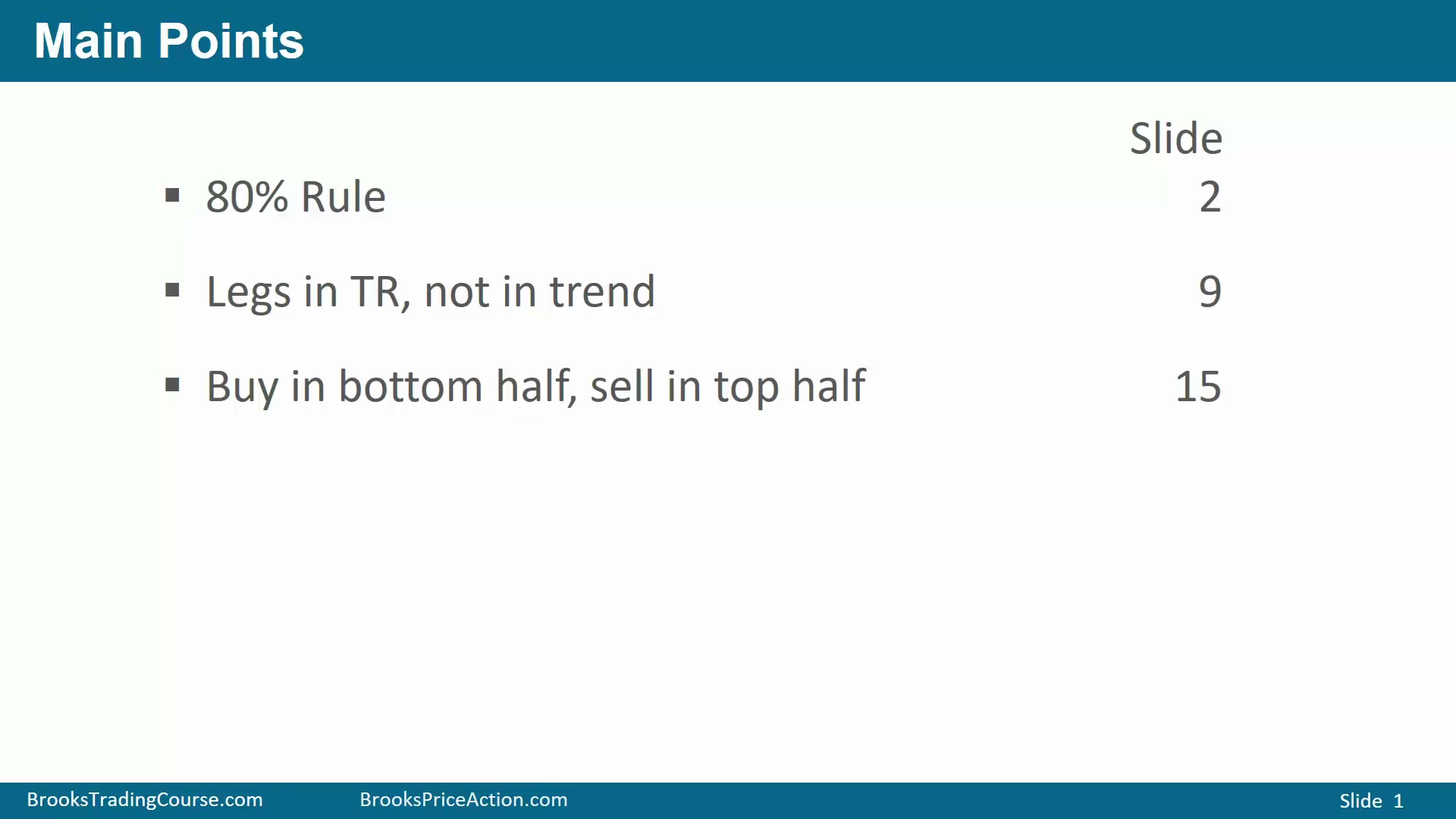
EN: I want to begin by talking about my 80% rule,

ZH: 我想先谈谈我的80%法则——市场具有惯性

00:17 - 00:19

EN: and that is that the market has inertia.

ZH: 我想先谈谈我的80%法则——市场具有惯性

00:19 - 00:32

EN: 80% of the time when it’s in a trend and it tries to reverse,

ZH: 当市场处于趋势,80%反转的尝试会失败; 当市场处于震荡区间,80%突破的尝试会失败

00:23 - 00:32

EN: the reversal will fail, and 80% of the time when the market’s in a Trading Range

ZH: 当市场处于趋势,80%反转的尝试会失败; 当市场处于震荡区间,80%突破的尝试会失败

00:29 - 00:32

EN: and it tries to break out, the breakout will fail and reverse.

ZH: 当市场处于趋势,80%反转的尝试会失败; 当市场处于震荡区间,80%突破的尝试会失败

00:34 - 00:39

EN: There are characteristics that distinguish legs within a trend from legs

ZH: 趋势中的波段,和震荡区间中的波段,是有一些区别的

00:39 - 00:42

EN: within a Trading Range, and I want to talk about some of those characteristics.

ZH: 我想讲一讲它们各自的特征

00:42 - 00:50

EN: When the market’s in a Trading Range, traders want to buy

ZH: 当市场处于震荡区间时,交易者想在下半部分买入, 在上半部分卖出

00:47 - 00:50

EN: in the bottom half and sell in the top half.

ZH: 当市场处于震荡区间时,交易者想在下半部分买入, 在上半部分卖出

00:54 - 00:57

EN: The market is in a Trading Range.

ZH: 市场处于震荡区间

00:57 - 00:58

EN: There’s a smaller range.

ZH: 这里是一个比较小的区间

00:58 - 01:01

EN: The whole thing is a Trading Range by the end here.

ZH: 整个是一个大区间,一直到这里

Slide 002

Time: 01:05

Slide 002

Bilingual Transcript

01:07 - 01:11

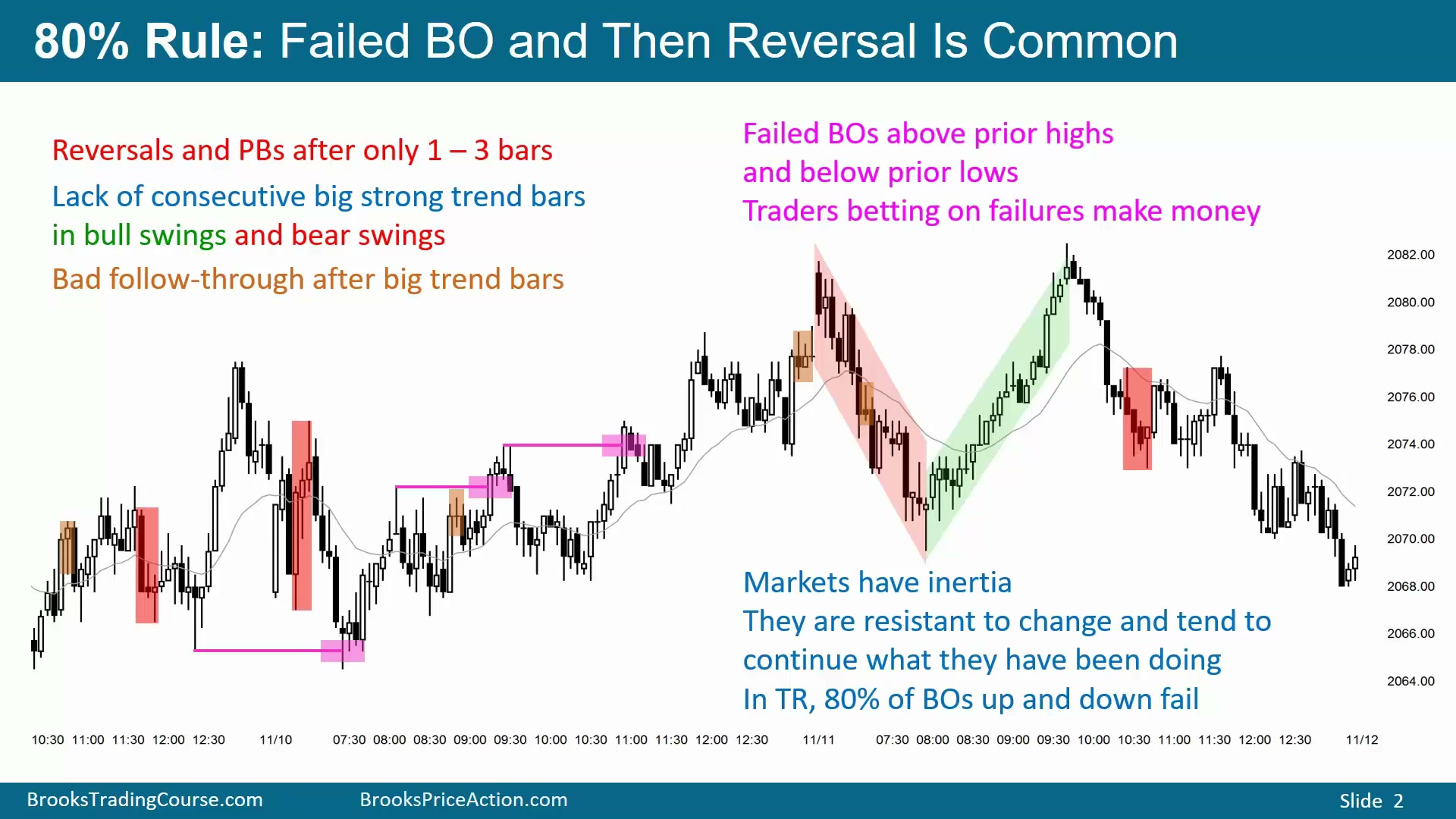
EN: I talked about how markets have inertia, and that means

ZH: 我谈到了市场具有惯性,

01:11 - 01:14

EN: they are resistant to change, and they tend to continue what they’ve been doing.

ZH: 市场抗拒变化,倾向于继续当前的行为

01:15 - 01:22

EN: In a Trading Range, 80% of the time the market

ZH: 在震荡区间中,看起来非常强势的突破,不管是上涨还是下跌

01:18 - 01:22

EN: will have breakout attempts that are strong, up and down,

ZH: 在震荡区间中,看起来非常强势的突破,不管是上涨还是下跌

01:22 - 01:25

EN: and they’ll fail and lead to reversals

ZH: 80%都会失败并反转

01:25 - 01:27

EN: instead of a successful breakout into a trend.

ZH: 而不是成功地突破进入趋势

01:32 - 01:36

EN: We have a strong reversal down, but it stops after a bar or two.

ZH: 强势的反转下跌,但一两根K线后就停止了

01:36 - 01:39

EN: Pretty strong reversal up, it stops after 2 or 3 bars.

ZH: 强势的反转上涨,两三根K线后就停止了

01:39 - 01:42

EN: 3 consecutive bear bars, the market reverses up.

ZH: 连续3根阴线,市场反转上涨

01:46 - 01:49

EN: That lack of consecutive strong trend bars

ZH: 没有连续的强趋势K线

01:49 - 01:52

EN: - here, a lack of consecutive strong bull bars.

ZH: ——这里,没有连续的大阳线

01:52 - 01:54

EN: Here, a lack of consecutive strong bear bars.

ZH: 这里,没有连续的大阴线

01:54 - 01:59

EN: Here, we have a couple bear bars, but a tail, and then we have a doji bar

ZH: 这里有两根阴线,但它有下影线,然后是一个十字星

01:59 - 02:02

EN: and then a bear bar and then a bull bar.

ZH: 然后是阴线、大阳线

02:02 - 02:04

EN: We have a couple bear bars and then a bull bar.

ZH: 之前这里有两根阴线,然后大阳线

02:04 - 02:12

EN: That lack of consecutive strong bear bars is much more common

ZH: 震荡区间中的下跌波段,往往都缺乏连续的大阴线

02:09 - 02:12

EN: when the market is in a bear leg in a Trading Range

ZH: 震荡区间中的下跌波段,往往都缺乏连续的大阴线

02:12 - 02:15

EN: or in a bull leg in a Trading Range.

ZH: 区间中的上涨波段也是一样

02:15 - 02:17

EN: The bulls have a good bar here, but a doji here.

ZH: 这根阳线很强势,但后面是十字星

02:17 - 02:19

EN: A bull bar here, a doji here.

ZH: 阳线,十字星

02:19 - 02:23

EN: A good bull bar here, but then a follow-through bar with a tail on top,

ZH: 这跟大阳线很漂亮,但后面一根阳线的上影线很长

02:23 - 02:27

EN: and then we have a Micro Double Top here at a prior high.

ZH: 然后在前期高点附近形成了一个小双顶

02:31 - 02:35

EN: Whenever there is a good trend bar, the follow-through tends to be bad.

ZH: 在强势的趋势K线之后,跟随K线往往不是很好

02:35 - 02:36

EN: Big bull bar and then a doji bar.

ZH: 大阳线,然后是一个十字星

02:36 - 02:38

EN: Big bull bar, a doji bar.

ZH: 大阳线,十字星

02:38 - 02:40

EN: Big bull bar, a bear doji.

ZH: 大阳线,十字星

02:40 - 02:45

EN: A pair of bear bars, and then a tail below and a doji bar here.

ZH: 两根阴线,但它有下影线,然后是十字星

02:51 - 02:57

EN: The market breaks below a major low, like here, but it reverses up.

ZH: 市场略微跌破前期重要的低点,但很快反转上涨

02:57 - 02:59

EN: Here it breaks above a prior high.

ZH: 这里突破了前期的高点

02:59 - 03:00

EN: Good breakout.

ZH: 看起来很不错

03:00 - 03:01

EN: It reverses down.

ZH: 但反转下跌

03:01 - 03:03

EN: Breaks out above a high, reverses down.

ZH: 突破前期高点,反转下跌

03:03 - 03:06

EN: So bad follow-through on breakouts.

ZH: 突破之后的跟随不好

03:06 - 03:08

EN: That’s another characteristic of Trading Ranges.

ZH: 这是震荡区间的另一个特征

03:08 - 03:20

EN: So, if you see legs up and down and they break out

ZH: 如果你看到价格在突破前期高低点之后很快就反转, 说明那更有可能是震荡区间,而不是趋势

03:12 - 03:20

EN: above highs and lows but reverse, that is a sign that the market

ZH: 如果你看到价格在突破前期高低点之后很快就反转, 说明那更有可能是震荡区间,而不是趋势

03:16 - 03:20

EN: is probably in a leg in a Trading Range and not in a trend.

ZH: 如果你看到价格在突破前期高低点之后很快就反转, 说明那更有可能是震荡区间,而不是趋势

Slide 003

Time: 03:25

Slide 003

Bilingual Transcript

03:29 - 03:33

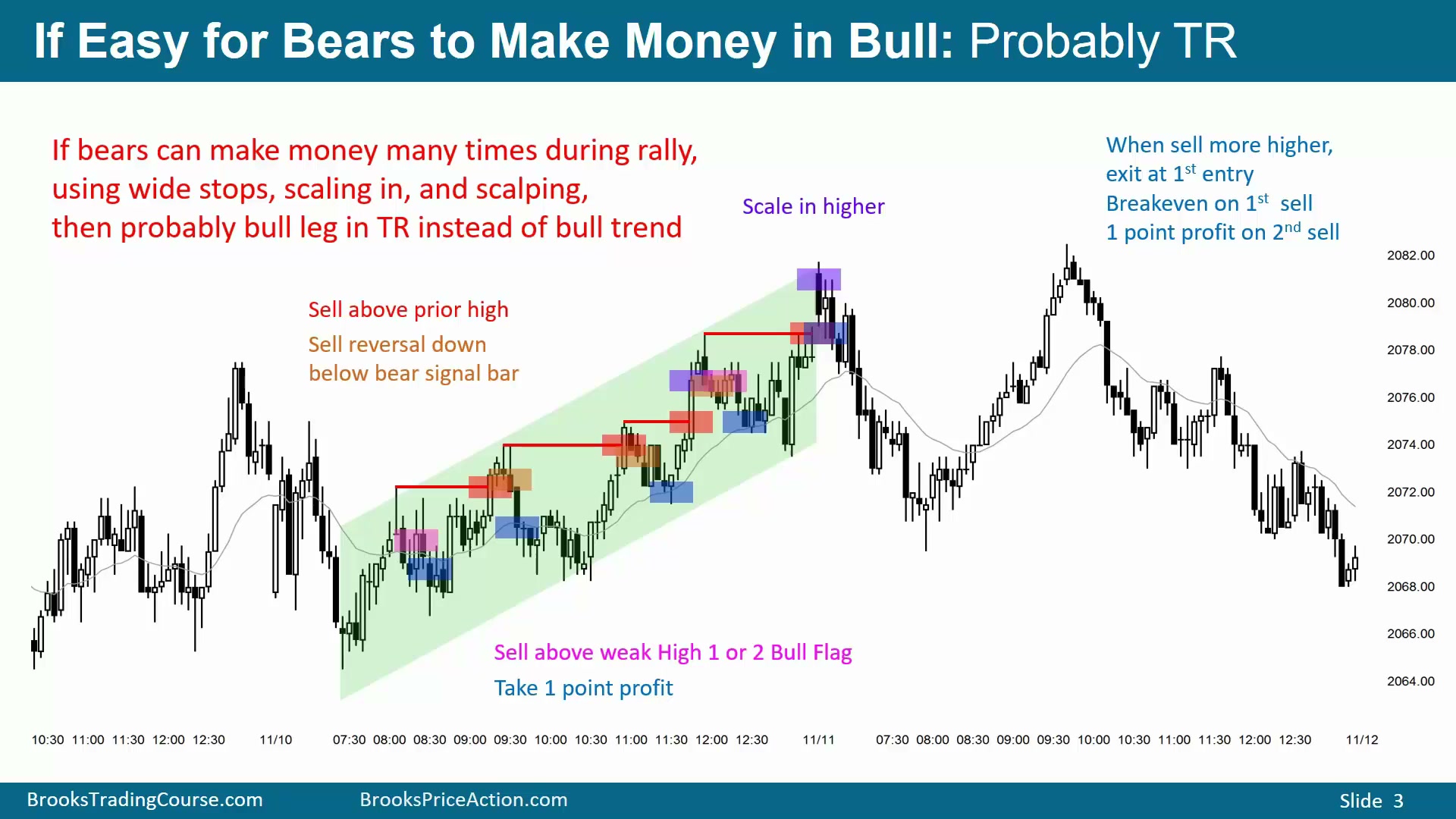
EN: When the market’s rallying, I pay a lot of attention to whether

ZH: 在市场上涨的时候,我非常关注空头能不能赚到钱

03:32 - 03:33

EN: or not the bears can make money.

ZH: 在市场上涨的时候,我非常关注空头能不能赚到钱

03:33 - 03:40

EN: If the bears can make money selling at a prior high or selling at a prior high

ZH: 如果空头在前期高点挂单做空并在上方加仓, 这样做可以赚钱的话,

03:38 - 03:48

EN: and scaling in, then the market is probably in a bull leg in what

ZH: 如果空头在前期高点挂单做空并在上方加仓, 这样做可以赚钱的话, 那么这个上涨波段更有可能会变成震荡区间, 而不是变成趋势

03:43 - 03:48

EN: will become a Trading Range and not a bull leg that is becoming a bull trend.

ZH: 那么这个上涨波段更有可能会变成震荡区间, 而不是变成趋势

03:52 - 03:57

EN: Here, if the bears sold above this High 1 bull flag – we have a rally,

ZH: 这里,如果空头在这个高1牛旗上方做空

03:57 - 04:02

EN: a pullback – if the bears can make money selling breakouts of bull flags,

ZH: 上涨,回调,如果空头在牛旗上方做空能赚钱

04:02 - 04:05

EN: High 1 and High 2 bull flags, that’s a problem.

ZH: 高1和高2牛旗——那就有问题了

04:05 - 04:07

EN: That’s a sign that the bulls are not all that strong.

ZH: 这说明多头并不是那么强壮

04:10 - 04:14

EN: The bears who sold at the high of this bear bar, a High 1 bull flag,

ZH: 如果空头在这根阴线的高点挂单做空,押注高1失败,

04:14 - 04:20

EN: made money, and that should not happen, or it should not happen often,

ZH: 他们赚到了钱——如果这真的是上涨趋势的初期, 这种事不应该发生,至少不应该经常发生

04:18 - 04:20

EN: if this is the start of a bull trend.

ZH: 他们赚到了钱——如果这真的是上涨趋势的初期, 这种事不应该发生,至少不应该经常发生

04:20 - 04:24

EN: The bulls have a Double Bottom and they’re trying to reverse up.

ZH: 双底,多头尝试制造反转上涨

04:24 - 04:26

EN: Is this going to be the start of a bull trend

ZH: 这会是上涨趋势的开始吗?

04:26 - 04:29

EN: or is this going to be a bull leg in a Trading Range?

ZH: 还是说,这只是震荡区间中的一个上涨波段?

04:29 - 04:33

EN: The rally can last 2 or 3 hours.

ZH: 上涨持续了几个小时——30、40、50根K线

04:31 - 04:33

EN: 30, 40, 50 bars.

ZH: 上涨持续了几个小时——30、40、50根K线

04:33 - 04:40

EN: However, it’s still more likely going to be a leg in what

ZH: 然而,它仍然更有可能只是震荡区间中的上涨波段, 而不是上涨趋势中的上涨波段

04:36 - 04:40

EN: will become a Trading Range and not the start of a bull trend.

ZH: 然而,它仍然更有可能只是震荡区间中的上涨波段, 而不是上涨趋势中的上涨波段

04:43 - 04:47

EN: Can bears sell at a prior high and make money?

ZH: 空头在前期高点挂单卖出,能赚到钱吗?

04:47 - 04:48

EN: Here they could.

ZH: 这里可以

04:48 - 04:52

EN: They sell at that high and the market fell far enough for them to make a profit.

ZH: 他们在那个高点挂单卖出,回调幅度足够大,空头可以赚钱

04:55 - 04:59

EN: Can they sell a reversal down from a prior high and make money?

ZH: 从前期高点反转下跌的时候入场做空,能赚到钱吗?

04:59 - 05:00

EN: Yes, they could.

ZH: 可以

05:02 - 05:03

EN: These bears made money.

ZH: 这些空头赚钱了

05:03 - 05:06

EN: They got out here, and the same thing here.

ZH: 他们在这里止盈; 那里也是一样

05:06 - 05:09

EN: Bears selling at this high, bears selling on the reversal down.

ZH: 空头在前期高点挂限价卖单, 或者在反转下跌时用突破卖单入场

05:10 - 05:12

EN: The market fell far enough for the bears to make money.

ZH: 市场下跌得足够多,空头可以赚到钱

05:15 - 05:22

EN: Bears selling at this high using a wide stop

ZH: 空头在这个高点挂单卖出,使用宽止损并加仓, 他们也赚到钱了

05:18 - 05:22

EN: and scaling in, they made money as well.

ZH: 空头在这个高点挂单卖出,使用宽止损并加仓, 他们也赚到钱了

05:22 - 05:24

EN: They sell more higher.

ZH: 他们在上方加仓做空

05:25 - 05:29

EN: They can sell more either at a fixed number of points above,

ZH: 一些人会在固定的距离加仓,

05:29 - 05:32

EN: they can sell more above a bad bull flag, above this bear bar,

ZH: 一些人在牛旗上方加仓——在这个阴线的高点挂限价卖单

05:32 - 05:35

EN: or they can sell on a reversal down.

ZH: 一些人在反转下跌时用突破卖单加仓

05:35 - 05:37

EN: Many different ways to scale in higher.

ZH: 有很多种加仓的方式

05:43 - 05:50

EN: Then they get out at their first entry price, breakeven on their first entry

ZH: 然后他们在初始入场价格平仓, 初始仓位打平,上方加仓的部分赚钱

05:48 - 05:50

EN: and then with a profit on their higher entry.

ZH: 然后他们在初始入场价格平仓, 初始仓位打平,上方加仓的部分赚钱

05:53 - 05:54

EN: Same thing here.

ZH: 这里也是一样

05:54 - 06:01

EN: Sell at that high, scale in higher, and the market fell back

ZH: 在那个高点挂单做空,在更高的价格加仓,

06:01 - 06:03

EN: to their original entry price and they could make money.

ZH: 等市场跌回到初始入场价格,他们就可以赚钱

06:05 - 06:10

EN: Obviously if they sell and the market immediately goes down,

ZH: 当然,如果开仓做空之后市场立刻下跌,那就不需要加仓了

06:08 - 06:10

EN: there’s no need to scale in higher,

ZH: 当然,如果开仓做空之后市场立刻下跌,那就不需要加仓了

06:10 - 06:13

EN: but sometimes they sell and the market goes up higher.

ZH: 但有时开仓做空之后市场会继续上涨

06:13 - 06:17

EN: But because the bears have been making money selling

ZH: 因为一路上逢高做空的空头一直在赚钱,

06:16 - 06:24

EN: above bars repeatedly through here, the bears are confident

ZH: 因为一路上逢高做空的空头一直在赚钱, 所以他们相信,如果在这个高点挂单做空, 使用宽止损并加仓,仍然可以赚到钱

06:19 - 06:24

EN: that they’ll make money selling at this high as well

ZH: 所以他们相信,如果在这个高点挂单做空, 使用宽止损并加仓,仍然可以赚到钱

06:22 - 06:24

EN: if they use a wide stop and scale in higher.

ZH: 所以他们相信,如果在这个高点挂单做空, 使用宽止损并加仓,仍然可以赚到钱

06:25 - 06:28

EN: Because the market fell back below the breakout point,

ZH: 因为价格跌回到了突破点的下方

06:28 - 06:35

EN: as it did for all of these breakouts – it kept pulling back

ZH: 就像之前每次突破之后一样——都回调到突破点的下方, 所以这是阶梯式上涨

06:31 - 06:35

EN: below the breakout point – that is a stairs type pattern,

ZH: 就像之前每次突破之后一样——都回调到突破点的下方, 所以这是阶梯式上涨

06:35 - 06:40

EN: and that’s more common in a bull trend

ZH: 这样的上涨趋势往往很快就会变成震荡区间

06:37 - 06:40

EN: that will soon evolve into a Trading Range.

ZH: 这样的上涨趋势往往很快就会变成震荡区间

Slide 004

Time: 06:45

Slide 004

Bilingual Transcript

06:48 - 06:51

EN: The opposite’s true of a bear trend.

ZH: 下降趋势也是一样

06:51 - 07:01

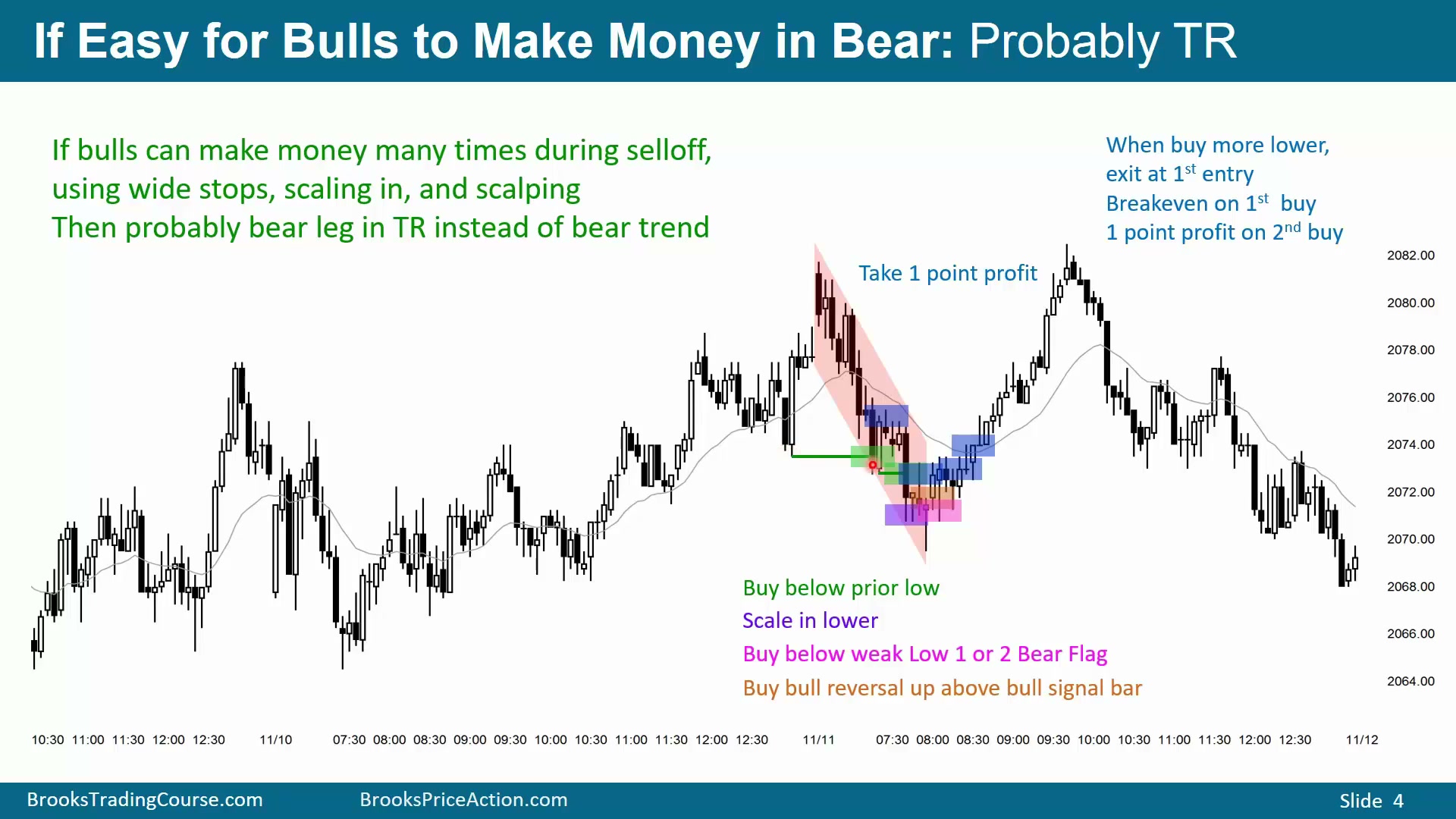
EN: If the bulls can make money repeatedly buying below bars, scaling in,

ZH: 如果多头在前期低点挂单做多并逢低加仓, 或者在反转上涨时买入做多,一直能赚钱的话, 那么它更有可能只是震荡区间中的下跌波段

06:56 - 07:01

EN: buying reversals up, then the leg down is probably a leg in a Trading Range

ZH: 或者在反转上涨时买入做多,一直能赚钱的话, 那么它更有可能只是震荡区间中的下跌波段

07:01 - 07:03

EN: and not the start of a bear trend.

ZH: 而不是下降趋势的开始

07:05 - 07:08

EN: For example, if bulls placed a limit order to buy at this low,

ZH: 例如,如果多头在这个低点挂限价买单

07:08 - 07:13

EN: betting against a successful breakout, and they can make money buying there,

ZH: 押注向下跌破失败,他们在这里买入能赚到钱

07:14 - 07:20

EN: then that makes it less likely that this is going to lead to a big bear trend.

ZH: 那么它就不太可能是一个大的下降趋势

07:20 - 07:21

EN: Here they bought that low.

ZH: 他们在前期低点挂单买入

07:21 - 07:23

EN: It rallied a point.

ZH: 市场反弹超过1个点

07:23 - 07:25

EN: They could exit with a 1 point profit.

ZH: 多头可以赚到1个点的剥头皮

07:26 - 07:27

EN: Same thing there.

ZH: 这里也是一样

07:27 - 07:28

EN: They buy at the new low.

ZH: 多头在前期低点挂单买入

07:30 - 07:32

EN: Here they had to scale in lower.

ZH: 这里他们需要在下方加仓

07:32 - 07:34

EN: It went back to their original entry price.

ZH: 市场回到了他们的初始入场价格

07:34 - 07:37

EN: They could get out with a 1 point profit on their second entry

ZH: 那么加仓的部分就能赚到1个点

07:37 - 07:42

EN: and get out breakeven on their first entry.

ZH: 初始仓位打平——在这里买入,在同样的价格离场

07:39 - 07:42

EN: They bought here and then they get out there breakeven.

ZH: 初始仓位打平——在这里买入,在同样的价格离场

07:52 - 07:55

EN: Let’s say a bull bought below this bar.

ZH: 假设一个多头在这根阳线的低点挂限价买单

07:55 - 07:59

EN: For the bears, it’s a bear channel, a bear trend, and it’s a Low 1 bear flag.

ZH: 对于空头来说,这是下降通道、下降趋势, 这根阳线的下方是低1入场点

07:59 - 08:03

EN: But it’s a bull body and it’s after a bull bar here.

ZH: 但它是一根阳线,前面也是一根阳线

08:03 - 08:05

EN: It’s probably not a very good Low 1 bear flag,

ZH: 所以这个低1做空入场点并不好

08:05 - 08:11

EN: and therefore some bulls would buy with a limit order

ZH: 因此多头会在它的低点挂限价买单,然后赚快钱离场

08:08 - 08:11

EN: at the low of that bull bar, and then they’ll scalp out.

ZH: 因此多头会在它的低点挂限价买单,然后赚快钱离场

08:11 - 08:18

EN: Again, bulls making money in a bear trend, the bear trend

ZH: 多头能在下降趋势中赚钱,说明市场很快就会进入震荡区间

08:13 - 08:18

EN: is probably a bear leg in what will end up as a Trading Range.

ZH: 多头能在下降趋势中赚钱,说明市场很快就会进入震荡区间

08:23 - 08:24

EN: Also buying a reversal up.

ZH: 在反转上涨时买入也能赚钱

08:24 - 08:27

EN: We broke below this low, we broke below that low,

ZH: 跌破了这个低点,跌破了那个低点

08:27 - 08:30

EN: and we’re getting a reversal and a second reversal up,

ZH: 第1次反转,第2次反转

08:30 - 08:34

EN: and the bulls made money buying above that reversal bar.

ZH: 在它的上方买入,多头赚到了钱

Slide 005

Time: 08:35

Slide 005

Bilingual Transcript

08:40 - 08:45

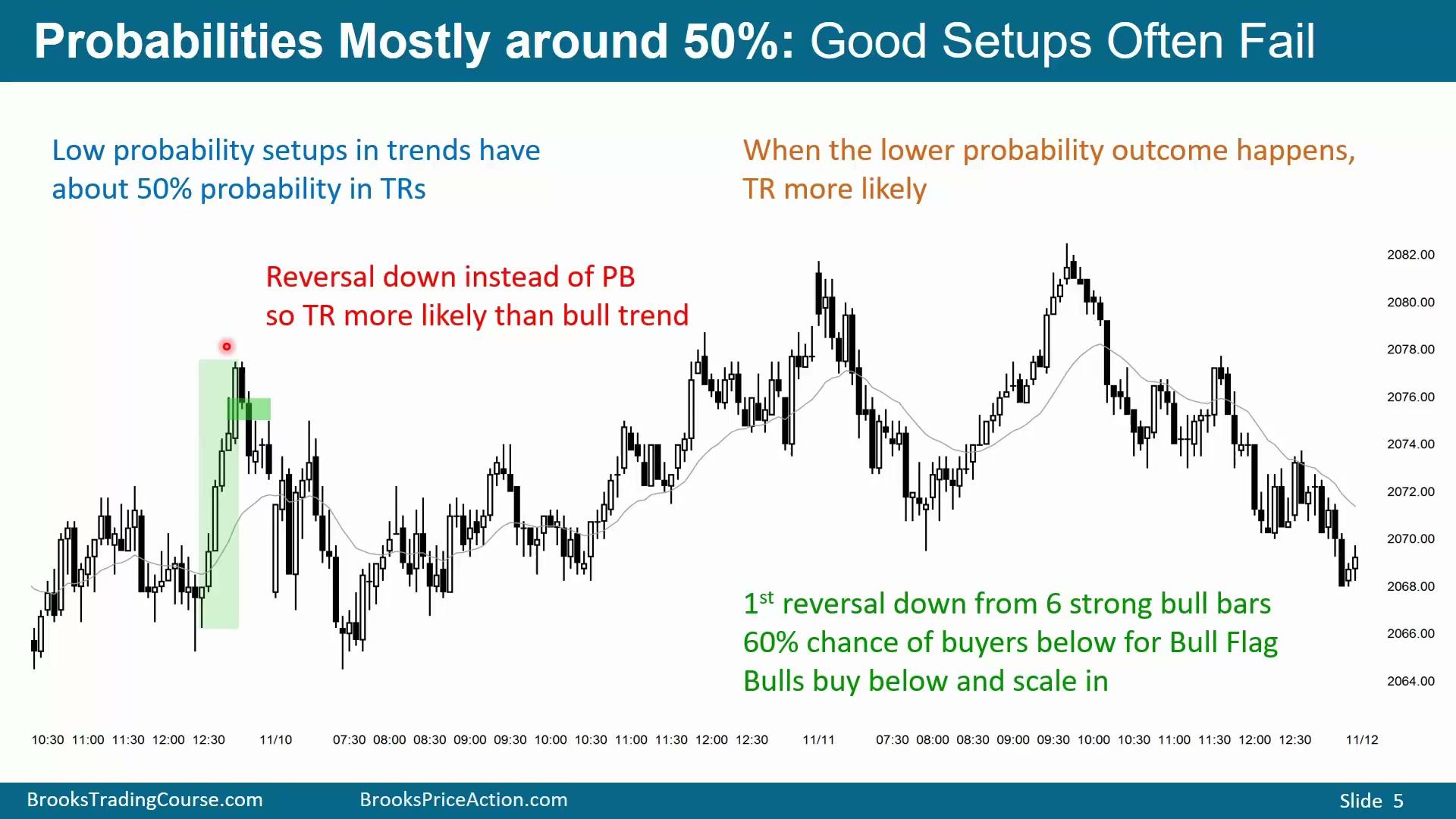
EN: In Trading Ranges, a lot of the probabilities gravitate toward 50%.

ZH: 在震荡区间中,概率趋向于50%

08:45 - 08:53

EN: Setups that would normally be high probability in a trend,

ZH: 在趋势中高胜率(60%)的交易机会, 在震荡区间中就只有50%

08:49 - 08:53

EN: like a 60% setup, are closer to 50% in a Trading Range.

ZH: 在趋势中高胜率(60%)的交易机会, 在震荡区间中就只有50%

08:53 - 09:01

EN: Setups that are typically low probability in a trend,

ZH: 在趋势中低胜率(40%)的交易机会, 在区间中也变成了50%左右

08:57 - 09:01

EN: like a 40% setup are also closer to 50%.

ZH: 在趋势中低胜率(40%)的交易机会, 在区间中也变成了50%左右

09:04 - 09:08

EN: When lower probability outcomes happen more than what you’d expect,

ZH: 如果低概率事件发生的频率比预期更高

09:09 - 09:13

EN: then you have to assume the market’s probably in a Trading Range.

ZH: 那么你就必须假设市场很可能处于震荡区间

09:20 - 09:24

EN: The first reversal down after a strong breakout to a new high.

ZH: 强势突破创新高之后,第1次反转下跌

09:24 - 09:27

EN: Probably buyers below the low of the bar.

ZH: 在这根K线下方大概率有很多买盘

09:28 - 09:34

EN: I’m not going to be buying at the low of a strong bear bar

ZH: 突破之后,如果有大阴线收在最低, 通常我不会在这里买入,因为有太多这样的陷阱

09:31 - 09:34

EN: after a breakout because too often it’s a trap.

ZH: 突破之后,如果有大阴线收在最低, 通常我不会在这里买入,因为有太多这样的陷阱

09:34 - 09:38

EN: However, the odds are there are buyers below,

ZH: 然而,在它的下方大概率会有很多买盘

09:38 - 09:41

EN: and bulls buying at that low can scale in lower.

ZH: 在它的低点买入的多头会在更低的价格加仓

09:42 - 09:46

EN: When you see a strong breakout like this, you know several things.

ZH: 当看到这样的强势突破时,你知道几件事情——

09:46 - 09:48

EN: You know the market’s probably not in a bear trend,

ZH: 你知道市场现在不是下降趋势

09:49 - 09:53

EN: but it’s either in a bull trend and it will go up without much of a pullback

ZH: 要么是上涨趋势,即使回调也很快就继续上涨

09:53 - 09:56

EN: or it’s a bull leg in what will become a Trading Range

ZH: 要么会变成震荡区间

09:56 - 10:01

EN: - in which case if you’re buying up here, you need a stop down here or down here

ZH: ——如果是这种情况,你在买入之后, 需要把止损放在这里或这里,

10:01 - 10:05

EN: because if it’s a bull leg in a Trading Range, you can get a very deep pullback.

ZH: 因为如果它真的是震荡区间,可能会有非常深度的回调

10:05 - 10:06

EN: You can get a bear leg in a Trading Range,

ZH: 接下来可能会是区间中的下跌波段

10:06 - 10:09

EN: and it could even go below the bottom of the range.

ZH: 甚至可能略微跌破区间的底部再反转上涨

10:11 - 10:12

EN: Strong rally.

ZH: 强势的上涨

10:12 - 10:17

EN: 60% chance there’ll be a second leg up and bulls will buy the reversal down.

ZH: 60%的概率会有第2段上涨,所以多头会在下跌时买入

10:17 - 10:19

EN: However, it’s a possible 2nd Leg Trap.

ZH: 然而,它有可能是第2段陷阱

10:19 - 10:22

EN: One leg up, a Wedge rally and then a pullback,

ZH: 第1段上涨,3推楔形,然后回调

10:22 - 10:25

EN: and then a second leg up that’s especially strong.

ZH: 然后是异常强势的第2段上涨

10:25 - 10:29

EN: It’s still a 60% chance that it’s going to have a second leg up,

ZH: 仍然有60%的概率,还会有一段上涨

10:29 - 10:34

EN: but if it does have a deep pullback – in other words, if the 40% happens

ZH: 但如果真的出现深度回调——换句话说,40%的情况发生了

10:35 - 10:43

EN: - then you have to be thinking that maybe this is a rally

ZH: 那么你就必须考虑到,它也许只是震荡区间中的一段上涨, 而不是一个大的上涨趋势的开始

10:39 - 10:43

EN: that is part of a Trading Range and not the start of a big bull trend.

ZH: 那么你就必须考虑到,它也许只是震荡区间中的一段上涨, 而不是一个大的上涨趋势的开始

10:49 - 10:50

EN: Strong reversal down.

ZH: 强势的反转下跌

10:50 - 10:53

EN: A pair of bear bars and then a deep pullback.

ZH: 两根阴线,深度回调

10:53 - 11:00

EN: Therefore, this rally is more likely a bull leg in what

ZH: 因此,这段上涨更有可能会变成震荡区间,而不是上涨趋势

10:57 - 11:00

EN: will become a Trading Range instead of the start of a bull trend.

ZH: 因此,这段上涨更有可能会变成震荡区间,而不是上涨趋势

Slide 006

Time: 11:05

Slide 006

Bilingual Transcript

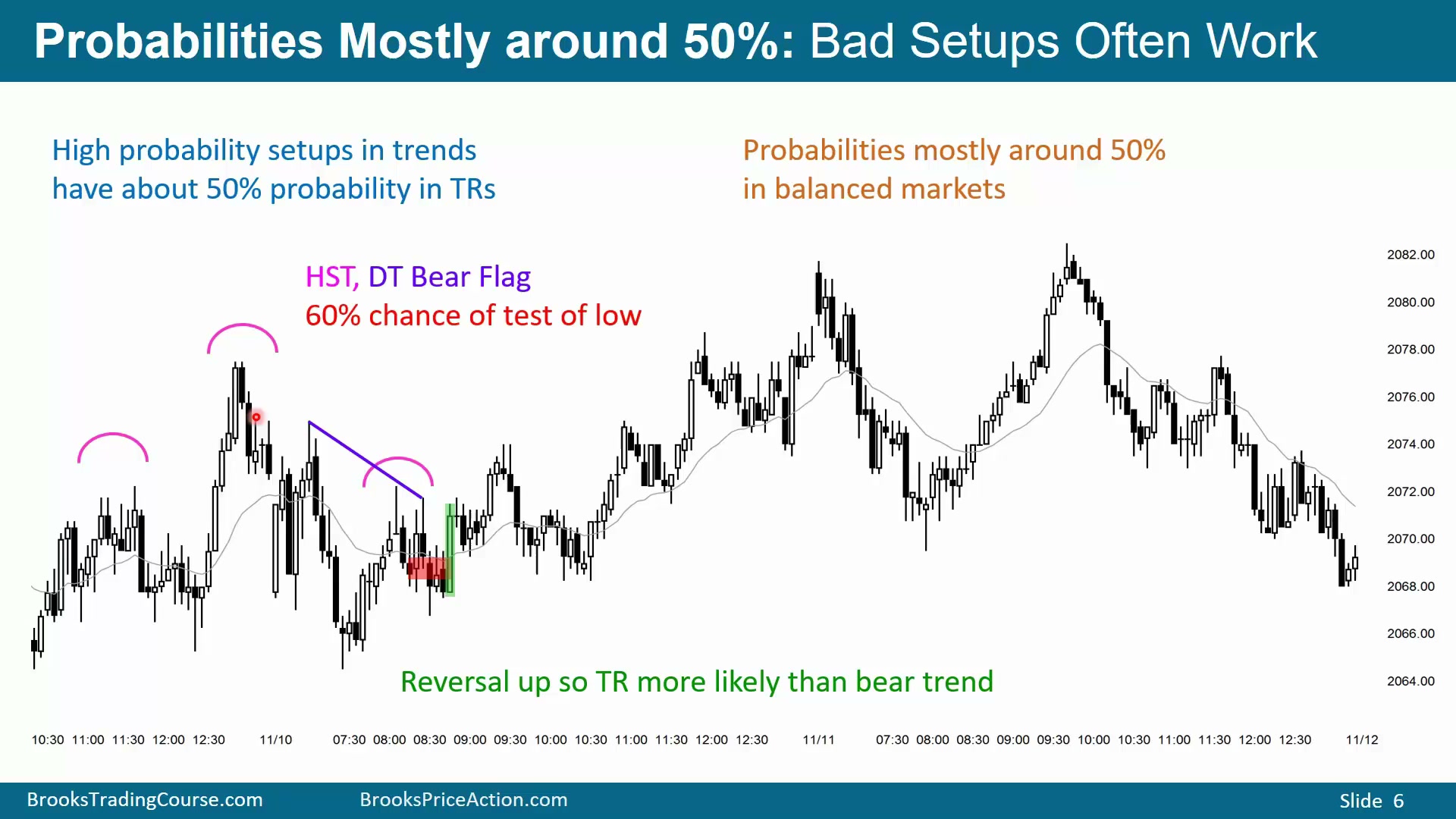
11:07 - 11:10

EN: Whenever something is a high probability setup in a trend

ZH: 每当你看到一个机会,它在趋势中的胜率很高

11:10 - 11:14

EN: and you see that pattern setting up in what you think is a Trading Range,

ZH: 但现在你认为市场更有可能是震荡区间

11:14 - 11:16

EN: the probability is not as high as you think.

ZH: 那么它的胜率就没有那么高了

11:16 - 11:19

EN: It’s probably more like 50% instead of 60%.

ZH: 概率变得只有50%,而不再是60%

11:26 - 11:30

EN: Head and Shoulders Top – left shoulder, head, and then right shoulder

ZH: 头肩顶——左肩、头,然后右肩

11:31 - 11:33

EN: - and there’s also a Double Top bear flag.

ZH: 还有一个双顶熊旗

11:33 - 11:38

EN: You would think 60% chance we would test the low,

ZH: 你觉得有60%的概率会测试前期低点, 也就是头肩顶的颈线

11:36 - 11:38

EN: the neckline of the Head and Shoulders Top,

ZH: 你觉得有60%的概率会测试前期低点, 也就是头肩顶的颈线

11:38 - 11:44

EN: but because so much of the trading is sideways,

ZH: 但左边全都在横盘震荡,所以概率没有60%那么高

11:41 - 11:44

EN: Trading Range, the probabilities are rarely ever 60%.

ZH: 但左边全都在横盘震荡,所以概率没有60%那么高

11:44 - 11:47

EN: So, it’s closer to 50/50.

ZH: 概率降低到了50%左右

11:51 - 11:54

EN: We got a pretty strong reversal up after the selloff

ZH: 在抛售之后,价格强势地反转上涨

11:54 - 12:00

EN: - a sign that instead of a continued bear trend, Lower Highs and Lower Lows,

ZH: 说明这不会是下降趋势,高点和低点不会一直降低

12:00 - 12:02

EN: this is probably a bear leg in a Trading Range,

ZH: 这段下跌更有可能会变成震荡区间

12:02 - 12:06

EN: and then this is probably the start of a bull leg in that same Trading Range.

ZH: 现在很可能正在进入区间中上涨波段

Slide 007

Time: 12:10

Slide 007

Bilingual Transcript

12:11 - 12:15

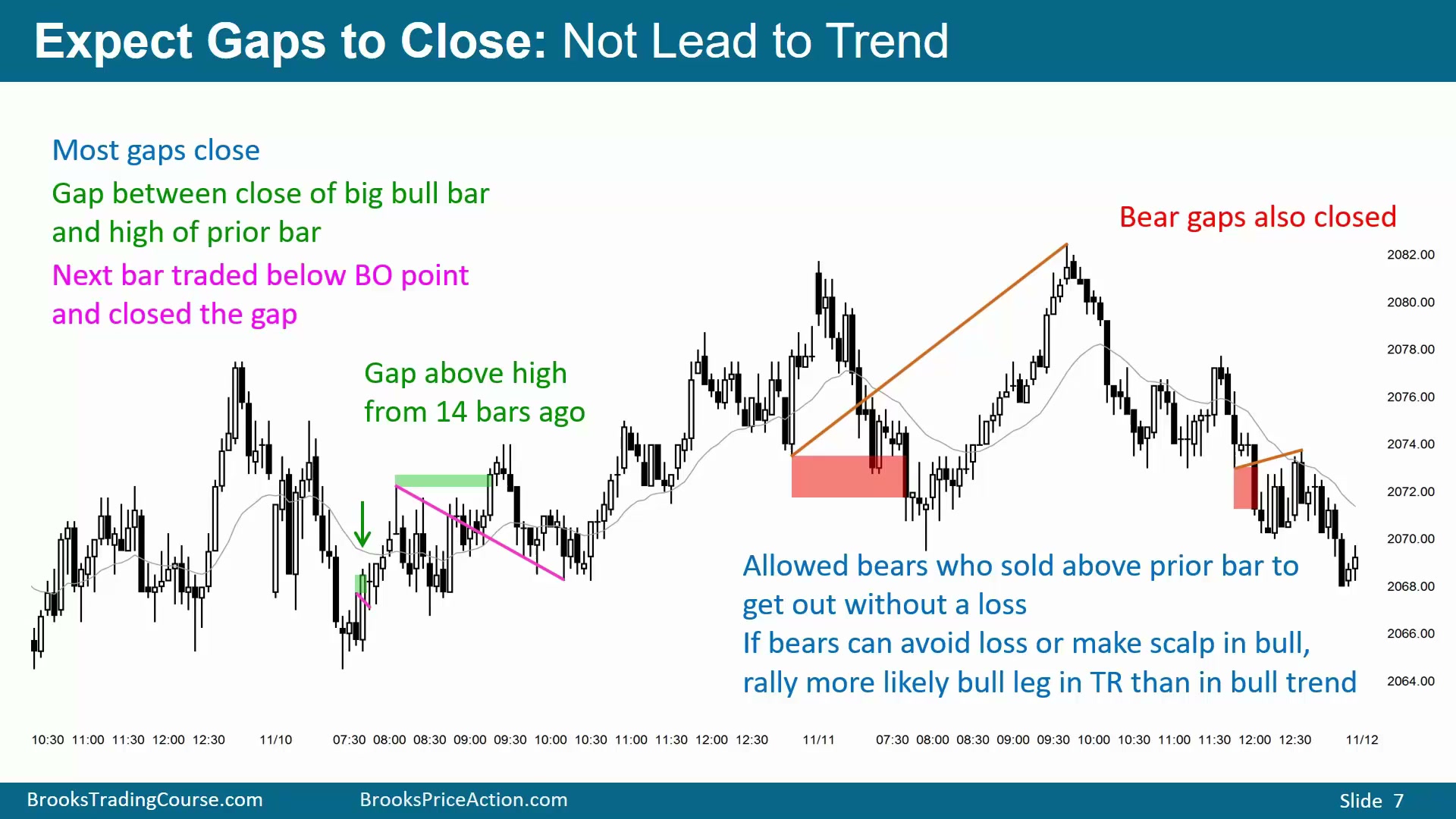
EN: I said that when the market’s in a Trading Range and you have a rally

ZH: 刚才讲过,如果是区间中的上涨或下跌波段,

12:15 - 12:19

EN: or a selloff, you get pullbacks beyond breakout points.

ZH: 回调或反弹经常会超过突破点

12:19 - 12:21

EN: In other words, a stairs type of pattern.

ZH: 换句话说,是阶梯式的

12:21 - 12:23

EN: That means most gaps close.

ZH: 大部分缺口都会被补掉

12:28 - 12:33

EN: Here we have a gap between the close of this bar and the high of the prior bar,

ZH: 这根K线的收盘价,和前一根K线的高点之间有缺口

12:33 - 12:36

EN: but if it’s a bull trend, higher probability the gap will stay open.

ZH: 如果是上涨趋势,缺口更有可能保持开放

12:37 - 12:43

EN: The next bar, the low fell below the high

ZH: 下一根K线跌破了突破点,缺口被填补

12:41 - 12:43

EN: of the breakout point and the gap closed.

ZH: 下一根K线跌破了突破点,缺口被填补

12:43 - 12:48

EN: That is more common if the rally is going to be a bull leg in a Trading Range.

ZH: 如果是震荡区间中的上涨波段, 这样的情况会更常见

12:52 - 12:58

EN: You can see the pullback; the following bar had a low

ZH: 可以看到,回调K线的最低点,低于突破点

12:56 - 12:58

EN: below the high of the breakout point.

ZH: 可以看到,回调K线的最低点,低于突破点

13:02 - 13:11

EN: Strong breakout above a prior high, and the market immediately pulled back

ZH: 强势突破前期高点,但市场立刻回调到它的下方, 然后继续下跌了很多

13:06 - 13:11

EN: below the high, and the pullback here went far below the breakout point.

ZH: 强势突破前期高点,但市场立刻回调到它的下方, 然后继续下跌了很多

13:11 - 13:13

EN: That gap closed.

ZH: 缺口被填补了

13:22 - 13:26

EN: These pullbacks allow bears to get out without a loss.

ZH: 这样的回调让空头至少不会亏钱

13:26 - 13:32

EN: So, bears selling at this high, they could be disappointed

ZH: 比如,在那个高点挂单做空的空头, 看到大阳线突破感到失望

13:30 - 13:33

EN: by the size of this bull bar and decide they want to get out breakeven.

ZH: 比如,在那个高点挂单做空的空头, 看到大阳线突破感到失望 于是想要争取打平离场(注:而不是再追求盈利)

13:33 - 13:35

EN: The next bar fell below the breakout point,

ZH: 下一根K线跌破了突破点

13:35 - 13:37

EN: and it allowed the bears to get out breakeven.

ZH: 所以空头能够顺利地打平离场

13:37 - 13:39

EN: The same right here.

ZH: 这里也是一样

13:39 - 13:41

EN: The bears who sold at this high,

ZH: 在这个高点挂单做空的空头

13:41 - 13:44

EN: the pullback was deep enough for them to make a profit.

ZH: 回调足够深,他们可以赚到钱

13:45 - 13:56

EN: If the bears can sell and avoid a loss like this

ZH: 如果空头可以不亏钱,或是像这样赚钱, 那么这个上涨波段大概率会变成震荡区间

13:49 - 13:56

EN: or make a profit like this, then the rally probably is going to be

ZH: 如果空头可以不亏钱,或是像这样赚钱, 那么这个上涨波段大概率会变成震荡区间

13:53 - 13:56

EN: a bull leg in what will end up as a Trading Range.

ZH: 如果空头可以不亏钱,或是像这样赚钱, 那么这个上涨波段大概率会变成震荡区间

13:58 - 14:00

EN: The opposite’s true for the bears.

ZH: 下降趋势中也是一样

14:00 - 14:04

EN: We have a gap between this close and that low.

ZH: 它的收盘价和那个低点之间有一个缺口

14:04 - 14:08

EN: Then we had a reversal back up above the breakout point,

ZH: 随后反弹超过了这个突破点

14:08 - 14:12

EN: and therefore the bulls who bought that low right here,

ZH: 因此在那个低点挂单买入的多头,

14:12 - 14:18

EN: if they did not scale in, this rally back above their entry price

ZH: 即使没有在下方加仓, 也能在价格涨回来的时候打平离场、避免亏损

14:16 - 14:18

EN: allowed them to get out without a loss.

ZH: 即使没有在下方加仓, 也能在价格涨回来的时候打平离场、避免亏损

14:18 - 14:22

EN: If they did scale in, the rally allowed them to make a profit.

ZH: 如果加仓的话,这笔交易能够赚钱

14:26 - 14:30

EN: We have a gap here, right here – this close and that low

ZH: 这里有一个缺口——它的收盘价和这个低点之间

14:30 - 14:34

EN: - and a bigger breakout here – this close and that low.

ZH: 还有一个更大的缺口——它的收盘价和这个低点

14:35 - 14:36

EN: Look at the pullback.

ZH: 看反弹的幅度

14:36 - 14:40

EN: The pullback went above the top of the bear swing.

ZH: 反弹甚至超过了下跌波段的起跌点

14:42 - 14:46

EN: So, bear gaps are also closing, just like the bull gaps are closing,

ZH: 所以和上涨波段一样,下跌波段中的缺口也都被补掉了

14:46 - 14:48

EN: and that’s one of the characteristics of a Trading Range.

ZH: 那是震荡区间的一个重要特征

14:53 - 14:59

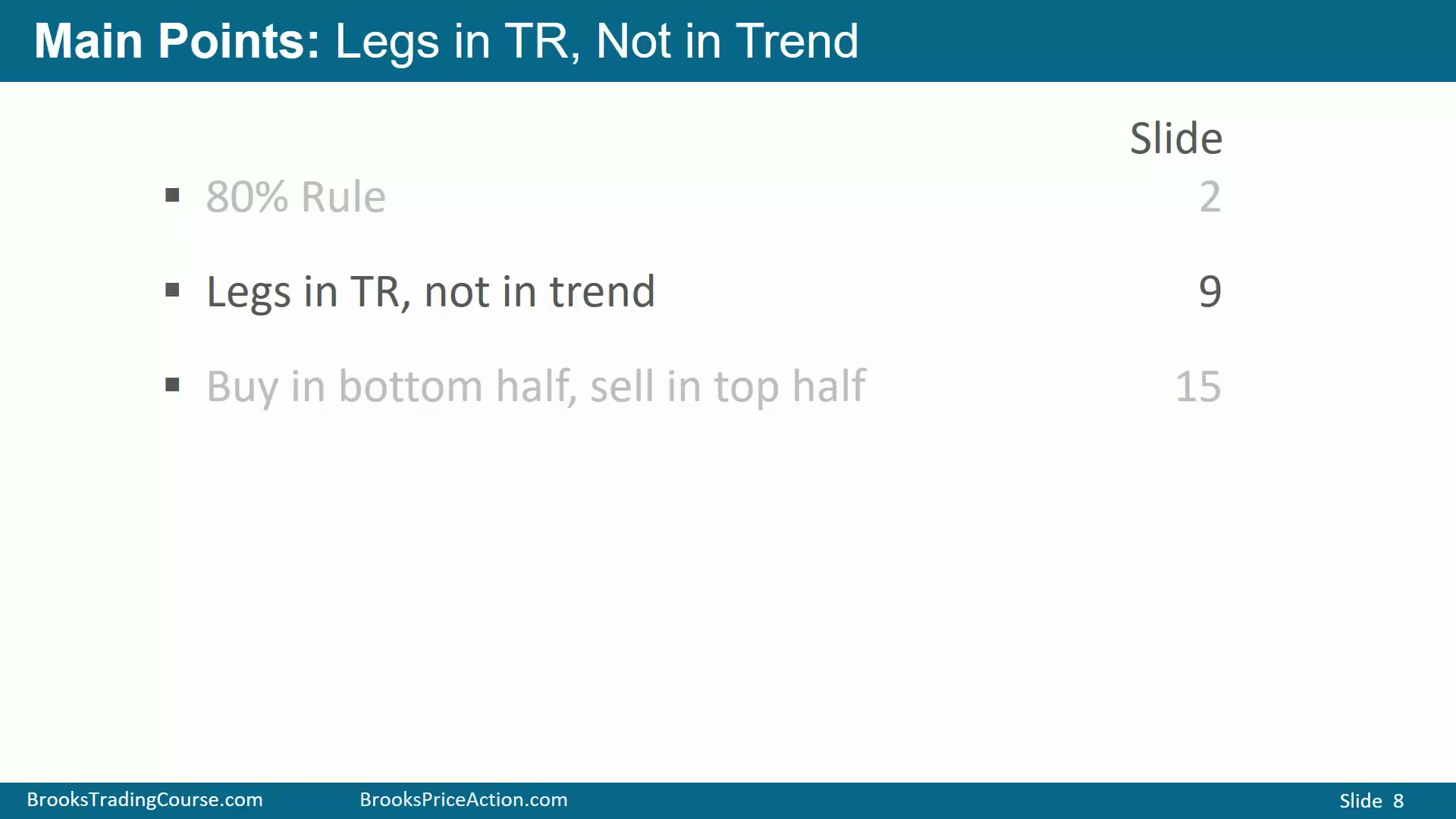
EN: I want to talk a little bit about legs

ZH: 我想对比一下震荡区间中的波段和趋势中的波段

Slide 008

Time: 14:55

Slide 008

Bilingual Transcript

14:55 - 14:59

EN: within a Trading Range instead of in a trend.

ZH: 我想对比一下震荡区间中的波段和趋势中的波段

Slide 009

Time: 15:00

Slide 009

Bilingual Transcript

15:05 - 15:07

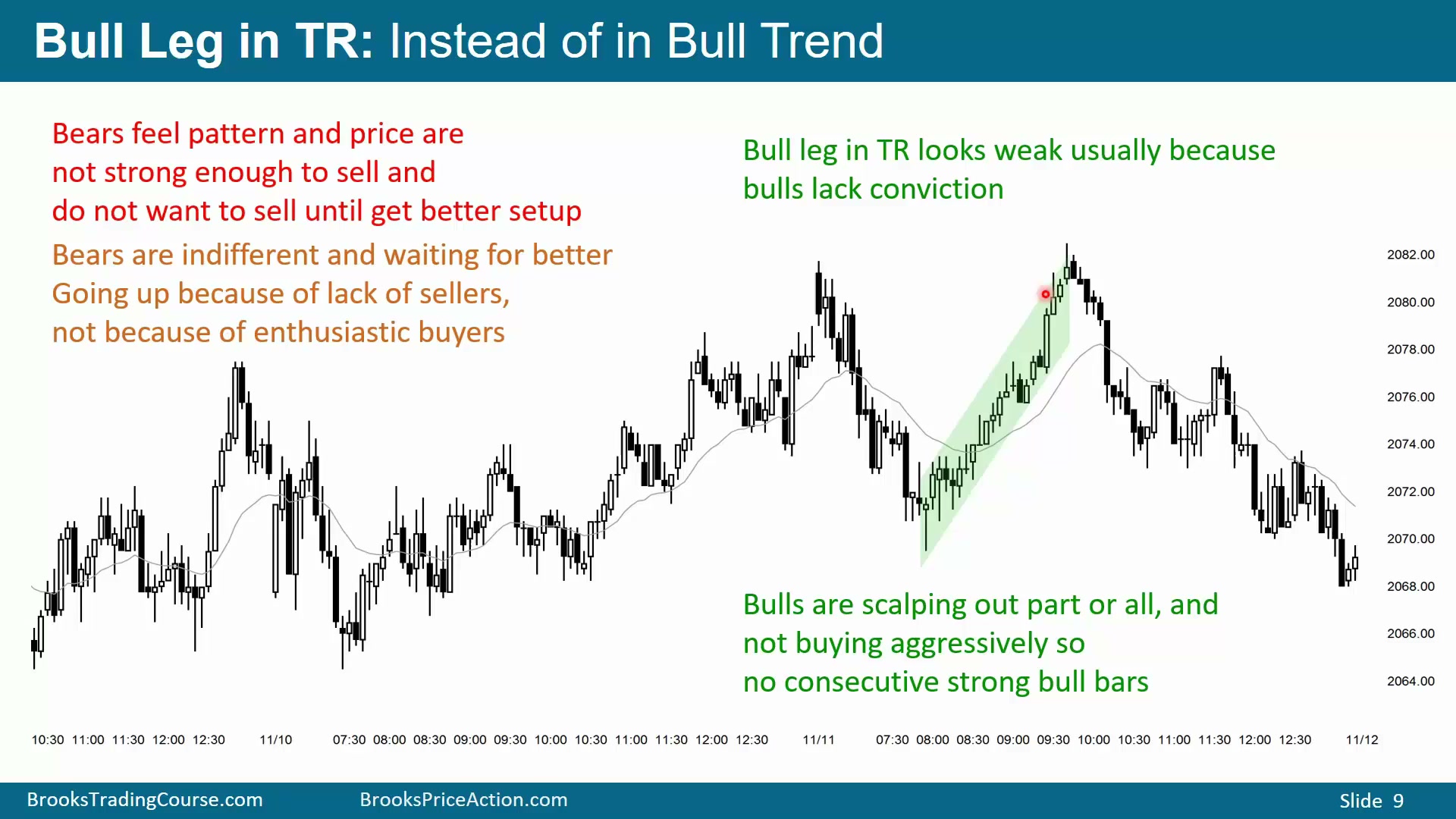
EN: Pretty good rally.

ZH: 非常好的上涨

15:07 - 15:09

EN: A very Tight Channel, a bull breakout.

ZH: 窄通道,向上突破

15:09 - 15:11

EN: But look to the left.

ZH: 但是看左边

15:12 - 15:15

EN: We’re barely above the top of the trend.

ZH: 只是略微超过前期高点

15:15 - 15:17

EN: We’re in a Broad Bull Channel at this point;

ZH: 此时市场处于宽上涨通道

15:17 - 15:21

EN: we have Higher Highs and Higher Lows, but it’s either a bull leg

ZH: 高点抬高,低点抬高, 但它要么是宽上涨通道中的上涨波段,

15:21 - 15:25

EN: in a Broad Bull Channel or a bull leg in a Trading Range.

ZH: 要么是震荡区间中的上涨波段,

15:26 - 15:30

EN: Look at the lack of consecutive big bull bars closing on their highs.

ZH: 没有连续的大阳线收在最高

15:30 - 15:33

EN: The bull bars that do close on their highs are not big,

ZH: 有的阳线确实收在最高,但体积并不大

15:33 - 15:36

EN: and we do not have consecutive big bull bars.

ZH: 而且没有连续的大阳线

15:36 - 15:40

EN: That is a characteristic of a rally that will end up in a Trading Range.

ZH: 震荡区间中的上涨波段都有这样的特征

15:40 - 15:45

EN: In other words, it’ll lead to a bear leg and not to a bull trend.

ZH: 换句话说,接下来会是一个下跌波段,而不是上涨趋势

15:50 - 15:57

EN: We get all of these tails on the tops of the bars

ZH: 所有这些上影线和回调,都是由于多头止盈而形成的

15:53 - 15:57

EN: and the pullbacks because the bulls are taking partial profits.

ZH: 所有这些上影线和回调,都是由于多头止盈而形成的

15:57 - 16:00

EN: When the market goes up a little, they take profits.

ZH: 当市场稍微有一些上涨,他们就止盈

16:00 - 16:04

EN: They lack confidence that the trend will continue up very far,

ZH: 多头对趋势大幅上涨缺乏信心

16:04 - 16:06

EN: so they keep taking profits.

ZH: 所以他们不断止盈

16:07 - 16:10

EN: The bears do not want to sell too low.

ZH: 空头不想卖得太低

16:10 - 16:14

EN: They see the market’s probably in a Trading Range, maybe a Broad Bull Channel.

ZH: 他们认为市场可能处于震荡区间,或者是宽上涨通道

16:14 - 16:15

EN: They want to sell high.

ZH: 他们想逢高做空

16:15 - 16:21

EN: They want to sell above prior highs, and very often they don’t want

ZH: 他们想要在前期高点的上方卖出做空, 而不是在前期高点下方卖出

16:18 - 16:21

EN: to sell too low below the prior high.

ZH: 他们想要在前期高点的上方卖出做空, 而不是在前期高点下方卖出

16:21 - 16:27

EN: That lack of selling by the bears can lead to a pretty strong reversal up.

ZH: 因为当中没有卖单,所以会形成非常强势的反转上涨

16:34 - 16:35

EN: They want to sell high.

ZH: 空头想要尽可能在高位卖出

16:35 - 16:37

EN: They don’t want to sell low.

ZH: 他们不想卖得太低

16:37 - 16:39

EN: So why is the market rallying?

ZH: 为什么市场强势上涨?

16:39 - 16:45

EN: It’s rallying because there are

ZH: 因为空头不愿意在这里卖出,所以没有卖盘

16:41 - 16:45

EN: not many sellers down here, so there are a lack of sellers.

ZH: 因为空头不愿意在这里卖出,所以没有卖盘

16:45 - 16:49

EN: The market has to go higher to find a price where bears are willing to sell.

ZH: 市场必须涨到更高的价格,才能找到更多愿意卖出的人

Slide 010

Time: 16:55

Slide 010

Bilingual Transcript

16:57 - 17:02

EN: This is I think important to distinguish from what I was just showing.

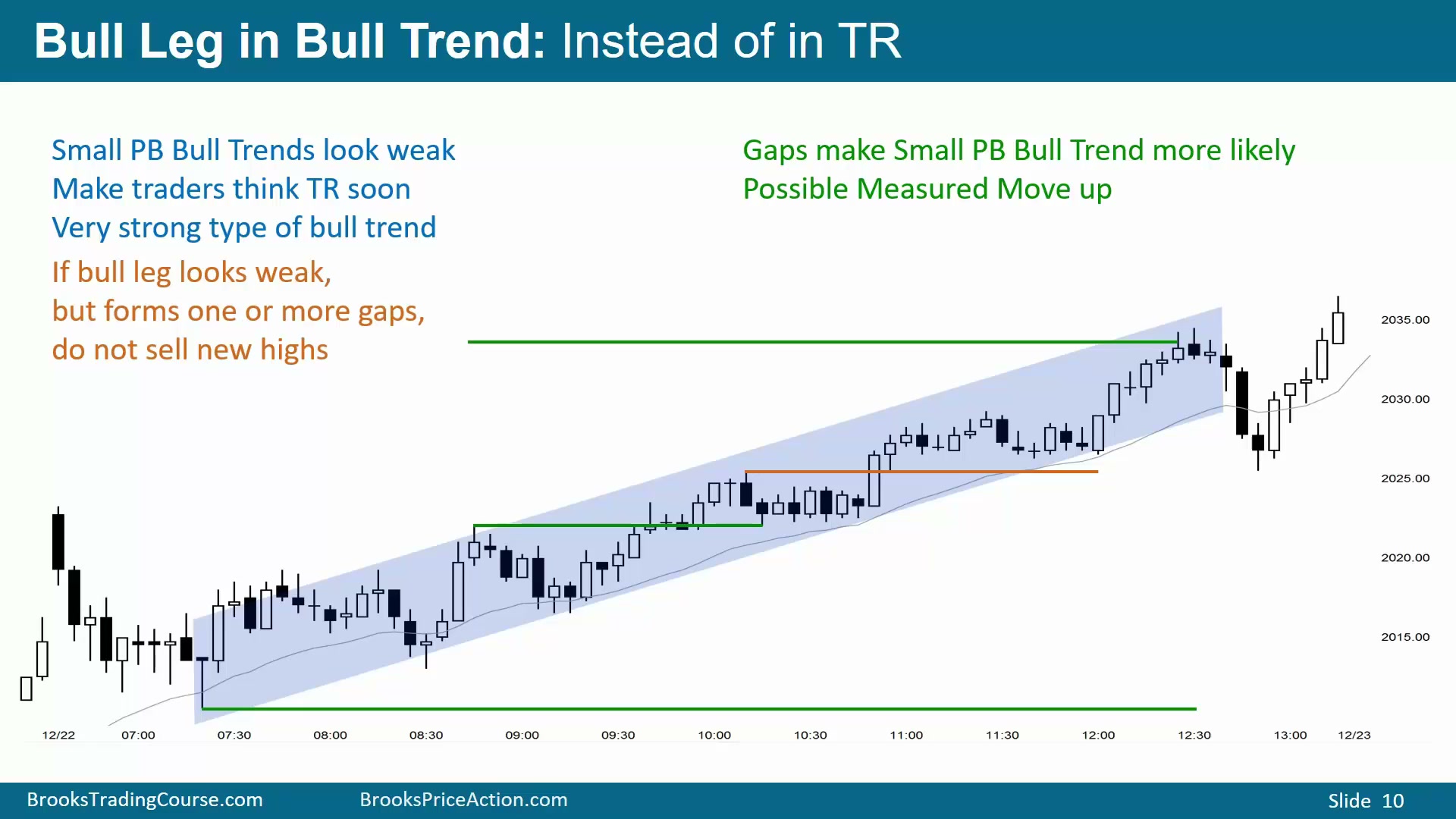
ZH: 这张图和刚才的案例是有区别的,你一定要能分辨

17:02 - 17:05

EN: We have a lack of consecutive big bull bars.

ZH: 它也没有连续的大阳线

17:05 - 17:08

EN: We have decent bull bar, but not consecutive big bull bars.

ZH: 有一些不错的阳线,但没有连续大阳线

17:08 - 17:10

EN: Terrible follow-through.

ZH: 跟随不好

17:10 - 17:12

EN: The same here, terrible follow-through, terrible follow-through.

ZH: 这里也是,跟随不好,跟随不好

17:12 - 17:19

EN: But what’s different between this rally

ZH: 那么这个上涨和之前课件中的上涨,到底有什么区别呢?

17:16 - 17:19

EN: and all the rallies that I’ve shown so far today?

ZH: 那么这个上涨和之前课件中的上涨,到底有什么区别呢?

17:23 - 17:25

EN: This: gaps.

ZH: 区别在于:缺口

17:26 - 17:29

EN: Whenever a rally looks weak and it looks like a bull leg in a Trading Range

ZH: 当上涨趋势看起来很弱,看起来只是震荡区间中的上涨

17:29 - 17:33

EN: but it’s forming gaps and negative (body) gaps – slight overlap.

ZH: 但它制造了缺口和实体缺口——影线略有重叠

17:33 - 17:35

EN: We have a breakout and a pullback.

ZH: 突破,回调

17:35 - 17:37

EN: Could not fall below this breakout point.

ZH: 没有跌回到突破点的下方

17:37 - 17:38

EN: We have a breakout.

ZH: 突破

17:38 - 17:42

EN: Does not look all that strong, but look at the pullback – here, here, here.

ZH: 看起来并不怎么强势,但是看回调——这里、这里、这里

17:42 - 17:44

EN: Could not fall below the breakout point.

ZH: 没能跌回到突破点的下方

17:44 - 17:49

EN: If you have a rally that looks weak but it’s forming two or three gaps,

ZH: 如果一个上涨趋势看起来很弱,但形成了两三个缺口

17:49 - 17:56

EN: it’s probably a Small Pullback Bull Trend and it probably is a bull trend

ZH: 那么它大概率是回调很小的上涨趋势—— 所以是趋势,而不是震荡区间中的上涨波段

17:54 - 17:56

EN: and not a bull leg in a Trading Range.

ZH: 那么它大概率是回调很小的上涨趋势—— 所以是趋势,而不是震荡区间中的上涨波段

17:56 - 17:59

EN: These gaps often lead to Measured Moves up.

ZH: 有缺口,所以大概率会涨到MM目标位

18:05 - 18:10

EN: If the market’s forming gaps or negative (body) gaps, just a little bit of an overlap,

ZH: 如果有实体缺口,只是影线有一点点重叠

18:10 - 18:15

EN: do not sell at prior highs and scale in higher because you will lose money.

ZH: 不要在前期高点挂单做空并在上方加仓, 因为这样做会亏钱

18:15 - 18:18

EN: For example, if you sold this high and scaled in higher,

ZH: 例如,如果你在这个高点挂单卖出,并且在上方加仓

18:18 - 18:21

EN: it never came back below the breakout point,

ZH: 价格从未跌回到突破点的下方

18:21 - 18:25

EN: and you would have had to cover, buy back your short with a loss.

ZH: 最终你不得不买入回补,接受亏损

18:25 - 18:26

EN: You would lose money.

ZH: 这样做会亏钱

18:27 - 18:30

EN: It’s a Small Pullback Bull Trend, not a bull leg in a Trading Range.

ZH: 这是回调很小的上涨趋势,不是震荡区间中的上涨波段

18:34 - 18:38

EN: Here, gap, and it did lead to a Measured Move up,

ZH: 缺口,然后涨到了MM目标位

18:38 - 18:40

EN: and you can see some profit-taking at the Measured Move up.

ZH: 可以看到在MM目标位有多头卖出止盈

18:40 - 18:43

EN: Aggressive bears might sell there for a scalp.

ZH: 激进的空头会在那里做空剥头皮

18:44 - 18:47

EN: Most of the selling is due to bulls taking profits.

ZH: 大多数卖盘来自于止盈的多头

Slide 011

Time: 18:49

Slide 011

Bilingual Transcript

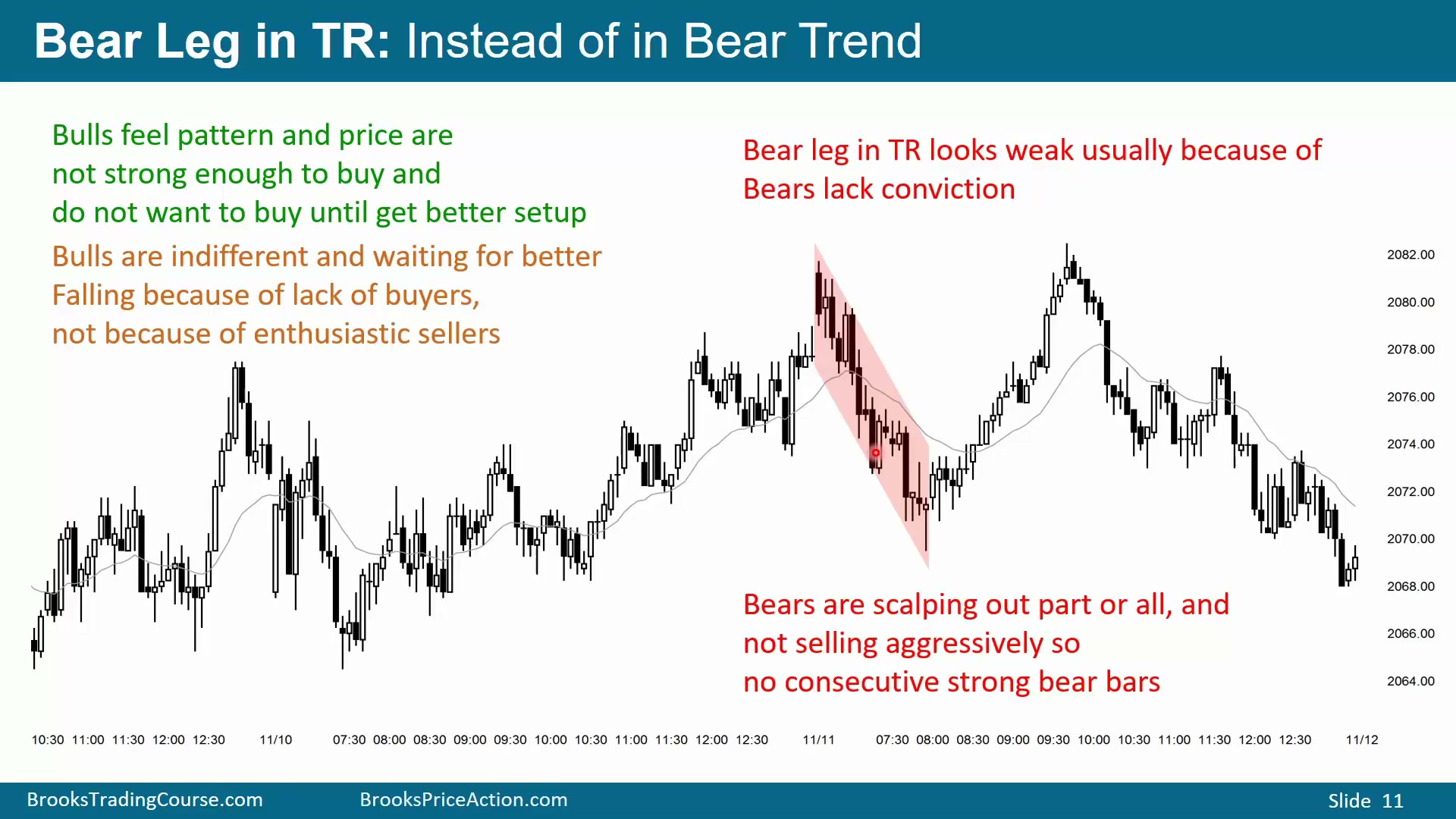
18:54 - 18:55

EN: We have a selloff.

ZH: 这段下跌

18:55 - 18:57

EN: We have a couple bear bars.

ZH: 其中有几根不错的阴线

18:57 - 18:59

EN: Why does this look weak?

ZH: 但为什么它很弱?

18:59 - 19:01

EN: Why does it look like a bear leg in a Trading Range?

ZH: 为什么只是震荡区间中的下跌波段?

19:01 - 19:04

EN: Well, the bears are lacking conviction.

ZH: 因为空头不够坚决

19:04 - 19:07

EN: We keep getting pauses after big bear bars because every time

ZH: 每次有大的阴线,后面下跌就会暂停

19:07 - 19:11

EN: the bears see a big bear bar, they see it as a gift

ZH: 因为空头把大阴线看作是市场的馈赠——

19:11 - 19:15

EN: - a surprisingly big bar allowing them to buy back their shorts for a profit.

ZH: 惊喜的大阴线,空头利用它来止盈

19:15 - 19:23

EN: They’re taking quick profits, so we keep getting reversals

ZH: 他们赚快钱离场,所以大阴线之后价格总是反弹, 而不是连续的下跌

19:19 - 19:23

EN: after big bear bars instead of a series of consecutive big bear bars.

ZH: 他们赚快钱离场,所以大阴线之后价格总是反弹, 而不是连续的下跌

19:23 - 19:25

EN: The bears lack conviction.

ZH: 空头不够坚定

19:25 - 19:28

EN: They do not believe the market is going down very far.

ZH: 他们不相信价格会大幅下跌

19:34 - 19:36

EN: They’re not selling at lows.

ZH: 他们不愿意追空

19:36 - 19:37

EN: They’re waiting to sell pullbacks.

ZH: 他们只想等反弹的时候卖出

19:37 - 19:43

EN: They’re buying back their shorts every strong bear bar,

ZH: 每次看到大阴线,他们就止盈,以防价格反弹

19:41 - 19:43

EN: betting that the market will pull back.

ZH: 每次看到大阴线,他们就止盈,以防价格反弹

19:50 - 19:54

EN: The bulls see that as well, but they don’t want to be buying high.

ZH: 多头也看到了这一点,但他们不想在高位买入

19:54 - 19:57

EN: They suspect it’s a Trading Range, and they prefer to buy low.

ZH: 他们怀疑现在是震荡区间,所以更倾向于在低位买入

19:58 - 20:04

EN: These little reversals are more due to bears taking profits

ZH: 这些小反弹主要是由空头止盈造成的,而不是多头买入

20:02 - 20:11

EN: and then selling again than from bulls buying, because they’re not willing

ZH: 这些小反弹主要是由空头止盈造成的,而不是多头买入 因为多头不想买在震荡区间的顶部,然后被套牢

20:06 - 20:11

EN: to buy too high up in a weak rally or at the top of a Trading Range.

ZH: 因为多头不想买在震荡区间的顶部,然后被套牢

20:17 - 20:25

EN: The bulls want to buy low, and the market’s falling

ZH: 多头想逢低买入,市场下跌是因为缺乏买盘, 而不是因为空头有多么兴奋

20:21 - 20:25

EN: because of a lack of buyers, not because of enthusiastic sellers.

ZH: 多头想逢低买入,市场下跌是因为缺乏买盘, 而不是因为空头有多么兴奋

20:25 - 20:29

EN: The bears keep buying back their shorts every time there’s a strong bear bar.

ZH: 每次看到大阴线,空头都利用它来止盈

Slide 012

Time: 20:33

Slide 012

Bilingual Transcript

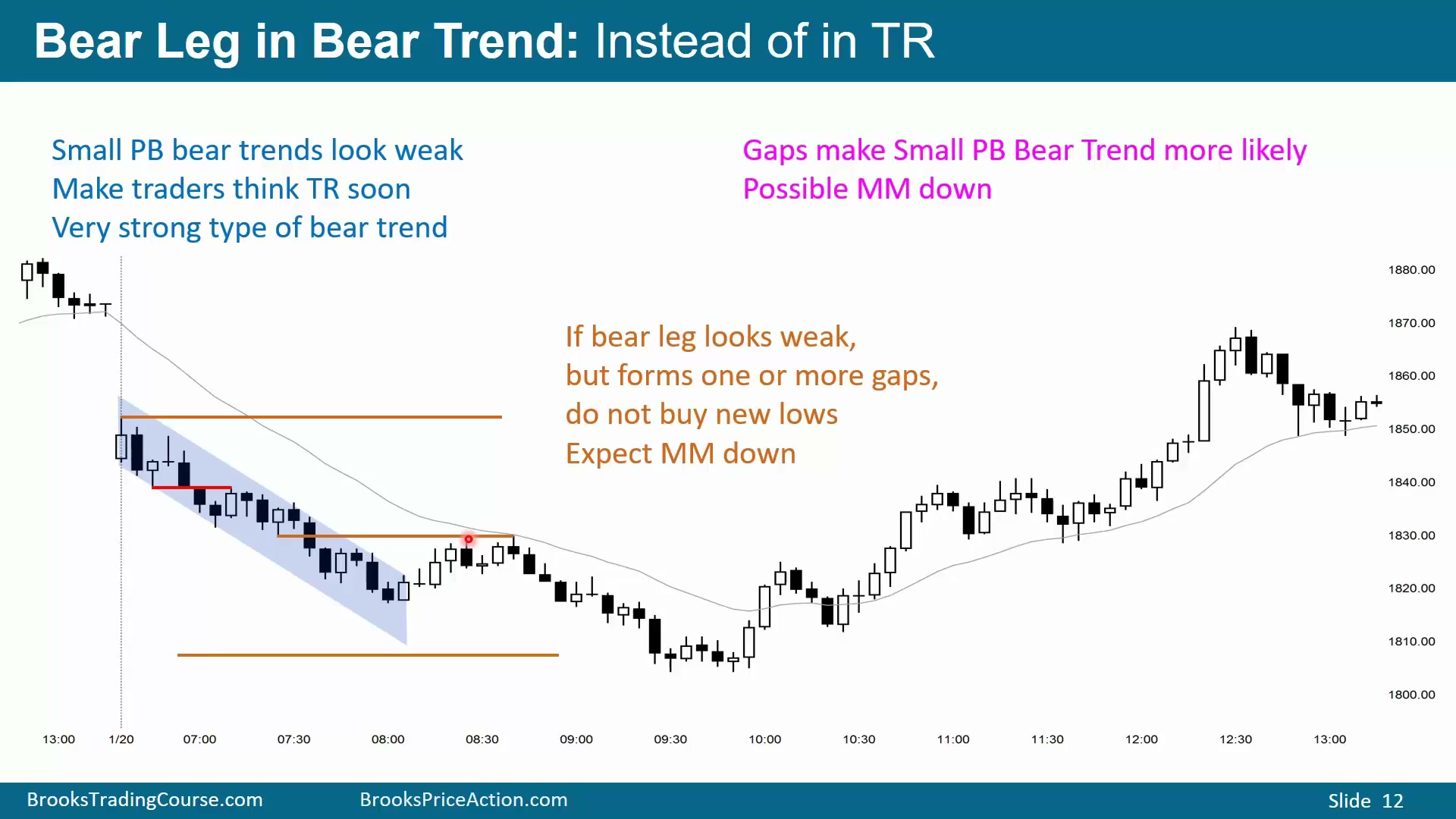
20:38 - 20:40

EN: We have a bear bar, bad follow-through.

ZH: 阴线,跟随很糟糕

20:40 - 20:42

EN: Bear bar’s not all that big.

ZH: 这些阴线体积并不大

20:43 - 20:46

EN: Bad follow-through, bad follow-through, lots of reversals up

ZH: 跟随糟糕,跟随糟糕,价格一直反弹

20:46 - 20:49

EN: - but a Small Pullback Bear Trend.

ZH: 但它是反弹很小的下降趋势

20:49 - 20:54

EN: We’re getting gaps, and that increases the chances that this is a bear trend

ZH: 空头制造了很多缺口,所以更有可能是下降趋势,

20:54 - 20:56

EN: and not just a bear leg in what will become a Trading Range.

ZH: 而不仅仅只是震荡区间中的下跌波段

20:56 - 21:01

EN: It’s a very strong type of bear trend, even though it looks weak.

ZH: 尽管看起来很弱,但这是一个非常强的下降趋势,

21:01 - 21:03

EN: Traders should not be buying.

ZH: 不能做多

21:08 - 21:10

EN: A pullback not overlapping the breakout point.

ZH: 反弹没有超过突破点

21:10 - 21:13

EN: A pullback not overlapping a breakout point.

ZH: 反弹没有超过突破点

21:13 - 21:17

EN: Small Pullback Bear Trend that is a bear trend.

ZH: 它是反弹很小的下降趋势

21:17 - 21:22

EN: It turns out we got a reversal and you can call the whole thing a Trading Range,

ZH: 尽管最终反转上涨了,最终是震荡区间日

21:22 - 21:27

EN: but when you see a selloff that does not look strong, yet it’s forming gaps,

ZH: 但当你看到一个下降趋势,看起来不强,却一直在制造缺口

21:27 - 21:29

EN: it’s probably a Small Pullback Bear Trend

ZH: 那很有可能是反弹很小的下降趋势

21:29 - 21:32

EN: and therefore it’s probably going lower – a lot lower.

ZH: 所以大概率会继续下跌——下跌很多

21:32 - 21:34

EN: Do not look to buy.

ZH: 不能做多

21:40 - 21:42

EN: We have a gap.

ZH: 因为有缺口

21:42 - 21:46

EN: We fell below a Measured Move, from here to this potential Measured Move.

ZH: 从这个高点到缺口的MM目标位被跌破了

21:46 - 21:50

EN: We did fall to a Measured Move based upon this gap.

ZH: 然后跌到下一个缺口的MM目标位

21:50 - 21:51

EN: It became a Measuring Gap.

ZH: 它是测量型缺口

21:52 - 21:54

EN: So, when you’re seeing a Small Pullback Bear Trend

ZH: 所以,当你在反弹很小的下降趋势中看到缺口,

21:54 - 22:00

EN: and you’re getting gaps, you have to be thinking that one

ZH: 你必须考虑到,价格会跌到某个缺口的MM目标位

21:58 - 22:00

EN: or more of those gaps will lead to a Measured Move down.

ZH: 你必须考虑到,价格会跌到某个缺口的MM目标位

Slide 013

Time: 22:05

Slide 013

Bilingual Transcript

22:08 - 22:13

EN: I talked about the characteristics of a Trading Range leg versus a trend leg.

ZH: 我讲解了震荡区间中的波段,和趋势中的波段各自的特征

22:14 - 22:19

EN: All the signs that the market’s in a Trading Range

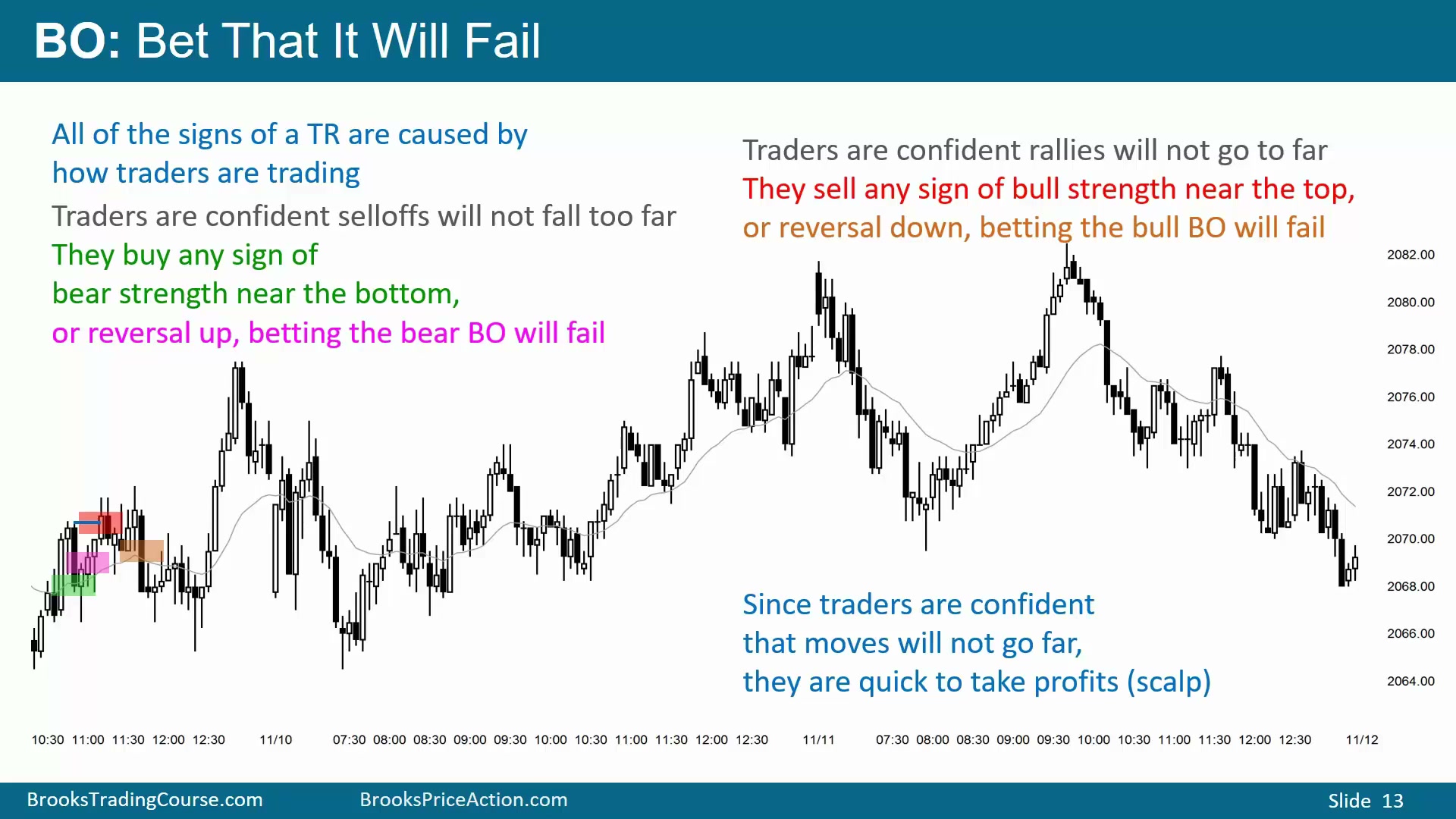
ZH: 表明市场处于震荡区间的信号,是由交易者的策略发出的

22:16 - 22:19

EN: are due to how traders are trading.

ZH: 表明市场处于震荡区间的信号,是由交易者的策略发出的

22:25 - 22:28

EN: The traders believe the selloffs will not get too far,

ZH: 交易者认为市场不会下跌太多

22:28 - 22:31

EN: and therefore they don’t want to sell near the bottom,

ZH: 所以他们不想在低位卖出做空

22:31 - 22:34

EN: and the bulls believe the selloffs and bear breakouts will fail,

ZH: 多头认为空头向下跌破的尝试会失败

22:34 - 22:37

EN: and they’re looking to buy low, betting on a reversal up.

ZH: 所以他们逢低买入,押注价格会反转上涨

22:37 - 22:41

EN: Then the opposite is true when the market gets up near prior highs.

ZH: 当市场接近前期高点时也是一样

22:41 - 22:44

EN: The bears are much more interested in selling rallies,

ZH: 空头更愿意在反弹时卖出做空

22:44 - 22:47

EN: but they’re not willing to hold their shorts for very long

ZH: 但他们不愿意持有太久

22:47 - 22:51

EN: because they’re not confident the reversals down will get very far,

ZH: 因为他们对大幅下跌没有信心

22:51 - 22:53

EN: and the bulls are not willing to buy high.

ZH: 同时多头不愿意在高位追涨

22:54 - 22:58

EN: They’re looking to sell rallies to take profits

ZH: 他们在低位买入之后,利用反弹的机会止盈

22:56 - 22:58

EN: on the longs that they bought lower.

ZH: 他们在低位买入之后,利用反弹的机会止盈

22:59 - 23:01

EN: Bulls are buying low, selling high.

ZH: 多头逢低做多,逢高止盈

23:01 - 23:04

EN: Bears are selling high and buying low.

ZH: 空头逢高做空,逢低止盈

23:04 - 23:06

EN: So, both bulls and bears are buying low, selling high,

ZH: 所以,多头和空头都在低买、高卖

23:06 - 23:10

EN: and both are taking quick profits, and the result is a Trading Range.

ZH: 而且都在剥头皮赚快钱,所以导致了震荡区间

23:10 - 23:13

EN: That is why when the market’s in a Trading Range,

ZH: 这就是为什么当市场处于震荡区间时

23:13 - 23:16

EN: traders should look to buy low, sell high, and scalp.

ZH: 交易者应该低买、高卖,做剥头皮交易

23:16 - 23:17

EN: Take quick profits.

ZH: 赚了就跑

23:19 - 23:22

EN: The bulls actually are buying bear reversals,

ZH: 多头会在大阴线的收盘买入

23:22 - 23:24

EN: betting that the reversals will fail.

ZH: 押注空头反转失败

23:24 - 23:32

EN: So, a strong bear bar, a lot of bulls will buy that if they think

ZH: 大阴线,多头在它的收盘买入,押注这是震荡区间, 他们也会在反转上涨时买入

23:29 - 23:32

EN: this is a Trading Range, and they’ll also buy a reversal up.

ZH: 大阴线,多头在它的收盘买入,押注这是震荡区间, 他们也会在反转上涨时买入

23:39 - 23:42

EN: When the market’s near the top, bears will do the opposite.

ZH: 当市场接近区间顶部时,空头也是一样的做法

23:42 - 23:44

EN: Every time they see a strong bull bar,

ZH: 每当他们看到一根大阳线

23:45 - 23:48

EN: they’ll sell it and they’ll sell a reversal down.

ZH: 他们就卖出做空,或者在反转下跌时卖出做空

23:49 - 23:52

EN: A bull breakout, bears will sell and they’ll take profits.

ZH: 向上突破时,空头做空,并快速止盈

23:53 - 23:55

EN: Take quick profits on the way down.

ZH: 在下跌过程中赚了就跑

23:59 - 24:07

EN: Neither the bulls nor the bears believe that the market’s going to go

ZH: 多头和空头都不认为价格会有很大的波动, 所以他们赚快钱离场

24:02 - 24:07

EN: very far up or down, and the result is they take quick profits.

ZH: 多头和空头都不认为价格会有很大的波动, 所以他们赚快钱离场

24:07 - 24:11

EN: Sometimes they can swing trade, but in general they’re not expecting

ZH: 有时区间足够宽,也可以做波段交易,

24:11 - 24:15

EN: a big trend up or down, and they’re looking to take quick profits.

ZH: 但总体上他们并不期待会有大幅的上涨或下跌

Slide 014

Time: 24:19

Slide 014

Bilingual Transcript

24:20 - 24:23

EN: When the market’s in a Trading Range, traders should look to buy low

ZH: 当市场处于震荡区间时,交易者应该逢低买入——

24:23 - 24:27

EN: - buy in the bottom half – and sell high – sell in the top half.

ZH: 在下半部分买入; 逢高卖出——在上半部分卖出

Slide 015

Time: 24:28

Slide 015

Bilingual Transcript

24:33 - 24:36

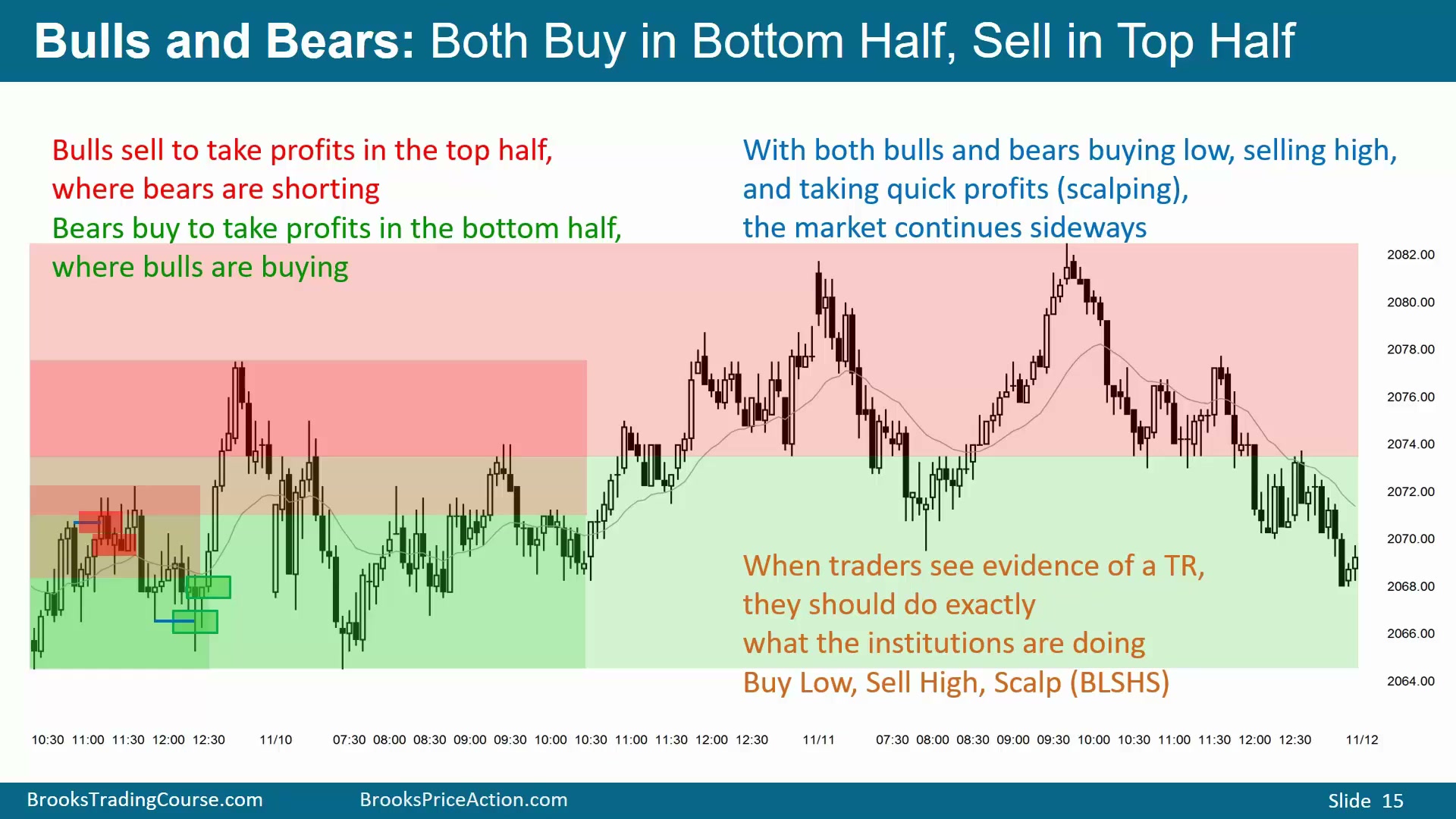
EN: At this point the market’s in a Trading Range right here,

ZH: 此时市场处于震荡区间

24:36 - 24:38

EN: and this is the top half.

ZH: 这是区间的上半部分

24:38 - 24:44

EN: Bears are going to sell in the top half and bulls

ZH: 空头会在上半部分卖出做空,同时多头会卖出止盈

24:41 - 24:44

EN: are going to sell out of their longs to take profits.

ZH: 空头会在上半部分卖出做空,同时多头会卖出止盈

24:48 - 24:50

EN: In the bottom half, the opposite is true.

ZH: 等价格跌到下半部分

24:50 - 24:54

EN: The bears are going to buy back their shorts

ZH: 空头买入止盈,多头买入做多

24:52 - 24:54

EN: and the bulls are going to buy to get long.

ZH: 空头买入止盈,多头买入做多

24:57 - 25:07

EN: As more bars get added, the Trading Range can expand, and you get a new top half

ZH: 随着K线越来越多,震荡区间会扩张, 上半部分和下半部分的范围发生了变化,但交易的方法不变

25:03 - 25:07

EN: and a new bottom half, and traders will do the same as they did earlier.

ZH: 随着K线越来越多,震荡区间会扩张, 上半部分和下半部分的范围发生了变化,但交易的方法不变

25:07 - 25:08

EN: Same here.

ZH: 一样的策略

25:08 - 25:10

EN: At this point the Trading Range high is up here,

ZH: 此时,区间的高点在这里,

25:10 - 25:14

EN: the low is down here, and bears will look to sell in the top half

ZH: 低点在那里,空头会在上半部分做空

25:14 - 25:16

EN: and bulls will look to buy in the bottom half.

ZH: 多头会在下半部分买入

25:21 - 25:29

EN: Because both bulls and bears are buying low, selling high,

ZH: 因为多空双方都在低买、高卖、赚快钱, 所以市场继续横盘震荡

25:25 - 25:29

EN: and taking quick profits, the market continues sideways.

ZH: 因为多空双方都在低买、高卖、赚快钱, 所以市场继续横盘震荡

25:29 - 25:33

EN: The market will create a Trading Range when traders trade that way.

ZH: 当交易者这样交易时,市场就形成了震荡区间

25:39 - 25:42

EN: As a trader, if you see evidence of a Trading Range,

ZH: 如果看到了震荡区间的信号

25:42 - 25:45

EN: you should do exactly what the institutions are doing,

ZH: 你应该完全按照机构的方法去交易——

25:45 - 25:47

EN: and that’s buy low, sell high, and scalp.

ZH: 低买、高卖,剥头皮赚快钱

25:48 - 25:51

EN: Here’s my acronym: BLSHS.

ZH: 缩写:BLSHS (注:Buy Low Sell High Scalp的首字母)

Slide 016

Time: 25:54

Slide 016

Bilingual Transcript

25:58 - 26:01

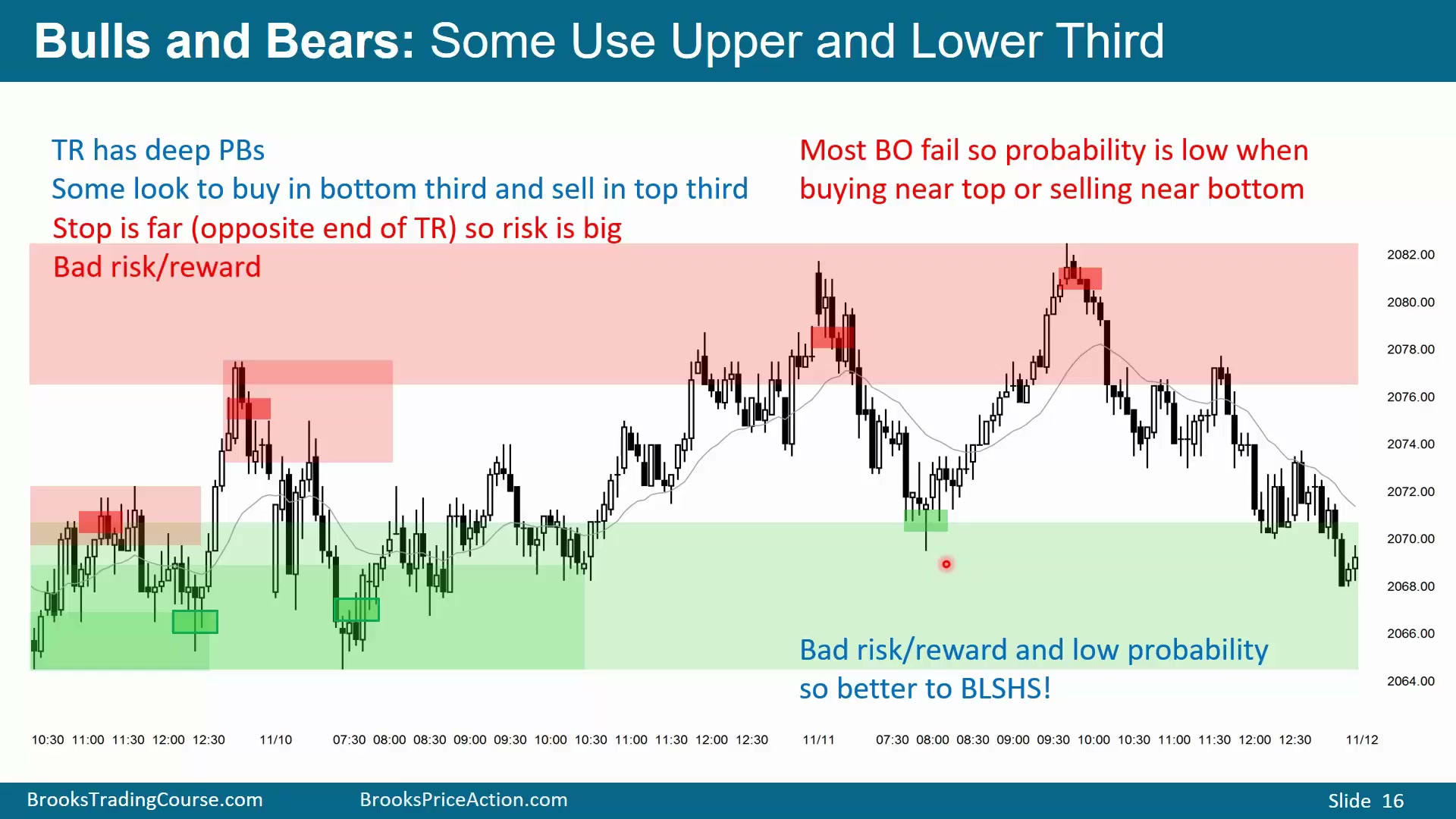
EN: Trading Ranges often have very deep pullbacks,

ZH: 震荡区间里经常会有非常深的回调或反弹

26:01 - 26:05

EN: and therefore a lot of traders prefer to buy in the bottom third

ZH: 因此很多交易者更喜欢在底部三分之一买入,

26:05 - 26:09

EN: and sell in the top third and do nothing in the middle third.

ZH: 在顶部三分之一卖出, 在中间三分之一的时候不做交易

26:10 - 26:12

EN: At this point we have a Trading Range.

ZH: 此时市场处于震荡区间

26:12 - 26:14

EN: It looks like a bull leg in a Trading Range.

ZH: 它看起来像是震荡区间中的一个上涨波段

26:14 - 26:18

EN: Traders want to sell in the top third and buy in the bottom third,

ZH: 交易者想在顶部三分之一卖出, 在底部三分之一买入

26:18 - 26:21

EN: either with limit orders or reversals up.

ZH: 要么挂限价单,要么在反转上涨时用突破单买入

26:22 - 26:25

EN: At this point the Trading Range is bigger.

ZH: 到了这里,震荡区间扩大了

26:25 - 26:28

EN: Traders want to sell in the top third, buy in the bottom third.

ZH: 交易者想在顶部三分之一卖出,底部三分之一买入

26:30 - 26:32

EN: A bigger Trading Range.

ZH: 更大的震荡区间

26:32 - 26:35

EN: Whenever the market’s in the bottom third, they’re looking to buy,

ZH: 每当价格跌到底部三分之一,多头就找机会做多

26:35 - 26:39

EN: either with a limit order on a reversal up – and when it’s in the top third,

ZH: 要么挂限价买单,要么在反转上涨时用突破单买入; 当价格涨到顶部三分之一

26:39 - 26:42

EN: they’re looking for reasons to sell, like a reversal down.

ZH: 空头就找机会做空,比如在反转下跌时卖出

26:42 - 26:44

EN: Especially a reversal down above a prior high.

ZH: 尤其是当价格从前期高点上方反转下跌的时候

26:49 - 26:57

EN: In general, stops can be very far away because a lot of traders

ZH: 通常来说,止损有可能比较大, 因为很多交易者会使用宽止损并加仓,所以风险比较大

26:52 - 26:57

EN: will use wide stops and scale in, and the result is the risk is big.

ZH: 通常来说,止损有可能比较大, 因为很多交易者会使用宽止损并加仓,所以风险比较大

26:57 - 27:00

EN: So, the risk/reward ratio is not all that good.

ZH: 盈亏比并没有那么好

27:00 - 27:04

EN: You’re taking quick profits, so the reward is not all that big.

ZH: 剥头皮赚快钱,所以利润并不大

27:05 - 27:12

EN: Because most breakouts fail, the probability is low

ZH: 但大部分突破都会失败, 在顶部追涨,或者在底部追空,胜率是很低的

27:09 - 27:12

EN: when buying near the top and selling near the bottom.

ZH: 但大部分突破都会失败, 在顶部追涨,或者在底部追空,胜率是很低的

27:12 - 27:15

EN: If you’re buying up here betting on a breakout, you’re probably going to lose.

ZH: 如果在这里追涨,押注突破成功,大概率是会亏钱的

27:15 - 27:17

EN: The probability is the breakout will fail.

ZH: 突破更有可能会失败

27:17 - 27:25

EN: The opposite’s true selling in the lower third, betting on the breakout

ZH: 同样,在底部三分之一做空, 押注向下跌破、进入下降趋势,这么做的胜率很低

27:22 - 27:25

EN: and the conversion into a bear trend, a low probability bet.

ZH: 同样,在底部三分之一做空, 押注向下跌破、进入下降趋势,这么做的胜率很低

27:29 - 27:37

EN: Therefore, if you’re looking to buy at the top, your stop is far away,

ZH: 如果你在顶部买入,你的止损很远、风险很大, 剩余的利润也不多,而且胜率又低

27:34 - 27:37

EN: the risk is big, probably not much reward, and the probability is low.

ZH: 如果你在顶部买入,你的止损很远、风险很大, 剩余的利润也不多,而且胜率又低

27:37 - 27:41

EN: That’s a bad Trader’s Equation for traders looking to buy high.

ZH: 所以在顶部追涨的数学期望很差

27:41 - 27:44

EN: The opposite is true for traders looking to sell low.

ZH: 在底部做空也是一样

27:44 - 27:46

EN: If you’re selling down here, your stop is up here.

ZH: 如果你在这里做空,止损在很上面

27:46 - 27:47

EN: Your risk is big.

ZH: 所以风险大

27:48 - 27:53

EN: Your reward is probably not great; because we’re in a Trading Range,

ZH: 剩余的利润大概率不多了, 因为市场处于震荡区间,不会下跌很远

27:51 - 27:53

EN: it’s probably not going to fall all that far.

ZH: 剩余的利润大概率不多了, 因为市场处于震荡区间,不会下跌很远

27:53 - 27:59

EN: So, you have bad risk/reward and you have low probability

ZH: 不但盈亏比很糟糕,而且胜率也低, 因为大部分突破的尝试都会失败

27:57 - 27:59

EN: because most breakout attempts fail.

ZH: 不但盈亏比很糟糕,而且胜率也低, 因为大部分突破的尝试都会失败

27:59 - 28:03

EN: This attempt to convert into a bear trend probably will fail.

ZH: 让市场进入下降趋势的尝试大概率会失败

28:03 - 28:06

EN: So, it’s better to look to buy low and sell high.

ZH: 所以,最好逢低买入,逢高卖出

Slide 017

Time: 28:10

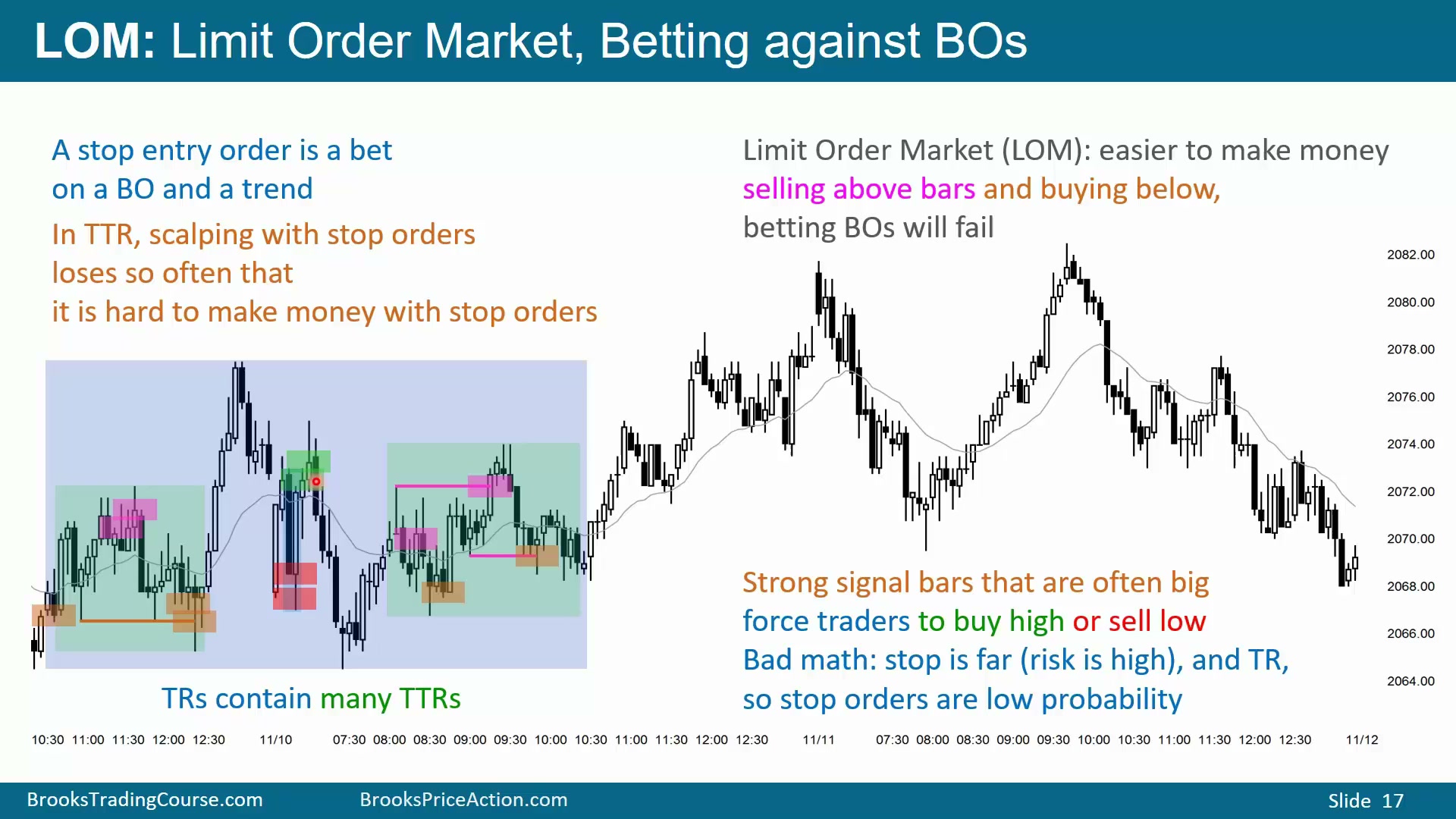
Slide 017

Bilingual Transcript

28:13 - 28:17

EN: A stop entry is a bet on a breakout and a trend.

ZH: 用突破单入场,是押注突破成功、进入趋势

28:21 - 28:30

EN: When the market’s in a Tight Trading Range, instead of buying with stops

ZH: 当市场处于窄震荡区间时, 与其在顶部用突破买单做多、押注上涨趋势, 不如用限价卖单逢高做空

28:25 - 28:30

EN: at the top betting on a trend, it’s better to sell with a limit order

ZH: 与其在顶部用突破买单做多、押注上涨趋势, 不如用限价卖单逢高做空

28:29 - 28:32

EN: at the top, betting on a continued Tight Trading Range.

ZH: 与其在顶部用突破买单做多、押注上涨趋势, 不如用限价卖单逢高做空 押注窄震荡区间会继续

28:32 - 28:36

EN: Instead of selling with a stop at the bottom betting on the conversion

ZH: 与其在底部用突破卖单做空、押注下降趋势,

28:36 - 28:39

EN: into a trend, it’s better to be buying with a limit order,

ZH: 不如用限价买单逢低做多

28:39 - 28:44

EN: betting on a failed breakout and a reversal back up

ZH: 押注突破失败,会反弹回到窄区间里面

28:43 - 28:44

EN: into the Tight Trading Range.

ZH: 押注突破失败,会反弹回到窄区间里面

28:44 - 28:47

EN: When the range is very tight, most traders should not trade.

ZH: 如果区间非常窄,那么大部分人都不应该交易

28:53 - 28:55

EN: It’s a limit order market.

ZH: 它是限价单市场

28:55 - 28:59

EN: Easier to make money selling above bars and buying below,

ZH: 逢高做空、逢低做多、押注突破失败,更容易赚钱 (注:新手不应该这样做,因为没有能力应对突如其来的突破)

28:57 - 28:59

EN: betting that breakouts will fail.

ZH: 逢高做空、逢低做多、押注突破失败,更容易赚钱 (注:新手不应该这样做,因为没有能力应对突如其来的突破)

28:59 - 29:02

EN: A limit order is basically the opposite of a stop order.

ZH: 限价单基本上就是突破单的对手盘

29:02 - 29:06

EN: A stop order is betting that a trend is beginning;

ZH: 突破单押注趋势开始

29:06 - 29:10

EN: a limit order is betting that there’ll be a reversal instead of a trend.

ZH: 限价单押注会有反转,而不是进入趋势

29:13 - 29:18

EN: Better to be looking to buy below and sell above and not the opposite.

ZH: 在区间里最好逢低买入,逢高卖出,不要做反了

29:27 - 29:31

EN: Very often you’ll get very big signal bars inside of Trading Ranges.

ZH: 在震荡区间里,你经常会看到非常大的信号K线

29:32 - 29:35

EN: They look strong, but if you look to the left,

ZH: 它们看起来很强,但如果看左边

29:35 - 29:38

EN: you see the market’s in a Trading Range, so the context is bad.

ZH: 你发现市场处于震荡区间,所以背景并不好

29:38 - 29:42

EN: So, for example, here we have a very big bear bar.

ZH: 例如,这里有一根非常大的阴线

29:42 - 29:44

EN: Do you really want to be selling below that big bear bar?

ZH: 可以在它的下方卖出做空吗?

29:44 - 29:45

EN: No.

ZH: 不能

29:45 - 29:50

EN: It’s a big bar, so the risk is big – at a minimum the stop is above the bar,

ZH: 它的体积很大,所以止损很远——至少放在它的高点上方

29:50 - 29:54

EN: maybe all the way up here – and it’s forcing you to sell

ZH: 甚至放在这个高点上方; 它迫使你在区间的底部卖出做空

29:53 - 29:54

EN: at the bottom of a Trading Range.

ZH: 甚至放在这个高点上方; 它迫使你在区间的底部卖出做空

29:54 - 29:57

EN: So, the reward is small and the probability is bad.

ZH: 利润很小、胜率很低

29:57 - 30:01

EN: Probably more buyers than sellers below that big bear bar.

ZH: 在这根大阴线的下方,大概率会有更多人买入,而不是卖出

30:02 - 30:05

EN: The opposite’s true here with this big bull bar.

ZH: 这根大阳线也是一样

30:05 - 30:07

EN: The bar is big, so the stop is far.

ZH: 体积很大,所以止损很远

30:07 - 30:08

EN: The risk is great.

ZH: 风险很大

30:08 - 30:12

EN: There’s not much reward because it’ll probably remain in a Trading Range,

ZH: 剩余的利润不多了,因为市场大概率会继续震荡

30:12 - 30:15

EN: and the probability is not good buying in the top half,

ZH: 在上半部分做多的胜率也不高

30:15 - 30:18

EN: and therefore, more likely sellers above

ZH: 所以上方会有更多人卖出

30:18 - 30:21

EN: and better to make money selling with limit orders above.

ZH: 在上方挂限价卖单做空更容易赚钱

Slide 018

Time: 30:25

Slide 018

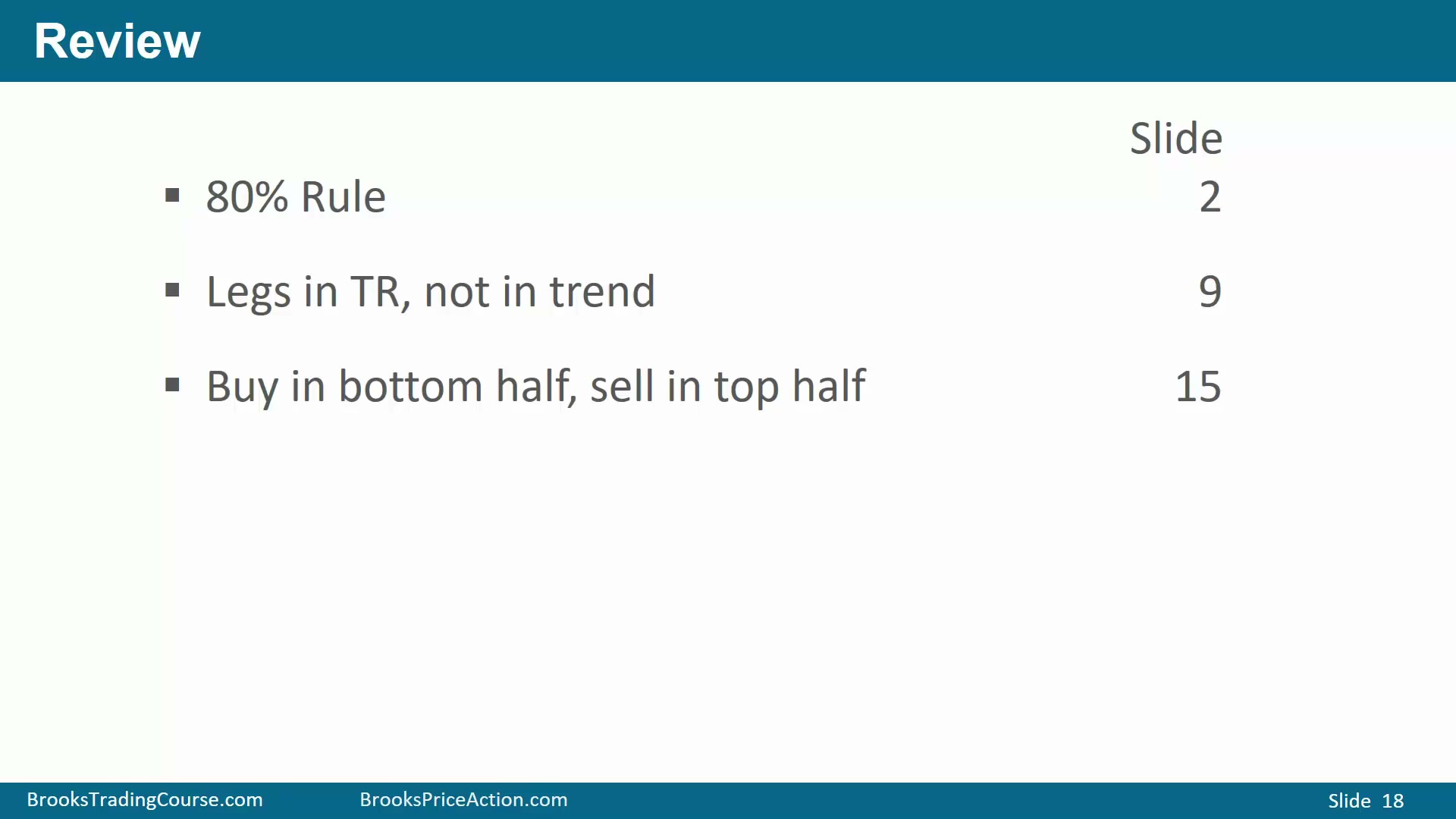
Bilingual Transcript

30:26 - 30:30

EN: I began by talking about my 80% rule, and that is that

ZH: 这节课我先是讲了我的80%法则——

30:30 - 30:33

EN: 80% of breakout attempts in a Trading Range fail.

ZH: 震荡区间里80%突破的尝试都会失败

30:33 - 30:36

EN: Traders should look for reversals instead of breakouts.

ZH: 交易者应该预期反转,而不是突破

30:36 - 30:42

EN: Next, I talked about characteristics of legs

ZH: 然后,我讲解了震荡区间中的波段, 和趋势中的波段有什么区别

30:39 - 30:42

EN: within a Trading Range in contrast to those within a trend.

ZH: 然后,我讲解了震荡区间中的波段, 和趋势中的波段有什么区别

30:43 - 30:47

EN: Finally, when the market’s in a Trading Range, traders should look to buy

ZH: 最后,如果市场处于震荡区间,

30:47 - 30:51

EN: in the bottom half and sell in the top half and take quick profits.

ZH: 交易者应该在底部做多、在顶部做空,并且赚快钱离场

30:55 - 30:56

EN: I’m Al Brooks.

ZH: 我是阿尔·布鲁克斯

30:56 - 30:59

EN: Thank you for watching the Brooks Trading Course.

ZH: 感谢观看布鲁克斯交易课程

30:59 - 31:03

EN: This is the second of four videos on trading in Trading Ranges.

ZH: 如何交易震荡区间的第2节课,就先讲到这里