Skip to content
Price Action Encyclopedia Index

al-brooks-course

51A - Losing Because of Mistakes

Raw transcript and slide notes for 51A - Losing Because of Mistakes.

Overview

  • Slides: 13
  • Transcript segments: 369
  • Status: 自动按 slide 时间线归档;核心概念和长期笔记可以在每个 slide 的 Study Notes 下继续整理。

Source Media

Transcript 001

Time: 00:02

Bilingual Transcript

00:02 - 00:03

EN: This is Al Brooks.

00:03 - 00:06

EN: Thank you for watching the Brooks Trading Course.

00:06 - 00:10

EN: This is the first of four videos about losing because of mistakes.

Slide 001

Time: 00:12

Slide 001

Bilingual Transcript

00:14 - 00:16

EN: One of the common reasons that beginners lose is

00:16 - 00:20

EN: because of psychology and false beliefs.

Slide 002

Time: 00:21

Slide 002

Bilingual Transcript

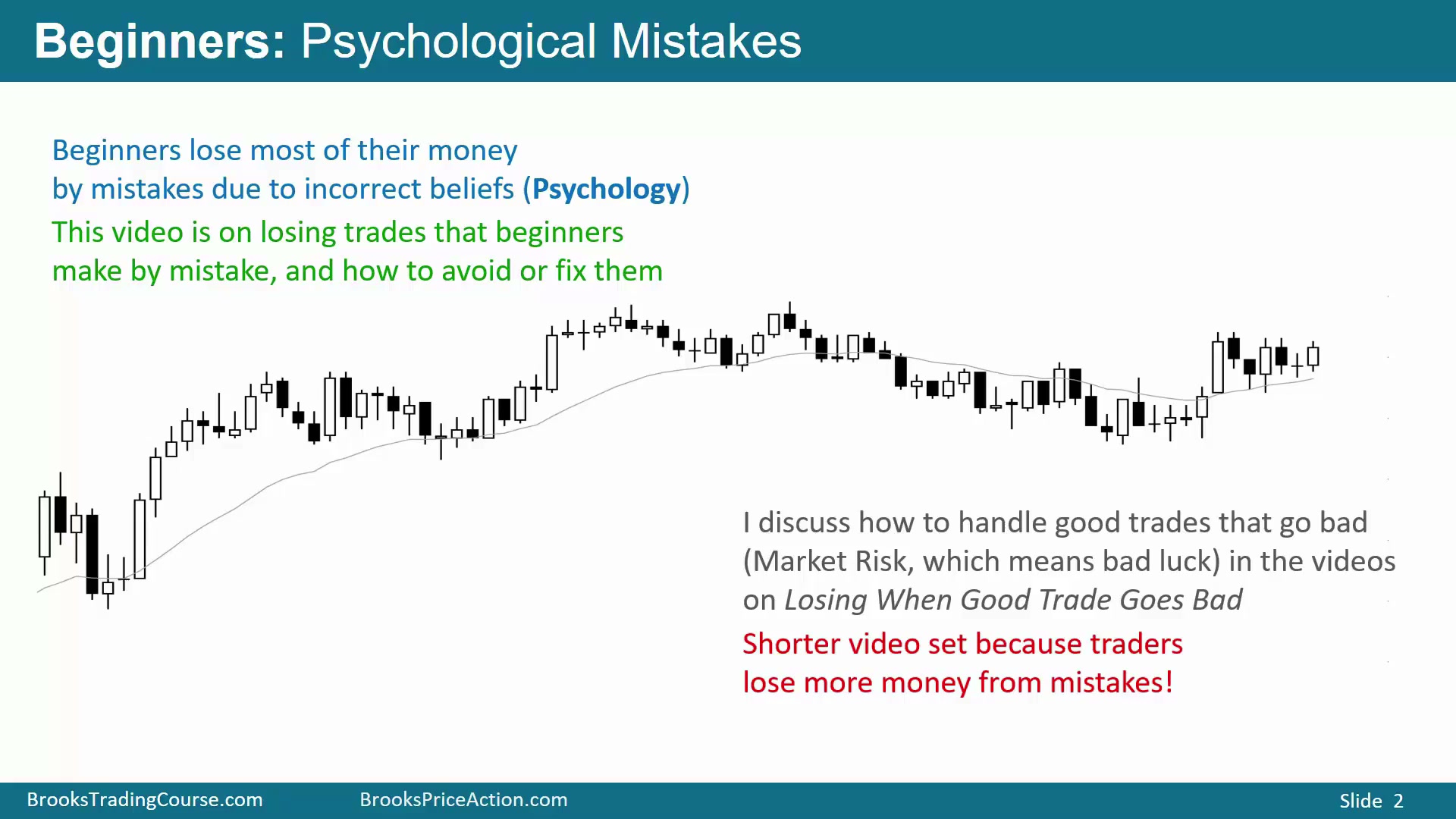
00:27 - 00:29

EN: Most of the money that beginners lose is

00:29 - 00:32

EN: because they have incorrect beliefs about the market.

00:32 - 00:36

EN: They try to apply logic that works outside of trading

00:36 - 00:40

EN: into the trading world, and they discover that it doesn’t work

00:40 - 00:43

EN: - that if you do what everybody else is doing,

00:43 - 00:45

EN: you’re probably doing the wrong thing.

00:52 - 00:55

EN: I want to talk about common mistakes that beginners make

00:55 - 00:58

EN: and how to avoid them or how to fix them.

01:03 - 01:05

EN: Every trader, no matter how good,

01:05 - 01:08

EN: is going to lose money sometimes because good trades go bad.

01:08 - 01:11

EN: There’s no 100% certain trade.

01:11 - 01:13

EN: I’m going to talk about those in the videos on losing

01:13 - 01:15

EN: when a good trade goes bad.

01:19 - 01:24

EN: That series of videos is shorter because traders lose much more money

01:24 - 01:27

EN: from mistakes than they do from good trades going bad.

Slide 003

Time: 01:30

Slide 003

Bilingual Transcript

01:37 - 01:38

EN: Beginners are ignorant.

01:38 - 01:40

EN: By ignorant I don’t mean a low IQ.

01:40 - 01:43

EN: For example, I’m ignorant of lots of things around the world,

01:43 - 01:46

EN: especially cultural things in countries where I have not visited.

01:46 - 01:49

EN: Ignorant simply means a lack of information.

01:55 - 01:58

EN: However, ignorance as a trader is a problem,

01:58 - 02:02

EN: but it’s easy to fix by simply spending time and being open to ideas

02:02 - 02:05

EN: that you would not have otherwise considered.

02:11 - 02:14

EN: Common ignorant beliefs that lead to beginners losing money?

02:14 - 02:16

EN: Perfect trades.

02:16 - 02:19

EN: Beginners always believe there’s some kind of a perfect setup,

02:19 - 02:21

EN: and they get mad at me for not telling them my perfect setup.

02:22 - 02:24

EN: Perfect trades cannot exist.

02:24 - 02:28

EN: Every trade is a combination of risk, reward, and probability,

02:28 - 02:33

EN: and a perfect trade has great profit, great probability, and very little risk.

02:33 - 02:35

EN: That cannot exist.

02:35 - 02:39

EN: If a trade has really good risk/reward, it has low probability.

02:39 - 02:43

EN: If a trade has very high probability, it has very bad risk/reward

02:43 - 02:46

EN: (usually very low profit, a scalper).

02:47 - 02:51

EN: Another thing that you sometimes hear is “noise.” Noise is a terrible term.

02:51 - 02:54

EN: It implies that the market is behaving randomly.

02:54 - 02:57

EN: The market never behaves randomly.

02:57 - 02:59

EN: It may be making moves that are too small

02:59 - 03:01

EN: for you to trade, but somebody’s trading them.

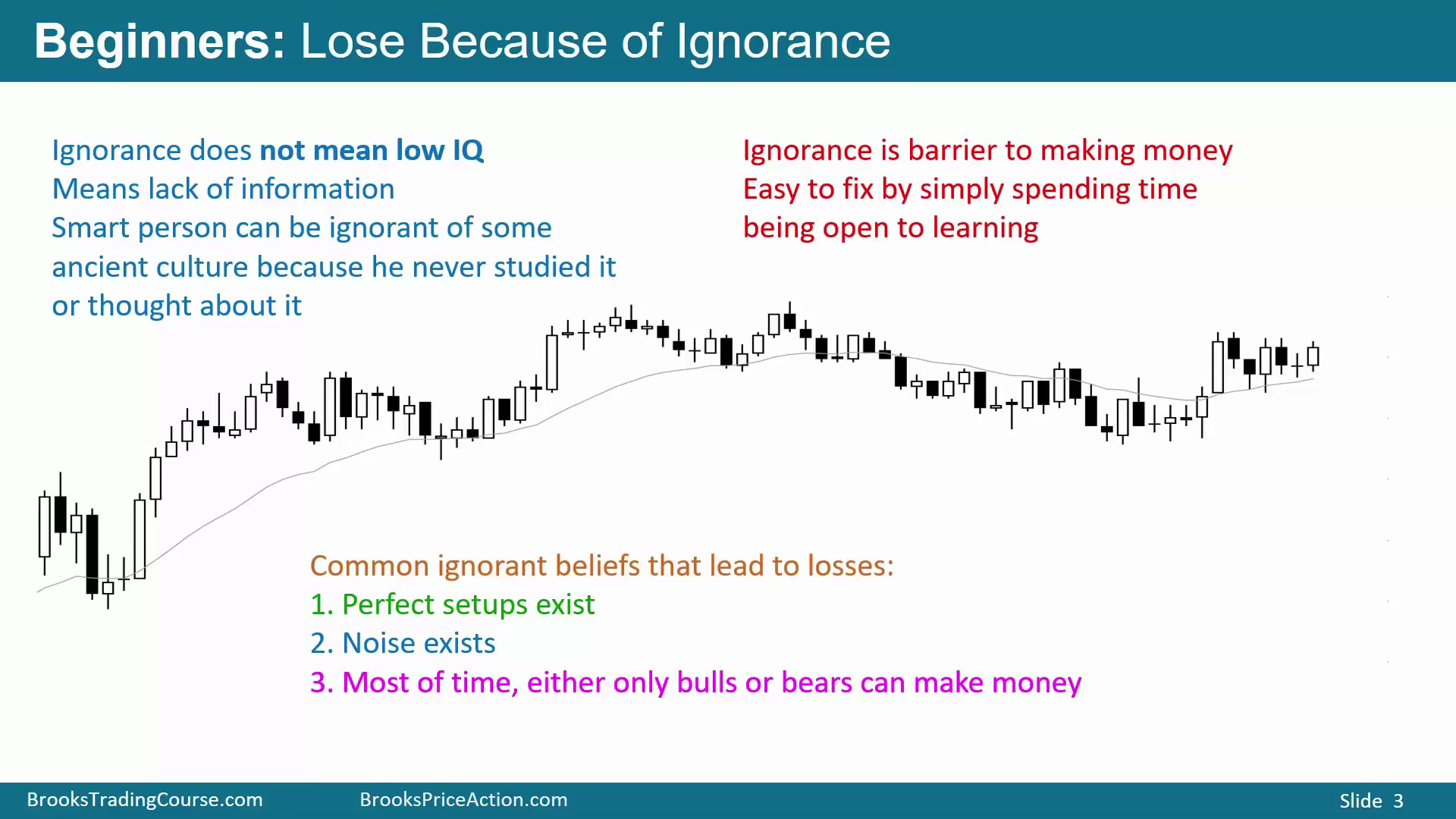
03:01 - 03:04

EN: For example, right here you might not want to trade,

03:04 - 03:06

EN: but there are lots of computers trading.

03:06 - 03:10

EN: Some for 1 or 2 tick or 1 or 2 pip scalps, but they’re trading.

03:10 - 03:13

EN: High frequency trading firms are trading, and other institutions

03:13 - 03:16

EN: are simply trading because they’ve determined

03:16 - 03:18

EN: that this is a good price where they should be selling.

03:18 - 03:21

EN: Just because the market is making moves that look too small

03:21 - 03:24

EN: for you to make money, does not mean that they are random.

03:25 - 03:27

EN: Everything that happens, happens for a reason.

03:28 - 03:31

EN: Another common false belief that beginners have is

03:31 - 03:35

EN: that either the bulls are making money or the bears are making money.

03:36 - 03:40

EN: Well, 90% of the time both the bulls and the bears can make money

03:40 - 03:44

EN: if they use wide stops, scale in, and manage their trade appropriately.

Slide 004

Time: 03:50

Slide 004

Bilingual Transcript

03:52 - 03:56

EN: One of the problems that beginners often have is they focus on risk,

03:56 - 03:59

EN: and they ignore probability and reward.

03:59 - 04:02

EN: That results in them sometimes picking bad entries.

04:03 - 04:07

EN: Beginners often have small accounts, and because they have small accounts,

04:07 - 04:09

EN: they don’t want to lose their money.

04:09 - 04:11

EN: They equate losing the money in that account

04:11 - 04:15

EN: as the death of their dream of being a profitable trader,

04:15 - 04:18

EN: and therefore they’re desperate to not lose that money.

04:18 - 04:21

EN: Also, their spouses will get mad at them if they lose money.

04:22 - 04:26

EN: There is therefore a lot of pressure on them to focus on risk

04:26 - 04:30

EN: - and unfortunately the result is all they see is risk.

04:30 - 04:34

EN: To trade profitably, you also have to consider probability

04:34 - 04:36

EN: and reward and not simply risk.

04:36 - 04:40

EN: If you only look at one variable, you’re probably going to lose money

04:40 - 04:43

EN: because you need the other two variables as well.

04:48 - 04:50

EN: For example, let’s say a beginner sells here,

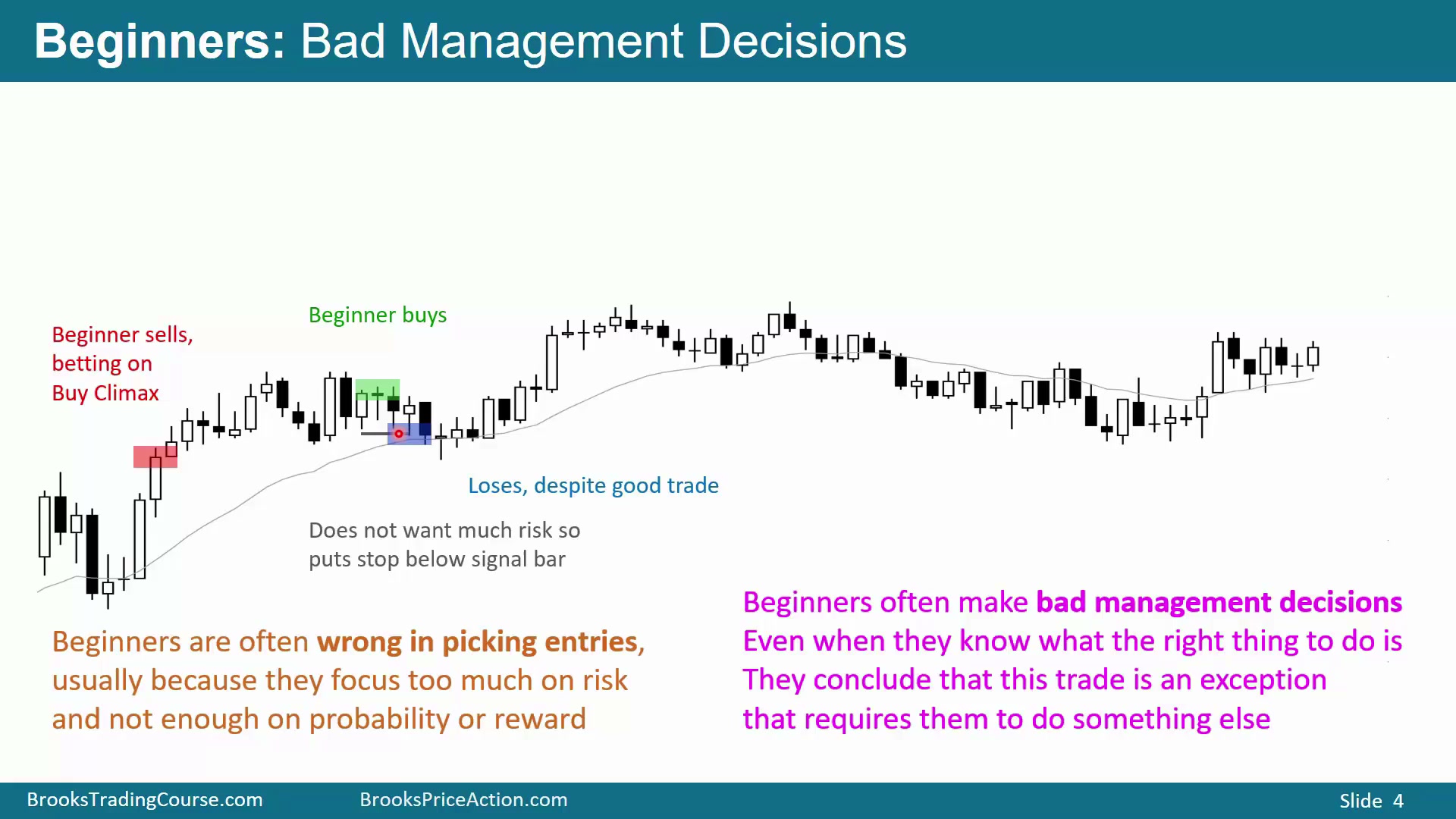
04:50 - 04:53

EN: thinking that “Oh, it’s a pair of big bars.

04:53 - 04:54

EN: It shouldn’t be doing that.

04:54 - 04:57

EN: We’re reversing up and down, up and down, up and down.

04:57 - 04:58

EN: This should reverse down.

04:58 - 05:01

EN: I’m going to sell this, betting that it’s a Buy Climax

05:01 - 05:02

EN: and it’s going to reverse.”

05:10 - 05:13

EN: If he took that short, at some point in the next bar

05:13 - 05:16

EN: or two he’s going to decide that, well,

05:16 - 05:19

EN: maybe he bought a breakout that’s going to succeed.

05:19 - 05:22

EN: However, a lot of times beginners will hold onto the trade,

05:22 - 05:25

EN: hoping that this is the exception.

05:25 - 05:29

EN: He knows at this point or this point the probability is we’re going higher,

05:29 - 05:33

EN: but he’ll hold knowing that nothing is 100%, and that means

05:33 - 05:37

EN: he has a real probability that the market will eventually go his way.

05:37 - 05:40

EN: He knows the probability is small, but it exists.

05:40 - 05:44

EN: It’s real, and therefore he’ll ignore the reality that’s in front of him

05:44 - 05:47

EN: - that he took a bad trade and he needs to get out,

05:48 - 05:50

EN: but he’s hoping that the market will go his way.

05:51 - 05:53

EN: That’s one of the other problems that beginners have.

05:54 - 05:56

EN: It’s natural that people are hopeful.

05:57 - 06:01

EN: If you think about it, it’s genetically bred into all of us to be hopeful.

06:01 - 06:04

EN: Thousands of years ago, if you did not have food in front of you

06:05 - 06:09

EN: and you were not hopeful that you could find a deer to shoot

06:09 - 06:13

EN: and feed your family, you’d just sit around and you would eventually go extinct.

06:14 - 06:19

EN: Whereas another person who was out there aggressively looking for food,

06:19 - 06:21

EN: confident and hoping that he’d find the food

06:21 - 06:24

EN: and he keeps persisting, he’s going to survive.

06:24 - 06:27

EN: So being hopeful is a survival skill.

06:28 - 06:30

EN: However, it’s horrible as a trader.

06:30 - 06:32

EN: You cannot make money hoping.

06:32 - 06:36

EN: You have to objectively evaluate what’s going on, and if you fall back

06:36 - 06:40

EN: on your natural tendency to be hopeful, you will lose money.

06:40 - 06:43

EN: Selling here and watching the market go up,

06:43 - 06:47

EN: hoping that it will reverse – that is the wrong thing to do.

06:50 - 06:52

EN: Let’s say a beginner buys here.

06:52 - 06:56

EN: He sees a bull trend, a pullback, a breakout of this bull flag,

06:56 - 06:58

EN: and a pullback from the breakout.

06:58 - 07:01

EN: A good-looking buy signal bar; a reasonable buy.

07:05 - 07:07

EN: However, he’s only thinking about risk.

07:07 - 07:10

EN: He doesn’t want to take a chance on losing any money,

07:10 - 07:14

EN: and therefore he uses a tight stop right below the buy signal bar, right here.

07:15 - 07:16

EN: That is wrong.

07:16 - 07:20

EN: If you’re taking this trade, there’s only one appropriate stop,

07:20 - 07:23

EN: and that’s down below the bottom of the original leg up.

07:23 - 07:25

EN: This is the major Higher Low.

07:25 - 07:27

EN: This is a minor Higher Low.

07:27 - 07:31

EN: The market could easily fall below this low in a two-legged pullback

07:31 - 07:35

EN: - one, pullback, two – and it did – and simply become a High 2 bull flag.

07:36 - 07:39

EN: Two legs down – one, pullback, two – and the bull trend resumed.

07:39 - 07:41

EN: You cannot use a tight stop like that.

07:45 - 07:48

EN: The beginner took the good trade, bought above the bull bar,

07:48 - 07:52

EN: but used a bad stop, and he got stopped out.

07:53 - 07:56

EN: It’s a small loss, but if you do it two or three times

07:56 - 08:00

EN: in the course of a day, you’re going to end up losing a lot of money.

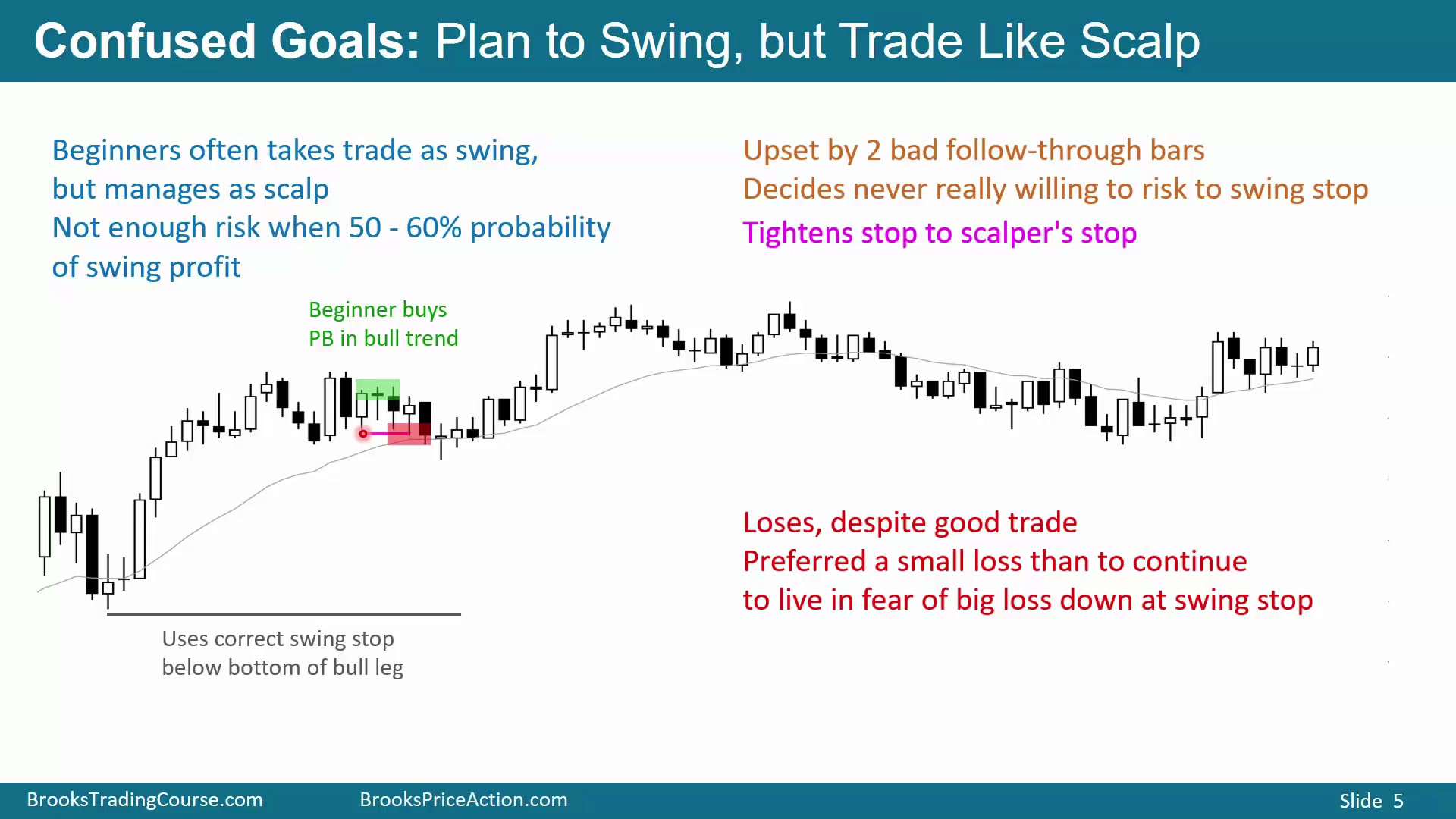
Slide 005

Time: 08:05

Slide 005

Bilingual Transcript

08:08 - 08:11

EN: Another problem that beginners often have

08:11 - 08:15

EN: is they’ll take a trade as a swing, but manage it as a scalp.

08:16 - 08:18

EN: The problem with that is if you’re taking a swing trade,

08:19 - 08:22

EN: the probability of success, the probability of making a profitable swing,

08:22 - 08:24

EN: is usually only about 40%.

08:25 - 08:27

EN: We have a very strong rally here.

08:28 - 08:31

EN: Traders buying for any reason and using the appropriate stop

08:31 - 08:34

EN: have maybe a 50% to 60% chance of making a profit.

08:38 - 08:42

EN: If a trader buys above this bull bar, he has to use the appropriate stop

08:42 - 08:45

EN: to get that 50% to 60% probability of success.

08:49 - 08:53

EN: This is a major Higher Low, a strong breakout to a new high.

08:53 - 08:56

EN: We have breakouts above minor highs here,

08:56 - 08:59

EN: but not strong breakouts lasting many bars,

08:59 - 09:03

EN: and therefore this is a minor Higher Low and the market could fall

09:03 - 09:05

EN: below it and still be in a strong bull trend.

09:10 - 09:15

EN: A beginner who took this buy above this bull bar and used this stop initially

09:16 - 09:19

EN: might become upset by the bad follow-through here and decide

09:19 - 09:24

EN: that he doesn’t want to risk the appropriate amount, and he uses a tighter stop,

09:27 - 09:31

EN: maybe below the bottom of the buy signal bar, and gets out here.

09:37 - 09:40

EN: He ends up losing on a good trade simply

09:40 - 09:43

EN: because he did not use the appropriate stop.

09:43 - 09:45

EN: He decided to convert it into a scalp.

09:45 - 09:49

EN: But for a scalp you probably need 70% or 80% probability of success,

09:49 - 09:53

EN: and this is not a 70% to 80% buy using that stop.

09:54 - 09:58

EN: The probability of making money buying above this bull bar,

09:58 - 10:02

EN: getting filled here, and putting a stop below here? I would say it’s 50/50,

10:02 - 10:07

EN: and therefore if you tighten your stop there, you’re going to lose money.

Slide 006

Time: 10:10

Slide 006

Bilingual Transcript

10:13 - 10:16

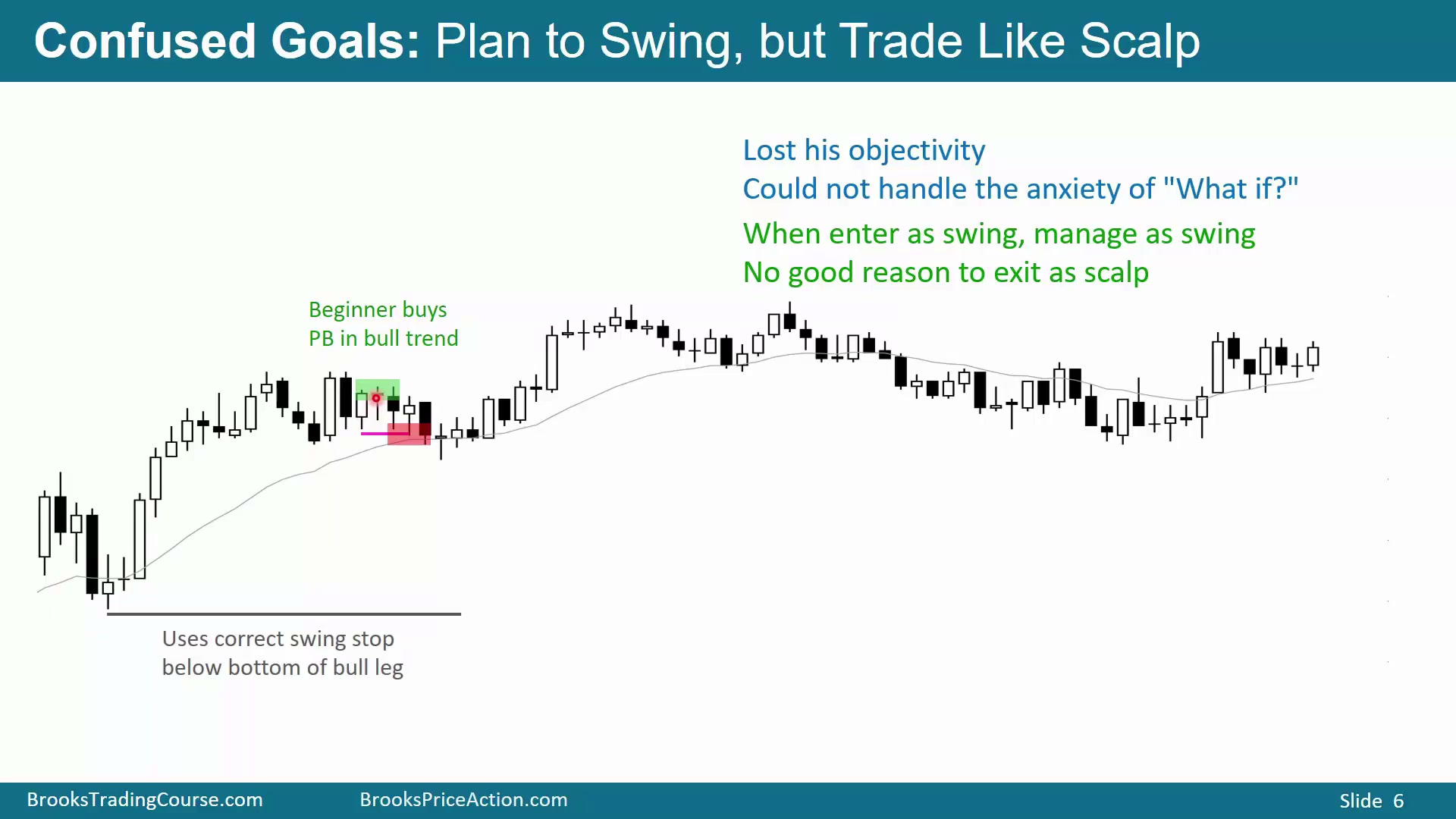
EN: What happens sometimes is the beginner takes the trade and then

10:16 - 10:19

EN: - let’s say this is a 5-minute chart – he has 5 minutes,

10:19 - 10:22

EN: 10 minutes to think about it, and he begins to wonder,

10:22 - 10:24

EN: “What if it goes against me? It could go all the way back down here,

10:24 - 10:29

EN: and I don’t want to risk that much.” Well, if he is unwilling to risk this much

10:29 - 10:33

EN: he cannot take that trade, because this is where the appropriate stop goes.

10:38 - 10:42

EN: If he’s entering as a swing, he has to be using the appropriate stop,

10:42 - 10:44

EN: and he only gets out if his stop is hit

10:44 - 10:49

EN: or if the market clearly becomes bearish – which it did not.

Slide 007

Time: 10:51

Slide 007

Bilingual Transcript

10:57 - 11:01

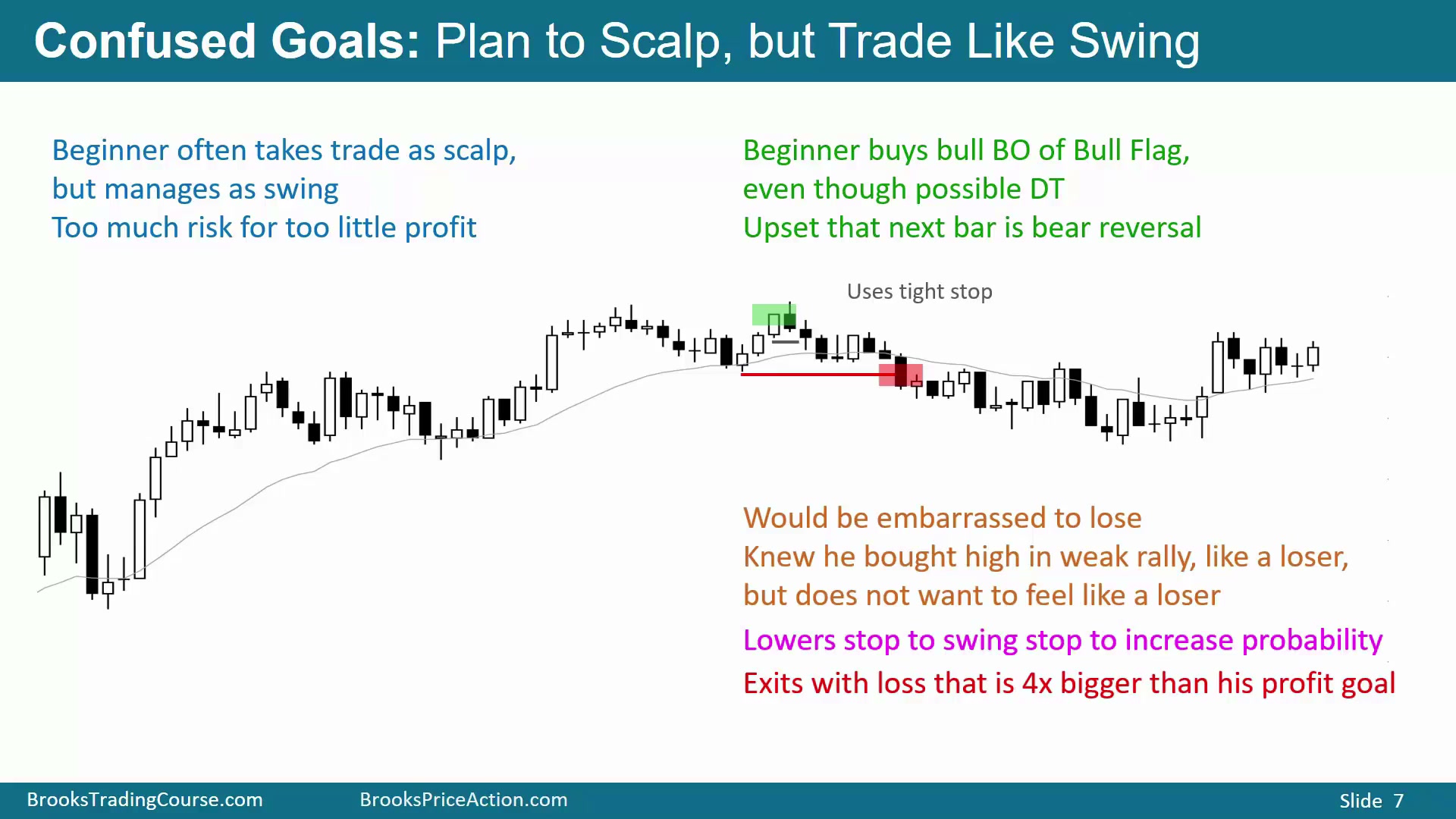
EN: The opposite is another common problem that beginners have.

11:01 - 11:05

EN: They take a trade as a scalp, and then they manage it as a swing trade,

11:05 - 11:09

EN: which means far too much risk for too little profit.

11:10 - 11:14

EN: Also, beginners should not be scalping because to scalp profitably

11:14 - 11:17

EN: you have to be able to win 70% or 80% of the time.

11:17 - 11:19

EN: Beginners simply cannot do that.

11:26 - 11:29

EN: The bulls have a breakout and the market went higher.

11:29 - 11:31

EN: Another breakout, a pullback.

11:31 - 11:33

EN: Let’s say a beginner buys this close,

11:33 - 11:35

EN: hoping that it’s the start of another leg up.

11:36 - 11:38

EN: Maybe he bought it even though he knows

11:38 - 11:42

EN: it might be a Double Top and a Wedge – one, two, three.

11:43 - 11:45

EN: Then the next bar is a bear reversal bar.

11:46 - 11:49

EN: The beginner who bought that close and sees this bar

11:49 - 11:51

EN: is now probably going to be upset.

11:54 - 11:57

EN: Let’s say initially he was planning on putting a stop right

11:57 - 12:00

EN: below his buy signal bar, which is right here.

12:07 - 12:11

EN: He was surprised by this bear bar, and now he’s frozen.

12:11 - 12:15

EN: He’s paralyzed, and he’s thinking that, “Well, if I take the loss

12:15 - 12:18

EN: and get out where my stop is hit, then I’ll lose money.”

12:19 - 12:22

EN: He knows that if he’s scalping he has to win most of the time,

12:22 - 12:24

EN: and therefore he’s afraid to take losses.

12:24 - 12:28

EN: So instead of exiting where he should exit, he’ll use a wide stop

12:28 - 12:30

EN: and try to convert his scalp into a swing trade.

12:31 - 12:34

EN: But then he will not manage the swing trade correctly

12:34 - 12:36

EN: and he’ll end up losing much more than he expected.

12:37 - 12:41

EN: When he bought that bull close, he knew the probability was not high,

12:41 - 12:44

EN: but he was hoping that the momentum up would lead to a profitable trade,

12:45 - 12:48

EN: and he was shocked to see that bear reversal bar.

12:48 - 12:50

EN: Once he saw it, he looked to the left and said,

12:50 - 12:53

EN: “Uh oh, maybe it’s a Double Top, maybe it’s a Wedge Top.

12:53 - 12:55

EN: Maybe I took a bad trade.”

12:59 - 13:03

EN: He decides that, “Well, swing traders usually can make money

13:03 - 13:07

EN: if they use wide stops and scale in, and therefore I’ll use a wider stop.

13:07 - 13:10

EN: Maybe I’ll put it below the bottom of the most recent bull leg.”

13:10 - 13:13

EN: Even though this is really a minor Higher Low

13:13 - 13:16

EN: - the breakout does not have enough bars, did not go up high enough,

13:16 - 13:20

EN: and therefore it could simply be a bull leg in a Tight Trading Range.

13:20 - 13:24

EN: The market can fall below it and the market could still remain Always In Long.

13:24 - 13:27

EN: The most recent major Higher Low is at this point.

13:27 - 13:33

EN: If a trader takes that buy on that close, he has to be using a stop down here.

13:37 - 13:39

EN: He eventually finds himself stopped out

13:39 - 13:42

EN: at the bottom of the most recent bull leg.

13:42 - 13:46

EN: He ends up exiting with a loss that’s four times bigger

13:46 - 13:49

EN: than the minimum scalp he was hoping to get when he bought that close.

13:50 - 13:53

EN: If you’re losing four times bigger than what you’re winning,

13:53 - 13:56

EN: you have to be right 80% of the time to break even.

13:56 - 13:59

EN: You probably have to be right better than 90% of the time

13:59 - 14:03

EN: to have a profitable strategy, and that’s simply unrealistic.

14:03 - 14:07

EN: Very few really good traders win 90% of the time,

14:07 - 14:09

EN: day in, day out, every day of the year.

14:09 - 14:13

EN: For a beginner to expect that, it’s just not going to happen,

14:13 - 14:15

EN: and therefore his strategy is wrong.

14:15 - 14:16

EN: It’s a losing strategy.

Slide 008

Time: 14:20

Slide 008

Bilingual Transcript

14:25 - 14:29

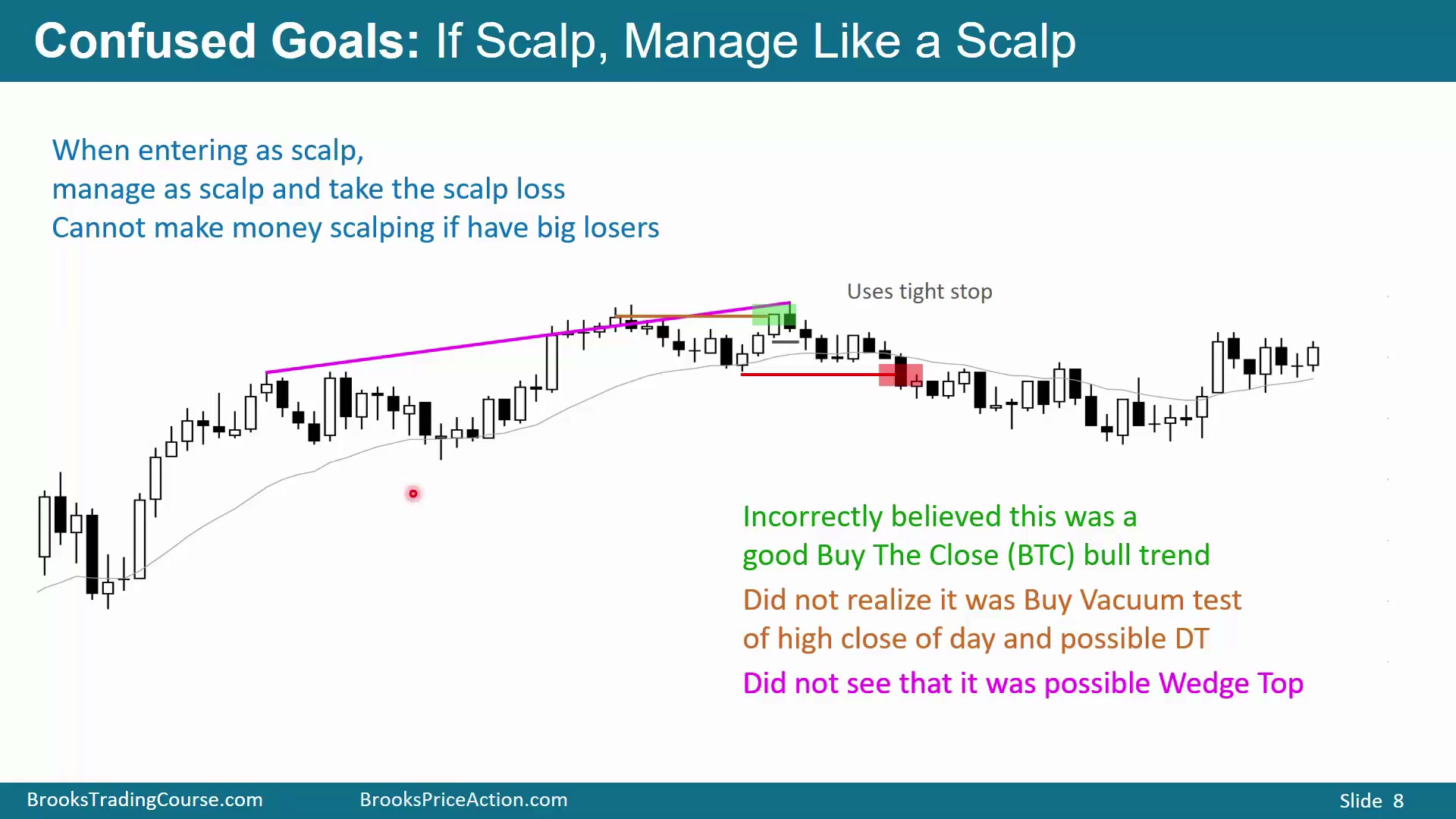
EN: If a beginner takes a trade as a scalp, he has to manage it as a scalp.

14:29 - 14:31

EN: This is a bad trade.

14:31 - 14:34

EN: It became clear when the bears had that reversal bar

14:34 - 14:37

EN: that beginners should simply get out, either below that bear bar

14:37 - 14:40

EN: or below the buy signal bar, and take the loss.

14:45 - 14:50

EN: In fact, any time a trader takes a trade and decides the trade is not good,

14:50 - 14:54

EN: he should get out immediately, and therefore a beginner who bought this bull close

14:54 - 14:57

EN: could get out at the close of this bear bar

14:57 - 15:00

EN: without waiting for the market to trade below the low of that bear bar.

15:00 - 15:03

EN: He had to know at the close of that bear bar

15:03 - 15:07

EN: that this was not a high probability bet that he’ll make money.

15:13 - 15:16

EN: A more experienced trader would have realized

15:16 - 15:20

EN: that this was probably a buy vacuum test of that close.

15:20 - 15:22

EN: The bulls had a reasonably good bull trend here.

15:22 - 15:24

EN: Some are buying closes all the way up.

15:24 - 15:29

EN: Some became disappointed here, held long, betting that the selloff

15:29 - 15:32

EN: would be a leg in a Trading Range and we’ll get back up to that close.

15:32 - 15:34

EN: So they’ll buy more lower.

15:36 - 15:40

EN: Those bulls who bought, used a wide stop, and scaled in lower are hoping

15:40 - 15:43

EN: the market will get back to their high close, where they could sell.

15:44 - 15:46

EN: That’s what exactly happened here.

15:46 - 15:50

EN: Buy The Close bulls bought more lower, and when it got back to their high close,

15:50 - 15:53

EN: their last entry price, they sold.

15:54 - 15:58

EN: Therefore this rally was probably a buy vacuum test of resistance

15:58 - 16:00

EN: at the high close and the high of the day,

16:00 - 16:02

EN: and not the start of a new Buy The Close rally.

16:03 - 16:05

EN: Bulls were selling here.

16:05 - 16:08

EN: The bulls who bought here are relieved to be able

16:08 - 16:11

EN: to get out breakeven, and now you have bulls selling.

16:11 - 16:14

EN: That’s not a good location for you to be buying.

16:18 - 16:21

EN: It’s also the third push up – one, pullback, two, pullback, three

16:21 - 16:25

EN: - and the pushes up are getting smaller, so it’s a Wedge Top.

16:25 - 16:27

EN: Again, a bad location to be buying.

Slide 009

Time: 16:30

Slide 009

Bilingual Transcript

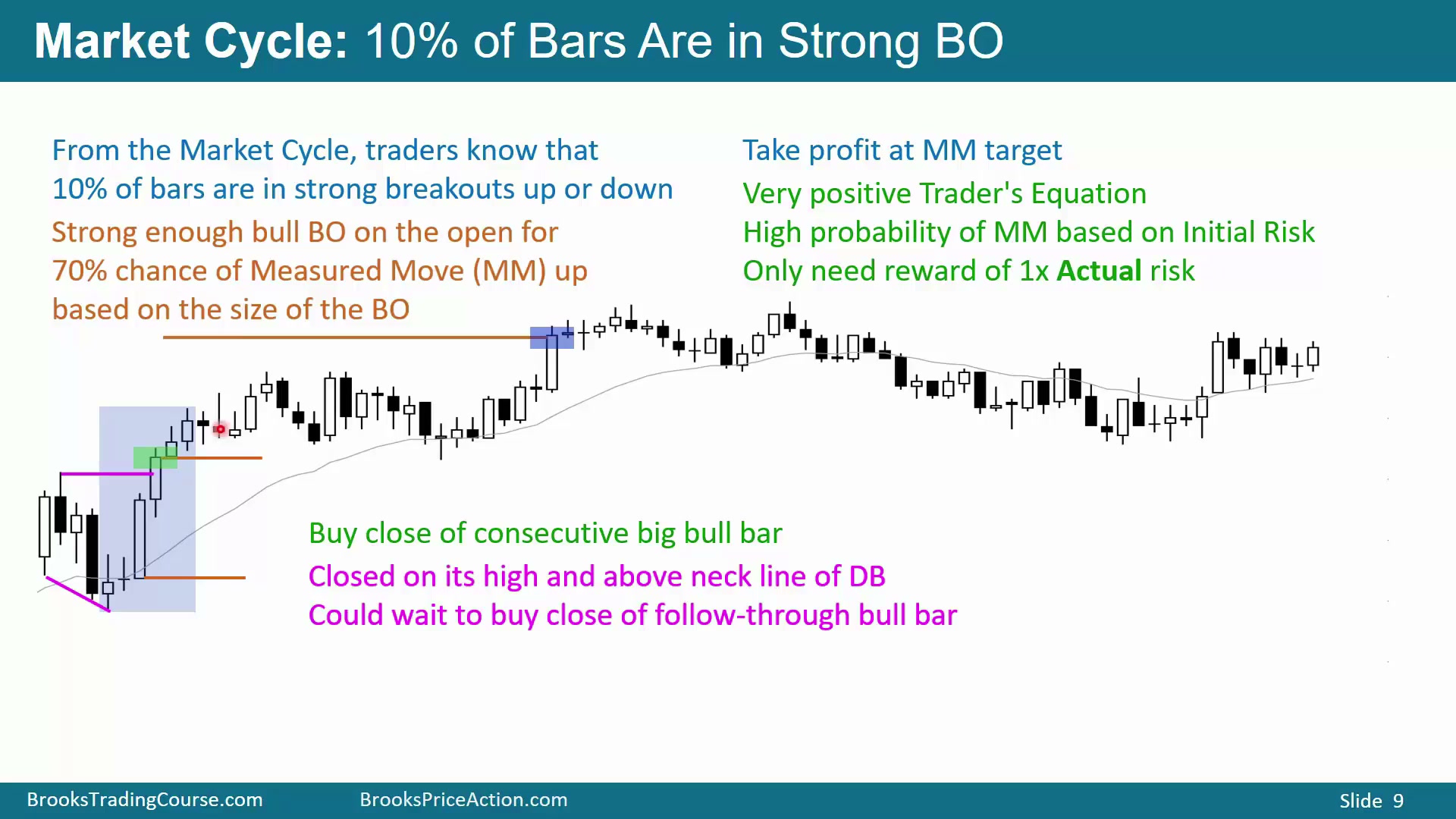
16:35 - 16:38

EN: If you look at a chart and you have 100 bars on the screen,

16:38 - 16:43

EN: only about 10% of them are in a very strong breakout up or down.

16:43 - 16:45

EN: Here we have a reasonably strong breakout.

16:45 - 16:47

EN: It’s about 10% of the bars on the screen,

16:47 - 16:51

EN: and when you have a very strong breakout, you have 60%, 70%,

16:51 - 16:54

EN: sometimes 80% chance of getting a Measured Move up

16:54 - 16:57

EN: based upon the bars in the breakout.

16:57 - 16:59

EN: For example, the open of the first bar to the close

16:59 - 17:02

EN: of the final strong bar in the breakout,

17:02 - 17:05

EN: probably 70% chance the market’s going to go up for a Measured Move.

17:11 - 17:14

EN: You can see what happened when it got to that Measured Move target.

17:14 - 17:18

EN: The market stalled, in part because bulls were taking partial profits.

17:22 - 17:24

EN: You can buy the close of any of these bars

17:24 - 17:28

EN: and take partial or full profits at the Measured Move target.

17:28 - 17:30

EN: 70% chance it’s going to get there.

17:37 - 17:41

EN: We have a close on the high well above the neckline of this Double Bottom,

17:41 - 17:45

EN: and we have a follow-through bar closing with a bull close as well.

17:45 - 17:48

EN: 70% chance we’re going up for at least a second leg.

17:48 - 17:52

EN: Probably at least a Measured Move based upon the height

17:52 - 17:53

EN: of the strong part of the breakout.

17:57 - 18:01

EN: Reasonable to take profits, partial profits, full profits,

18:01 - 18:04

EN: at a Measured Move target based upon the height of that breakout.

18:11 - 18:13

EN: The Actual Risk was small.

18:13 - 18:16

EN: If you bought that close, the Actual Risk is 1 or 2 ticks

18:16 - 18:18

EN: or 1 or 2 pips, but very, very small.

18:19 - 18:24

EN: High probability you can exit at simply one times Actual Risk

18:24 - 18:27

EN: if your profit is at least as big as a minimum scalp.

18:28 - 18:32

EN: Here, if the Actual Risk is only 2 ticks or 2 pips,

18:32 - 18:36

EN: one times Actual Risk is 1 tick or 1 pip, 1 or 2,

18:36 - 18:38

EN: and that is not as big as a minimum scalp.

18:39 - 18:42

EN: So if you’re trading the Emini you have to hold for at least 4 ticks

18:42 - 18:45

EN: (1 point, a minimum scalp), and if you’re trading the Forex markets

18:45 - 18:48

EN: you have to hold for at least 10 pips (a minimum scalp).

18:48 - 18:54

EN: However, if this Measured Move target is two to three times the minimum scalp,

18:54 - 18:58

EN: it’s reasonable to hold for two to three times the size of a minimum scalp.

Slide 010

Time: 19:01

Slide 010

Bilingual Transcript

19:06 - 19:10

EN: I said that 10% of the bars on any chart are in a strong breakout.

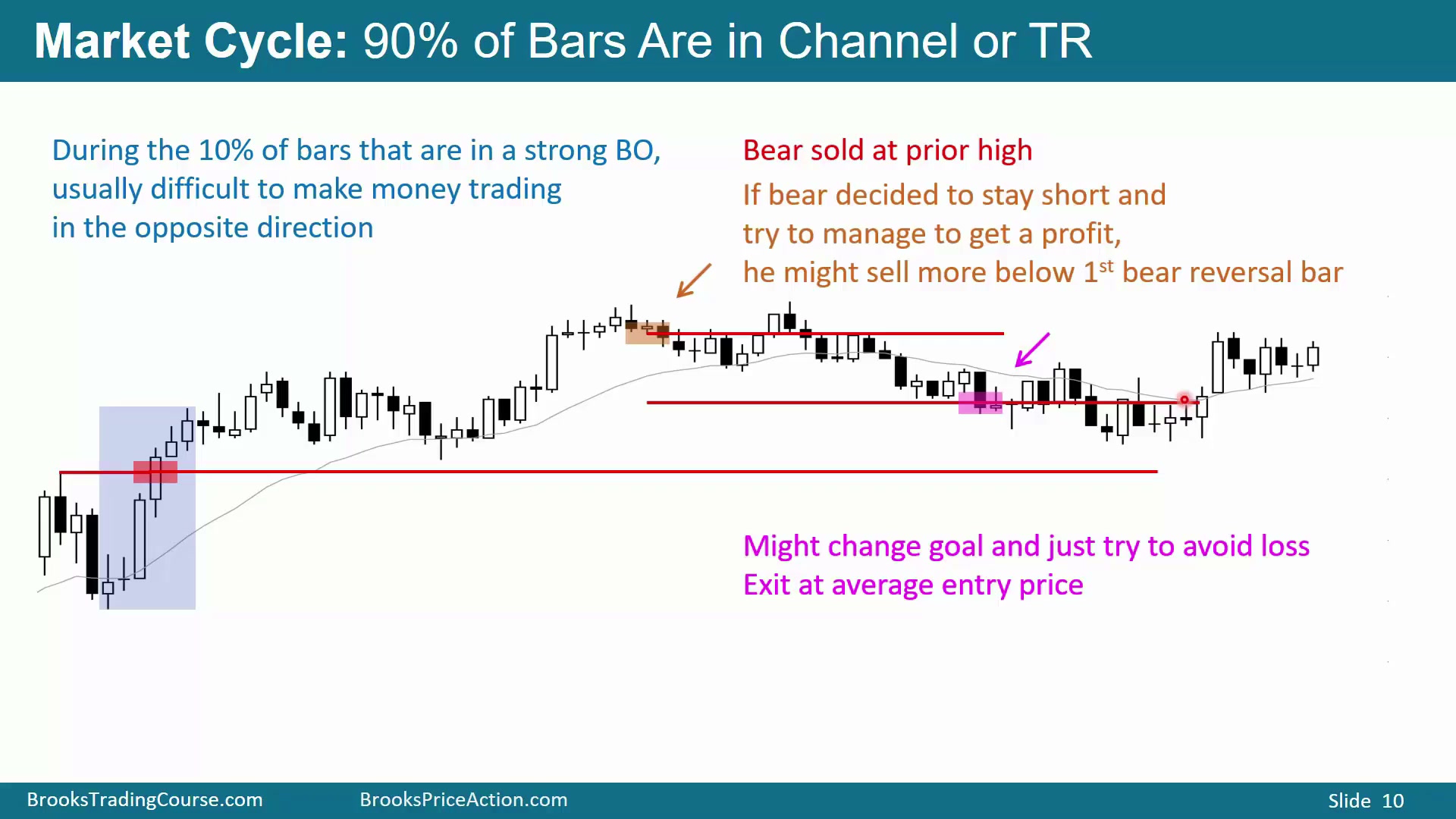
19:10 - 19:12

EN: That means there’s a high probability of some kind

19:12 - 19:14

EN: of a Measured Move in the direction of the breakout.

19:14 - 19:16

EN: Here, up.

19:16 - 19:19

EN: It also means that it’s very difficult to make money selling

19:19 - 19:21

EN: when the market’s in a strong breakout.

19:25 - 19:28

EN: If you sold this high, very difficult to make money.

19:28 - 19:32

EN: If you use a wide stop and scale in higher, you can avoid a loss,

19:32 - 19:34

EN: but very difficult to make money selling here

19:34 - 19:36

EN: and holding short as it’s going up.

19:43 - 19:47

EN: Some bears who sold here would be disappointed by the extent of the rally.

19:47 - 19:50

EN: They’ll sell more below a strong bear bar that is at least

19:50 - 19:55

EN: two to three times the size of a scalp higher, and then they’ll either hold,

19:55 - 19:58

EN: hoping the market gets back to their original entry price,

19:58 - 20:01

EN: getting out breakeven on their first sell and with a profit

20:01 - 20:07

EN: on their second sell, or they might decide that 30 or 40 bars up is so extreme,

20:07 - 20:11

EN: maybe it’s better simply to get out between the two entry prices

20:11 - 20:13

EN: and get out breakeven on the trade.

20:13 - 20:15

EN: Small loss here, small profit here.

20:21 - 20:23

EN: They sold this high.

20:23 - 20:26

EN: If they held through all of this, they could sell more below this bear bar,

20:26 - 20:29

EN: get filled here, and this is their average entry price.

20:29 - 20:33

EN: If they exit here, they lost money on their first sell,

20:33 - 20:35

EN: they made money on their second sell,

20:35 - 20:38

EN: and they get out breakeven on their entire position.

20:39 - 20:42

EN: Or they could hold, hoping it gets down here.

20:42 - 20:46

EN: If it makes a couple reversals up with bull bars just above their target,

20:46 - 20:48

EN: they would get out on the reversal up

20:48 - 20:51

EN: - which would be around breakeven on the entire trade.

Slide 011

Time: 20:55

Slide 011

Bilingual Transcript

20:57 - 21:00

EN: It never fell below the first entry price.

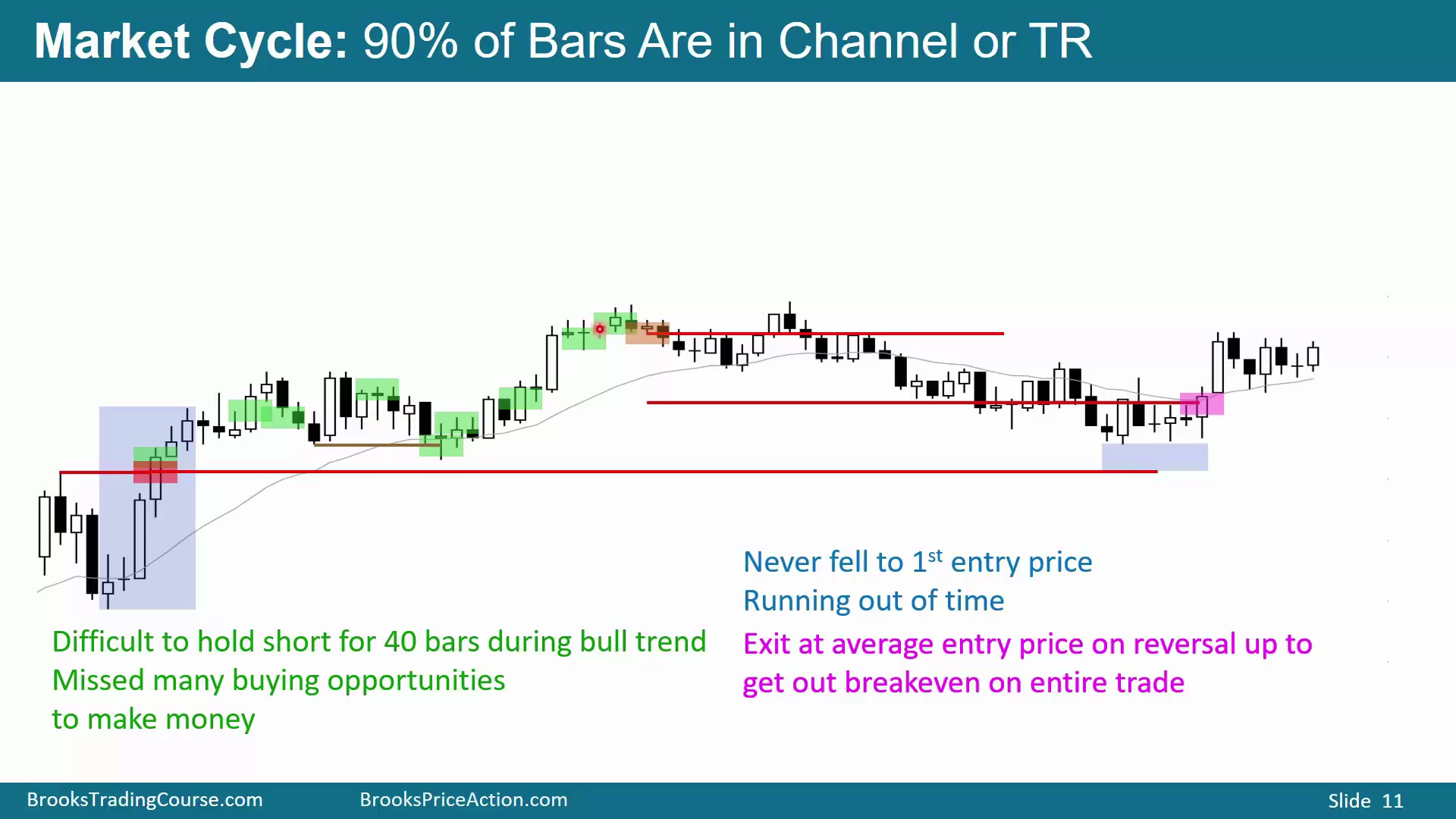
21:00 - 21:03

EN: They therefore could not get out breakeven on their first entry.

21:08 - 21:12

EN: They should just get out on a reversal up late in the day, late in the session.

21:20 - 21:25

EN: Can a beginner take that sell and sell more higher? Not realistic.

21:25 - 21:27

EN: That’s one of the problems that beginners have.

21:28 - 21:32

EN: They have the right idea; they know what they need to do to avoid a loss

21:32 - 21:35

EN: or to make money, but they don’t have the ability to do it.

21:36 - 21:41

EN: In this case, can a beginner hold onto a short through a rally

21:41 - 21:44

EN: that lasts 30 or 40 bars, and is his account big enough

21:44 - 21:48

EN: so that he can sell more here? Probably not.

21:48 - 21:52

EN: It makes more sense for the beginner to get out of his short

21:52 - 21:54

EN: on the close of the second or third or fourth bull bar

21:54 - 21:58

EN: and then buy the bull flags in a bull trend.

21:58 - 22:02

EN: He would more than make up for the small loss that he originally took.

Slide 012

Time: 22:05

Slide 012

Bilingual Transcript

22:13 - 22:15

EN: One of the main reasons why beginners lose money is

22:15 - 22:18

EN: because they don’t know how to manage trades properly.

22:18 - 22:22

EN: To manage traders properly, you have to make decisions about the position size,

22:22 - 22:26

EN: the risk (where your stop is), and the reward (where to take profits).

22:26 - 22:29

EN: If you make a mistake with any of those three things,

22:29 - 22:31

EN: you’re probably going to lose money.

22:34 - 22:36

EN: I said only 10% of the bars on any chart

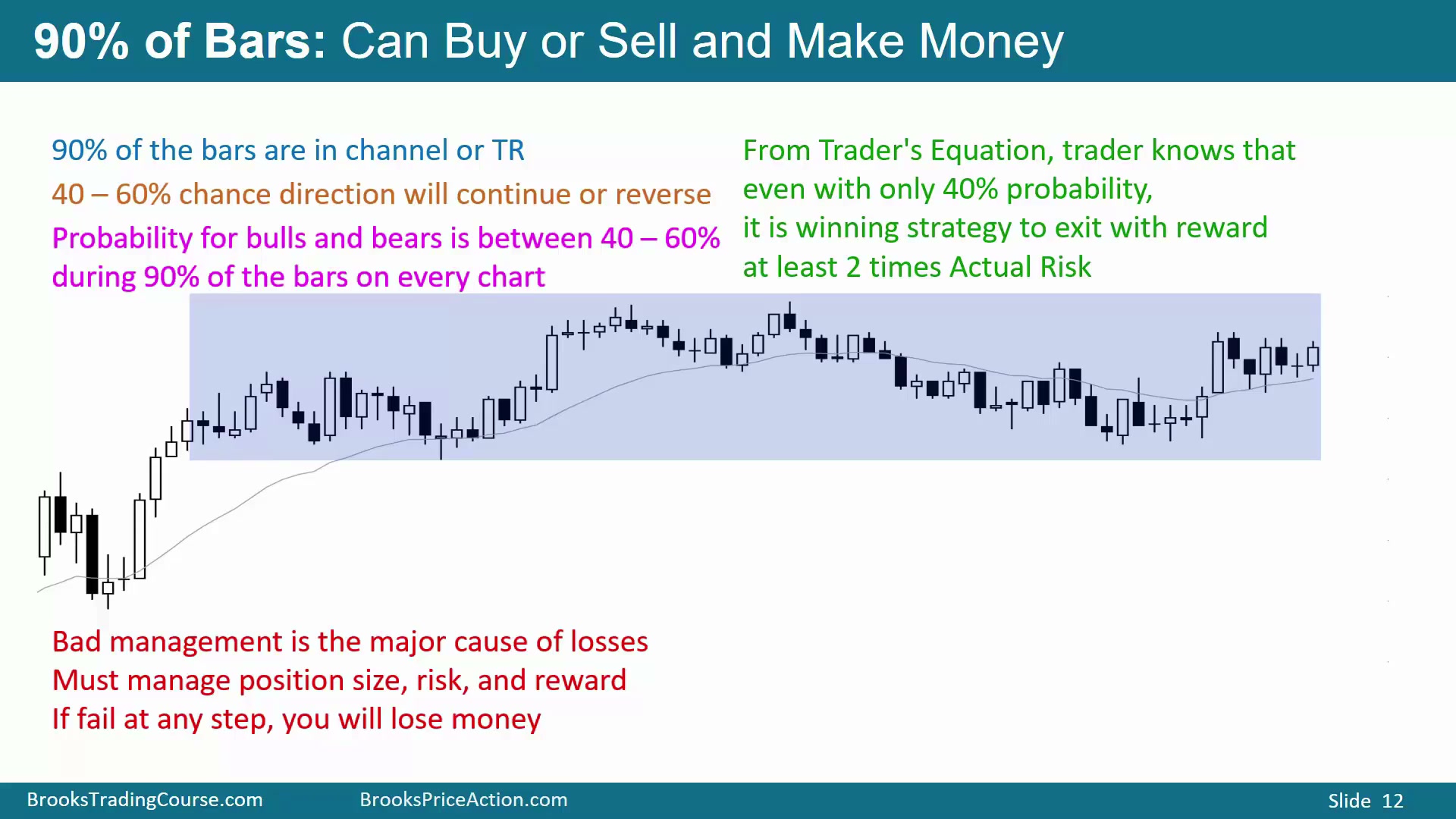
22:36 - 22:39

EN: are in a strong breakout – in other words,

22:39 - 22:42

EN: high probability of making money betting the trend will continue.

22:42 - 22:46

EN: 90% of the bars on any chart are either in a bull channel,

22:46 - 22:48

EN: a bear channel, or a Trading Range.

22:49 - 22:50

EN: Here we have all three.

22:50 - 22:53

EN: Every Trading Range has a leg up and a leg down.

22:53 - 22:55

EN: Here we have a bull channel and a bear channel and a Trading Range.

22:56 - 22:57

EN: This is typical.

22:57 - 23:00

EN: 90% of the bars are either in a bull channel,

23:00 - 23:02

EN: a bear channel, or a Trading Range.

23:06 - 23:11

EN: When that’s the case, buying or selling at any instant within the range,

23:11 - 23:15

EN: you have between a 40% and 60% chance of making a profit,

23:15 - 23:20

EN: 40% to 60% chance that the market will soon go against you.

23:25 - 23:28

EN: On every bar on the chart, if you buy you have

23:28 - 23:31

EN: between a 40% and 60% chance of making a profit.

23:32 - 23:35

EN: If you sell, there’s between a 40% and 60% chance of making a loss.

23:35 - 23:40

EN: You do not have a 70% trade when the market’s in a Trading Range.

23:48 - 23:52

EN: From the Trader’s Equation, you know that this is all you need to make money.

23:52 - 23:55

EN: As long as you have at least a 40% chance of making money

23:55 - 24:00

EN: - and you do, buying and selling at any point in a channel or in a Trading Range

24:00 - 24:03

EN: - as long as you have at least a 40% chance of making money,

24:03 - 24:05

EN: you have a winning strategy if you exit

24:05 - 24:08

EN: with at least two times your Actual Risk.

24:14 - 24:18

EN: Beginners lose money mostly because of psychology and false beliefs.

Slide 013

Time: 24:15

Slide 013

Bilingual Transcript

24:18 - 24:21

EN: For example, they believe perfect trades exist.

24:21 - 24:23

EN: They also believe that the market often moves randomly,

24:23 - 24:27

EN: with no rational trading going on behind it.

24:27 - 24:30

EN: They also believe that low probability events

24:30 - 24:33

EN: can save them when they make bad decisions.

24:33 - 24:34

EN: They cannot.

24:34 - 24:37

EN: Once you see that you’re wrong, you should get out.

24:41 - 24:42

EN: I’m Al Brooks.

24:42 - 24:44

EN: Thank you for watching the Brooks Trading Course.

24:44 - 24:48

EN: This is the first of four videos on losing because of mistakes.