Skip to content
Price Action Encyclopedia Index

al-brooks-course

51D - Losing Because of Mistakes

Raw transcript and slide notes for 51D - Losing Because of Mistakes.

Overview

  • Slides: 17
  • Transcript segments: 477
  • Status: 自动按 slide 时间线归档;核心概念和长期笔记可以在每个 slide 的 Study Notes 下继续整理。

Source Media

Transcript 001

Time: 00:02

Bilingual Transcript

00:02 - 00:03

EN: This is Al Brooks.

00:03 - 00:05

EN: Thank you for watching the Brooks Trading Course.

00:05 - 00:10

EN: This is the fourth of four videos on losing because of mistakes.

Slide 001

Time: 00:11

Slide 001

Bilingual Transcript

00:14 - 00:18

EN: A common problem with beginners i s they do not use the correct stop.

00:18 - 00:21

EN: They tend to use a stop that is too tight.

00:21 - 00:26

EN: Also, scaling in is a dangerous thing to do, especially as a beginner.

00:26 - 00:28

EN: It can lead to very big losses.

00:28 - 00:33

EN: Beginners, when they do scale in, they don’t realize how small they have to trade.

00:33 - 00:38

EN: Invariably they trade too large a position and they can’t handle the stress

00:38 - 00:42

EN: of the market going against them, and they end up exiting an otherwise good trade

00:42 - 00:46

EN: far too early with a loss instead of holding and making a profit.

Slide 002

Time: 00:48

Slide 002

Bilingual Transcript

00:53 - 00:57

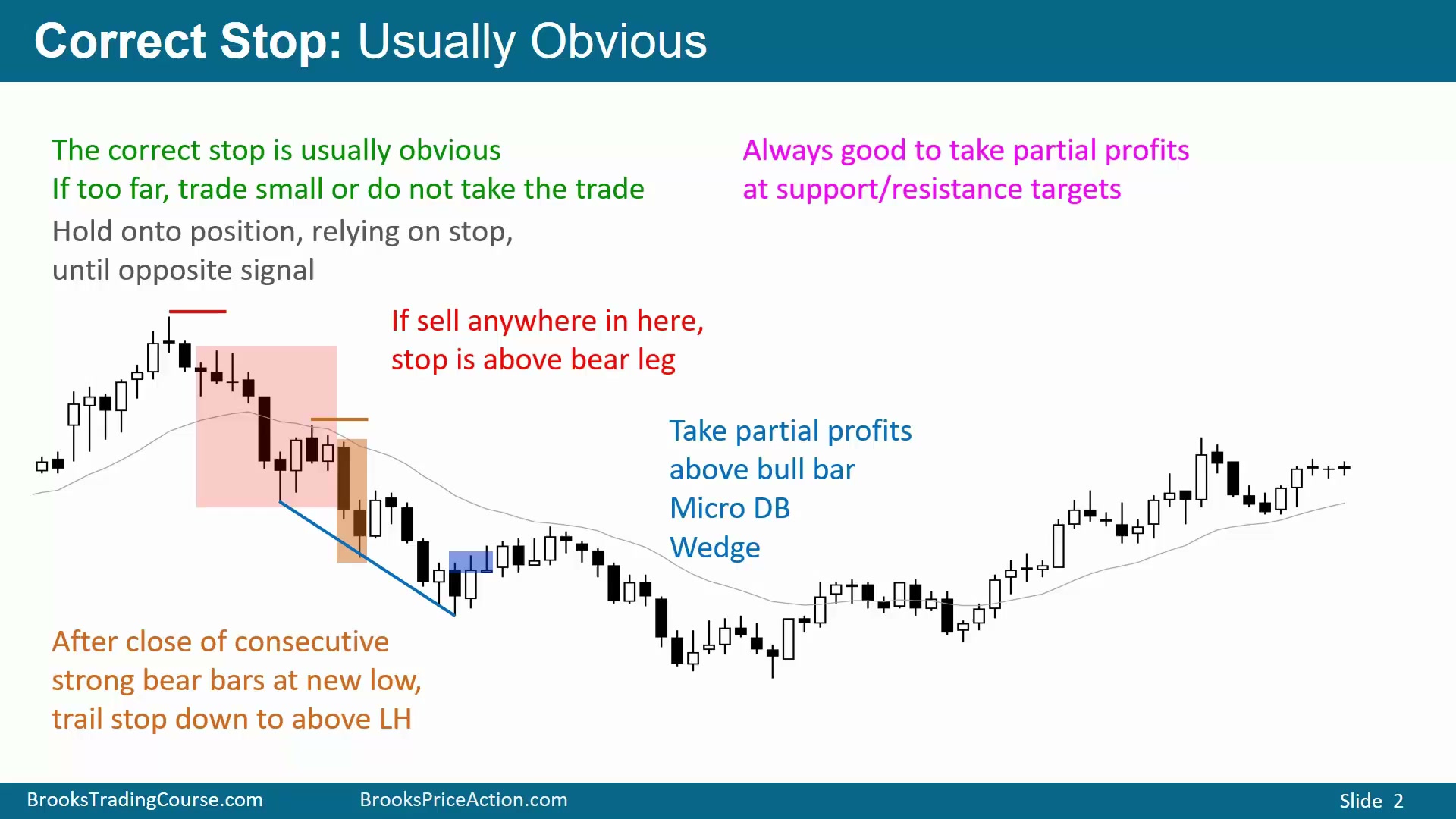
EN: When you’re trading, the appropriate stop is usually pretty obvious.

00:57 - 01:01

EN: If you look at the chart and you know where the stop is but it’s too far away,

01:01 - 01:04

EN: either you have to trade very small or do not take the trade.

01:05 - 01:08

EN: It’s perfectly reasonable to not take trades.

01:09 - 01:12

EN: If for any reason you cannot take the trade – if the stop is too far,

01:12 - 01:15

EN: if emotionally you’re distracted – you simply don’t take the trade.

01:15 - 01:17

EN: There’ll be plenty other trades.

01:21 - 01:25

EN: If you are in position and you’re swing trading, you hold onto the position

01:25 - 01:27

EN: until there’s a clear opposite signal

01:27 - 01:30

EN: or some other strong reason to get out of the trade.

01:30 - 01:34

EN: You rely on your stop, and you can trail your stop when the market goes your way.

01:37 - 01:42

EN: It’s always good to take partial profits at support and resistance targets.

01:42 - 01:44

EN: Also, you should get out of the trade

01:44 - 01:47

EN: if there’s a reasonable signal in the opposite direction.

01:51 - 01:54

EN: For example, let’s say you sold anywhere in this box.

01:55 - 01:56

EN: The stop is obvious.

01:56 - 01:58

EN: It’s at the top of the bear swing.

01:58 - 02:02

EN: It doesn’t matter if you sold here or if you sold here; the stop is right there.

02:07 - 02:10

EN: Here we have a couple bear bars, good size bars –

02:10 - 02:12

EN: a breakout bar, follow-through bar.

02:12 - 02:15

EN: The market should not get above this high if it’s in a bear trend,

02:15 - 02:17

EN: and therefore it’s reasonable to tighten your stop here.

02:17 - 02:20

EN: This is still the major Lower High,

02:20 - 02:22

EN: but it is reasonable to tighten your stop here.

02:22 - 02:25

EN: If the market pulls back, goes above it,

02:25 - 02:27

EN: and you get stopped out, you can always sell again.

02:33 - 02:37

EN: At this point we have three legs down and therefore a Wedge,

02:37 - 02:39

EN: and we have a Micro Double Bottom.

02:39 - 02:41

EN: We went up on this bar and down on this bar.

02:41 - 02:43

EN: If we go above the high of this bar,

02:43 - 02:45

EN: then we have a Micro Double Bottom and a Wedge.

02:45 - 02:47

EN: The channel down is tight.

02:47 - 02:52

EN: The reversal is probably minor, which means either a Trading Range or a bear flag,

02:52 - 02:55

EN: but it’s okay to get out here, especially if you sold up here.

02:55 - 02:57

EN: You have a reasonable profit.

02:57 - 02:59

EN: You have a reasonable excuse to get out.

03:00 - 03:04

EN: You can also take partial profits and hold onto the remainder of your position.

Slide 003

Time: 03:08

Slide 003

Bilingual Transcript

03:14 - 03:17

EN: If you’re in a swing trade, you need a swing stop.

03:17 - 03:21

EN: If the trade looks bad, either get out or rely on your stop.

03:25 - 03:28

EN: Beginners are always afraid to take losses

03:28 - 03:33

EN: because they focus on losses and they’re worried about being a loser.

03:33 - 03:36

EN: All beginners are losers, and it hurts.

03:36 - 03:40

EN: Emotionally, it hurts to take losses, and therefore beginners hate taking losses

03:40 - 03:43

EN: and they often do not take losses when they should.

03:46 - 03:48

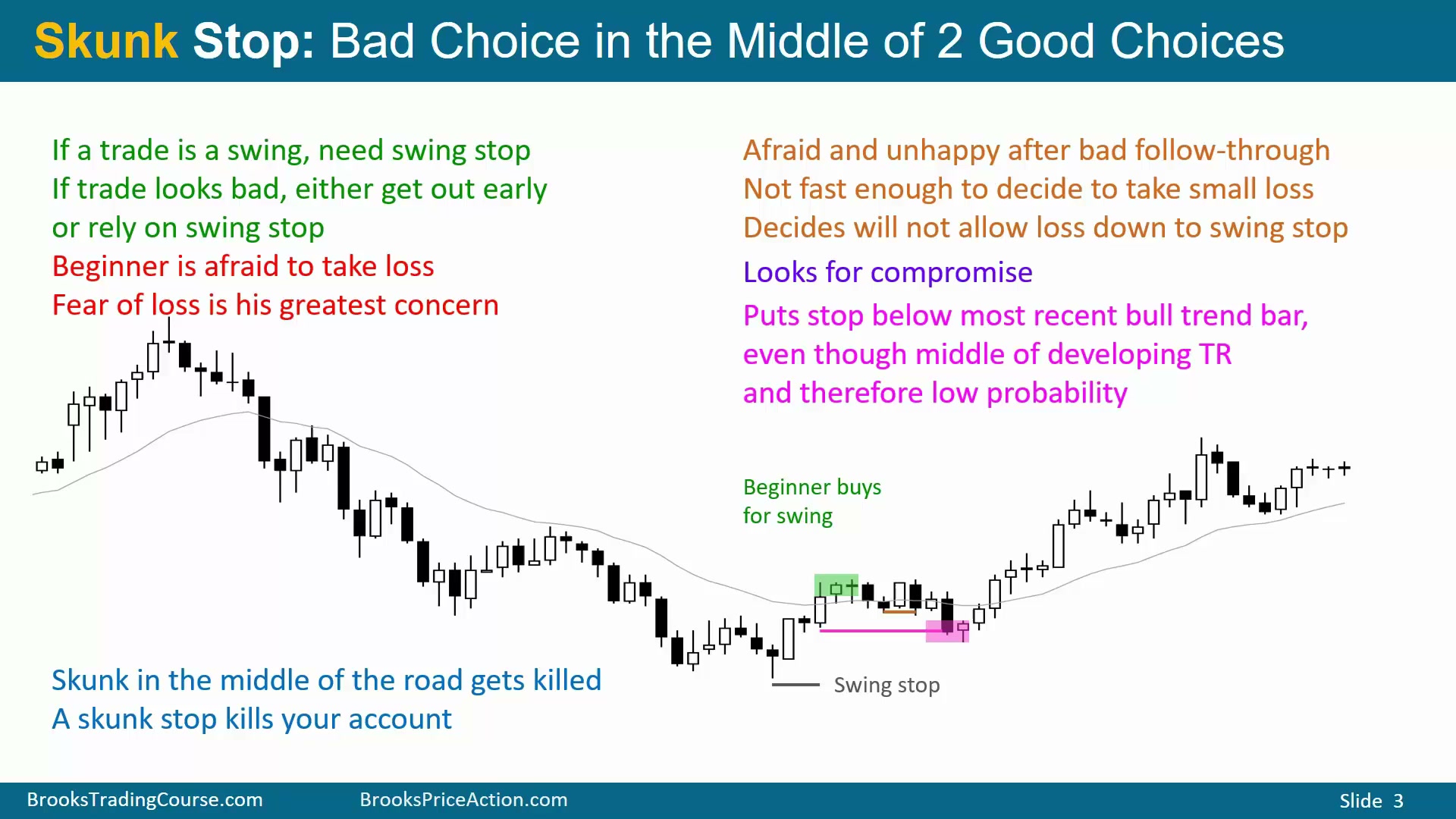
EN: Let’s say a beginner buys this reversal up,

03:48 - 03:51

EN: hoping that the leg up is strong enough to have a second leg up.

03:51 - 03:54

EN: So, he buys looking for possibly a swing up.

03:57 - 04:00

EN: If he takes the buy, his stop is down here.

04:00 - 04:04

EN: He has a Wedge Bottom, couple good bull bars.

04:04 - 04:06

EN: He might get a second leg up.

04:06 - 04:09

EN: Here he has a small Higher Low Major Trend Reversal,

04:09 - 04:11

EN: but at this point he does not know that.

04:11 - 04:15

EN: All he knows is Wedge Bottom, the market is starting to get flat,

04:15 - 04:19

EN: the trend is getting less steep, and he has a decent reversal up.

04:27 - 04:30

EN: If he buys here and then he sees this bear bar and another bear bar,

04:30 - 04:33

EN: a lot of times a beginner will get afraid because he’ll think,

04:33 - 04:38

EN: uh oh, maybe this is a bear flag and the market is simply going to continue down.

04:39 - 04:41

EN: Now let’s say he’s debating what to do in here

04:41 - 04:44

EN: and he’s not fast enough to put his stop below this low.

04:45 - 04:46

EN: Then what does he do?

04:46 - 04:48

EN: He has a swing stop down here.

04:48 - 04:50

EN: It’s reasonable to rely on it.

04:52 - 04:57

EN: This is a problem that a beginner often faces, and he looks for a compromise.

04:57 - 04:59

EN: He realizes that he could’ve gotten out early.

05:00 - 05:02

EN: He bought this close, a disappointment bar.

05:02 - 05:05

EN: He could’ve gotten out around breakeven here,

05:05 - 05:08

EN: and he chooses to take a chance that maybe it’ll go up.

05:08 - 05:10

EN: Instead, it starts to go down.

05:11 - 05:15

EN: He chooses not to use a tight stop because he does not want to take a loss.

05:16 - 05:19

EN: He’s thinking that, “Well, I don’t want to rely on the swing stop either

05:19 - 05:24

EN: because the loss will be too big” – even though when he put the trade on,

05:24 - 05:26

EN: he decided this was an acceptable size loss.

05:27 - 05:29

EN: Therefore, he’ll look for something in between.

05:30 - 05:31

EN: He did not take the early loss.

05:31 - 05:37

EN: He’s afraid to take the full loss, even though it’s still not too big of a loss,

05:37 - 05:40

EN: so he looks for some other place to put a stop in between.

05:40 - 05:42

EN: He says, “Well, this is a bull bar.

05:42 - 05:43

EN: It’s a breakout bar.

05:43 - 05:46

EN: Maybe I’ll put my stop below the low of this bar.”

05:52 - 05:53

EN: That’s a mistake.

05:53 - 05:55

EN: We’re in a Tight Bull Channel here.

05:55 - 05:58

EN: There’s no reason to get out below the low of this bar.

05:59 - 06:02

EN: Either you get out early or you rely on your stop.

06:02 - 06:05

EN: What happens is the beginner gets stopped out,

06:05 - 06:07

EN: he sees this big bear bar, and he panics.

06:08 - 06:10

EN: He’s happy to get out.

06:10 - 06:13

EN: He’s relieved to get out, and he’s unable to buy again above this bull bar.

06:13 - 06:17

EN: He misses the big trend that he was anticipating when he bought originally.

06:19 - 06:21

EN: This is what I call a skunk stop.

06:21 - 06:24

EN: It’s in between two reasonable stops.

06:29 - 06:31

EN: A skunk in the middle of the road is going to get killed,

06:32 - 06:36

EN: and if you start using skunk stops between two reasonable stops,

06:36 - 06:38

EN: your account is going to get killed.

Slide 004

Time: 06:40

Slide 004

Bilingual Transcript

06:47 - 06:52

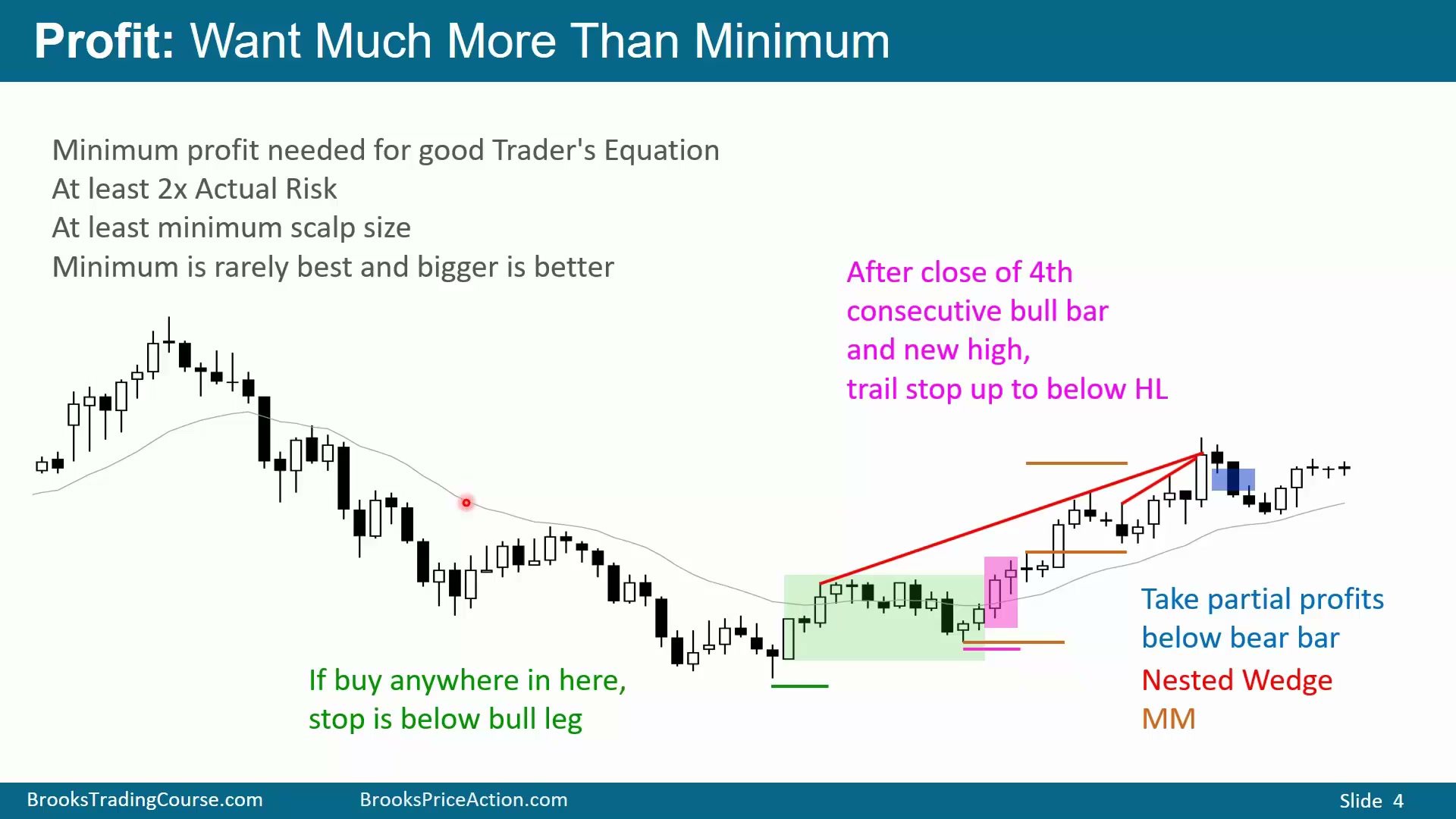
EN: The minimum profit that you need to trade based upon the Trader’s Equation

06:52 - 06:54

EN: is at least two times your Actual Risk,

06:54 - 06:58

EN: and that has to be at least a minimum scalp size.

06:59 - 07:02

EN: Minimum is rarely ever the best thing to choose in life.

07:02 - 07:07

EN: Having a goal of making minimum wage is rarely ever a good choice,

07:07 - 07:12

EN: and going for minimum profits when trading is rarely ever a good choice.

07:16 - 07:21

EN: If a trader buys anywhere in this green box, he knows his stop goes here.

07:21 - 07:24

EN: If he gets stopped out and it reverses again, he can always buy again.

07:30 - 07:32

EN: Here we have 4 consecutive bull bars.

07:32 - 07:34

EN: We have a breakout bar, a bigger bull bar,

07:34 - 07:37

EN: and a follow-through bar, and we’re breaking above this Lower High.

07:39 - 07:42

EN: Reasonably strong breakout to a new high.

07:42 - 07:46

EN: It’s reasonable to trail your stop up from this low to below this low.

07:50 - 07:52

EN: Getting late in the session.

07:52 - 07:54

EN: We have a bear bar after a Buy Climax bar.

07:54 - 07:58

EN: Around a 50% pullback, three pushes up – one, two, three.

07:58 - 08:01

EN: Nested three pushes up – one, two, three.

08:01 - 08:04

EN: Reasonable to take profits here below that bear bar.

08:07 - 08:10

EN: Nested Wedge, and around a Measured Move target.

08:10 - 08:13

EN: We have a gap between this breakout point and this pullback,

08:13 - 08:15

EN: and the Measured Move projection is right there.

08:15 - 08:19

EN: Lots of good reasons to exit here at the end of the session.

Slide 005

Time: 08:23

Slide 005

Bilingual Transcript

08:26 - 08:30

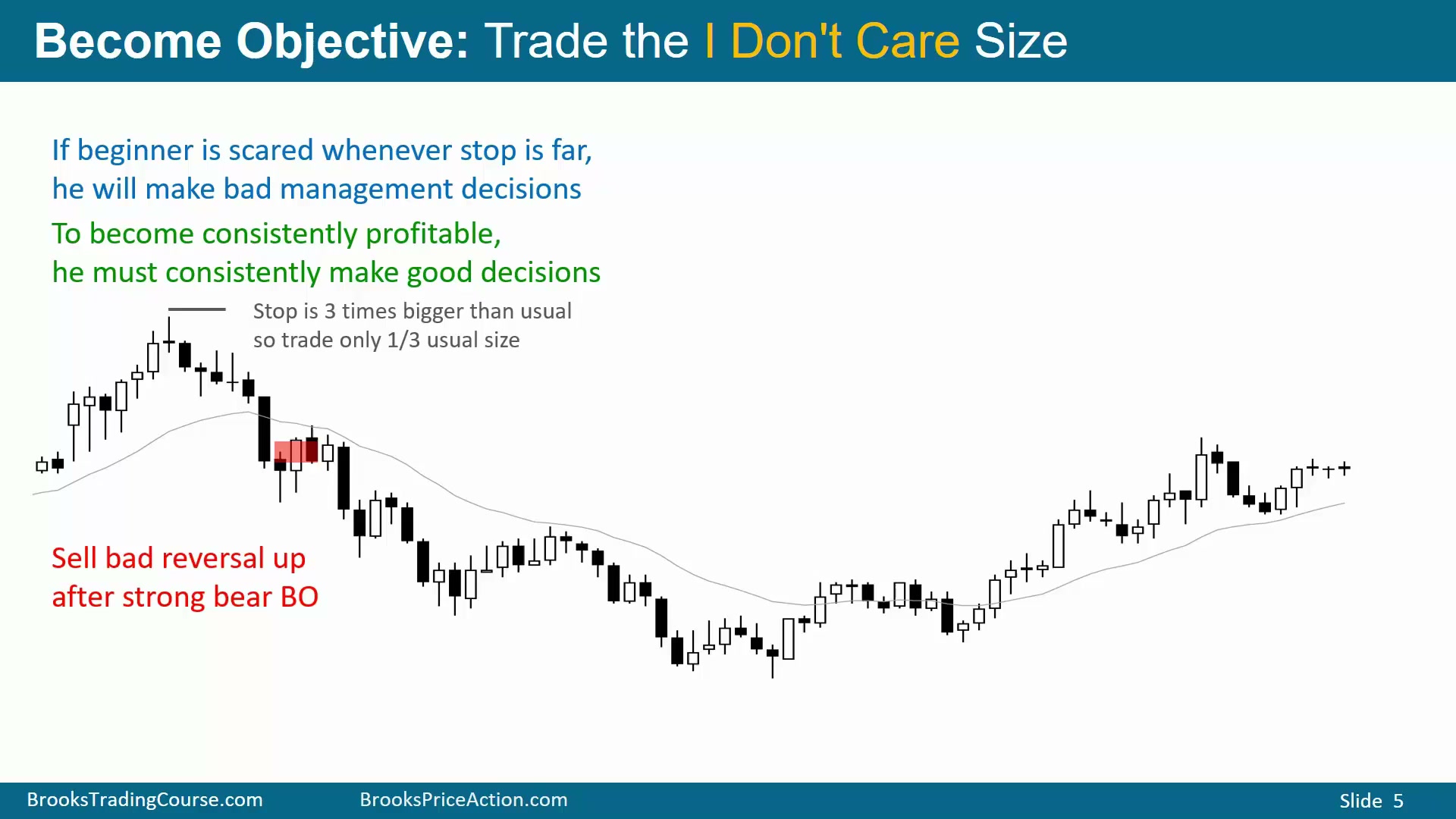
EN: Let’s say you look at this selloff, 8 bear bars,

08:30 - 08:32

EN: and you think it’s a bad buy setup,

08:32 - 08:36

EN: so you sell at the high of this bar and you get filled right here.

08:41 - 08:45

EN: It doesn’t matter where you sold; your stop is above the top of the bear leg.

08:46 - 08:50

EN: If this stop is three times bigger than your usual stop,

08:50 - 08:53

EN: then you have to trade one-third your usual size.

08:53 - 08:56

EN: If you cannot do that, then don’t take the trade.

09:01 - 09:06

EN: If a beginner is afraid that his stop is too far and he’s worried about his loss,

09:06 - 09:09

EN: he’ll make bad decisions and he should not take the trade.

09:14 - 09:16

EN: For a trader to become consistently profitable,

09:16 - 09:19

EN: he has to consistently make good decisions.

Slide 006

Time: 09:25

Slide 006

Bilingual Transcript

09:28 - 09:31

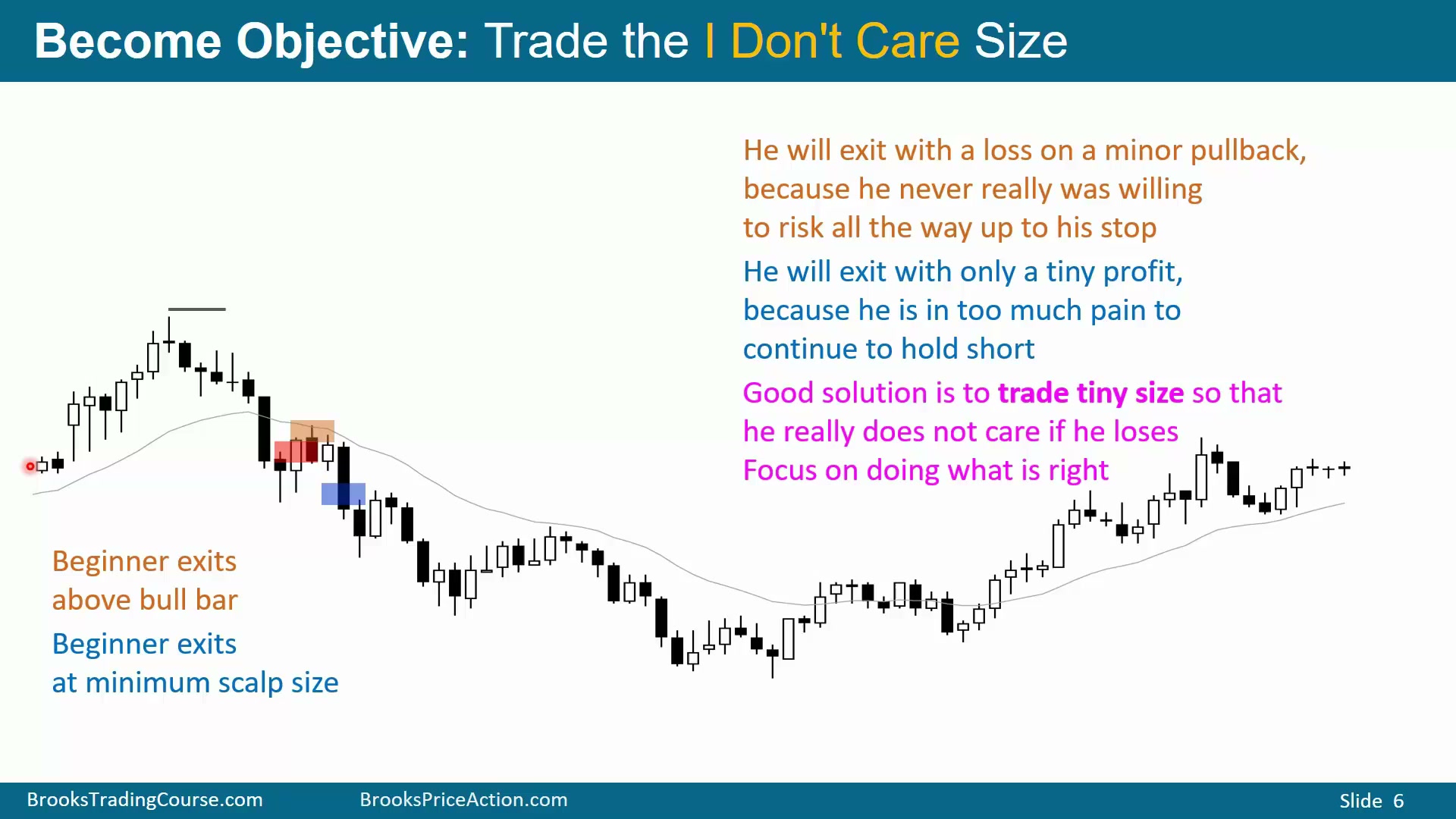
EN: The beginner, if he took this short – which is a reasonable thing to do;

09:31 - 09:34

EN: we have a Give-up Bar, we have a follow-through bar,

09:34 - 09:36

EN: we could be getting a Spike and Channel down

09:37 - 09:39

EN: - he might be panicked by this bull bar

09:39 - 09:42

EN: and get out above its high instead of relying on his stop.

09:42 - 09:47

EN: However, after 8 bear bars, the first reversal up is probably minor

09:47 - 09:50

EN: and the best the bulls probably will get is the Trading Range,

09:50 - 09:53

EN: and the bears will probably still get at least a small second leg down.

09:54 - 09:57

EN: Now, why would the beginner get out above this bar?

09:57 - 09:59

EN: Because he lied to himself.

09:59 - 10:01

EN: He said he was going to rely on his stop,

10:01 - 10:04

EN: but he had no intention of relying on that stop.

10:04 - 10:06

EN: He was afraid of too big of a loss.

10:06 - 10:09

EN: He was never willing to risk that much money,

10:09 - 10:12

EN: and as soon as the market went against him, he got out.

10:13 - 10:16

EN: He sold hoping the market would go immediately his way.

10:16 - 10:19

EN: That was his plan, even though he told himself

10:19 - 10:22

EN: his plan was he was going to rely on his stop.

10:29 - 10:34

EN: Alternatively, if he held, he was so afraid of this bear bar.

10:34 - 10:37

EN: Now he’s thinking this might be a climactic end of the move.

10:37 - 10:40

EN: He’ll scalp out for a minimum scalp.

10:40 - 10:42

EN: Beginners do that all the time.

10:42 - 10:46

EN: They’re in a good swing trade and they’re so happy to have any profit

10:46 - 10:49

EN: because they’ve lost so many times in the past few days

10:49 - 10:51

EN: that they’ll grab a minimum scalp.

10:52 - 10:56

EN: Very often it’ll be a positive Trader’s Equation,

10:56 - 10:58

EN: so mathematically it’s an acceptable thing to do.

10:59 - 11:01

EN: However, it’s rarely a good thing to do

11:01 - 11:03

EN: because you’re going to make mistakes in life,

11:03 - 11:08

EN: and you need occasional swing trades to offset all of your little mistakes.

11:14 - 11:17

EN: If the beginner is really worried about losing too much money,

11:17 - 11:19

EN: he simply has to trade small.

11:19 - 11:21

EN: I talk about the “I don’t care” size.

11:21 - 11:25

EN: You trade so small that you really don’t care if your stop gets hit.

11:25 - 11:28

EN: That way there, you’ll focus on doing what is right.

Slide 007

Time: 11:30

Slide 007

Bilingual Transcript

11:36 - 11:42

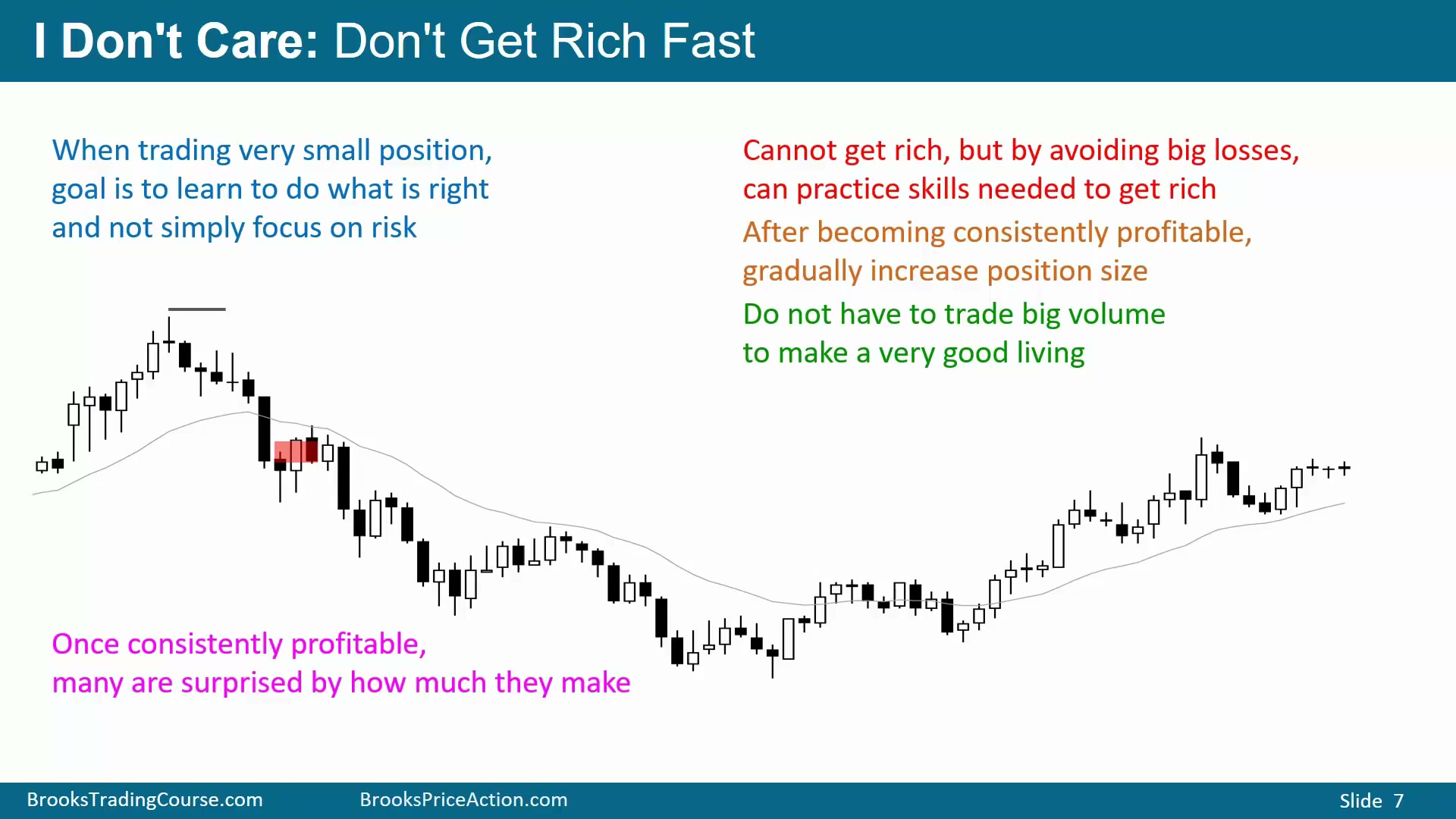
EN: Traders need experience doing what is right and not simply focusing in on risk.

11:42 - 11:44

EN: The Trader’s Equation has three variables.

11:44 - 11:46

EN: Beginners always focus on risk.

11:46 - 11:50

EN: They ignore probability and they ignore reward.

11:50 - 11:55

EN: This trade is a good trade for a swing, and it has a potential for a big reward.

12:00 - 12:03

EN: If you trade small, you’re not going to get rich.

12:03 - 12:06

EN: However, you can practice doing the right thing,

12:06 - 12:09

EN: and once you get experience doing the right thing

12:09 - 12:13

EN: and you consistently do the right thing, then you can start trading bigger,

12:13 - 12:16

EN: and eventually you’ll have a decent shot at becoming rich.

12:23 - 12:28

EN: Also, you do not have to trade big volume to get rich or make a very good living.

12:28 - 12:32

EN: I’ve known traders over the years who trade relatively small position sizes,

12:32 - 12:35

EN: but they trade extremely well and they make a lot of money.

12:40 - 12:44

EN: I’ve heard from many traders over the years that they’re surprised

12:44 - 12:47

EN: by how much money they’re making simply by doing the right thing.

12:53 - 12:56

EN: Scaling in is for experienced traders.

Slide 008

Time: 12:55

Slide 008

Bilingual Transcript

12:56 - 12:59

EN: It’s very easy for beginners to lose far more

12:59 - 13:02

EN: than they ever imagined if they’re scaling in incorrectly.

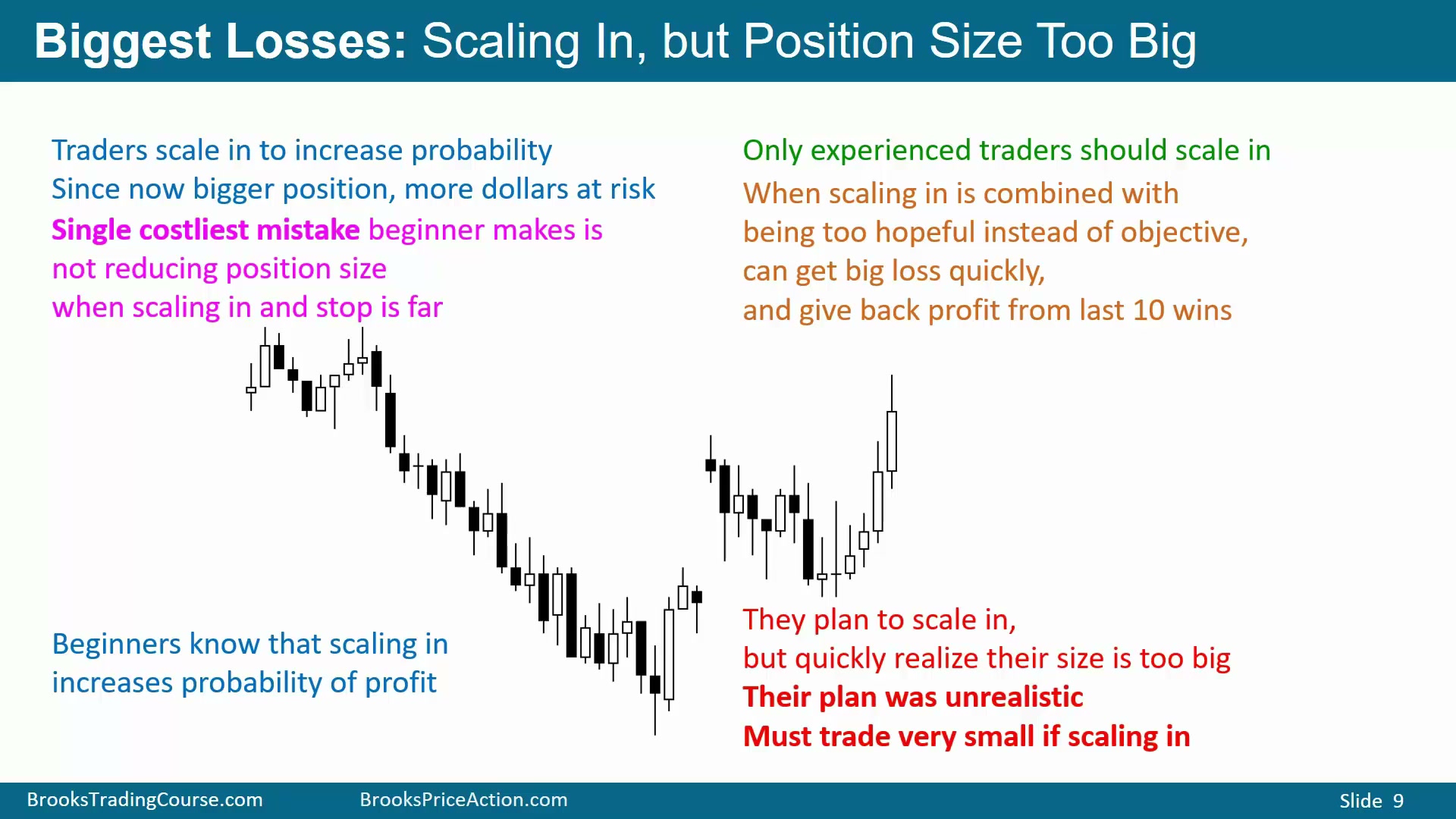
Slide 009

Time: 13:03

Slide 009

Bilingual Transcript

13:11 - 13:15

EN: The purpose of scaling into a trade is to increase your probability.

13:16 - 13:21

EN: Whenever you improve your probability, you always weaken your risk/reward situation.

13:22 - 13:24

EN: Typically, you’re increasing your risk.

13:30 - 13:34

EN: One of the biggest mistakes that beginners make is they scale in

13:34 - 13:37

EN: without greatly reducing their position size.

13:38 - 13:41

EN: They end up losing far more than they ever dreamed possible,

13:41 - 13:44

EN: and part of that is because they never dreamed

13:44 - 13:47

EN: that the market would go against them and hit their stop.

13:51 - 13:56

EN: Only experienced traders should scale in because an experienced trader will know

13:56 - 14:00

EN: if his trade is still valid, and if he thinks it’s no longer valid,

14:00 - 14:01

EN: he’s not going to scale in.

14:01 - 14:03

EN: He’s just going to get out and take a loss.

14:03 - 14:08

EN: A beginner will not admit that his premise is no longer valid

14:08 - 14:12

EN: and he’ll keep scaling in, hoping that the market again goes his way,

14:12 - 14:14

EN: and he ends up taking frequent big losses.

14:23 - 14:27

EN: It’s a terrible combination to be scaling in and being hopeful.

14:27 - 14:29

EN: You need to be objective.

14:29 - 14:33

EN: One big loss can easily wipe out 10 or 20 good trades,

14:33 - 14:38

EN: and it will take 10 or 20 other good trades to make up for that one big loss.

14:41 - 14:46

EN: Everybody knows that you scale in to increase the probability of making money.

14:53 - 14:56

EN: However, beginners think that they can scale in.

14:57 - 15:00

EN: Invariably they have an unrealistic plan.

15:00 - 15:04

EN: They’re not willing to take the loss because the position size

15:04 - 15:07

EN: is going to be too big when they add to their position,

15:07 - 15:10

EN: and they start seeing how fast their losses are growing.

15:10 - 15:13

EN: Even if the trade is still valid, they’ll be shocked

15:13 - 15:17

EN: by how fast the losses are growing because their position size is too big.

Slide 010

Time: 15:20

Slide 010

Bilingual Transcript

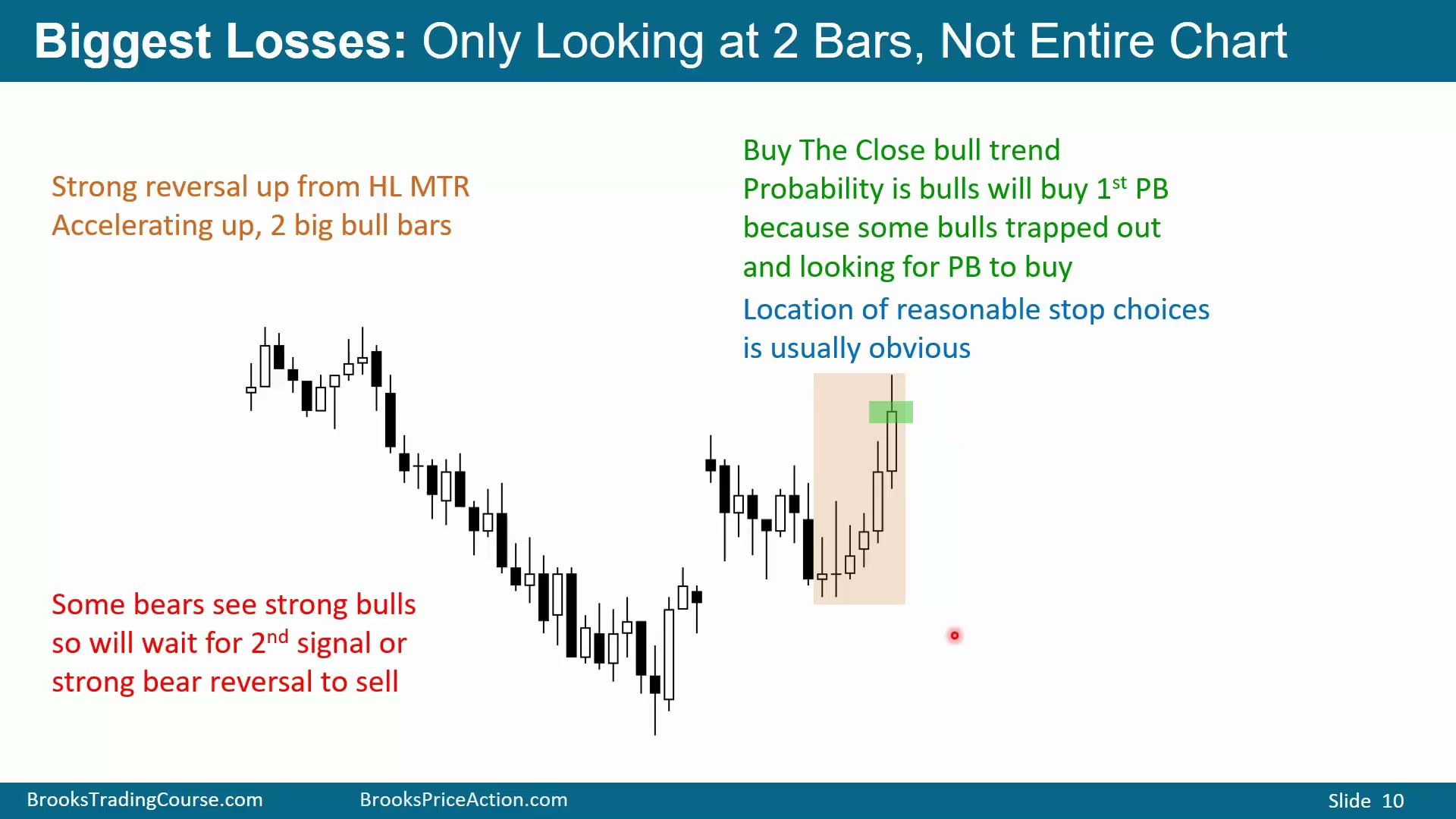
15:24 - 15:28

EN: We have a bear trend, a bull breakout, a Higher Low Major Trend Reversal,

15:28 - 15:31

EN: and now we have 4 bull bars with increasing body sizes.

15:31 - 15:33

EN: The market’s accelerating up.

15:33 - 15:36

EN: Therefore, it probably will go higher.

15:37 - 15:41

EN: Bulls will buy, thinking that either the market goes up and they make a profit,

15:41 - 15:44

EN: or this is a bull leg in what will become a Trading Range

15:44 - 15:47

EN: and they can buy more lower, expecting it to come back up here,

15:47 - 15:50

EN: and then they can make a profit on their lower entry

15:50 - 15:52

EN: and get out breakeven on their first entry.

15:58 - 16:00

EN: Buy The Close bull trend.

16:00 - 16:02

EN: We have a 6 bar bull Micro Channel.

16:02 - 16:04

EN: No bear bars in 6 bars.

16:04 - 16:08

EN: Yes, we’re still below a prior high, so this might be a bull leg

16:08 - 16:10

EN: in a Trading Range, but it’s a reasonable buy.

16:11 - 16:13

EN: It’s a strong enough rally

16:13 - 16:16

EN: so that the odds are bulls will buy the firsts reversal down.

16:16 - 16:20

EN: However, remember, at this point you don’t know if this is the start

16:20 - 16:24

EN: of a bull trend or if it’s a test of the top of the Trading Range,

16:24 - 16:29

EN: and it could be followed by a deep pullback to below the bottom of this Buy Climax,

16:29 - 16:32

EN: the breakout, but above the bottom of the bull trend.

16:38 - 16:42

EN: A lot of the bears see the 6 bars up and the 4 good bull bars

16:42 - 16:47

EN: and look at that and see a lot of momentum, and they wait for a second entry short.

16:47 - 16:49

EN: In other words, they’ll wait for a Micro Double Top

16:49 - 16:51

EN: or a Wedge Top before looking to sell.

16:56 - 16:58

EN: When you look at this, where should you put your stop?

16:58 - 17:03

EN: You see two obvious choices: the bottom of the breakout down here,

17:03 - 17:05

EN: or the bottom of the bull trend down here.

17:05 - 17:07

EN: Both are reasonable.

17:07 - 17:09

EN: If you use the tighter stop,

17:09 - 17:11

EN: you’re going to get stopped out more often but lose less.

17:12 - 17:15

EN: If you use the wider stop, you’ll get stopped out less often,

17:15 - 17:17

EN: but when you lose, you’ll lose more.

17:17 - 17:20

EN: If you take the tight stop in 10 trades like this

17:21 - 17:23

EN: and somebody else takes the wide stop,

17:23 - 17:27

EN: after 10 trades you’ll have about the same amount of money.

17:27 - 17:30

EN: Both are reasonable, and therefore you can use either one.

17:31 - 17:35

EN: If it goes down below this low and reverses up, you can always get stopped out

17:35 - 17:37

EN: and buy on the reversal up.

Slide 011

Time: 17:43

Slide 011

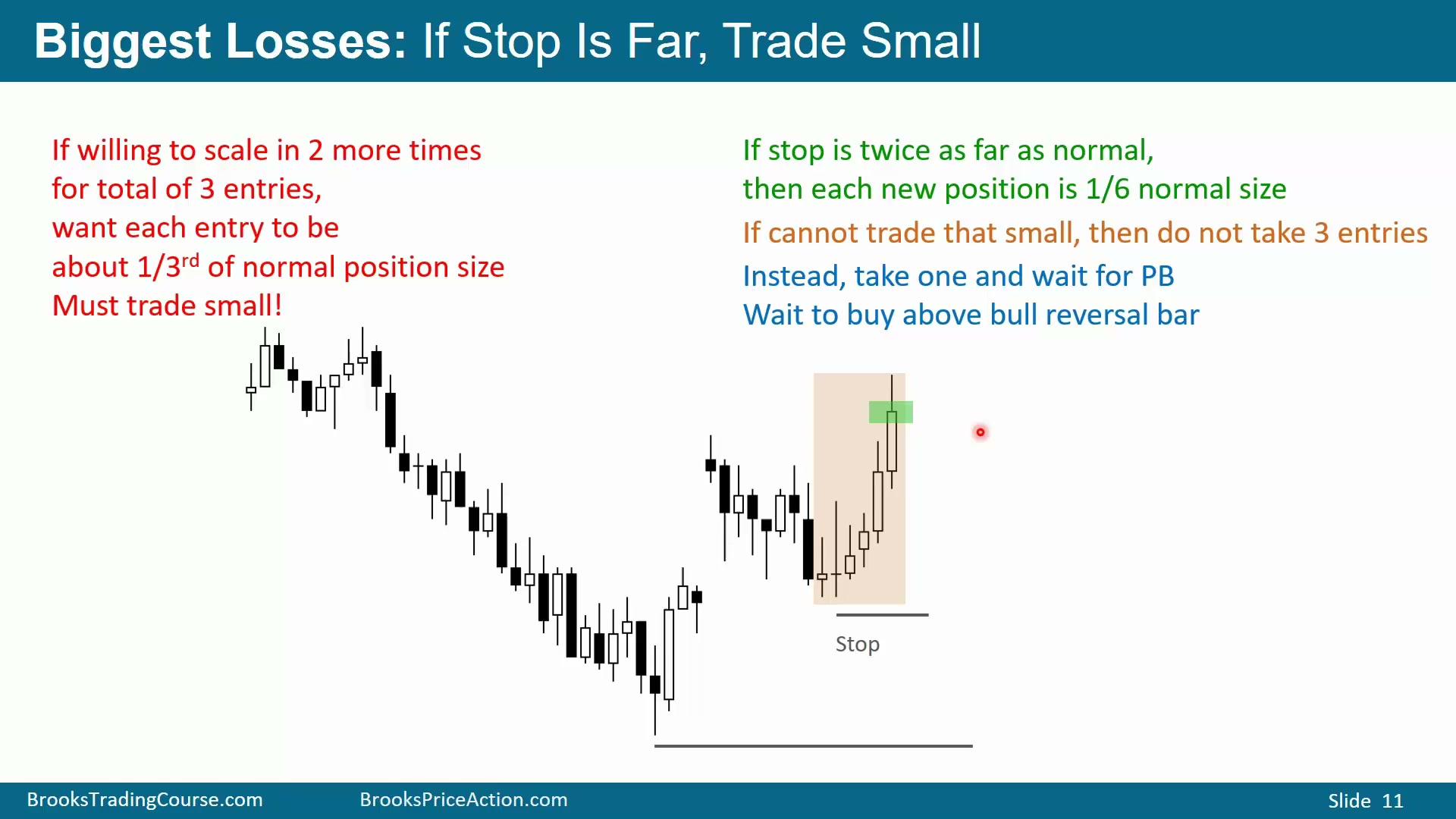
Bilingual Transcript

17:48 - 17:50

EN: Let’s say a trader is willing to scale in

17:50 - 17:52

EN: two more times for a total of three entries.

17:53 - 17:57

EN: Therefore, you have to make each entry about one-third

17:57 - 18:01

EN: of your normal position size if you’re using this stop or this stop.

18:01 - 18:05

EN: Whatever your position size is for either of these stops,

18:05 - 18:09

EN: if you’re thinking that you might scale in if this sells off

18:09 - 18:13

EN: and becomes a Trading Range, you have to true extremely small.

18:13 - 18:14

EN: Beginners can’t do that.

18:15 - 18:19

EN: Either their account size is small and their position size is small already

18:19 - 18:22

EN: and they cannot reduce their position to one-third size,

18:23 - 18:26

EN: or they simply think the position size then would be

18:26 - 18:28

EN: so tiny that it’s not worth taking the trade.

18:29 - 18:32

EN: The result is the beginner ends up taking too big of a trade,

18:32 - 18:36

EN: and he doesn’t realize how bad he’ll feel emotionally

18:36 - 18:39

EN: if it’s starting to go against him and he adds onto his position,

18:39 - 18:43

EN: and the rate of his losses accelerates.

18:48 - 18:52

EN: If your stop is twice your normal stop and you’re thinking

18:52 - 18:56

EN: of entering two more times – in other words, tripling the size of your position

18:56 - 19:02

EN: - then you have to trade one-sixth of your normal size, and if you cannot do that,

19:02 - 19:04

EN: you don’t take the trade – or you use a different plan.

19:05 - 19:07

EN: For example, don’t scale in.

19:15 - 19:19

EN: What you could do is you could buy here, wait for a pullback,

19:19 - 19:21

EN: and then buy more above a reversal bar.

19:21 - 19:23

EN: That’s a common approach.

Slide 012

Time: 19:25

Slide 012

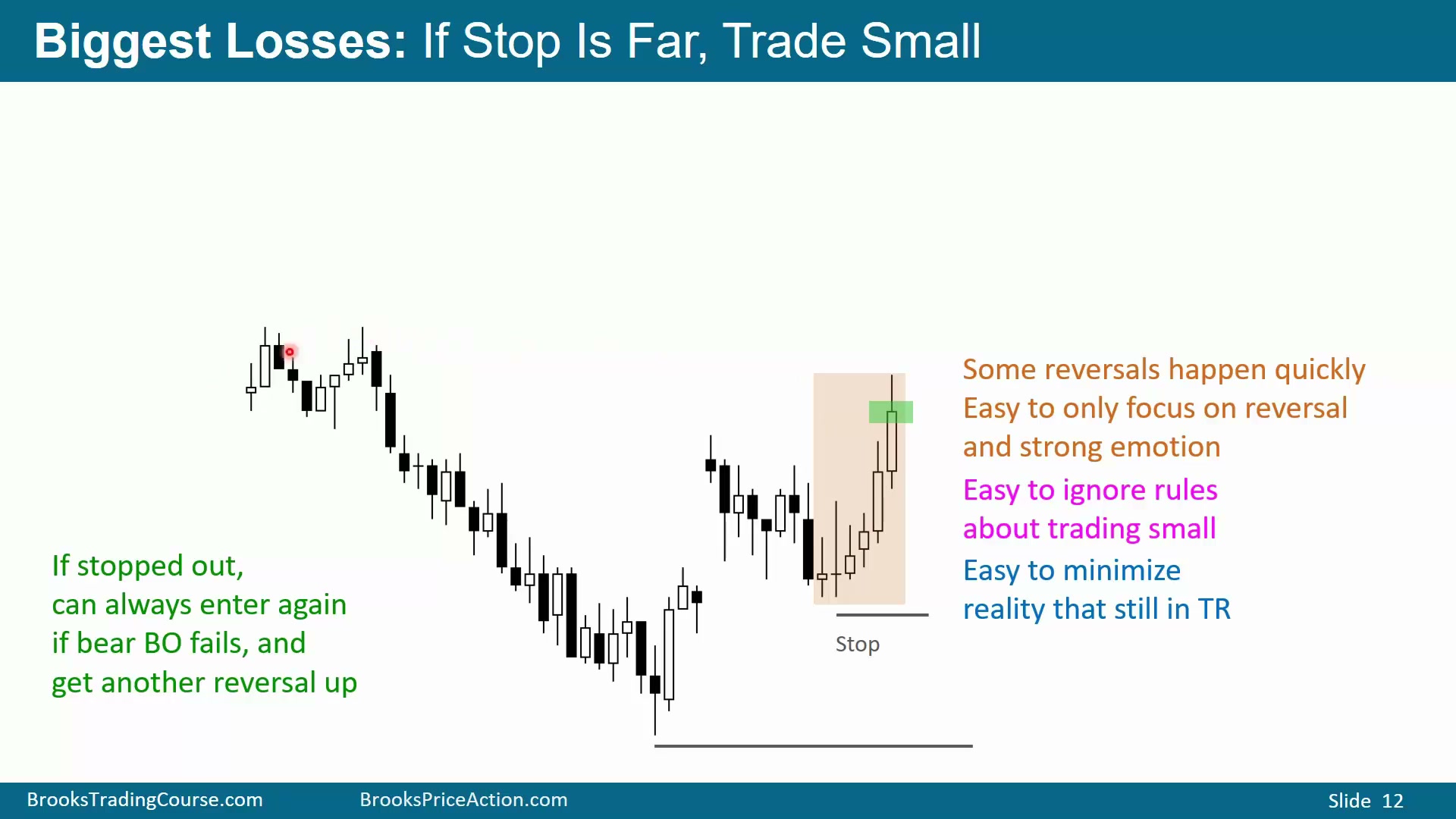
Bilingual Transcript

19:34 - 19:36

EN: One concern that you have to have

19:36 - 19:40

EN: when you’re in a possible Trading Range is a 2nd Leg Trap.

19:40 - 19:44

EN: Sometimes you’ll get a weak first leg and then a very strong second leg,

19:44 - 19:48

EN: but it’s not breaking far above all the bars to the left.

19:48 - 19:50

EN: Therefore, it could be a bull leg in a Trading Range

19:50 - 19:53

EN: instead of a Measuring Gap leading to a new bull trend.

19:54 - 19:56

EN: Beginners only see the 6 bars up,

19:56 - 19:59

EN: and they think that it’s going to be a successful breakout.

19:59 - 20:02

EN: The bull bodies are good, but they’re not particularly big

20:02 - 20:05

EN: and they have tails on top, so this is not all that strong,

20:05 - 20:07

EN: and look at all of these bars.

20:07 - 20:08

EN: Every bar has tails.

20:08 - 20:12

EN: That means this might be part of a Trading Range.

20:12 - 20:16

EN: If you have a lot of bars with tails, that is Trading Range price action,

20:16 - 20:19

EN: and a rally like this could be simply a bull leg in a Trading Range.

20:27 - 20:30

EN: Beginners only see this, big bull bars,

20:30 - 20:33

EN: and they think bull trend, and they don’t see this.

20:33 - 20:35

EN: We’re not above the top of the bars to the left,

20:35 - 20:39

EN: and this could simply be a buy vacuum test of the top of a Trading Range.

20:41 - 20:43

EN: Then you get this.

20:43 - 20:46

EN: Let’s say you buy that close and you see this bear bar.

Slide 013

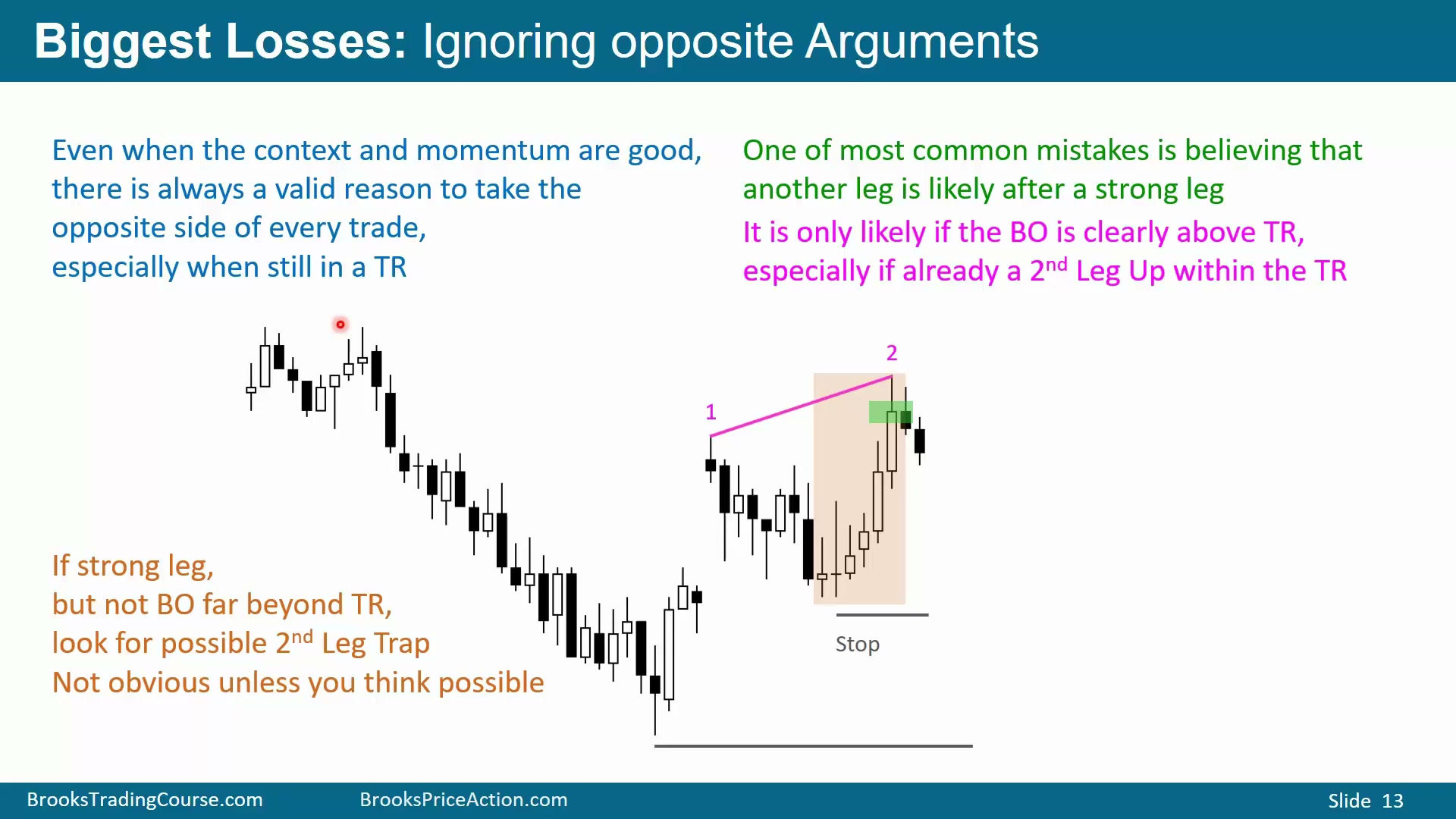
Time: 20:45

Slide 013

Bilingual Transcript

20:46 - 20:47

EN: It’s two legs up.

20:47 - 20:51

EN: We’re still below the bars to the left, the top of the bars to the left.

20:51 - 20:54

EN: This could be a 2nd Leg Trap in a Trading Range.

20:54 - 20:57

EN: Most traders, if they have a strong breakout like this

20:57 - 21:02

EN: and a possible Trading Range and they see a bear bar closing on its low like that,

21:02 - 21:04

EN: it’s better just to get out below the low of that bar,

21:04 - 21:08

EN: because if this is a 2nd Leg Trap, we could sell off very deeply

21:08 - 21:11

EN: in the Trading Range before we get a leg back up.

21:12 - 21:15

EN: If you do hold long and plan to scale in,

21:15 - 21:19

EN: you either rely on your stop here or on your stop here.

21:19 - 21:23

EN: If you get that bear bar and then it trades below that bar,

21:23 - 21:27

EN: I would not be scaling in at a fixed number of points or pips below.

21:27 - 21:31

EN: I would wait until we get a reversal up and then buy more above the bull bar,

21:31 - 21:34

EN: assuming I did not get out below that bear bar.

21:34 - 21:36

EN: I typically get out below that bear bar.

21:36 - 21:41

EN: A failed breakout, two legs up, still below the top of the bars to the left,

21:41 - 21:45

EN: still in a Trading Range or possibly even a Broad Bear Channel.

21:45 - 21:46

EN: We have a Lower High.

21:53 - 21:55

EN: When you look at this you say, well, it’s got to go up.

21:55 - 21:57

EN: No, it doesn’t.

21:57 - 22:00

EN: There’s always a reason to take the opposite side of the trade.

22:00 - 22:03

EN: The bears think this is just two legs up in a Broad Bear Channel

22:03 - 22:06

EN: and that we’ll get a Lower High and then a new low.

22:06 - 22:10

EN: It’s reasonable to think that, and then after this bear bar closes on its low,

22:10 - 22:12

EN: it’s reasonable to sell below this bar,

22:12 - 22:17

EN: betting on two legs up in either a Trading Range or a Broad Bear Channel.

22:17 - 22:18

EN: It’s a reasonable short.

22:23 - 22:28

EN: Strong enough rally so that the first leg down probably will be bought,

22:28 - 22:32

EN: but if this whole thing is a leg in a Trading Range,

22:32 - 22:34

EN: that first leg down could be very deep,

22:34 - 22:36

EN: and it could even fall below the bottom of this breakout.

22:37 - 22:40

EN: This is a reasonable Buy The Close bar.

22:40 - 22:44

EN: That means that we should get back here within the next 10, 20, maybe

22:44 - 22:46

EN: even 30 bars, but we should get back here.

22:46 - 22:48

EN: This is a disappointment bar.

22:48 - 22:50

EN: This is a disappointment as well.

22:51 - 22:53

EN: A lot of the bulls who bought here are hoping

22:53 - 22:56

EN: it comes back to this close so they can get out breakeven.

22:56 - 22:59

EN: Otherwise, if it keeps going down, they’re trapped.

22:59 - 23:03

EN: Experienced bulls will get out below that bear bar or on the second

23:03 - 23:07

EN: or third consecutive bear close if there are three bear closes,

23:07 - 23:12

EN: or they’ll rely on their stop here or here and look to buy more lower.

23:19 - 23:21

EN: This is a breakout above this high,

23:21 - 23:24

EN: but it’s not a breakout above the top of the Trading Range.

23:30 - 23:34

EN: 2nd Leg Traps trap traders into buying high, trap traders

23:34 - 23:37

EN: into thinking that this is the start of a trend.

23:37 - 23:38

EN: That’s the whole idea of it.

23:38 - 23:42

EN: But unless the breakout is far above all the bars to the left,

23:42 - 23:45

EN: you have to be thinking that it could be a 2nd Leg Trap,

23:45 - 23:48

EN: trapping beginners into buying momentum

23:48 - 23:52

EN: that has not yet broken above all the bars to the left.

23:52 - 23:55

EN: It could simply be a test of the top of the Trading Range.

24:00 - 24:03

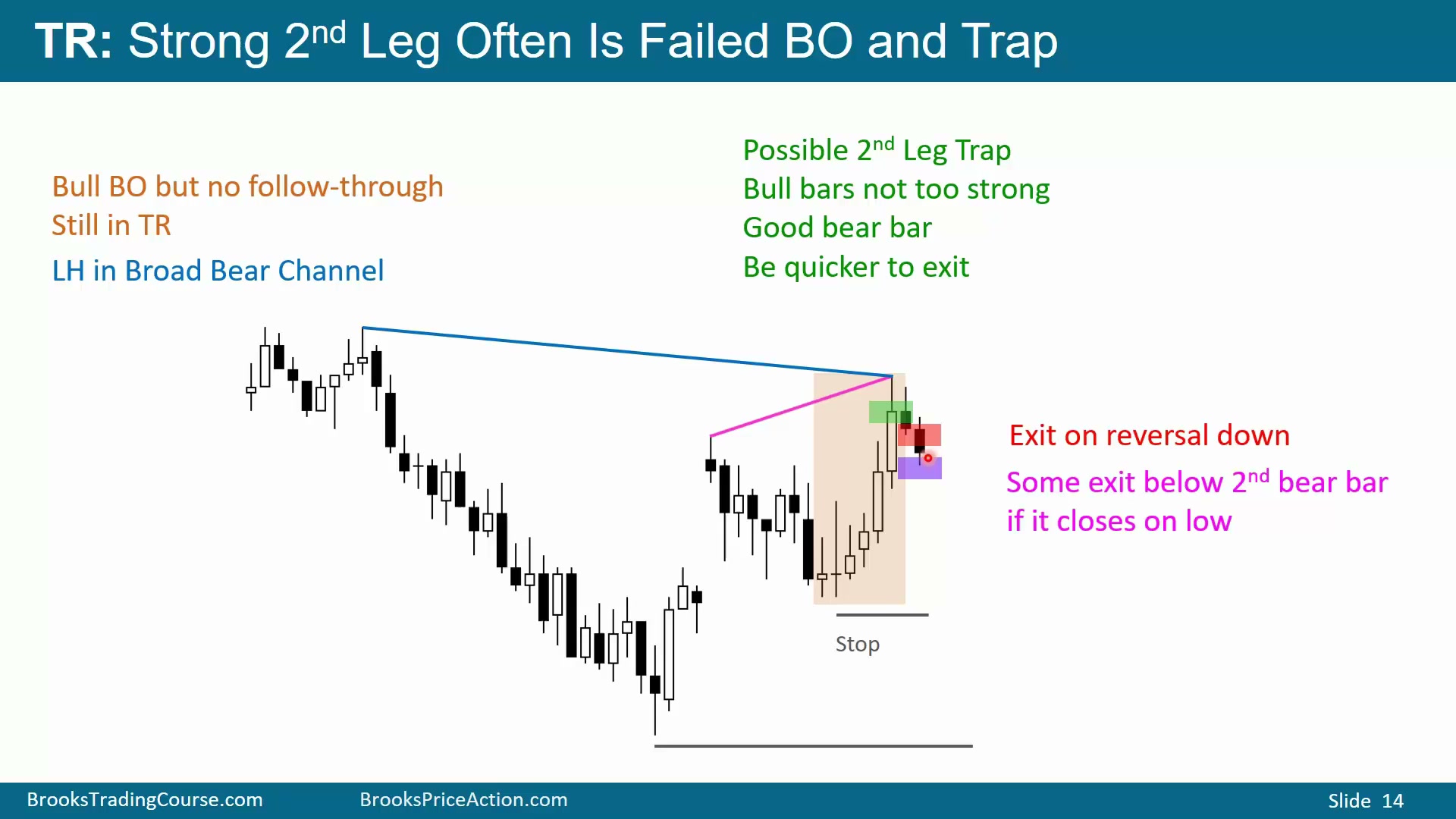
EN: Bull breakout above this high, but terrible follow-through,

Slide 014

Time: 24:00

Slide 014

Bilingual Transcript

24:04 - 24:07

EN: and therefore traders should conclude it’s still in a Trading Range.

24:08 - 24:11

EN: For the moment, although this could be the start of a bull trend,

24:11 - 24:15

EN: it’s also a bull leg in a Trading Range or a bull leg in a Broad Bear Channel.

24:15 - 24:17

EN: It’s still below this high.

24:28 - 24:30

EN: I think it’s reasonable to get out below that bear bar.

24:30 - 24:32

EN: You do not want to see a breakout

24:32 - 24:35

EN: and then have the follow-through bar be a bear bar closing on its low.

24:35 - 24:38

EN: It’s usually better just to get out below that low.

24:38 - 24:42

EN: If we go sideways here, you can always buy on a reversal back up.

24:42 - 24:45

EN: But too much risk that this is a bull leg in a Trading Range

24:45 - 24:48

EN: and that we might test all the way down to the bottom of the range.

24:52 - 24:55

EN: Some traders exit below the first bear bar.

24:55 - 24:56

EN: Others exit below the second.

24:56 - 25:00

EN: Others exit if we get three consecutive bear closes.

25:05 - 25:07

EN: Beginners, all they see is momentum up.

Slide 015

Time: 25:05

Slide 015

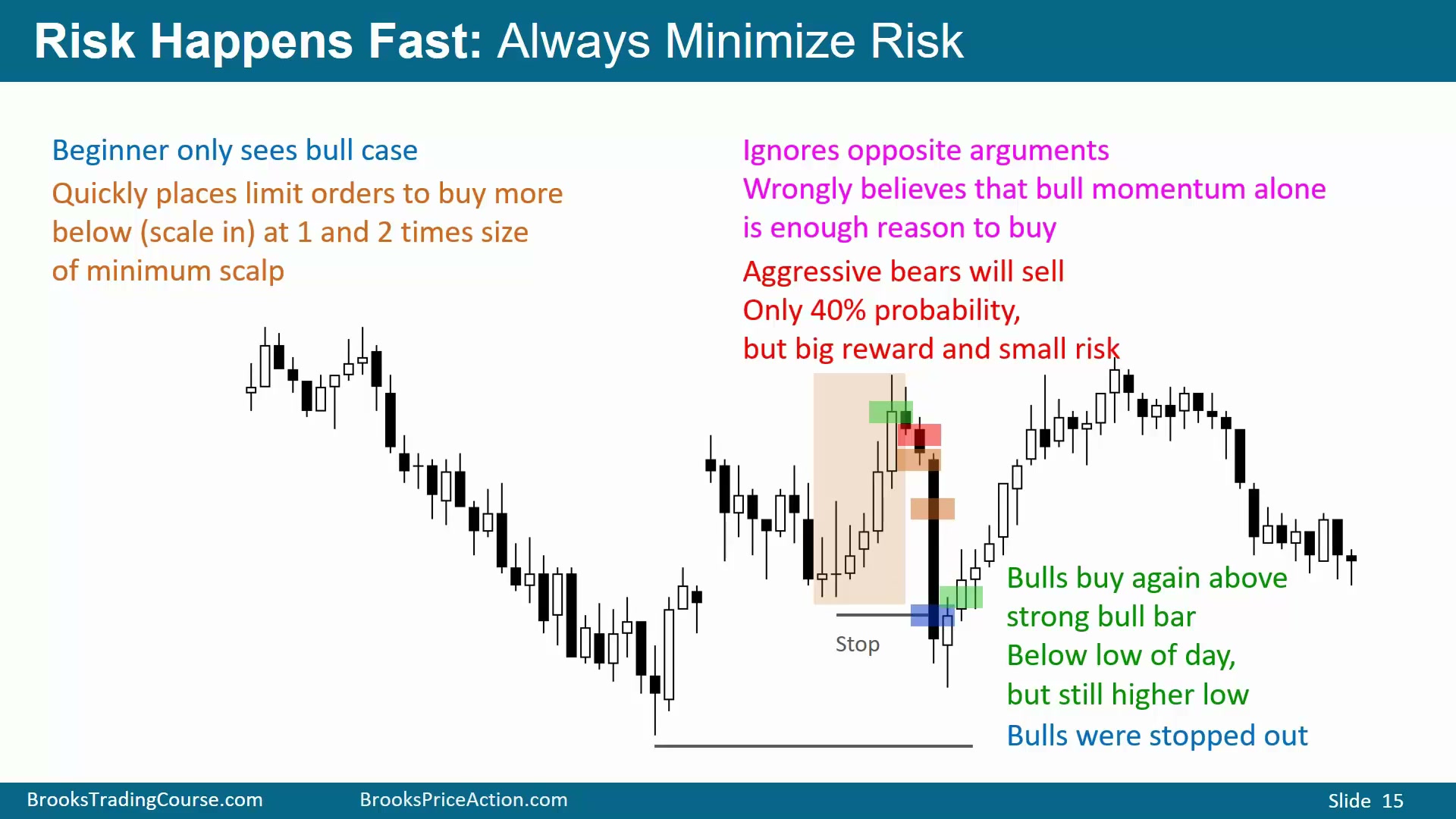
Bilingual Transcript

25:07 - 25:09

EN: All they see is a bull argument.

25:09 - 25:13

EN: They’re not thinking about the possibility that this is a bull trap.

25:18 - 25:21

EN: A lot of beginners will think, “Okay, I’ll buy.

25:21 - 25:23

EN: I want to increase my chances of winning.

25:23 - 25:25

EN: I know the size of minimum scalp.

25:25 - 25:28

EN: I’ll add on the size of a minimum scalp here

25:28 - 25:31

EN: and then two times the size of a minimum scalp here.

25:31 - 25:35

EN: I’ll get out breakeven if it gets back to my original entry price.”

25:43 - 25:45

EN: The beginner does not see the opposite argument.

25:45 - 25:50

EN: He only sees the momentum, but momentum alone is not enough reason to buy.

25:50 - 25:54

EN: Has the breakout broken above all the bars to the left,

25:54 - 25:56

EN: in which case maybe it is a bull trend?

25:57 - 26:00

EN: Or is this possibly a bull leg in a Trading Range?

26:00 - 26:02

EN: Momentum up is good.

26:02 - 26:05

EN: At the close of this bar, there’s a 60% chance we’re going higher.

26:06 - 26:10

EN: At the close of this bar, there’s a 50% chance we’re going higher,

26:10 - 26:12

EN: and 50% chance 2nd Leg Trap.

26:13 - 26:15

EN: As you start to get more and more bear bars,

26:15 - 26:18

EN: the probability is we’re going to get lower.

26:18 - 26:23

EN: The bears who take this sell have maybe a 40% chance of a swing down,

26:24 - 26:28

EN: but their risk is small and the reward is at least twice as big as their risk,

26:28 - 26:30

EN: so it’s reasonable for them to take that short.

26:33 - 26:35

EN: And this is what we got.

26:35 - 26:38

EN: A huge stop run below the Higher Low,

26:39 - 26:41

EN: yet look at the follow-through after this big bear bar.

26:41 - 26:46

EN: It’s breaking below an important low, but look at the follow-through.

26:46 - 26:48

EN: It’s the opposite of this.

26:48 - 26:51

EN: Strong rally, bear bar, strong selloff, bull bar.

26:51 - 26:54

EN: Terrible follow-through, terrible follow-through.

26:54 - 26:55

EN: We got a reversal.

26:55 - 27:00

EN: An experienced trader who took this buy would not buy more

27:00 - 27:02

EN: below that bear bar or below this bear bar.

27:02 - 27:06

EN: He would wait until there’s a bull bar and then buy more here,

27:06 - 27:09

EN: knowing that Buy The Close bulls were reasonable to buy this close,

27:09 - 27:14

EN: and if you do something reasonable and trade appropriately, scale in appropriately,

27:14 - 27:18

EN: 90% of the time you can either avoid a loss or make a profit.

27:18 - 27:22

EN: Experienced traders, if they bought this close and did not exit here,

27:22 - 27:27

EN: would buy more above a good bull bar here and then wait for the market

27:27 - 27:29

EN: to get back to their original close, get out breakeven

27:29 - 27:32

EN: at that close and then with a profit here.

27:32 - 27:34

EN: You can see the selling that took place here.

27:34 - 27:39

EN: A lot of that selling is from bulls getting out of their original position,

27:39 - 27:42

EN: and the smart ones bought more here,

27:42 - 27:44

EN: and they ended up getting a profit on their second entry.

27:47 - 27:50

EN: If you get stopped out – let’s say you use the tighter stop

27:50 - 27:53

EN: and you get stopped out – you simply buy again above this bull bar.

27:53 - 27:54

EN: It’s hard to do.

27:54 - 27:57

EN: It’s hard to get stopped out with a big loss and then go right back in

27:57 - 28:02

EN: and buy, but if you were thinking about scaling in when you put on that trade,

28:02 - 28:05

EN: if you get stopped out you buy a double position here,

28:05 - 28:10

EN: which is what you would’ve had if you bought here, relied on this stop,

28:10 - 28:12

EN: and then bought more above this bull bar.

28:18 - 28:23

EN: Bulls betting that this is not a Higher Low Major Trend Reversal anymore,

28:23 - 28:26

EN: but maybe this is a Higher Low Major Trend Reversal.

28:27 - 28:30

EN: It sounds easy, but difficult to do,

28:30 - 28:32

EN: and therefore beginners should not be doing this.

28:32 - 28:37

EN: Experienced traders can sit calmly and do the right thing, but beginners will not.

28:37 - 28:39

EN: They’ll panic and take losses all day long.

Slide 016

Time: 28:41

Slide 016

Bilingual Transcript

28:43 - 28:48

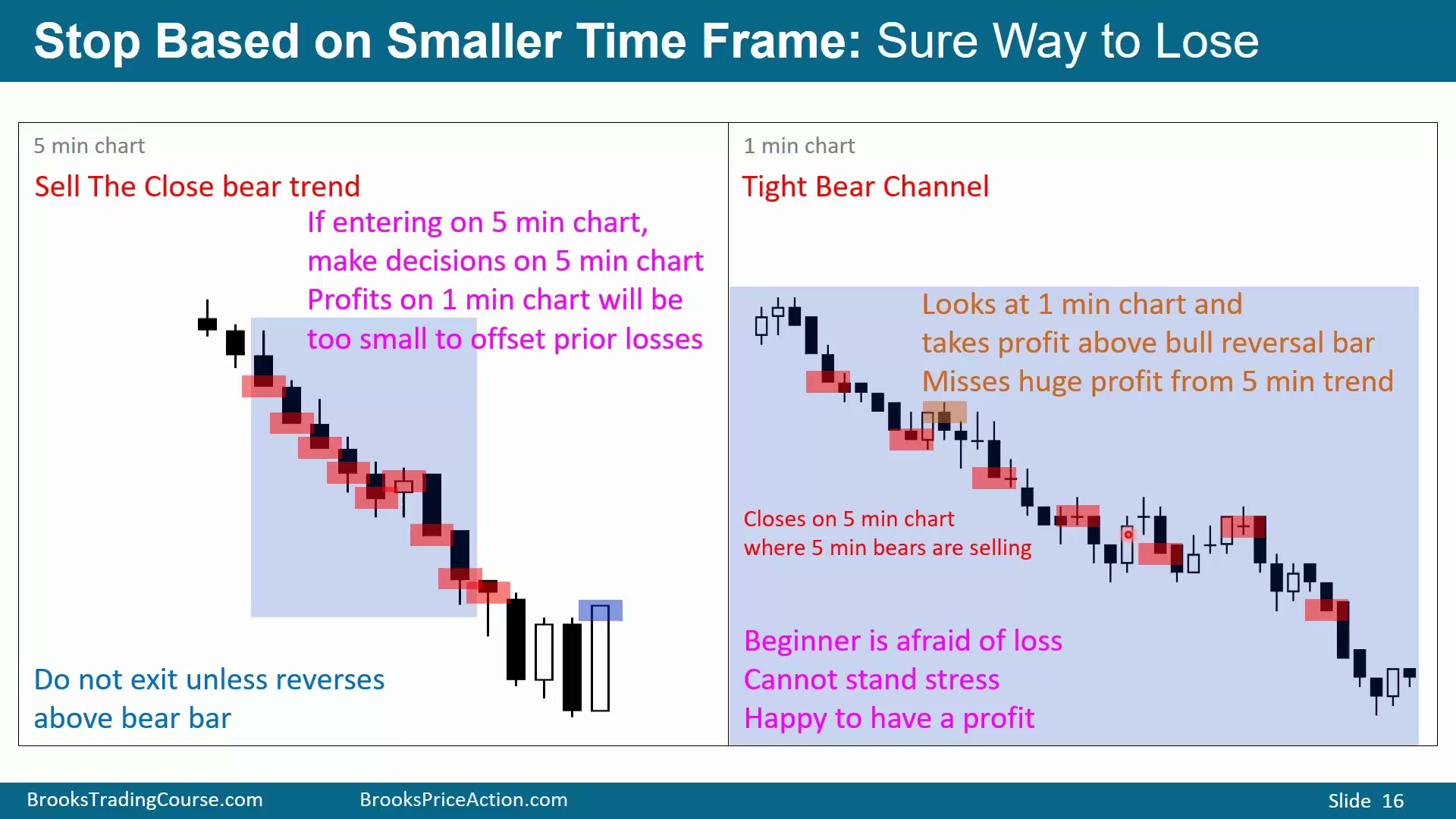
EN: This blue box, 5-minute chart, is the same as this blue box, 1-minute chart.

28:49 - 28:54

EN: Another mistake that beginners make is they’ll put a trade on using one timeframe,

28:54 - 28:56

EN: and then because they’re afraid of a loss,

28:56 - 29:00

EN: they’ll exit using a stop based upon a smaller timeframe.

29:02 - 29:04

EN: Sell The Close bear trend.

29:04 - 29:08

EN: Therefore, traders are selling any of these closes.

29:08 - 29:09

EN: Nobody’s going to sell all of them,

29:09 - 29:13

EN: but a good trader’s going to try to sell at least one or two of them.

29:16 - 29:19

EN: On the 1-minute chart it’s a very Tight Bear Channel.

29:23 - 29:26

EN: These are the entries from the 5-minute chart.

29:26 - 29:29

EN: That’s this entry, and then this is the next one.

29:29 - 29:34

EN: These are where you’d be getting in if you were selling closes on the 5-minute chart.

29:41 - 29:47

EN: If you’re taking a trade on the 5-minute chart, don’t exit on the 1-minute chart.

29:47 - 29:50

EN: The profits on the 1-minute chart will be too small to offset the losses.

29:54 - 29:57

EN: This is where you’d exit on the 5-minute chart.

29:57 - 30:01

EN: It’s a Sell The Close bear trend, so you’re looking to exit above a bull bar,

30:01 - 30:05

EN: or 4 or 5 ticks or 4 or 5 pips above any bar.

30:05 - 30:06

EN: This is a bull bar.

30:06 - 30:08

EN: Reasonable to get out above that high.

30:09 - 30:12

EN: If you took any of these sells, this is where you’d get out.

30:12 - 30:13

EN: You’d end up with a good profit.

30:19 - 30:22

EN: Beginners who took any of these sells are probably scared

30:22 - 30:25

EN: that it’s falling quickly and may reverse up quickly,

30:25 - 30:27

EN: and they’ll be happy to have any profit.

30:32 - 30:36

EN: The beginner who took this sell on the 5-minute chart, which is right here

30:36 - 30:39

EN: - if he looks at the 1-minute chart and he sees this bull bar,

30:39 - 30:42

EN: he’ll very often panic, thinking it’s a reversal,

30:42 - 30:46

EN: ignoring 7 or 8 or 9 consecutive bear bars, and he’ll get out there.

30:46 - 30:48

EN: If he sold here, he gets out with a loss.

30:48 - 30:51

EN: If he sold here, he gets out with very little profit

30:51 - 30:53

EN: and he misses the huge profit.

30:54 - 30:57

EN: If he took this trade on the 5-minute chart,

30:57 - 31:00

EN: he needs to manage it on the 5-minute chart.

31:00 - 31:02

EN: He cannot switch to the 1-minute chart

31:02 - 31:06

EN: and get out on a 1-minute reversal, which is a common occurrence.

31:06 - 31:08

EN: If you’re in a good trend on the 5-minute chart,

31:08 - 31:11

EN: a 1-minute chart is always going to be reversing.

Slide 017

Time: 31:15

Slide 017

Bilingual Transcript

31:16 - 31:18

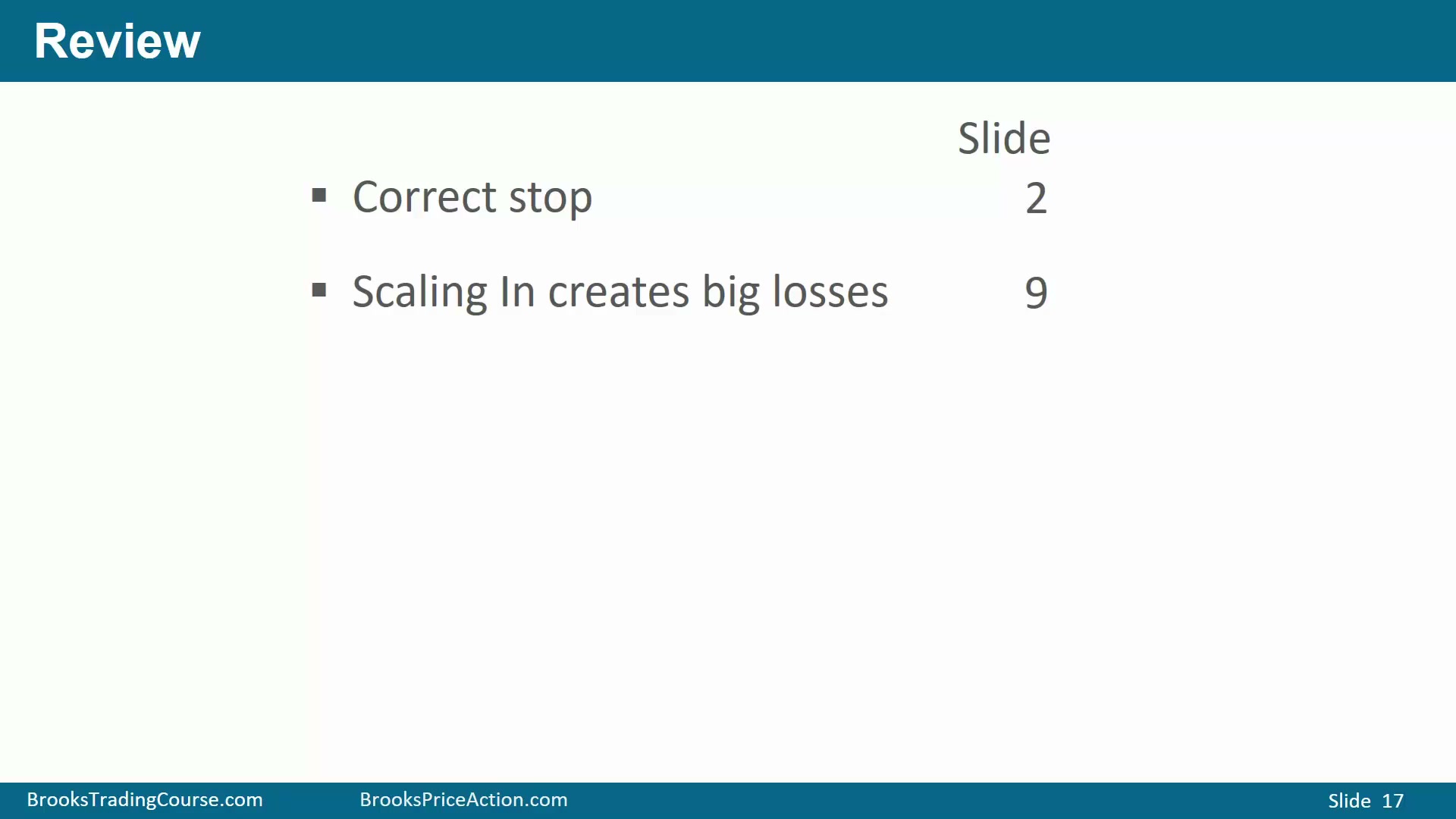
EN: It’s really important to use the correct stop,

31:18 - 31:20

EN: and the correct stop is usually obvious.

31:20 - 31:23

EN: If the correct stop is far, you have to trade small.

31:24 - 31:27

EN: If the stop is so far that your risk is bigger than on other trades,

31:27 - 31:29

EN: simply do not take the trade.

31:30 - 31:32

EN: Scaling in, only for experts.

31:32 - 31:35

EN: Beginners scale in to increase probability,

31:35 - 31:38

EN: but they don’t realize how greatly it increases their risk

31:38 - 31:41

EN: until they’re in the trade and it starts to go against them

31:41 - 31:44

EN: and they add on to a losing trade.

31:44 - 31:46

EN: Beginners should never scale in.

31:50 - 31:51

EN: I’m Al Brooks.

31:51 - 31:53

EN: Thank you for watching the Brooks Trading Course.

31:53 - 31:57

EN: This is the fourth of four videos on losing because of mistakes.