Skip to content
Price Action Encyclopedia Index

al-brooks-course

51C - Losing Because of Mistakes

Raw transcript and slide notes for 51C - Losing Because of Mistakes.

Overview

  • Slides: 16
  • Transcript segments: 338
  • Status: 自动按 slide 时间线归档;核心概念和长期笔记可以在每个 slide 的 Study Notes 下继续整理。

Source Media

Transcript 001

Time: 00:02

Bilingual Transcript

00:02 - 00:03

EN: This is Al Brooks.

00:03 - 00:05

EN: Thank you for watching the Brooks Trading Course.

00:05 - 00:09

EN: This is the third of four videos on losing because of mistakes.

Slide 001

Time: 00:11

Slide 001

Bilingual Transcript

00:13 - 00:16

EN: I’m going to give some rules on how to avoid big losses,

00:16 - 00:17

EN: which is very important.

Slide 002

Time: 00:18

Slide 002

Bilingual Transcript

00:21 - 00:26

EN: One of the problems with a big loss is that it wipes out many good trades,

00:26 - 00:29

EN: and it takes a lot of good trades to get back to breakeven.

00:29 - 00:32

EN: It’s very important to avoid big losses.

00:37 - 00:42

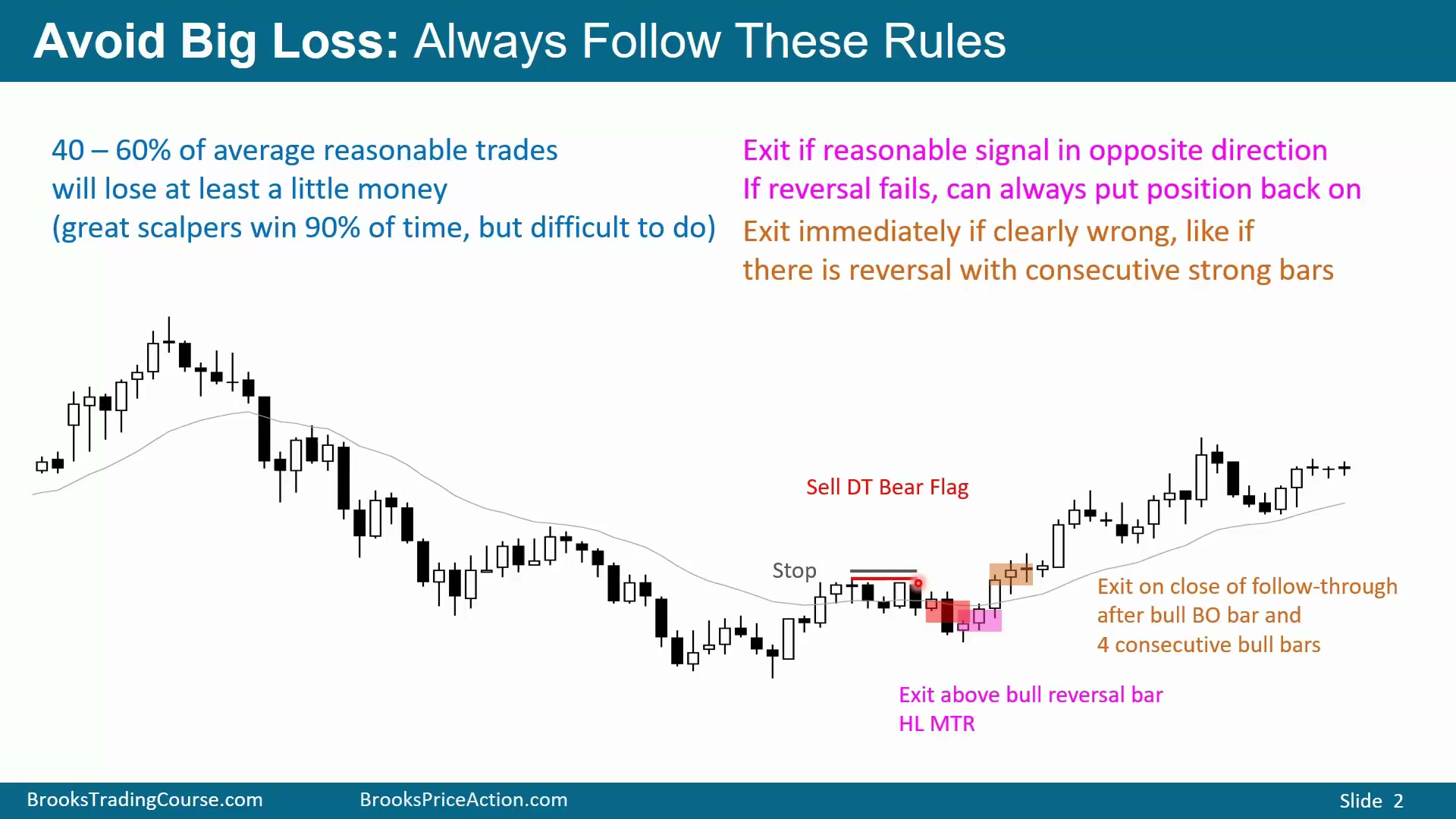
EN: On any reasonable trade, you have a 40% to 60% chance of making money

00:42 - 00:46

EN: and a 40% to 60% chance of losing a least a little bit of money.

00:47 - 00:52

EN: Great scalpers, they are rare, but they can win 90% of the time.

00:55 - 00:58

EN: Let’s say for example that you see a bear trend,

00:58 - 01:02

EN: and now you see a Double Top bear flag, a Lower High,

01:02 - 01:04

EN: and you sell, which is reasonable to do.

01:07 - 01:09

EN: You put your stop just above the top of the bear flag.

01:09 - 01:13

EN: You sell on a stop below the low of this bear bar and you get filled here.

01:20 - 01:24

EN: It’s reasonable to get out above this bull bar because you have the possibility

01:24 - 01:28

EN: that this will be a profitable Higher Low Major Trend Reversal.

01:28 - 01:31

EN: We have a bear trend, a strong enough minor reversal to break

01:31 - 01:33

EN: above the trend line, and now we have a pullback

01:33 - 01:38

EN: that has two or three legs down – one, pullback, two, pullback, three.

01:38 - 01:41

EN: Some computers will see it as a Wedge Higher Low.

01:41 - 01:44

EN: Others will see it as a High 2 – High 1 and then High 2,

01:44 - 01:46

EN: and it’s a good buy signal bar.

01:47 - 01:50

EN: If you’re short, I think you have to get out above this bull bar.

01:50 - 01:54

EN: If you’re flat, you can buy this, looking for a swing up.

01:54 - 01:59

EN: Any time there’s a reasonable opposite signal, it’s usually wise to get out.

01:59 - 02:03

EN: If you sold this Double Top bear flag, bear trend,

02:04 - 02:07

EN: and then you see a reasonable buy setup, it’s better to get out.

02:08 - 02:12

EN: If there’s then another sell setup, you can take that other sell setup.

02:12 - 02:17

EN: But it’s better to be out of your shorts when the bulls have a reasonable buy.

02:25 - 02:29

EN: Any time that you’re clearly wrong, you always should exit,

02:29 - 02:32

EN: and don’t sit there hoping that the market will go your way

02:32 - 02:36

EN: or go your way at least a little bit, enough to reduce your loss.

02:37 - 02:41

EN: If you did not get out on the stop, now we have a reversal up

02:41 - 02:43

EN: with a decent bull bar and we have a good follow-through bar

02:43 - 02:46

EN: after this bull breakout above this bull flag.

02:47 - 02:50

EN: We also have 4 consecutive bull bars and we have two closes

02:50 - 02:52

EN: above the top of your Double Top.

02:52 - 02:54

EN: You’re clearly wrong.

02:54 - 02:56

EN: You have to get out if you did not get out already.

Slide 003

Time: 03:00

Slide 003

Bilingual Transcript

03:04 - 03:08

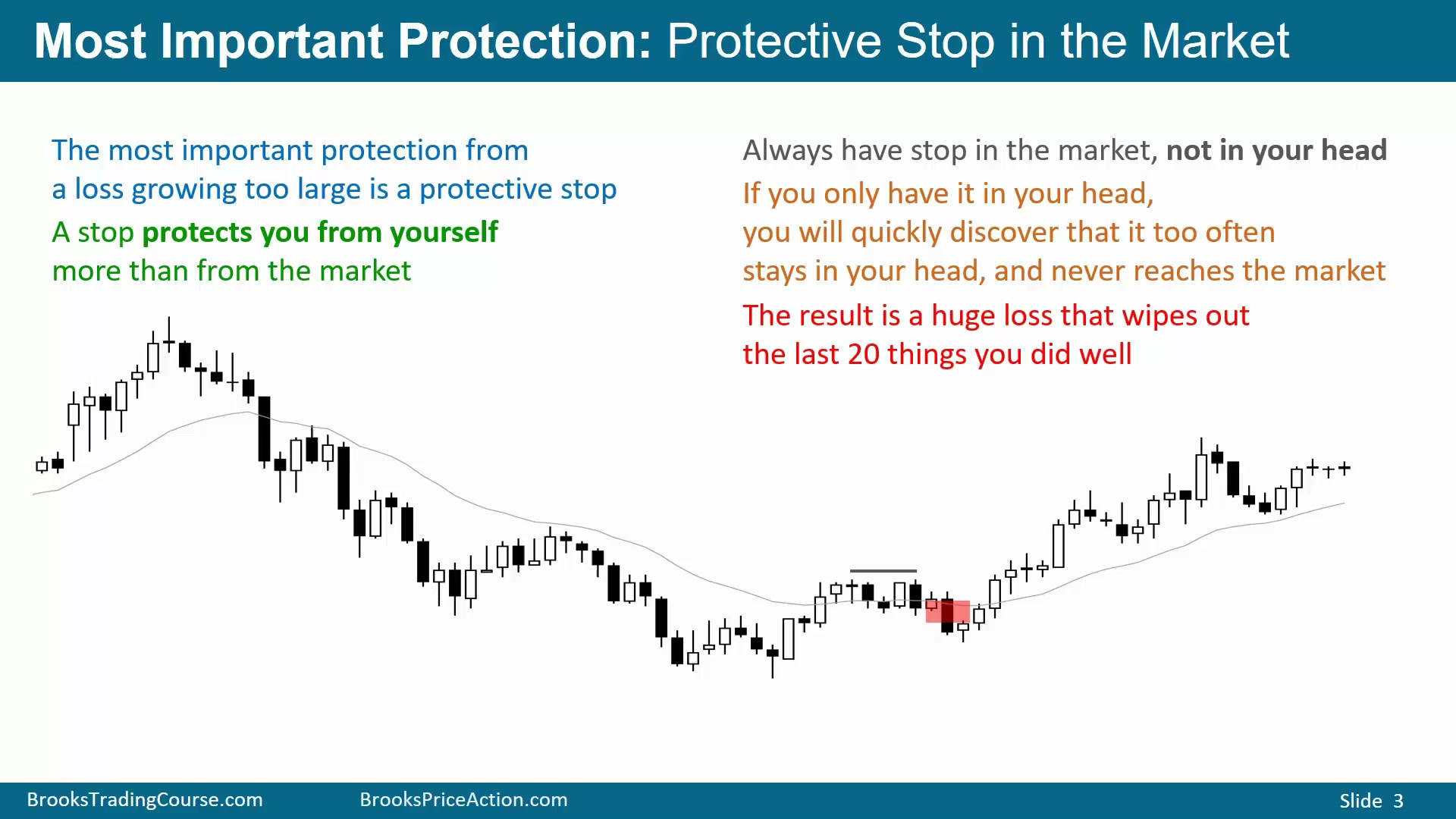
EN: The single most important thing that you can do to protect against a big loss

03:08 - 03:12

EN: is having a protective stop in the market, not in your head.

03:15 - 03:17

EN: The stop protects you from yourself.

03:17 - 03:21

EN: Some traders will see where the stop goes and not put it there

03:21 - 03:25

EN: just in case it goes a little bit above the stop and then reverses back down.

03:25 - 03:27

EN: That is a mistake.

03:27 - 03:30

EN: You have to have a price on the chart that tells you

03:30 - 03:32

EN: that you’re wrong, and you have to get out and take the loss.

03:36 - 03:38

EN: The single biggest problem with having a stop in your head

03:38 - 03:42

EN: and not in the market is that it tends to stay in your head and it never gets

03:42 - 03:46

EN: into the market, and the result is you watch the market go against you

03:46 - 03:49

EN: further and further and further, and you never exit.

03:49 - 03:52

EN: You end up getting a loss that’s far greater than you ever should take.

03:57 - 04:01

EN: One big loss can wipe out the last 20 good things that you did,

04:01 - 04:04

EN: and it might take 20 good things over the next week

04:04 - 04:07

EN: or two to erase this big loss.

04:07 - 04:10

EN: Therefore, you cannot take a big loss like that.

Slide 004

Time: 04:15

Slide 004

Bilingual Transcript

04:17 - 04:20

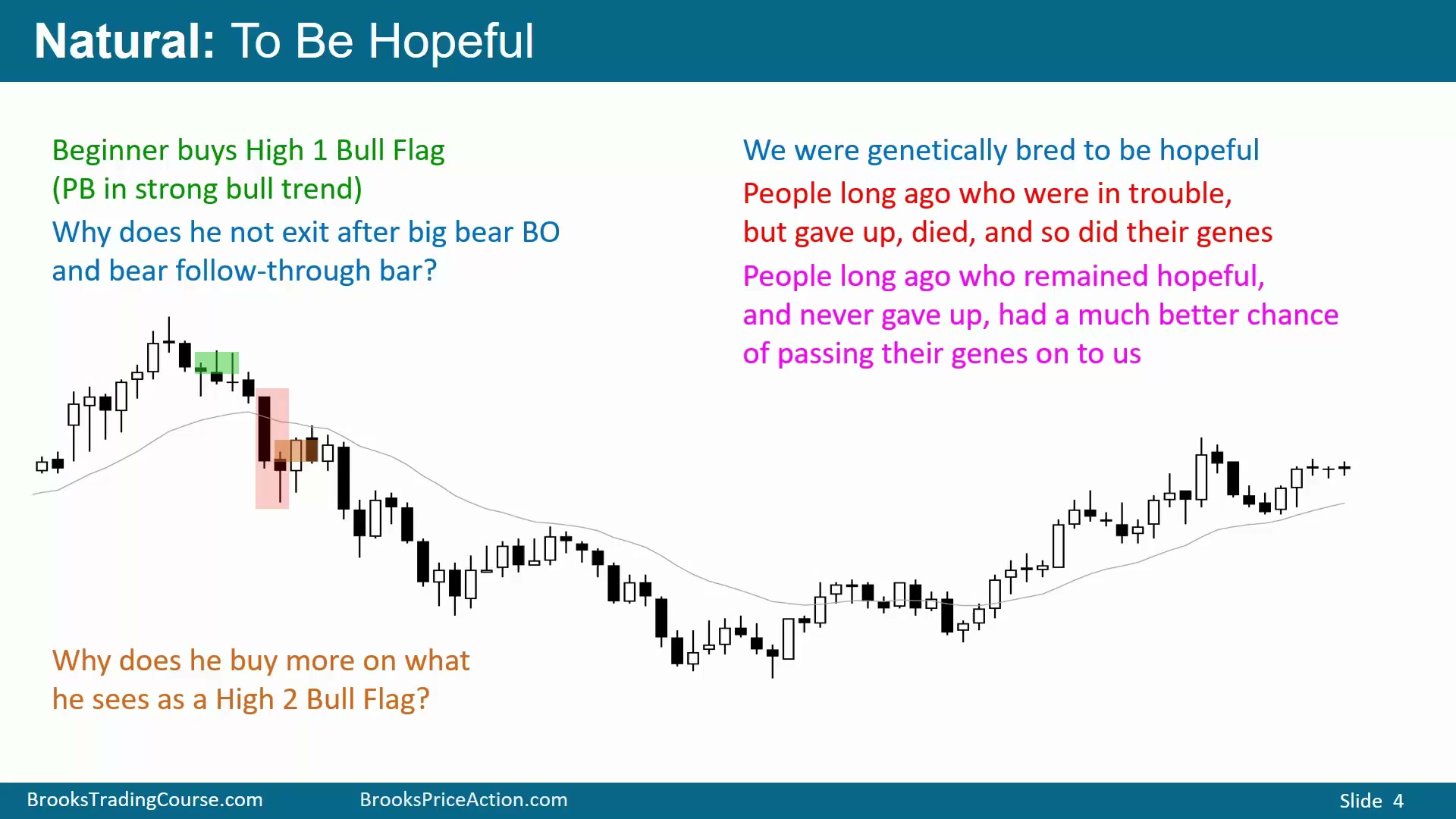
EN: We have a bull trend and we have a High 1 bull flag.

04:20 - 04:22

EN: It’s reasonable to buy above this bar.

04:22 - 04:25

EN: Not ideal; a little bit of a parabolic Buy Climax

04:25 - 04:28

EN: and then a bear bar and a bear buy signal bar.

04:28 - 04:32

EN: However, it’s reasonable to take that as a pullback in a bull trend.

04:37 - 04:39

EN: However, let’s say you held long

04:39 - 04:43

EN: and then you see this bear breakout and a follow-through bar.

04:43 - 04:45

EN: What are you thinking about at this point?

04:46 - 04:50

EN: An expert, if he made the mistake of holding long through all of this,

04:50 - 04:54

EN: he would get out at the market or above the high of this bear bar.

04:54 - 04:56

EN: What would a beginner do?

04:56 - 04:59

EN: Well, if the beginner did not have a stop in the market

04:59 - 05:04

EN: or a stop down here or a stop anywhere and he sees this, he might think that,

05:04 - 05:08

EN: “On television they talk about averaging in; maybe I’ll average in.”

05:08 - 05:12

EN: Averaging in – in other words, buying more in a losing position

05:12 - 05:17

EN: - is a great strategy if your premise is still valid, if it’s still a bull trend.

05:17 - 05:21

EN: However, once it’s clearly a bear trend or clearly no longer a bull trend,

05:21 - 05:24

EN: averaging in does not make any sense.

05:29 - 05:32

EN: The beginner, he might buy more here, arguing it’s a High 2,

05:32 - 05:35

EN: maybe a Trading Range, and he’s ignoring the reality.

05:35 - 05:38

EN: We’ve had 8 or 9 bars down without a bull body.

05:38 - 05:41

EN: We’ve had a strong bear breakout, and we have a follow-through bar

05:41 - 05:44

EN: after the breakout bar and it has a bear body.

05:44 - 05:46

EN: The odds are we’re going lower.

05:49 - 05:53

EN: There are a lot of personality traits that all of us have

05:53 - 05:56

EN: that are very effective in dealing with problems in the world,

05:56 - 06:00

EN: and one of the things is we’re genetically bred to be hopeful.

06:04 - 06:09

EN: What I mean by that is that people long ago who were in trouble but gave up;

06:09 - 06:13

EN: died, and so did their genes, and the result is people

06:13 - 06:16

EN: who give up tend to disappear from the gene pool.

06:16 - 06:20

EN: Their genes disappear, and people who are hopeful and hang in there,

06:20 - 06:25

EN: their genes survive and they make up a bigger percentage of the gene pool.

06:30 - 06:34

EN: You had a much better chance of surviving and passing your genes

06:34 - 06:37

EN: on to future generations if you were hopeful and you never gave up.

Slide 005

Time: 06:40

Slide 005

Bilingual Transcript

06:44 - 06:48

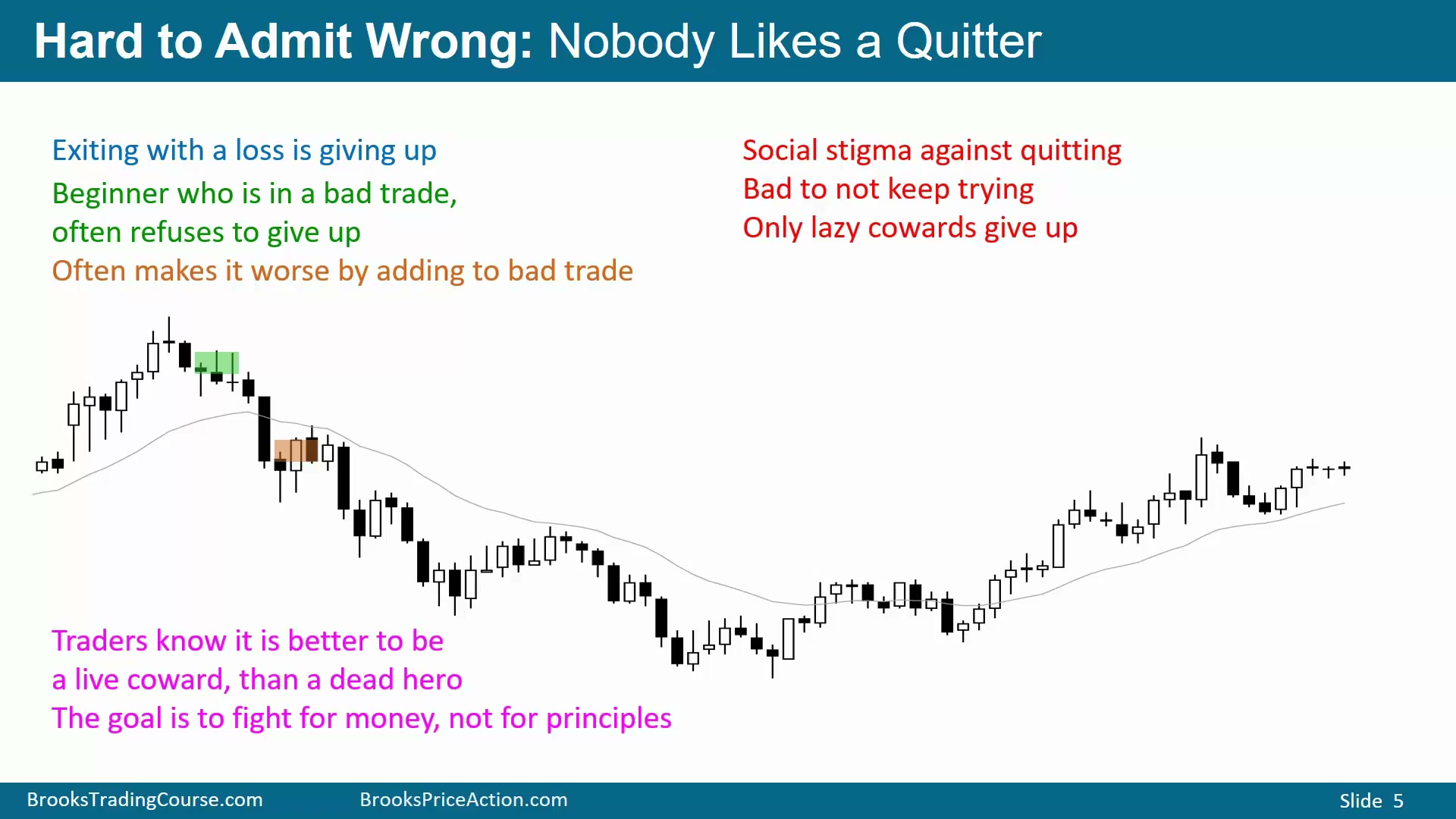
EN: If you exit with a loss, you’re a quitter, and nobody likes a quitter.

06:51 - 06:56

EN: Beginners refuse to give up, and therefore they’ll often add to the trade

06:56 - 07:01

EN: even though at some point it’s clear the trade is no longer valid.

07:01 - 07:04

EN: Once you know the trade is no longer valid, you have to get out.

07:04 - 07:08

EN: You cannot be adding on hoping that you’re going to be able

07:08 - 07:10

EN: to make a profit or avoid a loss.

07:15 - 07:18

EN: There’s also a social stigma against quitting.

07:18 - 07:21

EN: It’s bad not to keep trying.

07:21 - 07:23

EN: Only lazy cowards give up.

07:29 - 07:32

EN: However, experienced traders know that it’s better

07:32 - 07:34

EN: to be a live coward than a dead hero.

07:35 - 07:38

EN: The goal is to fight for money, not for principles.

Slide 006

Time: 07:40

Slide 006

Bilingual Transcript

07:44 - 07:46

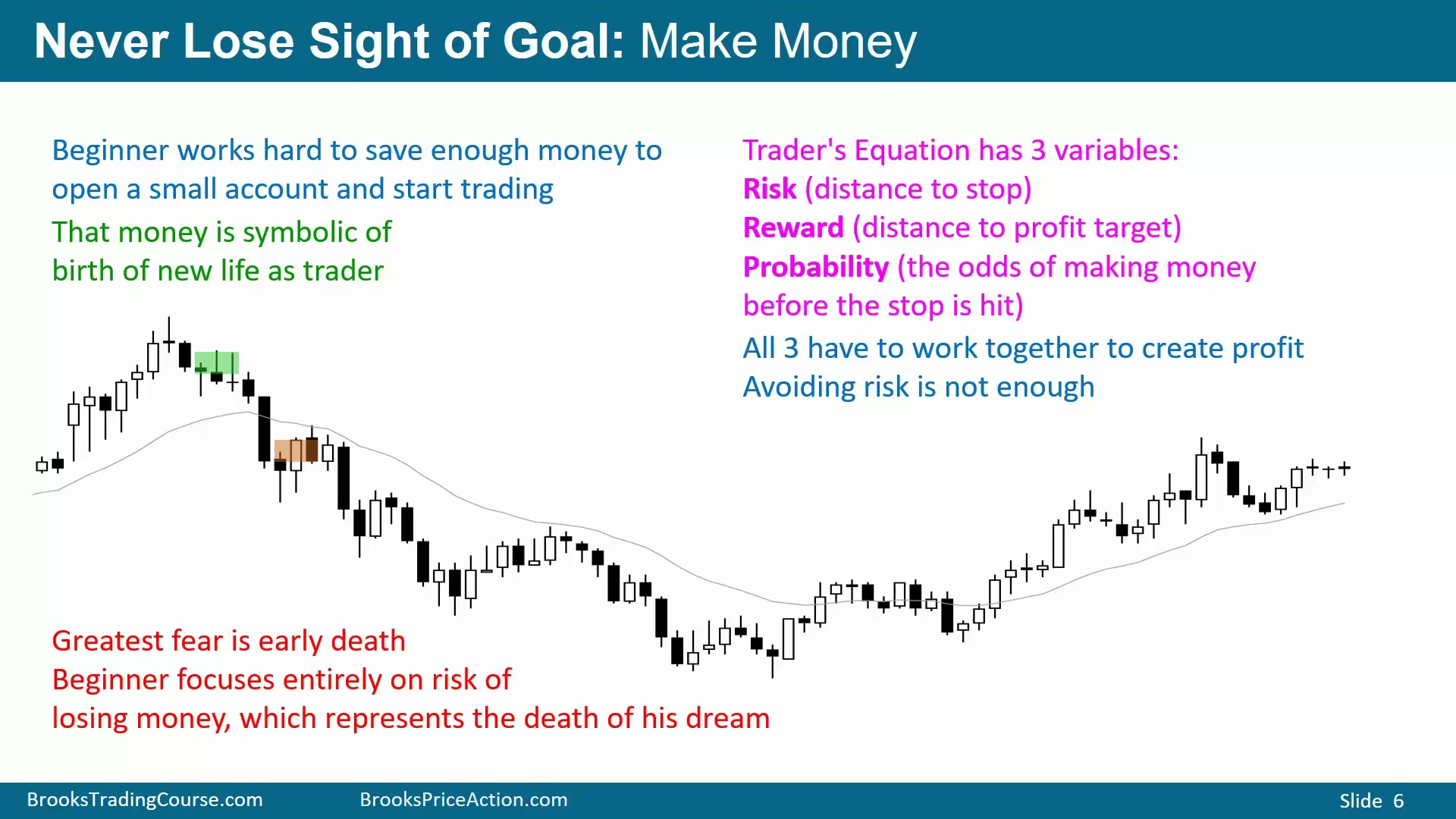
EN: When a person starts out, he has a small account.

07:46 - 07:49

EN: He worked really hard to get the account,

07:49 - 07:52

EN: and he has the dream of becoming a successful profitable trader.

07:55 - 07:58

EN: The money in his account is symbolic.

07:58 - 08:01

EN: It’s symbolic of the birth of his new life as a trader,

08:07 - 08:10

EN: and his greatest fear is an early death.

08:10 - 08:13

EN: He focuses entirely on risk.

08:13 - 08:16

EN: He does not want to lose money because if he loses his account,

08:16 - 08:19

EN: he loses his dream of being a profitable trader.

08:26 - 08:27

EN: He focuses on risk.

08:27 - 08:31

EN: The Trader’s Equation has three variables: risk, reward,

08:31 - 08:35

EN: and probability, and you have to be thinking about all three

08:35 - 08:37

EN: whenever you are structuring your trade

08:37 - 08:39

EN: and then once you’re in a trade and you’re managing a trade.

08:40 - 08:44

EN: Risk is the distance to your stop, reward is the distance

08:44 - 08:46

EN: to the target that you’re hoping to achieve,

08:46 - 08:51

EN: and probability is the odds of making money before your stop is hit.

08:55 - 09:00

EN: Avoiding risk, focusing on one variable, is not a profitable strategy.

09:00 - 09:03

EN: You always have to be considering all three variables.

Slide 007

Time: 09:10

Slide 007

Bilingual Transcript

09:12 - 09:16

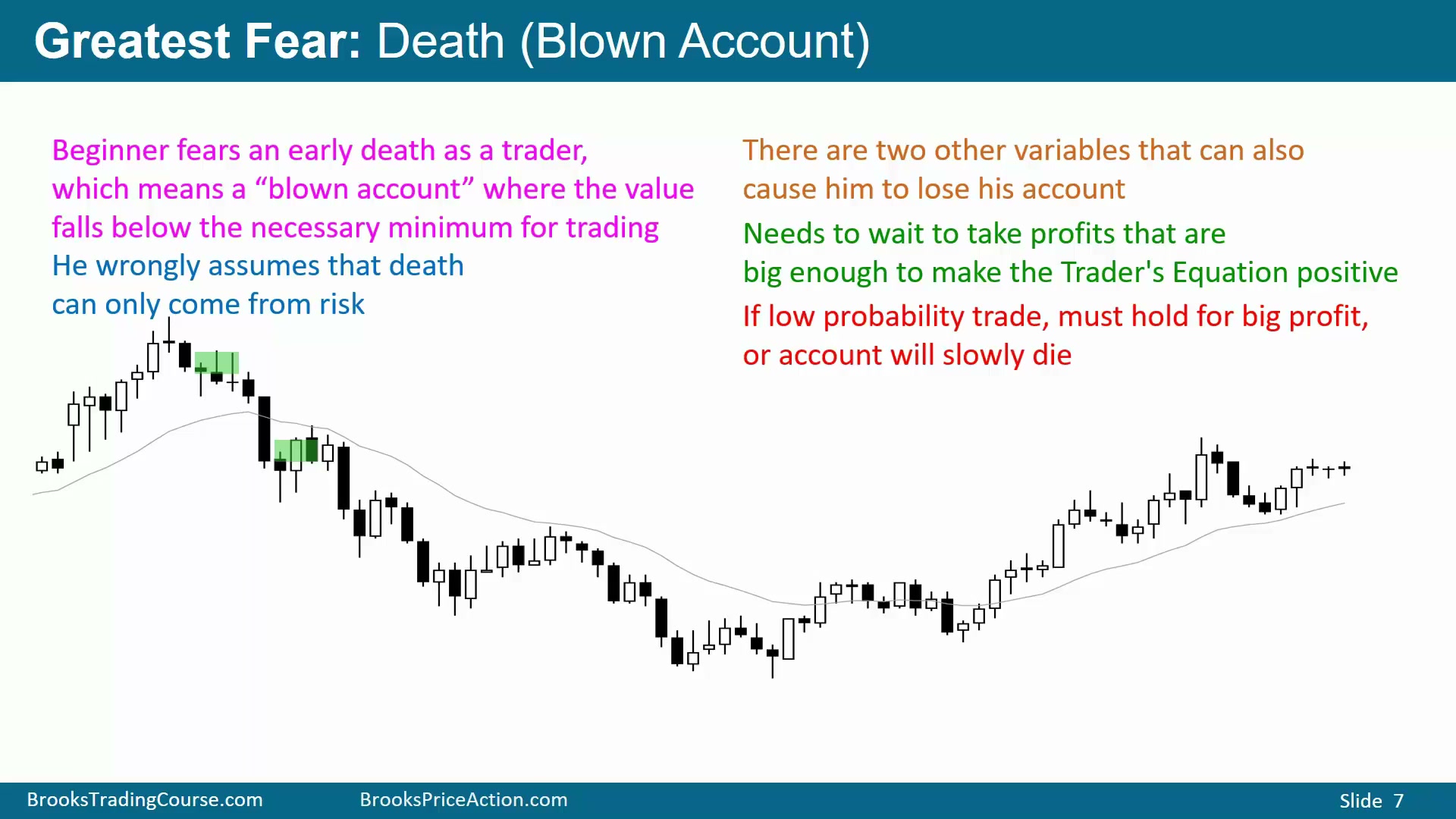
EN: You’ll sometimes hear traders take about a “blown account.”

09:16 - 09:20

EN: A blown account does not mean the account went to zero or went below zero.

09:20 - 09:23

EN: It simply means that the value of the account fell

09:23 - 09:26

EN: below the broker’s minimum level for trading.

09:26 - 09:29

EN: If your account does not have a certain number of dollars in it,

09:29 - 09:32

EN: the broker will not let you trade.

09:35 - 09:37

EN: One of the problems of only focusing on risk

09:37 - 09:42

EN: is you assume it’s the only danger – risk implies danger – but it’s not.

09:46 - 09:49

EN: You also have to consider reward and probability,

09:49 - 09:53

EN: and you need to think about all three when you’re structuring a trade.

09:59 - 10:01

EN: You need to take profits that are big enough

10:01 - 10:03

EN: to make the Trader’s Equation positive.

10:07 - 10:10

EN: If you take a trade that has low risk,

10:10 - 10:12

EN: you have a low probability of making money.

10:12 - 10:15

EN: That means you have a high probability of losing money,

10:15 - 10:20

EN: and if you’re only taking low probability trades, you must hold for big profits

10:20 - 10:25

EN: because you need those few winners to overcome all of those losses.

10:25 - 10:28

EN: If you don’t get the occasional very big winner,

10:28 - 10:30

EN: your account is slowly going to disappear.

Slide 008

Time: 10:35

Slide 008

Bilingual Transcript

10:38 - 10:41

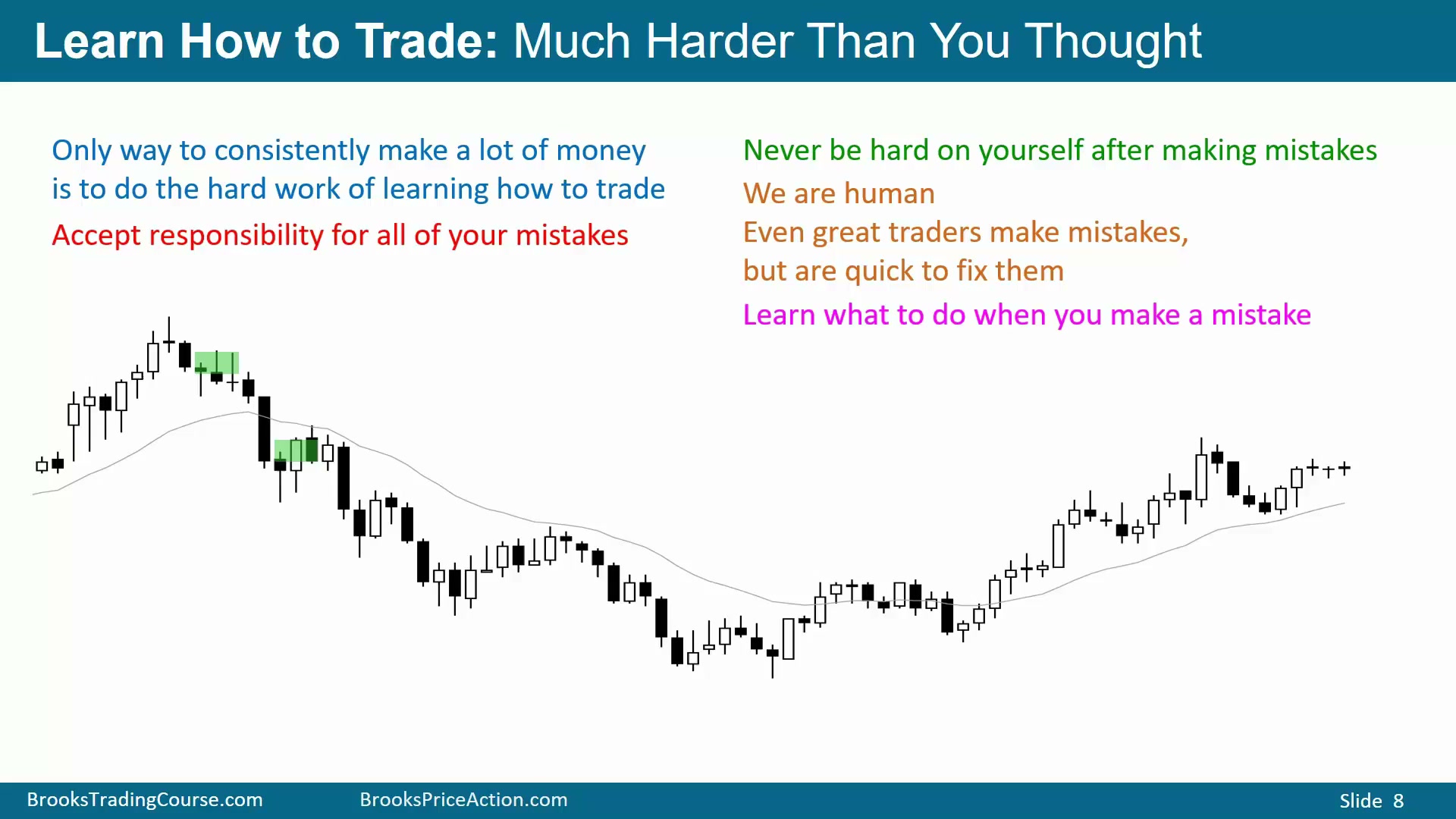
EN: There’s only one thing that you can do to consistently make money,

10:41 - 10:43

EN: and that’s do the hard work of learning how to trade.

10:44 - 10:46

EN: There are no magical candlestick patterns.

10:46 - 10:47

EN: Nothing is easy.

10:47 - 10:50

EN: You’re competing against the smartest people in the world.

10:50 - 10:53

EN: If something was easy, everyone would be doing it.

10:53 - 10:55

EN: Every trade needs someone to do the opposite.

10:55 - 10:58

EN: There would not be enough smart people willing to do the opposite.

10:58 - 11:03

EN: Therefore, you’re looking for an edge, a slight mathematical advantage

11:03 - 11:06

EN: that will allow you to consistently make money.

11:06 - 11:10

EN: Because the edge always has to be slight – you’re trying to take money

11:10 - 11:13

EN: from very smart people – you have to be consistently good.

11:16 - 11:19

EN: You cannot blame anyone else for your mistakes.

11:19 - 11:21

EN: You have to assume responsibility for your mistakes.

11:25 - 11:28

EN: At the same time, you should never be hard on yourself after making mistakes

11:28 - 11:32

EN: or after losing money, because everyone is going to have losing trades,

11:32 - 11:37

EN: and if you keep focusing on what took place 5 minutes ago, 5 days ago,

11:37 - 11:40

EN: you’re not focusing on what you should be doing right now at the moment.

11:44 - 11:46

EN: Great traders make mistakes.

11:46 - 11:48

EN: Great traders have losing trades.

11:48 - 11:50

EN: The difference between a great trader and a beginner is

11:50 - 11:55

EN: that the great trader is quick to see his mistake, and he gets out.

11:55 - 11:57

EN: When he knows he’s wrong, he just gets out.

11:57 - 11:58

EN: He doesn’t care if it’s a loss.

11:58 - 12:00

EN: He knows he’s wrong and he has to get out.

12:03 - 12:05

EN: That’s what you should do when you make a mistake.

12:05 - 12:06

EN: As soon as you decide that,

12:06 - 12:10

EN: “maybe this isn’t working out the way I thought it should,” just get out.

12:10 - 12:13

EN: Take the loss and move on to the next trade.

Slide 009

Time: 12:15

Slide 009

Bilingual Transcript

12:18 - 12:21

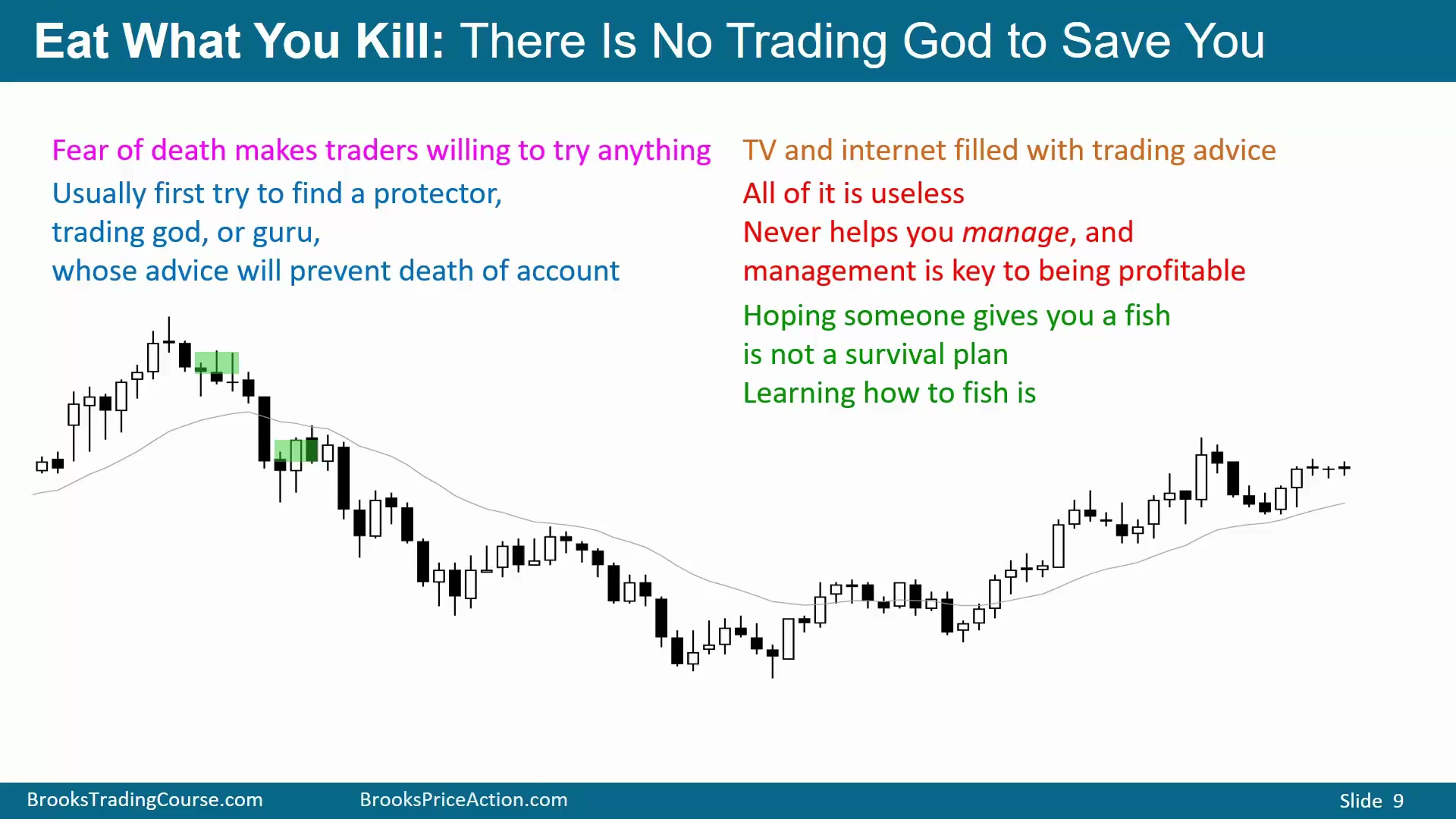
EN: Fear of death or the fear of death of your account

12:21 - 12:23

EN: is a tremendous motivating factor,

12:23 - 12:27

EN: and it will make traders do just about anything to avoid it.

12:33 - 12:36

EN: One of the first things traders do when they start out is,

12:36 - 12:38

EN: they look for some kind of protector,

12:38 - 12:42

EN: like a trading guard or guru or some expert who will help him.

12:42 - 12:45

EN: They’ll turn on television and take trades

12:45 - 12:48

EN: that somebody on television mentions – and that’s just dumb.

12:50 - 12:54

EN: TV, internet, magazines, they’re filled with trading advice,

12:54 - 12:58

EN: and it’s useless, right? As a trader, you eat what you kill.

12:58 - 13:00

EN: That means you have to make the money yourself,

13:00 - 13:03

EN: and nobody else is going to help you.

13:07 - 13:09

EN: Just because somebody on television says,

13:09 - 13:12

EN: “oh, this is a buy,” does not mean you make money.

13:12 - 13:16

EN: Not only do you have to buy to make money, you have to manage the trade,

13:16 - 13:19

EN: and as it unfolds you get more information,

13:19 - 13:22

EN: and that makes you adjust your management decisions.

13:22 - 13:26

EN: The guy on television is not telling you what to do after you’re in the trade.

13:26 - 13:30

EN: A lot of times as soon as you get in, you decide it’s a bad trade.

13:30 - 13:33

EN: Also, sometimes he’ll say on television it’s a buy,

13:33 - 13:36

EN: and then tomorrow some overnight event will have happened,

13:36 - 13:40

EN: either with your stock or with the market, that makes it a terrible buy.

13:40 - 13:42

EN: He’s not there to help you.

13:42 - 13:44

EN: You have to make the decisions yourself,

13:44 - 13:46

EN: and you have to learn how to make the decisions.

13:46 - 13:49

EN: Sometimes your decisions are going to be wrong.

13:49 - 13:50

EN: Just get out.

13:50 - 13:51

EN: As soon as you think you’re wrong,

13:51 - 13:55

EN: as soon as you think your premise is no longer valid, get out.

13:59 - 14:01

EN: That guy on television, you’re asking him

14:01 - 14:04

EN: to give you a fish so that you can eat.

14:04 - 14:05

EN: That’s not how it works.

14:05 - 14:09

EN: Hoping that someone gives you a fish is not a plan for survival.

14:09 - 14:11

EN: Learning how to fish is.

Slide 010

Time: 14:15

Slide 010

Bilingual Transcript

14:18 - 14:21

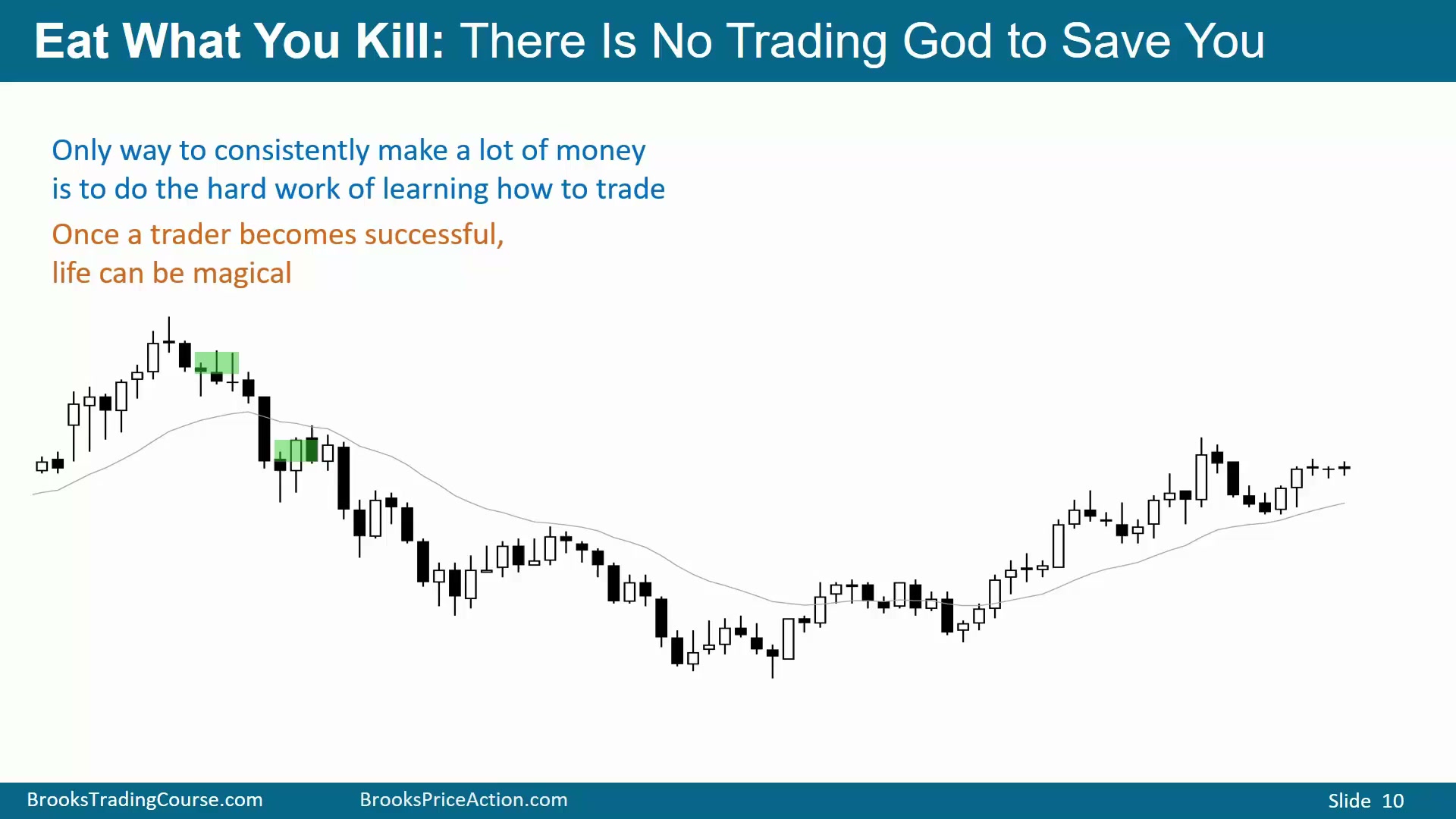
EN: You have to spend time to learn how to trade.

14:22 - 14:27

EN: However, once you become successful, life can become magical.

14:27 - 14:31

EN: I’ve heard from many, many traders over the years who were losing money

14:31 - 14:35

EN: for protracted periods of time, and then they finally became successful.

14:35 - 14:38

EN: The amount of money that they made was astonishing.

14:38 - 14:40

EN: They couldn’t believe how much money they were making.

Slide 011

Time: 14:45

Slide 011

Bilingual Transcript

14:46 - 14:49

EN: I’ve talked many times about how beginners focus on risk

14:49 - 14:52

EN: and how they want minimum risk

14:52 - 14:54

EN: because they’re afraid of losing their entire account.

14:55 - 14:57

EN: However, because of the Trader’s Equation,

14:57 - 15:03

EN: you know that if there’s small risk, then the risk/reward is fantastic.

15:03 - 15:06

EN: You’re risking very little money and you’re hoping for a great reward.

15:06 - 15:10

EN: You also know that whenever there’s fantastic risk/reward,

15:10 - 15:12

EN: the probability is low.

15:12 - 15:15

EN: Chances are you’re going to lose most of the time.

15:15 - 15:20

EN: It is impossible to have a small risk of making a reasonable profit

15:21 - 15:24

EN: and having a high probability of achieving that goal.

15:24 - 15:28

EN: It just cannot happen because everyone would take the trade

15:28 - 15:30

EN: and there would be no one left to take the opposite side of the trade.

15:30 - 15:33

EN: If you’re getting fantastic risk/reward,

15:33 - 15:36

EN: the institution taking the opposite side of the trade

15:36 - 15:38

EN: has a high probability of making money.

15:38 - 15:40

EN: You have a low probability of making money,

15:40 - 15:43

EN: and that means you’re going to lose most of the time.

15:48 - 15:51

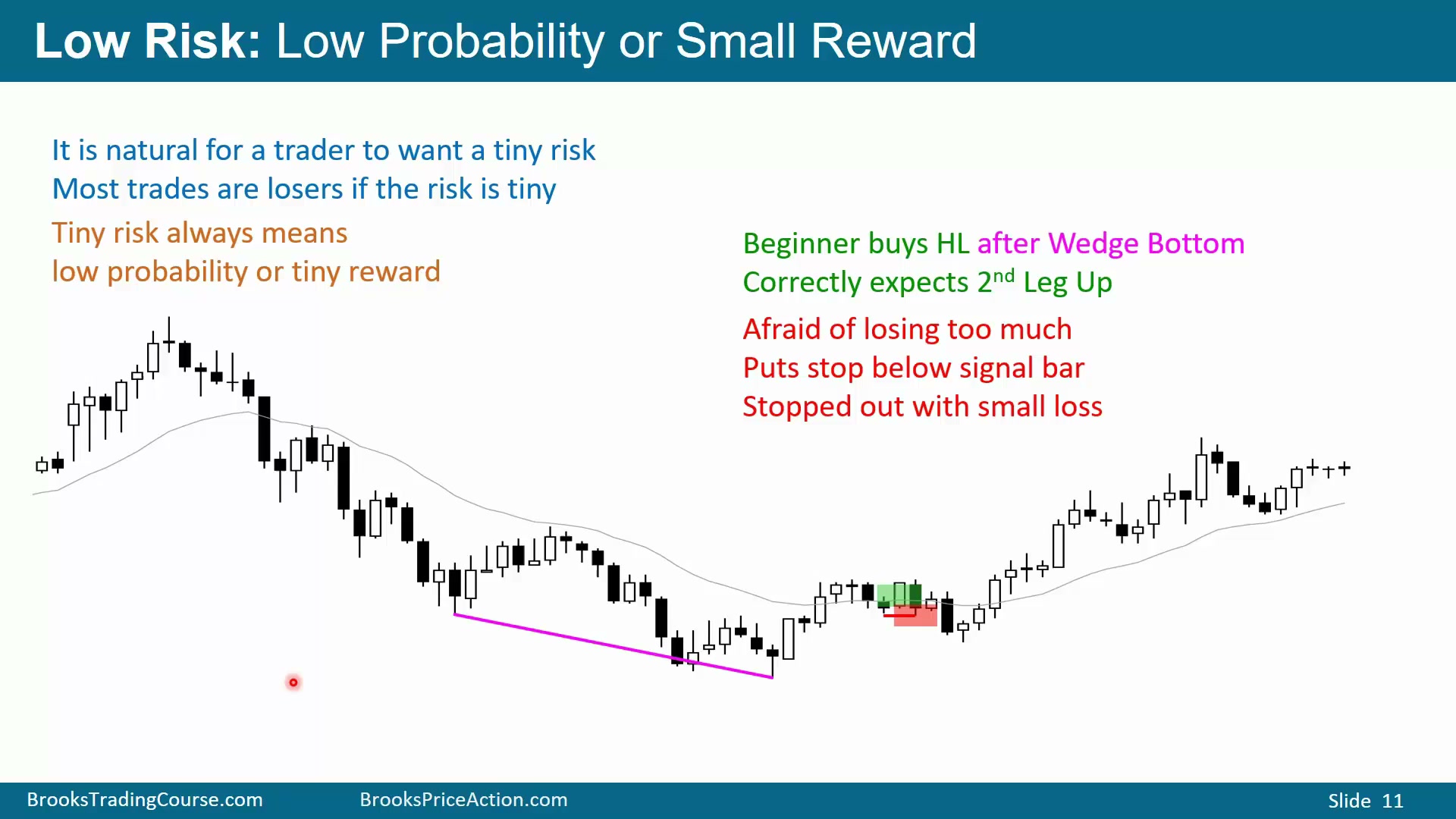
EN: Let’s say you see a Wedge Bottom in a bear trend

15:51 - 15:54

EN: and a decent reversal up, and now you see a Higher Low.

15:55 - 15:57

EN: Is it reasonable to buy here? Yeah.

15:57 - 15:59

EN: It’s probably better to take a second entry buy

15:59 - 16:01

EN: after 3 bear bars, but it’s reasonable.

16:06 - 16:10

EN: A beginner, he’s going to put his stop below his buy signal bar,

16:10 - 16:13

EN: thinking that “Oh my gosh, I don’t want to lose any money.

16:13 - 16:16

EN: If I’m going to lose, I don’t want to lose much.

16:16 - 16:17

EN: This is my signal bar.

16:17 - 16:20

EN: I’ll place my stop just below my buy signal bar.

16:20 - 16:22

EN: Therefore, my risk is very small.”

16:23 - 16:25

EN: Whenever you have small risk,

16:26 - 16:28

EN: the probability is high you’re going to get stopped out.

16:29 - 16:33

EN: That is just a fact, because you cannot have small risk

16:33 - 16:37

EN: of making a reasonable reward – in this case you’re hoping for a big reward

16:37 - 16:41

EN: - you cannot have a fantastic risk/reward situation

16:41 - 16:44

EN: and a good probability of achieving your goal.

16:44 - 16:48

EN: The probability is always going to be low, and that means chances are

16:48 - 16:50

EN: if you buy above this bar and put a stop below that bar,

16:50 - 16:53

EN: the odds are high you’re going to get stopped out.

Slide 012

Time: 16:55

Slide 012

Bilingual Transcript

16:59 - 17:02

EN: If you’re taking low probability trades like this,

17:02 - 17:05

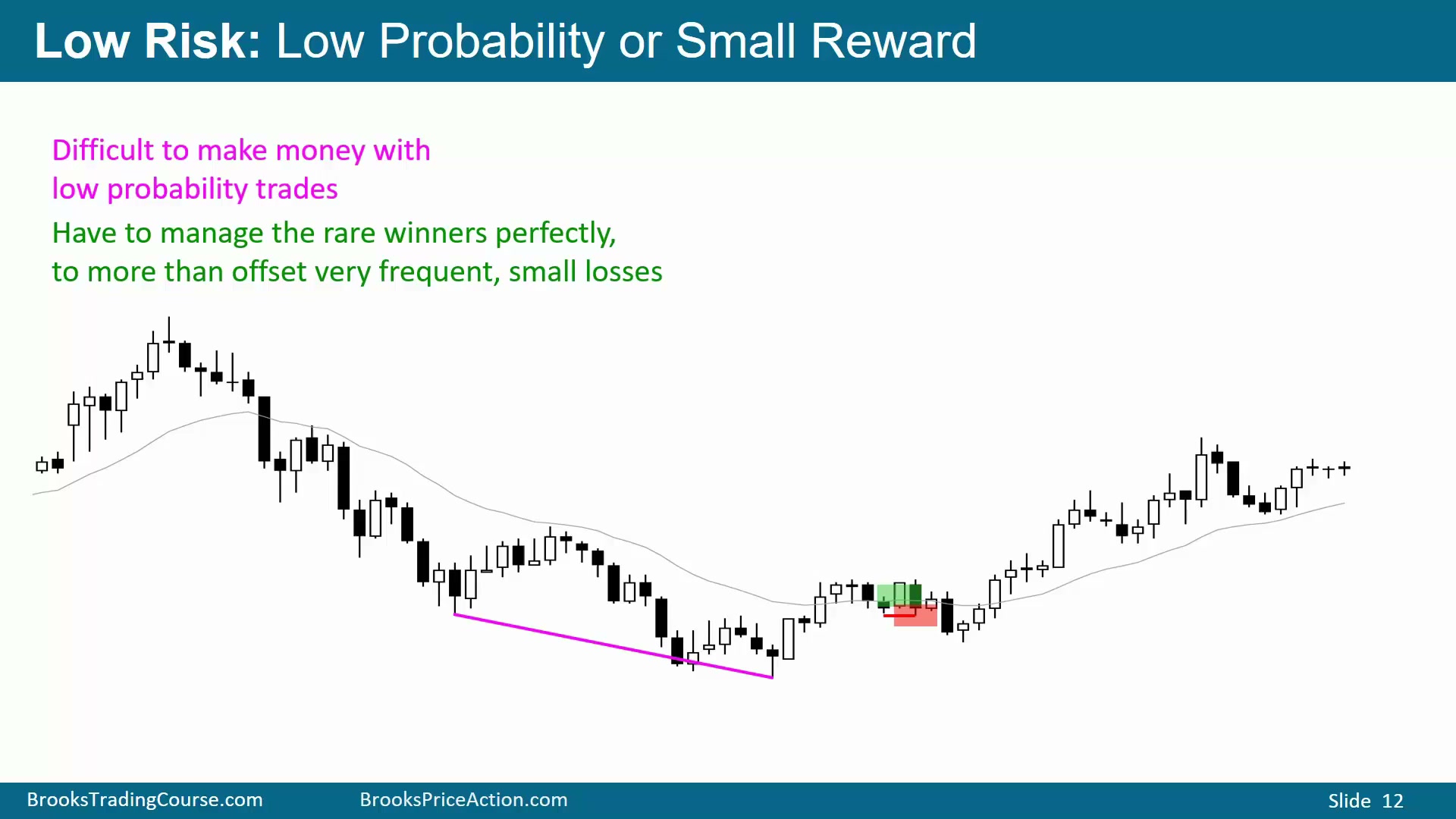
EN: you’re going to bleed to death from a thousand papercuts.

17:05 - 17:06

EN: Think about this for a second.

17:12 - 17:15

EN: Let’s say you win 10% of the time.

17:15 - 17:18

EN: When you do win, you win 20 times bigger than you lost.

17:18 - 17:21

EN: Well, that’s mathematically acceptable.

17:21 - 17:25

EN: But the problem is if you take 10 trades like that and you get one winner,

17:26 - 17:28

EN: you have to manage that trade perfectly to make up

17:28 - 17:31

EN: for the nine losers, and that’s unrealistic.

Slide 013

Time: 17:40

Slide 013

Bilingual Transcript

17:43 - 17:44

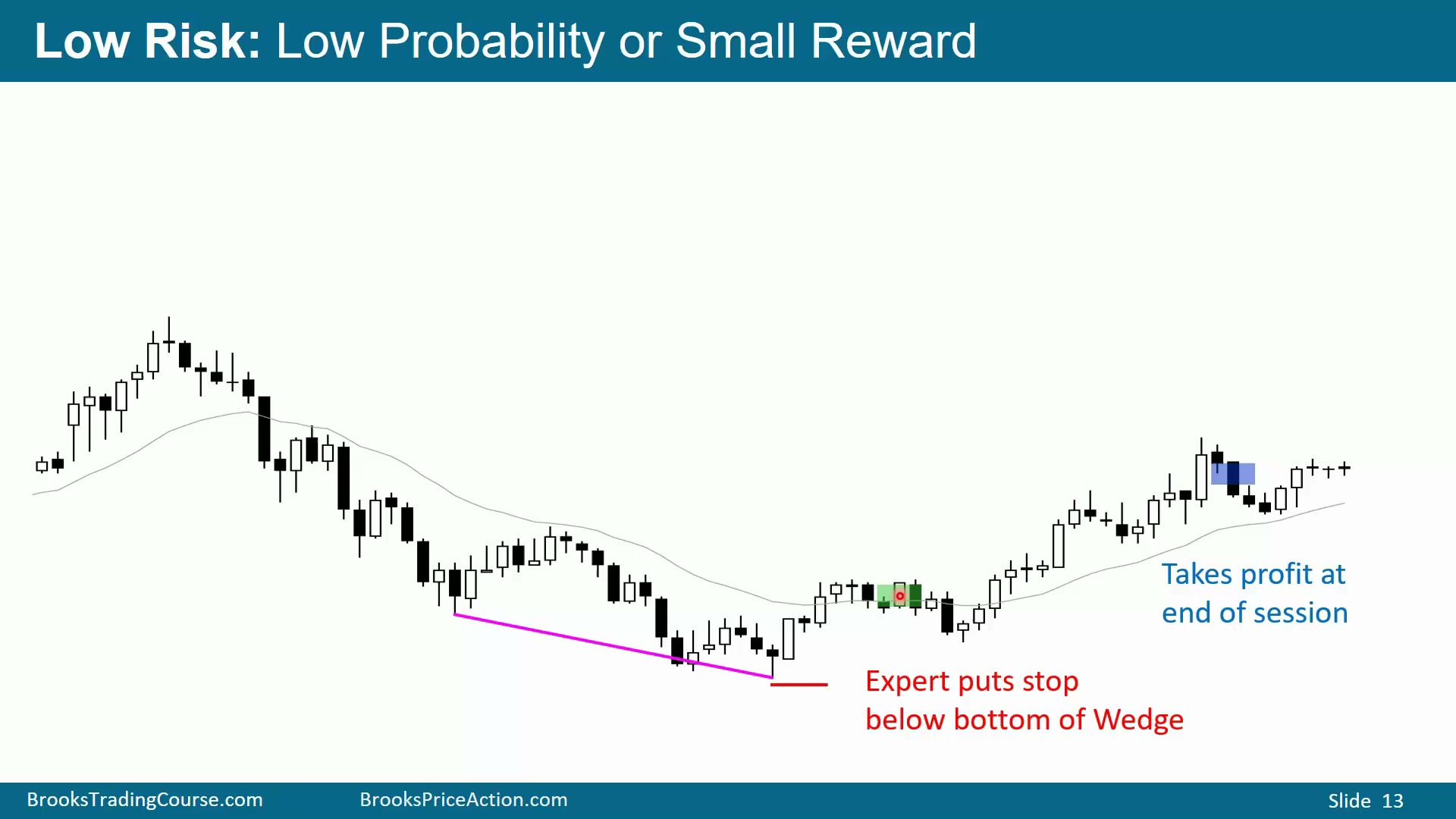
EN: An expert trader might take this buy.

17:44 - 17:46

EN: He certainly would take this buy.

17:46 - 17:49

EN: In either case he would put his stop here,

17:49 - 17:52

EN: below the bottom of the Wedge, below the bottom of the reversal.

17:52 - 17:56

EN: He’s risking more, but he’s also giving himself

17:56 - 17:58

EN: much higher probability of making money.

17:58 - 18:01

EN: He’s allowing for the possibility that the market might pull back,

18:01 - 18:04

EN: and maybe even pull back more before it goes up.

18:04 - 18:06

EN: All he knows is he thinks it’s going up,

18:06 - 18:10

EN: and he knows if it goes below the bottom of this bull reversal,

18:10 - 18:13

EN: then his premise is probably wrong and he wants to get out.

18:17 - 18:19

EN: Here he could take profits at the end of the session.

18:19 - 18:20

EN: He bought here.

18:20 - 18:23

EN: He did not get out; he relied on his stop,

18:23 - 18:27

EN: and he ended up making many times more than his Actual Risk.

18:27 - 18:32

EN: His Actual Risk was from his entry price above this bar right here

18:32 - 18:34

EN: to just below the low of this bar.

18:34 - 18:37

EN: His Actual Risk is small compared to his reward.

Slide 014

Time: 18:40

Slide 014

Bilingual Transcript

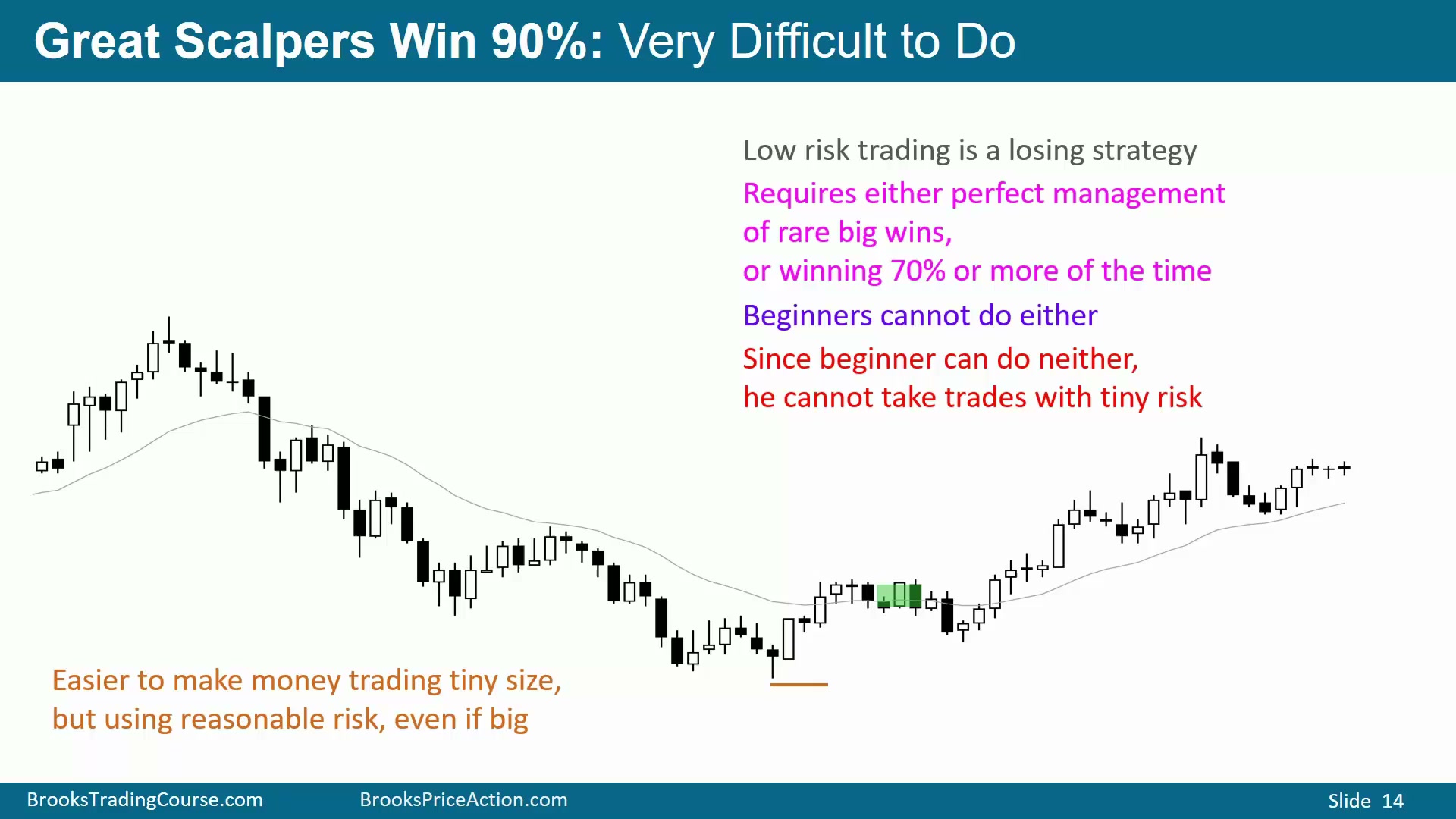
18:45 - 18:49

EN: The beginner who bought here and put a stop here is risking very little.

18:49 - 18:55

EN: It’s far easier to make money if he trades small and uses a reasonable stop,

18:55 - 18:59

EN: even if the stop is far away and the risk is relatively big.

18:59 - 19:01

EN: Much easier to make money.

19:02 - 19:05

EN: Use the appropriate stop and trade as small as you need to trade

19:05 - 19:08

EN: so that you don’t worry about the amount of money

19:08 - 19:09

EN: you’ll lose if your stop is hit.

19:10 - 19:13

EN: If the amount of money is too big, don’t take the trade.

19:13 - 19:16

EN: If your stop is too far away for you

19:16 - 19:19

EN: to be comfortable losing that amount of money, do not take the trade.

19:19 - 19:21

EN: Wait for a trade that’s in your comfort zone.

19:25 - 19:30

EN: Low-risk trading is very low probability trading, and that is a losing strategy.

19:35 - 19:40

EN: Again, you have to manage those rare wins perfectly to make money,

19:40 - 19:43

EN: or you have to be correct 70% of the time.

19:44 - 19:48

EN: If you’re taking a low-risk trade, the only way you can make money

19:48 - 19:50

EN: is be right a very high percentage of the time.

19:51 - 19:53

EN: As a beginner, that’s just not going to happen.

19:59 - 20:01

EN: Since a beginner cannot manage perfectly

20:01 - 20:05

EN: and since he’s not going to be right 70%, 80%, or 90% of the time,

20:05 - 20:08

EN: he should not be taking low-risk trades.

20:08 - 20:11

EN: He cannot make the Trader’s Equation positive,

20:11 - 20:16

EN: and with a negative Trader’s Equation, by definition it’s a losing strategy.

Slide 015

Time: 20:20

Slide 015

Bilingual Transcript

20:23 - 20:26

EN: Experienced scalpers sometimes will use tight stops,

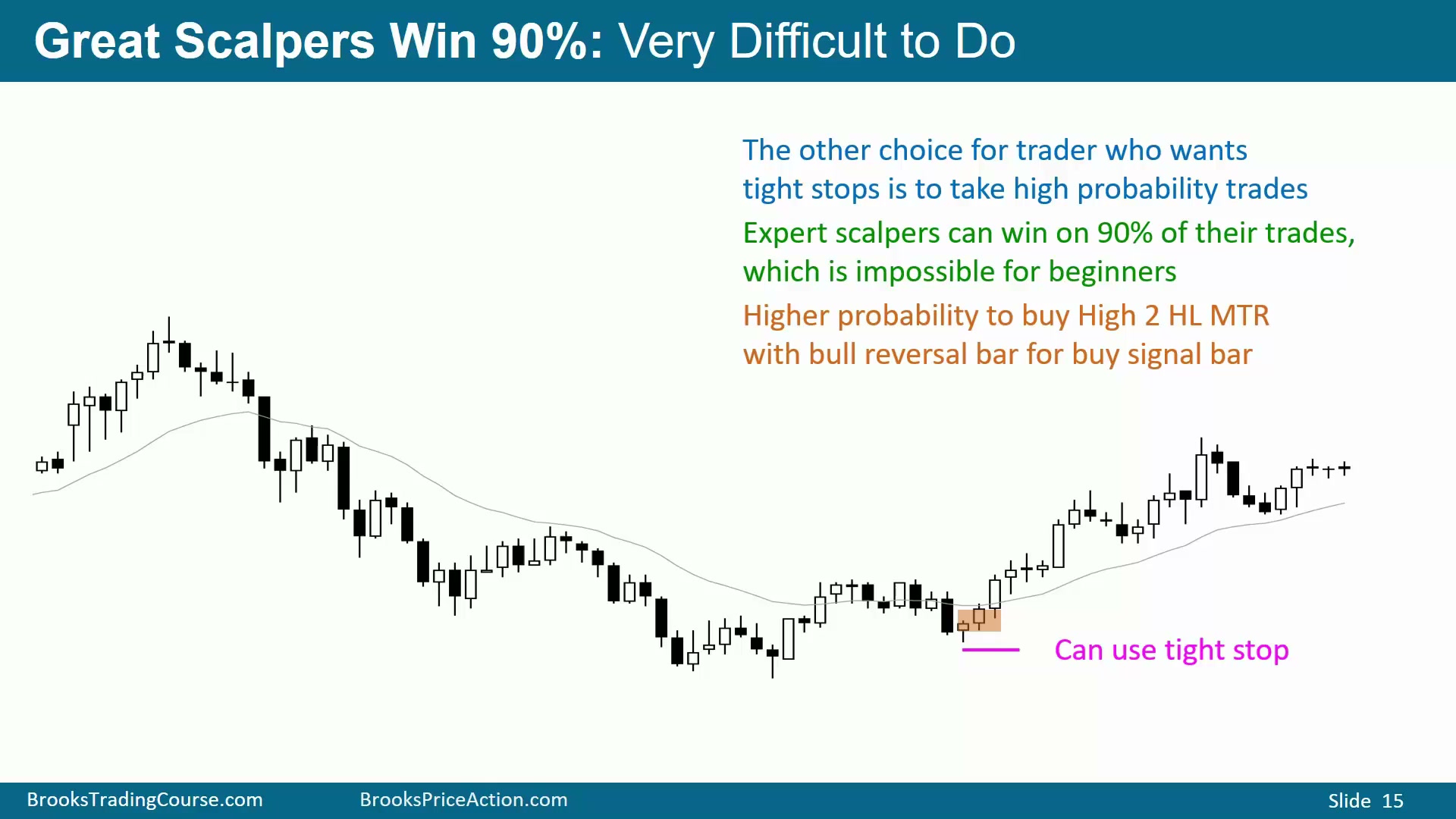
20:26 - 20:30

EN: and that’s because they know where a high probability trade is

20:30 - 20:32

EN: and they know how to structure a high probability trade.

20:37 - 20:41

EN: A really good scalper, he’s going to make money 80% or 90% of the time

20:41 - 20:44

EN: with his trades, and that’s absolutely impossible for beginners.

20:44 - 20:48

EN: It’s actually absolutely impossible for most really experienced traders.

20:48 - 20:52

EN: There are very few experienced, very profitable scalpers.

20:52 - 20:54

EN: Part of the problem is, first, it’s hard to do,

20:54 - 20:57

EN: and the other is it has to suit your personality,

20:57 - 21:00

EN: and most traders would not be comfortable with that style of trading.

21:06 - 21:10

EN: The math is better in this case buying here.

21:10 - 21:12

EN: We have a Higher Low Major Trend Reversal.

21:12 - 21:15

EN: Two or three legs down – one, pullback, two, pullback, three,

21:15 - 21:19

EN: or High 1 – High 1, High 2 – and a Higher Low Major Trend Reversal

21:19 - 21:21

EN: with a good-looking buy signal bar.

21:25 - 21:28

EN: In this particular case, you have a good-looking buy signal bar.

21:28 - 21:30

EN: You have a Wedge bull flag.

21:30 - 21:33

EN: Small bull trend, bull flag, Higher Low Major Trend Reversal.

21:33 - 21:36

EN: It’s reasonable to buy above this bar and put a stop here,

21:36 - 21:38

EN: or you could still put your stop down here.

21:38 - 21:42

EN: However, if this trade is good, after three attempts down

21:42 - 21:45

EN: - one, pullback, two, pullback, three – if it goes above this bull bar,

21:45 - 21:49

EN: it should not go below the low of that bull bar if the trade is good.

21:49 - 21:52

EN: If it goes below the low of this bar, the trade is probably not good.

21:52 - 21:56

EN: This is an example of when you can use a tight stop.

Slide 016

Time: 22:00

Slide 016

Bilingual Transcript

22:01 - 22:05

EN: In this video I talked about some rules for avoiding big losses.

22:05 - 22:08

EN: One of the most important rules is you always have

22:08 - 22:10

EN: to have a stop in the market, not in your head.

22:11 - 22:14

EN: Another is if you think your trade is unfolding different

22:14 - 22:17

EN: from what you were expecting, get out.

22:17 - 22:19

EN: If you think you’re clearly wrong, get out.

22:19 - 22:21

EN: Just take the loss and don’t worry about it.

22:22 - 22:25

EN: Finally, avoid low-risk trades.

22:25 - 22:26

EN: Use the appropriate stop.

22:26 - 22:29

EN: If the stop would result in a loss

22:29 - 22:31

EN: that is beyond your comfort level, do not take the trade.

22:31 - 22:35

EN: Just wait for a trade that would allow you to use a smaller stop.

22:39 - 22:40

EN: I’m Al Brooks.

22:40 - 22:42

EN: Thank you for watching the Brooks Trading Course.

22:42 - 22:46

EN: This is the third of four videos on losing because of mistakes.